A Black flight attendant shared an unexpectedly uplifting exchange with a white Fortune 500 CEO
Sometimes a random encounter turns out to be not so random at all. JacqueRae Hill, a flight attendant for Southwest Airlines, shared one such encounter on Facebook. She said that her heart has been heavy with everything going on, which is especially hard hard when your job is to put a smile on people’s face.…
Sometimes a random encounter turns out to be not so random at all.
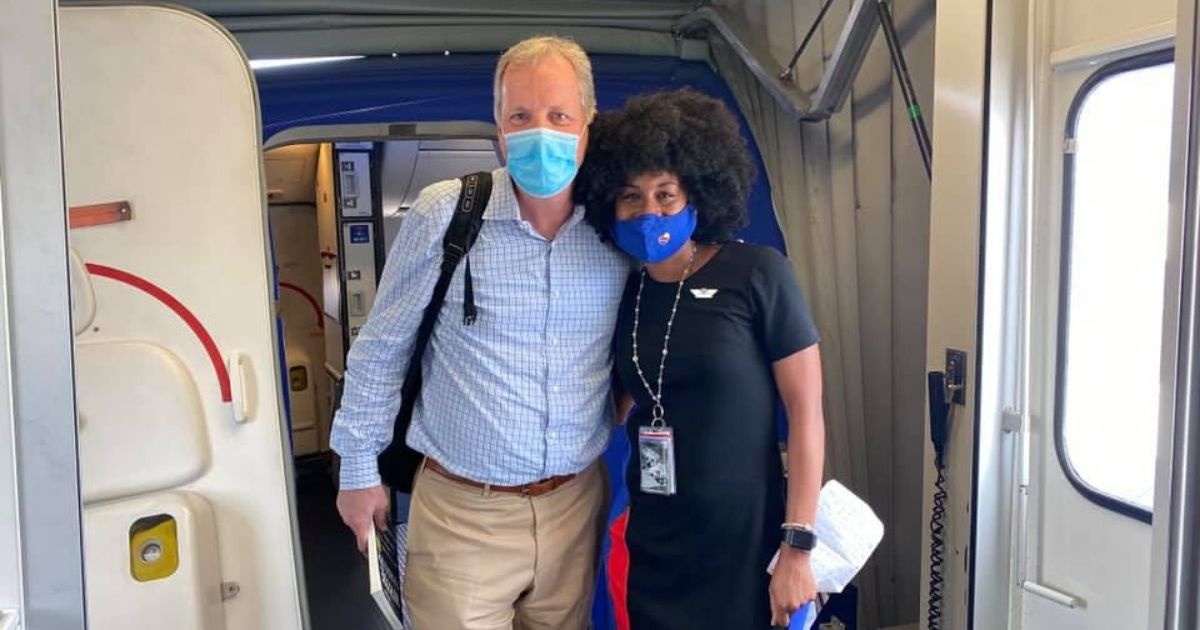
JacqueRae Hill, a flight attendant for Southwest Airlines, shared one such encounter on Facebook. She said that her heart has been heavy with everything going on, which is especially hard hard when your job is to put a smile on people’s face. But something happened on a recent flight that lifted her spirits.
She wrote:
“As we are boarding my first flight of the day I smile and I greet people when they come on and a man was holding a book that has been on my to read list. The book is entitled White Fragility. I was so happy to see that book in his grasp that I knew after I finished my duties I was going to make a point to ask him about it. I go sit next to him as he was sitting in a row all by himself (That was God). I said Hey How are you? I see you are reading that book .. So how is it? He replies oh I’m half way through it’s really good. It really points out how important these conversations on race are. As I began to respond the tears just start falling . I have been so sad every day and I just want to understand and be understood so we can began to fix it.
I’m pretty sure I startled him by seemingly dumping all my emotions on him but his reply was “I’m so sorry. And it’s our fault that this is like this. We continued to talk and when I tell you it was everything I needed. I was happy ( even tho I was crying ). I went on to tell him about my prayer on my way to work today and that he Answered that prayer for me with this conversation. As our conversation came to an end he asks me my name I told him JacqueRae and then he said well I’m Doug Parker the CEO of American Airlines. I told him my mother works for him in DC and then I reached over and gave him a BIG HUG ! I HAD TO!! (yes we were both masked) I thanked him for being open and allowing this conversation to happen because I just needed to hear it and I walked off. I thanked God for his LOVE AND FAITHFULNESS the rest of the Flight. On his way off the plane he hands me a handwritten note and I thank him again and ask for this pic. This encounter is Only A Holy Spirit thing!!!!
There are so many different ways to affect change in the world. I stand with anyone who wants to make a difference no matter if it is how I would do it or not. I believe that God answered my prayer so perfectly that I want to be apart of an answered prayer for someone else. I’m following behind my sister Audresha Lynn by saying LETS TALK !! Doug Parker said that the premise of the book is that we need to have these conversations so here I am. My heart is open and my ears are open as well. BLESSED TO BE A BLESSING.”
The note Parker wrote to her said:
“Thank you so much for coming back to speak with me. It was a gift from God and an inspiration to me. I am saddened that we as a society have progressed so slowly on an issue that has such a clear right v.s wrong. Much of the problem is we don’t talk about it enough. Thank you for talking to me and sharing your emotion. That took courage. The book, White Fragility, is great. But it’s more for people like me than you (a black friend recommended it to me). I really appreciate you. If you’d like to continue the conversation, my email is [blacked out]. Thank you! Doug
P.S. Say hello to your mother for me.”
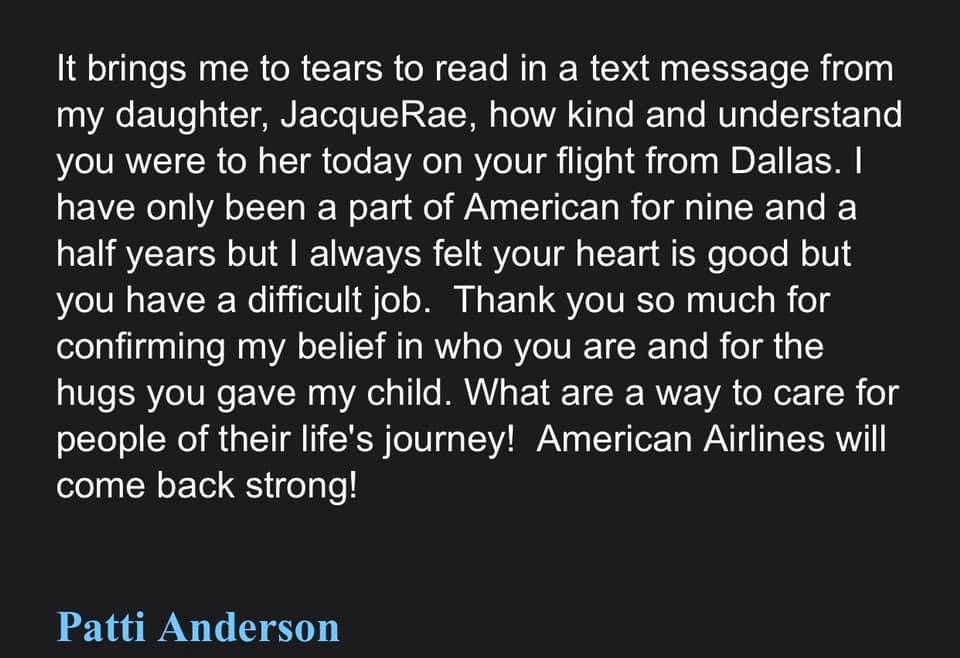
Hill’s also shared a message from her mother, Patti Anderson, to Doug Anderson, and the beautiful exchanges just keep on going.
Hill shared that CNN Travel picked up her story and interviewed her via video call, so we can hear some of the story in her own voice.
You never know when a seemingly small action—like reading a book to better understand the realities of race and racism in our society—might made a big difference to someone who sees it. Knowing that someone in charge of an enormous company is doing that personal work—and not just for a photo op or PR display—is heartening to see, as the lessons learned will hopefully trickle down through that business and beyond.
Thank you for sharing, Ms. Hill. Seeing this kind of encounter play out offers us all a taste of hope in a time of difficult, but necessary, upheaval and change.

In a small village in Pwani, a district on Tanzania’s coast, a massive dance party is coming to a close. For the past two hours, locals have paraded through the village streets, singing and beating ngombe drums; now, in a large clearing, a woman named Sheilla motions for everyone to sit facing a large projector screen. A film premiere is about to begin.
It’s an unusual way to kick off a film about gender bias, inequality, early marriage, and other barriers that prevent girls from accessing education in Tanzania. But in Pwani and beyond, local organizations supported by Malala Fund and funded by Pura are finding creative, culturally relevant ways like this one to capture people’s interest.
The film ends and Sheilla, the Communications and Partnership Lead for Media for Development and Advocacy (MEDEA), stands in front of the crowd once again, asking the audience to reflect: What did you think about the film? How did it relate to your own experience? What can we learn?
Sheilla explains that, once the community sees the film, “It brings out conversations within themselves, reflective conversations.” The resonance and immediate action create a ripple effect of change.
MEDEA Screening Audience in Tanzania. Captured by James Roh for Pura
Across Tanzania, gender-based violence often forces adolescent girls out of the classroom. This and other barriers — including child marriage, poverty, conflict, and discrimination — prevent girls from completing their education around the world.
Sheilla and her team are using film and radio programs to address the challenges girls face in their communities. MEDEA’s ultimate goal is to affirm education as a fundamental right for everyone, and to ensure that every member of a community understands how girls’ education contributes to a stronger whole and how to be an ally for their sisters, daughters, granddaughters, friends, nieces, and girlfriends.
Sheilla’s story is one of many that inspired Heart on Fire, a new fragrance from the Pura x Malala Fund Collection that blends the warm, earthy spices of Tanzania with a playful, joyful twist. Here’s how Pura is using scent as a tool to connect the world and inspire action.
A partnership focused on local impact, on a global mission
Pura, a fragrance company that recognizes education as both freedom and a human right, has partnered with Malala Fund since 2022. In order to defend every girl’s right to access and complete 12 years of education, Malala Fund partners with local organizations in countries where the educational barriers are the greatest. They invest in locally-led solutions because they know that those who are closest to the problems are best equipped to solve and build durable solutions, like MEDEA, which works with communities to challenge discrimination against girls and change beliefs about their education.
But local initiatives can thrive and scale more powerfully with global support, which is why Pura is using their own superpower, the power of scent, to connect people around the world with the women and girls in these local communities.
The Pura x Malala Fund Collection incorporates ingredients naturally found in Tanzania, Nigeria, Pakistan, and Brazil: countries where Malala Fund operates to address systemic education barriers. Eight percent of net revenue from the Pura x Malala Fund Collection will be donated to Malala Fund directly, but beyond financial support, the Collection is also a love letter to each unique community, blending notes like lemon, jasmine, cedarwood, and clove to transport people, ignite their senses, and help them draw inspiration and hope from the global movement for girls’ education. Through scent, people can connect to the courage, joy, and tenacity of girls and local leaders, all while uniting in a shared commitment to education: the belief that supporting girls’ rights in one community benefits all of us, everywhere.
You’ve already met Sheilla. Now see how Naiara and Mama Habiba are building unique solutions to ensure every girl can learn freely and dare to dream.
Naiara Leite is reimagining what’s possible in Brazil
Julia with Odara in Brazil. Captured by Luisa Dorr for Pura
In Brazil, where pear trees and coconut plantations cover the Northeastern Coast, girls like ten-year-old Julia experience a different kind of educational barrier than girls in Tanzania. Too often, racial discrimination contributes to high dropout rates among Black, quilombola and Indigenous girls in the country.
“In the logic of Brazilian society, Black people don’t need to study,” says Naiara Leite, Executive Coordinator of Odara, a women-led organization and Malala Fund partner. Bahia, the state where Odara is based, was once one of the largest slave-receiving territories in the Americas, and because of that history, deeply-ingrained, anti-Black prejudice is still widespread. “Our role and the image constructed around us is one of manual labor,” Naiara says.
But education can change that. In 2020, with assistance from a Malala Fund grant, Odara launched its first initiative for improving school completion rates among Black, quilombola, and Indigenous girls: “Ayomidê Odara”. The young girls mentored under the program, including Julia, are known as the Ayomidês. And like the Pura x Malala Fund Collection’s Brazil: Breath of Courage scent, the Ayomidês are fierce, determined, and bursting with energy.
Ayomidês with Odara in Brazil. Captured by Luisa Dorr for Pura
Ayomidês take part in weekly educational sessions where they explore subjects like education and ethnic-racial relations. The girls are encouraged to find their own voices by producing Instagram lives, social media videos, and by participating in public panels. Already, the Ayomidês are rewriting the narrative on what’s possible for Afro-Brazilian girls to achieve. One of the earliest Ayomidês, a young woman named Debora, is now a communications intern. Another former Ayomidê, Francine, works at UNICEF, helping train the next generation of adolescent leaders. And Julia has already set her sights on becoming a math teacher or a model.
“These are generations of Black women who did not have access to a school,” Naiara says. “These are generations of Black women robbed daily of their dreams. And we’re telling them that they could be the generation in their family to write a new story.”
Mama Habiba is reframing the conversation in Nigeria
Centre for Girls' Education, Nigeria. Captured by James Roh for Pura
In Mama Habiba’s home country of Nigeria, the scents of starfruit, ylang ylang and pineapple, all incorporated into the Pura x Malala Collection’s “Nigeria: Hope for Tomorrow,” can be found throughout the vibrant markets. Like these native scents, Mama Habiba says that the Nigerian girls are also bright and passionate, but too often they are forced to leave school long before their potential fully blooms.
“Some of these schools are very far, and there is an issue of quality, too,” Mama Habiba says. “Most parents find out when their children are in school, the girls are not learning. So why allow them to continue?”
When girls drop out of secondary school, marriage is often the alternative. In Nigeria, one in three girls is married before the age of 18. When this happens, girls are unable to fulfill their potential, and their families and communities lose out on the social, health and economic benefits.
Completing secondary school delays marriage, and according to UNESCO, educated girls become women who raise healthier children, lift their families out of poverty and contribute to more peaceful, resilient communities.
Centre for Girls’ Education, Nigeria. Captured by James Roh for Pura
To encourage young girls to stay in school, the Centre for Girls’ Education, a nonprofit in Nigeria founded by Mama Habiba and supported by Malala Fund and Pura, has pioneered an initiative that’s similar to the Ayomidê workshops in Brazil: safe spaces. Here, girls meet regularly to learn literacy, numeracy, and other issues like reproductive health. These safe spaces also provide an opportunity for the girls to role-play and learn to advocate for themselves, develop their self-image, and practice conversations with others about their values, education being one of them. In safe spaces, Mama Habiba says, girls start to understand “who she is, and that she is a girl who has value. She has the right to negotiate with her parents on what she really feels or wants.”
“When girls are educated, they can unlock so many opportunities,” Mama Habiba says. “It will help the economy of the country. It will boost so many opportunities for the country. If they are given the opportunity, I think the sky is not the limit. It is the starting point for every girl.”
From parades, film screenings to safe spaces and educational programs, girls and local leaders are working hard to strengthen the quality, safety and accessibility of education and overcome systemic challenges. They are encouraging courageous behavior and reminding us all that education is freedom.
Experience the Pura x Malala Fund Collection here, and connect with the stories of real girls leading change across the globe.
In many families, the wife often does the bulk of the grocery shopping. But as younger generations of men take on a more active role in day-to-day household management, there can be a learning curve. One man is trying to get ahead of that by teaching young boys how to shop for groceries on a budget using their own instincts.
King Randall founded The X for Boys, a nonprofit that helps underprivileged boys access the resources they need to succeed. The organization also teaches life skills they may not be learning at home. In a recent video posted to Instagram, Randall is seen in a grocery store with another man and a group of boys, introducing the idea of men grocery shopping for their families.
Randall explains that the boys should come to the grocery store prepared with a list and a strategy. As they shop, items should be checked off, even if the list isn’t organized by where things are located in the store.
“So in order to lessen our time in the store, what we’re going to do is, we’re going to categorize these,” he says.
After one of the boys grabs a shopping cart, Randall explains they have a $150 budget before asking what section of the store they’re in.
“We’re in the produce section, right?” he asks. “So what we’re going to do is we’re going to go down our list, and we’re going to go one by one and see what’s in produce.”
The boys enthusiastically agree and follow along. Randall adds that they’re shopping for a family of four, then shows them how to compare prices as they look for apples their family would eat. They continue through the produce section, checking off items along the way. Throughout the grocery run, Randall uses an imaginary wife in his examples, joking that when they’re newly married, they may need to call and confirm certain products.
Commenters thought the grocery store run was an important experience for the boys. Many viewers of the now-viral video praise him for putting effort into teaching young boys how to be helpful using their own instincts throughout.
One person says, “I absolutely love this. This is definitely needed in our community. All young men need to learn these skills to develop their young lives ~ It will last them their lifetime!”
Another writes, “As an educator, MORE OF THIS!!! Life skills! Executive functioning and money management, family planning, communication-I want to hear the debrief. What did we learn? When can we apply this? What transferable skills can we identify? Bravo”
Someone else chimes in, “Sir, you have no idea of the ripple effect you are making on future generations. May God bless you and give you favor.”
“I am so obsessed with this,” another person writes. “These kids won’t forget this lesson!! They’re so engaged and listen so well.”
“I love this!!! Keep this up sir!” a commenter adds. “And key…when youve been married a while and knowing what is needed will go a long way in the home with lowering your wife’s mental load. Glad you mentioned being newer to married and after been married you would know. This teaches to not use weaponized incompetence.”
This isn’t the only life skill Randall is teaching. His program also teaches the boys how to iron, order at a restaurant, pump gas, and more. They’re learning skills they’ll use for the rest of their lives.
Coming of age at the same time as the Internet is a wild experience that can be hard to explain to younger generations. At a recent stand-up event, comedian Josh Johnson found himself in a mixed-age crowd discussing early Internet use. He quickly realized just how difficult it would be to explain how people got online in the early 2000s.
For one, the process of getting onto the World Wide Web would likely sound made up to anyone under 30. And honestly, is there anyone who fully understands how it worked? Still, the comedian gives it his best shot, and hilariously struggles through it in a clip shared on his Instagram.
“When I got the Internet, it was on CD,” Johnson reveals. “To this day, I don’t know how that worked. What…what…what is on the CD? What is that, because I thought you had to have…”
That’s when he realizes he’s going to struggle with the explanation. Johnson warns the audience the process is going to be annoying, drawing even more laughter from those watching.
“Some of you are young, and this is going to sound fake, but you used to…” he says before pausing to laugh with the audience. “No. You used to get Internet…okay…you would get an offer in the mail. They would mail you Internet. You would open the mail, and it would be Internet in the mail, but it would be a CD.”
He then explains that a CD is a compact disc, and that Internet companies like AOL would send them through the mail as free trials. They could also be picked up at grocery stores near the checkout lanes.
The comedian says that when you received the CD, “you would put it in the computer and for whatever reason, you got like 30 hours of Internet, which was a lot back then. I know y’all use it up in a day, today, but 30 hours used to be a lot of Internet, and you would surf the web. It was called surfing. We had a name for the World Wide Web, that’s where the WWW comes from. Do you want to hear any other facts that sound like they’re from the Middle Ages?”
The more he explains, the more ridiculous it sounds out loud. With the Internet now easily accessible through Wi-Fi—not weird discs that mysteriously connect you—the old way feels almost unbelievable. But it’s true. There are likely storage boxes and landfills full of free Internet trial discs, long forgotten after cable Internet replaced dial-up.
People can’t get over how the world worked in the early days of the technology boom.
“Wait until the youths find out Netflix used to send DVDs to rent through the actual mail,” a commenter writes.
Another person writes, “Not to mention we would have several different internet providers because of all the ‘free trial’ disks. Each month or whenever you ran out of internet from the previous disk…what a time to be alive.”
Someone else jokes, “They weren’t just mailed. They came flying in like letters to Harry Potter’s front door…”
One person says, “My frugal midwestern mom had us on dialup for ages bc she hoarded all the AOL free trial CDs. I will hear that dialup tone on my death bed good lord.”
“And had bout 8 different email addresses so you could keep getting multiple free trials,” another person writes.
Removing a corn husk can be an annoying task when cooking dinner. After peeling the “jacket” layers off the delicious vegetable, you’re stuck pulling fibers out for what feels like an eternity. But there’s a simple trick that stops you from having to go through the whole fiber-finding mission, and a woman named Bella Devereux just revealed the secret to her grandmother.
Recently, the woman spent time with her grandmother and decided to share an easier way to de-husk a corn cob. Devereux filmed the interaction and uploaded the video to social media, sharing the hack with everyone.
In the video, the granddaughter unrolls a corn cob from a wet paper towel. The cob is on the counter after microwaving it for four minutes. It still has the husk. She then takes a paper towel to hold the corn cob in place while she cuts off the bottom. Once the bottom is cut, she uses the paper towel to stand the cob up, then squeezes it from the top.
The corn smoothly slides out of its green jacket, still standing. No stringy fibers are seen hanging onto the golden vegetable. The ease with which the corn cob came out of the husk amazed the grandmother.
“Oh, for goodness sake, I never thought of doing that! And it comes out perfect every time!” the grandma exclaims. “Why hasn’t anyone told us about that before? Because by the time you do this with each piece, then you’ve got to go pick all the bits off of it. Ahhh!”
Devereux’s grandmother can barely get out another sentence due to her bewilderment. She asked how long Devereux’s mother had known about this hack and how. The grandmother says, “It couldn’t be better. That is amazing!”
Eventually, they heat another piece of corn to give the grandmother a chance to do it herself.
“I cannot believe it. It was so clean,” the grandma says before she excitedly does her own corn cob. “I cannot believe that it’s as easy as that. How many years have I struggled to get it all off, and then I’ve had to go and do this and take off all the hair. Where have I been all this time?”
Devereux’s grandmother isn’t the only one gobsmacked by how easily the corn came out of the husk. Others simply cannot get enough of how excited the grandma is with her new discovery.
“Thank you for actually letting us witness her get a chance to do it as well,” someone says.
“Oh my, I love this so much,” another writes.
One person chimes in, “Amazing life hack and a wonderful reaction.”
Someone else admits, “Her reaction speaks for all of us!”
This person came across the video a week too late, writing, “I just fixed corn on the cob last week. I would have loved knowing this as I cleared those numerous corn silks.”
One viewer adds, “I love how excited she was. I also did not know this trick.”
“This is brilliant & who in this world came up with this hack first,” another asks.
The highlight of the performance was when Barry got ready to strum his guitar for a performance of “How Deep Is Your Love,” the 1977 megahit from the “Saturday Night Fever Soundtrack,” but instead chose to sing the song a cappella.
Their signature sound
Barry starts the song solo in his beautiful falsetto, but then, when his brothers join him, they create a wonderful harmony that only brothers can make. The show’s host, Des O’Connor, a notable singer himself, even joins in for a few bars.
Earlier in the performance, the brothers played their version of “Islands in the Stream,” a song made famous by Dolly Parton and Kenny Rogers in 1983 that was written by the Bee Gees. In 1998, the song was enjoying a resurgence as its melody was used in the song “Ghetto Supastar” by Pras of The Fugees.
Writing for music icons
Robin Gibb later admitted that the song was initially written for Marvin Gaye to sing, but he was tragically murdered in 1984 by his father. The band also had Diana Ross in mind while composing the tune.
During the appearance, the band also sang “Guilty,” a song that the Bee Gees wrote for Barbara Streisand and Barry produced in 1980.
You can watch the entire performance here:
The Gibb brothers started making music together when they were children, and after their first public appearance together at a local movie theater in 1956, they were hooked on performing.
“It was the feeling of standing in front of an audience that was so amazing,” said Barry. “We’d never seen anything like it. We were very young, but it made an enormous impression. We didn’t want to do anything else but make music.”
After the family moved to Australia in 1958, Barry, Maurice, and Robin were “discovered” at the Redcliffe Speedway, where they had asked to perform between races. Even over the tinny PA system, their harmonies made an impression. Speedway manager Bill Goode introduced the trio to DJ Bill Gates, who set them up with a recording session.
From a land down under
If you’ve ever wondered how the Bee Gees got their name, that was it: Bill Goode, Bill Gates, Barry Gibb, and the brothers’ mother Barbara Gibb all had the initials B.G. After a strong reception on the airwaves in Brisbane, Gates forwarded the brothers’ recordings to a Sydney radio station. They got a lot of airtime there as well, and the band had a run of success performing in Australia, but it wasn’t until their return to England in 1967 that they became the international sensation we all know today.
Manager Robert Stigwood had received tapes from the Gibbs brothers and called them up within weeks of their arrival in the U.K.
“I loved their composing,” Stigwood told Rolling Stone in 1977. “I also loved their harmony singing. It was unique, the sound they made; I suppose it was a sound only brothers could make.”
More than just disco
And, as they say, the rest is history. The award-winning 2020 HBO documentary, “The Bee Gees: How Can You Mend a Broken Heart” tells the story of the band with loads of footage from throughout their 40-year career, which includes not only their disco-era fame, but the various phases of their musical journey and the countless songs they wrote for other artists.
As one commenter wrote, “People that call the Bee Gees a ‘disco group’ don’t have a clue. They had 10 albums out before they ventured into ‘disco.’ Their song catalogue is amazing and some of their very best songs were written long before Saturday Night Fever. Those ‘disco’ songs are classics as well. It is nice to see they are finally getting the recognition they deserve.”
This article originally appeared two years ago. It has been updated.
When the 2024 Summer Olympics ended, few knew we weren’t quite done marveling at elite-level humans at the top of their game. America’s Got Talent returned from its two week hiatus in August 2024 with eleven incredible acts, but it was R&B singer Liv Warfield who stole the show with her rendition of “The Unexpected,” a song that just so happened to be written specifically for her by Prince. No big deal.
Warfield had already wowed audiences with her initial audition, which earned a Golden Buzzer from Simon Cowell. But her follow-up performance had Cowell saying, “If this was the Olympics for singing, you would have won the gold medal.”
Liv Warfield after receiving the Golden Buzzer. Photo credit: NBCUniversal.
Judges Sofia Vergara and Howie Mandel echoed similar praises. Vergara called Warfield’s set “perfection,” while Mandel, a self-proclaimed Prince fan, told Warfield that “The Purple One knew what he was doing when he gave you this gem. That was a million-dollar performance.”
And it’s not hard to see why Warfield got such high remarks. Beyond her unbelievable vocals was her undeniable star power and ability to transport us all back in time to the days of 70s rock n’ roll.
As one viewer put it, “If Prince and Janis Joplin had a baby = Liv Warfield!”
Just watch:
From Prince to AGT
Warfield’s connection to Prince began in 2009, when she joined his New Power Generation band. Though she noted that “backing up Prince was a dream,” not to mention the fact that she’s already made several chart topping achievements on her own, she still felt like her ultimate potential had yet to be reached, hence her AGT audition. Now, her quarterfinal performance has made Cowell declare another defining moment in her career.
“It felt to me like all those years you’ve been climbing the ladder to where you want to be, it all came out in those three minutes,” he said.
Indeed, what a testament to the power of steadily going after your dreams. Raw talent is great, but even with God-given gifts, there’s still so much work that goes into being ready for big opportunities. Though she didn’t win the competition in the end, Warfield is already a winner through and through.
Learning from the master
Warfield is continuing on her musical path in her hometown of Chicago and was invited to perform the Star-Spangled Banner at a Chicago Cubs baseball game in May of 2025.
Thank you @cubs for inviting me out to sing. ✨Beautiful Day, Beautiful People,Energy at @cubs game! With my @zinzannichicago Family❤️✨. Although sis, was hiding out like the 🦀 that I am. 😂😂🤘🏾 Love y’all! Yesterday was necessary 🫀. PR Queen @aidanhenri 😘✨🫶🏾 @princenolov3 😘
Her Prince roots are alive and well in her stage performances as she performed in a tribute concert series during the summer of 2025. She also has multiple albums under her belt, beginning with “Embrace Me” in 2006 and continuing through her 2023 album “The Edge.”
Warfield has credited Prince with her musical development, telling NPR in 2014:
“He’s influenced me first and foremost, as a performer. Just kind of like taking chances first. It took me a while. Like I thought I was a good performer, but when I got part of the New Power Generation, I was like, ‘Whoa this is a whole new world for me.’ And even in the writing and arranging, and him just teaching me how to really listen to the music. Listen to every instrument, give space, and I wasn’t really thinking about those things. I just wanted to hear everything. I thought, ‘If everybody plays, it’s good.’ … Sometimes it could sound like noise, but he just really kind of developed my ear.”
Liv Warfield performing on AGT. Photo credit: NBCUniversal
Just more proof that musical legends live on not only in the music they leave behind but in the talent they help nurture and develop.
This article originally appeared two years ago.It has been updated.
Childhood dishes can take you straight back to your seat at the family dinner table. Comfort meals that were served there are uber nostalgic. And there is one dish represents the epitome of Gen X and baby boomer childhoods: casseroles.
These one-dish wonders were loaded with flavor and baked to perfection. Pulled straight from the oven to the dinner table, casseroles filled the house with the smell of unique home-cooked recipes.
“Fancy Fast Chicken is delicious and so simple. Line up chicken breasts in a casserole dish. Dump uncooked stuffing over top the chicken breasts. Pour Cream of Mushroom (Onion or chicken works too) and incorporate it into the stuffing. Top with cheese of your choice, and fried onions if you’re inclined. Bake at 350 for 45min or until chicken is thoroughly cooked.” – Applepoisoneer
Chicken Curry Divan casserole
“My favorite is Chicken Curry Divan. A friend made it for me in college 40 years ago and it is a favorite to this day. Never disappoints. Many people have asked me for the recipe over the years. My best friends kids now that they are grown have each approached me for it.
1 1/2 lbs chicken breast tenders cooked and cut into bite sized pieces 3 cups broccoli in bite sized pieces 2 cans Cream of Chicken soup 1 cup mayonnaise (must be Mayo) 2 tsp curry Juice of 1 lemon Shredded sharp cheddar (use the amount you like o like a nice even cover of the top) 3/4 cup crushed Ritz crackers 3 tbsp melted butter In 9×13” baking pan layer chicken then broccoli.
Mix the soup, Mayo, lemon juice and curry together well, pour over chicken broccoli mixture evenly and smooth out. Sprinkle cheese over top evenly. Crush crackers fine, mix in melted butter well and sprinkle evenly over top. Cook at 375° for 25-30 minutes until bubbly and top brown. Serve with rice.” – karinchup
Chicken and Rice casserole
“This baked rice & cheese casserole has become a staple in our house! It’s great as a side dish, or I’ll add rotisserie chicken and serve it as a main dish.” – anchovypepperonitoni
Chicken & Dumplings casserole
“The secret of this is not to stir anything. That’s what makes your dumplings. When you dish it out, you have your dumplings on top. 2 chicken breasts, cooked and shredded; 2 cups chicken broth; 1/2 stick of butter; 2 cups Bisquick mix; 2 cups whole milk; 1 can cream of chicken soup; 1/2 medium onion, minced; 1 cup frozen peas; 3 tsp chicken Better Than Bouillon; 1/2 tsp dried sage; 1 tsp black pepper; 1/2 tsp salt.
(1) Preheat oven to 350 degrees (2) Layer 1 – In 9×13 casserole dish, melt 1/2 stick of butter. Spread shredded chicken over butter. Sprinkle black pepper and dried sage over this layer. Do not stir. (3) Layer 2 – Sprinkle minced onions and peas over chicken (4) Layer 3 – In small bowl, mix milk and Bisquick. Slowly pour all over chicken. Do not stir. (5) Layer 4 – In medium bowl, whisk together 2 cups of chicken broth, chicken bouillon, and soup. Once blended, slowly pour over the Bisquick layer. Do not stir. (6) Bake casserole for 30-40 minutes, or until the top is golden brown.” – Superb_Yak7074
Chicken broccoli casserole
“I made chicken broccoli casserole last week and that’s a favorite here. This is pretty close to how I do it.” – gimmethelulz
“Tater tot casserole. My mom made this at least once a week when I was growing up, but she added a quart of green beans to make it a meal. If you brown your ground beef in a good size cast iron skillet, you only dirty up one pan to make it!” – hcynthia1234, upperwareParTAY
Breakfast casserole
“I’m making a breakfast casserole this morning for brunch later—a bag of frozen hash brown potatoes thawed, a pound of sausage sauteed with peppers and onions, a brick of cheese grated, eight eggs beaten with a bit of milk and cream and some salt and pepper. Layer in a casserole, ending with cheese. Bake around an hour at 375.” – CWrend
Hamburger pie casserole
“One of my childhood favorites. Did not add vegetables or cheese though. This was an end of the month struggle meal that everyone loved.” – DarnHeather
Shepherd’s pie casserole
“Shepherd’s pie : brown 1.5 lbs ground beef with half a chopped onion, salt and pepper, drain it and then spread into a 13×9 and stir a can of cream of mushroom soup into it. Spread a drained family size can of corn on top, use a container of prepared mashed potatoes for the top layer. Bake for a half hour at 350.” – ExplanationLucky1143
Noodle casseroles
Tuna casserole
“Love my mom’s tuna noodle casserole: 1 bag broad egg noodles, 1 can cream of mushroom soup, 2 cans tuna, 1 cup frozen corn or 1 can kernel corn, 2 cups shredded sharp cheddar cheese, 1/2 cup seasoned bread crumbs, 1 tbsp celery salt Cook noodles per package directions, drain, then place in a 13×9 casserole dish. Mix in cream of mushroom soup, tuna, corn, 1 cup of the cheddar cheese, and celery salt. Top the casserole with the remaining cheese and bread crumbs. Bake at 350 for 20 minutes or until done enough for you.” – Pinkleton
Mock Stroganoff casserole
“Mock stroganoff – brown 1lb ground chuck. Mix in 8 oz sour cream and 1 can cream of mushroom. Add to 1 lb of cooked egg noodles. Season with black pepper. Extras – fresh mushrooms and/or onion cooked with the beef. Any precooked veggies of your choice, peas or broccoli work well. Splash of Worcestershire, soy sauce, or fish sauce. Garlic or onion powder. Parsley, thyme, or cilantro.” – Nathan_Saul
Cabbage noodle casserole
“I have a quick cabbage and noodles that uses bagged cole slaw. Cook a bag of noodles. Put aside. Cut up a lb of bacon and a med onion. Cook in pan until bacon is slightly fried and onions are clear. Add cabbage(without carrots) let sit 10 min or so. Add to noodles. It’s so easy.” – conjas11
Thanksgiving prep class is now in session! 🍂🧑🏫 If there’s one thing you need to nail on the big day (other than the turkey, of course), it’s Green Bean Casserole. This recipe tastes just like the one your grandmother used to make, if not even better! 😋 Continue reading or click the link in the @allrecipes bio to get the full recipe. Ingredients: 2 (15-ounce) cans cut green beans, drained 1 (10.5-ounce) can condensed cream of mushroom soup ¾ cup milk 1 (2.8-ounce) can French fried onions salt and ground black pepper to taste Directions: Gather all ingredients. Preheat the oven to 350 degrees F (175 degrees C). Mix green beans, condensed cream of mushroom soup, milk, and 1/2 of the fried onions in a 1.5-quart casserole dish. Bake in the preheated oven until heated through and bubbly, about 25 minutes. Sprinkle remaining onions on top and return to the oven for 5 minutes. Season with salt and pepper to taste. Let rest for a few minutes before serving. 🧑🍳: Nicole #thanksgiving#greenbeancasserole#greenbeans#thanksgivingsides
“This is the best green bean casserole recipe, it does use the canned onions but you make your own cream of mushroom and it’s soooo good. I’ve made it on random weekends, it’s not just a Thanksgiving food. I don’t know much about older foods, I just really wanted to share that recipe.”
Corn casserole
“Our family Corn custard doesn’t have crackers but we double the recipe and there’s never any left over. 2 eggs, 1 cup of sweetened condensed milk, 1/2 flour, 2 T soft butter, 1 tsp sugar, 1 can of creamed corn, 1 can of whole corn. Mix all together and bake in a 8×8 about 45 min at 350. Gotta have that!” – Psychological_Bat890
This article originally appeared last year. It has been updated.
Speaking with the astronauts, a CBS News reporter noted that the Apollo 8 crew delivered a Christmas Eve message during their 1968 mission. He asked whether the Artemis II crew had a message to share for Easter. When the microphone floated to Glover, he said he hadn’t prepared anything, but offered some impromptu thoughts:
“We are the same thing”
“I think these observances are important, as we are so far from Earth and looking back at the beauty of creation. I think for me, one of the really important personal perspectives that I have up here is I can really see Earth as one thing.
And you know, when I read the Bible, and I look at all of the amazing things that were done for us, who we’re created, it’s…you have this amazing place, this spaceship. You guys are talking to us because we’re in a spaceship really far from Earth. But you’re on a spaceship called Earth that was created to give us a place to live in the universe, in the cosmos.
Maybe the distance we are from you makes you think what we’re doing is special. But we’re the same distance from you, and I’m trying to tell you—just trust me—you are special. In all of this emptiness—this is a whole bunch of nothing, this thing we call the universe—you have this oasis, this beautiful place that we get to exist together.
I think as we go into Easter Sunday, thinking about all the cultures all around the world, whether you celebrate it or not, whether you believe in God or not, this is an opportunity for us to remember where we are, who we are, and that we are the same thing, and that we got to get through this together.”
People of all faiths—and no faith—appreciated the message
Commenters appreciated Glover’s perspective as he looked out at all 8 billion of us on our beautiful “pale blue dot.”
“One of the most beautiful perspectives I’ve ever heard on this topic. Thank you Victor.”
“Beautiful unifying message.”
“I am not a religious person at all but this speech made me cry.”
“It gave me chills. What a beautiful message.”
“As someone who’s not religious this is the perfect message conveyed by someone of faith without feeling unwarranted or preaching in a way that doesn’t land. Delivered perfectly and I respect him for that.”
“What a beautiful sentiment we all so desperately need to hear.”
Glover’s remarks reflect what others who have viewed Earth from space have said. The emotional experience of that perspective, known as the “overview effect,” often results in a profound awareness of humanity’s place in the universe.
The “overview effect” is a common experience for people who see Earth from space
For Star Trek actor William Shatner, who went to space at age 90 in 2021, that awareness gave him a surprising feeling of deep grief.
“It was the death that I saw in space and the lifeforce that I saw coming from the planet — the blue, the beige and the white,” he said. “And I realized one was death and the other was life.”
Earth and life are “so fragile,” Shatner said. “We hang by a thread…we’re just dangling.” Seeing humanity from that distance put conflicts between humans into perspective. “We’re entangled with each other,” he said. “We have a war…the stupidity of it all is so obvious.”
Frank White, the space philosopher who coined the term “overview effect” in his 1987 book of the same name, wrote that astronauts who leave Earth generally come back with “a greater distaste for war and violence, and a desire to do something to improve life back on the surface, because they’ve seen the truth of our situation.”
Space travel highlights our shared humanity
When Glover referred to Earth as a spaceship, he wasn’t just being metaphorical. Our planet is a self-contained, closed-loop system, meaning its resources are produced and recycled here. And we are hurtling through space at about 67,100 miles per hour—much faster than any spacecraft we’ve sent into space. For all intents and purposes, we are traveling together on a giant, round spaceship.
The universe is vast, yet it’s so easy to get wrapped up in the little details of life on our planetary ship. Zooming out—seeing Earth from a distance—can help us view ourselves and our lives in a different light. Seeing our home, our people, our lives as one has the power to change something within us. It’s a potent reminder that, for all our uniqueness, we really are one.
Watch the highlights from Day 4 of the Artemis II mission:
Millennials have noticed a problem with their Boomer parents’ phone addiction, and they’re calling it out. At first, it seemed like harmless teasing about role reversal, but their excessive screen time just might be an issue. Dr. Sue Varma, Board Certified Psychiatrist, reveals the risks related to increased screen time in adults.
The negative effects of too much screen time have been discussed ad nauseam when it comes to children and teens. However, rarely talked about is the cognitive impact it has on adults of all ages. Given that Boomers have reached senior status, cognitive lapses are already a heightened concern for many.
It turns out that screens might be mimicking a serious issue. This can create concern and anxiety for Boomers and their children. The psychiatrist joined the CBS Mornings co-hosts for a candid chat about the research on screen time.
When discussing the impacts of screen time on adults, Varma drops a bombshell, saying, “We end up getting something called digital dementia or digital fog, where the symptoms of poor attention span, memory, concentration all go down, and it very much mimics a real dementia where you walk into a room and you’re like ‘why am I here, what did I come for, where are my keys?’ The tip of the tongue feeling, like there’s a word, there’s a name, ‘I know that person, I can picture them in my head,’ and the word doesn’t come to mind.”
Researchers Rinanda Shaleha and Nelson Roque from the Pennsylvania State University Department of Human Development and Family Studies, Center for Healthy Aging, report concerning findings. “Digital engagement among older adults also carries risks, including attention deficits, disrupted sleep patterns, social isolation, reduced physical activity, and structural brain changes that could accelerate cognitive decline and dementia onset. Extended screen exposure may further contribute to visual fatigue, chronic distraction, and sedentary behaviors, potentially exacerbating cognitive vulnerabilities,” the duo writes in a recent study.
Dr. Varma tells CBS Mornings that the symptoms can “very much look like dementia,” invoking the “if you don’t use it, you lose it” warning. This isn’t just a quirky thing that happens and stops when the phone is put down.
According to Dr. Varma, “There are real structural changes in the brain for people who are using excessive screens, and we see that a lot of older adults are using 10 hours a day. That’s seven and a half hours of TV plus four hours of phones.” She later adds that 63% of seniors “find that social media strengthens their connections.”
Not all Boomers fall into this category. Many are connecting with their community physically, but those with chronic illnesses tend to be on screens more often. Pew Research found that 41% of all adults report being online constantly, 84% say they’re online multiple times a day.
If people are interested in breaking their phone habit, she advises them to put their phone in grayscale mode. Varma adds that replacing digital things with their analog counterparts will also help break a phone habit. Finding ways to connect in person instead of passively scrolling also reduces screen time. Varma says that these small changes can help limit your screen time and re-engage your brain.