It's Black Breastfeeding Week. Wondering why? One gut-wrenching poem says it all.
"I wish I dried up..."

This article originally appeared on 8/28/19
It's Black Breastfeeding Week, a week set aside in the U.S. to celebrate and encourage Black breastfeeding parents.
Some may wonder why such a week is necessary. After all, that's a pretty narrow niche, isn't it? Aren't Black moms included in all breastfeeding awareness and education campaigns? Is there something special about Black people breastfeeding?
The answer is yes, there is something unique about Black breastfeeding. Several somethings, actually, but one reason for Black Breastfeeding Week is summed up in a gut-wrenching poem by feminist author Hess Love.
I wish I dried up
I wish every drop of my milk slipped passed those pink lips and nourished the ground
Where the bones lay
Of my babies
Starved while I feed their murderer
I wish I dried up
So the missus babies would dry up too
And be brittle
So I could crumble them to dust
Return them to the ground
Where all children of my bosom lay equal
- Hess Love
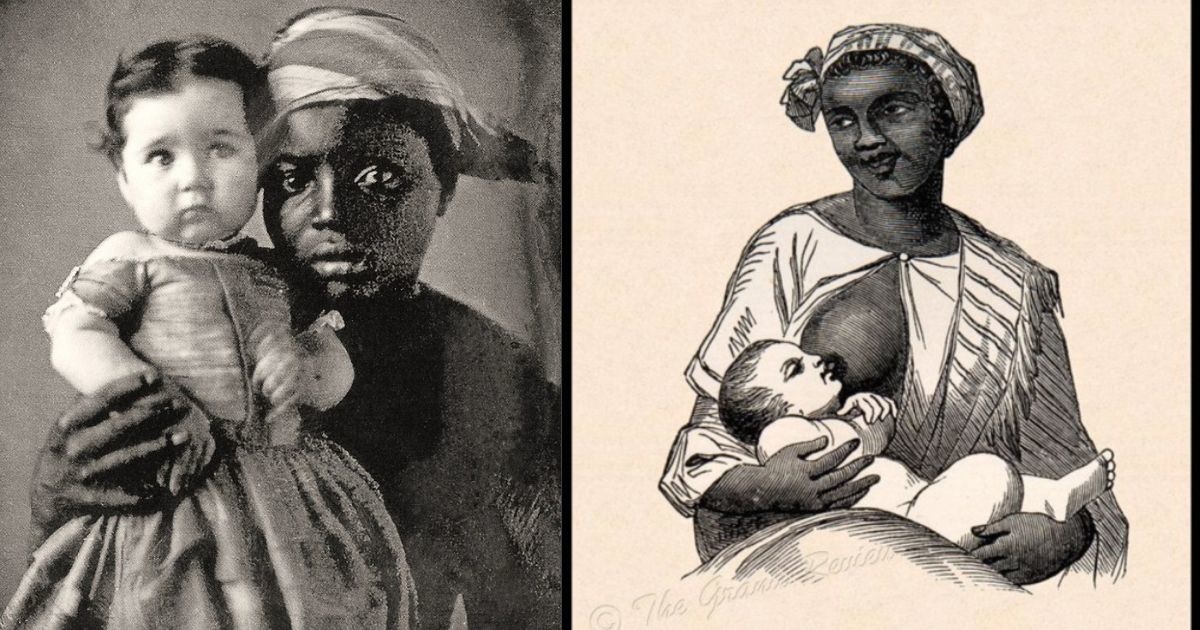
As Parenting Decolonized points out, Black parents have only been able to raise their own children for less than 160 years in America. That's basically two 80-year-old grandmothers living back to back. For most of U.S. history, generation upon generation upon generation of Black families were torn apart. Black mothers were often not allowed to nourish and raise their own babies, but were forced to nourish and raise the babies of their enslavers. For most of U.S. history, Black breastfeeding meant wet nursing white babies, sometimes at the expense of a Black woman's own children.
And when I say "most of U.S. history," I mean that literally. Slavery was the standard for close to 250 years on our soil, compared to the 154 years since slavery was legally abolished (and almost 100 of those years still allowed legal discrimination). The impact of that reality doesn't just disappear because slavery ended and the Civil Rights Act passed.
However, the historical effects stemming from slavery are not the only reason Black Breastfeeding Week is important. Black mothers face higher maternal and infant mortality rates in the U.S., and according to the CDC, there are "substantial" differences in breastfeeding rates between Black mothers and white mothers.
Add in cultural and social issues surrounding Black women's bodies, ongoing negative perceptions of breastfeeding, and a lack of representation in the lactation support field, and the answer to the question "Why Black Breastfeeding Week?" becomes apparent.
As Rochaun Meadows-Fernandez wrote on Scary Mommy,
"National Breastfeeding Month, which is observed the full month of August, addresses a few of the social concerns associated with breastfeeding, such as the mental exhaustion, the anatomical challenges, and the lingering stigma. But it doesn't address the ways each of these uniquely impact Black women.
The discourse that developed from Black Breastfeeding Week met me where 'regular' breastfeeding concerns left me struggling. It was a resource that tackled what it meant to nurse in public when your body is already hypersexualized. Black women and girls have some of the highest reports of sexual assault, as society seems to believe our bodies are community property- a message taught during slavery."
I know there will be people in the comments saying, "Slavery ended more than 100 years ago. Get over it." They don't understand the far-reaching effects of historical trauma. They don't understand that centuries of violent oppression followed by another century of blatant, legal discrimination impacts generations, and that the racism at the heart of all of that is still present in the health statistics of Black mothers and infants in America.
This is why Black Breastfeeding Week is needed. For more information, see www.blackbreastfeedingweek.org.

- A Black flight attendant shared an unexpectedly uplifting exchange with a white Fortune 500 CEO - Upworthy ›
- COVID-19 has made the overlooked Black maternal health crisis even more vital to address - Upworthy ›
- A haunting poem captures the 'Kyle Rittenhouse moment.' America: 'come get your children.' - Upworthy ›
- A haunting poem captures our Kyle Rittenhouse moment. America: 'come get your children.' - Upworthy ›
- A new program in Mississippi is helping Black mothers breastfeed. Here's why it's crucial. ›
- Breastfeeding mom fights back after professor 'humiliated' her in front of entire class - Upworthy ›
- Amanda Gorman, the 22-yr-old inaugural poet, symbolizes America's seismic shift in focus - Upworthy ›
- Woman has the best response to the woman who shamed her for breastfeeding. - Upworthy ›
- Baby won't take a bottle, so grandpa steps in to 'breastfeed' - Upworthy ›
- Breastfeeding mom shares her humiliating experience with airport security - Upworthy ›
- Historian offers a fact check on myths about infant feeding pre-formula - Upworthy ›
- The AAP has updated how long breastfeeding is recommended - Upworthy ›


A Generation Jones teenager poses in her room.Image via Wikmedia Commons
An office kitchen.via
An angry man eating spaghetti.via 


An Irish woman went to the doctor for a routine eye exam. She left with bright neon green eyes.
It's not easy seeing green.
Did she get superpowers?
Going to the eye doctor can be a hassle and a pain. It's not just the routine issues and inconveniences that come along when making a doctor appointment, but sometimes the various devices being used to check your eyes' health feel invasive and uncomfortable. But at least at the end of the appointment, most of us don't look like we're turning into The Incredible Hulk. That wasn't the case for one Irish woman.
Photographer Margerita B. Wargola was just going in for a routine eye exam at the hospital but ended up leaving with her eyes a shocking, bright neon green.
At the doctor's office, the nurse practitioner was prepping Wargola for a test with a machine that Wargola had experienced before. Before the test started, Wargola presumed the nurse had dropped some saline into her eyes, as they were feeling dry. After she blinked, everything went yellow.
Wargola and the nurse initially panicked. Neither knew what was going on as Wargola suddenly had yellow vision and radioactive-looking green eyes. After the initial shock, both realized the issue: the nurse forgot to ask Wargola to remove her contact lenses before putting contrast drops in her eyes for the exam. Wargola and the nurse quickly removed the lenses from her eyes and washed them thoroughly with saline. Fortunately, Wargola's eyes were unharmed. Unfortunately, her contacts were permanently stained and she didn't bring a spare pair.
- YouTube youtube.com
Since she has poor vision, Wargola was forced to drive herself home after the eye exam wearing the neon-green contact lenses that make her look like a member of the Green Lantern Corps. She couldn't help but laugh at her predicament and recorded a video explaining it all on social media. Since then, her video has sparked a couple Reddit threads and collected a bunch of comments on Instagram:
“But the REAL question is: do you now have X-Ray vision?”
“You can just say you're a superhero.”
“I would make a few stops on the way home just to freak some people out!”
“I would have lived it up! Grab a coffee, do grocery shopping, walk around a shopping center.”
“This one would pair well with that girl who ate something with turmeric with her invisalign on and walked around Paris smiling at people with seemingly BRIGHT YELLOW TEETH.”
“I would save those for fancy special occasions! WOW!”
“Every time I'd stop I'd turn slowly and stare at the person in the car next to me.”
“Keep them. Tell people what to do. They’ll do your bidding.”
In a follow-up Instagram video, Wargola showed her followers that she was safe at home with normal eyes, showing that the damaged contact lenses were so stained that they turned the saline solution in her contacts case into a bright Gatorade yellow. She wasn't mad at the nurse and, in fact, plans on keeping the lenses to wear on St. Patrick's Day or some other special occasion.
While no harm was done and a good laugh was had, it's still best for doctors, nurses, and patients alike to double-check and ask or tell if contact lenses are being worn before each eye test. If not, there might be more than ultra-green eyes to worry about.