upworthy
Add Upworthy to your Google News feed.
Google News Button
Pop Culture

People are sharing the adult problems that 'nobody prepared you for' and they're so true

Here are 21 of the most relatable.
being an adult, adult lessons, growing up
via PixaBay

Being an adult is tough.

Nothing can ever fully prepare you for being an adult. Once you leave childhood behind, the responsibilities, let-downs and setbacks come at you fast. It’s tiring and expensive, and there's no easy-to-follow roadmap for happiness and success. A Reddit user asked the online forum, “What’s an adult problem nobody prepared you for?” and there were a lot of profound answers that get to the heart of the disappointing side of being an adult.

One theme that ran through many responses is the feeling of being set adrift. When you’re a kid, the world is laid out as a series of accomplishments. You learn to walk, you figure out how to use the bathroom, you start school, you finish school, maybe you go to college, and so on.

However, once we’re out of the school system and out from under our parents’ roofs, there is a vast, complicated world out there and it takes a long time to learn how it works. The tough thing is that if you don’t get a good head start, you can spend the rest of your life playing catch-up.

Then, you hit middle age and realize that life is short and time is only moving faster.

Adulthood also blindsides a lot of people because we realize that many adults are simply children who grew older. The adult world is a lot more like high school than a teenager could ever imagine.

The Reddit thread may seem a bit depressing at first, but there are a lot of great lessons that younger people can take to heart. The posts will also make older people feel a lot better because they can totally relate.

Being an adult is hard, exhausting and expensive. But we’re all in this together and by sharing the lessons we’ve learned we can help lighten each other's load just a bit.

Here are 21 of the most powerful responses to the question: “What is an adult problem nobody prepared you for?”

1. Lack of purpose

"Lack of purpose. All your young life you are given purpose of passing exams and learning, then all of a sudden you are thrown into the world and told to find your own meaning," — Captain_Snow.

2. No bed time

"You can stay up as late as you want. But you shouldn't," — geek-fit

3. Friendships

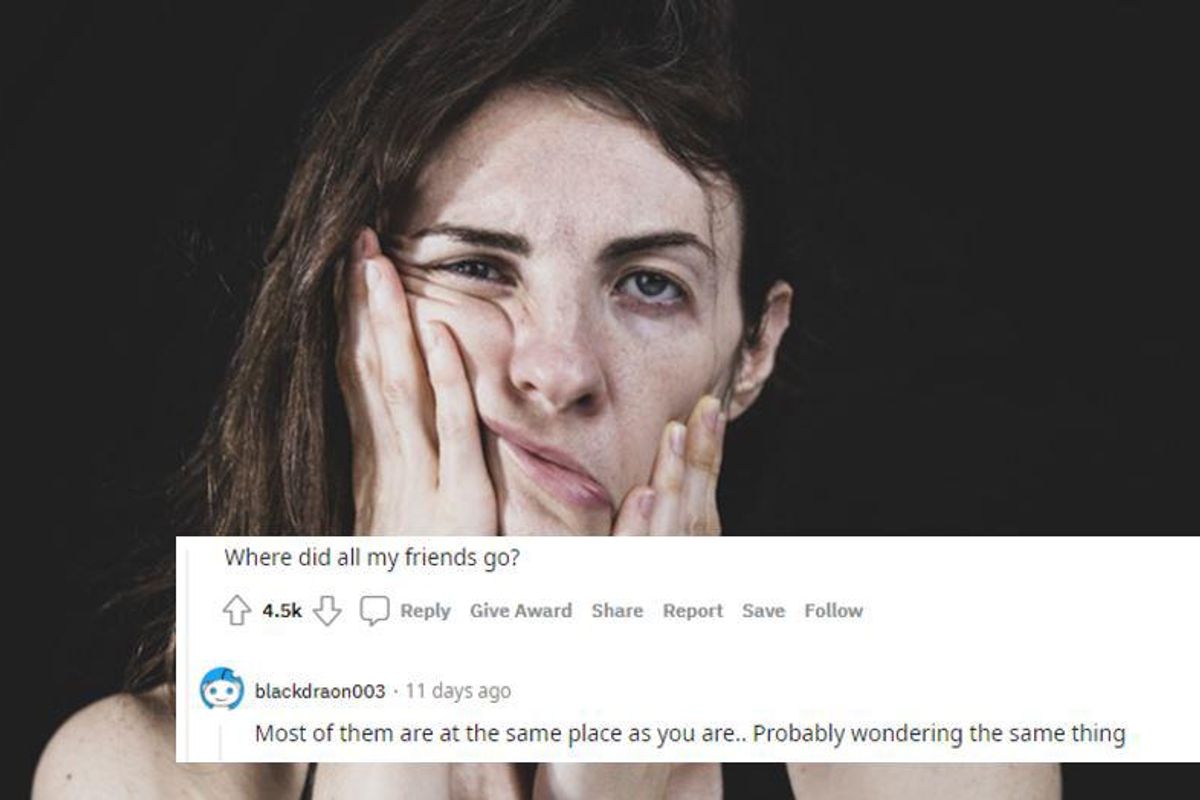
"Where did all my friends go?" — I_Love_Small_Breasts

Most of them are at the same place as you are ... Probably wondering the same thing," — Blackdraon003

4. Bodily changes

"I'm closer to fifty than forty, would have been nice to be better prepared for some of the ways your body starts to change at this point that don't normally get talked about. For instance your teeth will start to shift from general aging of your gums," — dayburner.

5. People don't change

"Didnt know that other adults have the emotional intelligence of teenagers and its almost impossible to deal with logically," — Super-Progress-6386

6. Money

"$5K is a lot to owe, but not a lot to have," — Upper-Job5130

7. Our parents age, too

"Handling the decline and death of your parents," - Agave666

8. Free time

"Not having a lot of free-time or time by myself," — detective_kiara

9. No goals

"Not having a pre-defined goal once I was out of college. Growing up my goals were set for me: get through elementary school! then middle school! Then high school, and get into college and get a degree, then get a job, and then...? Vague "advance in your career, buy a house, find a spouse, have a kid or multiple, then retire." At 22 I had no idea how to break that down more granularly," — FreehandBirdlime

10. Constant upkeep

"Life is all about maintenance. Your body, your house, your relationships, everything requires constant never ending maintenance," — IHateEditedBGMusic

11. Exhaustion

"Being able to do so many things because I'm an adult but too tired to do any of them," — London82

12. Loneliness

"Being an adult feels extremely lonely," — Bluebloop0

13. Dinner

"Having to make dinner every. Fucking. Day," — EndlesslyUnfinished

14. Time changes

"The more life you’ve lived, the faster time seems to go," — FadedQuill

15. You're responsibile, even if you didn't mean it

"You are held to account for bad behaviour for which you are negligent even if you had no intention to cause harm. As a lawyer, I see this all the time. People don't think they're responsible for mistakes. You are," — grishamlaw

16. Work is like high school

"The intricacies of workplace politics," — Steve_Lobsen writes. "

"When you're in school, you think that you won't have to deal with gossiping and bullying once you leave school. Unfortunately, that is not true," — lady_laughs_too_much

17. Nowhere to turn

"How easy it is to feel stuck in a bad situation (job, relationship, etc) just because the cost and effort of getting out can seem daunting. And sometimes you just have to accept a figurative bowl full of shit because you can't afford to blow up your life," — movieguy95453

18. The happiness question

"Figuring out what makes you happy. Everyone keeps trying to get you to do things you're good at, or that makes you money, but never to pursue what you enjoy," — eternalwanderer5

19. Constant cleaning

"The kitchen is always dirty. You’ll clean it at least three times every day," — cewnc

20. Life costs money

"One adult problem nobody prepared me for is how expensive everything is. I always thought that as an adult I would be able to afford the things I wanted, but it turns out that's not always the case! I've had to learn how to budget and save up for the things I want, and it's been a difficult process," — Dull_Dog_8126

21. Keeping above water

"All of it together. I was relatively warned about how high rent is, car bills and repairs, how buying healthy food is expensive as hell but important for your health, how to exercise and save what you can, my parents did their best to fill in my knowledge about taxes and healthcare and insurance that my schooling missed, about driving and cleaning a household, about setting boundaries at work but working hard and getting ahead if you can, about charity and what it means to take care of a pet and others, about being a good partner if you were lucky enough to have one, about how dark and messed up the world is when you just read the news and what all that means to me and my community… I was reasonably warned about all of it.

"No one could have ever prepared me for how hard doing all of it at the same time and keeping your head above that water would actually be," — ThatNoNameWriter


This article originally appeared two years ago.

Gen Z; Millennials; technology; cell phones; social media; teens and technology; teens social media

Gen Z is the first generation less cognitively capable than their parents. Denmark has the solution.

Nearly every parent hopes their child will be better off than they are: smarter, more secure, and more well-adjusted. Many parents see this as a stamp of successful parenting, but something has changed for children growing up today. While younger generations are known for their empathy, their cognitive capabilities seem to be lagging behind those of previous generations for the first time in history.

Dr. Jared Cooney Horvath, a teacher turned cognitive neuroscientist who focuses on human learning, appeared before Congress to discuss concerns about cognitive development in children. In his address to the members of Congress, he says, "A sad fact that our generation has to face is this: our kids are less cognitively capable than we were at their age. Since we've been standardizing and measuring cognitive development since the late 1800s, every generation has outperformed their parents, and that's exactly what we want. We want sharper kids."


kids, intelligence, sharp kids, generations, education, cognitive abilities Student smiling in a classroom, working on a laptop.Photo credit: Canva

Horvath explains that the reason this happens is that each generation has gone to school longer than the previous generation. Gen Z is no exception to the longer duration of time spent in school, but they're the first ones who aren't meeting this normal increase in cognitive development. According to the cognitive neuroscientist, the decline is due to the introduction of screens in the classroom, which started around 2010.

"Across 80 countries, as Jean was just saying, if you look at the data, once countries adopt digital technology widely in schools, performance goes down significantly. To the point where kids who use computers about five hours per day in school for learning purposes will score over two-thirds of a standard deviation less than kids who rarely or never touch tech at school," Horvath reveals.

In most cases, the decline in performance doesn't result in better strategies. The neuroscientist shares that the standardized testing has been adjusted to accommodate lower expectations and shorter attention spans. This is an approach that educators, scientists, and researchers went to Capitol Hill to express wasn't working. But not every country is taking the approach of lowering standards to meet lowered cognitive ability. Denmark went in the opposite direction when it realized their students were slipping behind.

France24 recently interviewed educators in Denmark following their seemingly novel approach to students struggling with cognitive development. Since the beginning of the 2025/2026 school year, Denmark has not only been having students turn in their cellphones, but they've also taken tablets, laptops, and computers out of the classroom. No more digital learning for the majority of the school day. Danes went old school by bringing back physical textbooks, workbooks, and writing assignments. The results have been undeniable. Even the students can't seem to deny the success of the countrywide shift in educational approach.

"I think the biggest issue has been that, because we kind of got rid of the books and started using screens instead, that we've noticed that a lot of the kids have trouble concentrating, so it's pretty easy to swipe with three fingers over to a different screen and have a video game going, for example, in class," Copenhagen English teacher, Islam Dijab tells France24.

Now, instead of computers being part of every lesson, Denmark uses computers very sparingly and with strict supervision. One student says that it has been nice not having screen time at school because she loves to read and write. But it wasn't just the lack of attention span children were developing, they were also developing low self-esteem and poor mental health due to the amount of time spent on devices.

kids, intelligence, sharp kids, generations, education, cognitive abilities Students focused and ready to learn in the classroom.Photo credit: Canva

The data showing the negative impact of screens on teens' brains has prompted a nationwide change in Denmark that extends outside of the classroom. Afterschool activities are eliminating or extremely limiting electronic use. There is also a national No Phone Day that encourages everyone to put away their devices for the day, and Imran Rashid, a physician and digital health expert, is petitioning parliament to ban social media use for children under the age of 15. The no phone movement in Denmark is a nationwide effort that hopes to right the ship before another generation feels the effects.

dementia, dementia village, elder care, memory care, alzheimer's disease

In a dementia village, people get to choose where they go.

No matter how much caregivers may want to keep a loved one with dementia in their home, it's not always feasible. Living with dementia is not easy, nor is living with someone who has dementia. But moving a loved one with dementia into a traditional care facility isn't always ideal, either. It can be difficult to find a suitable living situation that ticks all the boxes for what a family and their loved one would want.

That's where a "dementia village" comes in as an alternative. Instead of trying to fit a person with dementia into a living situation that either isn't designed for them or is overly focused on their limitations, a dementia village is an environment designed specifically to help people with severe dementia feel safe and free and live as normal a life as possible.


- YouTube www.youtube.com

The Hogeweyk was the world's first dementia village, founded in 2009. Since then, the idea has been replicated in dozens of locations all over the world. The concept is quite simple: A full, self-contained neighborhood where people with dementia can walk around freely without fear of getting lost, where everyone from shopkeepers to restaurant servers to salon workers are trained in dementia care, and where people who are losing their memory to dementia diseases are treated as people who still have aspirations.

Eloy van Hal, one of the founders of the Hogeweyk, explained to Vox how the guiding principle of the village is "normalcy." Traditional nursing homes keep all residents under one roof, and they are subject to do whatever program the institution provides for them. In the Hogeweyk, people live in small groups of six or seven in apartments with furnishings like they'd have at home. Distinct landmarks in the public space help residents know where they are, and putting a theater, grocery store, barber shop, etc. in separate buildings encourage movement through the neighborhood.

"It's about choice, choice, choice, where you want to be during the whole day and with whom," said van Hal. The idea is to balance safe design with controlled risk, allowing for as much of a normal life as possible.

dementia, dementia village, elder care, memory care, alzheimer's disease Every worker in a dementia village is trained in dementia care.Photo credit: Canva
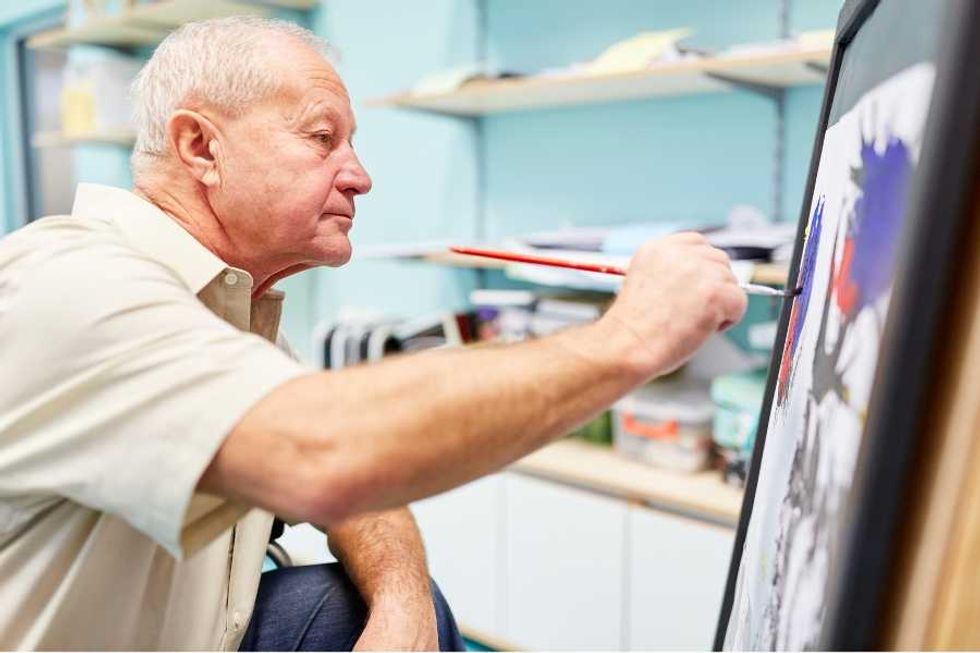
The one downside to the village concept, of course, is cost. Without adequate funding assistance from governments, living in a dementia village can be prohibitively expensive.

Does it really make a difference for residents, though? Has it been proven that outcomes are better than traditional care models? With dozens of villages now being used around the world, research is ongoing, but the data from the Hogeweyk is promising. People in the comments of Vox's by Design video shared how such facilities have been life-changing for their loved ones and how traditional care doesn't always meet the needs of people with dementia.

"My grandmother had dementia and when her caretaker who was my grandfather (her husband) passed unexpectedly we had to scramble to get her into a memory care facility in the US. The first place she was in temporarily was so sad, I could see her spirit drain but after about a year we were able to get her into a "village" and the quality of life difference is nothing short of ASTOUNDING! She could function in a way that was familiar and comfortable to her and not be in a foreign hospital setting. The abrupt change from a home where they are familiar, to a clinical setting must be very disorienting and upsetting to these people. That side of my family had mental health issues and memory loss starts early, so I know it will happen to me to some extent and I only hope I can have people take care of me as well as in this Hogeweyk."

"I've worked in a nursing home through high school and college. While I can't say it was the worst place for dementia patients, it certainly did not work well for all of them. One patient once tried to wedge herself through the door begging to go outside with me and I even had patients confide in me that they hated being institutionalized, they missed being able to live a normal life, being part of a real community, and being able to come and go as they pleased. This concept is probably the closest thing possible to a normal life a dementia patient could ever have."

dementia, dementia village, elder care, memory care, alzheimer's disease In a dementia village, residents can live somewhat "normal" lives.Photo credit: Canva

"A relative of mine used to get aggressive, violent and angry when she would encounter a locked door in the institution she was in. She couldn't understand why there would be a locked room in what she understood to be 'her home', this would take a lot of calming down and management, only for her to discover another locked door, and kick off again. I love these village based models as they allow autonomy for residents, and have an individual experience. Just because someone has a brain disease doesn't mean they aren't entitled to the very best care. I hope the govt spends far more on these establishments in the future."

"As he said at the end, people with dementia are still people—even if there is proven to be no benefits to this model over a care home, I would much prefer to have dignity in my final days than live in a clinical trap. Love all the incredible ideas the Netherlands come up with."

dementia, dementia village, elder care, memory care, alzheimer's disease A dementia village is a self-contained neighborhood with shops and places for people to go like a normal neighborhood. Photo credit: Canva

Dementia care is something Americans are going to have to look at closely. According to The Alzheimer's Association, the number of people living with Alzheimer's is set to nearly double from seven million to 13 million by the year 2050. As more of our elders require full-time care, the more we'll have to consider prioritizing putting resources into things like dementia villages.

Everyone deserves safety and a good quality of life. The Hogeweyk is a great example of what it looks like to view people with dementia as people first and to care for them accordingly.

This article originally appeared last year. It has been updated.

parenting, teens, raising teens, teen hangout, high school, game night for teens, activities for teens, parenthood

Amy White explains how her house became "the house" for her teens.

I grew up in "the house." In high school, my home was the designated place where my friends gathered, sometimes in big groups, sometimes just my small core squad. My three best friends spent the night there almost every Friday and/or Saturday night for four years straight. We devoured Totino's frozen pizzas by the dozen, inhaled soda, and laid waste to any snacks or leftovers that were brave enough to survive in the kitchen. Not only that, but my house was pretty small — four teenage boys took up a lot of space in the living room (the whole thing) and made a lot of noise playing video games deep into the night. It must have driven my parents and older brothers crazy. It's a wonder anyone put up with it.

Or so I thought when I was younger. When I became a parent myself, I started to understand a little more why my mom and dad were so willing to host and feed all my friends and me every single weekend. Why the outrageous grocery bill and constant chaos in the house were probably a small price to pay.


Mom explains how to make your house 'the house' where teenagers hang

One mom has perfectly encapsulated the value of turning your home into "the house" for your kids and their friends, and exactly how she did it for her family.

teens, teen house, teens hanging out, teens having fun, teenagers Teens hanging out in a living room.via Canva/Photos

Amy White shared a reel on Instagram showing her college-aged son hanging in her dining room with a group of friends playing cards. The text overlay reads "What makes your kids' high school friends want to come over, play cards & spend the night on their College Christmas Break." I think most parents can agree that we want our kids to keep coming home as long as possible! So how exactly did White pull this off?

Her explanation in the caption was spot-on.

First, White says that you have to start early. Become "the hang out house" in high school or even earlier. Then you have a better chance of holding onto the mantle into your kid's college years.


Next, be ready to stock the house with snacks and drinks, and don't make a fuss when your kid's friends have at it. "The kids knew we had food," she writes, "BUT they also knew I didn't care what they had. They knew they could eat anything in my pantry and fridge."

Third, and this is a big one, don't mistake being the "cool house" for being "the house." Some parents choose to allow their underage kids and friends to drink alcohol under their supervision, but you don't have to bend your morals and the law to lure the squad over to your place. Pizza and Coke is plenty to keep most teens happy. "We were not the house that served alcohol or even allowed the kids to bring alcohol to our house. And Guess What?? The kids still came and wanted to hang at our house!"

teens, teen house, teens hanging out, teens having fun, teenagers Teenagers eating pizza.via Canva/Photos

Fourth, always say Yes (as often as possible, anyway) when your kids want to have friends over. "They know my answer is 99% of the time YES," White writes. "You have to have your kids take the leadership of offering your home and if your home was 'open' to their friends in high school, they know it will be 'open' to their friends in college."

As a bonus tip, White pleas with parents not to worry about the mess having friends over makes. "I love a clean house and organization, BUT I would much rather have a crazy messy house for the kids where memories are made than a quiet house with nothing going on just to keep my house 'clean.'"

Should parents allow teens to drink at home?

There's an age-old debate over whether parents should allow teens to drink at home because it's better than if they do is unsupervised or keep their home dry as a bone. A recent study out of the University of Buffalo found that kids who grew up drinking at home had a greater chance of having addiction problems when they got older. "A robust relationship was found between parental permission to use alcohol during adolescence and increased alcohol use frequency and quantity, alcohol use disorder symptoms, and alcohol-related harms in young adulthood," the study says.

White writes, "It's worth being 'the house', so let go of control & get to know your kids friends." Commenters agreed.

White's video went viral to the tune of 8.5 million views and hundreds of comments. Parents shared their own experiences of what it's like being the default hang out house.

"Our house was the high school hangout for my son and friends... every weekend... I loved it!! Miss it now that they are all college graduates and have moved away. I love seeing them when they do come home for the holidays"

"A wise man once said don't be the house with the alcohol. Be the house with the food."

"Amy 1000% agree!!! My house is full of teenagers on the weekends and I love every bit of it. Even though I wake up to a kitchen that looked much different from when I left it"


teens, teen house, teens hanging out, teens having fun, teenagers Teenagers eating pizza.via Canva/Photos

"We never allowed alcohol, drugs, bad language, always respectful, and guess what, our house was always the house where the kids hung out. First my daughter, then my son. Through grade school, high school, then when my kids went out of state for college their college friends would come spend a couple weeks during the summer. I always thought of it this way, I loved knowing my kids friends and, who knows, maybe some of those kids, especially during the younger years, just maybe those kids just needed an adult to care. Anyway, it was always fun to have them here!"

"It used to crack me up when my daughter would bring over a bunch of her friends (girls and boys) in high school and instead of hanging out in the family room they all wanted to crowd into either the kitchen with me or our tiny office and happily share all the gossip with me."

Experts say that knowing your kids' friends, and their parents, can have huge benefits. Not only will it bring you the peace of mind of knowing where your kid is and who they're with when they get to those crucial high school years, it has been shown to tangibly improve kids ability to create positive relationships and problem-solve collaboratively. Plus, it can actually be really fun! Kids and teens are the funniest, silliest, most interesting people on the planet. Having a house full of them is messy and loud, but it's always a good time.

One caveat: "don’t feel bad if your house isn’t the chosen house," one commenter reminds us. "Just be happy your kid has a good group of friends and be thankful they have somewhere safe to hang out."

This article originally appeared last year.

text in mirrors reversed, text backward in mirrors, how mirrors work, mirrors, science

Why is text reversed in mirrors?

Have you ever wondered why text shows up backwards in a mirror? It's confusing to our brains because it doesn't seem like anything else is flipped like that. If we turn our head, it doesn't move the opposite direction in the mirror. Or does it? After all, right-handed you is actually left-handed you in the mirror. Right? (Wait, is that right?)

Mirrors can be confusing despite not being very complicated. A mirror image is simply a reflection of what's in front of it. But when someone else is looking at us head on, they don't see text in reverse, so why don't we see what other people see when we see ourselves in a mirror?


mirrors, mirror, how mirrors work, mirror image, text in mirrors Woman smiling in a mirror.Canva Photos.

(If you think this is a super stupid question with a super obvious answer, congratulations. Pat yourself on the back and scootch along so the folks who don't fully grasp the physics of mirrors can enjoy a demonstration that makes it a little easier to understand.)

"Why do mirrors reverse text?" asks the creator behind @humanteneleven on YouTube. "You might think it's just a property of mirrors—they flip things from left to right—but that's not true." He then picks up a metal arrow to show that it points the same direction in the mirror as it does in real life. So why is the text flipped when the arrow isn't?

- YouTube youtu.be

He then holds up a book to show how the text on the book cover appears backwards, just like the shirt. But when he holds up a Ziploc bag with the word "HELLO" written on it, the word shows up properly.

Why? How?

It's because he had to flip the book over to see the cover text in the mirror. The baggy, on the other hand, he could just hold up and see the letters through the transparent plastic, just as we see them in real life. If he flips the baggy over like he did the book, the text shows up backwards in the mirror, just like it does in real life.

"So it's actually not the mirror that's flipping anything from left to right," he says. "It's the human."

People appreciated the simple, straightforward explanation and demonstrations.

"One of the most insightful demonstrations I've seen. It's simple and explains the phenomenon. Well done!"

"While I've heard this explanation many times before, I've only recently seen it demonstrated with text-on-transparency, which is what really makes it click. Great video!"

"Love these sorts of demonstrations. It’s a bit of a complicated one, but I love seeing how different people's minds work when explaining simple things like this. My kid explains it with “left is on the left, right is on the right, things aren’t flipped, they are mirrored” but it’s true that you are the one who flips things and I’ve never thought of it that way before."

"Oh my God, I haven't understood explanations from physics videos about why mirrors flip but this, gosh this helps."

Mirrors have been hilariously befuddling people in other videos as they try to figure out how the mirror "knows" what's behind a barrier placed in front of objects.

@sarahcoome

this is kinda creepy 👀 #mirror #relatable #creepy

Is this something all of us should probably have learned in high school? Yes. Do all of us remember everything we learned in high school? No. Does the scientific explanation make perfect sense to everyone even if it's explained in detail? Um, no.

Like the reversed text question, having a simplified explanation that doesn't fully get into the nitty gritty physics and geometry of how mirrors work is helpful for some folks.

- YouTube youtu.be

For those who want a bit more scientific substance to their explanations, this next video does a good job of giving a bit more detail while still keeping the explanation simple. It even uses a visual diagram to explain:

- YouTube youtu.be

And for those who say, "This is so basic! How do people not understand this?" here's a video that really does get into the nitty gritty physics and geometry of how mirrors work, diving into ray and wave optics, photons, wave functions, probability, and quantum mechanics. It's only 12 minutes, and it manages to entertain while explaining, but it certainly blows the notion that understanding mirrors is super simple.

- YouTube youtu.be

As one commenter wrote, "I thought I understood mirrors. I understand mirrors even less now. And that's a compliment."

Isn't science fun?

This article originally appeared last year.

dog experiments, dog tongue cleaner than humans, experiments by kids, cool science, dogs, fun science, experiments, science

A young teen boy holding a beagle.

Dogs come in a wide variety of breeds, along with their own unique personalities and needs. They can be guardians, helpful workers, loyal friends, snuggly companions, but there's one thing almost all dogs have in common: Licking.

Sure, some dogs lick way more than others, but it's rare to find a dog who never licks anyone or anything. Many dogs communicate and show affection by licking, which is sweet—if a little gross—depending on how slobbery they are. There's a common saying that dogs' mouths are cleaner than humans', which is a bit hard to believe when you see what some dogs put in their mouths, but it is true?


What does science say about dog tongues and saliva? Is a dog licking our face something we should worry about?


dog experiments, dog tongue cleaner than humans, experiments by kids, cool science, dogs, fun science, experiments, science A man being licked by a golden retreiver. Photo credit: Canva

It turns out, the answer to whether a dog's mouth is cleaner than ours isn't super straightforward.

An 8th grader named Abby tackled this question in a science experiment that won her a Young Naturalists Award from the American Museum of Natural History in 2011. Her family had gotten a dog and her mom kept telling her not to let the dog lick her face because dog mouths are full of bacteria. Instead of arguing, Abby decided to find out herself if this was true.

"I hypothesized that human tongues would be cleaner than dog tongues," she wrote. "I thought this because humans brush their teeth at least once a day. I hypothesized that dogs' tongues would be dirty because they were always licking dirty things like garbage."

After diving into the research about bacteria that live in and on humans and dogs, Abby decided she had a testable hypothesis. But this wasn't any old middle school science experiment. She applied for and got a grant to the State Hygienic Lab at the University of Iowa, where she was assigned a mentor to work with her.

You can read the nitty-gritty details of her experiment here, but it involved a lab, swabs, agar plates, and more. Here was the conclusion:

dog experiments, dog tongue cleaner than humans, experiments by kids, cool science, dogs, fun science, experiments, science A dog's tongue close-up. Photo credit: Canva

"I concluded that dog and human mouth flora are very different. (Flora means the bacteria found in a mouth or anywhere else.) The bacteria found in human mouths are more similar to another human's oral bacteria than the bacteria found in a dog's mouth.

"I also concluded that dogs' mouths are cleaner than humans' in some ways, and dirtier in other ways. Humans have more bacteria in their mouths than dogs do, based on the total number of bacteria. Most of the humans had a 'moderate' number of bacteria, and most of the dogs had 'few' bacteria. A possible explanation of this might be that dogs pant a lot, and maybe while panting, bacteria falls off their tongues along with their saliva. But dogs had more types of bacteria. The average number of different bacterial colonies in a dog's mouth was about 5.7. The average number of different bacterial colonies in a human's mouth was about 4.1. I think this is so because dogs sniff and lick a variety of things, like carpets, floors, chairs, grass, etc., so they pick up bacteria from many places."

But what about the licking of our faces? That's a bit of a subjective call, but Abby's results gave her some peace of mind:

"In conclusion, will I let my dog continue to lick me? The answer to the question is yes!" she wrote. "I will feel guiltless about letting my dog lick me because I found out that human and dog oral bacteria are different, so my dog's oral bacteria present no harm to me."

What do the experts say?

According to Colin Harvey, professor at the University of Pennsylvania’s School of Veterinary Medicine and executive secretary at the American Veterinary Dental College, comparing dogs' mouths to humans' mouth is "like comparing apples to oranges." As Abby found, the microbes in a dog's mouth are very different than those in a human's.

The American Kennel Club elaborates:

"Most of the bacteria in your dog’s mouth aren’t zoonotic, which means you probably won’t get a disease from a big old doggy kiss. There are exceptions to this. Dogs that eat a raw diet are at an increased risk of contracting salmonella, which can be spread to humans. You also probably shouldn’t share kisses with a dog that regularly raids the litter box.

In other words, kissing your dog is less risky than kissing another human, but that doesn’t mean that your dog’s mouth is necessarily cleaner than a human’s—they just have a mostly incompatible set of germs."

Keeping your dog's mouth healthy through regular teeth cleaning and dental check-ups can also help prevent issues that could potentially come from dog licks.

dog experiments, dog tongue cleaner than humans, experiments by kids, cool science, dogs, fun science, experiments, science A golden retreiver getting their teeth brushed. Photo credit: Canva

So there you have it. If your dog doesn't eat a raw diet and doesn't go snacking in the cat box (or some other equally fecal-bacteria-ridden place), their kisses are probably not going to hurt you. Guilt-free pooch smooches for the win!

This article originally appeared last year.