We’ve all done it: You snap a selfie, look at it, say, “OMG is my nose swollen?” then try again from a different angle. “Wait, now my forehead looks weird. And what’s up with my chin?” You keep trying various angles and distances, trying to get a picture that looks like how you remember yourself looking. Whether you finally land on one or not, you walk away from the experience wondering which photo actually looks like the “real” you.
I do this, even as a 40-something-year-old who is quite comfortable with the face I see in the mirror. So, it makes me cringe imagining a tween or teen, who likely take a lot more selfies than I do, questioning their facial features based on those snapshots. When I’m wondering why my facial features look weird in selfies it’s because I know my face well enough to know that’s not what it looks like. However, when a young person whose face is changing rapidly sees their facial features distorted in a photo, they may come to all kinds of wrong conclusions about what they actually look like.
Not that it should matter, of course. But we’re talking about people living in a society obsessed with personal appearance. It’s going to matter to a lot of people, and if they get the wrong impression of their face, some people will go to all sorts of lengths to change it. That’s why understanding a bit about how focal lengths on cameras can impact what we see in photographs is vital.
Writer Evey Winters shared some of that education in a post on Facebook. She writes about this topic through a trans and dysmorphia lens, but it applies to everyone.
Winters points out that if someone is thinking of doing surgery to change their bodies, they should seek sources outside of themselves and a cellphone camera.
“I have dysmorphia and recognize that in myself,” she wrote, “but even if I didn’t, there’s not a selfie I’ve ever taken that would accurately help me make choices about my face. Mirrors are slightly better only for their minimal distortions.”
“If you want the best chance at getting good feedback pre-op about what you might want to change,” she added, “I’d recommend a skilled photographer take a series of photos of you at different focal lengths and even then none of these will be entirely accurate as none of these employ humans binocular vision and filtering.”
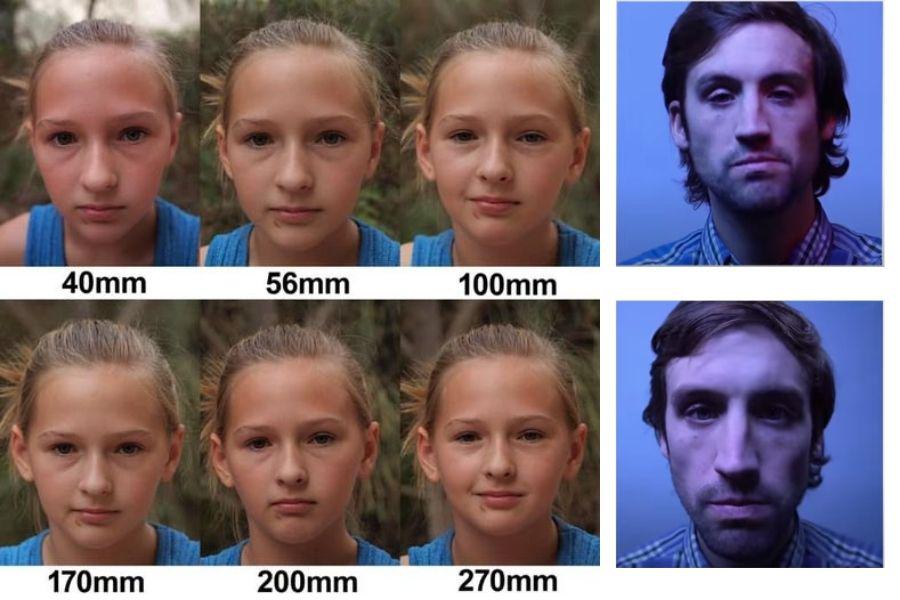
Winters shared a collage of photos of the same girl’s face at different focal lengths to show the significant difference it makes. “Notice how in different photos this child’s eyes may appear to be slightly hooded,” she wrote. “The nose appears enlarged disproportionately. Hairline seems to shift with every snap. So does jaw shape, face shape, and even the width and size of the ears.”
The difference between each of these photos is significant, but the difference between the first and the last is stunning. Cellphone selfie cameras usually have an even smaller focal length than the 40 mm shown here (Winters points out that the iPhone 13 Pro Max selfie camera has the equivalent of a 23 mm focal length), so they distort facial features even more. It also depends on how far away from the camera you are—the closer you are, the more distortion you’ll see. Lighting matters, too, but even the best lighting can’t cancel out what the focal length is doing.
Vox shared a video specifically about the “big nose” phenomenon with selfies, showing how drastic the distortion can be.
As a parent of two teens and a young adult, I find these photos to be fantastic tools for teaching my kids not to put too much stock in what they see in a selfie. Far too many people are increasingly seeking out plastic surgery to change a nose or a forehead or a jawline that doesn’t even really exist. Imagine looking in a funhouse mirror and thinking you need to do something to change how you look. Selfie cameras are basically mini funhouse mirrors. Smartphones and apps are getting better at making filters that adjust for those distortions, but none of us should be relying on selfies of any kind to see what we really look like, much less taking major measures to alter our appearance based on what we see in them.
Even if you have some physical feature you simply can’t accept and want to change, make sure you get a skilled photographer to give you the most accurate picture of what it actually looks like. As Winters concluded at the end of her post: “Make sure you’re not reshaping your body for a you that only exists in selfie cams.”
Thank you for the reminder, Ms. Winters.
This article originally appeared three years ago.