Have you ever wondered why text shows up backwards in a mirror? It’s confusing to our brains because it doesn’t seem like anything else is flipped like that. If we turn our head, it doesn’t move the opposite direction in the mirror. Or does it? After all, right-handed you is actually left-handed you in the mirror. Right? (Wait, is that right?)
Mirrors can be confusing despite not being very complicated. A mirror image is simply a reflection of what’s in front of it. But when someone else is looking at us head on, they don’t see text in reverse, so why don’t we see what other people see when we see ourselves in a mirror?
(If you think this is a super stupid question with a super obvious answer, congratulations. Pat yourself on the back and scootch along so the folks who don’t fully grasp the physics of mirrors can enjoy a demonstration that makes it a little easier to understand.)
“Why do mirrors reverse text?” asks the creator behind @humanteneleven on YouTube. “You might think it’s just a property of mirrors—they flip things from left to right—but that’s not true.” He then picks up a metal arrow to show that it points the same direction in the mirror as it does in real life. So why is the text flipped when the arrow isn’t?
He then holds up a book to show how the text on the book cover appears backwards, just like the shirt. But when he holds up a Ziploc bag with the word “HELLO” written on it, the word shows up properly.
Why? How?
It’s because he had to flip the book over to see the cover text in the mirror. The baggy, on the other hand, he could just hold up and see the letters through the transparent plastic, just as we see them in real life. If he flips the baggy over like he did the book, the text shows up backwards in the mirror, just like it does in real life.
“So it’s actually not the mirror that’s flipping anything from left to right,” he says. “It’s the human.”
People appreciated the simple, straightforward explanation and demonstrations.
“One of the most insightful demonstrations I’ve seen. It’s simple and explains the phenomenon. Well done!”
Mirrors (and vision) are very weird and you probably don’t understand how they work and that’s ok. Like, most people have no idea why mirrors seem to reverse text but do not flip you upside down.
“While I’ve heard this explanation many times before, I’ve only recently seen it demonstrated with text-on-transparency, which is what really makes it click. Great video!”
“Love these sorts of demonstrations. It’s a bit of a complicated one, but I love seeing how different people’s minds work when explaining simple things like this. My kid explains it with “left is on the left, right is on the right, things aren’t flipped, they are mirrored” but it’s true that you are the one who flips things and I’ve never thought of it that way before.”
“Oh my God, I haven’t understood explanations from physics videos about why mirrors flip but this, gosh this helps.”
Mirrors have been hilariously befuddling people in other videos as they try to figure out how the mirror “knows” what’s behind a barrier placed in front of objects.
Is this something all of us should probably have learned in high school? Yes. Do all of us remember everything we learned in high school? No. Does the scientific explanation make perfect sense to everyone even if it’s explained in detail? Um, no.
Like the reversed text question, having a simplified explanation that doesn’t fully get into the nitty gritty physics and geometry of how mirrors work is helpful for some folks.
For those who want a bit more scientific substance to their explanations, this next video does a good job of giving a bit more detail while still keeping the explanation simple. It even uses a visual diagram to explain:
And for those who say, “This is so basic! How do people not understand this?” here’s a video that really does get into the nitty gritty physics and geometry of how mirrors work, diving into ray and wave optics, photons, wave functions, probability, and quantum mechanics. It’s only 12 minutes, and it manages to entertain while explaining, but it certainly blows the notion that understanding mirrors is super simple.
As one commenter wrote, “I thought I understood mirrors. I understand mirrors even less now. And that’s a compliment.”
In a small village in Pwani, a district on Tanzania’s coast, a massive dance party is coming to a close. For the past two hours, locals have paraded through the village streets, singing and beating ngombe drums; now, in a large clearing, a woman named Sheilla motions for everyone to sit facing a large projector screen. A film premiere is about to begin.
It’s an unusual way to kick off a film about gender bias, inequality, early marriage, and other barriers that prevent girls from accessing education in Tanzania. But in Pwani and beyond, local organizations supported by Malala Fund and funded by Pura are finding creative, culturally relevant ways like this one to capture people’s interest.
The film ends and Sheilla, the Communications and Partnership Lead for Media for Development and Advocacy (MEDEA), stands in front of the crowd once again, asking the audience to reflect: What did you think about the film? How did it relate to your own experience? What can we learn?
Sheilla explains that, once the community sees the film, “It brings out conversations within themselves, reflective conversations.” The resonance and immediate action create a ripple effect of change.
MEDEA Screening Audience in Tanzania. Captured by James Roh for Pura
Across Tanzania, gender-based violence often forces adolescent girls out of the classroom. This and other barriers — including child marriage, poverty, conflict, and discrimination — prevent girls from completing their education around the world.
Sheilla and her team are using film and radio programs to address the challenges girls face in their communities. MEDEA’s ultimate goal is to affirm education as a fundamental right for everyone, and to ensure that every member of a community understands how girls’ education contributes to a stronger whole and how to be an ally for their sisters, daughters, granddaughters, friends, nieces, and girlfriends.
Sheilla’s story is one of many that inspired Heart on Fire, a new fragrance from the Pura x Malala Fund Collection that blends the warm, earthy spices of Tanzania with a playful, joyful twist. Here’s how Pura is using scent as a tool to connect the world and inspire action.
A partnership focused on local impact, on a global mission
Pura, a fragrance company that recognizes education as both freedom and a human right, has partnered with Malala Fund since 2022. In order to defend every girl’s right to access and complete 12 years of education, Malala Fund partners with local organizations in countries where the educational barriers are the greatest. They invest in locally-led solutions because they know that those who are closest to the problems are best equipped to solve and build durable solutions, like MEDEA, which works with communities to challenge discrimination against girls and change beliefs about their education.
But local initiatives can thrive and scale more powerfully with global support, which is why Pura is using their own superpower, the power of scent, to connect people around the world with the women and girls in these local communities.
The Pura x Malala Fund Collection incorporates ingredients naturally found in Tanzania, Nigeria, Pakistan, and Brazil: countries where Malala Fund operates to address systemic education barriers. Eight percent of net revenue from the Pura x Malala Fund Collection will be donated to Malala Fund directly, but beyond financial support, the Collection is also a love letter to each unique community, blending notes like lemon, jasmine, cedarwood, and clove to transport people, ignite their senses, and help them draw inspiration and hope from the global movement for girls’ education. Through scent, people can connect to the courage, joy, and tenacity of girls and local leaders, all while uniting in a shared commitment to education: the belief that supporting girls’ rights in one community benefits all of us, everywhere.
You’ve already met Sheilla. Now see how Naiara and Mama Habiba are building unique solutions to ensure every girl can learn freely and dare to dream.
Naiara Leite is reimagining what’s possible in Brazil
Julia with Odara in Brazil. Captured by Luisa Dorr for Pura
In Brazil, where pear trees and coconut plantations cover the Northeastern Coast, girls like ten-year-old Julia experience a different kind of educational barrier than girls in Tanzania. Too often, racial discrimination contributes to high dropout rates among Black, quilombola and Indigenous girls in the country.
“In the logic of Brazilian society, Black people don’t need to study,” says Naiara Leite, Executive Coordinator of Odara, a women-led organization and Malala Fund partner. Bahia, the state where Odara is based, was once one of the largest slave-receiving territories in the Americas, and because of that history, deeply-ingrained, anti-Black prejudice is still widespread. “Our role and the image constructed around us is one of manual labor,” Naiara says.
But education can change that. In 2020, with assistance from a Malala Fund grant, Odara launched its first initiative for improving school completion rates among Black, quilombola, and Indigenous girls: “Ayomidê Odara”. The young girls mentored under the program, including Julia, are known as the Ayomidês. And like the Pura x Malala Fund Collection’s Brazil: Breath of Courage scent, the Ayomidês are fierce, determined, and bursting with energy.
Ayomidês with Odara in Brazil. Captured by Luisa Dorr for Pura
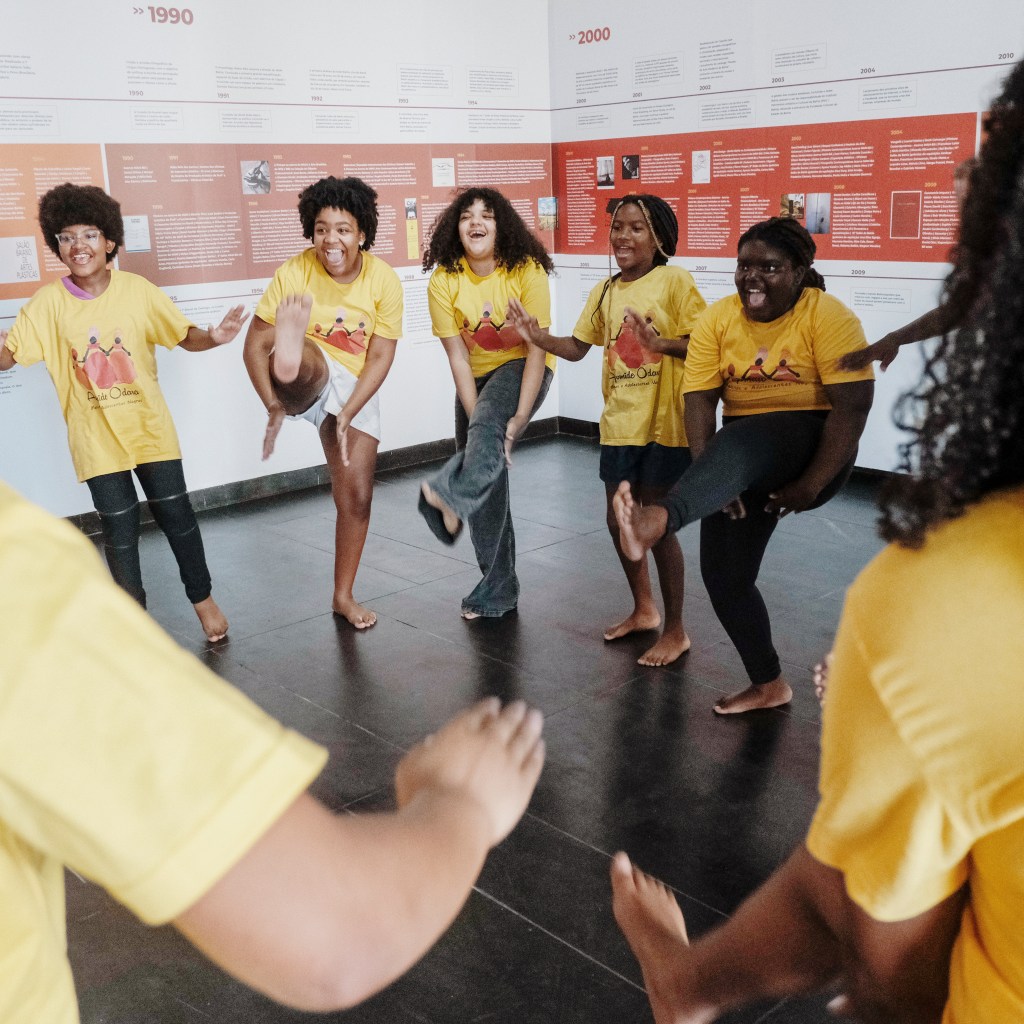
Ayomidês take part in weekly educational sessions where they explore subjects like education and ethnic-racial relations. The girls are encouraged to find their own voices by producing Instagram lives, social media videos, and by participating in public panels. Already, the Ayomidês are rewriting the narrative on what’s possible for Afro-Brazilian girls to achieve. One of the earliest Ayomidês, a young woman named Debora, is now a communications intern. Another former Ayomidê, Francine, works at UNICEF, helping train the next generation of adolescent leaders. And Julia has already set her sights on becoming a math teacher or a model.
“These are generations of Black women who did not have access to a school,” Naiara says. “These are generations of Black women robbed daily of their dreams. And we’re telling them that they could be the generation in their family to write a new story.”
Mama Habiba is reframing the conversation in Nigeria
Centre for Girls' Education, Nigeria. Captured by James Roh for Pura
In Mama Habiba’s home country of Nigeria, the scents of starfruit, ylang ylang and pineapple, all incorporated into the Pura x Malala Collection’s “Nigeria: Hope for Tomorrow,” can be found throughout the vibrant markets. Like these native scents, Mama Habiba says that the Nigerian girls are also bright and passionate, but too often they are forced to leave school long before their potential fully blooms.
“Some of these schools are very far, and there is an issue of quality, too,” Mama Habiba says. “Most parents find out when their children are in school, the girls are not learning. So why allow them to continue?”
When girls drop out of secondary school, marriage is often the alternative. In Nigeria, one in three girls is married before the age of 18. When this happens, girls are unable to fulfill their potential, and their families and communities lose out on the social, health and economic benefits.
Completing secondary school delays marriage, and according to UNESCO, educated girls become women who raise healthier children, lift their families out of poverty and contribute to more peaceful, resilient communities.
Centre for Girls’ Education, Nigeria. Captured by James Roh for Pura
To encourage young girls to stay in school, the Centre for Girls’ Education, a nonprofit in Nigeria founded by Mama Habiba and supported by Malala Fund and Pura, has pioneered an initiative that’s similar to the Ayomidê workshops in Brazil: safe spaces. Here, girls meet regularly to learn literacy, numeracy, and other issues like reproductive health. These safe spaces also provide an opportunity for the girls to role-play and learn to advocate for themselves, develop their self-image, and practice conversations with others about their values, education being one of them. In safe spaces, Mama Habiba says, girls start to understand “who she is, and that she is a girl who has value. She has the right to negotiate with her parents on what she really feels or wants.”
“When girls are educated, they can unlock so many opportunities,” Mama Habiba says. “It will help the economy of the country. It will boost so many opportunities for the country. If they are given the opportunity, I think the sky is not the limit. It is the starting point for every girl.”
From parades, film screenings to safe spaces and educational programs, girls and local leaders are working hard to strengthen the quality, safety and accessibility of education and overcome systemic challenges. They are encouraging courageous behavior and reminding us all that education is freedom.
Experience the Pura x Malala Fund Collection here, and connect with the stories of real girls leading change across the globe.
Artificial intelligence promises to completely upend just about every facet of modern life, from how we work to education, medical care, and the design and manufacture of everyday goods. On a deeper level, it will also change how we see ourselves as humans, placing greater value on the uniquely human skills that no computer can replicate, no matter how powerful the server.
One person who knows a great deal about that is Jensen Huang, the president and CEO of NVIDIA, a company that designs and manufactures chips for accelerated computing and AI data centers. Fortune has named Huang one of the world’s best CEOs for his leadership and innovation.
Recently, he appeared on the A Bit Personal podcast with Jodi Shelton, who posed a big question: “Who is the smartest person you’ve ever met?”
At first, the question sounds like a softball. Of course, Huang might be expected to name someone with exceptional technical talent or a keen eye for design and engineering. He could even point to an important scientist or a tech leader, such as Steve Jobs. Instead, Huang argues that the most intelligent people today are those whose skills can’t be duplicated by AI.
“I know what people are thinking, the definition of smart is somebody who’s intelligent solves [technical] problems,” Huang responded. “But I find that’s a commodity and we’re not about to prove that artificial intelligence is able to handle that part easiest, right?”
He added that software engineers were once widely seen as the most intelligent, but AI is now challenging that idea.
Huang says truly intelligent people know the “unknowables”
“I think long term … and my personal definition of smart is someone who sits at that intersection of being technically astute but [has] human empathy,” Huang said. “And having the ability to infer the unspoken around the corners. The unknowables. People who are able to see around corners are truly, truly smart. To be able to preempt problems before they show up, just because you feel the vibe. And the vibe came from a combination of data analysis, first principle life experience, wisdom, sensing other people, that vibe. That’s smart. I think it’s gonna be the future definition of smart, and that person might actually score horribly on the SAT.”
The podcast’s Instagram post received hundreds of comments. “This is a very smart answer to make everyone sound like they have a chance of being smartest person,” one popular commenter wrote. Another joked, “Bro knows he’s the smartest person he’s ever met.”
Ultimately, as we enter the AI era, it’s becoming clear that the edge humans have isn’t processing power, but the skills that make us most human: empathy, perception, wisdom, emotional intelligence, and the ability to read the room at both micro and macro levels. Huang understands that true human intelligence, something that can’t be created in a data center, is, for now, still the most valuable asset of all.
Question: If the average American eats 8 pounds of strawberries a year, and an average strawberry farm yields approximately 20,000 pounds of berries per acre, how many people could a 200-acre strawberry field yielding 4 million pounds of strawberries feed?
Don’t worry, you don’t have to do the math. The answer is 500,000 people. But what if that same 4-million-pound crop, providing enough strawberries for half a million people, could be grown on just one acre instead of 200? It’s possible. You just have to go—or rather grow—up, up, up.
Indoor vertical farm company Plenty Unlimited knows a lot about growing up. In fact, it’s their entire business model. Instead of the sprawling fields that traditional farming methods require, “vertical farms” have a much smaller land footprint, utilizing proprietary towers for growing. Plenty has used vertical farming methods to grow greens such as lettuce, kale, spinach and more for years, but now it boasts a vertical berry farm that can yield a whopping 4 million pounds of strawberries on a little less than an acre.
Growing indoors means not being at the mercy of weather or climate unpredictability (barring a storm taking out your building), which is wise in the era of climate change. Unlike a traditional greenhouse, which still uses the sun for light, Plenty’s indoor vertical farms make use of the latest technology and research on light, pinpointing the wavelengths plants need from the sun to thrive and recreating them with LED lights. Plenty farms also don’t use soil, as what plants really need are water and nutrients, which can be provided without soil (and with a lot less water than soil requires). Being able to carefully control water and nutrients means you can more easily control the size, taste and uniformity of the berries you’re growing.
If that sounds like a lot of control, it is, and that idea might freak people out. But when a highly controlled environment means not having to use pesticides and using up to 90% less water than traditional farming, it starts to sound like a solid, sustainable farming innovation.
Plenty even uses AI in its strawberry farm, according to its website:
“Every element of the Plenty Richmond Farm–including temperature, light and humidity–is precisely controlled through proprietary software to create the perfect environment for the strawberry plants to thrive. The farm uses AI to analyze more than 10 million data points each day across its 12 grow rooms, adapting each grow room’s environment to the evolving needs of the plants – creating the perfect environment for Driscoll’s proprietary plants to thrive and optimizing the strawberries’ flavor, texture and size.”
Plenty even has its own patent-pending method of pollinating the strawberry flowers that doesn’t require bees. Just the fact that this enormous crop of strawberries will be coming from Virginia is notable, since the vast majority of strawberries in the U.S. are grown in California.
Is Plenty’s model the farm of the future? Perhaps it’s one option, at least — though there are major questions about whether the vertical farming method is truly economically sustainable in the long run. Though Plenty had been growing diverse crops, the company completed a chapter 11 reorganization in the spring of 2025, narrowing the focus of its vertical farming model to strawberries.
“This emergence is the start of a new, focused era for Plenty,” said Dan Malech, Plenty’s Interim CEO. “Our technology has the power to make fresh food accessible to everyone. To accelerate our impact, we are laser focused on strawberries. We’re expanding the growing capacity in the Plenty Richmond farm and pursuing opportunities to bring Plenty’s vertical strawberry farming technology to new locations through farm sales – something Plenty is uniquely positioned to offer based on its proprietary technology.”
Strawberries are a wildlyu00a0popular fruit. Giphy
Plenty is not the only vertical farm company out there, which is great. The more we grapple with the impact of climate change and outdated, unsustainable farming practices, the more innovative ideas we’ll need to feed the masses. If they can get four million pounds of strawberries out of an acre of land, what else is possible?
This article originally appeared in February. It has been updated.
Ribal Zebian, a student from the city of London in Ontario, Canada, already made headlines last year when he built an electric car out of wood and earned a $120,000 scholarship from it. Now, he’s in the news again for something a little different. Concerned with homelessness in his hometown, Zebian got to work creating a different kind of affordable housing made from fiberglass material. In fact, he’s so confident in his idea that the 18-year-old plans on living in it for a year to test it out himself.
Currently an engineering student at Western University, Zebian was concerned by both the rising population of the unhoused in his community and the rising cost of housing overall. With that in mind, he conjured up a blueprint for a modular home that would help address both problems.
Zebian’s version of a modular home would be made of fiberglass panels and thermoplastic polyethylene terephthalate (PET) foam. He chose those materials because he believes they can make a sturdy dwelling in a short amount of time—specifically in just a single day.
“With fiberglass you can make extravagant molds, and you can replicate those,” Zebian told CTV News. “It can be duplicated. And for our roofing system, we’re not using the traditional truss method. We’re using actually an insulated core PET foam that supports the structure and structural integrity of the roof.”
Zebian also believes these homes don’t have to be purely utilitarian—they can also offer attractive design and customizable features to make them personal and appealing.
“Essentially, what I’m trying to do is bring a home to the public that could be built in one day, is affordable, and still carries some architecturally striking features,” he said to the London Free Press. “We don’t want to be bringing a house to Canadians that is just boxy and that not much thought was put into it.”
Beginning in May 2026, Zebian is putting his modular home prototype to the test by living inside of a unit for a full year with the hope of working out any and all kinks before approaching manufacturers.
“We want to see if we can make it through all four seasons- summer, winter, spring, and fall,” said Zebian. “But that’s not the only thing. When you live in something that long and use it, you can notice every single mistake and error, and you can optimize for the best experience.”
While Zebian knows that his modular homes aren’t a long-term solution to either the homeless or housing crisis, he believes they could provide an inexpensive option to help people get the shelter they need until certain policies are reformed so the unhoused can find affordable permanent dwellings.
What to buy for the homeless at the grocery store. 🛒 Most people get it wrong. After being there myself, these are the survival items that actually matter 💯 The 2nd to last one is about more than survival—it’s about DIGNITY. We are all one circumstance away from the same shoes 🙏 SAVE this for your next grocery run. 📌 IG@hardknockgospel Substack@ Outsiders_Anonymous #homelessness#helpingothers#kindness#payitforward#learnontiktok
Zebian’s proposal and experiment definitely inspires others to try to help, too. If you wish to lend a hand to the unhoused community in your area in the United States, but don’t know where to look, you can find a homeless shelter or charity near you through here. Whether it’s through volunteering or through a donation, you can help make a difference.
In Western culture, there has always been the assumption that self-control lies at the root of having a successful and happy life. After all, early to bed and early to rise makes one happy, wealthy, and wise, right? We assume that the child who chooses to wait 10 minutes to eat two marshmallows rather than eat only one right away has the impulse control to succeed in life. However, a new study from Singapore shows that we may have things backward.
Is self-control the key to happiness?
Researchers at the National University of Singapore noted that there was little solid research demonstrating that self-control was the key to happiness and success, so they set out to test that assumption. They found that the causal relationship between self-control and happiness or success was “surprisingly weak and fraught with issues.”
The researchers conducted two experiments, one involving participants in China and the other in the United States. Both came back with the same results: Participants who ranked high in self-control didn’t appear to be any happier six months later. However, participants who reported high levels of “well-being” at the initial assessment showed greater self-control at the subsequent measurement.
To put things simply, self-control doesn’t create personal well-being. People who cultivated well-being later showed improved self-control at the follow-up assessment. The key takeaway is this: If you want to achieve a goal, focus on your mental and emotional well-being first. Once that is aligned, you create the internal environment needed to take on difficult tasks. Feeling well leads to functioning well.
Feeling well precedes functioning well
“Instead of viewing happiness as a reward you get after achieving your goals through discipline, think of well-being as the fuel that powers the engine of self-control,” Lile Jia, an associate professor at the National University of Singapore and director of the Situated Goal Pursuit (SPUR) Lab, told PsyPost. “If you want to get better at resisting temptations, starting new projects, or sticking with good habits, a great first step is to invest in activities that make you feel happy, energetic, optimistic, and appreciative of life. Our research indicates that feeling well precedes functioning well.”
Jia conducted a 2018 study on college students and sports that reached a similar conclusion. The question was this: Do high-achieving students take time off from their studies to watch their football or basketball teams, or is that break taken only by students with lower GPAs? The study found that high-achieving students did take time off to watch their teams, but they planned ahead by adding extra study hours in the week before games. Conversely, low-GPA students skipped the game altogether.
Taking a break from work isn’t a problem – as long as it’s a PLANNED break. Among students indulging in study breaks, motivation and mood remained high among students who had PLANNED to take a break – but not ones who spontaneously decided to.
The lesson of the study: More successful people still enjoy indulgences; they simply plan them in advance so they can enjoy them more than if they were last-minute decisions.
The good news from Jia’s work is that the road to success doesn’t have to be a struggle, because the happier and healthier we are, the more successful we’ll be.
“Instead, it can be paved with positive experiences,” Jia said. “By actively cultivating joy, engagement, and meaning in our lives, we are not just making ourselves feel better in the moment; we are also building the psychological resources we need to be more effective and successful in the future. It places the pursuit of well-being at the very center of personal growth.”
Imagine this scenario, if you will: You’re scrolling along, minding your own business on the internet, when this little nugget comes across your timeline: “1980 and 2023 are as far apart as 1937 and 1980. Sleep tight, old fogies!”
Wait, what? Your first reaction is, “That can’t be right,” so you pull out the calculator and do the math yourself—several times because you’re sure you must’ve missed a number somewhere each time. You remember how long ago 1937 seemed in 1980, and there’s absolutely no way that much time passed between 1980 and 2023. Buy you’re wrong. As the warped reality of time washes over you, you sit in stunned silence, contemplating the existential crisis you’ve just been thrown into.
Why does it feel like time goes faster as you get older? Is there a scientific reason, or does it just feel that way because we’re busy living life?
Why does time work this way? Why does it seem to accelerate and condense, making decades seem shorter and shorter as we age? And perhaps more importantly, how the heck do we stop time from feeling like a runaway freight train?
Here are several theories about what causes the freight train phenomenon and what to do about it.
Time perception is relative—and kids perceive it differently
“Time flies when you’re having fun” is a saying for a reason. Time also drags when you’re doing drudgery and feels as if it stands still in moments of significance. And yet the ticking of seconds as they go by doesn’t change tempo. We measure it with steady, unchanging beats, but how it feels changes constantly.
This relativity exists in every passing moment, but it also exists in the bigger picture as well. The years felt to pass much more slowly when we were children, and by middle age they seem to pass in the blink of an eye. The pandemic gave us an even greater sense of this relativity as disruptions to our normal routines and the stress associated with the COVID-19 years messed with our sense of time. (On an odd side note, surveys show that our time perception during the pandemic varied a lot from place to place—people in some parts of the world felt that time moved more slowly, while others felt time moved more quickly.)
According to a 2023 Hungarian study published in Nature Scientific Reports, very young children perceive time differently than older children and adults. Researchers split 138 people into three age groups—pre-kindergarten, school-age and adults 18 and over—and showed them two videos of the same duration, one that was “eventful” and one that was “uneventful.” Interestingly, the pre-K group perceived the eventful video to be longer, while the older children and adults saw the uneventful video as longer.
The way the study participants described the length of the videos in gestures was also telling. Young children were much more likely to use vertical hand gestures, connoting volume or magnitude, to indicate a length of time than the other two age groups. School-aged kids and adults tended to use horizontal gestures, indicating time as linear, increasing with age.
Our neural processing slows down as we age
Professor Adrian Bejan has a theory based on how neurons process signals. As we age, our neural networks increase in size and complexity, and as a result, process visual information more slowly. That slower processing means we create fewer mental images per second than we did when we were younger, which makes time seem to slow down.
“People are often amazed at how much they remember from days that seemed to last forever in their youth, Bejan shared with Harvard University. “It’s not that their experiences were much deeper or more meaningful; it’s just that they were being processed in rapid fire.”
In other words, processing the same number of mental images we did in our youth takes longer now, somewhat counterintuitively making time seem to pass more quickly. So goes the theory, anyway.
It might simply be about time-to-life ratios
Another popular theory about why time feels different as a child than it does as an adult is the ratio of any given day, week or year to the amount of time we’ve been alive. To a 5-year-old, a year is 20% of their entire life. For a 50-year-old, a year only is 2% of their life, so it feels like it went by much more quickly.
It’s also a matter of how much change has happened in that year. A year in the life of a 5-year-old is full of rapid growth, change, learning, and development. A year in the life of a 50-year-old probably isn’t a whole lot different than when they were 48 or 49. Even if there are major life changes, the middle-aged brain isn’t evolving at nearly the same rate as a child. A 50-year-old looking back at the past year will have a lot fewer changes to process than a 5-year-old, therefore the year will seem like it went by a lot faster.
The key to slowing it all down? Be mindful of the present moment.
Lustig has a point. When we are in the moment, our perception of time is much different than when we look back. So, being fully conscious in the present moment can help us rein in the freight train effect.
One way to do that is to be mindful of your physical existence in this moment. Feel your heart beating. Feel your breath going in and out. Cornell University psychology professor Adam Anderson, Ph.D., conducted a study that found our perception of time may be linked with the length of our heartbeats. (Study participants were fitted with electrocardiograms and asked to listen to a brief audio tone. They perceived the tone as longer after a longer heartbeat and shorter after a shorter one.) He suggests starting a stopwatch, closing your eyes, and focusing on your breathing for what you think feels like a minute. Then, check your time to see how accurate your estimation was.
A good way to focus on your breath is to pay attention to how it goes in and out of your nostrils. If, during that minute, your attention strays from your breath, focus back on the feeling of the air coming out of your nose.
“This can give you a sense of how much your experience of your body is related to your experience of time,” Anderson told WebMD. “It will help teach you to enjoy the pure experience of time.”
You can also use focused breathing to slow your heart rate deliberately and, in turn, slow your sense of time. “We show that slow heart rates—that is, a longer duration between heartbeats—dilates time, slowing it down,” Anderson said.
We can also alter our perception of time by taking in novel experiences, such as traveling to new places. According to Steve Taylor, author of Making Time: Why Time Seems To Pass at Different Speeds and How to Control It, people who go on adventurous trips report that their vacations feel longer than those who choose a predictable destination. You can also make small changes to your daily routine, such as trying new foods or taking a new route home from work to expose yourself to novel stimuli and slow your perception of time.
The key here is to see the world as if it’s constantly unfolding in front of you and that you are being born into it. As the great Bob Dylan once wrote, “He not busy being born is busy dying.” As long as we keep being born by seeing the world through fresh eyes and a sense of adventure, we’ll be busy being born, and time won’t accelerate so quickly.
A study in 2024 found that people who do intense exercise experience a time warp, feeling like they exercised longer than they really did, so if you want to temporarily slow down time, you can push your body hard during a workout.
Finally, try to take in the world the way you did as a small child. Take note of life’s wonders. Engage fully in whatever you’re doing. Notice details and take mental pictures as much as you can. Time passes quickly when we’re distracted, so training our attention on the here and now can help. Ultimately, we can strive to perceive time more like we did when we were little, in its full depth and magnitude, instead of a narrow, straight line.
There’s an unspoken dilemma many of us face each evening when we change into our jammies: what do we do with our clothes that aren’t really dirty but aren’t really clean? Undies and socks definitely belong in the dirty laundry bin, but what about a sweater you wore over a t-shirt just to lounge around your house? What about jeans that you’re not supposed to wash every time you wear them?
“I’m going to go out on a limb, and I’m gonna guess that you have a chair in your bedroom where you throw the clothes that are too dirty to go back into the drawer but too clean to go into the laundry,” says inventor Simone Giertz.
Yep, fair guess. That covered-in-worn-but-not-really-dirty clothes chair, henceforth known simply as The Chair, is a familiar sight in thousands, if not millions, of bedrooms. Some even call it a “chairdrobe.”
“I have one of those chairs,” Giertz says. “I don’t like it. It looks messy, and I want to design a chair that is meant for throwing laundry on.”
So she conceived of a round chair with a swiveling armrest that could serve as a rack for hanging clothes and stay hidden behind the chair. But would it look odd? How would she engineer the swivel function? Would it really be any better than The Chair that already sits in many bedrooms? She had so many questions to answer as she attempted to create a prototype.
Watching an inventor work is really something. In the video, Giertz walks us through her process, and we see her working out ideas, questions, and conundrums in real time. She does everything herself, from the engineering to the woodworking to the upholstery. And the finished product looks like a sleek, modern chair without screaming, “Hey, I’m designed for half-dirty laundry!”
However, when she takes it to her bedroom and demonstrates how the swivel rack works, it’s clear her version of The Chair is extraordinary. She piles on a dozen or so pieces of clothing, and when she turns the swivel so they move behind the chair, it almost looks like there’s nothing there. It’s definitely a lot neater than The Chair normally looks in a bedroom.
Giertz was quite proud of her accomplishment.
“I cannot believe that I managed to wing this chair together just on vibes and plywood,” she says as she sits down on it. “I wish I could just snap my fingers and that it was a product so you could buy it.”
She’s not the only one. Though she said she was only joking, people in the comments gushed over her invention and seriously encouraged her to market it:
“I’m telling you right now: you have a market for this. If you can get some sort of design patent DO IT and then see if you can collab with a furniture company that has the finances to mass produce this. I want one REALLY BADLY. This is a much classier solution than throwing my half-clean clothes on the floor of my closet.”
“This could be an opportunity for an insane Simone Giertz x Ikea collab. I would totally buy this chair.”
“Simone, this could actually be one of the biggest inventions of the century. The wisdom of accepting the existence of “the chair” and coming up with a solution that’s both effective and aesthetic. brilliant. You should sell it.”
“You made a thing that really is a thing. Very clever and utilitarian. No motors to move it, no gimmicks. Nicely done.”
A good inventor sees a problem that doesn’t have a solution yet and comes up with an idea to solve it. The Chair is a universal problem, and this unique chair is a brilliant solution.
There are some people in life you may not like all that much, but it’s in your best interest to enjoy their company. It could be the brother-in-law who loves to antagonize you, a coworker who gets on your last nerve, or the parents of your child’s BFF whom you can’t ever seem to get on the same page with.
It feels nearly impossible to force yourself to like someone. However, a new study from the University of Colorado Boulder and the Max Planck Institute for Human Cognitive and Brain Sciences in Germany suggests that, thanks to a neuroscience-based trick, you can use your imagination to like people more.
How to use the 8-second rule
Let’s say that you have to go to lunch with a coworker who gets on your nerves. She talks too much, gives away too much personal information, and loves to talk behind your other coworkers’ backs. To make the situation more bearable, take just eight seconds before you go out to eat with her to imagine a scenario in which you have a good time. She lets you talk for a bit. The lunch tastes excellent, and you find out you both like the same music.
To put it simply: things turn out much better than you expected.
According to the neuroscientists behind the study, imagining an optimistic scenario with your coworker tricks your brain into thinking it was a real interaction. Therefore, you will begin to have more positive feelings toward them because of the encounter you had in the past. (Although it never really happened.)
Using this quick 8-second trick can also help people overcome phobias, much like exposure therapy. In exposure therapy, if you’re afraid of spiders, a psychologist might gradually expose you to them so repeated encounters help you overcome your fear. But this new research shows that simply imagining positive experiences with spiders can also help you overcome your fear.
“We show that we can learn from imagined experiences, and it works very much the same way in the brain that it does when we learn from actual experiences,” senior author Roland Benoit, associate professor of psychology and neuroscience at CU Boulder, said in a statement. “If memory and imagination are so similar, then theoretically people should be able to learn from merely imagined events.”
“It suggests that imagination is not passive,” author Aroma Dabas added. “Rather, it can actively shape what we expect and what we choose.”
It’s important to keep imagining positive things
The good news is that by imagining an optimistic scenario with your annoying coworker, you can increase your chances of liking them. However, imagination can also have a dark side. If you constantly imagine negative scenarios, you may experience more anxiety and depression. “You can paint the world black just by imagining it,” said Benoit.
The big takeaway is that your imagination is extremely powerful and, when used for good, can help you build a more positive reality. But you should also be careful to recognize when you’re catastrophizing about future events, because that can lead to unnecessary trouble. You are what you think. The more you imagine a positive reality, the more likely you are to live in one.
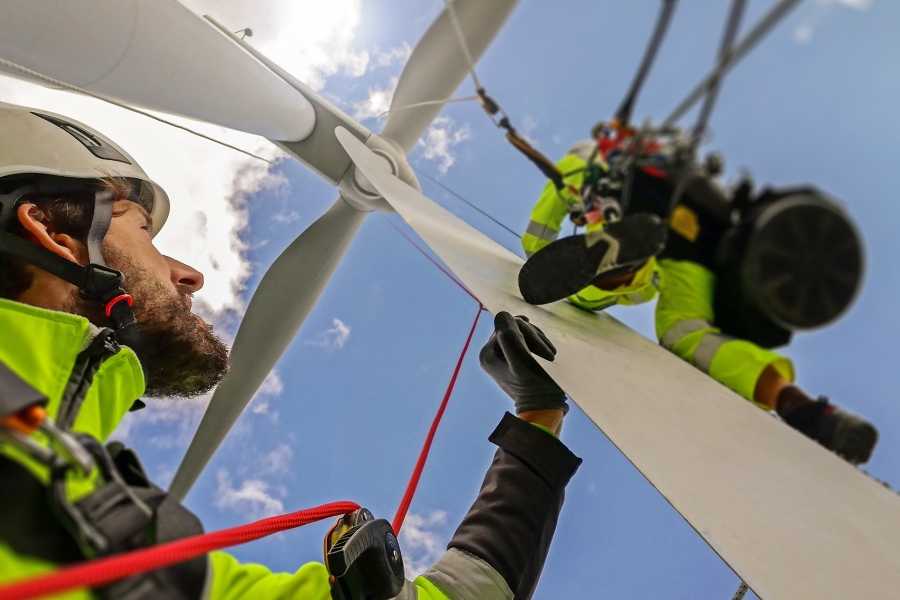
Many of us see the giant white turbines on a regular basis and may have some passing curiosity about them. Why are the blades so skinny compared to windmills of old? Why are they always white? Why are there three blades and not two or four or five?
The shape of the blades has to do with aerodynamics, which is also a part of why the vast majority of them are made with three blades. A video from MinutePhysics explains that there are three big reasons for the number of blades: physics (including aerodynamics), engineering, and human comfort.
Physics
Primarily, it’s all about torque (twisting force) vs. drag (resistance).
“All else being equal, the more blades a windmill has, the more torque it can generate,” the video states. “But also, the more drag it has, because each additional blade has to cut through the wind, and drag grows quickly the faster the windmill is spinning. So, in general, many bladed windmills work better at lower rotational speeds relative to wind speed. On the other hand, a windmill with fewer blades generates less torque, but also experiences less drag. So, fewer-bladed windmills tend to work better at higher rotational speeds.”
In looking at a graph of torque and drag on turbines with different numbers of blades, three blades are shown to be the most efficient overall.
“Windmills have to be strong enough to withstand the many different bending, rotational, and vibrational forces necessary for their operation,” the video explains. Even numbers of blades have proven to be a problem in that way, creating more balance problems. “If the rotor has an odd number of blades, like three or five, the fact that blades don’t come in pairs means that wind loads are more evenly distributed across the face of the rotor and so the bending and twisting forces are greatly reduced.”
And then there’s wear and tear. “More blades cause less wear and tear, but more blades cost more money,” the video states. “If you took the blades from two five-blade turbines, you’d have enough to make three three-blade turbines plus one left over.” That makes three blades the best engineering choice.
Physics and engineering make sense, but how does human comfort come into play with the three-blade design? “If you want to build a windmill, you need people to be okay with you building a windmill, so how it looks and how it sounds matters,” the video points out. Fewer blades mean less visual clutter, favoring a two- or three-blade design.
“Three-blade rotors are generally considered more visually pleasing than a two-blade equivalent,” the video asserts. “One possible reason for this is that the space taken up by a three-blade rotor in the horizontal and vertical directions changes only slightly over time, whereas a two-blade rotor switches back and forth and back and forth between mostly horizontal and mostly vertical and generally looks more choppy. Even at rest, people prefer the symmetry of three blades over two.”
As far as sound goes, three-blade turbines are more efficient at slower speeds, meaning they are less noisy than two-blade turbines producing the same amount of power.
So there you have it.
What about the white color, you ask? For one, it’s a neutral color (or one that most people don’t find obtrusive). White is easily visible from the sky, making it helpful for aircraft to see while flying. White also reflects the sun’s light and heat, which helps keep the turbine cooler and more durable. (However, some research indicates that painting turbines a different color might help reduce insect and bird mortality.)
For now, the big white windmills aren’t going anywhere, so we might as well know more about why they look the way they do.