upworthy
Add Upworthy to your Google News feed.
Google News Button
Identity

10 commonly used phrases that have racist origins

All language has a history.

10 commonly used phrases that have racist origins


As much as we'd like to pretend every phrase we utter is a lone star suspended in the space of our own genius, all language has a history. Unfortunately, given humanity's aptitude for treating each other like shit, etymology is fraught with reminders of our very racist world.

Since I have faith that most of you reading want to navigate the world with intelligence and empathy, I figured it'd be useful to share some of the everyday phrases rooted in racist etymology.

Knowledge is power, and the way we use and contextualize our words can make a huge difference in the atmospheres we create.


1. Thug


According to Meriam-Webster's dictionary definition, a thug is "a violent criminal." Obviously, this definition leaves the word open to define people of all ethnicities.

However, given the frequent ways this word has been used to describe Black Lives Matter protesters, the 17-year-old murder victim Trayvon Martin, and sadly, almost every black victim of police brutality — there is an undeniable racial charge to the word.

When you consider the people who are called thugs — groups of black protesters, victims of racist violence, teenagers minding their own business, and flip the racial element, you'd be hard-pressed to find examples of white people being called thugs in earnest by the media (or really by anyone).

Several prominent activists and black writers have written about the phenomenon of thug replacing the n-word in modern culture. In a popular press conference back in 2014, the Seattle Seahawks player Richard Sherman explained his feelings about the word.

"The reason it bothers me is because it seems like it's an accepted way of calling somebody the N-word now. It's like everybody else said the N-word and then they say 'thug' and that's fine. It kind of takes me aback and it's kind of disappointing because they know," Sherman said.

If you're talking about an actual criminal, there are so many descriptive words to invoke besides "thug." Given its current use as a negative, racially-coded word, avoiding its use seems like an easy and obvious move.

2. Grandfather Clause


When most of us hear the term "grandfather clause" we just think of the generalized description: a person or entity that is allowed to continue operating over now expired rules. But the literal meaning reveals the "grandfather clause" was a racist post-Reconstruction political strategy.

This is the historical definition, according to Encyclopedia Britannica:

"Grandfather clause, statutory or constitutional device enacted by seven Southern states between 1895 and 1910 to deny suffrage to African Americans. It provided that those who had enjoyed the right to vote prior to 1866 or 1867, or their lineal descendants, would be exempt from educational, property, or tax requirements for voting. Because the former slaves had not been granted the franchise until the adoption of the Fifteenth Amendment in 1870, those clauses worked effectively to exclude black people from the vote but assured the franchise to many impoverished and illiterate whites."

In modern speak, this basically meant the Grandfather Clause let white people off the hook for new voting requirements because their ancestors were already registered voters. Meanwhile, black people were required to fill out impossible literacy tests and pay exorbitant poll taxes to vote. This in turn, meant many black people were unable to vote, while white people weren't held to the same standard.

3. Gypsy or "Gyp"


The word "Gypsy" was (and is) a racial slur referring to the Roma people. The Roma people are descendants of Northern India who, due to severe marginalization and threats of violence by others, lived a nomadic lifestyle of forced migration for centuries.

During a fraught history, Roma people were taken as slaves in Romania and were targeted for genocide by the Nazis.

The word "Gypsy" is a slang word perpetuating stereotypes of Roma people as "thieves, rowdies, dirty, immoral, con-men, asocials, and work-shy" according to the Council of Europe.

In a similar vein, the term "Gyp" or "getting gypped" means to cheat or get conned, and many connect this meaning as another racist extension of Gypsy.

4. No Can Do

According to the Oxford Dictionary, the very common phrase "no can do" was originally made popular as a way to make fun of Chinese immigrants.

"The widespread use of the phrase in English today has obscured its origin: what might seem like folksy, abbreviated version of I can’t do it is actually an imitation of Chinese Pidgin English. The phrase dates from the mid-19th to early-20th centuries, an era when Western attitudes towards the Chinese were markedly racist."

5. Sold Down The River

Upon first hearing, many people associate the phrase "sold down the river" with the notion of being betrayed, lied to, or otherwise screwed over. While these definitions all technically apply to the origin, the root of this phrase is much more bleak.

According to a report from NPR, being "sold down the river" was a literal reference to slavery, and the families that were torn apart in the south.

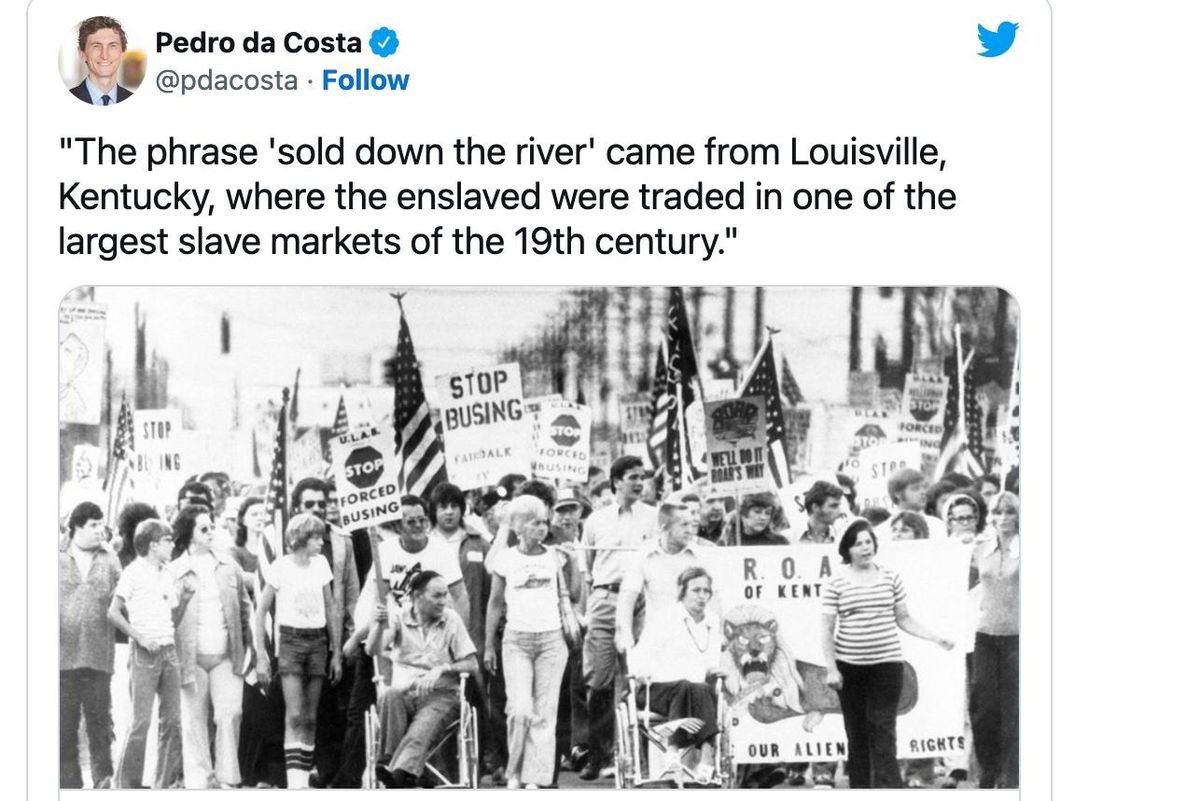
"River" was a literal reference to the Mississippi or Ohio rivers. For much of the first half of the 19th century, Louisville, Ky., was one of the largest slave-trading marketplaces in the country. Slaves would be taken to Louisville to be "sold down the river" and transported to the cotton plantations in states further south.

This heavy connotation sadly makes sense, but also makes casual use of the phrase feel way more cringe-inducing.

6. Welfare Queen

The term "welfare queen" was first popularized by Ronald Reagan's 1976 presidential campaign in which he repeatedly painted a picture of a Cadillac-driving welfare queen.

This straw woman in Reagan's campaign served as a racially-charged exaggeration of one minor case of real welfare fraud used to pedal his platform for welfare reform.

Needless to say, the term has sadly lived on as a racially-charged vehicle used to undermine the importance of welfare programs, while peddling gross stereotypes about black women.

On top of all the other offenses, this stereotype is of course ignoring the fact that poor white Americans receive the most welfare out of any economically-disadvantaged demographic.

7. Shuck And Jive

The term shuck and jive is both common and very obviously rooted in the language of slavery.

According to the Online Etymology Dictionary, the phrase shuck and jive refers to:

"The fact that black slaves sang and shouted gleefully during corn-shucking season, and this behavior, along with lying and teasing, became a part of the protective and evasive behavior normally adopted towards white people in ' traditional' race relations."

Likewise, the modern usage of this phrase refers to pandering, selling out, or instances in which black people go along with racist white people's wishes. Again, not a phrase to be thrown around lightly.

8. Long Time No See

The very commonly used greeting "long time no see" first became popular as a way to make fun of Native Americans. The phrase was used as a way to mock a traditional greeting exchanged between Native Americans.

This is the official definition, according to the Oxford Dictionary:

"Long Time No See was originally meant as a humorous interpretation of a Native American greeting, used after a prolonged separation. The current earliest citation recorded in the Oxford English Dictionary (OED) comes from W.F. Drannan’s book Thirty-one Years on Plains (1901): ‘When we rode up to him [sc. an American Indian] he said: ‘Good mornin. Long time no see you’."

The act of committing genocide is not limited to human lives, but also translates to a normalized cultural violence. Deconstructing, mocking, and erasing someone's language contributes to this pattern of colonialism.

9. The Peanut Gallery

Most modern uses of the term "the peanut gallery" is in reference to a group of people who needlessly criticize or mocking another person. However, the historical roots of this term are much more racist and painful.

Originally, this term referred to the balconies in segregated theaters where black people were forced to sit. The nickname "peanut" was given due to the fact that peanuts were introduced to America at the same time as the slave trade. Because of this, there was a connection drawn between black people and peanuts.

10. Uppity

As of now, the word "uppity" is often used as a synonym for "stuck up" or "pretentious" or "conceited." But the roots of the word are far more specific and racist.

The word Uppity was first used by Southerners to refer to slaves who did not fall into line, or acted as if they "didn't know their place."

So, basically, any black person who overtly stood up to racism. Given the heaviness of this origin, it seems best to leave this word at home when looking to describe a pretentious acquaintance.

Sadly, given our ugly history, there are many more words and phrases I could add to this list. In the meantime, hopefully this list is helpful for navigating the racism innate in our language.


The article was originally published by our partners at someecards and was written by Bronwyn Isacc. It originally appeared on 02.04.19

Pop Culture

All In: 5 Ways This Week

From the silly to the sentimental, there are so many ways people like to go “all in” on something. Here are our five favorite examples we found this week across the internet.

5 ways people are going "All In" this week
True

When you hear the words “all in,” what do you think? You might picture a Dancing with the Stars trend gone viral or maybe bridesmaids who fully supportive of the bride's favorite movie (and recreates an iconic scene). Whatever you picture, the idea is the same: Someone who does something with 100 percent total commitment. Going “all in” means giving your all—going completely over the top, no second guessing, no holding back. Just full-throttle enthusiasm, with some flair and creativity thrown in. And when people go “all in,” something truly special usually happens as a result.


The internet abounds with examples of people giving it their all—whatever it is. In this roundup, we’ve found the very best examples of people going “all in”—moments where passion, creativity, and commitment take center stage. Some are sentimental, some are silly, but all of them are a reminder that giving 100 percent is truly the only way to leave a mark on this world. Get ready: These folks didn’t just show up, they went all in.


1. An Iconic "snow-coaster"

One thing about going all in - it can be crazy and childish at times. That’s something that makes going all in special, connecting with that side of you that takes things less seriously in order to have some fun. Shira Goldstone and her husband took to that mindset when it started snowing in their backyard. Shira’s husband picked up planks of wood (and whatever other tools are required) and within the same night, in the falling snow, built a “snow-coaster” for the two of them to play on.

2. A Truck That's Feeding It's Community

You already know our friends at All In—they’ve got some seriously tasty snacks that are not only healthy and affordable (scroll to the bottom of this article to see how you can snag a free bar), they help fund food banks, gardens, community fridges, meal programs, and other amazing things

For Giving Tuesday, All In teamed up with Fresh Truck, a weekly mobile market that brings fresh and affordable produce to neighborhoods in the Boston area. Fresh truck hosts weekly markets, pop-up events, and an online storefront, all to help strengthen communities who need it the most. They’re going all in on local nutrition and food access, and we’re here for it.


3. All In on Madam Morrible

I’m always all in on a good TikTok trend. This week, I’m going to share with you a classic that has come out of the Wicked franchise and the incredible actress Michelle Yeoh.

Michelle, who plays Madame Morrible in the Wicked movies, is an outstanding actress. She’s known for iconic films like Everything, Everywhere, All At Once, as well as Crazy Rich Asians and Star Trek. But her legacy might be this one quote, which she’s said in interviews countless times, and now people can’t stop making videos with the phrase “Madame Morrible, M.M…flip it around, W.W. Wicked Witch!”

You might have to take a look at how people are going all in yourself, the sound has taken off with already 14.3K videos, and the variations are unstoppable...defying all odds and maybe even...defying gravity?

4. Spotify Wrapped: All in on "Coconut Mall"

TikTok · Ale

www.tiktok.com

There’s nothing better than finding a song that hits just right and gets you feeling productive. For some people, it’s lofi beats. For others, it’s orchestra music. For TikTok user @aleinmotion, it was the “coconut mall” song from the Mario Kart racing soundtrack. Ale never realized how much she listened to the song until it became #1 on her Spotify Wrapped. Sometimes you’ll be surprised by what you love most, and I’m thinking this is one of those moments for Ale.

5. A Family Prank Everyone Enjoys

This girl said her boyfriend had an ugly hat, so her family decided to go all in on supporting him instead. This is when love and humor come together, a perfect prank that actually made the boyfriends day…and taught his girlfriend that nothing is really that serious! They even got the daughter her very own hat as well, and she looked happy to wear it!

As someone who grew up with a dad who always wore floppy hats to protect him from the sun, I understand the embarrassment. Maybe it’s time I go all in and show my support with a matching hat and white long sleeve sun shirt!

Snag your free (!!) snack bar here while this deal lasts. Simply sign up with your phone number, pick up your favorite flavor of an All In bar at Sprouts, and then text a picture of your receipt through Aisle. They’ll Venmo or PayPal you back for the cost of one bar. Enjoy!

batteries, energy, sustainability, power, breakthroughs

UCI doctoral candidate Mya Le Thai has developed a nanowire-based technology that allows lithium-ion batteries to be recharged hundreds of thousands of times.

A quote widely attributed to the Roman philosopher Seneca says, "Luck happens when preparation meets opportunity." In 2016, a doctoral candidate at the University of California Irvine proved that this is indeed the truth.

Nine years ago, Mya Le Thai, PhD was playing around in the lab when she made a colossal discovery that could lead to a rechargeable battery—that could last up to 400 years. That means longer-lasting appliances, laptops, smartphones, cars and so much more, plus fewer lithium ion batteries piling up in landfills.


A team of researchers at UCI had been experimenting with nanowires for potential use in batteries, but found that, over time, the thin fragile wires would break down and crack after too many charging cycles. A charge cycle is when a battery goes from completely full to completely empty and back to full again.

charging station, battery, charging battery, charge, batteries Phone charging.Canva Photos.

But one day on a whim, Thai coated a set of gold nanowires in manganese dioxide and a Plexiglas-like electrolyte gel.

"She started to cycle these gel capacitors, and that's when we got the surprise," said Reginald Penner, chair of the university's chemistry department. "She said, 'this thing has been cycling 10,000 cycles and it's still going.' She came back a few days later and said 'it's been cycling for 30,000 cycles.' That kept going on for a month."

This discovery is mind-blowing because the average laptop battery lasts 300 to 500 charge cycles. The nanobattery developed at UCI made it though 200,000 cycles in three months. That would extend the life of the average laptop battery by about 400 years. The rest of the device would have probably gone kaput decades before the battery, but the implications for a battery that lasts hundreds of years are pretty startling.

- YouTube www.youtube.com

“Mya was playing around, and she coated this whole thing with a very thin gel layer and started to cycle it,” Penner added. “She discovered that just by using this gel, she could cycle it hundreds of thousands of times without losing any capacity.”

“That was crazy,” he added, “because these things typically die in dramatic fashion after 5,000 or 6,000 or 7,000 cycles at most. ”"The big picture is that there may be a very simple way to stabilize nanowires of the type that we studied. If this turns out to be generally true, it would be a great advance for the community."

Not bad for just fooling around in the laboratory!

science, discovery, lab, batteries, Bill Nye, gif bill nye chemistry GIF by NETFLIX Giphy

Since her discovery, Mya Le Thai earned her PhD and has gone on to a successful career as the Principal Scientist with the Enevate Corporation, a company set "to develop innovative battery technologies that accelerate adoption of electrified mobility," according to their website.

She has also filed patents for her various inventions, the most recent of which being "Cells with blocking devices for delayed heat propagation" in July 2025. Her full list of patents can be found on Justia.

This article originally appeared eight years ago. It has been updated.

social awkwardness, resilience, talent, evolution, growth

If you're socially awkward, you may be more resilient than others think.

Many people experience social awkwardness from time to time, but for some, it happens much more often.

They accidentally say the wrong thing, miss social cues, or are simply overly shy at parties, in meetings, or around people in general. It can make you wonder how social awkwardness still exists as a trait in humans, given that we’ve evolved into such a highly social species—starting with small tribes built for survival and eventually growing into the thriving societies we have today.


Well, one psychologist has a theory about how socially awkward people not only survived evolution but actually thrived.

"There’s this curious and strong correlation between social awkwardness and what researchers call 'extraordinary achievement' or 'striking talent,'" said psychologist Ty Tashiro on the A Bit of Optimism podcast. "People who achieve amazing things in this world, things that are kind of the tail end of the bell curve, they're actually more likely to be more awkward."

@simonsinek

What if being socially awkward is actually a superpower? Ty Tashiro, an incredible psychologist and author, joined me on A Bit of Optimism this week for a deep dive on why awkward is awesome. It's an episode filled with laughs, 'aha' moments, and maybe a bit of self-recognition. 🤓 Check it out wherever you listen to podcasts and find out why your next awkward moment could be the start of something amazing.

Tashiro explained that socially awkward individuals often have an "obsessive interest in things," zeroing in on details and minutiae, sometimes at the cost of engaging with others or following social norms. However, he argues that this obsessiveness can translate into persistence during hard times and resilience in the face of challenges, ultimately helping them achieve great things.

This could explain why many people perceive brilliant scientists as smart but poor communicators, and why so many highly successful people who are often considered geniuses or leaders in their fields are also introverts.

"Socially awkward individuals often spend a lot of time alone," therapist Lesley Lesker told Upworthy. "This provides the opportunity for them to process information thoroughly, look at all different angles and analyze situations in a more depth manner than non-socially awkward individuals."

- YouTube youtu.be

Support systems are necessary for success

But can being socially awkward or neurodivergent really lead to greater resilience in the face of struggles and more persistence when confronting challenges? The experts who spoke to Upworthy believe it's possible, especially when socially awkward individuals have a strong support system around them.

"Resilience is built when we go through difficult situations and come out on the other side, realizing that we are okay," said Lesker. "For socially awkward people, these challenging situations often happen several times a day, every day of the week. The difference between someone who is able to build resilience and someone who is not often comes down to whether or not they live within a supportive environment."

"The key factor in whether these 'super powers' lead to resilience really depends on support systems—family, education, social, and psychological support make all the difference," said therapist Karissa Provost.

"Social awkwardness is a blessing and a curse. The reason that many people are socially awkward is because their brain is so unique and sees the world in such different ways that they naturally don't conform to social norms," said Tyana Tavakol, a licensed trauma therapist in California and Florida, and virtual private practice owner of Uncovering You. "This uniqueness can build resilience when their awkwardness is more consistently than not taken as quirky, funny, or some other type of endearing way. This can happen when they grew up in a very attuned and accepting home or family, or happened to find friends or community that also have their own unique brains and can really appreciate that in others."

"For those who struggle to build resilience, it is likely they experienced the exact opposite: being bullied, shamed, criticized, or going through other types of negative responses to their social awkwardness more often than they got support for it," Tavakol added.

"There's also a biological component," said Provost. "Resilience is linked to brain structure, particularly how the frontal cortex regulates emotional responses from the amygdala. People with better-regulated fear responses recover more quickly from social stress, and the good news is this can be developed through coping skills and emotional regulation strategies over time."

What if social awkwardness still hurts?

Lesker told Upworthy that social awkwardness can still feel emotionally overwhelming, and that breathing techniques, grounding exercises, and other strategies can help regulate that stress. She also recommends that socially awkward people "create scripts" for common social situations to rely on in order to make them more comfortable and confident. This can include small talk like, "Hi, how was your day?" or "How do you know the host?"

Overall, self-compassion is the key to working through socially awkward feelings and building resilience.

@kolourmemisfit_24

Be my friend 🥹 #sociallyawkward #awkward #awkwardmoments #momsoftiktok #momfriends #locs #girlswithtattoos

"Developing self compassion can help a socially awkward person to build resilience," Lesker concluded. "It is common for a socially awkward individual to blame themselves excessively, but when you speak to yourself compassionately in the same way that you would speak to a friend, resilience will grow."

snl, christmas, holidays, satire, comedy, kristen wiig, saturday night live, humor, youtube, christmas presents, moms
SNL/YouTube

Classic SNL Christmas sketch has people rethinking the holiday dynamics in their family.

Five years ago, one of the most iconic Christmas sketches ever aired on Saturday Night Live. It's called simply, "Christmas Robe," and it depicts an average American family excitedly waking up on Christmas morning, running to the tree, and opening their presents. In song form, each member of the family takes turns rapping about their own gift haul: A hat, a drone, a pinball machine...

Except for poor mom, played perfectly by Kristen Wiig, who only got a robe—that was 40% off. Things only get worse for Mom as she discovers that her stocking is also empty and she must now go make the family breakfast while everyone plays with their new gifts.


If you haven't seen it, here it is. It's well worth watching in its entirety:


- YouTube www.youtube.com

The sketch got a lot of laughs and resonated deeply with people—especially moms—who watched it.

It's no big secret that moms are the primary makers of Christmas magic in most Western families. While they get joy out of making the holidays special for their families, it's a lot of exhausting work, made worse when it goes unnoticed and unappreciated. It's implied, of course, that Kristen Wiig's character bought everyone their presents while no one in the family bothered to think of her at all.

Jessica Cushman Johnston writes for Motherly: "[Making Christmas magic] is not something my husband or my kids put on me, it’s my own deal. It’s also a tinsel-covered baton handed down from generation to generation of women. As a kid, I just thought the warm fuzzy feelings I felt on Christmas morning 'happened.' Now I know that the magic happens because someone is working hard, and now that someone is me."

Kristin Wiig's character beautifully says it all with the dead-inside expression as she feigns excitement over her lonely robe. In just two and a half minutes, the cast and writers managed to capture a frustrating feeling that millions of women relate to.

The sketch spawned discussions, think pieces, and even parodies when it aired in 2020. Real moms took to social media to "show off" their own robes in an act of solidarity. The sketch had, one could say, a moment. And then, quietly, it retired and took its place in the SNL holiday hall of fame, destined to be re-watched for years to come.

And then something funny happened. People kept tuning in. The skit continued to reach new viewers, and somewhere along the line, a few people actually learned something from the extremely silly sketch.

Saturday Night Live's YouTube and social media are full of comments from viewers who say the sketch opened their eyes in a very real way. And even better, that they're changing their behavior because of it:

"As a retail worker, I actually heard multiple people reference this sketch while buying presents for their wife/mom this year. Thanks SNL!"

"This skit changed Christmas in our house. The year it aired my husband made sure I didn’t get a robe and since this aired (okay, two Christmases have gone by) it’s a joy to see boxes under the tree and a full stocking- now in our house when I’m forgotten my husband says, “you got a robe” and adjusts the situation. Never thought a skit could change my life."

"I just saw this first time. I'm definitely going to buy better present next Christmas to my mom."

"A few years ago, I got a robe. This year, I got a new iPad plus all the accessories. SNL doing all the moms a solid."

"As a grown man, this skit is the first time I've realized how true this is. And now I feel so damn awful :( Gonna bombard moms with the presents this year"

"Seriously! I got a bunch more stuff for my mom after seeing this! It's so accurate. No more robes for mom!"

"I was laughing at this, then realized my mom's stocking was empty and ran out and bought her a truckload of stuff. Love you Mom!"

"Thanks, SNL. After watching this with the family, I had the most bountiful Christmas ever!! And the gifts were wrapped instead of left in the bags the came in."

"This video did more to stimulate spending on Moms this year than almost anything else, guaranteed. Look at SNL actually making a difference with their humor"

The comments go on and on, with the video now reaching over 12 million views. Some moms changed their behavior, too, after seeing the sketch:

"This is spot on, and exactly why I now buy myself Christmas presents, without feeling guilty about it."

The trouble of moms unfairly shouldering too much labor around the holidays (and, well, most other times of the year) is not a new problem. Not by a long shot. So why has this skit reached people when other forms of messaging has failed to sway them?

Marie Nicola, a pop culture historian and cultural analyst, says that no amount of deeply serious essays or shrugged off "mom is complaining again" can fix what satire easily addresses. That's the power of comedy at its best:

"It allows the audience see what was historically unseen or ignored, and it validates the labour as visible and concrete, without being accusatory because it wraps the whole thing up in camp comedy and exaggeration. The skit makes it safe to laugh. This is what psychologists call benign violation," she says. "SNL is showing viewers that something is wrong but they have made it safe enough that people can laugh at it instead of feeling attacked. Once the defenses drop, then recognition can flow through that opening."

The Humor Research Lab writes that humor occurs when an accepted "norm" is violated in a benign way—that's the benign violation Nicola's referring to. "Jokes ... fail to be funny when either they are too tame or too risqué."

The best pieces of satire—the ones that reach the highest levels of cultural relevance—thread that needle perfectly. The norm, in this case, according to Nicola, is that it is "a privilege to curate the perfect holiday experience for the family, the gift is the joy in the moment and their memories for years to come." We're not allowed to talk about the dejection and exhaustion that come from all that hard work. This sketch gave a lot of people permission for the first time to do so.

It’s not the first time that SNL’s comedy and satire have had a palpable effect on how we view the world.


- YouTube www.youtube.com

Once SNL performed the "More Cowbell" sketch, none of us could look at the bizarrely overproduced "Don't Fear the Reaper" the same way again. An old Eddie Murphy sketch got a lot of laughs out of the idea of "white privilege" long before it became a commonly known concept. And people had a hard time taking Sarah Palin seriously after Tina Fey's spot-on yet over-the-top impersonation, with studies later investigating the "Tina Fey Effect's" impact on the election.

And now, the more than 12 million people who have seen "Christmas Robe" are going to have a hard time looking at Mom’s empty stocking without being reminded of Kristen Wiig’s pitch-perfect performance.

Of course, "Christmas Robe" continues to land and connect with viewers today in part because it has not solved the problem of household inequities. The phenomenon continues to exist in spades. But the fact that it’s made even a small dent is pretty remarkable for a two-and-a-half-minute parody rap song.

france, germany, netherlands, english, european people, eu

A French woman, German man, and Dutch woman.

Even though the United Kingdom isn’t in the European Union, English is the lingua franca throughout the region because it's the standard language for international commerce. A lingua franca is a common language that two people who don’t speak the same language use to communicate. When one person speaks French and the other German, they can use English to communicate.

There are 27 countries in the European Union and 24 native tongues, but a whopping 43% of the nearly 450 million people who live there speak English, and German is a far second with 16% of people in the EU fluent in the language.


According to the EF English Proficiency Index, if you travelled to Europe and wanted to go somewhere where people are best at speaking English,, the best country is the Netherlands. Croatia and Austria finish 2nd and 3rd, respectively.

dutch woman, netherlands, dutch people, dutch street, happy woman A happy woman in the Netherlands.via Canva/Photos

The top 10 countries in English proficiency as a second language are all in Europe:

1. Netherlands

2. Croatia

3. Austria

4. Germany

5. Norway

6. Portugal

7. Denmark

8. Sweden

9. Belgium

10. Slovakia

Ranking countries in English proficiency isn’t just about finding places where Americans, British people, or Australians can go on vacation; it has to do with the number of opportunities that people, especially those who are economically disadvantaged, can have.


“Working adults who speak English in addition to their other languages have access to a wider range of information and more diverse professional opportunities. For individuals in marginalized groups or geographically disadvantaged locations, a professional level of English may represent a pathway to financial independence they could not otherwise attain,” the EF English Proficiency Index writes in their 2025 report.

Having a large number of English speakers also bodes well for a country’s economic development. “English proficiency reflects a workforce's capacity to engage with the global economy beyond national boundaries. In economies transitioning toward knowledge-based sectors, comfort with English often signals adaptability to international standards and practices,” the report continues.

- YouTube youtu.be

Why do the Dutch speak English so well?

This study raises an important question: Why are the Dutch so good at speaking English? The first reason is that in the Netherlands, television shows aren’t dubbed. So, if you are watching an episode of Happy Days, you hear it in the original English, but it is subtitled in Dutch. In countries such as Germany, Spain, or France, TV shows are dubbed into the local language, so viewers hear less English.

Second, the Dutch economy is predicated on international trade. It’s a small country with just 17 million inhabitants; however, it has the 18th-largest economy in the world. This means that people in the Netherlands have to be great at speaking the international language of business if they are going to get by. The Dutch tradition of international business dates back to 1602, when the Dutch East India Company became the world's first multinational corporation.

Their culture's openness to hearing other languages and dependence on global trade have made it so that up to 93% of Dutch people can carry on a conversation in English.

Ultimately, the EU’s embrace of English isn’t just historical happenstance—it’s closely tied to the region's growing economic, social, and cultural interconnectedness. For many, speaking English is a gateway to opportunity and participation in the global economy. The Netherlands is an excellent example of how learning a second language can lead to incredible prosperity.

farts, fart research, farting all the time, flatulence, gas causing foods, science, study, research

What's bad for the nose is good for the brain.

Everybody farts. Upwards of 23 times a day, in fact. It’s one of the most universal human experiences, cutting (the cheese) across age, culture, and personality. Yet for something so common, it somehow feels very different coming from a woman than it does from a man.

But according to research highlighted in a now-legendary study, there indeed is a difference between man farts and lady farts. This unexpected fact about the battle of the sexes carries an even more unexpected health benefit.


Yes, this is a story about farts. But stay with us.

The doctor who wanted to know what makes flatulence smell

farts, fart research, farting all the time, flatulence, gas causing foods, science, study, research Thumbs up media3.giphy.com

Back in 1998, Dr. Michael Levitt, a gastroenterologist known among colleagues as the “King of Farts,” set out to understand where that unmistakable scent of human flatulence comes from. To answer the question, he recruited 16 healthy adults with no gastrointestinal issues. Each participant wore a “flatus collection system,” described as a rectal tube connected to a bag.

After eating pinto beans and taking a laxative, the volunteers provided samples that were then analyzed using gas chromatographic mass spectroscopic techniques. Levitt and his team broke down the chemical components inside each bag and invited two judges to help evaluate the results. The judges did not know they were sniffing human gas (which in retrospect sounds diabolical). They rated each sample on an odor scale from zero to eight, with eight meaning “very offensive.”

Their assessments pointed clearly to one culprit. Sulfur-containing compounds were responsible for the strongest and most memorable odors, especially hydrogen sulfide, which produces that classic “rotten egg” smell.

So where does the gender difference come in?

Here is the twist researchers did not expect: although men tended to produce larger volumes of gas, women’s flatulence contained a “significantly higher concentration” of egg smelling hydrogen sulfide. When the judges rated the odor of each sample, they consistently marked women’s gas as having a “greater odor intensity” than men’s.

farts, fart research, farting all the time, flatulence, gas causing foods, science, study, research Woman in chair. media0.giphy.com

The unexpected health connection

Hydrogen sulfide may smell intense and unpleasant, but inside the body, at low levels, it plays a key role in helping brain cells communicate. It works by chemically adjusting proteins through a process called sulfhydration. This process tends to decline as people age, and it declines even more sharply in patients with Alzheimer’s disease.

That singular fact sparked a new wave of research.

In 2021, scientists at Johns Hopkins Medicine conducted experiments on mice genetically engineered to mimic human Alzheimer’s. The mice received injections of a hydrogen sulfide carrying compound called NaGYY for 12 weeks. The results were remarkable. Behavioral tests revealed that treated mice saw a 50 percent improvement in cognitive and motor function compared with untreated mice.

In conclusion: women's farts are worse for the nose, but better for the brain.

A reframing of an everyday experience

The science suggests that the very compound behind a silent but deadly toot may also be a quiet guardian of brain health. Something that has historically been a source of embarrassment, especially for women, might actually reflect a built in biological benefit.

Sometimes the world offers good news in the most unexpected places.