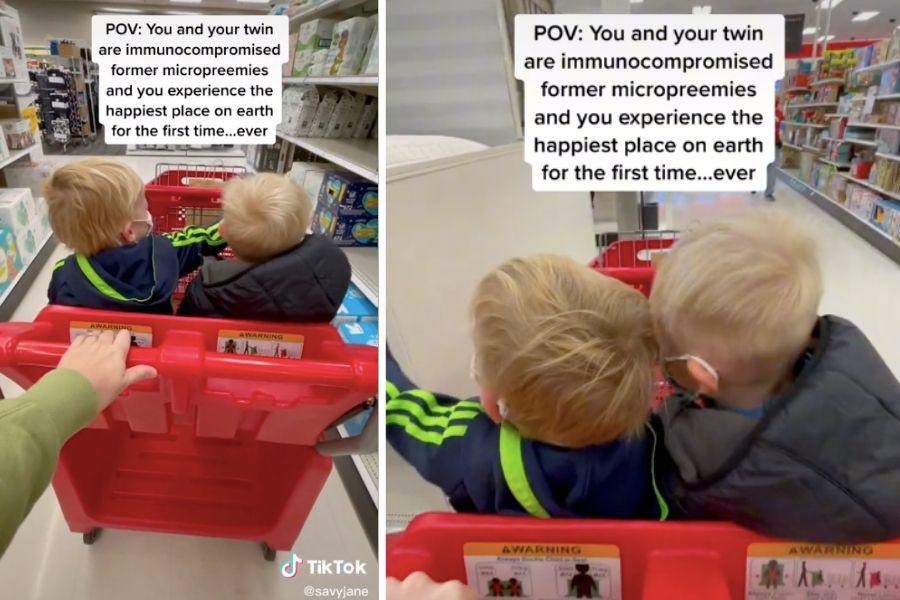
These toddler twins giggling through their first trip to Target is pure bliss
If I thought I was alone in this opinion, I might be a little embarrassed. But countless conversations with other moms in my two decades of parenting tell me I’m not. Target is magical. It just is. Target is like the Disneyland of big box stores. The Happiest Retail Store on Earth. It’s not that…
If I thought I was alone in this opinion, I might be a little embarrassed. But countless conversations with other moms in my two decades of parenting tell me I’m not.
Target is magical. It just is. Target is like the Disneyland of big box stores. The Happiest Retail Store on Earth.
It’s not that the stuff it sells is remarkably better than any other retail outlet. It’s not that the prices are amazing or that the store feels particularly luxurious. It’s just … satisfying. Especially when you’re a parent constantly trying to keep your house organized while children follow you around undoing everything you’ve done.
Target has everything you need, more than enough of it and has it all perfectly displayed in neat rows. That’s true of a lot of stores, of course, but Target somehow does it better. Maybe it’s the lighting? Maybe it’s how forward-thinking the company is? Who knows. All I know is that a trip to Target alone is a legitimate form of self-care.
To illustrate, check out these toddler twins on their first trip to Target. They are all of us, squealing with delight at the magic that is Target.
Those Gremlin-like giggles of unbridled joy? That’s what I hear on the inside when I walk through the aisles of Target. Every time.
TikTok user @savyjane shared the video, calling the boys Thing 1 and Thing 2 (a shout out to Dr. Seuss) and writing, “POV: You and your twin are immunocompromised former micropreemies and you experience the happiest place on earth for the first time…ever.”
The commenters loved it. Target even responded, saying, “My Target heart just grew three sizes.” Awww.
“If this isn’t the next Target commercial, I don’t want it…this is pure joy,” wrote one commenter.
“This is how I feel whenever I go to Target too,” wrote another. (See? Not just me.)
And another: “Girl, this is how Target makes ME feel, too.” (Seriously, it’s a thing.)
“Me at Target every single time. Too precious.” (Yup.)
Some of the comments pointed to the fact that the boys were immunocompromised, urging people to take COVID mitigation measures.
“I wear my mask for sweet babies like them,” wrote one person.
“THIS is who we get vaccinated for,” wrote another. “So happy they’re getting to experience new things!”
The pandemic has been hard on all of us, but for parents of kids who are at higher risk and who haven’t been able to get vaccinated, it’s been particularly stressful. Most kids fare okay if they get COVID-19, but there are lots of children with health conditions that make the virus something to avoid at all costs.
Imagining these sweet babies ill is just too much. Not when there’s this much joy to be had with them and from them.
Can you picture these two at actual Disneyland? They’re giddy over the diaper shelves at Target, for goodness sake. Please, @savyjane, pleeeeeaase take these cherubs to an amusement park and mic them up so we can live vicariously through their delight. Do it for the good of humanity. Our weary world needs this ASAP.
A single door can open up a world of endless possibilities. For homeowners, the front door of their house is a gateway to financial stability, job security, and better health. Yet for many, that door remains closed. Due to the rising costs of housing, 1 in 3 people around the world wake up without the security of safe, affordable housing.
Since 1976, Habitat for Humanity has made it their mission to unlock and open the door to opportunity for families everywhere, and their efforts have paid off in a big way. Through their work over the past 50 years, more than 65 million people have gained access to new or improved housing, and the movement continues to gain momentum. Since 2011 alone, Habitat for Humanity has expanded access to affordable housing by a hundredfold.
A world where everyone has access to a decent home is becoming a reality, but there’s still much to do. As they celebrate 50 years of building, Habitat for Humanity is inviting people of all backgrounds and talents to be part of what comes next through Let’s Open the Door, a global campaign that builds on this momentum and encourages people everywhere to help expand access to safe, affordable housing for those who need it most. Here’s how the foundation to a better world starts with housing, and how everyone can pitch in to make it happen.
Volunteers raise a wall for the framework of a new home during the first day of building at Habitat for Humanity’s 2025 Carter Work Project.
Globally, almost 3 billion people, including 1 in 6 U.S. families, struggle with high costs and other challenges related to housing. A crisis in itself, this also creates larger problems that affect families and communities in unexpected ways. People who lack affordable, stable housing are also more likely to experience financial hardship in other areas of their lives, since a larger share of their income often goes toward rent, utilities, and frequent moves. They are also more likely to experience health problems due to chronic stress or environmental factors, such as mold. Housing insecurity also goes hand-in-hand with unstable employment, since people may need to move further from their jobs or switch jobs altogether to offset the cost of housing.
Affordable homeownership creates a stable foundation for families to thrive, reducing stress and increasing the likelihood for good health and stable employment. Habitat for Humanity builds and repairs homes with individual families, but it also strengthens entire communities as well. The MicroBuild® Initiative, for example, strengthens communities by increasing access to loans for low-income families seeking to build or repair their homes. Habitat ReStore locations provide affordable appliances and building materials to local communities, in addition to creating job and volunteer opportunities that support neighborhood growth.
Marsha and her son pose for a photo while building their future home with Southern Crescent Habitat for Humanity in Georgia.
Everyone can play a part in the fight for housing equity and the pursuit of a better world. Over the past 50 years, Habitat for Humanity has become a leader in global housing thanks to an engaged network of volunteers—but you don’t need to be skilled with a hammer to make a meaningful impact. Building an equitable future means calling on a wide range of people and talents.
Here’s how you can get involved in the global housing movement:
Speaking up on social media about the growing housing crisis
Volunteering on a Habitat for Humanity build in your local community
Travel and build with Habitat in the U.S. or in one of 60+ countries where we work around the globe
Join the Let’s Open the Door movement and, when you donate, you can create your own personalized door
Every action, big and small, drives a global movement toward a better future. A safe home unlocks opportunity for families and communities alike, but it’s volunteers and other supporters, working together with a shared vision, who can open the door for everyone.
Chef Craig Bowerson had a wonderful idea. He had noticed that the residents in the nursing home where he oversaw the dining menu had quite a few complaints about the food. So, it dawned on him to let their own personal recipes do the talking. He asked them for their favorite homespun dishes, and what happened next was downright lovely.
In a TikTok video, food podcaster Owen Roy shared a clip of Bowerson explaining his program for getting recipes from the residents. He asked them questions like, “How did you make spaghetti? How did you make lasagna? How did you make your chicken Cordon Bleu?” There is clear emotion in his voice, as he expresses the importance of embracing and cooking the food that might make the residents feel the most at home.
Ultimate hospitality. Chef Craig Bowerson talks about how he personalized the menu at the nursing home he used to work at for the residents that lived there. He took their old recipes from their parents and built the food program around them. I think more nursing homes should follow suit! Episode 17 is out now on all major streaming platforms. #chef#nursinghome#food#menu#owenbytheoven
He shared, “As you’re pulling all these recipes from the 1920s, 1930s, I’ve had residents give me index cards that their mother had written like in the 1920s. They’d say, ‘These are all my mom’s recipes. Find one that you like. This is what my mom used to cook for me. I cooked this for family.’ So we ended up incorporating all of our resident recipes into our menu, where we were actually reproducing all the family recipes. And my complaints went from almost 75 percent to almost no complaints whatsoever.”
Under the clip, there were over 2,500 comments on TikTok alone. One person shares, “This is what dignity looks like.”
Another points out how incredibly thoughtful the idea is. “Can you imagine tasting your comfort food from childhood as an aging, reliant, invalid person? A time when you miss your mom the most. This is beautiful.”
And this TikToker, as many of the commenters do, believes this should be incorporated everywhere. “Every retirement home, nursing home, memory care home should do this. I bet it’s really comforting and brings back great memories for them. Beautiful idea.”
Chef Bowerson dreamt of becoming a chef
Upworthy had the opportunity to learn more about Bowerson, his love of food, and his admiration and respect for nursing home residents he serves. He also addressed a few of the questions that were repeatedly asked in the comment section.
Upworthy: What drew you to the art form of cooking?
Bowerson: “I have dreamed of being a chef since I was 6. My grandmother started cooking with me around then. Currently, I’ve worked in food service for 31 years, and would say maybe the last 14, I’d consider myself a chef.
Food has always made sense to me. I love food, I love to talk about food, think about food, and I love the emotions that food can create. When you’re sick, you want grandma’s soup, or during a holiday it doesn’t feel right without that one dish that gets passed on and passed down. Food, I think, has been the ultimate expression of appreciation for nature as the ingredient maker. And the eater, who is the person receiving from the chef, (gets) the full expression of themselves, presented in a dish.”
Upworthy: How and when did you begin working with nursing homes?
(Bowerson first explains it was trial and error when he first began working with nursing homes.)
Bowerson: “Covid hit and my focus shifted from having to deal with administrative duties to developing relationships with residents to help make the ‘lockdown’ period better. It was during this time that I started talking more one-on-one with residents and learning about their backgrounds. I found many of the women were homemakers and ran the house prior to coming to the nursing home. Many reminded me of my own grandmother, who initially was the first person to teach me how to cook.
Working for contract services, we had to follow menu plans and recipes that designated ingredient inventories and so on. Residents at my home felt like they were receiving someone’s idea of ‘showing off.’ They said the food they received was nothing like what they had made at home, and it was a hard adjustment for them to make. Long story short, I learned how to submit substitute recipes into our menu system to receive CDM and dietitian approval for facility use. Then, as we could, we would substitute previous menu items. Let’s say (we would sub) the company’s potato salad recipe, for Peggy Sue’s potato salad recipe and notate it on the menu.”
Sopapillas
Upworthy: Do you have a favorite recipe so far?
Bowerson: “One of my favorite recipes is only my favorite because of the story behind it. Sopapillas. I had a pair of residents who were from New Mexico and had been moved to Kansas. I used to have conversations about food with the wife. Her husband was not doing well at this point and was almost nonverbal. She used to tell me how much she missed sopapillas and green chili enchiladas. She gave me her favorite sopapilla recipe and said if I could make it for her sometime, she would enjoy that. At times her husband would wake up and could eat on occasion, so one day when I knew he was awake, I converted a food cart into a buffet line and made her enchiladas and her sopapillas. For the next few weeks, until his passing, he would wake up and request green chili and sopapillas.
A resident’s handwritten note, c/o Bowerson
I received a personal handwritten letter from her describing how much they enjoyed having their personally prepared upscale meal.”
Recipes and stories
Upworthy: Any plans to create a senior cookbook?
Bowerson: “I’ve had some people request one on social media. I have thought about collecting all the recipes, adding in copies of letters and notes I’ve received from residents, and stories on what made the recipe stand out to me. I hope I can follow through and put one together.”
Upworthy: My mom resides in a senior living home in Dallas, and I know she would just love giving recipes to the chef/cook. Have you encouraged others to do this?
Bowerson: “I have tried to champion this type of approach for some time. I actually designed a food service program that helps convert kitchens into a more ‘home design’ type menu. I submitted it to one company but don’t know of another way to submit it without it being lost in the shuffle of large corporations.”
I trained my cooks to look at food from a resident perspective and remember that a lot of those we serve feel like their choices are being lessened and restricted. And if giving them control of their menu, their food, and how it’s cooked helps with the transition, then that’s what needs to happen. I have seen a lot of people say I must have struggled maintaining my budget, but I found as a chef it’s my job to learn ways to make better food and at lower costs without compromising the quality of what is being served. Homemade is always better than premade.”
Jimmy Carter was the 39th president of the United States (1977 to 1981). Looking back on his achievements both in and out of office, it’s easy to say that he was a man ahead of his time. He was far ahead of the mainstream when it came to advocating for social justice, human rights, and the environment.
The former peanut farmer and Navy Lieutenant from Plains, Georgia, was also far ahead of his time when supporting gay rights. In 1976, while running for president, he said he would sign the Equality Act, an amendment to the 1964 Civil Rights Act that would prohibit discrimination based on sexual orientation. “I will certainly sign it, because I don’t think it’s right to single out homosexuals for special abuse or special harassment,” he said.
He continued to advocate for gay rights as president. In 1977, the first gay delegation visited the White House. He also campaigned against California’s Proposition 6, which would have barred gays and lesbians from teaching in the state’s schools and was the first Democratic president to endorse gay rights in the party’s platform in 1980.
It may seem unusual for Carter, a confessed born-again Christian, to be a staunch advocate for gay rights. But he has publicly said that he believes that being pro-gay is wholly aligned with the teachings of Jesus Christ. Carter’s advocacy found itself in the spotlight once again after a meme featuring his thoughts about Christ and homosexuality from 2012 went viral on Reddit’s MadeMeSmile forum on April 8, 2024.
“A lot of people point to the Bible for reasons why gay people should not be in the church or accepted in any way,” the interviewer Rev. Paul Brandeis Raushenbush said. But Carter responded by correctly noting that Jesus Christ never said anything about homosexuality.
“Homosexuality was well known in the ancient world, well before Christ was born and Jesus never said a word about homosexuality. In all of his teachings about multiple things—he never said that gay people should be condemned. I personally think it is very fine for gay people to be married in civil ceremonies,” Carter said. “I draw the line, maybe arbitrarily, in requiring by law that churches must marry people. I’m a Baptist, and I believe that each congregation is autonomous and can govern its own affairs.
“So if a local Baptist church wants to accept gay members on an equal basis, which my church does, by the way, then that is fine. If a church decides not to, then government laws shouldn’t require them to,” he continued.
Jimmy Carter in the White House.
Three years later, Carter shared the same sentiments in another interview with the Huffington Post, this time shortly after the U.S. Supreme Court legalized same-sex marriage. “I think Jesus would encourage any love affair if it was honest and sincere and was not damaging to anyone else, and I don’t see that gay marriage damages anyone else,” Carter said.
Jimmy Carter’s belief in gay rights stems from his faith as a Christian, but it’s also in complete alignment with his values as an American. Carter believed that the United States was a “beacon” for human rights, and in his 1981 presidential farewell address, he reminded the nation that the job was an ongoing struggle.
“The battle for human rights–at home and abroad–is far from over,” Carter said. “If we are to serve as a beacon for human rights, we must continue to perfect here at home the rights and values which we espouse around the world: A decent education for our children, adequate medical care for all Americans, an end to discrimination against minorities and women, a job for all those able to work, and freedom from injustice and religious intolerance.”
Jimmy Carter passed away on December 29, 2024, at the age of 100 years old. He was the longest-lived U.S. president. After his passing, President Joe Biden wrote that Carter, “stands as a model of what it means to live a life of meaning and purpose, a life of principle, of faith and humility. His life was dedicated to others.” He will forever be remembered as a man who fought for human rights both at home and abroad.
This article originally appeared two years ago. It has been updated.
Like the space flights before it, the Artemis II mission revolves around hard science and data. But what has captivated us most here on Earth is the beauty and humanity it reveals. We’ve enjoyed the astronauts’ joyful camaraderie as they reach farther into space than any humans have gone before. We’ve been touched by the reminder that we are all one people. And we’ve wept at the naming of a moon crater after Commander Reid Wiseman’s late wife.
And now, we’re hearing from the lone Canadian onboard, sharing how Indigenous elders’ wisdom has helped guide him through this mission.
In preparation for the Artemis II launch, mission specialist Jeremy Hansen said he sought advice that led him to Indigenous wisdom. Asked what he learned from Indigenous elders, Hansen shared his response from space.
“I’ve had many Indigenous elders spend time with me in my travels across the country, and I’ve always enjoyed it,” he said. “If I can give you one piece of advice, sit with your elders and ask questions. But listen intently. Every time I’ve stopped to listen, I’ve just learned these amazing things.”
Hansen pulled out the personal mission patch he carried onboard.
‘This encompasses a few of the things I learned from the elders,” he said. “But when I left the vision quest, I had a better understanding of it. These animals in this patch, that was created by Anishinaabe artist Henry Guimond from the Turtle Lodge, these animals represent some things that I try to think about every day. My mantra when I wake up is I am just going to try to spend my day walking with these attributes. And so I start with courage, humility, respect, love, honesty, wisdom, and truth.”
Hansen said the crew named their Orion spacecraft “Integrity,” which he says encapsulates those attributes.
“For me, being ‘in integrity’ is walking in accordance with these seven sacred laws, and it’s just something that helps guide me through life,” he said.
The Canadian Space Agency (CSA) explains the “Seven Sacred Laws” represented by the animals on Hansen’s patch. The following descriptions come from Sabe, Leader of Turtle Lodge, and have been edited for concision by the CSA:
Buffalo – Respect
The buffalo represents respect. It gives its entire being to feed the people, for them to live. Elders teach that when you respect others, you give of yourself, you give your life to help people around you to create a better existence for all.
Eagle – Love
The eagle represents love. Grandmothers say that one of the most powerful medicines we have is love, that love is a powerful healer. The eagle also symbolizes vision and sight. It is important to see ahead, to have a vision of one’s purpose and to work towards it. Elders teach that one’s true purpose is always rooted in love and in support of others.
Bear – Courage
A very physically powerful animal, the bear represents courage.A mother bear is fearless in the protection of her cubs. It is natural for her to display courage and strength, to do what is right in life. It is not always easy to face challenges, follow one’s purpose and do the right thing. Only with the courage and resilience of the bear will you be able to face and overcome the challenges that could prevent you from living out your life’s purpose.
Sasquatch – Honesty
Sasquatch or Bigfoot – Sabe or ‘giant’ in the Ojibway language – represents the importance of honesty and being true to one’s word. Say what you mean and be honest with yourself and others. Elders often exemplify this trait; when they say something, their word is a commitment and can be counted upon. Honesty is also speaking true and good words about others and avoiding gossip.
Beaver – Wisdom
The beaver represents wisdom. It has an incredible gift to build and create, as well as the wisdom of how to use this gift. The beaver’s creation harnesses life-giving water to create important ecosystems that support and enable life. It can even channel water back into an area following a devastating forest fire, renewing and revitalizing that ecosystem.
Like the beaver, we all have a special gift to offer others. Use the wisdom of the beaver to acknowledge your gifts and put them to use in the service of others: this is the source of life satisfaction and happiness.
Wolf – Humility
The wolf represents humility, acknowledging that there is a higher power and natural laws governing the universe. Showing gratitude for our life and our existence, while acknowledging that we are all equal is a sign of humility. The sun shines on us all equally, and no one is better or less than others.
Turtle – Truth
The turtle is truth. The Elders say that in order to know and understand truth, we have to learn to understand the six other teachings: respect, love, courage, honesty, wisdom, humility. The turtle leaves a trail, truth, for us to follow. As we are constantly faced with challenges, we should do our best to follow that trail and live truthfully.
Ahead of #NDTR on Monday, we invite you to reflect and learn about the diverse cultures of the Indigenous Peoples. You can also read about the Seven Sacred Laws depicted on @astro_Jeremy’s personal mission patch for his journey to the Moon on Artemis II. https://t.co/TDUkxwv1CF
The patch has some obvious symbols, such as the Big Dipper, the North Star (with five points to represent Hansen’s five family members), the Canadian flag, and the Royal Canadian Air Force astronaut wings.
But it holds other symbolism as well, the CSA explains. The bow represents Artemis, the twin sister of Apollo and the goddess of the moon and the hunt. She launches her arrow with the astronauts, taking off from Turtle Island—the Indigenous name for the Americas—toward Grandmother Moon. The silver border represents the Orion spacecraft. The blue border beneath it represents the light, or spirit, in all living things that travels with the crew through space.
What a beautiful reminder of our connection to Earth, and of the meaningful lessons we carry with us when we leave it.
At 88 years old, Marie McLaren has done a lot in her life. Before retirement, she worked as a sales assistant, a factory worker, and a cleaner—all while raising three children, who now have kids of their own. But in her golden years, she’s pursuing a new challenge: stand-up comedy.
Most up-and-coming comedians make their debut at small shows or open mics. McLaren, however, had the added pressure of performing a five-minute set as part of the Glasgow International Comedy Festival. It would be understandable to flop or fumble under those conditions. Instead, McLaren nailed it like a pro.
McLaren decided to give stand-up comedy a try after years of encouragement from family and friends. In fact, she was practically pushed into it. Her daughter signed her up for a four-week stand-up comedy course for seniors.
“I’ve always liked making people laugh. I’ve been a bit of a joker all my life and I’ve never had much time for folk that just complain and moan,” McLaren told Chortle. “My friends used to say I should try stand-up, so when my daughter signed me up for this I thought, ‘Well, I’ll give it a go.’ I might be 88 but that doesn’t mean you should stop trying new things.”
The class, taught by award-winning Scottish comedian Viv Gee, teaches senior students how to write and develop original material. It also focuses on building confidence and controlling the room in front of a live audience. The course is promoted in partnership with Age Scotland.
Age Scotland is a charity focused on the social and mental well-being of older adults. It helps fund and promote programs that provide activities, care, and companionship. These efforts aim to address the loneliness epidemic among elderly communities.
A new star is born
Once the course ended, McLaren and her classmates performed at the Social Hub in Scotland. The class and the show were organized in partnership with Age Scotland. The name of the seniors’ comedy show? The Old Ones Are the Best.
McLaren credits her successful debut to her teacher.
“Viv has been brilliant. She explains everything properly and gives you the confidence to try it,” she said. “You come in thinking you don’t know what you’re doing and then suddenly you’re writing things down and thinking, ‘I can do this.’”
While this was her first time writing and performing stand-up comedy, McLaren has always had a performance bug. Prior to her comedy debut, she and her husband joined a talent agency for walk-on roles in film and TV. Most notably, she appeared in a music video for The Proclaimers, directed by Matt Lucas.
While the class is over, McLaren’s journey into the comedy world is just beginning.
“If I was asked to do more, I would definitely say yes. As long as I can still stand up and make people laugh, I’ll keep going,” she said. “I don’t think you should ever stop. If something comes along and you fancy it, just do it.”
There’s no doubt that the role aunts and uncles play in a child’s life is important. Typically, these are the people who are raising the cousins that often serve as your child’s first best friends. But many Millennials are part of a growing group of adults opting not to have children.
Instead of raising their own children, they’re leaning into their childfree status and the additional bandwidth it affords them. “Rich auntie” status is not new. It’s the endearing nickname given to women who chose to forego children to maintain the lifestyle they worked for. It replaced the more derogatory term of “childless cat lady,” which replaced “spinster.”
Though the idea of a childless aunt or uncle isn’t new, the prevalence is. This phenomenon was once so rare that it caused speculation around sexuality and sanity. Clearly, there must be something wrong with you if you didn’t have children. Today, people are celebrating the mutually beneficial role childless adults play. Not only do they bring fun and adventure to a child’s life, but they also serve as a trusted babysitter for a much-needed evening out.
It’s not only the kids and parents that benefit, but the childless adults also gain. TikToker Amanda Vanhook says, “I’m very much single, no interest in dating, none. And I’m very happy that way. I’m very happy in my life.” Later, she adds, “I’m also very fortunate that I had a sister that gave me two little crazy hooligans, my four-year-old nephew and my two-year-old niece, and I would not change that for the world because they are the light of my life.
I would go above and beyond, go over the moon, and wouldn’t even blink an eye for those two. So I get the best of both worlds. I get to spoil myself, treat myself whenever I want, and enjoy my quiet time life, but I also get my nuggets, who I want to spend all this time with. I want to show them the world, I want to show them the great things of life.”
Adults remain childless for a variety of reasons. Struggles with fertility, not finding the right partner, or simply not having the desire to raise a child full-time are some of the most prominent. No matter the reason for being child-free, though, the mutual benefit of those without kids having close relationships with those who do have them shouldn’t be understated. One family has a tradition they’ve shared online for others to see. Since their aunt doesn’t have children, instead of Mother’s Day, they created a special day just for her called “Auntie Lynn Day.”
Man holding young girl like an airplane. Photo Credit: Canva
Every year, the family gathers for a cookout complete with decorations and a cookie cake, declaring it “Auntie Lynn Day.” It’s a day filled with love and smiles, acknowledging how valued her role is in their family.
Another woman, Jillian Gerhardt, explains the importance of having childless friends who double as aunties and uncles to your children. “Every parent needs a childless auntie or uncle friend. They’re not real aunts and uncles, but they’re that friend that shows up smelling like independence and freedom.” She advocates that their role is vital to remind parents who they were before they had children, to keep them grounded in their sense of self.
Mike Mancusi, a childless uncle, makes an argument for those on the fence about becoming a parent. “Anyone that’s on the fence about having kids or not having kids, I’m going to propose to you a third option, and it is by far the best option–being an aunt or an uncle. It is the best. It’s all of the good parts of parenting and none of the bad parts.” He adds, “You get to hang out with these kids, you get all of the joy, all the endorphins, and then as soon as they start being annoying, you just get to hand them off to the people that are legally required to take care of them.”
The consensus of the childfree aunts and uncles is that they get to be the fun-havers. They come in like a superhero to either give parents a break while they spoil them, or rile the kids up right before bedtime. Either way, they get to go home or drop the kids back off with their parents when they’re overstimulated.
Parents who appreciate the childless aunties and uncles celebrate what they bring to their lives. Childless aunts and uncles appreciate that they get to share parenting with their sibling or friend without the full-time responsibility. It’s a win-win-win. A win for the parents, a win for the childless person, and a win for the kids.
“The DINK, Auntie and Funcle life is really underrated,” one person says. DINK stands for Dual Income No Kids.
“It really is the best option. Also, when they become teenagers, they only fight with their parents and have a great relationship with you and ask for your advice and will listen to you,” someone writes in response to Mancusi’s video.
An adult child reveals, “My Auntie is my favorite human. 42 years later that woman is my go to for just about EVERYTHING.”
Someone else adds, “Childless auntie here! My besties kids are my world. My weekends are spent at soccer games, cheer games, etc and then I get to go home at night and read my book in silence. Someday we will build a compound so they can just walk to my house whenever lol.”
CNN had created a remembrance video for the Back to the Future star, titled “Remembering the life of Michael J. Fox.” Now, it’s fairly standard practice for news outlets to make these sorts of posthumous tributes in advance. But publishing them before the celebrity actually passes away? Not so much.
And yet, on Tuesday, April 7, that’s what happened. But when Fox saw the accidental announcement of his death, he met it with a bit of philosophical humor.
On Threads, Fox wrote, “How do you react when you turn on the TV and CNN is reporting your death? Do you…A) switch to MNSBC, or whatever they are calling themselves these days, (B) Pour scolding hot water on your lap, if it hurts your fine, (C) Call your wife, hopefully she’s concerned but reassuring, (D) Relax, they do this once every year, (E) Ask yourself wtf ?”
@realmikejfox Threads
Ending with just a dash of self-deprecation, he concluded, “I thought the world was ending, but apparently it’s just me and I’m ok. Love, Mike.”
As to be expected, fans were quick to “yes and” Fox’s sense of humor.
“Go outside and ask the first person you come across: ‘Can you see me?’ Glad you’re ok btw!” wrote one person.
Meanwhile, actor Kathy Griffin quipped, “You’re a helluva ghost.”
In CNN’s defense, the tribute, however premature, did respectfully honor Fox’s legacy not only as a beloved actor, but also as an active Parkinson’s advocate.
According to Entertainment Weekly, the narrator in the now-deleted video said of Fox: “He came into our living rooms on the small screen each week as Alex P. Keaton [on Family Ties] and eventually onto the big screen as Marty McFly in [Back to the Future]. But Michael J. Fox had a compelling third act as a Parkinson’s sufferer and stem cell research advocate.”
“His most lasting role may have been as a tireless voice against Parkinson’s, a performance the Academy of Motion Pictures Arts and Sciences honored with the Jean Hersholt Humanitarian Award in 2022,” the clip went on. “In the end, Fox came to understand that his battle against the disease brought out the best in him.”
A CNN spokesperson also stated: “The package was published in error; we have removed it from our platforms and send our apologies to Michael J. Fox and his family.”
On Wednesday, Fox’s rep assured TMZ that “Michael is doing great.”
So great, in fact, that he was out and about in Los Angeles speaking on a panel for the Apple TV series Shrinking, in which he filmed a three-episode guest arc playing a character who also deals with Parkinson’s disease. The guest spot marked his first on-screen appearance since 2020. Harrison Ford, who also plays a character with Parkinson’s on the show, regarded Fox as “an extraordinarily powerful person” after meeting and working with him on set.
So, Michael J. Fox is still kickin’. And he’s still meeting each moment with a tremendous amount of humility and humor, lifting our spirits as he does it.
There is something about finding connection with fellow humans that can help make even the hardest obstacles seem more bearable. So when Kirsty Waugh was diagnosed with a brain tumor in 2024, she and her family sought to fight it. Not just for her, but for anyone out there suffering.
They had an ingenious idea. What if they could find every person named Kirsty, Kirstie, or Kirsti in the world to bond together and help support her battle, and any other child who might have the same affliction?
Kirsty Waugh. Photo Credit: Mat Waugh, website
Kirsty’s father Mat Waugh shared a bit of their story on his LinkedIn page, as well as their new plan to be of service. “Last year, our 11-year-old daughter Kirsty – who’s having chemotherapy for a brain tumour – raised £120,000 for Children with Cancer UK. As she cracks on with a second year of chemo, we have a new plan but we need your help!”
Looking for Kirstys
“We’re hunting for every Kirsty, Kirstie, and Kirsti we can find: to show their support for her, and for every other child with a brain tumour. There are about 50,000 in the UK, more elsewhere. There’s a one in three chance that you work, live, or are related to one – that’s the same odds of knowing someone with a brain tumour. (Try tagging below: there were three in my modest circle alone).”
Mat adds the importance of donating, as government child cancer research is underfunded. “Aside from giving a massive, Kirsty-shaped hug, we’re trying to raise money for badly needed research into child brain tumours: just 3p in every £100 of gov cancer funding gets allocated. Yet it’s the biggest cancer killer of kids, and indeed anyone under 40. Every penny raised will be spent on projects vetted and selected by OSCAR’s Paediatric Brain Tumour Charity to find kinder, better treatments.
Everyone can show their support by joining Kirsty’s map and perhaps making a donation. Please help our girl by sharing her quest and let’s find those Kirstys!”
Kirsty shares her story
On their website, “My Name is Kirsty,” there is a statement from Kirsty herself. “My name is Kirsty. I’m 11, and I’m sorry you don’t have the best name in the world. But you can help! Here’s how.” She then relays the similar details her father had listed about her journey with chemo, and how to raise money for others.
There is a clickable map that shows every Kirsty in the world (who has so far participated), from Europe to Canada to the US to Australia. A red star indicates a “Kirsty” (or a spelling close to it), and a green heart represents a supporter.
Kirsty Waugh map, Photo Credit: Mat Waugh
Update on Kirsty
Upworthy had the chance to speak with Mat, who gave us updates and explained more about how the idea to create a “Kirsty map” came to be.
Upworthy: First and foremost, how is Kirsty feeling now?
Mat: “Kirsty’s into her second year of weekly chemotherapy following her diagnosis in November 2024 for a benign brain tumour. If you’ve known anyone who’s gone through this, you’ll know that it’s really tough. Hair loss, nausea, anaemia, aches, and lack of energy: she’s had it all. And she has more than a year to go. It’s tough-going psychologically, too. But she’s a bright, feisty, and creative girl who fills her time with crochet, dance, and everything else she can manage. We’re learning a lot from her! ‘One day at a time’ is the cliche, but it’s true that we’re not looking too far ahead because we can’t control that. We can, however, control how much fun we have today.”
How to help
Upworthy: Whose idea was the “Finding Kirsty” challenge, and how did you turn it into such a successful nonprofit?
Kirsty Waugh, Photo Credit Mat Waugh
Mat: “The idea to find all the Kirstys came because she had to change treatment, and suddenly 70 weeks of chemo became 150. She’d spent much of 2025 raising money with her crochet project, raising £120,000 for a children’s cancer charity. But over the same period, she’d learned how poor and harsh the available treatments for brain tumours are, and how little money is spent on researching the biggest cause of cancer deaths in the under 40s. She decided she wanted to fund more research and chose OSCAR’s Paediatric Brain Tumour Charity. They provided our family with support, but also run a research arm where every penny donated will go to research.
And so we had to work out who we should ask, because we’d already leaned on all our friends, relatives, and neighbours for the first campaign! Kirsty suggested that the best people to ask would be other Kirstys because, in her experience, they’re always kind and lovely. So we looked up how many there are, because it’s a pretty rare name now in every country. But there was a time in the 1980s when lots of girls were named Kirsty or Kirstie. We reckon there are about 50,000 worldwide. The website www.mynameiskirsty.com was born.”
A plethora of Kirstys
Upworthy: Who are some of your favorite Kirsty(s) and from which countries?
Mat: “First on the map was Kirsty Gilmour, who is the UK’s no.1 badminton player; our Kirsty met her when she was a guest at the All England badminton championships, and the lovely Kirsty G offered to be the first Kirsty in her campaign. Second was a duck – the newborn sister to a therapy duck called Goldie that Kirsty met the following day!
Kirsty has now hit the first milestone of 1,000 Kirstys found, and exploring their photos and messages on the map is great fun. But equally rewarding are the words left by other supporters of every name. They’re united by their appreciation of the tough time kids with brain tumours are going through, and the need to improve the odds for thousands of children worldwide who face an uncertain future and life-changing symptoms and treatments.”
Onion rings are a staple fast-food item. Yet you’re unlikely to find them at McDonald’s, one of the most recognizable fast-food chains in the world.
However, once upon a time, Mickey D’s did experiment with its own version of the side item, and it’s easy to see why the idea was short-lived.
It was the 1970s, and by then, allegedly thanks to a Texas-based drive-in restaurant called The Pig Stand, onion rings were already a popular fast-food item. However, McDonald’s’ entire brand is centered around efficiency and profit, and compared to fries, onion rings would have been more time-consuming to make and less cost-effective.
Enter: Onion Nuggets
Photo credit: Wiki.com – A vintage ad for McDonald's Onion Nuggets.
According to Mental Floss, the rather baffling idea came from Rene Arend, McDonald’s first executive chef, who would later develop the somewhat controversial McRib. And get this: they actually predate chicken nuggets.
Rather than cutting onions into thin rings, food workers would batter and deep-fry onion bits. However, it soon became clear that customers, especially children, didn’t enjoy this particular vegetable-to-batter ratio. You can almost picture the confusion at the counter: someone opens the box expecting a familiar crispy ring and instead finds a pile of tiny fried onion clusters. Technically accurate, sure. Emotionally satisfying? Eh, that’s another story.
But Arend was then instructed to apply the concept to a chicken-based product, and voilà—the Chicken McNugget was born, and we were never the same. So you could say onion nuggets walked so chicken nuggets could run!
Interestingly, McDonald’s could take Burger King’s approach, which essentially makes “rings” out of minced onions. According to Tasting Table, “The goal isn’t to recreate the diner-style onion ring, but to offer a salty, crunchy side that’s cheap, uniform, and easy to churn out by the millions.” However, some have criticized this recipe as more like “tiny onion flavored doughnuts.” Honestly, not seeing the problem there.
There have been far worse mess-ups
And when you think about McDonald’s’ long history of bizarre menu failures, including the 1960s Hula Burger (a pineapple slice with cheese), McSpaghetti, and Seinfeld-inspired Muffin Toppers, deep-fried onion bits don’t sound too strange. Some folks are even nostalgic about it and would love to see its glorious return. While the odds are never zero, they are quite low.
That’s not to say the restaurant won’t ever sell proper onion rings. But Mike Haracz, a former McDonald’s manager of culinary innovation, explains in a TikTok video that they would likely only ever be a “limited-time offer” so as not to compete with their “over-the-top profitable” French fries.
If you’re jonesing for some McDonald’s onion rings, they’re occasionally served in places outside the United States, such as Turkey, Greece, Israel, and even Australia. Just as Haracz predicted, they’re limited-time items.
We can probably all agree that if any menu item deserves a comeback, it’s the Apple Fritter.