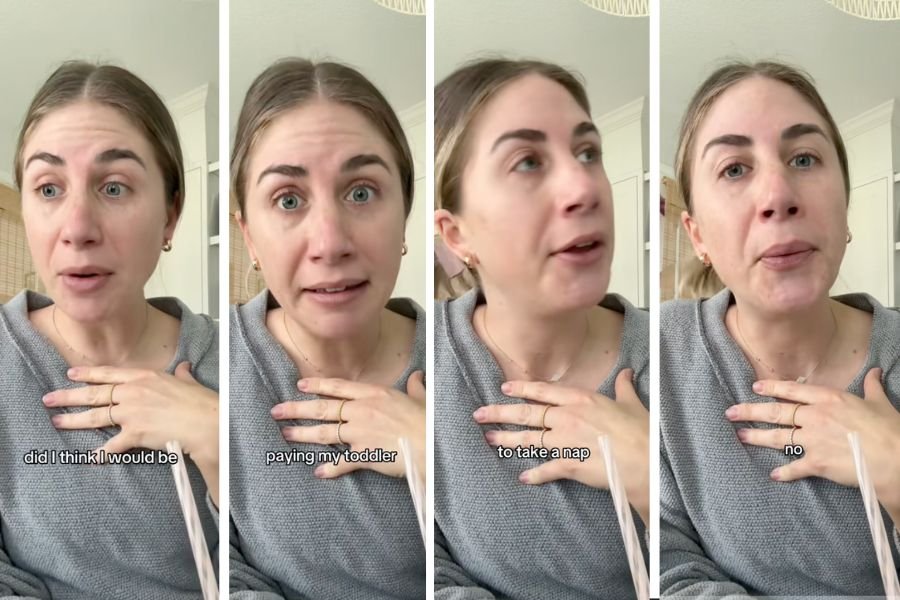
Can't get your toddler to take a nap? Mom swears by the 'Nap Fairy' method.
"Before you judge me, this works.”

Don't you wish YOU could be paid to nap?
It’s crazy to think about how, as an adult, we’d give damn near anything just to be able to take a nap, and yet when we’re kids it’s tantamount to a death sentence. Some kiddos fight, others whine, and still others scream a protest with all their might against an afternoon snooze for fear of missing out on the world around them…even though missing said nap is a surefire way for them to be in a foul mood later. Not to mention naps are vital for their mental development. But try telling that to a toddler who’s had their first taste of FOMO.
So how do parents coax kids into getting some midday rest? One mom swears by going the capitalistic route—with cold hard cash.
In a video posted to her TikTok, Sam Previte explains how her “very defiant, very independent" toddler daughter would nap at school “like a princess,” but refuse to do so at home on the weekends.
Getting creative, Previte introduced her daughter to the “Nap Fairy”—an idea she stumbled upon on social media—who would leave a penny, nickel, dime, or quarter in exchange for a nap. Of course, this fictional deal only closes if Previte's daughter actually falls asleep.
“Nap Fairy only comes when those eyes get heavy, and you rest your head on the pillow,” Previte quipped.
@findfoodfreedom i saw this on social media and idk who suggested this so please comment below if it was you🩵 #parenting #parentingtips #postpartum #toddlersoftiktok #toddlermom #naptime
To really sweeten the pot (and make the experience more fun), Previte even gave her daughter a little unicorn piggy bank to store all her nap coinage in, which opens the door to have future lessons about saving money.
And while Previte admitted that she never anticipated needing to incentive her kid this way, she lightheartedly warned folks that “ before you judge me, this s**t works.” Going by the comments, no judgment was had anyway. Parents were merely taking notes.
“Judge?! Mad at myself for not thinking about this!,” one person wrote, while another echoed. “Judge? Gurrrrl this is GENIUS.”
Still another joked, “girlll, we DONT judge. My dad printed face money with HIS FACE on em and called them ‘daddy dollars.’!
A few even shared how they too motivated their children with money, and to great success.
One mom wrote, “I pay my 5yo to read books. .25 for reading with help. $1 for reading to me.” While another said, “I pay my toddler for using the potty, she gets a quarter and I help her count her money then when we go to Walmart she can either get something small or she can save up for a toy.”
Previte’s "Nap Fairy" is a great example of creatively using positive reinforcement to teach kids about good habits. And what keeps it from being too extrinsic is that the reward itself is kept small, just enough for it to be an enjoyable ritual rather than a chore —though experts might suggest that Previte and other parents still not rely on this method too much, and consider weaning off it once a routine has been established.
Alternatively (or in addition to), parents could incorporate some verbal praise. Statements like, “Look how much energy you have after that nap!” are simple but make a big impact, and sometimes are the only magic words needed for a kid to continue pursuing desired behaviors.
Other than that, the key to creating a nap routine is quite similar to setting up a healthy bedtime routine as an adult—creating a cozy winding down ritual, dimming the lights, playing relaxing sounds, etc., and doing it at the same time each day. Even if no zzzs actually occur, there’s often a rejuvenating recharge.
Bottom line: when it comes to instilling good habits into kids, sometimes you gotta just go with what works. And you know what they say…cash is king.

- These toddler twins giggling through their first trip to Target is pure bliss ›
- Dad makes brilliant motivational podcast for toddlers to help center them for day of chaos ›
- 'Entitled parent' discovers airline moved their toddler's seat just before flight takes off ›
- A 3-year-old asked if "workmans" take naps and grown-ups had the most heartwarming responses - Upworthy ›


a man sitting at a desk with his head on his arms Photo by
Can a warm cup of tea help you sleep better? If you believe it, then yes. Photo by 
A woman is getting angry at her coworker.via
A man with tape over his mouth.via
A husband is angry with his wife. via 
Three women sit on a blanket in the park. 
Two women engaging in a pleasant conversation inside a coffee shop
Two men engaging in a peaceful disagreement.
Resurfaced video of French skier's groin incident has people giving the announcer a gold medal
"The boys took a beating on that one."
Downhill skiing is a sport rife with injuries, but not usually this kind.
A good commentator can make all the difference when watching sports, even when an event goes smoothly. But it's when something goes wrong that great announcers rise to the top. There's no better example of a great announcer in a surprise moment than when French skier Yannick Bertrand took a gate to the groin in a 2007 super-G race.
Competitive skiers fly down runs at incredible speeds, often exceeding 60 mph. Hitting something hard at that speed would definitely hurt, but hitting something hard with a particularly sensitive part of your body would be excruciating. So when Bertrand slammed right into a gate family-jewels-first, his high-pitched scream was unsurprising. What was surprising was the perfect commentary that immediately followed.
This is a clip you really just have to see and hear to fully appreciate:
- YouTube youtu.be
It's unclear who the announcer is, even after multiple Google inquiries, which is unfortunate because that gentleman deserves a medal. The commentary gets better with each repeated viewing, with highlights like:
"The gate the groin for Yannick Bertrand, and you could hear it. And if you're a man, you could feel it."
"Oh, the Frenchman. Oh-ho, monsieurrrrrr."
"The boys took a beating on that one."
"That guy needs a hug."
"Those are the moments that change your life if you're a man, I tell you what."
"When you crash through a gate, when you do it at high rate of speed, it's gonna hurt and it's going to leave a mark in most cases. And in this particular case, not the area where you want to leave a mark."
Imagine watching a man take a hit to the privates at 60 mph and having to make impromptu commentary straddling the line between professionalism and acknowledging the universal reality of what just happened. There are certain things you can't say on network television that you might feel compelled to say. There's a visceral element to this scenario that could easily be taken too far in the commentary, and the inherent humor element could be seen as insensitive and offensive if not handled just right.
The announcer nailed it. 10/10. No notes.
The clip frequently resurfaces during the Winter Olympic Games, though the incident didn't happen during an Olympic event. Yannick Bertrand was competing at the FIS World Cup super-G race in Kvitfjell, Norway in 2007, when the unfortunate accident occurred. Bertrand had competed at the Turin Olympics the year before, however, coming in 24th in the downhill and super-G events.
As painful as the gate to the groin clearly as, Bertrand did not appear to suffer any damage that kept him from the sport. In fact, he continued competing in international downhill and super-G races until 2014.
According to a 2018 study, Alpine skiing is a notoriously dangerous sport with a reported injury rate of 36.7 per 100 World Cup athletes per season. Of course, it's the knees and not the coin purse that are the most common casualty of ski racing, which we saw clearly in U.S. skier Lindsey Vonn's harrowing experiences at the 2026 Olympics. Vonn was competing with a torn ACL and ended up being helicoptered off of the mountain after an ugly crash that did additional damage to her legs, requiring multiple surgeries (though what caused the crash was reportedly unrelated to her ACL tear). Still, she says she has no regrets.
As Bertrand's return to the slopes shows, the risk of injury doesn't stop those who live for the thrill of victory, even when the agony of defeat hits them right in the rocks.