upworthy
Add Upworthy to your Google News feed.
Google News Button
Modern Families

Parents are split on the 'FAFO' parenting style that emphasizes natural consequences

Don't want to wear your coat when it's cold out? OK, have fun.

two boys having pillow fight
Allen Taylor/Unsplash

I've never been a big fan of arguing with my kids over common sense. The classic example is that kids, once they reach a certain age, never want to wear a coat no matter how cold it is outside. Some parents, knowing the correct decision, will force their kids to wear the coat. Others will carry it along, just in case their kids do decide they want it, and wave it around so other parents know they're not being irresponsible.

I've always thought a perfectly acceptable way to handle this is to let my kids experience the consequences of their own actions. Oh, you're cold now? Who could have possibly predicted that?! Finding out that not wearing a coat when it's cold outside feels bad is a pretty good way for them to make sure they learn how to make a better decision next time.

There are caveats, of course. You can never let your kids do anything dangerous or something that can't be fixed in some way. But in general, natural consequences are really a great way to learn — as opposed to parent-imposed consequences like timeouts, being grounded, yelling, etcetera.

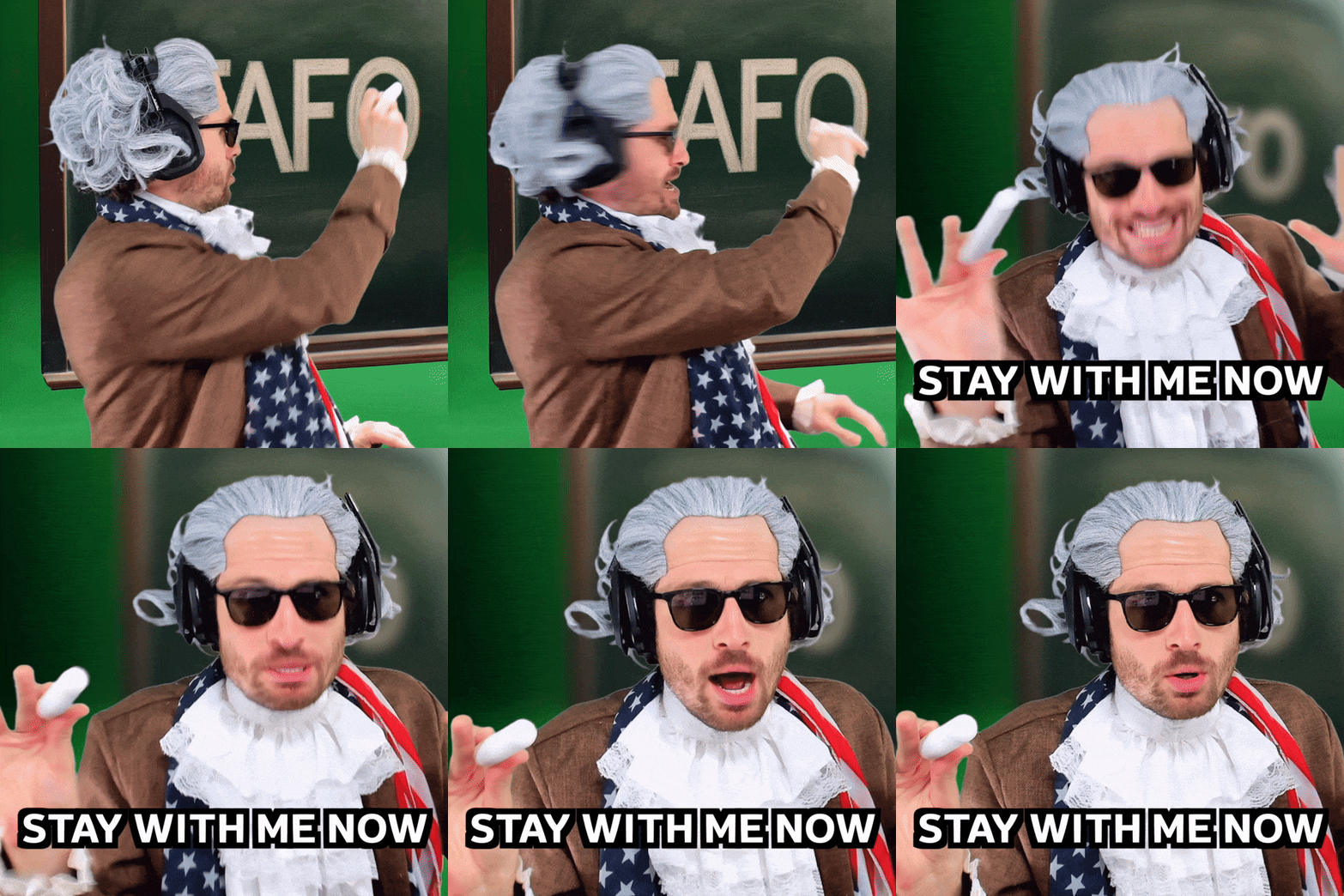
It turns out there is a name for this parenting style, and it's all the rage on social media: It's called 'FAFO' Parenting.

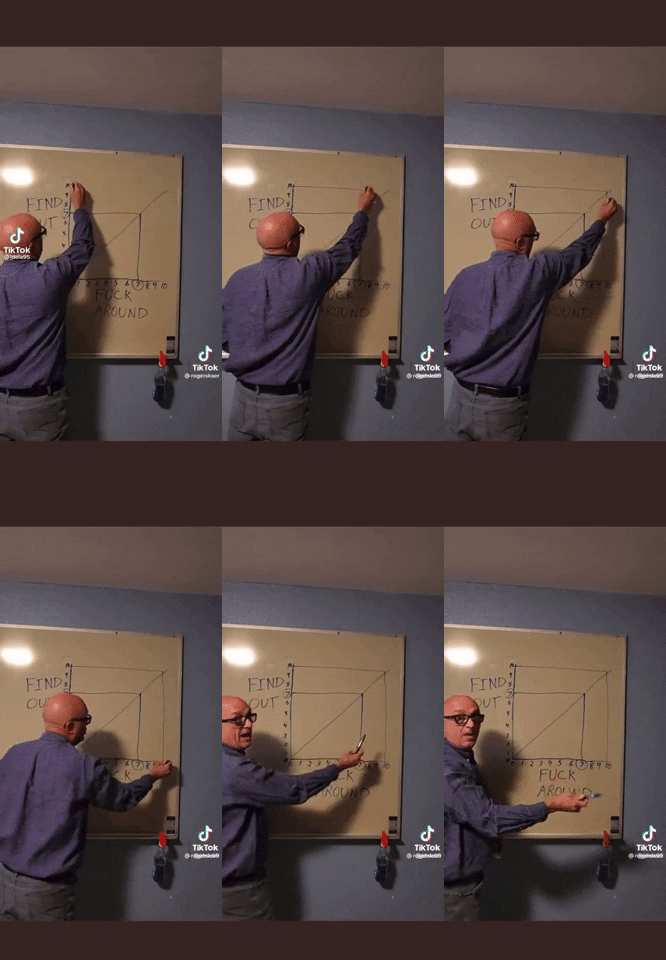
You might know the acronym FAFO as "F Around and Find Out," and I think that sums up this approach perfectly.

Giphy

FAFO Parenting emphasizes that kids should learn by experiencing the natural consequences of their actions, instead of punishments imposed by parents.

Punishments are often not an amazing way for kids to learn. They're usually completely unrelated to the actual lesson ("Eat your vegetables or go to your room") or they actually turn out to be harder on the parents than the kids (Ever try "No TV for the weekend"? Not a lot of fun, is it?). That's not to say that punishments have no place in parenting, but there's often a better way.

Natural consequences, on the other hand, are how adults learn — so it stands to reason that they can help kids learn, too. Natural consequences should be immediate and relatively low stakes. For example, if your child plays rough with a toy and breaks it, they no longer have that toy. Easy peasy!

On the other hand, if your kid is being mean to his friend, the natural consequence would be that eventually, that person won't be his friend anymore. That's a really tough lesson for a young kid to learn, and it could have lasting consequences. Plus it's also not immediate, it would build up over time, so it's not the best time for parents to avoid stepping in FAFO-style.

The natural consequence of playing with a lighter is that your kid might get burned. Again, not a good time for FAFO!

One viral video explains FAFO Parenting perfectly, along with giving a few examples.

“So I practice authoritative parenting, but within what I would consider a subgenre that I would call 'fuck around and find out' parenting, they fuck around, then they find out," says TikTok mom Janelle. "They get their natural consequences and get to figure out the way through them,”

“This weekend, I took my kid camping for the first time with the Cub Scouts, and we had a great time. But at one point it was raining pretty hard. It was raining all day. It was real wet, and the kids were all just playing around at the campsite, and my son decided he didn't want to wear his rain jacket anymore," she explains. "OK that's up to you, I'm not fighting my kid on a jacket unless temperatures are such that it could be dangerous with it. I did warn him like, OK but you're gonna get wet, just so you know, I'm not gonna get a new shirt out for you. You're gonna have to figure this one out yourself."

She says about 10 minutes later her son decided he didn't like being wet and wanted to go change.

"He got to decide for himself when he needed to go find a new shirt and stop playing and change. And we pretty much do that with everything that there's not a safety concern."

@hey.im.janelle

Probably described by less uncouth parents as "learning from natural consequences," I've found that the #FAFO method helps kids learn much better than lectures do. #authoritativeparenting #parentsoftiktok #momsoftiktok

Parents are split on FAFO as a parenting style. It does foster independence and better decision making, but it comes with its downsides.

"I love this. This is what we do. My kids are confident and polite and thinkers! You're doing great!!!🥰," wrote on parent.

"We looove fafo parents. That’s how I was raised. That’s how my kids will be raised bc that’s how they listen and behave and learn," commented another.

Janelle's video is originally from 2022 but has more recently skyrocketed in views, racking up over 340,000 to date. But not all of those viewers were on board with the approach.

The downsides to FAFO parenting, or natural consequence parenting, are twofold:

First, it can be tricky to determine what is a reasonable natural consequence for your kid to experience and what's too harsh or dangerous. It's a tough line to draw in the moment. As a parent, you're supposed to teach them, but you're also supposed to protect them. Later in Janelle's video, she uses the example of her kids climbing too high in a tree — the consequence is that they have to figure out a way to get down safely. Sounds a little too risky for me, but maybe I'm just a worrier.

Second, natural consequences aren't always immediate. Especially in younger kids, it might be tough to connect consequences that come way later to the actions that caused them. If they skip a meal or snack, they might not be hungry for several hours. At that delayed point, the lesson may not land as well as you'd think.

Giphy

There's also a risk that, if not done properly, FAFO can be construed by your child that you aren't concerned for their safety and well-being.

"Makes ur kid feel like u don’t actually care about them or what happens to them. My mom did that," one user wrote under the video.

Every parent has to draw their own line, and determine their own teaching style. Not matter what flavor or parenting you prefer, not every tool in your toolbox will work in every situation. Some scenarios lend themselves perfectly to FAFO and natural consequences. Others require a more protective style of teaching. Learning when and how to use technique properly is a frustrating and never-ending process. Welcome to parenting!



From Your Site Articles
black lab, dog walker, dog walker near me, dog walker ap, neighbors, good news, pets, feel good news

black lab (left. Handwritten letter (right)

If you've lived your whole life with a dog, a home has to feel pretty empty without one. Your heart has to feel like there's something missing as well. When Jack McCrossan, originally from Scotland, moved to Bristol, England with his three friends, they were bummed out to learn that their landlord didn't allow dogs.

So when they saw a beautiful black Sheprador (a German Sheppard Lab mix) in their neighbor's window, they knew that had to become buddies with her. They wrote the dog's owner, Sarah Tolman, a letter asking to arrange a play date with the dog. "If you ever need someone to walk him/her, we will gladly do so," they wrote.


"If you ever get bored (we know you never will, but we can dream), we are more than happy to look after him/her. If you want to come over and bring him/her to brighten our day, you are more than welcome. If you want to walk past our balcony windows so we can see him/her, please do," the letter continued.

"We hope this doesn't come too strong, but our landlord won't allow pets, and we've all grown up with animals. The adult life is a struggle without one," they wrote. "Yours sincerely, The boys from number 23," the letter concluded.

Soon after, the boys in 23 received a response from the dog herself, Stevie Ticks, accepting the offer. However, it may have been written by her human, Sarah Tolman. In the letter, Stevie shares a bit about herself, saying she's two years and four months old, was adopted in Cyprus, and that she's "very friendly and full of beans." (The boys shouldn't worry about a gassy hound, in England, "full of beans" means lively.)

"I love meeting new people and it would be great if we can be friends. I must warn you that the price of my friendship is 5 x ball throws a day and belly scratches whenever I demand them," the letter continued. A few days later, the boys got to meet Stevie.

"Meeting Stevie was great!" McCrossan told Buzzfeed. "She was definitely as energetic as described. We got to take her for a walk and she wouldn't stop running!"

Tolman thought the boys' letter was a fantastic gesture in an era where, quote often, neighbors are strangers. "In a day and age where people don't really know or speak to their neighbors, it was really nice for them to break down that barrier," she said. After the story went viral, she saw it as an opportunity for people to share their love of dogs with the world. "My mother and I are amazed at all the love we've received from around the world these past few days," Tolman wrote as Stevie. "If you have a doggo in your life, share that love with those around you."

A lot has changed since this story first warmed hearts around the globe. The boys have since moved away, but as of September 2024, Stevie is around 8 years old and still living her best life. Recently, she even made it to the doggie wall of fame at her local coffee shop.

In the years since this story first went viral, pet-sharing and neighbor dog borrowing have actually become more common, especially in cities where landlords restrict pets. Several platforms (like BorrowMyDoggy) and community groups now exist to pair dog owners with trusted neighbors who want occasional playtime, walks, or dog-sitting without having to own a pet. It’s a small but growing trend that reflects how deeply animal companionship is needed—even for people who can’t adopt a dog full-time. In many apartment buildings, these kinds of informal arrangements help reduce loneliness, build community, and give non-owners the emotional benefits of living with pets.

Just goes to show the power of a dog's love…even if that dog isn't your own.

This article originally appeared six years ago.

shoe tying; tying shoes; how to teach tying shoes; shoe tying trick; Ian's Knot; tying shoes with pinkies

Woman is blowing people's minds tying her shoes in a split second with her pinkies.

Teaching children how to tie their shoes can be frustrating for both parent and child. Usually, adults try to turn it into a fun game that uses the imagination to convert the laces into bunny ears, roller coasters, or rocket ships. But what if tying your shoes could be as entertaining as a magic trick? This one isn't just for parents teaching kids to tie their laces. This bow-making trick just might change the way everyone ties their laces.

A woman who goes by the name Alet on social media recently uploaded a video of herself tying her shoe. It was so quick that viewers thought it was fake or done with savvy editing, but it's real. She introduces the lace tying trick as "your next party trick to impress a drunk person or a surgeon equally." But to be fair, you don't have to be drunk to be impressed by this speedy sorcery.


To prove that she didn't splice the video in anyway, Alet slows down the process to show viewers how it's done after sharing how tying her scrub pants resulted in an impromptu cheering session. While standing in the operating room hallway with surgeons and others crowded around her excitedly shouting at her to "do it again," she explains before spilling the secret of the neat trick.

shoe tying; tying shoes; how to teach tying shoes; shoe tying trick; Ian's Knot; tying shoes with pinkies Mom ties kid's shoe.Photo credit: Canva

"I worked in an orthopedic hospital, so it was all men, and so all of a sudden it was just like eight or ten men standing around me in a hallway, staring at my crotch, periodically going 'WAHHHH!!!' I was doing this," Alet says before quickly tying her laces.

In an effort to show the viewers how to tie their laces as quickly as she does, she explains it using fun terms that can also be used when teaching small kids. She explains that you have to start by using "fancy pinkies" to hold the laces. Then Alet says the next step is to make little finger guns, complete with laser shooting sounds, before turning those finger guns into crab claws. The next step will make or break this shoe-tying experiment: the two crab claws have to kiss in a very specific way to make a bow. It's something you have to see to understand.

Watch the clip here:

@dr.mrs.knits Introducing your next party trick to impress a drunk person or a surgeon equally. #tutorial #howto #knots #surgery #medstudent #partytrick ♬ original sound - Alet

One person in the comments summarized the steps to make it clear for others, though unless you watch the process slowed down, the steps will seem nonsensical: "fancy pinkies - pew pew - lobster claws - eff you, no eff me - train tracks, make them kiss - tighten."

Another person shares that her autistic child picked up the steps in no time, writing, "Uhhhhhhh my autistic son figured it out the second you turned the phone around… no explanation needed. He’s 10 and COULD NOT tie his shoes before this… haha he is also making the noises too. Apparently they are a must."

shoe tying; tying shoes; how to teach tying shoes; shoe tying trick; Ian's Knot; tying shoes with pinkies Girl helping tie shoelaces on the trail.Photo credit: Canva

The video is clearly tickling the brain of neurodivergent people. Another person says, "I do believe the sound effects helped my ADHD brain better understand it."

"Girl, nevermind the insane party trick power, I have dyspraxia and never learnt to tie my shoes "normally". I'm 31 and I've been doing double knotted loop bows my entire life. I just managed this first try. It's a miracle!" someone else shares.

predators, forensics, crime, women, awareness
via Екатерина Шумских/Pexels, Vladimir Konoplev/Pexels and Teona Swift/Pexels

Three women walking down city streets.

A forensics student named Alexandria recently shared vital information on TikTok that all women should know. She detailed the specific signs male predators are looking for when they choose a victim.

Her video is based on a 2013 study entitled “Psychopathy and Victim Selection: The Use of Gait as a Cue to Vulnerability.” For the study, researchers interviewed violent criminals in prison and asked them the type of women they’d be most likely to victimize.


The study found that the criminals all agreed that how the woman walked was a deciding factor.

“What the selected women all had in common was the way that they walked and how they generally held themselves in public,” Alexandria says in the video she later deleted but has been shared broadly across the platform.

@_alf_90_

How to walk for your safety! #women #safety #tips #walking #kidnapping #murder #attacks #fyp

“The selected women all had a similar ‘awkwardness’ to the way that they walked and carried themselves,” she continued. “The first part of the woman had a gait that was a little bit too small for their body, which resulted in smaller steps, slower speed and their arms more typically to their sides, or crossed, as well as their heads being down and not really taking in their general surroundings, which indicated three different things to these potential attackers.”

The woman’s body language signaled to attackers that she was fearful and anxious and because her head was down, she'd be easier to surprise. Alex then described the second type of woman the criminals said they’d target.

“On the other hand, the other part of the women that were selected had a gait that seemed a bit too big for their body and their arms tended to flail to the sides and seemed just overly awkward,” Alexandria continued.

The woman with the bigger gait signaled to potential attackers that she may be clumsy and won’t put up a good fight. “Because their arms were out and flailing to the side, it left the lower body open to, again, come around and grab them,” she said.

women, walking, predators, crime, body language Women walking down a street.Image via Canva Photos.

The video was helpful because Alexandria also discussed the types of women the attackers wouldn’t pursue. Alex says these women “walked with a gait that tended to be more natural to their body.” She adds they moved at the same pace as those in the immediate area, with their shoulders back and chins up and asserting a general sense of confidence.

“Essentially, the women that were not selected gave off an energy that said, ‘Don’t mess with me. I will put up a good fight.’ And that’s why they weren’t selected,” Alex said. “I know that it sounds silly, but something as simple as the way you walk or the way that you carry yourself in public could determine the likelihood that you become a target of a predator.”

According to the Center for Violence Prevention and Self Defense Training, detecting vulnerability is the biggest factor in who predators choose to victimize. Confusion, isolation, appearing insecure, unaware, unassertive, or distracted all play a part in who predators target, but being aware of these factors can increase safety considerably. They also note that access plays a part in being targeted, stating that, "Attackers tend to target people positioned near entrances, exits, or secluded areas where they can quickly grab and escape without arousing suspicion."

woman, crime, predator, safety, awareness Woman aware of her surroundings in a parking garage. Image via Canva Photos.

Alexandria concluded her video by sharing an acronym that can help prevent women from being victimized while in public: STAAR.

S(tride): Walk with a natural stride to your body with steps that are not too far apart or short.

T(all): Stand tall. Keep your shoulders back and your chin up. Assert a natural confidence and dominance to those around you.

A(rms): Swing your arms naturally by your sides, avoiding keeping them too close to your body or flailing out of your natural range of motion.

A(wareness): Stay aware of your surroundings. Take notice if something feels or looks off.

R(elax): Stay cool, calm, and collected and don’t indicate to a potential attacker that you feel or see something is wrong.


This article originally appeared last year. It has been updated.

college classroom, class, classmates, taking someone's seat

Don't judge a book by its cover.

You know that feeling you get when you walk into a classroom and see someone else's stuff on your desk? OK, sure, there are no assigned seats, but you've been sitting at the same desk since the first day and everyone knows it. So why does the guy who sits next to you put his phone, his book, his charger, his lunch, and his laptop in the space that's rightfully yours? It's annoying.

All you want to do was walk in, sit down, get out your notebook and (try to) pay attention. But now? Now you've got to talk to a stranger about moving their stuff and there goes your day, already bogged down with petty annoyances. Sound familiar?


classroom, desk, classmates, claiming a seat Even when there's no assigned seat, everyone knows where they usually sit.Photo credit: Canva

We've all got so much to do these days that interacting with people we see every day — not our friends, but our classmates, fellow commuters, co-workers, the people in line for coffee with us every day — can feel like a burden. So, when these people do something we perceive as annoying, like putting their stuff on our desks, we don't have the time or the energy to assume their intentions or think about the lives they're leading.

But if we stepped out of ourselves for a second, we might just realize that we're all much more connected than we think, that our preconceived notions of others are usually just that — preconceived. And, often, inaccurate.

That's why this X story about a guy who learned an important life lesson from a classmate he was frustrated with has resonated with thousands. It's the perfect example of that "don't judge a book by its cover" adage we should have all learned in preschool but sometimes forget. And it starts the exact same way as this post — with a college student groaning on the inside as he sees someone's stuff on his desk.

Thomas McFall (@thomas___mcfall) wrote:

"So in one of my Management classes I sit in the same seat in the front every day. Every single day I sit there. Now, I also sit next to some foreign guy that barely speaks English. The most advanced thing I've heard this guy say in English is 'Wow, my muffin is really good.'

This guy also has a habit of stacking every item he owns in the exact space I sit. His bag, his food, his books, and his phone are ALWAYS right on my desk space.

Now, every single time I walk into class this guy says 'Ah, Tom. You here. Okay.' And starts frantically clearing my desk of his belongings. He then makes it a habit to say 'Ready for class, yeah?' And gives me a high five. Every day this guy gives me a high five.

I was ALWAYS annoyed with this guy. I'm thinking 'Dude, you know I sit in this seat every day. Why are you always stacking your shit here? And the last thing I want to do is give a guy who barely speaks my language high fives at 8 in the morning.' Just get your shit off my desk.

But today I came to class and was running a few minutes late. I'm standing outside because I had to send a quick text. I could see my usual space through the door out of the corner of my eye. Of course, my desk was filled with his belongings. The usual.

As I'm standing there on my phone another guy who was also late walks into the class before me and tried to take my seat since it's closest to the door. The guy sitting next to me stops this dude from sitting down and says 'I'm sorry. My good friend Thomas sits here.'

It was then that I realized this guy wasn't putting stuff on my seat to annoy me. He was saving me the seat every morning. And this whole time he saw me as a friend but I was too busy thinking about myself to take him into consideration. Cheesy as it sounds, I was touched.

I ended up going into class and of course he cleared the seat and said 'Ah, Tom. You here. Okay.' And I did get a high five. At the end of class I ended up asking him if he wanted to get a bite to eat with me. We did. And we talked for a while. I got through the broken English.

The guy moved here from the Middle East to pursue a college education in America. He plans to go back after he gets his degree. He's got two kids and a wife. He works full time and sends his all his left over money back home to his wife.

I asked him how he liked America as well. He said he misses his family but it's exciting to be here. He also said 'Not every American is nice to me like you are, Tom.' I bought lunch, of course. Dude deserves it. He gave me a high five for buying lunch. Gotta keep up tradition.

Moral of the story? Don't do what I do and constantly only think about yourself. It took me nearly the entire semester to get my head out of my ass and realize this guy was just trying to be my friend. Better late than never I suppose."

If not for this one day running late, McFall may have never realized what his classmate was trying to do. And he may have continued to think of him as annoying, maybe telling others about "the weird guy who was always trying to take up my space"... when all the guy was really trying to do was be kind. We all misinterpret the actions of others sometimes. It's easy to do that!

But if there's one thing this story reminds us, it's that it's important to stop and remember that while you're living your life, other people are living theirs, so assuming best intentions can do us a great favor. That's why we should step outside of our bubbles and engage with the world on a regular basis. You could make a new friend. You might brighten someone's day.

But most importantly, getting out of your own head, checking your own biases, and giving others the benefit of the doubt will make you a more compassionate person. You don't have to engage with everyone you meet, but the next time someone smiles and offers you a high-five? Maybe just take them up on it.

This article was originally published seven years ago.

chris starkey, dad daughter dance, dance battle, dance off

The Starkeys' epic dance battle.

It may be hard to remember now, but back in March of 2020, the world underwent a startling shift. People were asked to stay at home to keep the virus from spreading out of control. We made masks. We sanitized our groceries. Concern and uncertainty permeated our daily existence as news reports of outbreaks and full ICUs became more and more prevalent. Words like "lockdown" and "quarantine" and "super-spreader" and "PPE" became part of our collective vernacular.

That was a difficult time, but as humans do, we tried to make the most of it. Being stuck at home meant more time with our families. Not being able to go out to a show or concert or get together with friends meant all of our entertainment had to happen in our houses. That's how one dad-daughter duo ended up with a viral dance battle that hit the internet at just the right time.


Season 3 Dancing GIF by Party Down Giphy

Chris Starkey posted a video to Facebook on March 23, 2020, of himself and his daughter Brooklyn doing a dance-off to Flo Rida's "Low"—and it's unexpectedly awesome. Starkey wrote, "My daughter challenged me to a dance off and said I don't have it anymore. See that closet in the back she is still crying in it!!!" So much silly shade thrown around in this family, it's delightful.

When you see their fun banter and Starkey's middle-aged-man moves, you'll see why the video was shared more than 280,000 times in two days and has racked up over 14 million views since. Starkey wrote in a comment that the reaction brought tears to his eyes and encouraged everyone to "Give back to your community." This kind of levity and sense of community was definitely needed in that moment, but it still delights even now.

- YouTube youtu.be

People greatly appreciated getting dose of unbridled joy.

"Thank you guys soooo much i am crying right now because it felt so good to laugh and smile....thank you sooo much!!!!!" wrote on commenter.

"This seriously made my day," wrote another.

Starkey asked people to vote for who they think won the battle, and the results were split, though Dad had a whole lot of fans rooting for him.

"Dad gets my vote!!!"

"Dad!!! winner winner chicken dinner."

music video happy dance GIF by Apple Music Giphy

"DAD totally wins!!"

"You still got it dude!"

"Truth be told I had the sound off, but would have to say DAD wins this one strictly due to facial expressions. Both dancers were equally as good in my eyes. On a side note, quarantine looks like it isn't so bad when you have a HOUSE instead of a TINY NYC ONE-BEDROOM."

"Daddy’s got the moves!!! Great job having fun together!!!""

Since 2020, life hasn't exactly gone back to the way it was, but normalcy has returned to most of our day-to-day lives. For Starkey, life has added a grandbaby, but if you think Dance Dad wasn't going to become Dance Grandad, you couldn't be more wrong.

Check this out—the old man's still got it:

- YouTube www.youtube.com

Families that can have fun and laugh together are a gift. Here's to the dads, daughters, grandpas, uncles, aunts, and everyone else who don't take themselves too seriously and aren't afraid to let loose to bring a little unexpected joy to themselves and others.

You can follow Dance Dad TV on YouTube and find more from Chris Starkey on his website.

This article originally appeared five years ago. It has been updated.