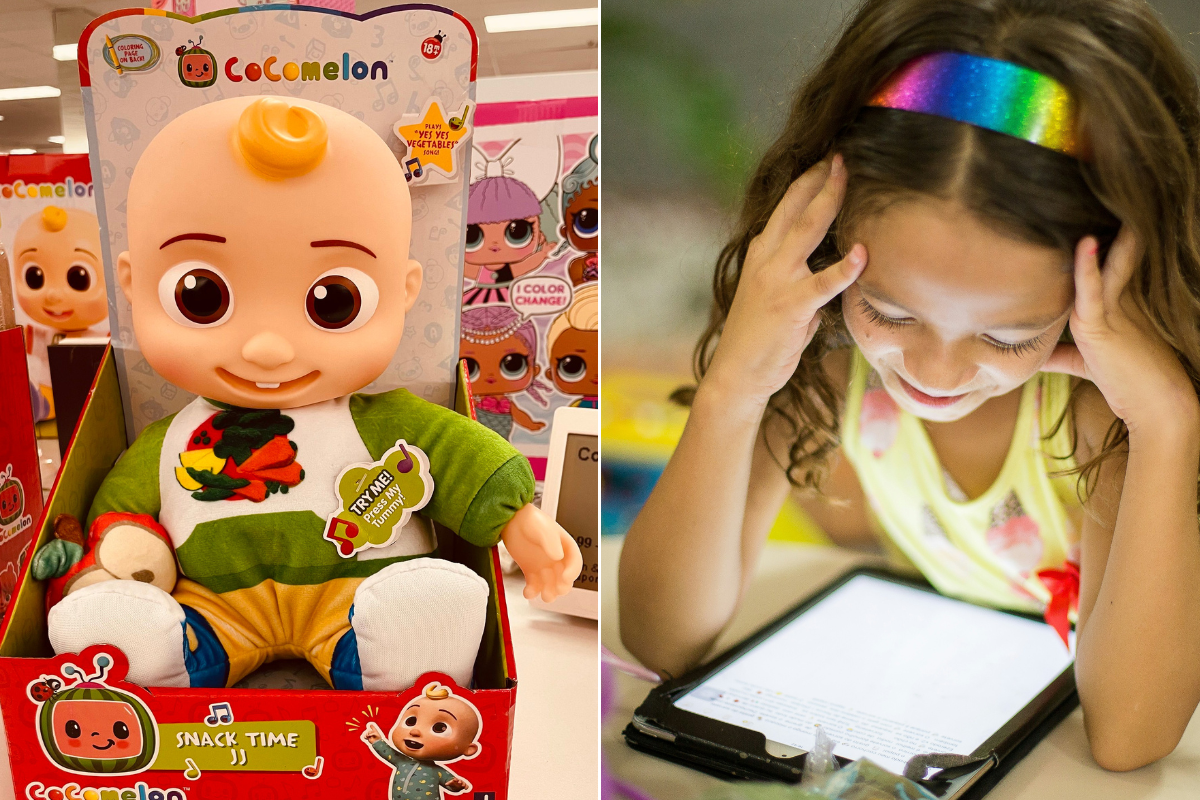
When my oldest daughter was little, Cocomelon wasn’t the sensation it is today. It didn’t take over on YouTube until around 2018 and it didn’t show up on Netflix until 2020. We discovered it around the time my youngest was born, and it was a lifesaver! What an amazing tool to have in our arsenal when we needed a break from chasing her around or needed her to sit still and eat for a few minutes.
She absolutely devoured it, and I never had an issue with JJ and the gang being on in the background. The show had cute songs, bright colors, and seemed to have some light teaching elements that I liked (letters, manners, eating fruits and vegetables, that kind of thing). Little did I know that Cocomelon was actually the most destructive show on television. At least, according to some parents and experts.
More and more has come out in recent years about Cocomelon’s methods and how they’re able to make their content so sticky.
The show is meticulously engineered to hold the attention of babies and toddlers. Everything is intentional, from the bright colors to the frequent cuts and scene changes.
In fact, during testing, Moonbug Entertainment (the producers behind the show) use something called a “Distractatron” to measure exactly when they’re losing kids’ attention. Basically, the Distractatron is a screen with mundane real-world footage rolling on it next to the episode they’re testing. When kids look away from the show to watch whatever boring thing is being shown on the Distractatron, producers know they can tweak those moments in the episodes to make them more engaging.
Or addicting, depending on how you look at it.
There’s a growing chorus of parents online that think this kind of testing and optimization is not just icky, but truly harmful.
Some even accuse Cocomelon of causing or contributing to serious lifelong issues like delayed speech, ADHD, and even Autism.
People claim it turns kids into zombies and that they show symptoms of withdrawal when you make them turn it off.
The experts have weighed in, too: Cocomelon isn’t necessarily great for kids, but it might be getting a bad rap.
“Cocomelon is very stimulating thus it really draws in the attention of children and it is also faster paced than some other shows for children which can make it more addictive,” says Dr. Maya Weir of Thriving California.
The bright colors and quit camera cuts definitely contribute to the dopamine reward response in children, which makes watching it feel extra exciting. It can also make them really not want to turn the show off.
But… it’s probably misguided to single out Cocomelon in particular.
“All screens and tv shows are attention grabbing and addictive for children. Any show will activate dopamine which will create the child to desire the show again and again. I don’t think it is appropriate for parents to attribute speech delay, autism and ADHD to watching Cocomelon,” says Weir.
Let’s say that again for the folks in the back.
Watching TV, even hyper-optimized shows like Cocomelon, will not give your kids ADHD or autism.
It is worth having a look at how much overall screentime your kids are getting, however, whether it’s with Cocomelon, another show, or a mix of different content.
“Highly stimulating shows like Cocomelon can make quieter activities feel as exciting as watching paint dry,” says Veronica West, psychologist at My Thriving Mind. “That doesn’t mean it causes ADHD or speech delays, but too much screen time can crowd out important interactions like chatting, playing, and, you know, digging through the trash when you’re not looking. So, let’s blame screen overuse, not just JJ and his catchy tunes.”
Screentime guidelines from the American Academy of Pediatrics are a good starting point. For kids 2-5, they recommend keep it to an hour or less per day.
Parents panicking over TV shows is nothing new. And it’s totally understandable.
Anyone remember when Barney was thought to be subliminally sending satanic messages to kids through songs and leading to a generation of morally-bankrupt children?
Remember when Caillou was going to, for lack of a better term, turn kids evil through his modeling of horrible behavior?
Peppa Pig was even accused of quite literally causing autism in kids. The study the rumor was based on turned out to be a complete hoax, but those rumors have stuck around and turned a lot parents away from the show.
It’s a good idea to try not to get caught up in the panic whenever a new show starts getting criticism.
In the last year or so, we’ve drastically reduced the amount of Cocomelon we use in our house. Down to almost zero. Part of that is that my youngest daughter is getting older. But I admit that I don’t necessarily love the way it’s engineered to be addicting, and that’s been part of the decision.
But again, it’s not just Cocomelon.
Our beloved Disney and Pixar do similar testing on their movies — they want to make sure they’re triggering the right emotions at the right times and, of course, not losing your attention along the way.
That’s just the world we live in now, and it continues through adulthood with Instagram, TikTok, and pretty much everything else we interact with.
I get the instinct to protect your kids from as much of this stuff as possible for as long as you can.
You’re not going to mess your kids up by letting them watch Cocomelon! But here are a few things you might keep in mind if you choose to.
First, remember to set screentime limits. Just as important as what you choose to watch, is how much of it you allow.
Next, if possible, watch Cocomelon with your kids! The APA actually recommends zero solo media usage for kids under two. If you can, sit and watch with them and ask them questions about what they’re seeing on the screen.
Similarly, sing the songs and do the dances with them after you’ve turned the show off. This will help reinforce critical social and speech skills.
And finally, remember that it’s your choice. You don’t have to allow Cocomelon in your house if you want. But we do need to be careful about casually implying that anything causes ADHD, autism, or speech delays when the evidence just isn’t there.
And if you find JJ and his pals annoying and just don’t want to listen to it anymore? Well, you’re definitely not alone!