Trump tried to troll Michigan’s Secretary of State on voting laws. It didn’t end well for him.
In a now-deleted tweet, President Trump engaged in one of his favorite pastimes on Wednesday—accusing another elected official of committing a crime on Twitter. This time, the object of his accusation was Michigan’s “rogue” Secretary of State, Jocelyn Benson. The crime? Trump accused her of “illegally and without authorization” sending absentee ballots to 7.7 million…
In a now-deleted tweet, President Trump engaged in one of his favorite pastimes on Wednesday—accusing another elected official of committing a crime on Twitter.
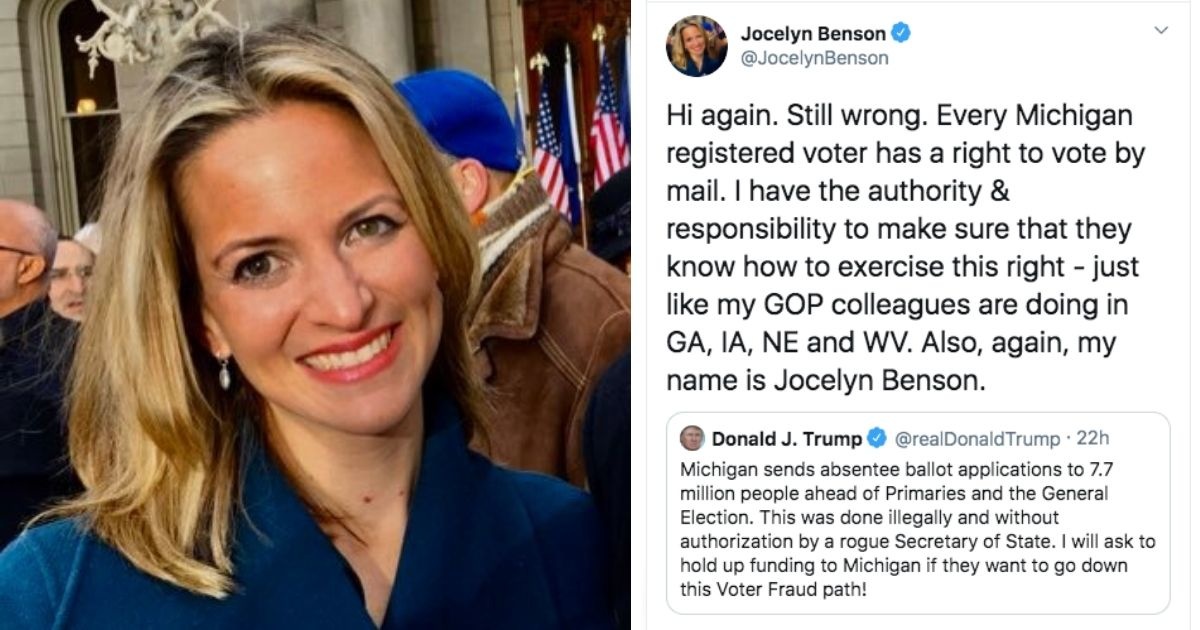
This time, the object of his accusation was Michigan’s “rogue” Secretary of State, Jocelyn Benson. The crime? Trump accused her of “illegally and without authorization” sending absentee ballots to 7.7 million people in her state. He threatened to withhold funding to Michigan saying, “If they want to go down this Voter Fraud path!” (Ahem, is “voter fraud” a proper noun, sir?)
Benson responded to Trump’s tweet in the best way possible—she fired back with facts and a reminder of her name.
“Hi!” she wrote, with a wave emoji. “I also have a name, it’s Jocelyn Benson. And we sent applications, not ballots. Just like my GOP colleagues in Iowa, Georgia, Nebraska and West Virginia.”
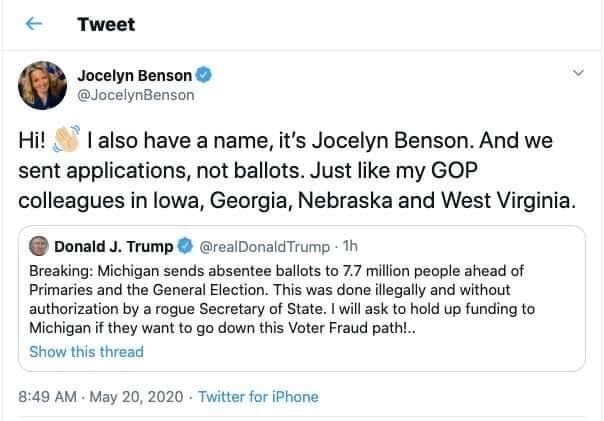
The president was roundly called out for being so inaccurate. Trump partially corrected his previous tweet two-and-a-half hours later, only adding the word “applications,” but but still falsely claiming the mail-in voting broke the law.
The president seems hell bent on making people believe that mail-in voting is “ripe for fraud” and that making it easier for people to vote by mail is somehow beneficial for Democrats. Let’s not forget he voted by mail in Florida in March. Or that Washington and Oregon, who have had all-mail-in voting for years, both have Republican Secretaries of State overseeing their elections. Voter fraud, despite claims to the contrary, is a statistically insignificant occurrence—and a bipartisan one at that.
Benson, again, responded with the facts. And again, she reminded him that she has a name.
“Hi again,” she wrote. “Still wrong. Every Michigan registered voter has a right to vote by mail. I have the authority & responsibility to make sure that they know how to exercise this right – just like my GOP colleagues are doing in GA, IA, NE and WV. Also, again, my name is Jocelyn Benson.”
Hi again. Still wrong. Every Michigan registered voter has a right to vote by mail. I have the authority & responsibility to make sure that they know how to exercise this right – just like my GOP colleagues are doing in GA, IA, NE and WV. Also, again, my name is Jocelyn Benson. https://t.co/deZJwbMlT0— Jocelyn Benson (@JocelynBenson) May 20, 2020
Benson insisting that President Trump call her by her name may seem like a small thing, but it’s not. In fact, it might be the most powerful part about her responses. The president has a habit of not referring to women he doesn’t like by name, instead making up childish nicknames for them or simply omitting their name altogether. It’s a power play of sorts—one that Benson expertly diffuses in her tweets to him.
As political historian Heather Cox Richardson pointed out on Facebook:
“From Moby Dick’s famous beginning ‘Call me Ishmael’ to the fear in the Harry Potter books of calling the evil Voldemort by name, invoking someone’s name makes them a power to be reckoned with. In this case, a woman doing her job, insisting on reality that interrupts Trump’s narrative, repeatedly demands that he use her name.
It’s a powerful moment. At a time when senators and government officials appear to have ceded their power to Trump, it is ordinary Americans like Jocelyn Benson, ordinary women like Jocelyn Benson, who are standing up to him. ‘Hi!’ she wrote. ‘I also have a name.’
Indeed she does. That’s exactly what the president is afraid of.”
Strong, smart and self-respecting women who don’t peddle “alternative facts” are Trump’s kryptonite. He doesn’t know what to do with them, other than attack them with false claims and nicknames. In the space of two tweets, Jocelyn Benson managed to not only correct the president’s falsehoods, but also show that she’s not going to let him play that game. It’s ridiculously unfortunate that government officials have to battle lies from the president on Twitter, but since that’s how he’s chosen to communicate, that’s where it has to happen.
Of course, Benson’s office also issued official statements on the matter, because despite appearances, governance is not actually done over Twitter. The Department of State wrote:
“President Donald Trump’s statement is false. The Bureau of Elections is mailing absent voter applications, not ballots. Applications are mailed nearly every election cycle by both major parties and countless advocacy and nonpartisan organizations. Just like them, we have full authority to mail applications to ensure voters know they have the right to vote safely by mail.”
We need to see women standing calmly and confidently in the storm, providing factual, low-key fierce rebuttals to the blatantly false accusations that keep flying from the president’s fingertips.
In a small village in Pwani, a district on Tanzania’s coast, a massive dance party is coming to a close. For the past two hours, locals have paraded through the village streets, singing and beating ngombe drums; now, in a large clearing, a woman named Sheilla motions for everyone to sit facing a large projector screen. A film premiere is about to begin.
It’s an unusual way to kick off a film about gender bias, inequality, early marriage, and other barriers that prevent girls from accessing education in Tanzania. But in Pwani and beyond, local organizations supported by Malala Fund and funded by Pura are finding creative, culturally relevant ways like this one to capture people’s interest.
The film ends and Sheilla, the Communications and Partnership Lead for Media for Development and Advocacy (MEDEA), stands in front of the crowd once again, asking the audience to reflect: What did you think about the film? How did it relate to your own experience? What can we learn?
Sheilla explains that, once the community sees the film, “It brings out conversations within themselves, reflective conversations.” The resonance and immediate action create a ripple effect of change.
MEDEA Screening Audience in Tanzania. Captured by James Roh for Pura
Across Tanzania, gender-based violence often forces adolescent girls out of the classroom. This and other barriers — including child marriage, poverty, conflict, and discrimination — prevent girls from completing their education around the world.
Sheilla and her team are using film and radio programs to address the challenges girls face in their communities. MEDEA’s ultimate goal is to affirm education as a fundamental right for everyone, and to ensure that every member of a community understands how girls’ education contributes to a stronger whole and how to be an ally for their sisters, daughters, granddaughters, friends, nieces, and girlfriends.
Sheilla’s story is one of many that inspired Heart on Fire, a new fragrance from the Pura x Malala Fund Collection that blends the warm, earthy spices of Tanzania with a playful, joyful twist. Here’s how Pura is using scent as a tool to connect the world and inspire action.
A partnership focused on local impact, on a global mission
Pura, a fragrance company that recognizes education as both freedom and a human right, has partnered with Malala Fund since 2022. In order to defend every girl’s right to access and complete 12 years of education, Malala Fund partners with local organizations in countries where the educational barriers are the greatest. They invest in locally-led solutions because they know that those who are closest to the problems are best equipped to solve and build durable solutions, like MEDEA, which works with communities to challenge discrimination against girls and change beliefs about their education.
But local initiatives can thrive and scale more powerfully with global support, which is why Pura is using their own superpower, the power of scent, to connect people around the world with the women and girls in these local communities.
The Pura x Malala Fund Collection incorporates ingredients naturally found in Tanzania, Nigeria, Pakistan, and Brazil: countries where Malala Fund operates to address systemic education barriers. Eight percent of net revenue from the Pura x Malala Fund Collection will be donated to Malala Fund directly, but beyond financial support, the Collection is also a love letter to each unique community, blending notes like lemon, jasmine, cedarwood, and clove to transport people, ignite their senses, and help them draw inspiration and hope from the global movement for girls’ education. Through scent, people can connect to the courage, joy, and tenacity of girls and local leaders, all while uniting in a shared commitment to education: the belief that supporting girls’ rights in one community benefits all of us, everywhere.
You’ve already met Sheilla. Now see how Naiara and Mama Habiba are building unique solutions to ensure every girl can learn freely and dare to dream.
Naiara Leite is reimagining what’s possible in Brazil
Julia with Odara in Brazil. Captured by Luisa Dorr for Pura
In Brazil, where pear trees and coconut plantations cover the Northeastern Coast, girls like ten-year-old Julia experience a different kind of educational barrier than girls in Tanzania. Too often, racial discrimination contributes to high dropout rates among Black, quilombola and Indigenous girls in the country.
“In the logic of Brazilian society, Black people don’t need to study,” says Naiara Leite, Executive Coordinator of Odara, a women-led organization and Malala Fund partner. Bahia, the state where Odara is based, was once one of the largest slave-receiving territories in the Americas, and because of that history, deeply-ingrained, anti-Black prejudice is still widespread. “Our role and the image constructed around us is one of manual labor,” Naiara says.
But education can change that. In 2020, with assistance from a Malala Fund grant, Odara launched its first initiative for improving school completion rates among Black, quilombola, and Indigenous girls: “Ayomidê Odara”. The young girls mentored under the program, including Julia, are known as the Ayomidês. And like the Pura x Malala Fund Collection’s Brazil: Breath of Courage scent, the Ayomidês are fierce, determined, and bursting with energy.
Ayomidês with Odara in Brazil. Captured by Luisa Dorr for Pura
Ayomidês take part in weekly educational sessions where they explore subjects like education and ethnic-racial relations. The girls are encouraged to find their own voices by producing Instagram lives, social media videos, and by participating in public panels. Already, the Ayomidês are rewriting the narrative on what’s possible for Afro-Brazilian girls to achieve. One of the earliest Ayomidês, a young woman named Debora, is now a communications intern. Another former Ayomidê, Francine, works at UNICEF, helping train the next generation of adolescent leaders. And Julia has already set her sights on becoming a math teacher or a model.
“These are generations of Black women who did not have access to a school,” Naiara says. “These are generations of Black women robbed daily of their dreams. And we’re telling them that they could be the generation in their family to write a new story.”
Mama Habiba is reframing the conversation in Nigeria
Centre for Girls' Education, Nigeria. Captured by James Roh for Pura
In Mama Habiba’s home country of Nigeria, the scents of starfruit, ylang ylang and pineapple, all incorporated into the Pura x Malala Collection’s “Nigeria: Hope for Tomorrow,” can be found throughout the vibrant markets. Like these native scents, Mama Habiba says that the Nigerian girls are also bright and passionate, but too often they are forced to leave school long before their potential fully blooms.
“Some of these schools are very far, and there is an issue of quality, too,” Mama Habiba says. “Most parents find out when their children are in school, the girls are not learning. So why allow them to continue?”
When girls drop out of secondary school, marriage is often the alternative. In Nigeria, one in three girls is married before the age of 18. When this happens, girls are unable to fulfill their potential, and their families and communities lose out on the social, health and economic benefits.
Completing secondary school delays marriage, and according to UNESCO, educated girls become women who raise healthier children, lift their families out of poverty and contribute to more peaceful, resilient communities.
Centre for Girls’ Education, Nigeria. Captured by James Roh for Pura
To encourage young girls to stay in school, the Centre for Girls’ Education, a nonprofit in Nigeria founded by Mama Habiba and supported by Malala Fund and Pura, has pioneered an initiative that’s similar to the Ayomidê workshops in Brazil: safe spaces. Here, girls meet regularly to learn literacy, numeracy, and other issues like reproductive health. These safe spaces also provide an opportunity for the girls to role-play and learn to advocate for themselves, develop their self-image, and practice conversations with others about their values, education being one of them. In safe spaces, Mama Habiba says, girls start to understand “who she is, and that she is a girl who has value. She has the right to negotiate with her parents on what she really feels or wants.”
“When girls are educated, they can unlock so many opportunities,” Mama Habiba says. “It will help the economy of the country. It will boost so many opportunities for the country. If they are given the opportunity, I think the sky is not the limit. It is the starting point for every girl.”
From parades, film screenings to safe spaces and educational programs, girls and local leaders are working hard to strengthen the quality, safety and accessibility of education and overcome systemic challenges. They are encouraging courageous behavior and reminding us all that education is freedom.
Experience the Pura x Malala Fund Collection here, and connect with the stories of real girls leading change across the globe.
For young baseball fans, meeting a Major League Baseball player can be a memorable highlight of a trip to the ballpark. However, one fan not only got to enjoy their favorite hobby with a player, but also walked away with two impromptu autographs from others thanks to him.
MLB veteran Paul Lo Duca met a young baseball card collector named Noah and his brother on the sidelines before a Mets game. He took the time to open a pack of 2008 Topps baseball cards with Noah, even joking that one of his own cards might appear. When the pack was opened, Lo Duca wasn’t among the players—but two of his former teammates were: Mike Piazza and Johan Santana. Without prompting, Lo Duca grabbed the cards and a pen and ran onto the field to have both players autograph them.
Watch til the end! Our number 1 video of the season! We rip a pack of 2008 Topps with Paul Lo Duca! He pulls both a Mike Piazza AND Johan Santana! He then goes and gets both signed! #baseballcards#packrip#sportscards#topps#baseball @Topps @MLB Network @MLB @ESPN @Collect @Fanatics @Baseball Lifestyle @The Athletic @New York Mets
It would have been understandable for Lo Duca to just give Noah a quick hello, maybe even sign a card if one of his had turned up in the pack. Instead, he went out of his way to get signatures from other players for the young fan. Noah graciously thanked Lo Duca for the gesture and even posed for a photo with him.
The comments on the boy’s TikTok were abuzz with praise for Lo Duca and the interaction:
“You never see a professional player interact with a fan this long. He opened a pack and then RAN to get both the cards he got signed. What an amazing guy.”
“That’s so cool, ripping packs with the pros 💪”
“It was unbelievable. The kids will never forget this.”
“This is why baseball will forever be America’s favorite pastime…My friend’s daughter was lucky enough to get a game-used Bryce Harper bat from Harp himself at one game.”
“How can you not be romantic about baseball?”
“Outstanding! Made a lifelong memory for the kids and cost nothing but kindness.”
“I love EVERYTHING about this!!! 💙 I have two grandsons who play baseball and I think I would be literally in tears if this were to happen to them because I know how much they love the game and look up to men like this in the sport! 🧢⚾️”
“This is officially the best card opening pack video I’ve ever seen. Regardless of sport or collectible.”
“Paul is every kid’s dream interaction at the ball park. Class act.”
“Not a Mets fan, but just became a Paul fan!”
“It doesn’t take long for athletes and former athletes to make a story for a kid they’ll never forget. Lots of respect for Paul doing this!”
“He’s just happy to see kids still into baseball cards! Keeping it alive!”
Baseball cards are making a comeback
Since the COVID-19 pandemic, baseball cards and other trading cards have surged in popularity among young fans like Noah, as well as adults. Lo Duca even mentions that he owns a collectible card store. In an era when many young people’s hobbies revolve around screens and online interaction, parents and teachers are largely welcoming the return of trading cards to schoolyards.
Trading cards can have several benefits for kids, including: 1. Fostering a sense of community and social connections through trading and collecting with friends and peers. 2.Encouraging organization and categorization skills as they sort and manage their collections. 3.Developing research and critical thinking skills as they learn about different cards, players, and teams. 4.Promoting patience, persistence, and self-discipline as they hunt for rare or hard-to-find cards. 5.Enhancing knowledge and interest in various subjects, such as sports, history, or pop culture. 6.Encouraging entrepreneurship and business skills through buying, selling, and trading cards. 7.Building self-confidence and pride in their collections and accomplishments. 8.Developing fine motor skills through handling and sorting cards. 9.Learning about the value of money and responsible spending habits. 10.Having fun and enjoying a hobby that can last a lifetime! #lawlerballers#topps#bowman#panini#baseballcards#sportstradingcards#cardbreaks#memories#baseballboys @mlb (Also they have already started a nice little savings!) @topps
While trading cards still require the same parenting and supervision as any hobby, they’re often seen as a way to “trick” kids into learning math. Sports cards like Noah’s offer opportunities to measure and learn statistics, while kids interested in commerce can learn to assess value in collector markets. Even non-sports cards, like Pokémon or Magic: The Gathering, involve similar math both in the cards themselves and in gameplay.
It’s players like Lo Duca who help keep fandom alive, whether it’s baseball, card collecting, or both. As commenters noted, that kind of joy, kindness, and excitement gets passed on to future fans and players alike.
The Oscars are a major event that draws millions of viewers each year. But for Marshall, the March 15 ceremony became a moment of inclusion. As she watched Coogler sign, her emotions grew. The filmmaker took to social media to share her excitement with her followers.
In her Instagram video, Marshall excitedly signs, “That’s director Ryan Coogler signing ‘I love you.’ But there’s more.”
A brief clip of musician Ludwig Göransson saying Coogler’s name plays, prompting the Black Panther director to sign, “I love you. Thank you, brother.” Marshall then reappears to explain that Coogler was signing to people all night. As she shows more clips, her emotions build until she’s nearly in tears.
Marshall adds, “I just learned that his wife Zinzi, is an ASL interpreter… my heart…As a Deaf filmmaker, watching them normalize sign language like that…More please!”
Zinzi Coogler, who co-founded Proximity Media with her husband and Sev Ohanian, didn’t always plan to work in film—in fact, the career wasn’t on her radar. She attended California State University, Fresno, where she studied communicative sciences and deaf studies, according to Marie Claire. After graduating, she worked as an interpreter at the nonprofit Deaf Counseling, Advocacy & Referral Agency. Given their shared professional paths, it’s likely Ryan Coogler picked up some sign language, though it’s unclear to what extent.
The inclusion of ASL isn’t new to the Cooglers. In 2015, Leonard Maltin hosted Ryan Coogler for his film symposium class at the USC School of Cinematic Arts. One student asked why the lead female character in Creed, played by Tessa Thompson, experiences hearing loss.
Maltin shared, “Ryan explained that his fiancée teaches ASL (American Sign Language) and being with her has brought him into that sphere. In other words, a significant facet of the movie is drawn from reality and is not a mere bit of business.”
It seems that ASL is integrated into the lives of the Cooglers, and they regularly incorporate it into their films. This seamless inclusion helps normalize sign language for audiences. Advocates report that the media underrepresents deaf and hard-of-hearing people, as well as ASL users.
In a statement, the National Association of the Deaf said, “Portrayals of deaf and hard of hearing people in film, television, and theater have a significant impact on the public image of our community. There is no shortage of professional deaf and hard of hearing actors to fill these roles. … We call for increased casting of deaf and hard of hearing actors in all roles.”
People who viewed Marshall’s post expressed gratitude for the inclusion of ASL and agreed that representation matters. One person wrote, “Inclusivity is not that hard and makes an incredibly huge impact.”
Advocating for ASL to be taught alongside English, another commenter wrote, “Sign Language should be taught to everyone along English or the main language. Imagine if we could ALL communicate in silence as well! Like calling or texting, we should be able to switch between talking and signing!”
Another person revealed, “His wife has Deaf family members. That’s why he learned (and there’s a lot of stories of him interpreting for Deaf/hoh people without making a big deal of it.) That’s also why there was a push for HBO to have BASL interpreted version of sinners.”
Further in the comments, someone shared their anticipation for the next Creed movie bringing more representation to the big screen. They wrote:
“And in his ‘CREED’ movies one of his main characters has a condition where she is losing her hearing. By CREED 3 there is the introduction of a Deaf character, Creed’s daughter. The two main characters and the daughter use sign language. This daughter seems interested in becoming a boxer…so now that CREED 4 has been announced, I predict the daughter will be the main character. This will be a movie that champions the ASL community, so keep an eye out for CREED 4.”
One of the best things about house pets is that few of us expect them to be smart. There are the occasional owners who rigorously train their dogs, but most of us are perfectly happy with friendly, dumb pets—as long as they love us unconditionally and like to snuggle. However, every now and then, they surprise us and reveal just how smart they really are.
Extending to the wider world of animals, most people simply have no idea how intelligent some species can be. It’s honestly mind-boggling.
A recent viral Reddit thread asked people about the “creepiest” signs of intelligence they’d ever seen. Though the prompt didn’t specify animals, countless users chimed in with moments when they witnessed an animal do something so smart it made their jaws drop. It can even be a little unsettling.
1. The canine empath
“I was dog-walker when my daughter was a baby, and I had one dog who absolutely understood every word I said. … If she didn’t want to do something, such as cross the street to a trash can, you just had to explain why it was necessary and she’d cooperate.
One time she got irritated because I wasn’t feeling well and was walking super slowly. She kept tugging on the leash til I finally told her I was feeling sick. She immediately lead me to a bench and sat there, totally calm, for like 10 minutes before leading me back home again.”
Dogs can’t speak English, but they pick up on far more than you might realize. The smartest ones can learn hundreds of words, and many can even recognize when you’re speaking gibberish (or another language). They’re also exceptionally good at picking up on human nonverbal cues.
Put it all together, and it can sometimes seem like they understand everything you’re saying.
2. The guard crows
“I’ve been feeding this family of 5 crows for years. They have gotten comfortable enough with me that they’ll come get snacks while I’m still sitting next to the food. I can call them with a specific whistle I use just for them, and they make a rattle noise (that sounds like the Predator) with me to thank me for food.
One late night I hear this horrible loud screeching. It woke me up, so I ran outside to see what it was. There was a guy trying to break into a window in my house and the 5 crows were dive bombing him screaming as loud as they could. He ran away. … So I guess I have guard-crows now.”
Crows are not only sneaky-brilliant, but they can also become your best buds if you treat them well. According to MIT Technology Review, “A 2020 study published in Science found that crows can think about their own thoughts. They can also recognize individual human faces, associate them with friendliness or danger, and pass that knowledge along to their peers.”
If you’re cool with the local murder of crows, word may just spread.
3. Puzzling crows
“Seeing a crow solve a puzzle box in seconds after watching it once gave me chills, it felt like it was actually thinking things through. Stuff like that makes you realize some animals are way smarter than we usually give them credit for.”
Crows are thought to be about as intelligent as a 5- to 7-year-old human child. Not only can they make friends, but they can also invent and use tools, solve puzzles, and maybe even count. By all accounts, they’re among the smartest animals in the world, and they may be hanging out in your backyard right now.
4. The magpie truce
“I ended up working as an adult really close to my family home I lived in since I was born. The area has always been occupied by Magpies which swoop at you all through summer. For those who don’t know, it’s terrifying.
At work there was an injured Magpie that we fed and took care of for ages. When it got better enough to roam, it ‘told’ all the other magpies in the area and since then, about a decade ago, all the magpies in the area never swooped any of us who worked at the store again. And Alfred the magpie used to fly beside me when I’d ride my bike to work! And on the way back too, to make sure I was safe. So insane.”
Though notoriously territorial and “swoopy,” magpies, like crows, can remember human faces. They can form strong bonds with humans who are friendly and helpful to them.
5. The dog that needed thumbs
“My dog starts barking at the door so I open it to see what’s going on. there’s a border collie sitting there waiting. I go to check on the dog and he gets up and walks a bit away, sits and stares at me. I follow him. this goes on till I’m in front of a house in my neighborhood.
Collie stares at the doorbell. I ring it. no one answers. collie stares at the door. I knock, no answer. dog gets up and walks to the side gate and stares at me and then up at the latch. I open the gate for the dog. the dog walks into the back yard, turns around, sits and stares at me and then at the open gate. I close the gate and watch the dog relax. dog used me for my thumbs and wouldn’t even let me pet him.”
Dogs frequently turn to humans for help in tough situations—it’s in their nature. When an owner or friendly human isn’t around, they’ll even seek out a stranger for a helping hand. It’s a distinctly social brand of genius.
6. The sneaky octopus
“I heard of an octopus who would break out of its tank at night and eat the crabs in a neighbouring tank. The aquarium staff didn’t understand how the crabs kept getting eaten until they watched cctv and saw what the octopus was doing. Creepy thing is, the octopus knew to replace the lids and return to its own tank. That must mean it understood the need for deception.”
Variations of this story have been going around for years. It’s even a plot point in the popular novel Remarkably Bright Creatures.
While the original source is difficult to verify, the story isn’t all that far-fetched. Octopuses are extremely gifted escape artists, able to solve puzzles, unscrew jars, and navigate mazes. They also seem to possess a strong understanding of what others—prey, humans, and other octopuses—may be thinking, and they have been known to use intentional deception.
“Was at a party and had a sudden mid conversation realization that we were all standing uncomfortably close to each other. My buddies border collie had slowly herded us all to the center of the room.”
Herding is an instinct hardwired into the Border Collie. Needless to say, it can take some owners by surprise just how eerily good they are at it.
“You will never remove herding instinct from a Border Collie and neither should you want to,” writes trainer Sarah Hedderly at DingBatt Dog Training.
8. The ham dog
“My dad’s German Shepherd figured out how to open the fridge, take out one slice of ham, and close it again. We only caught him because my dad set up a camera thinking my brother was sneaking food at night. The dog looked directly at the camera once and never did it again while we were home.”
Similar to octopuses, dogs understand deception. They can sometimes tell when a human is lying to them and have even been shown to distinguish between an honest mistake and an outright lie. In turn, they can be pretty sneaky themselves.
9. The dog that found its way home
Move over, Homeward Bound: The Incredible Journey.
“Not necessarily creepy, but I have no explanation for it – I’ve told this story before but when our dog was maybe 6 months old we took her to the groomers for the first time. My wife took her there in a taxi, she was lying on the floor the entire way with no way to see out. She had never been to that area before, and it was about 4 miles from our apartment, which itself was on the third floor of an apartment block. We get a call about 30 min later saying our dog had jumped a gate and ran out of the groomer, everyone’s freaking out, she’s a labradoodle but still a puppy, and she’s alone and scared in central London in the middle of the day.
We started searching and my wife was inconsolable so I said maybe she should wait at home – she got there and our dog was sitting on our doorstep on the third floor, happy as Larry, just chilling her beans. She had jumped a 4 foot fence, got out of a locked door, then ran across 4 miles of central London traffic, crossing at least one highway, through streets she’d never been to or even seen, and got home around 25 minutes after she left the groomers.”
It may be hard to believe, but dogs can follow a scent for miles. In one widely reported case, a dog returned to its owner after an 11-mile journey. Bonnie Beaver, executive director of the American College of Veterinary Behaviorists and a professor at Texas A&M University, told Time, “An eleven-mile distance is actually not terribly long for a dog.”
10. The cozy pup
“My dog knows how to turn on my wife’s heated blanket, and he knows he likes it on the 2 setting. He will change it to the 2 setting if she has it warmer or colder.”
All the different things dogs can learn to do never cease to amaze. They can operate appliances, dial a telephone, and apparently even use a heated blanket. What’s creepy—in the best way—is that your dog may know things you don’t even realize it knows. Like humans, dogs can learn remarkably well through observation.
It’s one thing to watch documentaries or learn in school about the brilliance of dolphins, crows, and even ordinary house dogs. But seeing surprising displays of animal intelligence for yourself can be downright eerie, in the coolest way.
A grandmother’s candid take on family dynamics is getting people talking, and for many, nodding in agreement. After noticing a recurring question from frustrated grandparents online, one woman decided to address a sensitive topic head-on: why grandchildren often seem to spend more time with their mother’s side of the family.
In a recent Instagram reel, Maria DeLorenzo, 59, responded to a wave of comments, particularly from mothers-in-law (MIL), wondering how to “counteract” what feels like an uneven relationship. Her answer was simple but eye-opening.
“Kids live their lives in proximity to their parents,” she said, implying that they’re often closer to their mother. As a result, if grandparents on the father’s side don’t try to “cultivate” a relationship with the mom, aka the daughter-in-law (DIL), they may have fewer opportunities to see their grandchildren as a consequence.
“It’s not rocket science,” she added. “That’s all there is to it…so choose.”
That opinion is shared by Cheryl Groskopf, a holistic therapist at Evolution to Healing.
“It’s important to understand that grandparent relationships usually grow out of the parent relationship first,” Groskopf said. “A child’s primary sense of safety runs through their parent—especially early on. So if a mother feels supported, respected, and emotionally safe with a grandparent…the most effective mindset shift is understanding that connection with the grandchild comes through connection with the parent.”
Video sparks thoughtful debate
The Instagram video drew more than 100,000 views and sparked a thoughtful discussion in the comments.
Many parents shared personal experiences that supported DeLorenzo’s perspective. However, others felt it was an “outdated” view of MIL/DIL dynamics and argued that both the DIL and the son share responsibility for cultivating closeness.
Even Groskopf agreed that “DILs can also be intentional about creating space for connection. Many grandparents are trying to figure out what their role is in a new family system. Small gestures like sharing updates, inviting them into moments with the child, and acknowledging their excitement about being a grandparent can go a long way toward building safe and supportive relationships.”
No matter how you slice it, effort and intention from all sides seem to be necessary ingredients for building relationships.
What a grandparent can do to build a relationship
Here are some helpful ideas, courtesy of certified parent coach Sari Goodman:
Ask the parents, “How can I help?” and then follow through.
Show up without judgment. Your grandkids may not be raised the way you would raise them, but it’s best to keep that to yourself.
Show up with compliments. Notice something the parents do well and share the observation. When the grandkids do something brilliant, adorable, or sweet, point it out.
Follow the rules the parents have established. If, for example, the children aren’t allowed to have sugar, don’t give it to them.
Compliment the DIL’s parents. Did they bring the grandchildren a clever toy? Tell them. Do they have a method for getting the grandchildren into the car calmly? Say you want to learn from them.
Ask for help. Grandparents want to feel needed. Raising kids is hard. It’s a win-win.
Ask grandparents for their opinion once in a while.
Ask grandparents how things were done when you were a child.
Be clear about the rules and policies you have established for your family.
If the grandparents are babysitting, be sure to show them where the drinks and snacks are.
If the grandparents are babysitting over a mealtime, have a meal prepared for them to eat.
Compliment their grandparenting skills.
Bottom line: all relationships take work. And very often, whether it’s with grandparents or within friendship circles, that effort pays off exponentially.
“Conversation about the weather is the last refuge of the unimaginative” is a quote often attributed to author and raconteur Oscar Wilde. Whether he said it or not, he’d probably wince at the idea of yammering on about the English rain or whether the autumn almanac was correct. However, he may have been missing the point of why we make small talk about the weather.
Dr. Thomas Smithyman, a clinical psychologist who helps people beef up their social skills, says we should view small talk about mundane topics, such as the weather, as a platform to show off our social competence and deepen relationships.
“Talking about the weather is this cliché, right?” he says in a YouTube video. “It’s everyone’s most dreaded, boring topic, but it works because it’s a commonality. We all have it in common. We’re all experiencing it.”
What does it really mean when you make small talk?
According to Smithyman, conversing about the weather isn’t about having keen insights into meteorology or comparing how much you’ve sweated; it’s to show that you are socially competent.
“Small talk can also signal to people that you understand how social interactions work,” he says. “If you can handle small talk, people trust you and can probably get into a bit of a deeper conversation without things getting terribly awkward. It’s just a little communication that says, ‘I know how to do this. I’m safe.’”
People usually think that being good at small talk means being entertaining, witty, or full of great stories. In reality, though, the key is to be a good listener and ask great questions. People tend to like those who appear to be interested in them. In fact, a Harvard University study found that when you ask a question and then two follow-ups, people like you more than if you quickly turn the conversation back to yourself.
Being good at small talk is about listening
“If you want to master small talk, it is luckily not about being the funniest or the most entertaining person,” Smithyman says. “If you look at good conversationalists, they don’t dominate, right? They actually are really good at making it easy for the other person to engage, because that’s what really helps a conversation flow.”
Think of it as a little test. The other person is thinking, “If this person can’t talk about the fact that it was slightly cloudy today, they’re not going to be able to help me with my existential crisis.” Or, “If they come off as awkward, or even sketchy, I’m not going to interact with them any further.”
The good news is that if you’re able to move beyond the usual introductory topics—such as the weather, sports, or traffic on the way to the party—and into more personal territory, you’ve likely been deemed a capable conversation partner and, possibly, even a friend.
The notice informed her that a neighbor had filed a complaint about her “inappropriate public displays” and “disturbance of community aesthetics.” She was baffled. She practiced at 6 AM when almost no one else was awake, wore standard workout clothes, and made no noise.
Then it got stranger. When she followed up with the HOA manager for specifics, she learned the neighbor had gone further than a written complaint. They had been photographing her in various poses and submitted the photos as evidence, arguing they were “inappropriate for children to potentially see” and were “promoting Eastern religious practices in a family community.”
A woman meditates while doing yoga. Photo credit: Canva
“I’m literally just doing basic vinyasa flow!” she wrote.
The detail about Eastern religious practices caught significant attention when the post went viral on Reddit, and for good reason. Legal experts and housing advocates are clear on this point: the Fair Housing Act prohibits HOAs from restricting a homeowner’s use of their property based on religion. As one legal resource explains it plainly, an HOA can ban exercise broadly, but it cannot single out yoga specifically because of its perceived religious associations. The same logic applies to holiday decorations — an HOA that bans string lights for Diwali but allows Christmas lights is on legally shaky ground.
Commenters on the post were quick to flag this. “If that whole promoting Eastern religion thing is an exact quote, I feel like that right there is your ticket to fight,” wrote u/cheybananas. “They can’t just outlaw religious practices.”
Others were more focused on the neighbor’s surveillance. Several urged her to file a counter-complaint about someone photographing her on her own private terrace at dawn. “Taking photos of someone on their private residence without their knowledge or consent?” u/ok-pomegranate-6479 wrote. “Involve authorities if you have to, that’s creepy.”
A woman executes an advanced yoga pose on the beach. Photo credit: Canva
The homeowner had already come to the same conclusion on her own. After reviewing her HOA’s bylaws, she found nothing prohibiting yoga or exercise on private terraces, only a vague clause about maintaining community standards. She drafted a formal email to the HOA board requesting the specific bylaw citation they were relying on, along with copies of all photos collected of her. She also made clear she was considering a counter-complaint about the neighbor’s behavior.
“The irony is that yoga is supposed to reduce stress,” she wrote, “but this whole situation is doing the opposite.”
Her experience isn’t unusual. A Rocket Mortgage survey of more than 1,000 HOA homeowners found that more than 3 in 10 feel their HOA has too much power, and 10% have considered selling their home because of it.
This article originally appeared earlier this year.
Glenda Bridges had none of the usual warning signs. The 83-year-old Naples, Florida, woman wasn’t obese, didn’t have diabetes, didn’t have high blood pressure. But in the span of just a few days, she had three strokes. She said that one morning she woke up and “had no balance, and my vision was blurry,” according to the Gulf Coast News.
With each stroke, her brain was sustaining more damage, and doctors at NCH (the only Joint Commission-certified comprehensive stroke center in southwest Florida) needed answers fast.
Dr. Viktoria Totoraitis, a vascular neurologist at NCH, noticed something that other doctors might have missed: all three strokes had occurred in exactly the same location in Bridges’ brain. That wasn’t typical. “Blood vessels are like highways,” Dr. Totoraitis explained, “meaning they each go to a specific territory. So when a patient has a stroke, I know what blood vessel supplies that territory.” The fact that every stroke hit the same spot pointed to a single, consistent cause rather than random clotting events.
The strokes were what neurologists call wake-up strokes, meaning Bridges had gone to sleep without symptoms and woken up with them. Research suggests that roughly one in five acute ischemic strokes falls into this category, and they’re notoriously difficult to treat because the exact time of onset is unknown, complicating eligibility for clot-busting medications.
What Dr. Totoraitis needed to know next was exactly how Bridges slept. When she asked, Bridges answered: “On my side, kind of all curled up in a fetal position.” That detail, combined with something else in Bridges’ medical history, several prior neck surgeries and significant cervical spinal arthritis, led to an imaging test with Bridges positioned the same way she slept every night. The results were clear. “When she’s sleeping and curled up like that, because she does have a lot of cervical spinal arthritis, some narrowing, she was pinching off one of her vessels.”
The fix required no surgery. Dr. Totoraitis recommended Bridges change her sleeping position and wear a soft cervical collar at night. She also clarified that the fetal position is not dangerous for people without prior neck surgeries. For Bridges, though, the combination of arthritis, surgical history, and a habitual curl was cutting off blood flow to her brain every night.
Since making that small change, Bridges has not had another stroke.
Her case is an unusual one, but it carries a useful reminder: strokes don’t always look the way we expect. The fastest way to identify one remains the F.A.S.T. method: Face drooping, Arm weakness, Speech difficulty, Time to call 911. The sooner someone gets to a hospital, the more brain tissue can be saved.
Sage Pasch’s unique family situation has attracted a lot of attention recently. The 20-something mother of 2 shared a 6-second TikTok video on September 29 that has been viewed over 48 million times because it shows how hard it can be for young moms to be taken seriously.
In the video, the young-looking Pasch took her son Nick to the ER after he injured his leg at school. But when the family got to the hospital, the doctor couldn’t believe Pasch was his mother.
“POV, we’re at the ER, and the doctor didn’t believe I was the parent,” she captioned the post.
Pasch and her fiancé , Luke Faircloth, adopted the teen in 2022 after his parents tragically died two years apart. “Nick was already spending so much time with us, so it made sense that we would continue raising him,” Pasch told Today.com.
The couple has two sons together, including toddler Laith, and is now a family of five.
Pasch says that people are often taken aback by her family when they are out in public. “Everybody gets a little confused because my fiancé and I are definitely younger to have a teenager,” she said. “It can be very frustrating.”
It may be hard for the young parents to be taken seriously, but their story has made a lot of people in a similar situation feel seen. “Omg, I feel this. I took my son to the ER, and they asked for the guardian. Yes, hi, that’s me,” Brittany wrote in the comments. “Meee with my teenager at a parent-teacher conference. They think I’m her older sister and say we need to talk with your parents,” KatMonroy added.