
upworthy
Add Upworthy to your Google News feed.
Google News Button
Science

It feels like time accelerates as we get older. An easy 60-second fix can help slow it down.

Some fascinating research shows that our perception of time may be linked to the length of our heartbeats.

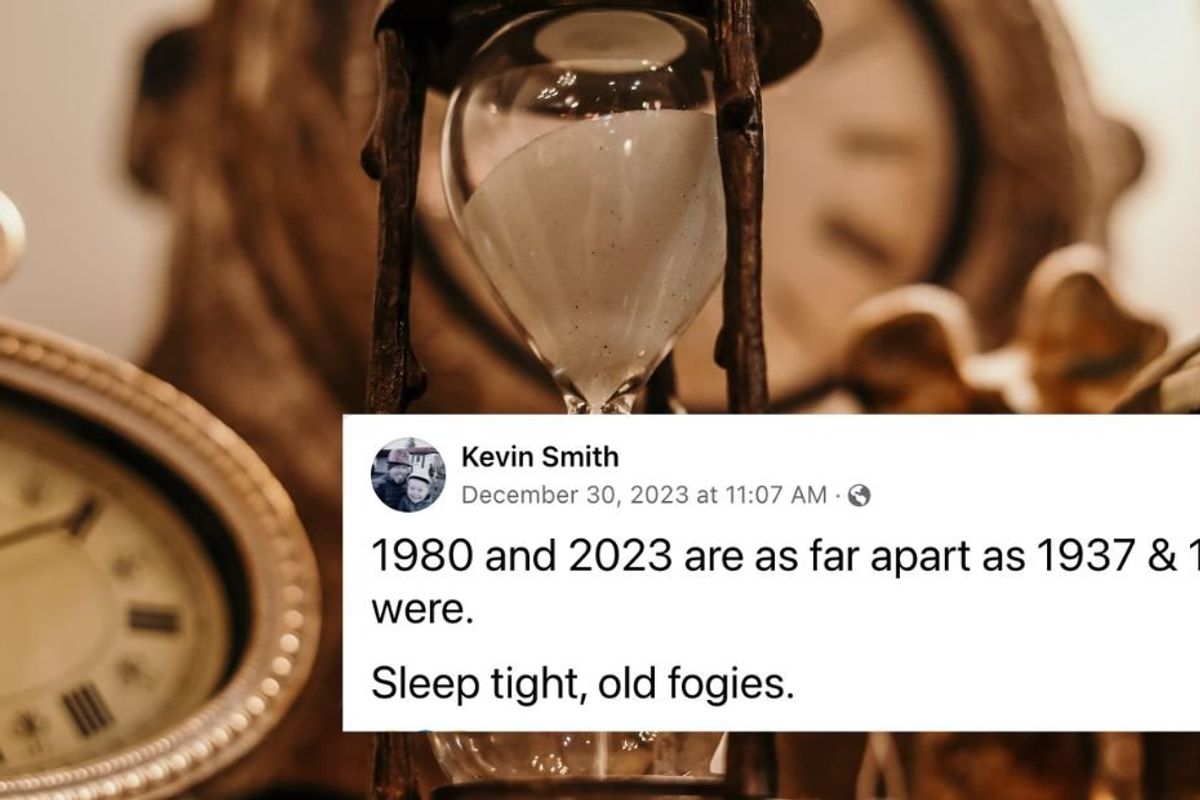
hourglass and clocks with screenshot of post saying 1980 and 2023 are as far apart as 1937 and 1980
Jordan Benton/Canva

Time accelerates as we get older, but there are some interesting ways we can slow it down.

Imagine this scenario, if you will: You're scrolling along, minding your own business on the internet, when this little nugget comes across your timeline: "1980 and 2023 are as far apart as 1937 and 1980. Sleep tight, old fogies!"


Wait, what? Your first reaction is, "That can't be right," so you pull out the calculator and do the math yourself—several times because you're sure you must've missed a number somewhere each time. You remember how long ago 1937 seemed in 1980, and there's absolutely no way that much time passed between 1980 and 2023. Buy you're wrong. As the warped reality of time washes over you, you sit in stunned silence, contemplating the existential crisis you've just been thrown into.

Why does time work this way? Why does it seem to get faster and faster and condense to make decades seem shorter and shorter as we age? And perhaps more importantly, how the heck do we stop time from feeling like a runaway freight train?

Here are a few theories about what creates the freight train phenomenon and what to do about it.

Time perception is relative—and kids perceive it differently

"Time flies when you're having fun" is a saying for a reason. Time also drags when you're doing drudgery work and feels like it stands still in moments of significance. And yet the ticking of seconds as they go by doesn't change tempo. We measure it with steady, unchanging beats, but how it feels changes constantly.

kids playing, time passing, perception of time Time moves more slowly for kids.Photo credit: Canva

This relativity exists in every passing moment, but it also exists in the bigger picture as well. The years felt like they passed by much more slowly when we were children, and by middle age, they feel like they pass in the blink of an eye. The pandemic gave us an even greater sense of this relativity as disruptions to our normal routines and the stress associated with the COVID-19 years messed with our sense of time. (On an odd side note, surveys show that our time perception during the pandemic varied a lot from place to place—people in some parts of the world felt that time moved more slowly, while others felt time moved more quickly.)

According to a 2023 Hungarian study published in Nature Scientific Reports, very young children perceive time differently than older children and adults. Researchers split 138 people into three age groups—pre-kindergarten, school-age and adults 18 and over—and showed them two videos of the same duration, one that was "eventful" and one that was "uneventful." Interestingly, the pre-K group perceived the eventful video to be longer, while the older children and adults saw the uneventful video as longer.

The way the study participants described the length of the videos in gestures was also telling. Young children were much more likely to use vertical hand gestures, connoting volume or magnitude, to indicate a length of time than the other two age groups. School-aged kids and adults tended to use horizontal gestures, indicating time as linear, increasing with age.

Our neural processing slows down as we age

Professor Adrian Bejan has a theory based on how neurons process signals. As we age, our neural networks increase in size and complexity and, as a result, process visual information at a slower rate. That slower processing means we create fewer mental images each second than we did when we were younger, thereby making time seem to slow down.

time, time perception, science of time, aging, neural processing, youth, lifespans, female aging, woman's face over the years A woman slowly ages over about 15 years. assets.rebelmouse.io

“People are often amazed at how much they remember from days that seemed to last forever in their youth, Bejan shared with Harvard University. "It’s not that their experiences were much deeper or more meaningful; it’s just that they were being processed in rapid fire.”

In other words, processing the same number of mental images we did in our youth takes longer now, somewhat counterintuitively making time seem to pass more quickly. So goes the theory, anyway.

It might simply be about time-to-life ratios

Another popular theory about why time feels different as a child than it does as an adult is the ratio of any given day, week or year to the amount of time we've been alive. To a 5-year-old, a year is 20% of their entire life. For a 50-year-old, a year only is 0.2% of their life, so it feels like it went by much more quickly.
hands, clocks, passage of time, age aging, old age, time perception, time flies An elderly person's hands holding a small clock.Photo credit: Canva

It's also a matter of how much change has happened in that year. A year in the life of a 5-year-old is full of rapid growth and change and learning and development. A year in the life of a 50-year-old probably isn't a whole lot different than when they were 48 or 49. Even if there are major life changes, the middle-aged brain isn't evolving at nearly the same rate as a child. A 50-year-old looking back at the past year will have a lot fewer changes to process than a 5-year-old, therefore the year will seems like it went by a lot faster.

“Our perception of days, weeks, years and that kind of time seems to be especially influenced by our perspective: Are we in the moment experiencing it, or are we looking backward on time?” psychology professor Cindy Lustig told the University of Michigan.

The key to slowing it all down? Be mindful of the present moment.

Lustig has a point. When we are in the moment, our perception of time is much different than when we look back. So, being fully conscious in the present moment can help us rein in the freight train effect.

One way to do that is to be mindful of your physical existence in this moment. Feel your heart beating. Feel your breath going in and out. Cornell University psychology professor Adam Anderson, Ph.D., conducted a study that found our perception of time may be linked with the length of our heartbeats. (Study participants were fitted with electrocardiograms and asked to listen to a brief audio tone. They perceived the tone as longer after a longer heartbeat and shorter after a shorter one.) He suggests starting a stopwatch, closing your eyes and focusing on your breathing for what you think feels like a minute. Then, check your time to see how accurate your estimation was.

Breathe World Series GIF by MLB Giphy

“This can give you a sense of how much your experience of your body is related to your experience of time,” Anderson told WebMD. “It will help teach you to enjoy the pure experience of time.”

You can also use focused breathing to purposely slow down your heart rate, and thus slow down your time perception. “We show that slow heart rates—that is, a longer duration between heartbeats—dilates time, slowing it down," Anderson said.

We can also alter our perception of time by taking in novel experiences, such as traveling to new places. According to Steve Taylor, author of Making Time: Why Time Seems To Pass at Different Speeds and How to Control It, people who go on adventurous trips report that their vacations feel longer than those who choose a predictable destination. You can also make small changes to your daily routine, such as trying new foods or taking a new route home from work to take in some new stimuli and slow your perception of time.

A study in 2024 found that people who do intense exercise experience a time warp, feeling like they exercised longer than they really did, so if you want to temporarily slow down time, you can push your body hard during a workout.

- YouTube youtu.be

Finally, try to take in the world the way you did as a small child. Take note of life's wonders. Engage fully in whatever you're doing. Notice details and take mental pictures as much as you can. Time goes by fast when we're distracted, so training our attention on the here and now can help. Ultimately, we can strive to perceive time more like we did when we were little, in its full depth and magnitude instead of a narrow, straight line.

This article originally appeared last year.

time, neil degrasse tyson, time flies, perception of time. clock, science,

A clock and Neil deGrasse Tyson.

When you’re a kid, time passes a lot more slowly than when you’re an adult. At the age of seven, summer seems to go on forever, and the wait from New Year’s Day to Christmas feels like a decade. As an adult, time seems to go faster and faster until one weekend you’re putting up your Christmas lights though you swear you just took ‘em down a month ago.

Why does time seem to speed up as we get older? Astrophysicist Neil deGrasse Tyson recently explained the phenomenon in a video posted to Instagram. He also offered tips on how to slow the passage of time as you age. DeGrasse Tyson is one of the most popular science communicators in the world and the host of 2014's Cosmos: A Spacetime Odyssey and 2020’s Cosmos: Possible Worlds.


Why does time appear to speed up as we get older?


“When you're young, everything is new. Your brain is constantly recording fresh memories, and the more memory your brain stores, the longer the experience feels. But then something changes. As you get older, routines take over. Your brain stops saving so much detail. It switches to autopilot because everything feels familiar and predictable,” deGrasse Tyson explains. “And when your brain stores fewer new memories, your perception of time compresses. That's why childhood feels long, and adulthood feels like a blur.”


Steve Taylor, PhD, author of many best-selling books including Time Expansion Experience, The Leap, and Spiritual ScienceThe Leap, and Spiritual Science, agrees with deGrasse Tyson.

“This is mainly because, as children, we have so many new experiences, and so process a massive amount of perceptual information,” Taylor writes at Psychology Today. “Children also have an unfiltered and intense perception of the world, which makes their surroundings appear more vivid. However, as we get older, we have progressively fewer new experiences. Equally importantly, our perception of the world becomes more automatic. We grow progressively desensitized to our surroundings. As a result, we gradually absorb less information, which means time passes more quickly. Time is less stretched with information.”

How do we make time slow down?

There’s something a little depressing about the idea that time speeds up as we age because we have fallen into predictable routines. The good news is that we can break this cycle by changing our habits and having new experiences. The more novel information we can process and the less routine our lives become, the slower time will move.

DeGrasse Tyson believes that with some change in our behaviors, we can get back to longer summers and Christmases that aren’t perpetually around the corner.

“You can actually slow time down again. Do something unfamiliar,” deGrasse Tysons says. "Travel somewhere new. Break a routine you've repeated for years. Learn a skill your brain hasn't mapped yet. Because the more new memories your brain forms, the slower time feels as it passes. So if life feels like it's accelerating, it's not your age. It's your brain, and you can reboot it.”

Identity

Woman on a plane who saw man's body-shaming texts about her handles the situation with pure grace

“I was afraid that if I started this conversation with him, I would be asked to leave the plane.”

social media, screen shot, body shaming, people, flight
via Canva/Photos and Sober Spouse/TikTok (used with permission)

Screenshots of woman speaking to camera; a plane taking off.

Vanessa, a TikTok user who goes by (@soberspouse), is an inspiration to many because of the way she handled an incredibly uncomfortable situation on a flight from Tampa, Florida, to New York on Delta Airlines. It all started when she sat down beside a man, who immediately rolled his eyes at her.

When she sat down, she noticed he had sent a text message to someone that read: “Ugh, HUGE woman sat next to me,” she recalled. “As soon as I sat, I just glanced over, and I saw it. It was right there in front of my face, and after he had to hit send, he sent a series of empty texts to essentially push what he had written off the view of his screen,” Vanessa told The Mary Sue. Before the plane took off for the two-hour flight of misery, she posted a TikTok sharing her story while asking for kindness.


“Be kind. If you’re feeling inclined, can you send some love? I lost 60+ lbs and have actually been feeling good about myself,” she requested.

After two hours of torture in the sky, Vanessa landed in New York to countless well-wishers congratulating her on her weight loss. "You lost 60 lbs?!? CONGRATULATIONS! That clearly took a lot of effort from you… Don’t let the jerk derail you as you are on a JOURNEY!" one TikTok commenter wrote. "CONGRATS on losing 60lbs! That’s amazing!! So proud of you! Keep feeling good about yourself and do NOT let someone else that clearly doesn’t even like themselves make you doubt yourself!" another added.

During the flight, Vanessa wanted to speak her mind and tell the guy off, but she didn’t want to cause drama on the airplane. To make it through two hours without causing a scene was a lesson in grace. “I didn’t wanna say anything because I really needed to get home to my kids, and I was afraid that if I started this conversation with him, I would be asked to leave the plane,” she told The Mary Sue. “So I took a few deep breaths, made the TikTok or two. I remember thinking I wish I could tell the flight attendant, but I didn’t even wanna get up or move.”

texts, fat-shame, airplanes, mean texts, rude texts, body positivity, A representative image of a text.via Tod Perry

Vanessa attributes her self-control to the personal development she’s made as a sober spouse. “When it happened, my husband was the first person I texted,” she told Upworthy. “He responded by validating the situation I was in and then reassured me I am beautiful, to take a deep breath, and that I would be home soon. If he didn't have the tools from the program, I'm sure the conversation would have looked different.”

Even though she stayed quiet, Vanessa had some things she would have wished she could have told the man. “I’ve thought about this a lot. Part of me has some choice words for him and his khaki pants and his manspread, but then I remember the whole lesson in kindness here. I'm going to assume he's been through something or has been hurt before, and just remember that his comment was more about what he's experienced than me. I honestly have prayed for him and hope he can find some kindness to pay forward in his life,” she told Upworthy.

Vanessa shared a follow-up video sharing the real lesson of the incident. "I'm so glad this little moment of lemons has turned into so much lemonade for so many people," she said. "The amount of kindness that's been spread and shared is really unbelievable."

snl, christmas, holidays, satire, comedy, kristen wiig, saturday night live, humor, youtube, christmas presents, moms
SNL/YouTube

Classic SNL Christmas sketch has people rethinking the holiday dynamics in their family.

Five years ago, one of the most iconic Christmas sketches ever aired on Saturday Night Live. It's called simply, "Christmas Robe," and it depicts an average American family excitedly waking up on Christmas morning, running to the tree, and opening their presents. In song form, each member of the family takes turns rapping about their own gift haul: A hat, a drone, a pinball machine...

Except for poor mom, played perfectly by Kristen Wiig, who only got a robe—that was 40% off. Things only get worse for Mom as she discovers that her stocking is also empty and she must now go make the family breakfast while everyone plays with their new gifts.


If you haven't seen it, here it is. It's well worth watching in its entirety:


- YouTube www.youtube.com

The sketch got a lot of laughs and resonated deeply with people—especially moms—who watched it.

It's no big secret that moms are the primary makers of Christmas magic in most Western families. While they get joy out of making the holidays special for their families, it's a lot of exhausting work, made worse when it goes unnoticed and unappreciated. It's implied, of course, that Kristen Wiig's character bought everyone their presents while no one in the family bothered to think of her at all.

Jessica Cushman Johnston writes for Motherly: "[Making Christmas magic] is not something my husband or my kids put on me, it’s my own deal. It’s also a tinsel-covered baton handed down from generation to generation of women. As a kid, I just thought the warm fuzzy feelings I felt on Christmas morning 'happened.' Now I know that the magic happens because someone is working hard, and now that someone is me."

Kristin Wiig's character beautifully says it all with the dead-inside expression as she feigns excitement over her lonely robe. In just two and a half minutes, the cast and writers managed to capture a frustrating feeling that millions of women relate to.

The sketch spawned discussions, think pieces, and even parodies when it aired in 2020. Real moms took to social media to "show off" their own robes in an act of solidarity. The sketch had, one could say, a moment. And then, quietly, it retired and took its place in the SNL holiday hall of fame, destined to be re-watched for years to come.

And then something funny happened. People kept tuning in. The skit continued to reach new viewers, and somewhere along the line, a few people actually learned something from the extremely silly sketch.

Saturday Night Live's YouTube and social media are full of comments from viewers who say the sketch opened their eyes in a very real way. And even better, that they're changing their behavior because of it:

"As a retail worker, I actually heard multiple people reference this sketch while buying presents for their wife/mom this year. Thanks SNL!"

"This skit changed Christmas in our house. The year it aired my husband made sure I didn’t get a robe and since this aired (okay, two Christmases have gone by) it’s a joy to see boxes under the tree and a full stocking- now in our house when I’m forgotten my husband says, “you got a robe” and adjusts the situation. Never thought a skit could change my life."

"I just saw this first time. I'm definitely going to buy better present next Christmas to my mom."

"A few years ago, I got a robe. This year, I got a new iPad plus all the accessories. SNL doing all the moms a solid."

"As a grown man, this skit is the first time I've realized how true this is. And now I feel so damn awful :( Gonna bombard moms with the presents this year"

"Seriously! I got a bunch more stuff for my mom after seeing this! It's so accurate. No more robes for mom!"

"I was laughing at this, then realized my mom's stocking was empty and ran out and bought her a truckload of stuff. Love you Mom!"

"Thanks, SNL. After watching this with the family, I had the most bountiful Christmas ever!! And the gifts were wrapped instead of left in the bags the came in."

"This video did more to stimulate spending on Moms this year than almost anything else, guaranteed. Look at SNL actually making a difference with their humor"

The comments go on and on, with the video now reaching over 12 million views. Some moms changed their behavior, too, after seeing the sketch:

"This is spot on, and exactly why I now buy myself Christmas presents, without feeling guilty about it."

The trouble of moms unfairly shouldering too much labor around the holidays (and, well, most other times of the year) is not a new problem. Not by a long shot. So why has this skit reached people when other forms of messaging has failed to sway them?

Marie Nicola, a pop culture historian and cultural analyst, says that no amount of deeply serious essays or shrugged off "mom is complaining again" can fix what satire easily addresses. That's the power of comedy at its best:

"It allows the audience see what was historically unseen or ignored, and it validates the labour as visible and concrete, without being accusatory because it wraps the whole thing up in camp comedy and exaggeration. The skit makes it safe to laugh. This is what psychologists call benign violation," she says. "SNL is showing viewers that something is wrong but they have made it safe enough that people can laugh at it instead of feeling attacked. Once the defenses drop, then recognition can flow through that opening."

The Humor Research Lab writes that humor occurs when an accepted "norm" is violated in a benign way—that's the benign violation Nicola's referring to. "Jokes ... fail to be funny when either they are too tame or too risqué."

The best pieces of satire—the ones that reach the highest levels of cultural relevance—thread that needle perfectly. The norm, in this case, according to Nicola, is that it is "a privilege to curate the perfect holiday experience for the family, the gift is the joy in the moment and their memories for years to come." We're not allowed to talk about the dejection and exhaustion that come from all that hard work. This sketch gave a lot of people permission for the first time to do so.

It’s not the first time that SNL’s comedy and satire have had a palpable effect on how we view the world.


- YouTube www.youtube.com

Once SNL performed the "More Cowbell" sketch, none of us could look at the bizarrely overproduced "Don't Fear the Reaper" the same way again. An old Eddie Murphy sketch got a lot of laughs out of the idea of "white privilege" long before it became a commonly known concept. And people had a hard time taking Sarah Palin seriously after Tina Fey's spot-on yet over-the-top impersonation, with studies later investigating the "Tina Fey Effect's" impact on the election.

And now, the more than 12 million people who have seen "Christmas Robe" are going to have a hard time looking at Mom’s empty stocking without being reminded of Kristen Wiig’s pitch-perfect performance.

Of course, "Christmas Robe" continues to land and connect with viewers today in part because it has not solved the problem of household inequities. The phenomenon continues to exist in spades. But the fact that it’s made even a small dent is pretty remarkable for a two-and-a-half-minute parody rap song.

Pop Culture

88-year-old veteran's touching story of why he works full time goes viral, raising over $1 million

Veteran Ed Bambas lost his pension, then lost his wife of more than 50 years.

ed bambas, Samuel Weidenhofer, retired vet, amry vet, veterans, gofundme, charity, donation, fundraiser
@itssozer/Instagram, used with permission

Ed Bambas instantly moved people with his heartfelt honesty.

When shoppers at a Meijer grocery store in Brighton, Michigan stop by the self-checkout, many of them look forward to seeing the friendly face of Ed Bambas, an 88 year old Army veteran who would find himself at the center of social media attention.

Bambas works eight hours a day, five days a week. When Australian content creator and “kindness influencer” Samuel Weidenhofer asked Bambas why he was still working at his age, his heartfelt answer instantly struck a chord.


“I have to.”

In a video that has now reached millions of viewers, Bambas explained that he retired from General Motors in 1999. But in 2012, the company went bankrupt, and Bambas’ pension was taken away. To make matters worse, his wife of fifty year, Joan, became ill and her medical bills had to be paid out of pocket.

“The thing that hurt me the most was when my wife was really sick and when they took the pension, they also took the healthcare coverage and all but 10000 of my life insurance,” he said, voice breaking.

After selling his house and other property he owned, Bambas and Joan “made it through” for a time, but she did pass away seven years ago. Since then, he has been trying to “re establish” himself, but his income has never been enough to stop working.

When asked what his dream was, Bambas simply said to “live somewhat the life I was hoping for.”

That is what prompted Weidenhofer to hand him a $400 tip on the spot, then set up a GoFundMe to help him finally retire.

“Despite everything, Ed shows up every day with quiet dignity, strength, and perseverance. His story is a stark reminder that too many of our seniors, especially veterans, face incredible challenges just to survive,” Weidenhofer wrote on the GFM page.

The fundraiser passed $800,000 on its first day. By Wednesday it had climbed well above $1.2 million.

Supporters shared why they felt compelled to help.

One commenter wrote, “This man is the salt of the earth. We see him every time we go into the store and he is always smiling and just the kindest soul. This makes me so happy to see him recognized and receiving the flowers he deserves and earned so very long ago.”

Celebrities took notice as well. Charlie Puth commented, “Commenting to spread this video. I also donated to you sir.”

Meijer confirmed Bambas has been part of their team for more than five years. The company said, “Ed is a beloved member of the Brighton Meijer store and has been a team member for more than five years. He has a wonderful way of connecting with customers and brings joy to the store with his warmth and his smile.” They added that they are providing him with financial planning assistance so he can make the most of the donations.

Bambas, who’s only ever had a flip phone, never engaged with Instagram or TikTok, let alone knew he had gone viral.

"It came out of the clear blue — I really truly mean that," he told WXYZ.

Weidenhofer has yet to reveal Bambas’ grand total to him, and the fundraiser is still going. Soon he’ll learn that an entire community saw his dream was worth fighting for.

If you’d like to help make this dream come true, you can contribute to Bambas’ GoFundMe page here.

Christmas, santa, kids, parenting, holidays, Christmas magic, holiday spirit, christmas gifts for kids, true meaning of Christmas, Santa songs

No parent loves the moment they have to have the Santa talk.

For many families, Santa is a beloved part of the holiday season…until the inevitable happens, and kids start asking questions. Because treading that fine line between preserving holiday magic and avoiding gaslighting is precarious.

One mom named Martha, aka @read_between_the_whines on TikTok, unfortunately did not strike that balance last year, and inadvertently "ruined" Christmas for her daughter. And now she’s sharing her "cautionary tale" in hopes that it will help other parents navigate those early curious years, especially with what she calls "cuspy kids" who are beginning to connect the dots.


In her video, Martha explained that she used to be someone who was determined to stay completely truthful with her children. So once the holidays rolled around and her oldest began asking pointed questions, she tried to keep things vague without directly lying.

"Last year, the whole season, my oldest was saying things to me that's making me go, 'Okay, she's questioning the validity of this. Tread lightly.' I would try not to lie," she said.

When Martha’s daughter finally did ask outright if Santa was real, she simply responded with, "A lot of people believe he is."

But on Christmas morning, after Martha’s three-year-old opened a much bigger gift, her daughter voiced concerns again, saying, "I don't think Santa came for me."

Thinking this was the perfect moment to offer a gentle explanation and give her kiddo some clarity, Martha said:

"You know how Anna and Elsa are very fun ideas to imagine? Well, similarly, Santa is an idea. He's a really, really fun magical thing to imagine. Santa did come for you. Daddy and I are Santa."

And that’s when everything went downhill. Her daughter cried, she cried, and everything was a huge emotional mess.

"Watching the innocence and magic leave your child’s body is one of the most devastating things I've ever experienced," she shared.

This left poor Martha with only one conclusion: Ride that "gray line" as long as possible, and only answer what kids are directly asking you (in this instance, it was the question of whether Santa had come for her daughter, not whether or not Santa was real).

"Because there's nothing else in life that we lie to our children about," she said. "And if this is going to bring them a little bit of magic, and then they naturally come to the conclusion that this just actually doesn't make that much sense, let them get there on their own."

The comments on her video show just how emotionally loaded this moment can be for families.

One person wrote, "I'm 34 and my mom has still never said Santa isn't real."

Another shared, "This is why we never did Santa. I don't ever want my kid to look at me and say, 'you lied to me? My whole life?'"

One added, "I got to watch both my kids hear their aunt say that he isn’t real, but our family is allowed to believe if we want to. My son was on the cusp as well, but my daughter still fully believed. Heartwrenching for me. I had to leave the house for a bit so I could cry and collect myself."

Another commenter wrote, "[My] daughter asked me to pinky promise, swear on my life, that I wasn’t Santa so I told her the truth and she bawled her eyes out, as did I. It was horrific."

On the bright side, one person shared a heartwarming moment from their own childhood: "When I was probably 6, I saw my dad assembling a Barbie Dreamhouse on Christmas Eve. I was stunned so I was telling a friend about it. Her teenage brother overheard me and said 'you’re right. You figured it out. It’s ridiculous to think Santa visits all of the kids on earth in one night. There’s no way. Santa actually sends your gifts to your parents by UPS and your parents have to put them together for you.' That made sooooo much sense and actually had a lot of explanatory power. It allowed me to continue to believe for several more years. Now as an adult I think of the kindness of a teenage boy saving Christmas for me and for his sister. That was so sweet and I know he’s probably an amazing dad now."

Every family handles this moment differently. But once that moment happens, there’s no going back. So it’s understandable that no parent looks forward to it. However, it can also be a good opportunity to teach them other ways Christmas can feel special.

And that’s exactly what Martha did. In a follow-up video, she told her daughter:

"I know that it feels very sad right now because you feel like the magic of Christmas is just completely gone, but what you don’t realize is that the magic of Christmas has just begun. The true magic of Christmas is when you get to be Santa for other people."

@read_between_the_whines Like… fixed it but she’s still kinda sad… but is also so excited to be my helper this season. #parentingishard #millenialmom #kidsgrowingup #parentingmoments #momof3 ♬ original sound - read_between_the_whines

Suddenly, instead of anguish, Martha’s daughter felt pure excitement at the thought of getting to go Christmas shopping, wrapping presents, eating Santa's cookies, and making magic for others. Martha even went the extra mile by enlisting the extended family to help welcome her daughter into the super secret "Santa Club," making it feel more like a fun rite of passage.

If this isn’t grade-A parental pivoting, we don’t know what is.