People are busting out calculators to check this seemingly impossible math equation
This math isn't mathing.

It's math that's simple enough for a third grader, but it seems wrong no matter how you calculate it.
Time is a strange phenomenon. It speeds up when we want it to slow down and drags when we wish it would go by faster. Sometimes it feels like we blink and a decade has gone by. Cue "the days are long, but the years are short," "time flies when you're having fun," and all the other time cliches that feel 100% true.
Of course, those truisms are all about our perception of time, not time itself. Time ticks by in a never-changing rhythm of seconds, minutes, hours, days and years, perfectly metered and measured. But it sure doesn't feel that way, which is why a simple math equation an average third grader can do has grown adults pulling out their calculators to make sure it's correct.
The equation in question comes from meme that reads "1981 and 2024 are as far apart as 1981 and 1938."
Yep, it's correct. The math checks out, no matter how many times you plug the numbers into the calculator. So why does it feel so wrong?
Again, time is a tricky thing. Those of us who were alive in 1981 remember how far back 1938 seemed to us at that time, and there's simply no way that distance is what 1981 is to us now. It seems impossible.
Part of the problem is that, at least for the middle-agers among us, the 80s still feels like they happened 20 years ago, not 43. That's simply how time perception works as we age.
But that's not all of it. As some people have pointed out, there were certainly major changes in both time periods, but the hugely significant cultural changes from 1938 to 1981 were more visible in many ways than most changes we've seen since then. Yes, technology exploded near the turn of the millennium, but once the internet and laptops and smartphones hit the scene, tech advancements have mostly been a matter of degree—better, smaller, lighter, faster, more efficient, more intuitive—in fairly steady increments and not so much dramatic jumps.
From 1938 to 1981, we saw huge leaps, from tiny black-and-white television to full-color cable television, from the first transatlantic passenger flight to sending humans to the moon on space shuttles, from switchboards and party lines to cell phone technology, from human computers to PCs.
We also saw clothing styles change drastically from one decade to the next during that time period in a way that we haven’t really seen in the past 40 years. Same with architecture and home designs. The mid-20th century saw the birth of rock n' roll, the Civil Rights Movement and the shift to women into the workforce. Again, huge leaps.
Wars also defined generations more in the mid-20th century than in the decades since, from WWII to the Vietnam War to the Cold War. It’s not that we haven’t had wars since 1981, but the direct impact of those wars on American life has not been as notable as those previous wars were.
Then again, it’s possible that much of the difference in feel is simply our perception of life now vs. then. Do the years since 1981 seem shorter simply because we’ve lived them, whereas most of us weren’t alive for a good chunk of the 1938 to 1981 time period and only learned it as “history”?
Hard to say, but one thing that’s clear is that people do not like the way this math feels, as evidenced by the comments people left on the post.
“Fitz is cancelled. Feeling triggered here. Lol”
“I did the math too many times because I don’t want to believe this.”
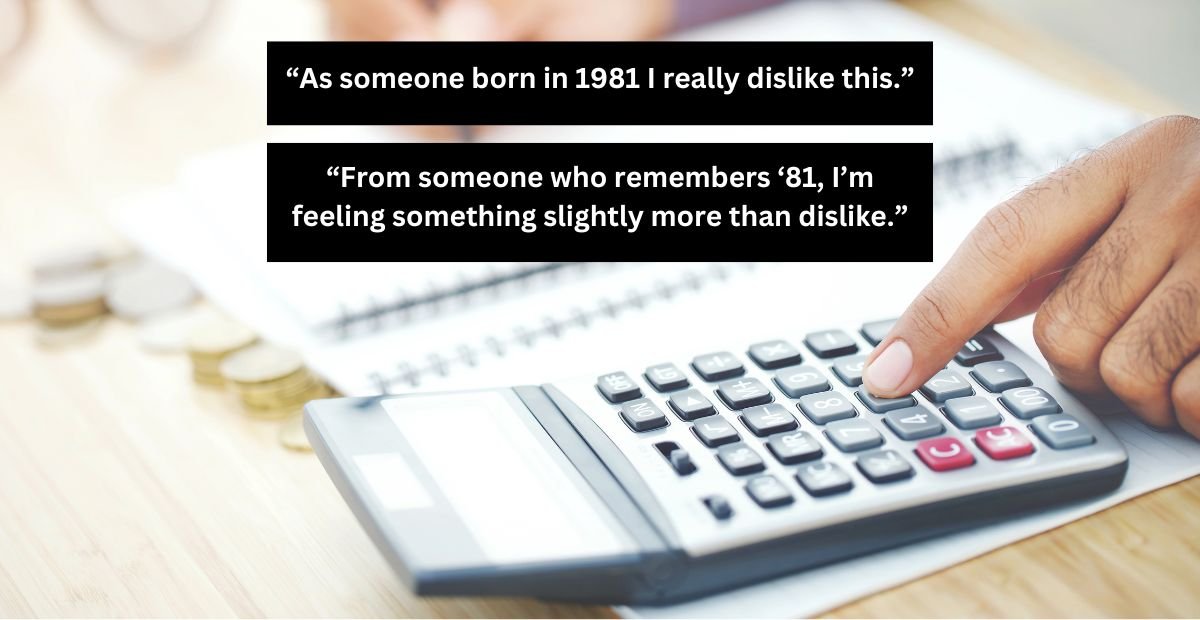
“As someone born in 1981 I really dislike this.”
“Shut your mouth. Those are fighting words! “
“I honestly did nothing to you! Like why?”
“They're not far apart. You're far apart."
It certainly will be interesting to see how the next 43 years feel for the people who live through it vs. 1981 until now.

- Dad's TikTok for son showing what his 80s childhood was like is total Gen X nostalgia ›
- Why time seems to accelerate as we get older and what we can do to slow it down ›
- 3 moments that might convince you Edgar Allan Poe was a time traveler. ›
- Why time seems to speed up as we age and how you can slow it down - Upworthy ›
- Time goes by faster as we age. Here's how to slow it down. - Upworthy ›


A Generation Jones teenager poses in her room.Image via Wikmedia Commons
An office kitchen.via
An angry man eating spaghetti.via 


An Irish woman went to the doctor for a routine eye exam. She left with bright neon green eyes.
It's not easy seeing green.
Did she get superpowers?
Going to the eye doctor can be a hassle and a pain. It's not just the routine issues and inconveniences that come along when making a doctor appointment, but sometimes the various devices being used to check your eyes' health feel invasive and uncomfortable. But at least at the end of the appointment, most of us don't look like we're turning into The Incredible Hulk. That wasn't the case for one Irish woman.
Photographer Margerita B. Wargola was just going in for a routine eye exam at the hospital but ended up leaving with her eyes a shocking, bright neon green.
At the doctor's office, the nurse practitioner was prepping Wargola for a test with a machine that Wargola had experienced before. Before the test started, Wargola presumed the nurse had dropped some saline into her eyes, as they were feeling dry. After she blinked, everything went yellow.
Wargola and the nurse initially panicked. Neither knew what was going on as Wargola suddenly had yellow vision and radioactive-looking green eyes. After the initial shock, both realized the issue: the nurse forgot to ask Wargola to remove her contact lenses before putting contrast drops in her eyes for the exam. Wargola and the nurse quickly removed the lenses from her eyes and washed them thoroughly with saline. Fortunately, Wargola's eyes were unharmed. Unfortunately, her contacts were permanently stained and she didn't bring a spare pair.
- YouTube youtube.com
Since she has poor vision, Wargola was forced to drive herself home after the eye exam wearing the neon-green contact lenses that make her look like a member of the Green Lantern Corps. She couldn't help but laugh at her predicament and recorded a video explaining it all on social media. Since then, her video has sparked a couple Reddit threads and collected a bunch of comments on Instagram:
“But the REAL question is: do you now have X-Ray vision?”
“You can just say you're a superhero.”
“I would make a few stops on the way home just to freak some people out!”
“I would have lived it up! Grab a coffee, do grocery shopping, walk around a shopping center.”
“This one would pair well with that girl who ate something with turmeric with her invisalign on and walked around Paris smiling at people with seemingly BRIGHT YELLOW TEETH.”
“I would save those for fancy special occasions! WOW!”
“Every time I'd stop I'd turn slowly and stare at the person in the car next to me.”
“Keep them. Tell people what to do. They’ll do your bidding.”
In a follow-up Instagram video, Wargola showed her followers that she was safe at home with normal eyes, showing that the damaged contact lenses were so stained that they turned the saline solution in her contacts case into a bright Gatorade yellow. She wasn't mad at the nurse and, in fact, plans on keeping the lenses to wear on St. Patrick's Day or some other special occasion.
While no harm was done and a good laugh was had, it's still best for doctors, nurses, and patients alike to double-check and ask or tell if contact lenses are being worn before each eye test. If not, there might be more than ultra-green eyes to worry about.