upworthy
Add Upworthy to your Google News feed.
Google News Button
Pop Culture

3 moments that might convince you Edgar Allan Poe was a time traveler.

In the case of Poe, it was his fiction that was, well, stranger than fiction.

3 moments that might convince you Edgar Allan Poe was a time traveler.


I'm pretty positive that Edgar Allan Poe had (has?) the power to travel through time. Hear me out on this one.

It's not just the well-known circumstances of his life — orphaned at a young age, father of the mystery novel, master of cryptology, maestro of the macabre. Nor am I referring to the head-scratching details of the days leading up to his death: how he was found on the street near a voting poll wearing someone else's clothes, and during his subsequent hospitalization, he was alleged to babble incoherently about an unidentified person named “Reynolds."

And I won't even get into the confounding reports of a nameless figure who, for seven decades, would show up to Poe's gravesite in the early hours of his birthday with a glass of cognac and three roses.


Tragic and curious, yes, but hardly evidence that the acclaimed horror writer could transcend the limits of space and time. No, my time travel theory concerns the author's creative output, which you'll soon see is so flukishly prophetic as to make my outlandish claim seem plausible — nay, probable!

The proof is in the pudding, and the pudding is a loosely linked map of flesh-eating floaters, crunched skull survivors, and primordial particles. OK, here we go…
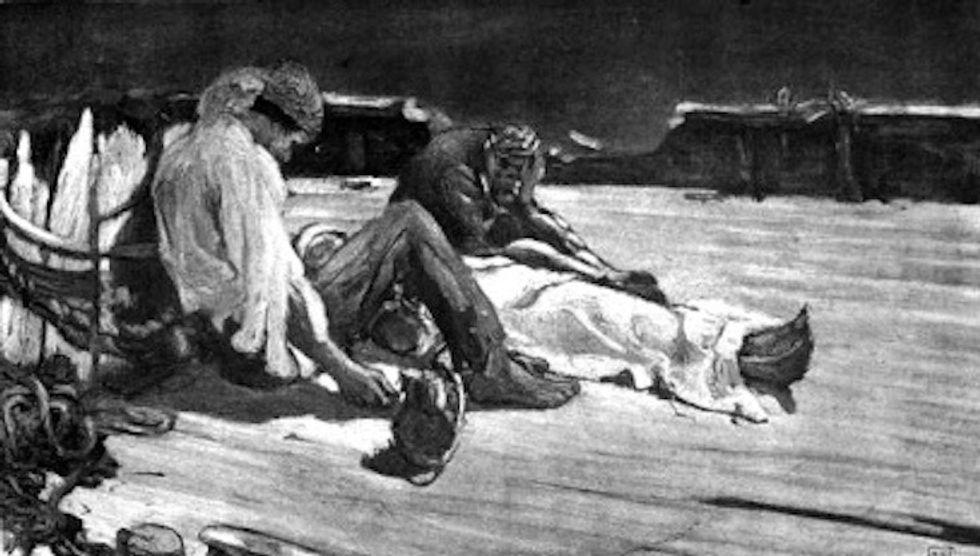
Photo by Albert Sterner/Wikimedia Commons.

Exhibit A: "The Narrative of Arthur Gordon Pym of Nantucket"

Published in 1838, Poe's only completed novel details a mutiny on a whaling ship lost at sea. Out of supplies, the men revert to cannibalism, drawing straws to elect a sacrifice. A boy named Richard Parker draws the shortest straw and is subsequently eaten.

Now here's where it gets weird(er): In 1884, 46 years after the novel's publication, four men would be set adrift following the sinking of their yacht. Shipwrecked and without food, they too would go the survival cannibalism route, electing to kill and eat a 17-year-old cabin boy. The boy's name: Richard Parker.

The extraordinary parallel went unnoticed for nearly a century, until a widely-circulated letter from a descendant of the real Parker outlined the similarities between the novel's scene and the actual event. The letter was selected for publication in The Sunday Times after journalist Arthur Koestler put out a call for tales of “striking coincidence." Striking indeed.

Image from the collection of Jack and Beverly Wilgus/Wikimedia Commons/Wikimedia Commons.

Exhibit B: "The Businessman"

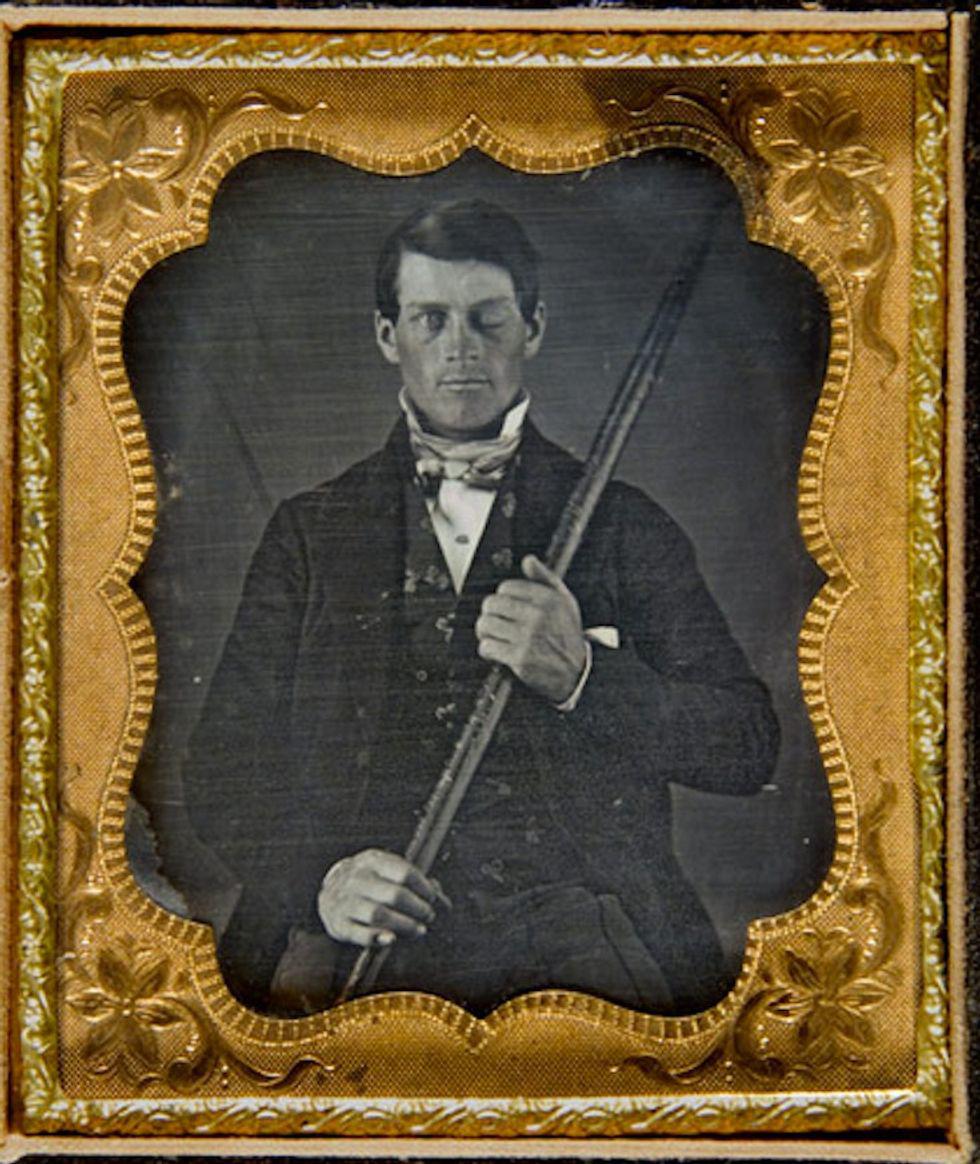
In 1848, a railroad worker named Phineas Gage suffered a traumatic brain injury after taking an iron spike through the skull. Somehow he survived, though his personality would change drastically. These behavioral changes were closely studied, allowing the medical community to develop the first understanding of the role played by the frontal lobe on social cognition.

Except for Poe, who'd inexplicably understood the profound personality changes caused by frontal lobe syndrome nearly a decade earlier. In 1840, he penned a characteristically gruesome story called “The Businessman" about an unnamed narrator who suffers a traumatic head injury as a young boy, leading to a life of obsessive regularity and violent, sociopathic outbursts.

Poe's grasp of frontal lobe syndrome is so precise that neurologist Eric Altshuler wrote, “There's a dozen symptoms and he knows every single one… There's everything in that story, we've hardly learned anything more." Altshuler, who, to reiterate, is a medically-licensed neurologist and not at all a crackpot, went on to say, “It's so exact that it's just weird, it's like he had a time machine."

Photo via NASA/Wikimedia Commons.

Exhibit C: "Eureka"

Still unconvinced? What if I told you that Poe predicted the origins of the universe 80 years before modern science would begin to formulate the Big Bang theory? Surely, an amateur stargazer with no formal training in cosmology could not accurately describe the machinery of the universe, rejecting widely-held inaccuracies while solving a theoretical paradox that had bewildered astronomers since Kepler. Except that's exactly what happened.

The prophetic vision came in the form of "Eureka," a 150-page prose poem critically panned for its complexity and regarded by many as the work of a madman. Written in the final year of Poe's life, "Eureka" describes an expanding universe that began in “one instantaneous flash" derived from a single “primordial particle."

Poe goes on to put forth the first legitimate solution to Olbers' paradox — the question of why, given the vast number of stars in the universe, the night sky is dark — by explaining that light from the expanding universe had not yet reached our solar system. When Edward Robert Harrison published "Darkness at Night" in 1987, he credited "Eureka" as having anticipated his findings.

In an interview with Nautilus, Italian astronomer Alberto Cappi speaks of Poe's prescience, admitting, “It's surprising that Poe arrived at his dynamically evolving universe because there was no observational or theoretical evidence suggesting such a possibility. No astronomer in Poe's day could imagine a non-static universe."

Photo from Dodd, Mead and Company/Wikimedia Commons.

But what if Poe wasn't of a day at all, but of all the days?

What if his written prophecies — on the cannibalistic demise of Richard Parker, the symptoms of frontal lobe syndrome, and the Big Bang theory — were merely reportage from his journey through the extratemporal continuum?

Surely I sound like a tinfoil-capped loon, but maybe, maybe, there are many more prophecies scattered throughout the author's work, a possibility made all the more likely by the fact that, as The New York Times notes, “Poe was so undervalued for so long, there is not a lot of Poe-related material around."

I'll leave you with this quote, taken from a letter that Poe wrote to James Russell Lowell in 1844, in which he apologizes for his absence and slothfulness:

"I live continually in a reverie of the future. I have no faith in human perfectibility. I think that human exertion will have no appreciable effect upon humanity. Man is now only more active — not more happy — nor more wise, than he was 6000 years ago. The result will never vary — and to suppose that it will, is to suppose that the foregone man has lived in vain — that the foregone time is but the rudiment of the future — that the myriads who have perished have not been upon equal footing with ourselves — nor are we with our posterity. I cannot agree to lose sight of man the individual, in man the mass… You speak of “an estimate of my life" — and, from what I have already said, you will see that I have none to give. I have been too deeply conscious of the mutability and evanescence of temporal things, to give any continuous effort to anything — to be consistent in anything. My life has been whim — impulse — passion — a longing for solitude — a scorn of all things present, in an earnest desire for the future."


This story was originally published on HistoryBuff and first appeared on 8.16.16



dance, motherhood, mommy daughter dance, mother daughter relationship, parenting, wholesome
Umi4ika/Youtube

Svetlana Putintseva with her daughter Masha.

In 2005 at only 18 years old, Russian rhythmic gymnast Svetlana Putintseva became a world champion, after which she retired and eventually became a mom. Then, in 2011, Putintseva came out of retirement for one special Gala performance.

Little did anyone know that her then two-year-old daughter named Masha would be the key to making that performance so special.


As the story goes, the young child refused to leave her side that night. But rather than stopping the performance, Putintseva did what so many incredible moms do: she masterfully held space for two different identities.

As we see in the video below, Putintseva simply brought Masha onto the dance floor and incorporated her into the routine—holding and comforting her at times, performing impressive moves while she ran around at others…letting it all become a lively, endearing interaction rather than a rote routine. It became something really touching:

Watch:

Now, a bit of fact-checking as this video has once again started going viral. Despite what many captions say, Putintseva‘s daughter was likely always a planned part of the performance (the tiny leotard is a bit of a giveaway). But that doesn’t really take away from the message behind it: motherhood weaves another soul into one's identity, forever. And one of the biggest lessons it teaches is how to hold someone else steady, all while becoming ourselves.

Every day, moms are engaging in a similar type of “dance”: navigating through the world while guiding and nurturing their little ones. It probably doesn't always feel quite as graceful as what Putintseva put out, and, yet, it is just as beautiful.

dance, motherhood, mommy daughter dance, mother daughter relationship, parenting, wholesome A mother hugging her daughter.Photo credit: Canva

Maybe so many thought it was an improvised moment because improvising is a very real parent superpower. That’s certainly the takeaway we get from some of these lovely comments:

“You cannot control life but you can learn to dance with it. 🤍”

"This is beyond beautiful. 🥲"

“If this isn't a metaphor for motherhood. We improvise so much.”

“A mother’s unconditional love 🥹❤️ She just made my whole month.”

“I do this sometimes while deejaying. My daughter comes up so I hit the slicer and let her chop it up. A few chops and she is happy and goes about her business. 🥰”

“I can see my daughter doing this to me soon whenever I get up on stage on perform. She already stares long and hard at me whenever I am onnstage singing. She doesn't take her eyes off me. Sure she would be running up to stand with me when she starts walking 😂😂 i look forward to it tho”

“Sobbing 😭😭😭😭 As a dancer who hasn’t performed since having a kid, this inspires me in so many ways 🥹🥹 So beautiful and it’s clear that she admires her mom so much 🥰”

- YouTube www.youtube.com

Though not much is written on Putintseva following this performance, one blog post says that Masha has followed in her footsteps by getting into rhythmic gymnastics. Maybe it all started with this one performance. ❤️

Science

Her groundbreaking theory on the origin of life was rejected 15 times. Then biology proved her right.

Lynn Margulis had the audacity to challenge Darwin. And we're lucky she did.

lynn margulis, lynn margulis symbiosis, biology, scientific breakthroughs, darwin, darwinism, women in science
Facts That Will Blow Your Mind/Facebook

A photo of Lynn Margulis.

Throughout her prolific and distinguished career, biologist Lynn Margulis made several groundbreaking contributions to science that we take for granted as common knowledge today. For example, she championed James E. Lovelock’s “Gaia concept,” which posited that the Earth self-regulates to maintain conditions for life.

But by far, her most notable theory was symbiogenesis. While it was first written off as “strange” and “aesthetically pleasing” but “not compelling,” it would ultimately prevail, and completely rewrite how we viewed the origin of life itself.


In the late 1960s, Margulis wrote a paper titled "On the Origin of Mitosing Cells," that was quite avant-garde. In it, she proposed a theory: that life evolved through organisms merging together to become inseparable.

In essence, cooperation is the driver of life, not competition and domination. This directly went against Darwin’s “survival of the fittest” principle that was considered gospel in scientific circles. Margulis’ paper was rejected by fifteen journals before getting accepted into the Journal of Theoretical Biology.

- YouTube www.youtube.com

Time would be on Margulis’ side, however. By the late ‘70s and early ‘80s, research proved that the two major building blocks of plants and animals, chloroplasts and mitochondria were at one time independent bacteria. This solidified the fact that on a biological level, connection trumps autonomy for longevity. And now that fact is written in textbooks, with no real story of the adversity it overcame to get there.

While it is customary for most new scientific theories to be met with criticism, especially those that completely shift the current narrative, many have noted that sexism played a key part in Margulis’ initial lack of acceptance. On more than one occasion, she herself had hinted that women were seen as mothers and wives first, and scientists second. She recalled that while married to fellow scientist Carl Sagan that “Carl would finish his sentence, unperturbed” while she was expected to “handle all the duties of a 1950s housewife, from washing dishes to paying the household bills.”

And yet, Margulis would have other ideas that were controversial that had nothing to do with her gender. Most famously, she did not believe that AIDS was caused by HIV, and instead believed it was cause by a syphilis-causing type of bacteria, despite there already being decades of research proving otherwise. That view was seen as an endorsement of AIDS denialism, which undermined prevention and treatment effort. Then later in life, Margulis became a vocal proponent of 9/11 conspiracy theories suggesting government involvement the in Twin Towers attacks.

And yet, perhaps this is one of those “you gotta take the good with the bad” situations. Margulis’ inherent contrarian nature gave us both these unfounded, even harmful stances, in addition to entirely new paradigms that altered our understanding of life itself.

And if nothing else, it illuminated the need for science to include multiple points of view in order to unlock the truth. It seems life is, after all, about coming together.

feel good story, music, rock music, lost and found, musicians
Photo credit: Marcus Pollard on Facebook

Marcus Pollard is reviving a 77-year-old warehouse worker's lost rock music.

In the 1960s, Norman Roth and his band, The Glass Cage, were Canadian indie rockers who played small local shows and built enough of a following to land gigs in bigger cities. When Roth was 18, the band recorded a live performance that was never officially released and was eventually lost after they broke up shortly afterward. Now, thanks to a four-dollar thrift store purchase, the band's music is reaching a wider audience—58 years later.

In 2016, veteran rock music promoter Marcus Pollard bought an unlabeled vinyl record at a thrift store on a whim, despite the album being physically damaged. He fell in love with the six songs recorded on it and spent the next two years trying to track down any band members connected to the record.


"I searched in vain for two years trying to get any clue as to who was on the record, but to no avail," Pollard wrote on Facebook. "Then, in a last ditch effort I posted a clip on the Canadian Artists Records Appreciation FB page and... I got a hit!"

Pollard eventually received a reply that read, "Hey, that's my record!" from Roth, now 77 and working as a warehouse manager. Roth was floored that his band's long-lost recording had resurfaced, and he was able to listen to songs he hadn't heard in more than 50 years.

- YouTube youtube.com

After reuniting Roth with his lost music, Pollard went a step further. After consulting with the other band members, he set out to bring The Glass Cage's music back to life after remaining dormant for generations. Pollard spent the next eight years using his industry connections and expertise to officially release the album. Working with a team of professionals, he refurbished the damaged record, digitally remastered the songs, designed elaborate packaging, and developed a booklet detailing the band's impact on the Vancouver indie rock scene of the 1960s before they broke up.

The finished vinyl album, titled Where Did the Sunshine Go?, is scheduled for release on February 24, 2026.

"I feel like everyone has done something in their life that was dismissed," Pollard told CTV News. "And I wanted them to feel like what they created was actually important."

While Roth and his former bandmates are excited about the album's release, they aren't trying to relive their youth or chase the rock star dreams they once had. They're just happy that others will now have access to their music and are enjoying the ride.

"I'm not looking for accolades or super stardom—that's long gone," Roth told CTV News. "It's just saying to the world, 'I was here.' And I hope they enjoy it."

If you'd like to hear Roth's music, you can stream tracks by The Glass Cage on Bandcamp and purchase the vinyl when it's released.

top sheet, flat sheet, bedding, duvet, generations, millennials, Gen Z, hygiene, sleep, making the bed

A woman sleeps peacefully in bed.

Once again, the youngins are flabbergasting the older generations with their disregard for once-important things they now deem unnecessary. There's always something that gets dropped or altered generation to generation. We learn better ways to do things and technology makes certain practices obsolete. But in one area, it doesn't matter how far we've come: our beds still need sheets to cover the mattress.

The debate is on the use of top sheets, also known as flat sheets. They're the sheets that keep your body from touching the comforter, and most Gen X and Boomers are firmly for the use of top sheets as a hygiene practice. The idea is the top sheet keeps your dead skin cells and body oils from dirtying your comforter, causing you to have to wash it more often.


Apparently, Millennials and Gen Zers are uninterested in using a top sheet while sleeping. In fact, they'd rather just get a duvet cover, though they may be cumbersome. A duvet cover can be washed fairly frequently, but some may opt for a simple comforter, a cheaper option that should be washed even more often. Still, many young people don't care how much more frequently they'll need to wash their comforters because their distain for a top sheet is that strong.

top sheet, flat sheet, bedding, duvet, generations, millennials, Gen Z, hygiene, sleep, making the bed A man sleeps peacefully. Canva Photos

But why on earth do Millennials and Gen Zers hate top sheets? It turns out it's mostly about practicality. Many Millennials are on the move holding a full-time job and a side hustle or two to make ends meet. Thus, to add an extra step when making the bed seems unnecessary.

“For a younger demographic, eliminating that step when making the bed in the morning really gives you a jump start on the day," Ariel Kay, CEO of Parachute tells Wall Street Journal.

Parachute is a company that offers bedding sets sans top sheets for folks who just don't like them and, boy, has Kay heard everyone's unsolicited opinions on the matter. She told WSJ that people will stop her on the street to get into debates about the importance or unimportance of top sheets. Yikes.

In a since deleted tweet, @JesseLynnHarte writes, "People say millennials 'killed' chain restaurants, marriage, & napkins... But WHEN will they acknowledge our greatest take-down yet?? TOP SHEETS. I don’t know a single millennial who uses one. Top sheets are archaic. This is just the truth."

It would seem that Millennials and Gen Z would much rather wash their duvet covers weekly than to add a flat sheet into the mix. One big complaint about the flat sheet that adds another con to the list is they get bunched up or tangled around your legs if you're a restless sleeper. Not everyone likes hotel tucked corners on their sheets because it can feel confining.

top sheet, flat sheet, bedding, duvet, generations, millennials, Gen Z, hygiene, sleep, making the bed Woman snuggled in bed.Canva Photos

But if you run hot, Boomers and Gen Xers might be onto something with the top sheet. It would seem that that thin piece of material that irritates some people can help control your body temperature according to USA Today. Even if you don't tend to need the cooling effect of a top sheet, what Mary Johnson, Tide Principal Scientist at Procter & Gamble has to say in a USA Today follow up article, just may make you rethink ditching the top sheet.

Simply by existing, "people produce one liter of sweat, 40 grams of sebum, 10 grams of salt, and 2 billion skin cells. All that stuff that happens below the waist [and] up by your head—skincare products, hair care products, ear wax, snot, drool, lots of really gross stuff—is transferred to your sheets," Johnson tells the outlet.

So whether you're team top sheet or not, it may be a good idea to at least wash whatever you use to cover your bed at least once a week. It couldn't hurt.

@goodhousekeepingofficial

We asked the #GoodHousekeeping team what they really think about #topsheets, and the answers might surprise you. 😆 Keep watching to find out where everyone stands in this epic #bedding #debate.

This article originally appeared last year. It has been updated.

american, americans, proud american, funny things about americans, people in the united states, hilarious americans, united states

Non-Americans share the funniest things they've heard about what Americans are like.

The United States is unlike any other country in the world. From its sheer size to the abundance of free refills, it's a place and culture that many non-Americans can't wrap their heads around.

On the flip side, it can lead to lots of funny (and sometimes true) assumptions about what the United States and American culture is really like. A Reddit user asked Americans for “the funniest thing a foreigner has said to you about America.”


The answers were a great mix of cultural misunderstandings, myth-busting, and much-needed geography lessons. Here are 15 of the funniest things non-Americans have told Americans about the U.S.

- YouTube www.youtube.com

1. Slick Willy

"While being transported from the airport to the hotel in Morocco, the cab driver said, 'American?' I responded, 'Yes.' His response: 'Ahhh yes. Bill Clinton.'"

"Buddy was in Eastern Europe in the 90s, and a little old lady who spoke no English found out he was American and just said 'Monica Lewinsky' and then laughed."

2. American monsters

"An International Student (from Malta) and I were hanging out at the 'Smoker's Lounge,' aka the place in front of the dorms where people smoked. A raccoon popped out of one of the trash cans, and he freaked out and said that the animals in North America were the size of monsters."

3. It's a big country

"A Japanese person once told me that the US is 'enviably wide.'"

"Because Japan is similarly tall, but lamentably skinny."

japan, size of japan, size of united states, japan vs united states, map of united states The size of Japan compared to the United States.Image via Wikimedia

4. Melon farmers?

"A guy from the UK I know loves to refer to Americans as melon farmers. Melon farming imbeciles. Doesn't know what some object I refer to is? Must be some kind of weird melon farming contraption. Where have I been the last few days? Must have been tending to my melon farm. I wish I had a backyard instead of a dumb asphalt apartment parking lot? Ah, I must be missing life back on my melon farm."

5. No wood houses

"This man I knew in college was from rural Kenya. Apparently, your temporary house was constructed of wood. Folks that had gained enough wealth no longer had a wooden house."

"We had a guy from Kenya bring pumpkin spice muffins to a potluck. He said something like 'I see how you keep pumpkins on your porches, so I figured you must really love them.'"

6. We love ranch

"A French guy asked me if we really put ranch on everything. I said, 'Yes, even salad,' and he stared at me like I’d just admitted to living in a dumpster."

- YouTube www.youtube.com

7. Guns, guns, guns

"A Persian man that I worked with did a redneck impression. He said 'I'm an American and I like guns and Jesus' in a perfect southern accent."

"When I lived in Italy, one of the first questions my neighbors asked was 'How many guns do you have and where do you keep them all?' They were absolutely floored that I didn’t own any guns."

8. Small world

"A waiter in Prague asked where I was from. I told him Boston. He said, 'Oh, I have a friend named Tomas Dvorak in Wyoming. Do you know him?'"

9. We love peanut butter

"When I studied abroad in Germany, my host family told me 'We bought lots of peanut butter for you. We know Americans need peanut butter.' I do love peanut butter, but I had definitely never heard that stereotype before!"

I did once startle a lovely Australian couple with my PBJ. Apparently, PB and J are only considered compatible here in North America. They looked at the sandwich I made with the same kind of horror I might’ve used on something with, IDK, tuna and marshmallow fluff."

10. Are cheerleaders real?

"'Are cheerleaders real?' Cheerleaders were in movies, but a teenager in London had no idea if that was a real thing. It was a charming conversation as a teenager."

"I like how foreigners will believe that everyone in America is dodging gunfights and car chases on their morning commute, but then think we made up cheerleaders and yellow busses for the movies."

11. Sweet tea is addictive

"A British friend of mine called southern sweet tea 'the most vile, disturbing, horrific swill ever created. Please bring another pitcher.'"

"If they don't have to amputate a foot after your first glass it needs more sugar."

@landontalks

Let’s discuss: Sweet Tea in the south. #southern #southernaccent #sweettea #southernliving #thesouth @ibbkate

12. Angry sink

"Saying I had an angry sink because it had a garbage disposal in it."

13. Crossed-up

"My fiancé from the Netherlands asked what the 'zing' road sign meant that he kept seeing everywhere. I couldn’t figure out what the heck he was talking about at first. It was the X-ing (crossing) sign."

"My international colleague thought it was a word in Chinese (Xing) and was very confused by this lol."

14. It's bigger than you think

"My wife's Swedish cousins thought they could go explore both New York City and Los Angeles in a single weekend."

"Also had Swedish visitors, and we live in New England. They wanted to take a drive to California during the 5 days they were going to be here, and they wanted to stop and see the Grand Canyon along the way, then be back in time to catch their flight home out of Boston."

15. The Ohios

"Was at a pub in Italy with a friend, and some of the guys found out we were American. Proceeded to take shots with them toasting ‘to the Ohios!’… we’re not from Ohio lol."

"Which Ohio are you not from, North Ohio, or South Ohio?"

This article originally appeared last year. It has been updated.