This kids' worksheet is a perfect example of how implicit bias gets perpetuated.

Stereotypes are formed and reinforced in countless ways we may not even be aware of—but we have to be aware of them.

The term "implicit bias" refers to the unconscious attitudes, beliefs, and stereotypes that affect how we think about and behave towards others. Harvard's famous implicit bias test for race evaluates how quickly you associate certain positive or negative terms with faces of different races, and the issue of bias has come up repeatedly in debates around police brutality.

Because racism, racial prejudice, and racial bias are prominent and problematic issues in society, it's vital that we all become aware of how they work—and how they can show up in seemingly innocuous places.


See exhibit A:

It's the subtle, subliminal messages that we have to watch out for. Those images that seep into our children's sub conscience and derail their confidence. Not on my watch! Not my brilliant babies!

Posted by Aqkhira S-Aungkh on Thursday, January 3, 2019

This kids' worksheet offers a perfect example of how implicit racial bias gets perpetuated.

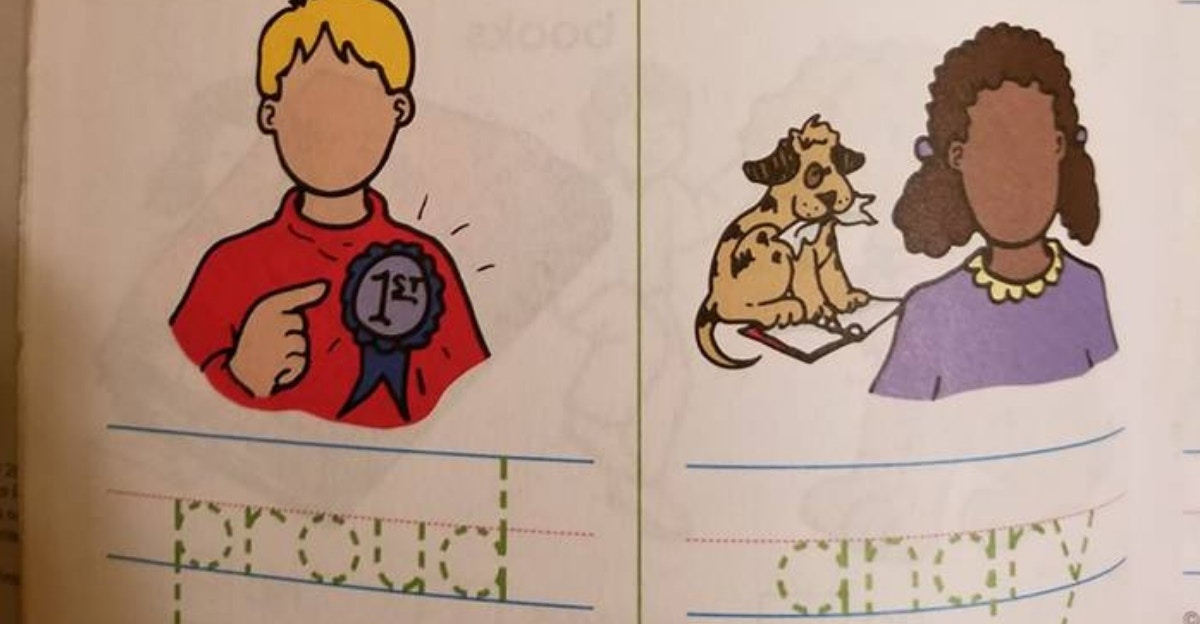
Facebook user Aqkhira S-Aungkh shared a photo of a worksheet from a child's vocabulary workbook with four children with blank faces on it—one celebrating a birthday with the word "happy" underneath it, one with a broken balloon and the word "sad," one with a 1st prize button and the word "proud," and one with a dog eating homework and the word "angry."

The problem? The "happy" and "proud" kids are white. The "sad" and "angry" kids are brown or black.

S-Aungkh shared that she found the page in a vocabulary workbook for kindergarten and first grade kids, which had a publication date of 2009.

She wrote in a comment:

"This book was gifted to me and I was going thru it when I saw the picture the post [sic] was reaction like not this sh.. again. It will definitely be followed up with a letter, and more importantly not be used with my students. Any of my parents past and present can attest to the lengths I will go to instill a sense of pride , appreciation and knowledge of who they are and their rich ancestral history including having certain online homeschool curriculum changed because of videos they had students view that were harmful to the psyche of our children."

Ascribing the "positive" feelings to white kids and the "negative" feelings to black kids is 100% not okay. When black women are often stereotyped as being angry, this kind of representation is harmful. When white people have historically oppressed black people in America, portraying the white kids as "happy" and "proud" with a 1st prize ribbon while the black kids are suffering and experiencing sadness and anger right beside them merely perpetuates unequal historical norms.

Such racial representation reinforces white supremacy and sends kids of color negative messages about themselves—hence perpetuating implicit racial bias. Is it just coincidental that the races of kids were distributed this way? Possibly. Is it okay to let it fly because someone may not have done it on purpose? Nope.

The CEO of the publishing company responded to people's outcry over the page with a clear statement.

S-Aungkh shared the company's response on Facebook:

"It has been brought to our attention that our Homework Helpers Vocabulary Development Workbook features an occurrence of implied racism.

We are deeply apologetic that this has happened. While this was a completely unintentional error when this book was published in 2001, I want to be perfectly clear about this: the appearance of implied racism, sexism, or bias of any nature is unacceptable to me and everyone at Carson Dellosa—and it is not what we stand for.

Effective immediately, this particular title will no longer be available for sale, and our existing inventory will be destroyed. We would like to provide an equivalent, replacement workbook to any teacher or parent who currently owns this book.

As a company, we strive to publish educational materials that are inclusive. We can do better, and we are taking the proper steps, now and moving forward, to assure that mistakes like this one do not happen again. To that end, our organization is moving forward with the following initiatives to ensure that our products are of utmost quality:

- The formation of an editorial committee comprised of both internal and external resources, with expertise in diversity, to create an internal process for evaluation and identification of any implied racism, sexism, or bias of any nature.

- A process to review all currently available materials both in our warehouse and available on our digital assets with the intent to immediately dispose of/correct any unacceptable content

- An awareness program that helps ensure that we continue to create inclusive materials

- A donation to a non-profit organization that combats racism – and we welcome suggestions for organizations that you support

Sincerely,

Ira Hernowitz, CEO of Carson Dellosa Education"

Hernowitz's response acknowledges the problem, remedies the immediate issue, explains the learning process taking place, and offers specific actions the company will take to avoid repeating the same problem—including financial support for groups doing anti-racism work. Of the various corporate responses to racial bias complaints I've seen, this is one of the better ones. Let's hope they follow through and that other publishers take a page from their book.

We all have to stay aware of the messages we may be getting in our everyday lives, and especially watch for what our children may be learning without realizing it. The only way we'll slowly weed out subconscious racial bias is by recognizing examples that perpetuate it and call it out when we see it.  
via Kat Stickler / TikTok

Kat Stickler has created a hilarious series of videos about her husband that a lot of women say they can relate to because theirs behave the exact same way.

Stickler is a mother who shares funny videos about her domestic life on TikTok where she's earned over six million followers.

In the videos, she transforms into her husband Mike by throwing on a backward baseball cap and adopting a deeper voice. From the videos, it's pretty clear that Mike always wants some sort of praise for doing the things he's supposed to do.

The interesting thing about the couple is that they went from dating to parents pretty much overnight. Three months after their first date, Kat was pregnant and they were married.

Keep Reading Show less
via Kat Stickler / TikTok

Kat Stickler has created a hilarious series of videos about her husband that a lot of women say they can relate to because theirs behave the exact same way.

Stickler is a mother who shares funny videos about her domestic life on TikTok where she's earned over six million followers.

In the videos, she transforms into her husband Mike by throwing on a backward baseball cap and adopting a deeper voice. From the videos, it's pretty clear that Mike always wants some sort of praise for doing the things he's supposed to do.

The interesting thing about the couple is that they went from dating to parents pretty much overnight. Three months after their first date, Kat was pregnant and they were married.

Keep Reading Show less
True

Each year, an estimated 1.8 million people in the United States are affected by cancer — most commonly cancers of the breast, lung, prostate, and blood cancers such as leukemia. While not everyone overcomes the disease, thanks to science, more people are surviving — and for longer — than ever before in history.

We asked three people whose lives have been impacted by cancer to share their stories – how their lives were changed by the disease, and how they're using that experience to change the future of cancer treatments with the hope that ultimately, in the fight against cancer, science will win. Here's what they had to say.

Celine Ryan, 55, engineer database programmer and mother of five from Detroit, MI

Photo courtesy of Celine Ryan

In September 2013, Celine Ryan woke up from a colonoscopy to some traumatic news. Her gastroenterologist showed her a picture of the cancerous mass they found during the procedure.

Ryan and her husband, Patrick, had scheduled a colonoscopy after discovering some unusual bleeding, so the suspicion she could have cancer was already there. Neither of them, however, were quite prepared for the results to be positive -- or for the treatment to begin so soon. Just two days after learning the news, Ryan had surgery to remove the tumor, part of her bladder, and 17 cancerous lymph nodes. Chemotherapy and radiation soon followed.

Ryan's treatment was rigorous – but in December 2014, she got the devastating news that the cancer, once confined to her colon, had spread to her lungs. Her prognosis, they said, was likely terminal.

But rather than give up hope, Ryan sought support from online research, fellow cancer patients and survivors, and her medical team. When she brought up immunotherapy to her oncologist, he quickly agreed it was the best course of action. Ryan's cancer, like a majority of colon and pancreatic cancers, had been caused by a defect on the gene KRAS, which can result in a very aggressive cancer that is virtually "undruggable." According to the medical literature, the relatively smooth protein structure of the KRAS gene meant that designing inhibitors to bind to surface grooves and treat the cancer has been historically difficult. Through her support systems, Ryan discovered an experimental immunotherapy trial at the National Institutes of Health (NIH) in Bethesda, MD., and called them immediately to see if she was eligible. After months of trying to determine whether she was a suitable candidate for the experimental treatment, Ryan was finally accepted.

The treatment, known as tumor-infiltrating lymphocyte therapy, or TIL, is a testament to how far modern science has evolved. With this therapy, doctors remove a tumor and harvest special immune cells that are found naturally in the tumor. Doctors then grow the cells in a lab over the next several weeks with a protein that promotes rapid TIL growth – and once the cells number into the billions, they are infused back into the patient's body to fight the cancer. On April 1, 2015, Ryan had her tumor removed at the NIH. Two months later, she went inpatient for four weeks to have the team "wash out" her immune system with chemotherapy and infuse the cells – all 148 billion of them – back into her body.

Six weeks after the infusion, Ryan and Patrick went back for a follow-up appointment – and the news they got was stunning: Not only had no new tumors developed, but the six existing tumors in her lungs had shrunk significantly. Less than a year after her cell infusion, in April 2016, the doctors told Ryan news that would have been impossible just a decade earlier: Thanks to the cell infusion, Ryan was now considered NED – no evaluable disease. Her body was cancer-free.

Ryan is still NED today and continuing annual follow-up appointments at the NIH, experiencing things she never dreamed she'd be able to live to see, such as her children's high school and college graduations. She's also donating her blood and cells to the NIH to help them research other potential cancer treatments. "It was an honor to do so," Ryan said of her experience. "I'm just thrilled, and I hope my experience can help a lot more people."

Patrice Lee, PhD, VP of Pharmacology, Toxicology and Exploratory Development at Pfizer

Photo courtesy of Patrice Lee

Patrice Lee got into scientific research in an unconventional way – through the late ocean explorer Jacques Cousteau.

Lee never met Cousteau but her dreams of working with him one day led her to pursue a career in science. Initially, Lee completed an undergraduate degree in marine biology; eventually, her interests changed and she decided to get a dual doctoral degree in physiology and toxicology at Duke University. She now works at Pfizer's R&D site in Boulder, CO (formerly Array BioPharma), leading a group of scientists who determine the safety and efficacy of new oncology drugs.

"Scientists focused on drug discovery and development in the pharmaceutical industry are deeply committed to inventing new therapies to meet unmet needs," Lee says, describing her field of work. "We're driven to achieve new medicines and vaccines as quickly as possible without sacrificing safety."

Among the drugs Lee has helped develop during her career, including cancer therapies, she says around a dozen are currently in development, while nine have received FDA approval — an incredible accomplishment as many scientists spend their careers without seeing their drug make it to market. Lee's team is particularly interested in therapies for brain metastases — something that Lee says is a largely unmet need in cancer research, and something her team is working on from a variety of angles. "Now that we've had rapid success with mRNA vaccine technology, we hope to explore what the future holds when applying this technology to cancers," Lee says.

But while evaluating potential cancer therapies is a professional passion of Lee's, it's also a mission that's deeply personal. "I'm also a breast cancer survivor," she says. "So I've been on the other side of things and have participated in a clinical trial."

However, seeing how melanoma therapies that she helped develop have affected other real-life cancer patients, she says, has been a highlight of her career. "We had one therapy that was approved for patients with BRAF-mutant metastatic melanoma," Lee recalls. "Our team in Boulder was graced by a visit from a patient that had benefited from these drugs that we developed. It was a very special moment for the entire team."

None of these therapies would be available, Lee says without rigorous science behind it: "Facts come from good science. Facts will drive the development of new drugs, and that's what will help patients."

Chiuying "Cynthia" Kuk (they/them) MS, 34, third-year medical student at Michigan State University College of Human Medicine

Photo courtesy of Cynthia Kuk

Cynthia Kuk was just 10 years old when they had a conversation that would change their life forever.

"My mother, who worked as a translator for the government at the time, had been diagnosed with breast cancer, and after her chemotherapy treatments she would get really sick," Kuk, who uses they/them pronouns, recalls. "When I asked my dad why mom was puking so much, he said it was because of the medicine she was taking that would help her get better."

Kuk's response was immediate: "That's so stupid! Why would a medicine make you feel worse instead of better? When I'm older, I want to create medicine that won't make people sick like that."

Nine years later, Kuk traveled from their native Hong Kong to the United States to do exactly that. Kuk enrolled in a small, liberal arts college for their Bachelor's degree, and then four years later started a PhD program in cancer research. Although Kuk's mother was in remission from her cancer at the time, Kuk's goal was the same as it had been as a 10-year-old watching her suffer through chemotherapy: to design a better cancer treatment, and change the landscape of cancer research forever.

Since then, Kuk's mission has changed slightly.

"My mom's cancer relapsed in 2008, and she ended up passing away about five years after that," Kuk says. "After my mom died, I started having this sense of urgency. Cancer research is such that you work for twenty years, and at the end of it you might have a fancy medication that could help people, but I wanted to help people now." With their mother still at the forefront of their mind, Kuk decided to quit their PhD program and enter medical school.

Now, Kuk plans to pursue a career in emergency medicine – not only because they are drawn to the excitement of the emergency room, but because the ER is a place where the most marginalized people tend to seek care.

"I have a special interest in the LGBTQ+ population, as I identify as queer and nonbinary," says Kuk. "A lot of people in this community and other marginalized communities access care through the ER and also tend to avoid medical care since there is a history of mistreatment and judgement from healthcare workers. How you carry yourself as a doctor, your compassion, that can make a huge difference in someone's care."

In addition to making a difference in the lives of LGBTQ+ patients, Kuk wants to make a difference in the lives of patients with cancer as well, like their mother had.

"We've diagnosed patients in the Emergency Department with cancer before," Kuk says. "I can't make cancer good news but how you deliver bad news and the compassion you show could make a world of difference to that patient and their family."

During their training, Kuk advocates for patients by delivering compassionate and inclusive care, whether they happen to have cancer or not. In addition to emphasizing their patient's pronouns and chosen names, they ask for inclusive social and sexual histories as well as using gender neutral language. In doing this, they hope to make medicine as a whole more accessible for people who have been historically pushed aside.

"I'm just one person, and I can't force everyone to respect you, if you're marginalized," Kuk says. "But I do want to push for a culture where people appreciate others who are different from them."