upworthy
Add Upworthy to your Google News feed.
Google News Button
Education

She quit teaching, works at Costco, and has 'never been happier.' That says something.

Maggie Perkins' viral videos and unique perspective have ignited the conversation around teacher attrition.

Teacher turned Costco employee talking to camera

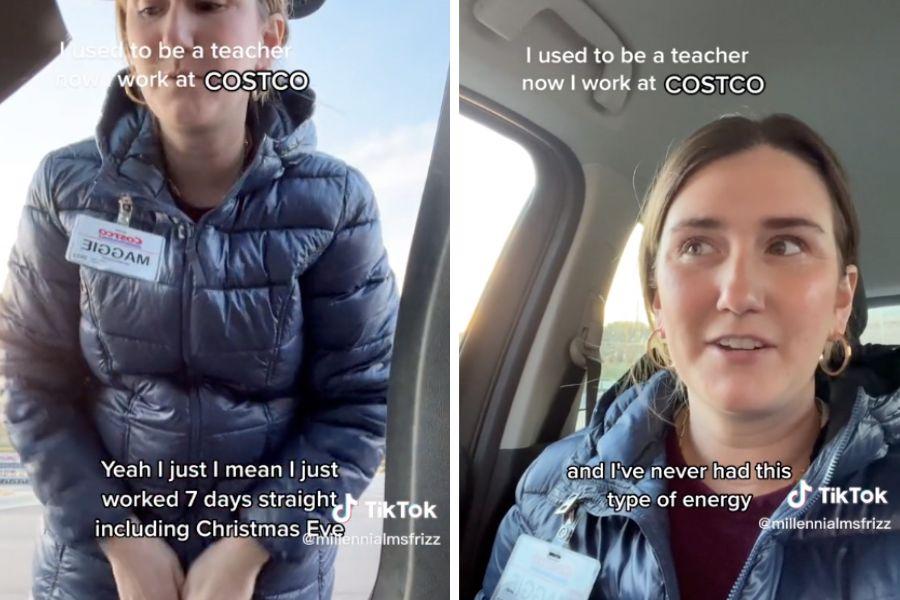
Maggie Perkins doesn't miss having a winter break.

Maggie Perkins loves teaching, loves teachers and loves students. In fact, she loves them so much that working on her Ph.D. in Educational Theory and Practice. Her research is focused on teacher attrition, examining why quality, experienced teachers quit the profession—something she understands all too well since she recently became one of them.

The former educator now works at Costco and she says she's never been happier. Her migraines are gone. Her anxiety has improved. She sleeps through the night. As an entry-level employee, she makes less money than she did teaching, but not enough less to make a difference in her financial situation. She goes home from work happy at the end of the day.

Perkins has been sharing the contrast in working conditions between the classroom and Costco on her TikTok channel and it is eye-opening, to say the least.


To be fair, Costco is known for employee satisfaction. They take good care of their people with solid wages and benefits, and as a result, they have an impressive 94% retention rate for employees who stay longer than a year. That's incredible for a retail business. And it's not just about their comparatively generous compensation package. Perkins has shared in several of her videos how she feels respected and valued as an employee at Costco—far more than she did as a teacher working in various schools, teaching various grades in two different states.

People often assume that the biggest reason teachers quit is inadequate pay, but compensation is just one piece of the teacher exodus puzzle. Perkins makes it clear that teachers should definitely be paid more, but attrition isn't just about money. It's often a result of burnout caused by a multitude of factors, including lack of time and support to do the job they are trained to do, the twisted way the teaching profession is viewed and valued by society and the pile-on of additional duties teachers are assigned to do besides teaching.

@millennialmsfrizz

Today I was on Varner & Co with 🦊. This is the full segment. It feels short, but they managed to squeeze me in between a study about it cheese causes nightmares and the woke 👮‍♀️ adding pants to a root beer mascot. It was my pleasure to make a contribution.

Let's look at the time element alone. Planning is a big part of teaching, especially if you're trying to meet individual students' learning needs, yet teachers are rarely given the amount of planning time they need. On top of that, the time they do have is often usurped by other things.

"Let's say you have a fight in your classroom," Perkins tells Upworthy. "Well, then you just lost 45 minutes of your planning because you're going to have to be in the front office doing documentation, calling people. You just lose your day. There's so many different ways to lose your whole day, and then you end up either taking work home or making hard choices about what to let go, like you're juggling glass and rubber balls and you have to figure out which ones are glass and which ones are rubber. Like, what can you let drop?"

@millennialmsfrizz

Tonight when I walked out of work, I felt happy. I felt happy because I enjoyed my work, my coworkers and felt good about my job. When I was a teacher I only felt good leaving work *because I was leaving* the building. Yes, of course, there were *things* I enjoyed about the job, but being a teacher was so much more than teaching, and the anxiety inducing parts of the job were shredding me. Education as a whole is an environment of scarcity. From the resources to the ways teachers are treated. Costco is run in a way that operates from a place of generosity and genuine care. It’s amazing to me that a multi billion dollar company can exude this for its members and employees but the education system cannot. #formerteacher #teacherquittok #costcotiktok #retailworker #exteachertiktok #formerteacher #scarcitymindset #costcodoesitagain

A big misconception some people have about teaching is that it's easier than other professions because you have long holiday breaks and summers off. Some even go so far as to use the word "cushy." Plenty of teachers have refuted that notion, showing how many hours they actually work outside of official work hours or how they have to work two jobs to not be living paycheck to paycheck.

"If you're coming at teachers being like, oh, you have a cushy job, then you work it," says Perkins. "If you think it's so soft and so cushy, it has so many amazing benefits, then come on over and work this job. More of us should be lining up for it."

"But if we have a teacher shortage, how can it be that cushy of a job?" she adds. The reality is that people who have never worked in a classroom have no idea how relentless and stressful it can be on multiple levels, even when you love teaching and love your students.

Here Perkins describes what it was like working a 7-day shift during the holidays instead of having that cushy winter break:

@millennialmsfrizz

I used to be a teacher and now I work at Costco. This is my first year not having a winter break. I do not miss it at all. My pace of my work life now is so much better, I am not sick or exhausted like I used to be when I was a teacher. When I was a teacher I used my winter break basically to recover and go into the next semester of just surviving. #f#formerteachert#teacherquittokc#costcotiktokr#retailworkere#exteachertiktokc#careertransitiont#teachersonbreak

Perkins points out that we don't actually have a teacher shortage, but rather a teacher exodus. There are plenty of qualified, credentialed teachers who have simply given up trying to make the career they love actually sustainable.

Many people have put forth suggestions for various school reforms, but those who have seen the problems from the inside know they are layered, widespread, systemic and deeply ingrained. Perkins tells Upworthy she believes the school system needs a complete overhaul.

"I think we will be forced into it," she says. "But I don't think that'll happen for at least 10 years. I think things are going to get much worse before they get better."

@millennialmsfrizz

If you are new to this account, you should know that the issues I discuss are things I’ve experienced at several schools, grade levels and in different states. These are systemic issues, and are getting worse, not better. But, welcome, I suppose, and I hope you feel seen, known and appreciated because you are. #teachersoftiktok #formerteacher #teacherquittok #educatedexit #KAYKissCountdown #educationcrisis #teachershortage

She says focusing more on teachers and students would help alleviate some of the "crash and burn" she sees coming, or perhaps even help prevent it. But some major changes would have to take place for that to happen.

"A teacher who has six class periods with 35 students in them? That person cannot possibly deliver quality instruction to all of those students all day. And then have one planning period to grade, plan, et cetera. It's just it's impossible."

She says reducing class sizes, increasing planning periods and eliminating extra duties such as carpool duty, hallway duty and other seemingly small things that chip away at a teacher's time are immediate changes that can and should be made. But school administration is often more focused on testing, data, and resources than on what students and teachers themselves need to create a healthy, sustainable learning environment.

Then there's the issue of how teachers are viewed. Outright disrespect is one thing teachers face, but even well-meaning people who think they are supporting teachers can contribute to the problem.

For instance, Perkins explained in a video that she doesn't call teachers "heroes" anymore because it's a loaded term that leads to a martyrdom mindset. After all, heroes fulfill the mission, no matter how hard it gets, right? Heroes are ready and willing to sacrifice it all for the cause. Most people who refer to teachers as "heroes" do so as a compliment, but when you really break down what that term means, it sets an expectation that teachers will do the job no matter how bad it gets, sacrificing themselves and their own well-being because their profession is a "noble" one. That's not just unfair; it's abusive.

@millennialmsfrizz

Teachers are called heros. Teaching is regarded as a noble profession, a higher calling. Teachers should be able to work in conditions that do not require heroic sacrifice. Teachers should be able to do their job in a normal way without suffering, sacrificing, defend for themselves etc. #teachersoftiktok #teacherquittok #teachersareheroes

"The thing that I most want to communicate in my videos is that teaching is not a 'noble profession.'" Perkins tells Upworthy. "It's a job, and people should be paid for the job that they do and respected for the work that they do, and that by attributing nobility to the profession, you assign to teachers this emotional labor of the whole culture, of the whole society."

"When we do that, we add to them additional responsibility above and beyond their actual jobs," she adds. "And then that allows people to degrade the profession by saying basically we pay you with emotion. Like we say, 'You're heroes!' and we get in the cycle of praising them for what they do, and then gaslighting them for what they fall short on. But what they're falling short on is stuff that was never their job in the first place."

Perkins also wants teachers to know that they have transferable skills and that they don't have to put up with a poor quality of life when they can find a higher one in a different profession.

"I see so many teachers like myself even feeling trapped or feeling limited, like teaching is the only thing we can do," she says. "And then when they go into other professions, they're wildly successful. They rise to the top in their career fields. They are good employees and they enjoy the quality of their life as well."

"I want to communicate to teachers—you're not stuck, you don't have to be afraid, your quality of life matters, and it's not selfish to transition your career, because a lot of teachers stay in it, too, because they don't want to feel like they're failing the students."

To hear more of Perkins' perspective on working at Costco and on what teaching can and should be, check out her TikTok channel @millennialmsfrizz.

dance, motherhood, mommy daughter dance, mother daughter relationship, parenting, wholesome
Umi4ika/Youtube

Svetlana Putintseva with her daughter Masha.

In 2005 at only 18 years old, Russian rhythmic gymnast Svetlana Putintseva became a world champion, after which she retired and eventually became a mom. Then, in 2011, Putintseva came out of retirement for one special Gala performance.

Little did anyone know that her then two-year-old daughter named Masha would be the key to making that performance so special.


As the story goes, the young child refused to leave her side that night. But rather than stopping the performance, Putintseva did what so many incredible moms do: she masterfully held space for two different identities.

As we see in the video below, Putintseva simply brought Masha onto the dance floor and incorporated her into the routine—holding and comforting her at times, performing impressive moves while she ran around at others…letting it all become a lively, endearing interaction rather than a rote routine. It became something really touching:

Watch:

Now, a bit of fact-checking as this video has once again started going viral. Despite what many captions say, Putintseva‘s daughter was likely always a planned part of the performance (the tiny leotard is a bit of a giveaway). But that doesn’t really take away from the message behind it: motherhood weaves another soul into one's identity, forever. And one of the biggest lessons it teaches is how to hold someone else steady, all while becoming ourselves.

Every day, moms are engaging in a similar type of “dance”: navigating through the world while guiding and nurturing their little ones. It probably doesn't always feel quite as graceful as what Putintseva put out, and, yet, it is just as beautiful.

dance, motherhood, mommy daughter dance, mother daughter relationship, parenting, wholesome A mother hugging her daughter.Photo credit: Canva

Maybe so many thought it was an improvised moment because improvising is a very real parent superpower. That’s certainly the takeaway we get from some of these lovely comments:

“You cannot control life but you can learn to dance with it. 🤍”

"This is beyond beautiful. 🥲"

“If this isn't a metaphor for motherhood. We improvise so much.”

“A mother’s unconditional love 🥹❤️ She just made my whole month.”

“I do this sometimes while deejaying. My daughter comes up so I hit the slicer and let her chop it up. A few chops and she is happy and goes about her business. 🥰”

“I can see my daughter doing this to me soon whenever I get up on stage on perform. She already stares long and hard at me whenever I am onnstage singing. She doesn't take her eyes off me. Sure she would be running up to stand with me when she starts walking 😂😂 i look forward to it tho”

“Sobbing 😭😭😭😭 As a dancer who hasn’t performed since having a kid, this inspires me in so many ways 🥹🥹 So beautiful and it’s clear that she admires her mom so much 🥰”

- YouTube www.youtube.com

Though not much is written on Putintseva following this performance, one blog post says that Masha has followed in her footsteps by getting into rhythmic gymnastics. Maybe it all started with this one performance. ❤️

Wellness

Woman follows '1940s bedtime routine' and can't believe how restful it is

The evening wind-down was elaborate, lengthy, and completely screen-free.

sleep, sleep tips, nighttime routine, 1940s, 1940s nostalgia, women, sleep hacks, bedtime, self-care
Photo credit: Public Domain & Canva

A woman tried a "1940s bedtime routine" and called it a game-changer for her sleep.

The CDC reports that about 15% of adults have trouble sleeping "most days or every day." That number is on the rise, and can be seen in the rapid rise of melatonin usage—up nearly five-fold in the past 20 years or so—and other sleep aids.

There are a lot of modern factors that play a role in difficulty sleeping, from high caffeine consumption to a heavy use of blue-light screens. These, along with high levels of general stress and anxiety, suppress natural melatonin production and make falling and staying asleep a challenge for many people.


One YouTuber decided to take matters into her own hands and try a brand new nighttime routine in order to get better sleep. She borrowed the entire thing from the 1940s.

Hannah, who runs the channel Real Vintage Dolls House, shared in a recent video that she had a "non-existent nighttime routine," and decided to try a routine similar to what the average woman would have done in the 1940s.

sleep, sleep tips, nighttime routine, 1940s, 1940s nostalgia, women, sleep hacks, bedtime, self-care The 1940s were a time of great fear and consternation. But somehow people slept way better. Photo by Unseen Histories on Unsplash

She explains that the 1940s, of course, were a time of great international strife and rationing for the war effort. But even still, people (women, especially) were expected to keep on top of their hygiene and personal appearance.

Many women at the time, Hannah goes on to say, would actually leave the house to work traditionally male jobs during the war. A woman like Hannah may have worked at a shipyard or factory and then returned to a homemaking and child-rearing role at the end of a long day.

For Hannah's experiment, she began with a bath after working hours. Of course, due to rationing, she could only use five inches of water.

From there, Hannah changes into her "night clothes": A set of silk pajamas with matching robe and house slippers. Extremely cozy.

Fascinatingly, after sitting down to brush her hair after washing, she rubs the strands together between her fingers to test for cleanliness. Women at the time would often wash with soap once every two weeks or so, then do another pass with lemon juice or vinegar to strip away the soap residue. If the hair made a squeaking sound when rubbed together, it meant you did a good job, hence the term "squeaky clean." The vintage 1940s nighttime routine then called for a significant amount of time spent brushing the hair. One hundred brushes was a commonly recommended practice at the time.

Hannah then continues following 1940s protocol and cleans her skin with a cleansing cream, plucks her eyebrows, applies Vaseline to her lips, files her nails, and sets her hair in overnight rollers. Men, for their part (if they weren't at war), would likely be reading the paper or listening to the radio while resting after a long day.

Finally, it's time to wind down. Hannah sets a dim light in her room, bundles up under a blanket, then proceeds to knit and read a book before turning out the light for sleep.

"The bedtime routine of this era was a much more thorough and communal ritual than I'm used to. Centered around rest and basic comforts... evenings were quieter, slower, and focused on family connections."

- YouTube www.youtube.com

Hannah says she thinks screens are a big reason people today have trouble sleeping, and the experts agree.

"And that's something that I find really interesting, and is likely a huge reason many of us struggle to go to sleep: Mobile phones and televisions. There weren't any," she says. "With fewer distractions, the emphasis was on comfort and quiet. People would actually settle in for a more peaceful and slower transition to sleep. Which probably meant that they got a better nights sleep. And that was a focus. Getting a good night's rest to prepare for the busy day ahead."

Working on a laptop, scrolling on a phone, or even watching television are extremely common before-bed activities in many parts of the world now. But scientists unanimously agree that these habits are harmful to our sleeping habits.

In 2022, the National Sleep Foundation noted, "Light exposure within two hours of bedtime can be disruptive to one’s sleep cycle. That’s because exposure to blue light at night stimulates your brain into thinking it’s earlier in the day. Your brain slows or stops its release of melatonin, making it harder to fall asleep."

Of course, it's not only the screens. Surveys show that about one third of people don't have a consistent bedtime routine at all, and if they do, it's far shorter than what was common in the 1940s (just 21 minutes on average). The long, thorough, completely analog routine demonstrated by Hannah does a lot more than keep your skin moisturized and your hair looking nice. It gradually unwinds you and allows tension, stress, and anxiety to slowly melt away before you attempt to sleep.

Another vintage YouTuber conducted a similar experiment here:

- YouTube www.youtube.com

Phones and televisions have made our lives easier and more enjoyable in many ways, and no one would ever yearn for the days of a violent World War. But the data is clear that people are sleeping worse than ever, so there may be some helpful clues we can take from the past.

We may not be able to completely isolate ourselves from the fast-paced society around us, but it's worth considering if we each can't slow down our nighttime routines. Try less screen time, more self-care, and a gentler, slower transition from go-go-go to deep rest for better sleep.

Science

Her groundbreaking theory on the origin of life was rejected 15 times. Then biology proved her right.

Lynn Margulis had the audacity to challenge Darwin. And we're lucky she did.

lynn margulis, lynn margulis symbiosis, biology, scientific breakthroughs, darwin, darwinism, women in science
Facts That Will Blow Your Mind/Facebook

A photo of Lynn Margulis.

Throughout her prolific and distinguished career, biologist Lynn Margulis made several groundbreaking contributions to science that we take for granted as common knowledge today. For example, she championed James E. Lovelock’s “Gaia concept,” which posited that the Earth self-regulates to maintain conditions for life.

But by far, her most notable theory was symbiogenesis. While it was first written off as “strange” and “aesthetically pleasing” but “not compelling,” it would ultimately prevail, and completely rewrite how we viewed the origin of life itself.


In the late 1960s, Margulis wrote a paper titled "On the Origin of Mitosing Cells," that was quite avant-garde. In it, she proposed a theory: that life evolved through organisms merging together to become inseparable.

In essence, cooperation is the driver of life, not competition and domination. This directly went against Darwin’s “survival of the fittest” principle that was considered gospel in scientific circles. Margulis’ paper was rejected by fifteen journals before getting accepted into the Journal of Theoretical Biology.

- YouTube www.youtube.com

Time would be on Margulis’ side, however. By the late ‘70s and early ‘80s, research proved that the two major building blocks of plants and animals, chloroplasts and mitochondria were at one time independent bacteria. This solidified the fact that on a biological level, connection trumps autonomy for longevity. And now that fact is written in textbooks, with no real story of the adversity it overcame to get there.

While it is customary for most new scientific theories to be met with criticism, especially those that completely shift the current narrative, many have noted that sexism played a key part in Margulis’ initial lack of acceptance. On more than one occasion, she herself had hinted that women were seen as mothers and wives first, and scientists second. She recalled that while married to fellow scientist Carl Sagan that “Carl would finish his sentence, unperturbed” while she was expected to “handle all the duties of a 1950s housewife, from washing dishes to paying the household bills.”

And yet, Margulis would have other ideas that were controversial that had nothing to do with her gender. Most famously, she did not believe that AIDS was caused by HIV, and instead believed it was cause by a syphilis-causing type of bacteria, despite there already being decades of research proving otherwise. That view was seen as an endorsement of AIDS denialism, which undermined prevention and treatment effort. Then later in life, Margulis became a vocal proponent of 9/11 conspiracy theories suggesting government involvement the in Twin Towers attacks.

And yet, perhaps this is one of those “you gotta take the good with the bad” situations. Margulis’ inherent contrarian nature gave us both these unfounded, even harmful stances, in addition to entirely new paradigms that altered our understanding of life itself.

And if nothing else, it illuminated the need for science to include multiple points of view in order to unlock the truth. It seems life is, after all, about coming together.

youtube, budgeting, budget, saving, money

Bradley, a content creator, saved nearly 90% of his annual income.

You know the feeling. That gut-punch moment when you open a credit card statement or check your loan balance and watch the number refuse to budge. For too many of us, debt doesn't feel like a problem to solve. It feels like a life sentence. But what if the answer isn't chipping away at it dollar by dollar? What if you burn the whole thing down and start over?

Meet Bradley, known online as "Bradley on a Budget." This content creator isn't just avoiding avocado toast or skipping oat milk lattes. He's turned frugality into an art form. A chilling, extreme performance art. In a recent video titled "How much money I saved living extremely frugally this year," Bradley revealed that he saved an astounding $201,369, roughly 85.9% of his total income.


- YouTube youtube.com

Sounds impossible, right? Well, yes. For starters, it means Bradley earned $234,479 in 2025. While his financial transparency is admirable, that level of income simply isn't a reality for most Americans. In 2025, the average individual income was $53,010, placing Bradley in roughly the top 4% of American earners. When you have the luxury of knowing there's money in the bank, living life to the extreme gets a whole lot easier.

Bradley's methods might sound extreme, but there's something worth paying attention to here. Through sheer discipline and a willingness to live differently than most people, he managed to save more than $200,000 in a single year. His approach won't work for everyone, and honestly, it probably shouldn't. Still, it proves an important point: you have more control over your money than you think.

Here's how Bradley did it, and the specific habits that helped him save nearly 90% of his income.

The moment that changed everything

Bradley's story didn't begin with an impressive income. It started in a place many of us know well: deep financial stress. After graduating from the Culinary Institute of America, he earned a prestigious degree and diploma, but he also inherited $130,000 in student loan debt. Out of the Institute, his first job paid $12 an hour.

"My student loan payment was almost half of my monthly income, and I had two choices: I could accept defeat and let this be my life forever, or I could make my situation better," he told People.

He chose the latter. Entering what he describes as "survival mode," Bradley stripped his life down to its barest essentials. There were no financial mentors or wealthy parents to bail him out. Instead, he decided that financial freedom was more valuable than his current comforts.

Years later, that survival mode has evolved into a lifestyle choice. In 2025, despite earning $234,000 from various income streams, he spent just $33,100 to live.

For context, the average American household spends about $6,545 per month, which comes out to approximately $78,535 per year. Of course, that figure reflects household income. If there are two earning adults in a household, that breaks down to about $3,272 per person each month, or $39,268 per year. That's still higher than Bradley's annual spending of $33,100, or about $2,758 per month. And if you could save even $500 a month, wouldn't you?

(For transparency, we're using half of the average household income to approximate individual income in the U.S., according to data from the U.S. Bureau of Labor Statistics.)

Step 1: A disciplined approach to groceries

Food is one of the biggest budget busters for families and individuals alike, with Americans spending about 13.7% of their total expenses on food and alcohol. For individuals, that's $5,406 per year, or $451 per month.

In total, Bradley spent just $2,940 on food in 2025.

Broken down, that's about $245 a month, or roughly $60 a week. How the heck does he manage that? A dinner at a nice restaurant can easily cost more than that per person.

The answer is simple. Bradley sticks to a strict routine, cooking all of his meals at home and eating the same simple meals every day. By eliminating variety, he reduces food waste and impulse spending. He knows exactly what he needs, buys only that, and eats every simple bite.

Isn't he a culinary school graduate? Yes. While his diet might seem dull to most, Bradley views it differently. For him, food is fuel, and money saved tastes better than any fancy restaurant meal. In fact, he avoids dining out altogether, calling it "expensive and stupid" if you're trying to save money as aggressively as he does.

Step 2: Car costs are kept to a bare minimum

Anyone who drives knows how quickly car expenses can pile up, from monthly payments and insurance to registration fees and the occasional ticket. Bradley sidesteps most of that by driving an older car he's already paid off and maintaining it carefully. In 2025, his total car-related costs, including oil changes, registration, and a taillight repair, came to just $264.

Insurance is a necessary evil, and Bradley paid $1,014 for the year, or about $85 a month. He notes that he saves money by choosing six-month bundles instead of paying monthly premiums. He also spent roughly $780 on gas. For comparison, the U.S. Energy Information Administration (EIA) estimates that the average individual spends about $2,148 on gas each year, or roughly $179 a month. Of course, that figure can vary widely depending on where you live.

@baddie.brad Crazy right? People think small purchases don’t matter when actually they add up to A LOT over time.
♬ Thrill of the Night (feat. Nile Rodgers) - Sébastien Tellier & Slayyyter & Nile Rodgers

In total, Bradley spent $2,058 on car-related costs. By driving a paid-off vehicle and using it only when necessary, he's able to keep his transportation expenses low.

Step 3: Traveling the world on a dime?

You might think someone who banks 90% of their income spends weekends in a dark room, eating beans straight from a can. But Bradley actually traveled quite a bit in 2025, taking five trips in total, including a week in London.

The shocker? He spent $1,854 across all five trips.

Pause. Reality check. In 2025, Bradley was also a certified social media superstar, a frugal influencer with 1.5 million followers on TikTok. Without a detailed breakdown of flights, accommodations, and daily expenses, it's hard to tell what was frugal traveling and what was a paid opportunity, like the speaking event he gave (where he was paid but booked the flight and accommodations out-of-pocket).

Bradley's travel advice is harder to scale than his grocery budget, but the principles still hold up. Book flights early or late, whenever the algorithm blinks. Travel in the off-season. Pack snacks. Stay in hostels, or at least skip the hotel minibar. It's not revolutionary, but it works.

It's a nice reminder that living within your means doesn't have to limit your lifestyle.

Step 4: Extreme utility savings

Here's where Bradley loses most people. To keep his annual electric bill under $600, about $49 a month, he lives like someone prepping for the end times, just without the stockpile of canned beans.

He unplugs everything when it's not in use—yes, even the refrigerator if he's leaving town for a while, contents and all. He washes his hair in the sink to avoid heating a full shower's worth of water. And he refuses to turn on the heat in winter or the air conditioning in summer.

"I think it's amazing," he said. "Basically, I live in the dark."

While this extreme "survival mode" isn't realistic for everyone, especially considering that Bradley lives alone, it underscores his dedication to achieving financial stability, even at the cost of his own physical comfort.

Other expenses

Let's fill out the rest of Bradley's expenses:

  • Gym: His lowest annual expense was his gym membership, which cost just $120 for the year, or $10 a month, because he "refuses to pay more."
  • Haircuts: Six throughout the year, totaling $130, or about $22 per cut.
  • Internet: $552 per year, or $46 a month.
  • Home inspection: "And I almost bought a house this year!" he shared. That home inspection cost him $695.
  • Friends, fun, and dates: $567 per year, or about $47.25 a month, roughly $12 a week.
  • Gift giving: A wonderful place to spend extra money. $1,080 for the year. Bradley shares that he bought his mom Coldplay tickets, paid for his sister to get her nails done, and replaced the fireplace doors in his mom's home for Christmas.
  • Donations: "I started donating earlier this year to work on my relationship with money," he said. His donations totaled $1,248 for the year.
  • Taxes: "I owed $8,219 in taxes for the 2024 season."
  • Rent: Like most Americans, rent was Bradley's largest expense, totaling $9,800 for the year, or about $816 per month. That's a true achievement, considering he lives in New York City.
@baddie.brad Basically I go without until I can get it for free haha
♬ Morning Happy Melody - Donguri

Step 5: Side hustles and smart saving

Bradley's remarkable work ethic and commitment to his lifestyle may be his strongest attributes. Remember that top 4% income bracket? Bradley isn't just saving. He's hustling, too. He manages 10 diverse income streams, including content creation, brand partnerships, financial coaching, and more.

@baddie.brad I basically didn’t have a day off last year haha but the hard work paid off!
♬ Morning Happy Melody - Donguri

Despite his significant income, he avoids "lifestyle creep" by refusing to upgrade his apartment unnecessarily, buy a new car, or dine at luxury restaurants.

Money, budget, budgeting, spending, extreme A breakdown of Bradley's annual expenses. Photo credit: Bing

A quick analysis of Bradley's 2025 finances shows that his exceptionally high savings rate, roughly 86% of his income, reflects strong financial discipline and cost-effective management.

Rent, his biggest fixed expense, remains well below what he could afford, whether by careful design or by choosing to live somewhere most people wouldn't. The home inspection fee also suggests he's eyeing real estate and searching for smart investments.

The numbers tell the story plainly. Bradley keeps his fixed costs low, spends money only on what truly matters to him, and saves the rest. There's no fancy apartment, no new car, and no creep toward a more expensive lifestyle just because he can afford it. It's discipline, yes, but it's also strategy, the kind that builds wealth rather than merely earning it.

It's not deprivation. It's freedom.

It would be easy to dismiss Bradley's lifestyle, with its cold apartment and repetitive meals, as miserable. But Bradley genuinely believes the sacrifices are worth it, and he lights up when discussing his bank account.

"For me, 'treating myself' means watching my bank account grow," he said.

It's gratitude, plain and simple. When temptation hits, say in mid-July, when the apartment feels like a brick oven and the A/C unit sits there taunting him, he thinks back to what it felt like to be underwater. The sleepless nights. The pit in his stomach every time a bill arrived. The way debt made him feel small. Compared to that, a bowl of oatmeal tastes just fine.

Creating your own version of financial peace

Bradley knows his approach isn't for everyone. He's single, hyper-focused, and willing to live like a monk if it means hitting his financial goals. If he had a partner or kids, he admitted he'd dial it back. After all, no one wants to explain to their spouse why the refrigerator is unplugged again.

The takeaway here isn't about living in the dark or eating the same meal every day. It's about knowing exactly where your money goes. Bradley can pull up his spending down to the dollar because he tracks it. Most of us couldn't do that even if someone offered us a hundred bucks on the spot. We swipe, we tap, we subscribe, and we assume it'll all work out. It usually doesn't.

Start by questioning the expenses you've normalized. That gym membership you haven't used since February. The streaming service you forgot you had until the charge hit. The new car when your current one runs fine. Pick one category—groceries, transportation, housing, whatever bleeds the most—and get serious about it. Not miserable. Just deliberate.

You don't need to save 86% of your income or completely transform your life. But doesn't saving 10% or 20% of your earnings, and actually knowing where your money is going, sound nice?

spin doctors, chris barron, two princes, '90s music, rental cars, spin doctors video
Photo credit: screenshots via Spin Doctors Instagram

Spin Doctors' Chris Barron delighted car-rental employees with an impromptu version of "Two Princes."

Securing a rental car is usually, at best, a boring and tedious process—not usually the kind of thing you’d want to livestream or film for posterity. But that’s probably because you’ve never waited in line for your compact Sedan next to the singer of a popular alt-rock band. Chris Barron, singer of Spin Doctors, went viral on Instagram for an impromptu performance at the Enterprise Rent-A-Car at Chicago’s O’Hare Airport. It was a jovial acoustic version of the band’s 1991 classic "Two Princes," and the Internet loved every second of it.

The clip opens abruptly, with Barron strumming and singing the chorus. John Hampson of the band Nine Days, best remembered for their 2000 single "Absolutely (Story of a Girl)," films the clip and harmonizes nearby. It’s lovely to see Barron beaming—according to Setlist.fm, Spin Doctors have played this song 740 times, but that doesn’t seem to have diminished his joy for it. Equally great is the response from the Enterprise workers happily recording with their phones. (Kudos to the employee on our right, who dances and claps along.)


"They clearly don’t know that I’m the dude from Spin Doctors"

Upworthy reached out to Barron, who offered some backstory of this "organic" human moment. On December 13, 2025, he played an unplugged "Story of a Song" show alongside Hampson, Brian Vander Ark (The Verve Pipe) and J.R. Richards (Dishwalla) in Des Plaines, Illinois, but his flight wound up canceled due to weather conditions. "We got to the airport, and the new flight got delayed until 7 that night," Barron says. "[Hampson and I] looked at each other like, 'This flight’s not gonna happen.' Both of us are very seasoned travelers, old-school road dogs. We’re like, 'Let’s rent a car and drive. Let’s make it to Pittsburgh tonight and grab a hotel.'" After sorting out baggage, they headed down to Enterprise, which was empty except for four employees. When the workers saw the guitar cases, they asked the musicians to play a song.

"I just pull out my guitar and start playing 'Two Princes,'" he says. "They all pull their phones out, and John pulls his phone out. They’re clearly like, 'Wow, this guy is good, but they also clearly don’t know that I’m the dude from Spin Doctors.'" When he stepped away for a second, Hampson gave the workers that extra info: "They’re all like, 'Wait, that's the guy?'" Barron adds with a laugh. "I come out of the bathroom, and they all want to take pictures." The vibes was "all smiles"—plus, Barron's travel hunch was right: "We get to Pennsylvania at 1 a.m. and look at our phones, and at that flight had been canceled, so we definitely wouldn’t have gotten out that day. The next morning at 10 a.m.—about 24 hours after John and I decided to pull the plug and get it in a rental car—I was sitting on the couch with my cat at home. [Laughs.]"

- YouTube www.youtube.com

"Love the one gentleman not recording it! Living in the moment!"

The video blew up on Instagram, with hundreds of people praising both the performance and the sweetness of this random encounter. Some celebrities and musical peers even weighed in, including singer-songwriter Lisa Loeb, who responded with a simple, "Yeah!" Here are some more great comments, including more than a couple rental-car jokes:

"I’m a firm believer this is one of the greatest songs ever made."

"I was getting ready to say damn this dude did a good job with this cover until I noticed it was the spindoctors page 😂👏🔥. One of my favorite songs growing up"

"Not me being like oh my God this is a great cover only to realize it’s you. Happy holidays, indeed."

"Feels like a complimentary upgrade to me"

"Most perfectly crafted pop rock song of the 90’s"

"I’m sorry sir but we still cannot upgrade your Kia Forte"

“'That’s great, but sir, you’re still going to need to purchase comprehensive coverage.'"

"Making the most of the situation! 👏"

"This song is forever in my shower-singing repertoire"

"This is just… fun. Life needs more of this."

"Real artists will play even the smallest of stadiums"

"Love the one gentleman not recording it! Living in the moment!"

- YouTube www.youtube.com

Virality, it should be noted, was never on Barron's wish list: "I really don’t think in terms of viral-video stuff," he says. "I’m not that generation. I’m a 20th-century guy. I was born in 1968. But John was like, 'We should post this. I bet it would take off.’ [The video is] very organic. It’s very analog. It’s a real moment that somebody captured."

"Two Princes" was one of two major hits from Spin Doctors’ debut LP, 1991’s Pocket Full of Kryptonite, along with "Little Miss Can’t Be Wrong." The former song hit No. 7 on the Billboard Hot 100 and earned a Grammy nomination for Best Rock Performance by a Duo or Group With Vocal. But the band is still going—they’ve released five more albums over the years, including their most recent, 2013’s If the River Was Whiskey, and they have tour dates scheduled throughout 2026, including a run with Blues Traveler and Gin Blossoms.