When people talk about teacher salaries, they often talk about teacher schedules—or what they think are their work schedules. Depending on where you live, school hours might go from 8:00 to 2:30. And teachers are usually contracted for around 180 days a year. With a 6 or 7 hour work day and summers and holiday breaks off, aren't teachers making decent money for the hours they work?
Umm, no.
The assumption some people make is that teachers only work their contracted hours, but that's simply not true for most teachers. One teacher broke down the extra hours she puts in beyond her contract and estimated that she actually works 42 hours a week, and actually works 250 days per year. That's a pretty normal, full-time job, for which she only gets paid part-time wages. Scholastic reported that a survey of 10,000 teachers found that most work 10 to 11 hour work days, with those who advise extracurricular activities clocking even more than that.
Salaries for teachers vary a lot by state, but according to Business Insider, in the majority of school districts starting salaries for a new teacher is less than $40,000 a year. In 300 districts, it's less than $30,000. If we consider that teachers do work full-time hours, that's less than the proposed $15 per hour we've seen proposed as a minimum wage.
My brother currently works as an art teacher. I've seen his pandemic hybrid school schedule—in addition to photos of him up planning at 1:30 am—and it's absolutely bananas. Having been a teacher myself, I'm familiar with the amount of work teachers put in beyond school hours—and not just in terms of time, but in emotional labor.
Teaching itself—as in instructing students on how to write essays, how to do algebra, how to analyze history—is somewhat of a challenge with dozens of unique students, but that's not really the hard part of teaching. The hard part is caring about those dozens of students on a personal level, advocating for them in a system of standardization and testing that doesn't acknowledge their unique gifts, dealing with parents who take out their parenting frustrations on the school, and feeling like society doesn't value your work even though you know it's vitally important.
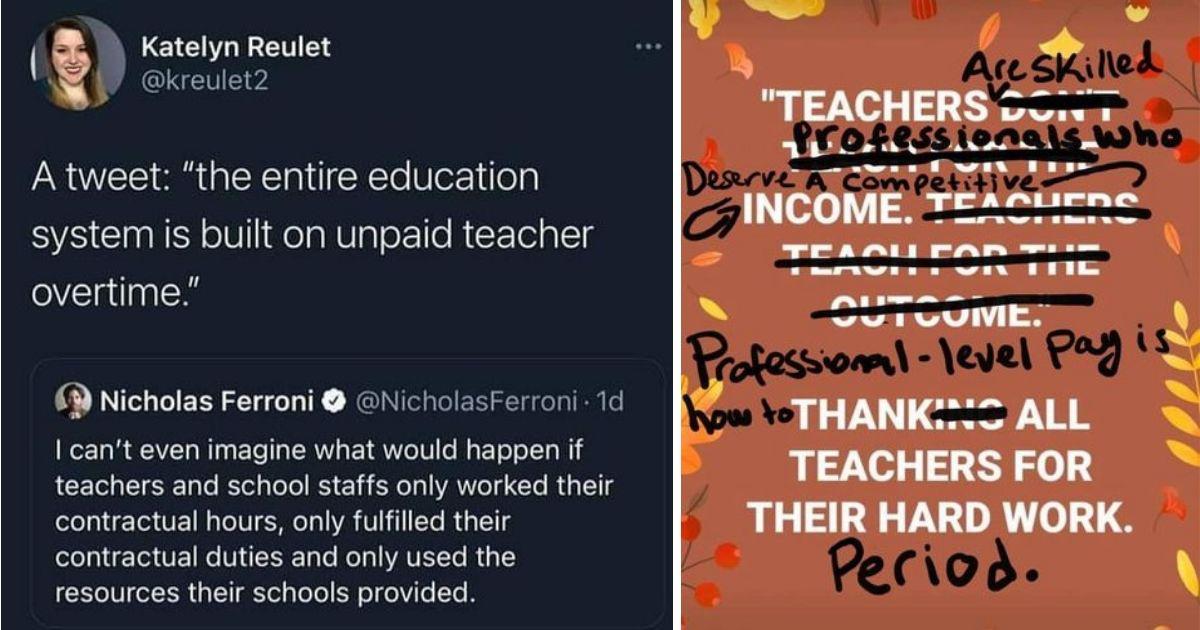
And the real kicker is that the system would suffer greatly if teachers only worked the hours they are paid to work and only used the resources they are provided. We've created a culture in which teachers are expected to work sacrificially, which is ridiculous. Teachers are skilled professionals. They deserve to be paid as if their time, knowledge, skills and experience are exceptionally valuable because they are.
Of course, there are plenty of jobs where people work beyond their expected work hours. But such jobs usually come with bonus incentives or high-paying salaries or some other perks that make up for it. It's like teachers are expected to see the rewarding nature of working with kids as enough—but that expectation doesn't account for the fact that working with kids is as stressful as it is rewarding.
Sometimes it feels like we as a society take advantage of the fact that teachers care so much. Generally speaking, people who go into teaching do it for the right reasons—to help kids learn and grow. It's a job that requires an emotional investment in order to do it well. We know that good teachers are going to be good teachers whether we pay them well or not. They're going to put in the hours and make the sacrifices regardless, and our system exploits that dedication in so many ways.
I've worked in a lot of different jobs, and teaching in a public school was by far the most challenging work I've done. I loved it, but it was hard. I know a man who worked as a garbage collector and in sawmills and the logging industry for 30 years before he became a high school math teacher. He says teaching is the hardest job he's ever had. Long hours, 6 to 7 days a week. Rewarding and meaningful work, of course, but definitely not easy.
It's time to stop expecting the work itself to be the reward and acknowledge that teachers deserve not just decent but competitive incomes. Teachers shouldn't have to be saints or martyrs—they deserve to have their work recognized with salaries that reflect their real value. I haven't taught in a classroom in more than two decades, so I have no skin in the game myself in saying that I think teachers should be paid bucketloads of money. Not just the average for their education and skill level, but beyond it.
In paying teachers extremely well, we would retain more good teachers who leave the job for financial reasons and we would recruit more top people to the profession. We would show as a society that we truly value education and see it as the best investment in the future. And we would all be the better for it.

- A celebrated teacher's 5-point explanation of why she's quitting has ... ›
- In a heartfelt post, an educator shows us exactly how poorly we pay ... ›
- Bhutan just made teachers, medical staff the highest paid civil ... ›
- Teachers competing for cash at a hockey game is dystopian ›
- High school teacher describes her day in viral video with a plea to give educators grace ›
- High school teacher describes her day in viral video with a plea to give educators grace - Upworthy ›
- This first-grader needed a special kind of help. So her teacher gave her the gift of life. - Upworthy ›
- Pre-K teacher pretends to be robbed in funny viral video - Upworthy ›
- Community supports teacher placed on leave for OnlyFans - Upworthy ›
- Video shows how men and women enter work differently - Upworthy ›
- What things today will be cringeworthy in the future? - Upworthy ›
- Teachers get brutally honest about how different students are 2024 vs. when they first started teaching - Upworthy ›
- Let's help teachers by clearing their Amazon wish lists - Upworthy ›
- Teacher working at IHOP has the best reaction to $2.000 tip - Upworthy ›
- Garbage man shares exactly how much he makes and now everyone wants to get their hands dirty - Upworthy ›
- Merit-based pay for teachers is a ridiculous idea - Upworthy ›
- A teacher asked a great question about superintendent pay. And then she got arrested. - Upworthy ›
- Teacher of the year explains why he's leaving his district in landmark 3-minute speech - Upworthy ›
- Teacher sews squishmallows designed by her young students - Upworthy ›
- Teacher caught on camera showing up to her middle school at 10pm in a bonnet and pajamas - Upworthy ›


a man sitting at a desk with his head on his arms Photo by
Can a warm cup of tea help you sleep better? If you believe it, then yes. Photo by 
A woman is getting angry at her coworker.via
A man with tape over his mouth.via
A husband is angry with his wife. via 
Three women sit on a blanket in the park. 
Two women engaging in a pleasant conversation inside a coffee shop
Two men engaging in a peaceful disagreement.
Resurfaced video of French skier's groin incident has people giving the announcer a gold medal
"The boys took a beating on that one."
Downhill skiing is a sport rife with injuries, but not usually this kind.
A good commentator can make all the difference when watching sports, even when an event goes smoothly. But it's when something goes wrong that great announcers rise to the top. There's no better example of a great announcer in a surprise moment than when French skier Yannick Bertrand took a gate to the groin in a 2007 super-G race.
Competitive skiers fly down runs at incredible speeds, often exceeding 60 mph. Hitting something hard at that speed would definitely hurt, but hitting something hard with a particularly sensitive part of your body would be excruciating. So when Bertrand slammed right into a gate family-jewels-first, his high-pitched scream was unsurprising. What was surprising was the perfect commentary that immediately followed.
This is a clip you really just have to see and hear to fully appreciate:
- YouTube youtu.be
It's unclear who the announcer is, even after multiple Google inquiries, which is unfortunate because that gentleman deserves a medal. The commentary gets better with each repeated viewing, with highlights like:
"The gate the groin for Yannick Bertrand, and you could hear it. And if you're a man, you could feel it."
"Oh, the Frenchman. Oh-ho, monsieurrrrrr."
"The boys took a beating on that one."
"That guy needs a hug."
"Those are the moments that change your life if you're a man, I tell you what."
"When you crash through a gate, when you do it at high rate of speed, it's gonna hurt and it's going to leave a mark in most cases. And in this particular case, not the area where you want to leave a mark."
Imagine watching a man take a hit to the privates at 60 mph and having to make impromptu commentary straddling the line between professionalism and acknowledging the universal reality of what just happened. There are certain things you can't say on network television that you might feel compelled to say. There's a visceral element to this scenario that could easily be taken too far in the commentary, and the inherent humor element could be seen as insensitive and offensive if not handled just right.
The announcer nailed it. 10/10. No notes.
The clip frequently resurfaces during the Winter Olympic Games, though the incident didn't happen during an Olympic event. Yannick Bertrand was competing at the FIS World Cup super-G race in Kvitfjell, Norway in 2007, when the unfortunate accident occurred. Bertrand had competed at the Turin Olympics the year before, however, coming in 24th in the downhill and super-G events.
As painful as the gate to the groin clearly as, Bertrand did not appear to suffer any damage that kept him from the sport. In fact, he continued competing in international downhill and super-G races until 2014.
According to a 2018 study, Alpine skiing is a notoriously dangerous sport with a reported injury rate of 36.7 per 100 World Cup athletes per season. Of course, it's the knees and not the coin purse that are the most common casualty of ski racing, which we saw clearly in U.S. skier Lindsey Vonn's harrowing experiences at the 2026 Olympics. Vonn was competing with a torn ACL and ended up being helicoptered off of the mountain after an ugly crash that did additional damage to her legs, requiring multiple surgeries (though what caused the crash was reportedly unrelated to her ACL tear). Still, she says she has no regrets.
As Bertrand's return to the slopes shows, the risk of injury doesn't stop those who live for the thrill of victory, even when the agony of defeat hits them right in the rocks.