upworthy
Add Upworthy to your Google News feed.
Google News Button
Pop Culture

A viral post argues East Coast folks are better people even if they aren't as 'nice' as those out West

It's sparked a "nice vs. kind" debate from people across the country.

A viral post argues East Coast folks are better people even if they aren't as 'nice' as those out West

Having lived in small towns and large cities in the Pacific Northwest, Southwest, and Midwest, and after spending a year traveling around the U.S. with my family, I've seen first-hand that Americans have much more in common than not. I've also gotten to experience some of the cultural differences, subtle and not-so-subtle, real and not-so-real, that exist in various parts of the country.

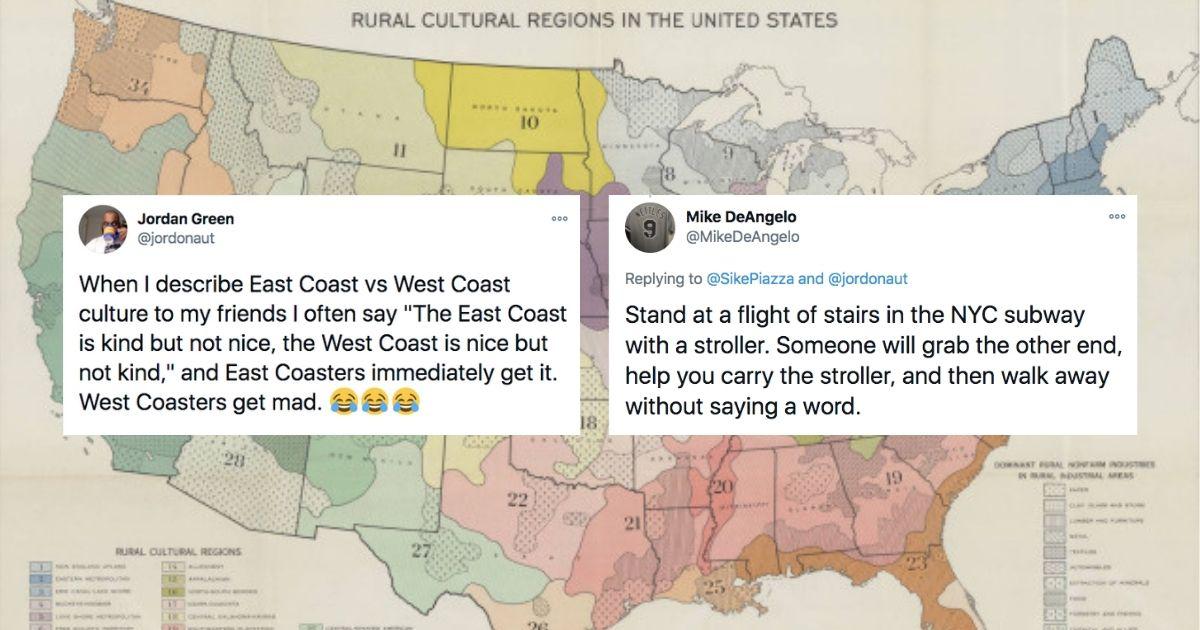
Some of those differences are being discussed in a viral thread on Twitter. Self-described "West coaster" Jordan Green kicked it off with an observation about East coasters being kind and West coasters being nice, which then prompted people to share their own social experiences in various regions around the country.

Green wrote:

"When I describe East Coast vs West Coast culture to my friends I often say 'The East Coast is kind but not nice, the West Coast is nice but not kind,' and East Coasters immediately get it. West Coasters get mad.

Niceness is saying 'I'm so sorry you're cold,' while kindness may be 'Ugh, you've said that five times, here's a sweater!' Kindness is addressing the need, regardless of tone.

I'm a West Coaster through and through—born and raised in San Francisco, moved to Portland for college, and now live in Seattle. We're nice, but we're not kind. We'll listen to your rant politely, smile, and then never speak to you again. We hit mute in real life. ALOT.


So often, we West Coasters think that showing *sympathy* or feeling *empathy* is an act of kindness. Sadly, it's really just a nice act. Kindness is making sure the baby has a hat. (s/o to breenewsome and BlackAmazon)

When you translate this to institutions or policy, you'll see alot of nice words being used, & West Coast liberals/radicals are really good at *sounding* nice. But I've seen organizers & activists from other places get frustrated because nothing happens after ALOT of talk.

Nothing happens after the pronoun check-ins and the icebreakers. It's rare we make sure that people's immediate needs are addressed. There's no kindness. You have people show up to meetings hungry, or needing rides home, and watching those with means freeze when asked to help.

As we begin to 'get back a sense of normalcy' or 're-calibrate' to what people in Blue States™ think is Right™ and Just™, I want us to keep in mind the difference between Niceness and Kindness. If something sounds nice, doesn't mean that it's kind."

Of course, there are genuinely kind and surface nice people everywhere you go, so no one should take these observations as a personal affront to them individually. Generalizations that lead to stereotypes are inherently problematic, and broad strokes like "East coast" and "West coast" are also somewhat meaningless, so they should taken with a grain of salt as well.

In reality, a small town in South Carolina is probably more culturally similar to a small town in Eastern Oregon than it is to New York City, and there are some strong differences between various subregions as well. A more specific cultural comparison, such as "big cities on the West coast vs. big cities in the Northeast" might be more accurate as far as generalizations go, but regardless, many people related to Green's observations based on their own experiences.

To kick things off, a slew of responses poured in from people describing how New Yorkers can be cold on the surface while simultaneously reaching out their hand to help you.

Several people explained that the hustle required to afford the expense of living in New York explains why people skip the niceties. It's about valuing people's time; wasting it with nice words is ruder than just quickly helping out and then moving on.

Many people chimed in with agreement with the original post (even some Canadians confirming that their East/West differences aligned with ours).

"No sense of urgency" is definitely a West coast vibe, but is generally viewed a positive out here. And "inconveniencing everyone around them" might be a subjective observation. Maybe.

Plenty of people with bicoastal experience weighed in with their stories of how their experiences lined up with the basic premise of the thread, though.

Though certainly not universally true, the tendency for West coasters to be more hands-off might extend back to the frontier days. The pioneer and gold rush mindset was necessarily individualistic and self-sufficient. In my experience, West coasters assume you don't need help unless you directly ask for it. But people don't ask because of the individualistic and self-sufficient thing, so automatic helpfulness just hasn't become part of the dominant culture.

Things got even more interesting once the South and Midwest entered the chat.

But the takes on warm/nice/kind thing varied quite a bit.

One thing that seems quite clear if you read through the various responses to the thread is that specific states and cities seem to have their own cultures that don't break down as simply as East/West/Midwest/South. There's an entire book about how the U.S. can actually be subdivided into 11 different regions that are almost like nations unto themselves. Even this map from 1940 included 34 different cultural regions in the U.S.

And don't even get a Californian started on the differences between Northern CA, Southern CA, and the Central Valley. "Culture" can even be narrowed down even to specific neighborhoods, and people's experiences and perceptions vary for all kinds of reasons, so once again, generalizations only go so far before they fall flat.

If you're curious about what the data says about all of this, a cursory search of surveys about which states are the kindest brings up a fairly mixed bag, but people seem to find Minnesota quite friendly. A Wallethub ranking of charitability by state based on 19 factors including volunteerism also placed Minnesota at number one, followed by Utah, Maryland, Oregon, and Ohio. Pretty hard to make a regional generalization with those states.

Then again, there's the whole "Minnesota nice" thing, which brings us full circle back to the original thread.

So many elements go into the culture of a place, from population density to the history of settlement to the individual personalities of the people who make someplace their home. And nothing is set in stone—the atmosphere of a place can change over time, as anyone who's visited a city a decade or two apart can attest.

One thing that's true, no matter where we live, is that we play a role in molding the culture of our immediate surroundings. If we want where we live to be friendlier, we can be friendlier ourselves. If we want to see people help one another, we can serve as that example. We might stand out, but we also might inspire others who yearn for the same thing.

"Be the change" might seem a bit cliche, but it truly is the key to shifting or world in the way we want it to go, no matter what part of the country—or the world—we live in.


This article originally appeared on 01.22.21
From Your Site Articles
generation jones, gen jones, gen jonesers, girls in 1970s, 1970s, teens 1970s
Image via Wikimedia Commons

Generation Jones is the microgeneration of people born from 1954 to 1965.

Generational labels have become cultural identifiers. These include Baby Boomers, Gen X, Millennials, Gen Z and Gen Alpha. And each of these generations is defined by its unique characteristics, personalities and experiences that set them apart from other generations.

But in-between these generational categories are "microgenerations", who straddle the generation before and after them. For example, "Xennial" is the microgeneration name for those who fall on the cusp of Gen X and Millennials.


And there is also a microgeneration between Baby Boomers and Gen X called Generation Jones, which is made up of people born from 1954 to 1965. But what exactly differentiates Gen Jones from the Boomers and Gen Xers that flank it?

- YouTube www.youtube.com

What is Generation Jones?

"Generation Jones" was coined by writer, television producer and social commentator Jonathan Pontell to describe the decade of Americans who grew up in the '60s and '70s. As Pontell wrote of Gen Jonesers in Politico:

"We fill the space between Woodstock and Lollapalooza, between the Paris student riots and the anti-globalisation protests, and between Dylan going electric and Nirvana going unplugged. Jonesers have a unique identity separate from Boomers and GenXers. An avalanche of attitudinal and behavioural data corroborates this distinction."

Pontell describes Jonesers as "practical idealists" who were "forged in the fires of social upheaval while too young to play a part." They are the younger siblings of the boomer civil rights and anti-war activists who grew up witnessing and being moved by the passion of those movements but were met with a fatigued culture by the time they themselves came of age. Sometimes, they're described as the cool older siblings of Gen X. Unlike their older boomer counterparts, most Jonesers were not raised by WWII veteran fathers and were too young to be drafted into Vietnam, leaving them in between on military experience.

How did Generation Jones get its name?

generation jones, gen jones, gen jones teen, generation jones teenager, what is generation jones A Generation Jones teenager poses in her room.Image via Wikmedia Commons

Gen Jones gets its name from the competitive "keeping up with the Joneses" spirit that spawned during their populous birth years, but also from the term "jonesin'," meaning an intense craving, that they coined—a drug reference but also a reflection of the yearning to make a difference that their "unrequited idealism" left them with. According to Pontell, their competitiveness and identity as a "generation aching to act" may make Jonesers particularly effective leaders:

"What makes us Jonesers also makes us uniquely positioned to bring about a new era in international affairs. Our practical idealism was created by witnessing the often unrealistic idealism of the 1960s. And we weren’t engaged in that era’s ideological battles; we were children playing with toys while boomers argued over issues. Our non-ideological pragmatism allows us to resolve intra-boomer skirmishes and to bridge that volatile Boomer-GenXer divide. We can lead."

@grownupdish

Are you Generation Jones? Definitive Guide to Generation Jones https://grownupdish.com/the-definitive-guide-to-generation-jones/ #greenscreen #generationjones #babyboomer #generationx #GenX #over50 #over60 #1970s #midlife #middleage #midlifewomen #grownupdish #over50tiktok #over60women #over60tiktok #over60club

However, generations aren't just calculated by birth year but by a person's cultural reality. Some on the cusp may find themselves identifying more with one generation than the other, such as being culturally more Gen X than boomer. And, of course, not everyone fits into whatever generality they happened to be born into, so stereotyping someone based on their birth year isn't a wise practice. Knowing about these microgenerational differences, however, can help us understand certain sociological realities better as well as help people feel like they have a "home" in the generational discourse.

As many Gen Jonesers have commented, it's nice to "find your people" when you haven't felt like you've fit into the generation you fall into by age. Perhaps in our fast-paced, ever-shifting, interconnected world where culture shifts so swiftly, we need to break generations into 10 year increments instead of 20 to 30 to give everyone a generation that better suits their sensibilities.

This article originally appeared two years ago. It has been updated.

boss, angry boss, mad boss, benihaha chef, laptop

A boss is fed up with his employee's antics.

One of the most frequently debated topics in professional etiquette is which foods are appropriate to eat in the office. People often take offense when others cook smelly foods, such as fish or broccoli, in a shared microwave. It can also be rude to bring a bag of snacks into a meeting as a lot of folks don't want to hear chewing while they're trying to think.

When it comes to remote workers, people are even less sure about proper eating etiquette. Is it okay to eat a large meal during an all-hands meeting? One remote worker recently claimed they pushed those boundaries to the limit when their boss allegedly did something most employees would find rude: He scheduled meetings during lunchtime and showed zero interest in apologizing for it.


office, office kitchen, office fridge, workers, employees An office kitchen.via Canva/Photos

"I used to take my lunch break at the same time every day - 12 to 1. I don't eat breakfast (just coffee and lots of water), so my lunch is essential, and I can't just skip it," a Redditor wrote. "My calendar was blocked, but my boss (newly promoted, power-tripping) started scheduling meetings right in the middle of it."

At first, it wasn't a problem, but it became a habit. "The first couple of times, I let it slide," the employee continued. "Figured maybe it was urgent. But then it became a pattern. I pushed back and reminded him that it was during my break, and he said, 'Well, we all have to make sacrifices sometimes.'"

spaghetti, mean spaghetti, pasta, italian food, lunch An angry man eating spaghetti.via Canva/Photos

Sometimes? That would make sense if the boss only occasionally scheduled lunchtime meetings, but this was becoming a regular thing. So, the employee decided they wouldn't skip lunch and would make the meeting as uncomfortable as possible.

"Next meeting, I showed up with a full plate of spaghetti and meatballs. Had my camera on and mic unmuted, slurping and chewing, occasionally gave thumbs up while mid-bite," they wrote. "A few days later, it repeated, so I brought sticky wings. Last week on Thursday, it happened again, glad I still had my pizza."

"We all have to make sacrifices sometimes"

After the boss started noticing a trend, he spoke up: "Do you have to eat during the meeting?" The employee had the perfect response: "I smiled and said, 'We all have to make sacrifices sometimes.'" During the following week, the boss didn't schedule any lunch meetings.

The post went viral. After receiving countless awards from readers, the poster joked about new and inventive ways they could get back at their boss, including dressing up as a Benihana chef and performing an onion volcano, heating cheese mid-meeting with a fondue pot, and carving a massive tomahawk steak on camera.

The Redditor also claimed they purposely behaved obnoxiously during the meeting to further drive home their point. But where do people draw the line when it comes to eating during a remote meeting?

Kate Noel, head of People Ops at Morning Brew, said it's important to read the room:

"All Zoom meetings are not created equal," Noel wrote. "If it's with your closest teammates, it's probably nbd. But if you feel nervous about eating your sushi on camera, then you might want to wait until after the awkward goodbye waves at the end of your meeting. Not for nothing, you could probably get away with keeping your video off during a larger group meeting to eat food. But at your own risk, so choose your own adventure."

Culture

26 words that have gone nearly 'extinct' in the English language

"Comely (meaning beautiful) and homely (meaning ugly)."

words, english words, old words, old fashioned words, disappearing words, extinct words

Black and white 1920s woman on the phone.

Our vernacular is always changing. Every generation has its own slang words, from Xennials to Millennials and Gen Z.

In 2025, Dictionary.com deemed '67' as the word of the year, the Oxford University Press claimed the word of the year was "rage bait," and Merriam-Webster claimed it was "slop."


In an interview with the BBC, host Kate Colin offered an example of words that have disappeared in English when she opened a segment for the broadcasting network with this greeting: "Good morrow! I beseech thee, whence comest thou?" (Translation: "Good morning. Where do you come from?")

- YouTube www.youtube.com

Colin noted that this phrase was "Old English" used hundreds of years ago, and a great example of "disappearing words." Colin's co-host Jackie Dalton added, "Yes, English is a language which is evolving all the time. So this mean there are new words continuously appearing, and older words are disappearing."

In English, words are here today and will likely be gone tomorrow. Language lovers on Reddit shared their favorite old-fashioned words that have gone nearly "extinct" in English today (and many they wish would make a comeback).

26 disappearing words

"Overmorrow. It means 'the day after tomorrow'." - TheGloveMan

"I remember the word 'grody' from the 90s. It meant gross or yucky." - Glittering_Age_5591

"Comely (meaning beautiful) and homely (meaning ugly)." - oddwithoutend, Suspicious_Art9118

"Rolodex. There was something great about those. My own was a desk model with a lockable closing cover. Something about the tangibleness, the physicality and the control. Having the different kinds of cards and card covers, hearing them click when you spun it. I was sad to let it go." - Matsunosuperfan, BASerx8

"Bitchin' (meaning excellent)." - fox3actual

"Yellow pages." - Matsunosuperfan

"Forsooth." - fingermagnets459

Merriam-Webster notes that the definition of forsooth is "in truth : indeed —often used to imply contempt or doubt; now usually used to evoke archaic speech." It comes from Middle English and dates back to the 12th century.

"Lunting: walking while smoking a pipe." - RainbowWarrior73

@pbsdigitalstudios

Wouldn’t it be a dilly idea to bring back these 1900s slang words!? Which one fractured you the most 😅 Let us know in the comments and catch up on episodes of Otherwords with @Dr. Erica Brozovsky on the Stoired YouTube channel! #slang #english #language #linguistics #history #vintage @PBS

"Only a 'square' would remember things like that." - EighthGreen

"'Cattywampus' also sometimes known as 'catawampus'. A cool word that you don't hear much anymore." - Dead_Is_Better

"I use finagle and my high school students think I'm so weird. I'm 47. This word is normal." - MLAheading

"Frippery, at least in American English (think it's used in France for thrift shops?)" - KobayashiWaifu

Merriam-Webster notes that the definition of frippery is "finery, also an elegant or showy garment; something showy, frivolous, or nonessential." Its origins are Old French and date back as far as 1568.

"Handsome (when describing a woman)." - Odd-Scheme6535, Popular-Solution7697

"I love the word 'scrimshaw.' I don't hear it enough." - nocatleftbehind420

"Maybe not extinct but it's meaning completely obliterated: nonplussed." - LeFreeke

"Oblige. Rarely hear it except in old westerns." - ReadySetGO0

"Druthers." - Embarrassed_Wrap8421

- YouTube www.youtube.com

"Bogart. Monopolizing something that's meant to be shared." - CoderJoe1

"Bumbershoot." - kelariy

Merriam-Webster notes that "bumbershoot" is an American nickname for an umbrella that was first used in 1856.

"Ne'er-do-well. From the early 20th century, basically some who never-does -well, implying a slacker or underachiever. Although people never said it even when I was growing up, I still think it's a cool word." - fabgwenn

"Whippersnapper - a young and inexperienced person considered to be presumptuous or overconfident. I've heard people on TV say it, (maybe Dennis the Menace, or some other 50s show). I heard a 90 year old woman say it IRL and I laughed so hard." - JazzFan1998

"Xeroxing a document." - C-ute-Thulu

"Blatherskite." - Biff_Bufflington

Merriam-Webster notes that the definition of "blatherskite" is "a person who blathers [talks foolishly at length] a lot; nonsense." Its first known use dates back to 1650.

"I don't seem to hear penultimate much anymore." - TakeMetoLallybroch

"I'm quite fond of the word slubberdegullion, meaning 'dirty scoundrel'. I use it frequently when I talk to my senior, who is a rather clean upstanding citizen. We laugh and then he tells me to get back to work." - r-pics-sux

green eyes, funny story, viral video, humor, comedy
Photo credit: @margoinireland on Instagram

Did she get superpowers?

Going to the eye doctor can be a hassle and a pain. It's not just the routine issues and inconveniences that come along when making a doctor appointment, but sometimes the various devices being used to check your eyes' health feel invasive and uncomfortable. But at least at the end of the appointment, most of us don't look like we're turning into The Incredible Hulk. That wasn't the case for one Irish woman.

Photographer Margerita B. Wargola was just going in for a routine eye exam at the hospital but ended up leaving with her eyes a shocking, bright neon green.


At the doctor's office, the nurse practitioner was prepping Wargola for a test with a machine that Wargola had experienced before. Before the test started, Wargola presumed the nurse had dropped some saline into her eyes, as they were feeling dry. After she blinked, everything went yellow.

Wargola and the nurse initially panicked. Neither knew what was going on as Wargola suddenly had yellow vision and radioactive-looking green eyes. After the initial shock, both realized the issue: the nurse forgot to ask Wargola to remove her contact lenses before putting contrast drops in her eyes for the exam. Wargola and the nurse quickly removed the lenses from her eyes and washed them thoroughly with saline. Fortunately, Wargola's eyes were unharmed. Unfortunately, her contacts were permanently stained and she didn't bring a spare pair.

- YouTube youtube.com

Since she has poor vision, Wargola was forced to drive herself home after the eye exam wearing the neon-green contact lenses that make her look like a member of the Green Lantern Corps. She couldn't help but laugh at her predicament and recorded a video explaining it all on social media. Since then, her video has sparked a couple Reddit threads and collected a bunch of comments on Instagram:

“But the REAL question is: do you now have X-Ray vision?”

“You can just say you're a superhero.”

“I would make a few stops on the way home just to freak some people out!”

“I would have lived it up! Grab a coffee, do grocery shopping, walk around a shopping center.”

“This one would pair well with that girl who ate something with turmeric with her invisalign on and walked around Paris smiling at people with seemingly BRIGHT YELLOW TEETH.”

“I would save those for fancy special occasions! WOW!”

“Every time I'd stop I'd turn slowly and stare at the person in the car next to me.”

“Keep them. Tell people what to do. They’ll do your bidding.”

In a follow-up Instagram video, Wargola showed her followers that she was safe at home with normal eyes, showing that the damaged contact lenses were so stained that they turned the saline solution in her contacts case into a bright Gatorade yellow. She wasn't mad at the nurse and, in fact, plans on keeping the lenses to wear on St. Patrick's Day or some other special occasion.

While no harm was done and a good laugh was had, it's still best for doctors, nurses, and patients alike to double-check and ask or tell if contact lenses are being worn before each eye test. If not, there might be more than ultra-green eyes to worry about.

Netflix and chill, reddit, funny, millennials, millennial humor, tifu
Image via Canva

An image of an embarrassed woman interlaid with a picture of two people cuddling while watching Netflix.

For many, if not most of us, when someone uses the term “Netflix and chill,” we know it to be a euphemism for, well, not much TV watching.

And yet, not everyone knows that this phrase has sexual connotations, apparently. At least one 34-year-old female college professor recently admitted to not knowing. Too bad she had been using the phrase as one of her go-to “icebreakers” in class.


A teacher learns she’s been using “Netflix and chill” wrong

As she shared on Reddit, she would often list “Netflix and chill” as one of her favorite hobbies. Not only that, but whenever students mentioned how stressed they were, she would reiterate: “While it's important to study, it's also important to take time to relax and recharge, so I hope they are able to do something for themselves soon, like ‘Netflix and chill.’”

It wasn’t until she visited her husband for lunch at his work and struck up a conversation with two of his co-workers that she discovered her hefty misunderstanding.

“I'm currently on maternity leave and mentioned to his co-workers that I can't wait for my infant to be older so I can ‘Netflix and chill’ again instead of having to feed and change diapers,” she wrote.

When one of the coworkers had a “shocked look on his face,” the OP was “confused.” She couldn’t believe it when this person explained that it’s a “euphemism for hooking up.” And yet, when the other coworker, a 50-year-old female, said, "Oh he's right, even I know what that means!" there was really no denying it.

Photo credit: Canva


Well, understandably, this woman was “mortified” at having learned the truth and was “now terrified I'm going to be reported for sexual harassment because I guess I've been inadvertently telling my students I love to hook up and have been encouraging them to hook up, too??”

In her defense, it's true that “Netflix and chill” used to mean relaxing while streaming, but that was about 17 years ago. The context we are all familiar with has been around since 2015.


She also noted that she and her husband married young and therefore never spent much time on dating apps, which could help explain why she remained unaware. Plus, she lived at home and worked two jobs during her college years, which meant "Netflix and chill” was literally “Netflixing and chilling,” she quipped.

All in all, she chalked this up to being an “oblivious Millennial.” And by that, she meant a “Millennial who is clearly oblivious” to something “invented by Millennials and has been around for at least 10-15 years.”

Reddit's reactions

Down in the comments, people tried to ease her worries about the whole accidental harassment thing.

"They either thought you were adorably clueless, or just a very cool teacher. Don't sweat it."

“Either people figured she didn’t know and thought it was funny or just assumed they’re very open and sex positive. NBD either way.”

“Rate my professor: 10/10. She told me I can come over and netflix and chill anytime 🥵”

Others didn’t let her off so easily, especially when she surmised that her older coworkers also likely didn’t know what it meant.

“I was shocked when I opened the post and saw OP was 34. I expected her to be 64.”

“I am 38 and have known what it means since it’s been around. This definitely isn’t an age thing, this is a living under a rock thing lol”

“I’m an out of touch millennial but that’s been a saying for like a decade now. lol. You might be under a rock.”

Photo credit: Canva


Regardless, the OP has had a good sense of humor despite being mortified. She concluded her post by saying, “Anyone who has lived the past decade+ under a rock like me is welcome to come over to my place and literally chill and watch Netflix with me anytime! I'll supply the popcorn 🤣”

Listen, it’s bonkers when things like this happen, but they do happen. Is it embarrassing? Sure. But does it remind us that life is about laughing at ourselves? Also yes.