
When people talk about sustainability in the food and drink industry, there’s a lot of talk about plastic straws and reducing waste. But at Bar Pionero, the sustainability standard is set much, much higher. They do things I didn’t even know were possible, and they don’t do things a lot of people—those who put profit before protection of the environment—would do in the name of conservation.
And most of it comes down to the vision of elite bartender Federico Gil.
Gil and his brother founded Bar Pionero 14 years ago, after moving to Chilean Patagonia from Uruguay. The bar sits adjacent to the main lobby of the Las Torres Hotel, just inside Torres del Paine National Park, and with its wall of windows framing a towering mountain, just being in the bar is an experience. The food is good, and as someone who doesn’t drink, I was delighted by the incredible mocktail offerings. But the highlight of the bar is Gil himself.
Watching Gil speak about sustainability was mesmerizing, even with him speaking in Spanish and me only understanding a few words of what he said. For the details, I needed the English-speaking translator, but Gil’s passion for sustainability needed no translation; it was genuine and palpable. Federico Gil shares how Bar Pionero creates its sustainable cocktails. Annie Reneau

On a practical level, here are some of the zero-waste practices the bar has implemented:
– Not only do they not use plastic straws but they use signature copper straws. Chile is the world’s largest copper producer, so the metal is plentiful. It’s also naturally anti-bacterial (though they have a sanitation process they use to clean them, of course).
– They repurpose bottles and jars into drinking glasses and tools for the bartenders. Sometimes they even combine them with copper. Check out this gorgeous glass made from an upside down glass bottle top and copper.Cocktail glass made from a glass bottle top and copper Annie Reneau

– They make their own mixes, spirits, bitters, vinegars, etc. from the plants that grow naturally in the surrounding landscape as well as from the organic garden on site.
– They also make vinegar by capturing and repurposing the dribbles of beer that come out of the tap after a draft beer is poured.
– They brew their own beer using pure glacial water and hops grown in the garden. The byproduct of the brewing process then goes back into the garden as fertilizer.Glacier in Torres del Paine National Park, part of the Southern Patagonia Ice Field Annie Reneau

– They distill their own gin in small batches, using glacial water, 13 botanicals from the natural landscape and the clay left behind from the moving glaciers. Gil says his goal with the gin is to convey the “spirit of the ice.” Glacial gin. Who knew?
The gin is so unique, Gil could certainly make money distributing it around the world, but he refuses. Same with the beer.
“The world doesn’t need one more gin or one more beer,” he says. The most sustainable way is not to sell it outside the hotel, where it would have to be shipped and transported. “We’re not thinking about how much we can sell, but what impact we have,” he adds.
It’s literally putting their money where their mouth is, knowing they could have a lucrative product on their hands but not capitalizing on it because of the environmental impact that would have. And it’s not just a guess—Gil says the bar actually keeps track and calculates their environmental impact using various measures.Federico Gil painting a lemon extraction onto a frozen rock from Torres del Paine National Park Annie Reneau
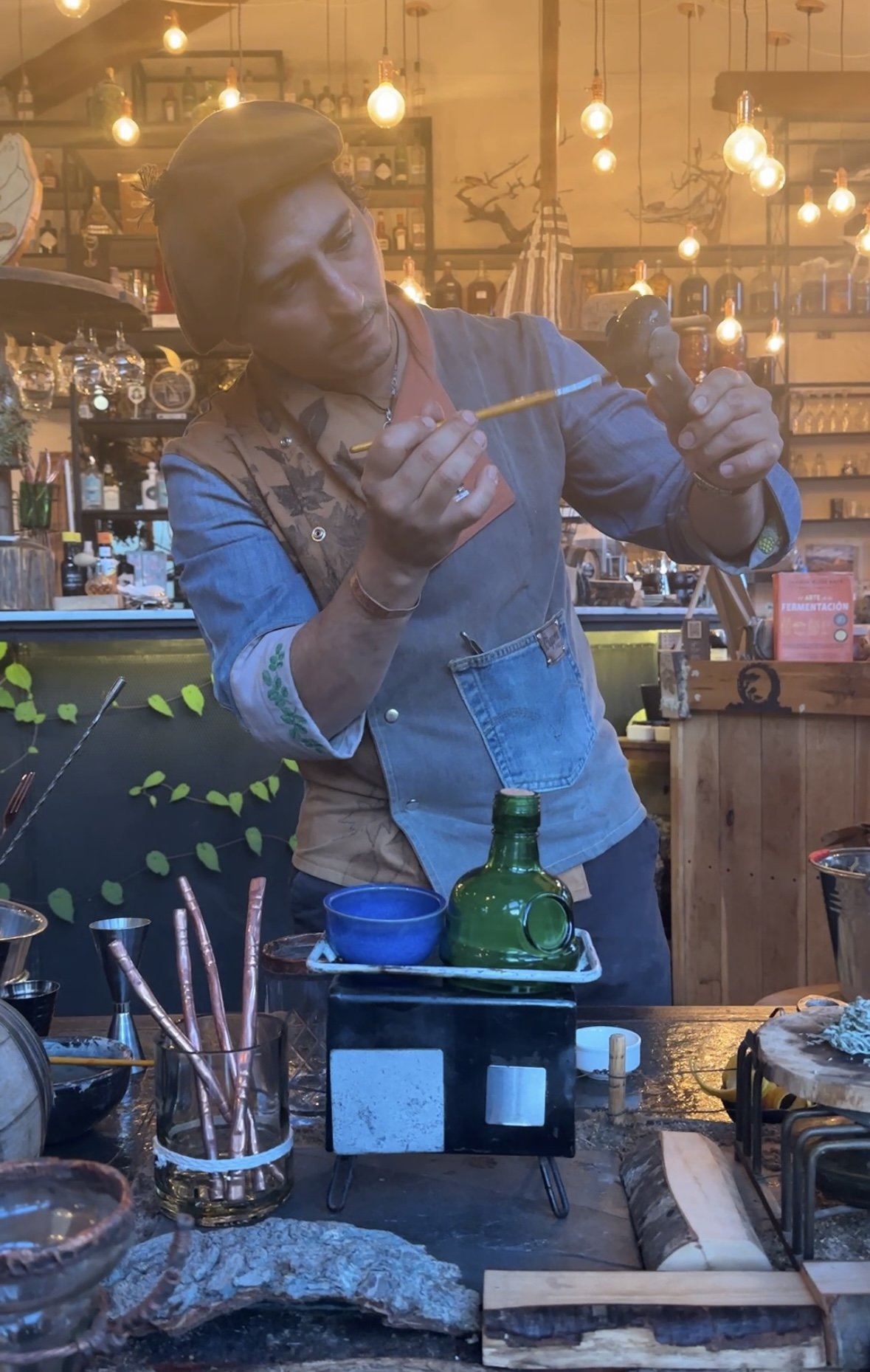
On top of all of that, watching Gil craft a cocktail is like watching an artist at work. He’s as passionate about creativity as he is about sustainability, and it shows. I watched him light herbs on fire and set a glass bottle top over the flame to capture their essence, then paint a homemade cold extraction of lemon onto a frozen stone from the park, then shake together various liquids created from park botanicals and put it all together into glass made of layers of jar and glass tops.
I’d never seen anything like it, and I’ve rarely seen anyone who walks the sustainability talk so clearly in their work. It not only gave me hope for the conservation of Torres del Paine and Patagonia (which is stunning—a place bucket lists are made for, seriously), but also made me realize how much we have to learn from one another as we strive to protect our beautiful planet.
If you’d like to see Federico in action, check out this video from my experience there:
In a small village in Pwani, a district on Tanzania’s coast, a massive dance party is coming to a close. For the past two hours, locals have paraded through the village streets, singing and beating ngombe drums; now, in a large clearing, a woman named Sheilla motions for everyone to sit facing a large projector screen. A film premiere is about to begin.
It’s an unusual way to kick off a film about gender bias, inequality, early marriage, and other barriers that prevent girls from accessing education in Tanzania. But in Pwani and beyond, local organizations supported by Malala Fund and funded by Pura are finding creative, culturally relevant ways like this one to capture people’s interest.
The film ends and Sheilla, the Communications and Partnership Lead for Media for Development and Advocacy (MEDEA), stands in front of the crowd once again, asking the audience to reflect: What did you think about the film? How did it relate to your own experience? What can we learn?
Sheilla explains that, once the community sees the film, “It brings out conversations within themselves, reflective conversations.” The resonance and immediate action create a ripple effect of change.
MEDEA Screening Audience in Tanzania. Captured by James Roh for Pura
Across Tanzania, gender-based violence often forces adolescent girls out of the classroom. This and other barriers — including child marriage, poverty, conflict, and discrimination — prevent girls from completing their education around the world.
Sheilla and her team are using film and radio programs to address the challenges girls face in their communities. MEDEA’s ultimate goal is to affirm education as a fundamental right for everyone, and to ensure that every member of a community understands how girls’ education contributes to a stronger whole and how to be an ally for their sisters, daughters, granddaughters, friends, nieces, and girlfriends.
Sheilla’s story is one of many that inspired Heart on Fire, a new fragrance from the Pura x Malala Fund Collection that blends the warm, earthy spices of Tanzania with a playful, joyful twist. Here’s how Pura is using scent as a tool to connect the world and inspire action.
A partnership focused on local impact, on a global mission
Pura, a fragrance company that recognizes education as both freedom and a human right, has partnered with Malala Fund since 2022. In order to defend every girl’s right to access and complete 12 years of education, Malala Fund partners with local organizations in countries where the educational barriers are the greatest. They invest in locally-led solutions because they know that those who are closest to the problems are best equipped to solve and build durable solutions, like MEDEA, which works with communities to challenge discrimination against girls and change beliefs about their education.
But local initiatives can thrive and scale more powerfully with global support, which is why Pura is using their own superpower, the power of scent, to connect people around the world with the women and girls in these local communities.
The Pura x Malala Fund Collection incorporates ingredients naturally found in Tanzania, Nigeria, Pakistan, and Brazil: countries where Malala Fund operates to address systemic education barriers. Eight percent of net revenue from the Pura x Malala Fund Collection will be donated to Malala Fund directly, but beyond financial support, the Collection is also a love letter to each unique community, blending notes like lemon, jasmine, cedarwood, and clove to transport people, ignite their senses, and help them draw inspiration and hope from the global movement for girls’ education. Through scent, people can connect to the courage, joy, and tenacity of girls and local leaders, all while uniting in a shared commitment to education: the belief that supporting girls’ rights in one community benefits all of us, everywhere.
You’ve already met Sheilla. Now see how Naiara and Mama Habiba are building unique solutions to ensure every girl can learn freely and dare to dream.
Naiara Leite is reimagining what’s possible in Brazil
Julia with Odara in Brazil. Captured by Luisa Dorr for Pura
In Brazil, where pear trees and coconut plantations cover the Northeastern Coast, girls like ten-year-old Julia experience a different kind of educational barrier than girls in Tanzania. Too often, racial discrimination contributes to high dropout rates among Black, quilombola and Indigenous girls in the country.
“In the logic of Brazilian society, Black people don’t need to study,” says Naiara Leite, Executive Coordinator of Odara, a women-led organization and Malala Fund partner. Bahia, the state where Odara is based, was once one of the largest slave-receiving territories in the Americas, and because of that history, deeply-ingrained, anti-Black prejudice is still widespread. “Our role and the image constructed around us is one of manual labor,” Naiara says.
But education can change that. In 2020, with assistance from a Malala Fund grant, Odara launched its first initiative for improving school completion rates among Black, quilombola, and Indigenous girls: “Ayomidê Odara”. The young girls mentored under the program, including Julia, are known as the Ayomidês. And like the Pura x Malala Fund Collection’s Brazil: Breath of Courage scent, the Ayomidês are fierce, determined, and bursting with energy.
Ayomidês with Odara in Brazil. Captured by Luisa Dorr for Pura
Ayomidês take part in weekly educational sessions where they explore subjects like education and ethnic-racial relations. The girls are encouraged to find their own voices by producing Instagram lives, social media videos, and by participating in public panels. Already, the Ayomidês are rewriting the narrative on what’s possible for Afro-Brazilian girls to achieve. One of the earliest Ayomidês, a young woman named Debora, is now a communications intern. Another former Ayomidê, Francine, works at UNICEF, helping train the next generation of adolescent leaders. And Julia has already set her sights on becoming a math teacher or a model.
“These are generations of Black women who did not have access to a school,” Naiara says. “These are generations of Black women robbed daily of their dreams. And we’re telling them that they could be the generation in their family to write a new story.”
Mama Habiba is reframing the conversation in Nigeria
Centre for Girls' Education, Nigeria. Captured by James Roh for Pura
In Mama Habiba’s home country of Nigeria, the scents of starfruit, ylang ylang and pineapple, all incorporated into the Pura x Malala Collection’s “Nigeria: Hope for Tomorrow,” can be found throughout the vibrant markets. Like these native scents, Mama Habiba says that the Nigerian girls are also bright and passionate, but too often they are forced to leave school long before their potential fully blooms.
“Some of these schools are very far, and there is an issue of quality, too,” Mama Habiba says. “Most parents find out when their children are in school, the girls are not learning. So why allow them to continue?”
When girls drop out of secondary school, marriage is often the alternative. In Nigeria, one in three girls is married before the age of 18. When this happens, girls are unable to fulfill their potential, and their families and communities lose out on the social, health and economic benefits.
Completing secondary school delays marriage, and according to UNESCO, educated girls become women who raise healthier children, lift their families out of poverty and contribute to more peaceful, resilient communities.
Centre for Girls’ Education, Nigeria. Captured by James Roh for Pura
To encourage young girls to stay in school, the Centre for Girls’ Education, a nonprofit in Nigeria founded by Mama Habiba and supported by Malala Fund and Pura, has pioneered an initiative that’s similar to the Ayomidê workshops in Brazil: safe spaces. Here, girls meet regularly to learn literacy, numeracy, and other issues like reproductive health. These safe spaces also provide an opportunity for the girls to role-play and learn to advocate for themselves, develop their self-image, and practice conversations with others about their values, education being one of them. In safe spaces, Mama Habiba says, girls start to understand “who she is, and that she is a girl who has value. She has the right to negotiate with her parents on what she really feels or wants.”
“When girls are educated, they can unlock so many opportunities,” Mama Habiba says. “It will help the economy of the country. It will boost so many opportunities for the country. If they are given the opportunity, I think the sky is not the limit. It is the starting point for every girl.”
From parades, film screenings to safe spaces and educational programs, girls and local leaders are working hard to strengthen the quality, safety and accessibility of education and overcome systemic challenges. They are encouraging courageous behavior and reminding us all that education is freedom.
Experience the Pura x Malala Fund Collection here, and connect with the stories of real girls leading change across the globe.
Even the coolest of the cool cannot escape the occasional social faux pas. Whether it’s putting your foot in your mouth at a dinner party, tripping in public and spilling coffee on yourself, or screwing something up at work, we all mess up from time to time. The good news is that every mistake is an opportunity to recover. This begs the question: What’s the best way to react when you’ve made a mistake?
Historically, people have thought that the best way to respond to a mistake is to express honest embarrassment. Feeling sheepish about your mistake is a great way to show others that you understand social norms and simply fell a bit short on this occasion. You blush, cast your eyes downward, and whisper a small “My bad” or “Sorry about that,” with a shrug of your shoulders.
What’s the best way to respond to making a public mistake?
However, research shows that the best way to recover after screwing up publicly is to laugh at yourself. A new study from the Cornell University SC Johnson School of Business involving 3,000 participants found that laughing at yourself can make you more likable than showing embarrassment.
“Our findings suggest that people often overestimate how harshly others judge their minor social mistakes,” said study co-author Övül Sezer, PhD, of the Cornell University SC Johnson School of Business, according to Neuroscience News. “For minor, harmless blunders, laughing at yourself can signal social confidence, reduce tension, and communicate that the mistake was accidental.”
Why is it better to laugh at yourself than to show embarrassment?
Laughing at yourself shows that you are socially confident and downplays the mistake in others’ eyes. Plus, people who can laugh at themselves are seen as warmer and more competent. The humor serves as a “reset button,” de-escalating the collective feeling of awkwardness.
On the other hand, when people appear embarrassed and apologetic after a mistake, others often see their reaction as excessive. This can come across as inauthentic or socially awkward. Often, people exaggerate their level of embarrassment to show that they understand what they did was inappropriate. Ironically, in trying to take the sting out of a cringeworthy moment by appearing embarrassed, they actually end up looking more awkward.
“What’s interesting is that embarrassment was often perceived as excessive,” Sezer said. “Observers tended to think that actors who displayed embarrassment were feeling more embarrassed than the situation warranted, while laughing signaled that they recognized the mistake was minor.”
Beyond the social situation itself, feeling embarrassed can be bad for our mental health.
“Some people can shake off their embarrassment when they make a mistake or violate a social norm,” Psychology Today noted. “Others who fear the disapproval of the group might be consumed by shame.”
The researchers added an important caveat to their results: If you are going to laugh off an embarrassing moment, it must be harmless. If your actions hurt someone, laughing things off can backfire in a big way, making you appear selfish and uncaring. “What’s important is calibrating the reaction to the seriousness of the mistake,” Sezer said.
We’re all bound to make a mistake from time to time. The good news is that every mistake presents an opportunity to recover and potentially make ourselves look even better than before. The key is to give your ego a rest and have a big laugh at your own expense. Most likely, people will find you more likable because you had the confidence to let your guard down.
If this sounds familiar, you’re not alone. Introverts make up one-third to one-half of the population, but our conversation norms—both online and off—are designed for extroverts.
Susan Cain, author of the bestselling book Quiet: The Power of Introverts in a World That Can’t Stop Talking, calls this phenomenon the “New Groupthink.” It’s a culture that favors constant collaboration and rapid-fire replies over stillness and deep thought. We live in a world that measures contribution by the number of messages sent, and it’s easy to feel like you’re falling behind when you go silent.
But what if this isn’t about falling behind? What if silence is just a different way of engaging? If you’ve ever wondered why you go quiet in group chats, consider these 10 signs you might be an introvert.
Unlike their extroverted counterparts, introverts take time to think about their responses before firing off a text. Photo credit: Canva
As Cain describes in her book, introverts “listen more than they talk, think before they speak, and often feel as if they express themselves better in writing than in conversation.”
In a group chat setting, this internal processing means you might mentally prepare a response, revise it, overthink the timing (can’t be too quick or too slow, right?), and then decide the conversation has already moved on without you. The perfect response you crafted vanishes before you hit send.
2. Surface-level banter drains you
For introverts, not all conversations are created equal. You might find endless small talk, quick memes, and emoji reactions tiresome, and yearn for messages with more substance. That’s because introverts crave depth—a meaningful exchange that explores an idea, a feeling, or a genuine problem.
How would you react in this situation? I already interact too much with some of my coworkers on a daily basis so please leave me out the group chat. Thanks #groupchat#introverts#workgossip
Research published in the Journal of Personality and Social Psychology found that serious conversations are more enjoyable than people expect, yet we consistently underestimate others’ interest in them. For introverts, this inclination toward depth isn’t a personality quirk—it’s a fundamental part of how they communicate.
3. You observe everything
If you’re quiet in the group chat, it doesn’t mean you’re not paying attention. Introverts are sharp readers of context: they notice shifts in tone, track emotional undercurrents, and pick up on what’s not being said as much as what is. This ability to observe and accurately synthesize group dynamics is one of the most underappreciated traits in online communication.
Introverts are sharp readers of context—everything that’s not being said. Photo credit: Canva
Psychologist Daniel Goleman found that empathy is a core component of emotional intelligence, and that quiet people often exhibit greater empathy because they listen more deeply. So while you may not be contributing messages to the group chat, you’re still playing an active role—picking up on subtle cues, like a shift in someone’s tone.
4. Group chats drain your social battery
Group chats require a lot of mental and social energy as you process multiple conversations, competing personalities, shifting group dynamics, and implicit social cues all at once. That’s an enormous cognitive load, especially compared to one-on-one conversations, where your focus can be directed toward a single person without all the noise.
If you feel overwhelmed, muting the chat might not be a bad idea. You need to manage—and maintain—your energy well.
5. You refuse to break the silence with noise
You won’t send a message just to be seen. While some group chat members are happy to drop a fire emoji or send an “lol” to stay visible, introverts tend to hold back unless they have something substantial to contribute. They’re committed to authentic communication.
Blake Griffin Edwards, a licensed marriage and family therapist, explains it this way: “Introverts must think it out before they are able to talk it out very well.”
As a result, your communication style is built on intention rather than impulse. You may send fewer messages, but when you do, they’re more meaningful.
6. Group chats can feel overwhelming, even for good writers
Here’s a paradox many introverts recognize: writing often feels more natural than speaking. Text removes the social pressure of real-time performance, giving you space to choose your words carefully. Yet despite being text-based, group chats can still trigger overstimulation.
The problem lies with pace. A group chat doesn’t move at the same speed as a thoughtful email chain or a journal entry. It’s fast and unpredictable—like a live conversation—which creates the same timing pressures introverts face in verbal group settings. Hans Eysenck’s foundational theory of introversion suggests that introverts have a higher baseline level of cortical arousal, meaning they reach sensory overload faster than extroverts when external stimulation—like a flood of notifications—keeps escalating.
7. You tune into how others are feeling
You’re not just reading the words in a thread—you’re reading between the lines. As an introvert, you probably notice delicate emotional shifts, like a person’s messages becoming shorter, a joke that falls flat, or silence from someone who’s usually chatty. This emotional sensitivity is a strength, but it can also make group chats feel more burdensome than expected.
Emotional sensitivity can feel like a burden in group chats. Photo credit: Canva
In The Mirror, Katie Oborn observed that introverts “pick up on unspoken emotions and subtle shifts in conversation and tone.” That level of awareness means introverts are often the first to notice when something is off.
8. You don’t bend to the pressure to perform
Group chats carry an implicit social pressure: respond quickly, be entertaining, stay visible. For emotionally independent introverts, that pressure can feel crushing. People who resist the pull to perform in group settings often have a strong internal compass about what matters to them and why. They won’t chime in for the sake of it, and they won’t be dragged into drama just because the group demands a response.
9. Constant notifications break your focus
For introverts, great thinking often happens when you’re alone. There’s research to support this: studies consistently link solitude to improved emotional regulation, creativity, and decision-making. When a group chat keeps pinging you—interrupting a reading session, the workday, or a quiet moment—it fragments the kind of deep focus and flow state introverts depend on.
Studies from Microsoft Research confirm that instant message notifications slow task performance and make it more likely you’ll lose your train of thought. For introverts, who need more time to process information, these interruptions can be even more costly. The “ping” of a phone notification can disrupt deep focus.
Scroll through your messages, and you might notice a pattern—either in yourself or in your introverted friends. Long periods of silence often lead to a single, valuable message that adds meaning to the conversation. That’s what strategic participation looks like: waiting for the right moment, then contributing something meaningful.
Embracing your strength
For introverts, hanging back and staying quiet in a group chat isn’t withdrawal. It’s a form of meaningful participation that favors observation, thoughtful processing, and intentional engagement over simply making noise.
If you recognize these signs in yourself and want to start engaging more on your own terms, these small shifts can help:
Try preparing your thoughts before or at the start of a lively group conversation.
Remember, writing is your natural way in. A thoughtfully crafted message at the right moment can carry more weight than a dozen impulsive replies.
Feel free to set notification boundaries without guilt.
When you’re ready to chime in, trust your timing and insight.
As Susan Cain reminds us, being the loudest in the chat doesn’t mean having the best ideas. The quietest voice may actually be paying the closest attention—and when their words are shared deliberately, they can shift the entire conversation.
Go ahead and pull up the paper emoji on your iPhone. The little white page, the one that looks completely blank from a distance. Now zoom in.
There’s a letter in there. It’s addressed to someone named Katie. It’s signed by someone named John Appleseed. And it has been sitting inside that emoji, invisible to most people, since iOS 5.
Instagram user Ella (@el_michelle1) posted a video zooming in on the emoji in December 2025, and it spread rapidly, racking up millions of views from people who could not quite believe they’d been sending that little icon around for years without knowing what was written on it. As LADbible reported in its coverage of the discovery, the reaction split neatly between people who immediately recognized the text and people who absolutely did not.
Those who recognized it knew it right away. The letter contains the full text of Apple’s “Think Different” campaign, which ran from 1997 to 2002 and became one of the most celebrated advertising moments in the company’s history. It reads, in part: “Here’s to the crazy ones. The misfits. The rebels. The troublemakers. The round pegs in the square holes. The ones who see things differently.” The letter ends: “Take care, John Appleseed.”
Per Emojipedia, which documents the design details of every emoji across platforms, the text has been embedded in Apple’s paper emoji since the icon was introduced. It’s not just the paper emoji, either. As Creative Bloq noted, the same hidden text shows up in Apple’s notebook, memo, scroll, and clipboard emojis, and the receipt emoji contains a partial reference with the words “misfits,” “square pegs,” and “round holes” listed as line items.
The name “John Appleseed” is Apple’s longstanding demo persona, used across its software and marketing materials for decades. As for Katie, nobody outside Apple knows for certain. The name varies slightly across emoji versions, appearing as “Kate,” “Katie,” or “Dear Katie” depending on which icon you’re looking at.
It’s worth noting that Apple isn’t the only platform hiding things in its emoji designs. As Emojipedia documents, Samsung’s version of the clipboard emoji was once addressed “Dear Samsung,” and Facebook’s clipboard features what appears to be a small table of first names and dates, possibly birthdays.
The response to Ella’s video captured something genuine: the strange pleasure of discovering that something you’ve looked at hundreds of times contained a message you never noticed. “Attention to detail is insane,” one commenter wrote. Another said: “I love when developers leave such tokens of their own in the things they built.” A third simply wanted to know: “Who is Katie?”
Apple, characteristically, has not said.
You can follow Ella (@el_michelle1) on Instagram for lifestyle content.
This article originally appeared earlier this year.
As workers struggle to land good jobs and employers struggle to find ideal candidates in the ever-changing job market, a new trend is emerging. Many applicants are turning to artificial intelligence to give them an edge—with mixed results at best. Because interviews are one of the most stressful parts of the job search, it’s become common for folks to input questions into ChatGPT to find the “perfect” response. However, a former recruiter warns that this is a bad idea, noting that you end up “sounding so fake” when using it.
Former recruiter turned career coach Madeline Mann showed an example of why ChatGPT shouldn’t be used to answer written interview questions. In a TikTok video, Mann shared a ChatGPT response to the question, “Why did you leave your last role?” ChatGPT replied with the following:
“I decided to move from independent work to a team environment so I can build deeper lifecycle expertise and learn from a strong mission-driven leadership team.”
It is common to use AI to help write your job interview answers, but often they are sounding too verbose and not human. If you are reading your interview answers from a script, you are likely to be rejected in the job interview and not get the job offer. Here is an example of how to sound more normal and like a coworker during a hiring process. Follow for more job interview tips, and job search strategies! #jobsearch#jobsearchtips#jobinterviewtips#jobinterview
Did that sound like something a human would say? Mann argued that ChatGPT used so much professional jargon that it sounded like a robot wrote it (because it did). Mann said that in interviews, it’s best to “sound like a coworker.”
“If you do not already sound like their coworker, they will have trouble picturing you as their coworker, and they won’t give you the job offer,” said Mann.
Mann said that a better response would be a quick and simple: “After freelancing for X years, I really missed being on a team.” She said that a reply like that is sincere, direct, and more like how a person would normally speak to a coworker. She added that if you were to use AI for interview responses, you should edit them down and remove any “bungle” to “talk like a person.”
Upworthy spoke to AI pros, business leaders, and recruiters about using artificial intelligence for job interviews. The majority arrived at the same conclusion: If you choose to use AI, it can be a useful tool for interview preparation. However, it shouldn’t sub in to do the actual interview for you.
“AI can be a useful tool for preparing for an interview,” said Megan Sweeney, public relations director at the American Staffing Association. “However, at the end of the day, the interviewer still needs to know you’re capable of doing the job.”
“If a company requests written interview questions, then using AI as a starting point is fair game in my book,” said Russell Taris, an expert on how managers can best use AI in the workplace. “The key statement, though, is ‘as a starting point.’”
“Candidates should use AI to organize their thoughts and firm up their language, but the examples and experiences need to be their own,” said Taris. “Managers can now tell right away when someone submits a response straight from ChatGPT without any editing. Smart candidates use AI the way you’d use a good friend who happens to be a great editor.”
Authenticity is key
“The problem is being authentic,” said Magical Brands CEO Mark Coffie. “Candidates who prepare and deliver scripted, overly polished answers tend to fail when asked questions spontaneously. You can use AI to outline your ideas but speak and answer questions in your own voice. That’s different from reading something generated. Interviews are a testing of judgment, communication, and problem-solving…Technology cannot substitute for that.”
“Using AI to pressure test your answers ahead of time can truly benefit candidates,” said Taris. “Run your ‘Why did you leave your last role?’ answer through it and ask it to poke holes, or practice your ‘greatest weakness’ answer until it’s specific and honest. The best answers I hear in interviews aren’t the most polished; they’re the ones where the candidate clearly thought it through beforehand and can go deeper, if needed. AI is one of the best prep tools available right now, and most candidates aren’t taking advantage of it.”
“Using AI for interview prep is helpful, but you will be the one being evaluated,” concluded Sweeney.
You might be shocked to learn that many people don’t like making small talk. Surprise, right? They either believe it’s beneath them to talk about mundane subjects or don’t see the benefit of discussing the weather, sports, or television with people they hardly know.
However, these folks are missing a very valuable form of interaction that can help them with their love lives, friendships, and careers. They also remove themselves from situations where they can elevate small talk to something more valuable and meaningful.
Jefferson Fisher, a Texas personal injury attorney and communications expert, has become massively popular on Instagram—with nearly 6 million followers—for sharing tips “to help people argue less and talk more.” While promoting his new book, The Next Conversation: Argue Less, Talk More, Fisher discussed the number one problem people have while making small talk.
What’s the biggest mistake people make during small talk?
“They unknowingly turn the conversation back to themselves too quickly,” Fisher tells Parade. “It’s a natural impulse—we want to relate, to show we understand. But what often happens is that we hijack the conversation.”
“For example, someone says, ‘I just got back from a trip to Italy,’ and instead of asking about their experience, we jump in with, ‘Oh, I’ve been to Italy several times, it’s great.’ It’s well-meaning, but it can come across as dismissive,” Fisher said. “Instead, focus on them. Ask open-ended questions like, ‘That’s wonderful, what was your favorite part?’ Small talk isn’t about impressing people, it’s about making them feel seen and heard.”
Fisher’s advice echoes that of the great Dale Carnegie, author of the 1936 classicHow to Win Friends and Influence People. In the book, Carnegie says, “To be interesting, be interested.” Carnegie’s advice is counterintuitive because we are taught to believe that being likable means dominating conversations and entertaining the other person. However, Carnegie thinks that people who are generous listeners tend to make a better first impression.
How to be more likable
Researchers at Harvard University found that when you ask someone a question, people will like you more if, after they answer, you ask them two more follow-up questions. So, if you ask, “Where did you go last summer?” And they reply, Italy, you can follow that up with two questions about their favorite city and the restaurant they’ll never forget. Then, you can tell them that you’ve been there, too.
“We identify a robust and consistent relationship between question-asking and liking,” the study’s authors write. “People who ask more questions, particularly follow-up questions, are better liked by their conversation partners.”
People will take a shine to you after you ask a few questions because it shows that you are listening and interested in what they say. “Follow-up questions are an easy and effective way to keep the conversation going and show that the asker has paid attention to what their partner has said,” the researchers write.
While at first, it may take a little practice to ask follow-up questions instead of turning the conversation to your experiences and opinions, it should take some pressure off the need to be interesting. Now, instead of trying to wow people with your stories, all you have to do is listen to theirs, and they’ll like you all the more for it.
This article originally appeared last year. It has been updated.
In the latest season of the popular reality game showThe Traitors, Rob Rausch emerged as the winner and the sole surviving Traitor. One reason he won was because he was able to see through the lies of his fellow competitors. A body language expert explained how Rausch was able to read people and win the entire cash prize.
Vanessa Van Edwards said that Rausch was able to discern who was lying to him and who was telling the truth while showing a clip from the show. In the Traitors clip, Rausch explained his strategy for trying to win the dagger prize through a game that required him to find who had it by asking questions.
Rausch explained that he was able to be a “human lie detector.” He would ask questions that he already knew the answers to and monitor his competitors’ responses. He would then ask whether the person had the dagger, watching how they responded to determine whether they were lying. After observing competitor Natalie Anderson’s responses, Rausch concluded that she was lying and had the dagger.
On TikTok, Van Edwards explained that Rausch was using a technique called “baselining.” Baselining involves making mental notes of a person’s baseline behaviors when they are speaking comfortably and truthfully. If you notice a person displaying atypical behavior when answering a question, it could be a sign that they’re lying, uncomfortable, or conveying a specific nonverbal response.
For example, if a person who doesn’t normally touch others when speaking to them suddenly touches you, that could indicate extra interest. In contrast, if someone who is known for touching people while speaking to them doesn’t touch you, they could be hiding something. In the case of The Traitors, Van Edwards said Rausch interpreted Anderson’s lip purse in response to his question as an indication that she was lying.
How baselining can help day-to-day life
Being able to baseline a person’s behavior can be helpful both professionally and personally. Professionals consider it one of the cornerstones of negotiation in business because both sides of a deal are likely withholding information. Much like in a game of poker, business professionals aren’t showing their “full hand” and are looking for “tells” before contracts are signed.
In terms of home life, baselining a family member can be especially helpful when communicating with children. This isn’t in a business negotiation or interrogation sense, though. Noticing a loved one’s common behaviors when speaking and seeing aberrations could indicate that something is wrong. You could approach them privately to ask if anything is making them feel uncomfortable and offer help. This way, you’re spotting their lies not to confront them, but to let them know they’re seen and that you’re someone they can trust.
Here’s something we all know but rarely think about: 75% of the human body is made up of water. Essentially, we’re water balloons with legs, or whatever the heck Flubber was.
But what if you’ve been drinking water, that sweet elixir of life, all wrong? Or, at the very least, ineffectively? Just as every plant has its ideal growing conditions, according to doctors and medical professionals, the temperature of the water we drink matters a lot more than you might think.
Room-temperature, ice-cold and straight from the fridge, slightly warm for no reason at all: when it comes to drinking water, everyone has their own unique methods of getting the job done. But while we continue to chug our preferred water temperatures without question, we might be missing out on some serious health benefits—or even causing ourselves unnecessary discomfort.
Medical experts have discovered that water temperature, when used at the right time, can significantly improve your wellbeing, affecting everything from how we digest our food to how well we perform during workouts. All water hydrates, but the temperature at which you drink it can make all the difference.
Room-temperature water is your digestive system’s best friend
Good morning! Many dieticians and wellness experts recommend drinking room-temperature water (about 68°F) first thing in the morning to gently activate your gastrointestinal tract (It also promotes regular bowel movements, FYI). This gentle approach is often referred to as “Japanese water therapy,” and encourages sipping 4-5 glasses (about ¾-cup each) upon waking then waiting 45 minutes before breakfast. It’s also great for everyday hydration, since room-temperature water is often easier to gulp.
Why it works
“In Chinese medicine we advocate drinking warm water because of its effect on the digestive system,” Dr. Jill Blakeway, a licensed doctor of acupuncture and Chinese medicine, explains. “Drinking cold water can congeal the fats in food and because of that can make the digestive system sluggish.”
Your body absorbs room-temperature water more easily, causing minimal disruption to the digestive system, making it the go-to option for sensitive stomachs.
Ice-cold water is perfect for workouts and hot days
This one is for the athletes and fitness gurus: Cold water (around 41°F from the fridge or 60°F from the tap) is your new best friend. Like a refreshing summer breeze, cold water has a natural way of cooling the body down during or after an exercise. It also gives your metabolism a tiny boost: according to research, your body expends about five calories per ounce of ice while warming the water to body temperature.
Why it works
Studies show that drinking cold water triggers a special reflex that helps you to stop sweating sooner, effectively lowering your core temperature and enhancing overall performance.
“It turns out that sweating stops before fluid can completely be incorporated into the body,” says gastroenterologist Dr. Brian Weiner. “There’s some kind of reflex that acknowledges liquid intake, and studies have shown that it kicks in more at the cold tap water level.”
Hot water (130-160°F) can be incredibly soothing when you’re under the weather. So, if you’re feeling congested or battling a sore throat, a nice mug of hot water might be just what the doctor ordered. A 2008 study found that hot drinks work like a natural remedy, providing quick, lasting relief from runny noses, coughing, sore throats, and fatigue.
Why it works
Like a warm summer rain, hot water creates steam that helps clear sinus congestion, while its pacifying warmth relaxes the gastrointestinal and digestive muscles. In fact, a small study showed that warm water worked wonders for patients recovering from surgery, improving their comfort and digestive health.
Warm or hot water can also literally melt away stress, as long as temperatures are kept comfortably warm: water above 160°F can scald your esophagus or damage your taste buds.
Migraines. Do not drink cold water! Research from 2001 found that the refreshing drink can trigger—or even exacerbate—headaches in those who are already prone to them.
Achalasia. If your esophagus is compromised, cold water can worsen symptoms. Try swapping in warm water instead, which can help soothe and relax the lower esophageal sphincter.
Hot, sweaty days. Surprisingly, despite what old wives’ tales might say, warm water can actually make you feel less thirsty, which registered dietician Vanessa Rissetto warns “can be dangerous on days when your body is losing water through sweating to try to keep cool.”
We all know drinking water is important, but just as a garden thrives with the right care at the right time, you can optimize and customize that all-essential water you drink throughout the day. Whether that’s out of a Stanley tumbler, Owala water bottle, or Yeti flask, is up to you.
This article originally appeared last year. It has been updated.
There seem to be two different ways of thinking about who we are attracted to, whether it’s in a romantic or a social relationship. Is it that opposites attract, or do birds of a feather flock together? The evidence overwhelmingly shows that likability has much more to do with what we share with others than with the traits that set us apart.
In fact, a 2023 study from the University of Colorado Boulder found that historically, romantic couples tend to share between 82% and 89% of the same personality traits.
“Our findings demonstrate that birds of a feather are indeed more likely to flock together,” said study author Tanya Horwitz, a doctoral candidate in the Department of Psychology and Neuroscience and the Institute for Behavioral Genetics, in a press release.
“How can we use the similarity-attraction effect to be more likable? Easy. You want to highlight your similarities. Here’s how to do this in an authentic way,” Van Edwards says in her video before sharing her three-step process:
Step 1: Search for similarities
“When you first meet someone, you should constantly be on the lookout for similarities. Are you both drinking red wine? Do you both know the host from work? Do you both love Thai food? Orient your first few conversational topics to find mutual likes and dislikes.”
Step 2: Capitalize on similarities
“Once you find a similarity, don’t let it pass you by. For example, if they think cilantro tastes like soap—because it does—share in the grossness. Double down on that disgusting little herb by saying, ‘Oh yeah, cilantro is the silent food killer. I’m totally on the same page.’ I’m a big fan of the high five, too. If I hear someone also loves Seinfeld, I’m like, ‘High five.’”
Step 3: Extend similarities
“This means using the similarity as a conversational diving board. If you both love watching soccer, ask if they’ve ever played. If they’re big into hiking, ask for their favorite trail and maybe throw out an option to go hike together. This builds on the similarity-attraction effect and creates rapport.”
It’s also important that when we meet people, we ask them about their likes and dislikes, because one of the quickest tricks to being likable when you meet someone new is to ask plenty of questions. Harvard University performed a study and found that after you ask someone the first question, ask two follow-ups, and they’ll be much more likely to like you. Studies show that the most likable people like others.
Now, for a tongue-twister takeaway from this likability story: We like people who are like us, and we also like people who like us. “So get real on what you love, and then highlight that love in other people,” Van Edwards says at the end of her video.