
upworthy
Add Upworthy to your Google News feed.
Google News Button
Pop Culture

Millennials nearing 40 are sharing their biggest mistakes so everyone can learn from them

Here are 21 of the most powerful responses.
millennials, regrets, millennial life lessons
via Pexels

Millennials are now old enough to seriously reflect on life.

It seems like only yesterday a millennial was a college kid that baby boomers chided for being entitled and Gen Xers thought were way too sincere and needed to learn how to take a joke. Today, the oldest millennials, those born around 1980, have hit their 40s and have lived long enough to have some serious regrets.

They also have enough experience to take some pride in decisions that, in hindsight, were the right moves. The good news is that at 40 there is still plenty of time to learn from our successes and failures to set ourselves up for a great second half of life. These lessons are also valuable to the Gen Zers coming up who can avoid the pitfalls of the older generation.

A Reddit user who has since deleted their profile asked millennials nearing 40 “what were your biggest mistakes at this point in life?” and they received more than 2,200 responses. The biggest regrets these millennials have are being flippant about their health and not saving enough money when they were younger.

They also realized that the carefree days of youth are fleeting and impossible to get back. So they should have spent less time working and more time enjoying themselves. Many also lamented that they should have taken their education more seriously in their 20s so they have more opportunities now.

The responses to this thread are bittersweet. It's tough hearing people come to grips with their regrets but the realizations are also opportunities to grow. Hopefully, some younger people will read this thread and take the advice to heart.

Here are 21 of the most powerful responses to the question: “Millennials of Reddit now nearing your 40s, what were your biggest mistakes at this point in life?”

1.

"Not taking care of my hearing, not even 35 and going deaf." — Kusanagi8811

2.

"Not getting healthy earlier." — zombiearchivist

3.

"Staying too long at a job in my 20s, just because it was safe and easy. When I finally got the motivation to leave, ended up with an almost 50% pay boost." — Hrekires

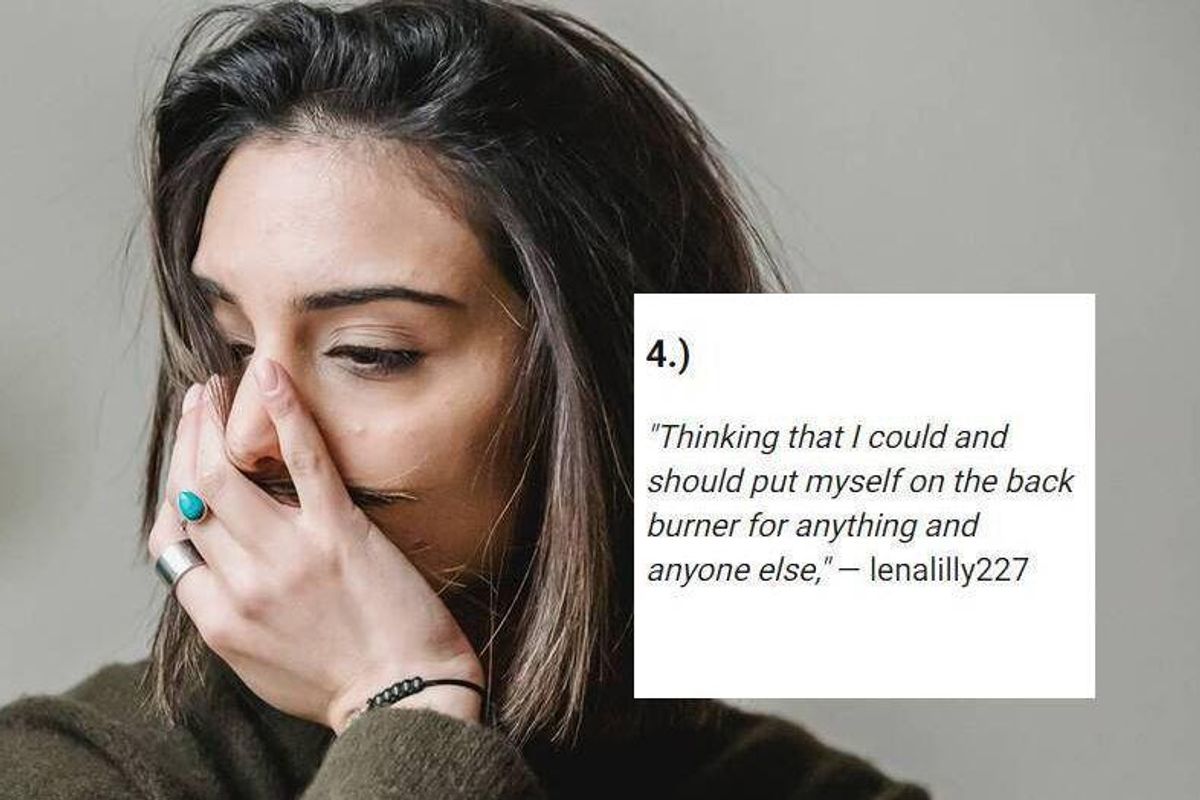
4. 

"Thinking that I could and should put myself on the back burner for anything and anyone else." — lenalilly227

5.

"Smoking and not dealing with my shit the right way." — Allenrw3

6.

"Pining after the wrong person." — runikepisteme

7.

"I turned 40 this year and just started liking who I am. Why the fuck did it take 40 years for self acceptance?" — guscallee

8.


"Take care of your fucking back. Lift with your knees. Sure it's rad when you grab a fridge by yourself and lift it in the back of a moving truck unaided, but one day that shit is going to have consequences that won't just magically go away by resting and "taking it easy" for a week." — GuyTallman

9.

"I wish I spent more time with my dad while I had the chance." — CharlieChooper

10.

"I'm 37. I absolutely could have taken better care of my body, but I'm in relatively good health. I'm starting to realize how important it is to maintain my health. I do also think I drank far too much in my 20 and early 30's. I'm trying to rectify that now, but it's hard. So that I guess." — dartastic

11.


"I'm not sure if people have experienced the same but when I entered my 30s I became convinced I was rapidly running out of time. Rather than using that as motivation I let it paralyze me with indecision because I "couldn't afford to make the wrong choice." Consequently, I'm now 39 and, though I've had great things happen in my 30s, I regret spending so much time worrying and so little time committing to a course of action." — tomwaste

12.

"Work to live, don’t live to work. You have half your working life after you turn 40 but only 20-25 years to really live it up before the responsibilities become heavy and your joints start to ache. Live life. Really LIVE it. Experience as much you can. Every sensation, sight, sound, touch. Be open. Be brave. Live your first few decades in the fast lane. You have the rest of your life to take it easy, when you have no choice." — MrDundee666

13.

"I should have paid more attention to my parents telling me to save money and less attention when they were teaching me about purity culture." — Arkie_MTB

14.

"If I could tell my 18 year old self one thing, it would be to save 10% of every paycheck I ever got." — PutAForkInHim

15.

"Thinking that I have time to do everything I want only to find myself loosing time, and the endless energy I used to have in order to purse them." — ezZiioFTW

16.

"Not wearing sunscreen." — blueboxreddress

17.

"Not recognizing the importance of work/life balance earlier in life. My late teens, all 20's, and early 30's were spent pulling 60-100+hr weeks because I thought it was what was required to succeed. How wrong I was. Others stabbed me in the back and reaped the reward.

1.) Putting work first for too long. Work is my #1 priority during work hours now. After quitting time, I don't think about it (much) anymore. I don't vent to my wife or friends about it anymore either.

2.) Investing more into fast cars than solid long-term investments. Sure, it was fun, but I could have made bookoos more had I put that towards less-fun investments.

3.) Not using PTO and just waiting for the payout. All those years, missed. I'm in my mid 30's and I didn't actually have a real vacation until 3 years ago.

4.) Not realizing that "the good guy" often loses. Just because you're morally justified doesn't mean you're going to win. Just because there's a number to call doesn't mean anyone will actually help you. Just because "law" exists, doesn't mean people follow it, enforce it, or create justice. The world is dog eat dog and cynicism can be healthy in moderate doses." — [Deleted]

18.

"When you get out of college, keep your friends. No matter how hard it is. Hold on to them." — mpssss22

19.

"I imagine these are kinda universal:

  • Not getting fit and healthy
  • Assuming I'd be offered proper guidance on how to achieve my goals
  • Assuming higher education would help me achieve my goals
  • Spending far too long caring what people think
  • Not taking risks that might better my life when I was younger and had nothing to lose
  • Staying in relationships too long after they were clearly done." — katapultperson

20.

"Always ask for more pay. Starting, yearly, before leaving, whatever. Get that money." — SensibleReply

21.

"Spending too much time in front of a screen and not enough enjoying life." — BellaPadella


This article originally appeared two years ago.

Planet

Our favorite giveaway is back. Enter to win a free, fun date! 🌊 💗

It's super easy, no purchase or donation necessary, and you help our oceans! That's what we call a win-win-win. Enter here.

Our favorite giveaway is back. Enter to win a free, fun date! 🌊 💗
True

Our love for the ocean runs deep. Does yours? Enter here!

This Valentine’s Day, we're bringing back our favorite giveaway with Ocean Wise. You have the chance to win the ultimate ocean-friendly date. Our recommendation? Celebrate love for all your people this Valentine's Day! Treat your mom friends to a relaxing spa trip, take your best friend to an incredible concert, or enjoy a beach adventure with your sibling! Whether you're savoring a romantic seafood dinner or enjoying a movie night in, your next date could be on us!

Here’s how to enter:


  • Go to upworthy.com/oceandate and complete the quick form for a chance to win - it’s as easy as that.
  • P.S. If you follow @oceanwise or donate after entering, you’ll get extra entries!

Here are the incredible dates:

1. Give mom some relaxation

She’s up before the sun and still going at bedtime. She’s the calendar keeper, the lunch packer, the one who remembers everything so no one else has to. Moms are always creating magic for us. This Valentine’s Day, we’re all in for her. Win an eco-friendly spa day near you, plus a stash of All In snack bars—because she deserves a treat that’s as real as she is. Good for her, kinder to the ocean. That’s the kind of love we can all get behind.


Special thanks to our friends at All In who are all in on helping moms!

2. Jump in the ocean, together

Grab your favorite person and get some much-needed ocean time. Did you know research on “blue spaces” suggests that being near water is linked with better mental health and well-being, including feeling calmer and less stressed? We’ll treat you to a beach adventure like a surfing or sailing class, plus ocean-friendly bags from GOT Bag and blankets from Sand Cloud so your day by the water feels good for you and a little gentler on the ocean too.

Special thanks to our friends at GOT Bag. They make saving the ocean look stylish and fun!

3. Couch potato time

Love nights in as much as you love a date night out? We’ve got you. Have friends over for a movie night or make it a cozy night in with your favorite person. You’ll get a Disney+ and Hulu subscription so you can watch Nat Geo ocean content, plus a curated list of ocean-friendly documentaries and a movie-night basket of snacks. Easy, comfy, and you’ll probably come out of it loving the ocean even more.

4. Dance all day!

Soak up the sun and catch a full weekend of live music at BeachLife Festival in Redondo Beach, May 1–3, 2026, featuring Duran Duran, The Offspring, James Taylor and His All-Star Band, The Chainsmokers, My Morning Jacket, Slightly Stoopid, and Sheryl Crow. The perfect date to bring your favorite person on!

We also love that BeachLife puts real energy into protecting the coastline it’s built on by spotlighting ocean and beach-focused nonprofit partners and hosting community events like beach cleanups.

Date includes two (2) three-day GA tickets. Does not include accommodation, travel, or flights.

5. Chef it up (at home)

Stay in and cook something delicious with someone you love. We’ll hook you up with sustainable seafood ingredients and some additional goodies for a dinner for two, so you can eat well and feel good knowing your meal supports healthier oceans and more responsible fishing.

Giveaway ends 2/15/26 at 11:59pm PT. Winners will be selected at random and contacted via email from the Upworthy. No purchase necessary. Open to residents of the U.S. and specific Canadian provinces that have reached age of majority in their state/province/territory of residence at the time. Please see terms and conditions for specific instructions. Giveaway not affiliated with Instagram. More details at upworthy.com/oceandate

quiet, finger over lips, don't talk, keep it to yourself, silence

A woman with her finger over her mouth.

It can be hard to stay quiet when you feel like you just have to speak your mind. But sometimes it's not a great idea to share your opinions on current events with your dad or tell your boss where they're wrong in a meeting. And having a bit of self-control during a fight with your spouse is a good way to avoid apologizing the next morning.

Further, when we fight the urge to talk when it's not necessary, we become better listeners and give others a moment in the spotlight to share their views. Building that small mental muscle to respond to events rather than react can make all the difference in social situations.


argument, coworkers, angry coworkers, hostile work enviornment, disagreement A woman is getting angry at her coworker.via Canva/Photos

What is the WAIT method?

One way people have honed the skill of holding back when they feel the burning urge to speak up is the WAIT method, an acronym for the question you should ask yourself in that moment: "Why Am I Talking?" Pausing to consider the question before you open your mouth can shift your focus from "being heard" to "adding value" to any conversation.

The Center for The Empowerment Dynamic has some questions we should consider after taking a WAIT moment:

  • What is my intention behind what I am about to say?
  • What question can I ask to better understand what the other person is saying?
  • Is my need to talk an attempt to divert the attention to me?
  • How might I become comfortable with silence rather than succumb to my urge to talk?

tape over muth, sielnce, be quiet, mouth shut, saying nothing A man with tape over his mouth.via Canva/Photos

The WAIT method is a good way to avoid talking too much. In work meetings, people who overtalk risk losing everyone's attention and diluting their point to the extent that others aren't quite sure what they were trying to say. Even worse, they can come across as attention hogs or know-it-alls. Often, the people who get to the heart of the matter succinctly are the ones who are noticed and respected.

Just because you're commanding the attention of the room doesn't mean you're doing yourself any favors or helping other people in the conversation.

The WAIT method is also a great way to give yourself a breather and let things sit for a moment during a heated, emotional discussion. It gives you a chance to cool down and rethink your goals for the conversation. It can also help you avoid saying something you regret.

fight, spuse disagreement, communications skills, upset husband, argument A husband is angry with his wife. via Canva/Photos

How much should I talk in a meeting?

So if it's a work situation, like a team meeting, you don't want to be completely silent. How often should you speak up?

Cary Pfeffer, a speaking coach and media trainer, shared an example of the appropriate amount of time to talk in a meeting with six people:

"I would suggest a good measure would be three contributions over an hour-long meeting from each non-leader participant. If anyone is talking five/six/seven times you are over-participating! Allow someone else to weigh in, even if that means an occasional awkward silence. Anything less seems like your voice is just not being represented, and anything over three contributions is too much."

Ultimately, the WAIT method is about taking a second to make sure you're not just talking to hear yourself speak. It helps ensure that you have a clear goal for participating in the conversation and that you're adding value for others. Knowing when and why to say something is the best way to make a positive contribution and avoid shooting yourself in the foot.

Community

15 sneaky signs someone is far more intelligent than you realize

People who are actually smart are usually a joy to be around.

intelligence, signs of intelligence, smart people, genius, IQ, einstein, psychology, human brain, human behavior
via Associated Press/Wikimedia Commons

People are sharing easy-to-miss signs that someone may be highly intelligent.

There are a few stereotypical traits we might associate with high intelligence. Someone who's arrogant, longwinded, or perhaps a bit socially awkward. We might expect them to constantly show off their smarts with rants and speeches and lectures and make a big show of how much more intelligent they are than others.

The truth is far more complicated. The smartest people, those who are truly brilliant, are usually delightful to be around. In fact, they may come across totally "normal." But there are still strong signs of their intelligence lurking beneath the surface; you just have to know what to look for.


A Redditor recently asked people on the AskReddit forum to share the “non-obvious signs” that people are intelligent. Many of their responses centered on highly intelligent people being open-minded, curious, and not wasting their time arguing with others.

Brilliant people are confident in what they know, consider other people’s opinions, and readily admit when they don’t know the answer.

intelligence, signs of intelligence, smart people, genius, IQ, einstein, psychology, human brain, human behavior Albert EinsteinArthur Sasse/Wikimedia Commons

What are 15 'non-obvious' signs that someone is really smart?

1. They know what they don't know

"They acknowledge areas where they lack knowledge."

"'Never pretend to know something when you don't' is something I always teach. It covers lying and ignorance."

Pretending to know everything is a sign of arrogance and ego. Truly intelligent people are always willing to learn.

2. They consider other people's ideas

"They’ll listen to the other's facts and points and take them into account when giving an objection."

"One of the best developers at my last job and manager of a project I was at is an extremely intelligent person. ... One thing I noticed is how he would take everyone's opinion into account. He would take my opinions into consideration even if I'm not a smarter person or know less about development."

3. They make you feel smart

"Talking to a dumb person will make you feel smart. Talking to a smart person will make you feel dumb. Talking to a very smart person will make you feel smart."

4. They see patterns

"Part of the reason smart people throughout history are well-known is because they discovered something new and figured out how to maximize its potential. Darwin was a guy who discovered a bunch of islands with slightly different animals. He then collected and analyzed that data to come up with the theory of evolution, which was largely correct. Einstein’s theory of relativity was based off of his observation that physics acted on everything equally. He figured out that “exceptions” were because of the way high-speed objects interact with the universe’s speed limit (the speed of light). He recognized these exceptions by gathering them and recognizing the pattern between them all, then created his theory of relativity based on that."


intelligence, signs of intelligence, smart people, genius, IQ, einstein, psychology, human brain, human behavior Neil deGrasse TysonUnited States Department of Education/Wikimedia Commons

5. They consider multiple intelligences

"They realize not everyone is smart the same way. Your 'stupid hick neighbor' might have dropped out of school in 8th grade, but he can drive your car once and tell you exactly what's wrong, then fix it. That a**hole in school that had no empathy for anyone and showed no emotion made that sci-fi sh*t you thought would never be real. Yeah, she's dingy and her worldview is tiny, but she's the best teacher you've ever met and inspires tons of kids to go on and do great things with themselves. There's no one-size-fits-all answer here, really."

People who are super bright are probably familiar with Howard Gardner's theory of multiple intelligences. The theory suggests that people have more than just one type of just one type of intelligence, like being good at mathematics. Gardener says there are several, including musical, spatial, linguistic, interpersonal, intrapersonal, and kinesthetic intelligence. This theory allows people to appreciate different forms of intelligence that may not be of the academic variety.

6. They choose their battles

"When another person is not able to process something and, therefore, sticks with his opinion, after a few tries, the smart person just gives up. There is no use in trying to make someone understand something while they already have an uneducated opinion."

7. They speak to their audience

"They know how to explain concepts on just about any level, tailoring that level to their intended audience, and without coming across as condescending in any way."

"I heard a saying that went 'you have to be an expert to explain it simply.'"


intelligence, signs of intelligence, smart people, genius, IQ, einstein, psychology, human brain, human behavior Stephen HawkingBy NASA/Paul E. Alers/Wikimedia Commons

8. They're confident in their intelligence

"Not constantly bragging about their intelligence. If they truly are smart, people can figure that out pretty quickly without them doing anything to show it."

"You generally only brag about things you're insecure about because you seek validation. If you are very comfortable with your intelligence, then you may not care if someone misinterprets you and makes you look dumb or something. You have nothing to prove. That's not just for intelligence but for anything."

9. They're funny

"I think the smart people are even more funny than stupid people because smart people understand the complexity behind humor and can make their jokes reflect that."

Scientific studies show that funny people, especially those with a dark sense of humor, are more intelligent than their not-so-funny peers. Researchers argue that it takes cognitive and emotional ability to make people laugh, and analysis shows that funny people have higher verbal and non-verbal intelligence.

10. They mind their own business

"This is a big one. They keep to themselves and deal with their own drama."

Truly smart people generally aren't entertained with drama and gossip.

11. They aren't necessarily great students

"Believe it or not 'average' or 'above average' students are often smarter than those with straight A’s on the report cards. They do enough to pass well and get what they want but don’t let the academic system control them. Life isn’t all about booksmarts. This shows they are independent thinkers and don’t get wrapped up in designed systems. Not all, but many. Many kids who are forced to always be exceptional in school can end up the worst off and can develop deeper issues."

12. They are good listeners

"They actually listen to who they are talking to as opposed to waiting for their turn to talk."

13. Curiosity

"It really does seem to be one of the single greatest differentiators between average and smart."

A meta-analysis of over 50,000 students from around 200 separate studies found that students who are curious do better in their school work over those who are not. Why is curiosity so important when it comes to IQ? “Curiosity is basically a hunger for exploration. If you’re intellectually curious, you’ll go home, you’ll read the books," Dr Sophie von Stumm, the study’s first author, said. "If you’re perceptually curious, you might go traveling to foreign countries and try different foods.”

intelligence, signs of intelligence, smart people, genius, IQ, einstein, psychology, human brain, human behavior Carl SaganKenneth C. Zirkel/Wikimedia Commons

14. Comfortable in silence

"Being comfortable enough to allow a moment of complete silence while you think when the natural instinct of most is to immediately start replying tells me that you are, at the very least, mindful of what you want to say."

15. Unattached to their opinions

"Most of the smart people I know are not pushy with their opinions; by contrast, most of the opinionated people I know are flaming morons. I don't know if there's a correlation there, but my anecdotal experience has always been that the more eager someone is to state their opinion, the less that opinion is probably worth."


- YouTube www.youtube.com

This article originally appeared two years ago. It has been updated.

arthur c. brooks, harvard, psychology, happiness research, bucket list

Harvard researcher Arthur C. Brooks studies what leads to human happiness.

We live in a society that prizes ambition, celebrating goal-setting, and hustle culture as praiseworthy vehicles on the road to success. We also live in a society that associates successfully getting whatever our hearts desire with happiness. The formula we internalize from an early age is that desire + ambition + goal-setting + doing what it takes = a successful, happy life.

But as Harvard University happiness researcher Arthur C. Brooks has found, in his studies as well as his own experience, that happiness doesn't follow that formula. "It took me too long to figure this one out," Brooks told podcast host Tim Ferris, explaining why he uses a "reverse bucket list" to live a happier life.


bucket list, wants, desires, goals, detachment Many people make bucket lists of things they want in life. Giphy

Brooks shared that on his birthday, he would always make a list of his desires, ambitions, and things he wanted to accomplish—a bucket list. But when he was 50, he found his bucket list from when he was 40 and had an epiphany: "I looked at that list from when I was 40, and I'd checked everything off that list. And I was less happy at 50 than I was at 40."

As a social scientist, he recognized that he was doing something wrong and analyzed it.

"This is a neurophysiological problem and a psychological problem all rolled into one handy package," he said. "I was making the mistake of thinking that my satisfaction would come from having more. And the truth of the matter is that lasting and stable satisfaction, which doesn't wear off in a minute, comes when you understand that your satisfaction is your haves divided by your wants…You can increase your satisfaction temporarily and inefficiently by having more, or permanently and securely by wanting less."

Brooks concluded that he needed a "reverse bucket list" that would help him "consciously detach" from his worldly wants and desires by simply writing them down and crossing them off.

"I know that these things are going to occur to me as natural goals," Brooks said, citing human evolutionary psychology. "But I do not want to be owned by them. I want to manage them." He discussed moving those desires from the instinctual limbic system to the conscious pre-frontal cortex by examining each one and saying, "Maybe I get it, maybe I don't," but crossing them off as attachments. "And I'm free…it works," he said.

- YouTube www.youtube.com

"When I write them down, I acknowledge that I have the desire," he explained on X. "When I cross them out, I acknowledge that I will not be attached to this goal."

The idea that attachment itself causes unhappiness is a concept found in many spiritual traditions, but it is most closely associated with Buddhism. Mike Brooks, PhD, explains that humans need healthy attachments, such as an attachment to staying alive and attachments to loved ones, to avoid suffering. But many things to which we are attached are not necessarily healthy, either by degree (over-attachment) or by nature (being attached to things that are impermanent).

"We should strive for flexibility in our attachments because the objects of our attachment are inherently in flux," Brooks writes in Psychology Today. "In this way, we suffer unnecessarily when we don't accept their impermanent nature."

What Arthur C. Brooks suggests that we strive to detach ourselves from our wants and desires because the simplest way to solve the 'haves/wants = happiness' formula is to reduce the denominator. The reverse bucket list, in which you cross off desires before you fulfill them, can help free you from attachment and lead to a happier overall existence.

This article originally appeared last year.

longevity, aging, living long, getting older, seniors, dying, mortality, health, fitness, longevity test
via Ketut Subiyanto/Pexels and Dinielle De Veyra/Pexels

People doing dead hangs in the park.

Here's a morbid question: Would you really want to know how long you have to live? On one hand, it’d probably inspire you to go out and complete your bucket list. On the other hand, it may be depressing to know just how many days you have left. Well, science has yet to find a way to determine the average person's life expectancy, but some indicators can show whether someone is at risk of having their life cut short by deteriorating health.

You could, if you were so inspired, shell out a bunch of money for fancy genetic and biological testing. Chasing immortality is all the rage with billionaires, so if you've got the money, you can find out an awful lot about how long you're likely to live.


Or you could just hit the gym or local playground and find out for free.

A 2019 study published in Clinical Interventions in Aging in 2019 found that handgrip strength can be a reliable proxy for longevity.

The importance of handgrip strength

One of the best ways to judge handgrip strength is to time how long you can hang from a bar. To test your grip strength, find yourself a pull-up bar, whether at a gym or local park, take a deep breath, and start hanging. Don't worry, you don't need to be able to do a pull up!

Ironically, the move is called a "dead hang." So-called, because you literally just hang there for as long as possible.

The literature revealed that 30 seconds is a good target for women and 60 seconds is an excellent goal for men.

Therefore, if you go longer than the goal, you’re looking at a long life. But if you can’t quite get there, your life may be shorter than you’d like.

handgrip strength, pull-up, working out, dead hang, park workout A man on a pull-up bar.via Canva/Photos


Dr. Peter Attia, founder of Early Medical and author of Outlive: The Science and Art of Longevity (2023), believes that grip strength is a great way to determine one’s overall health.

“It's just a great proxy for overall body strength and muscle mass, but I think it's also a very functional form of strength,” he said on The Drive podcast. “Basically, everything in your upper body is mediated through your hands. And if your grip is weak, everything downstream of that is weak. When you watch someone who's got a weak grip deadlifting, it's very difficult for them to deadlift correctly because they don't create a proper wedge."

There are many ways to measure grip strength, but the dead hang is likely the simplest. When you think about it, it requires an incredible combination of shoulder mobility, spinal stability, core strength, and overall fitness. Not only are these all positive biological health markers, but they're also all key to preventing falls as we get older.

Regularly practicing the dead hang, on the other hand, has incredible benefits, including stretching your muscles and deloading your joints and spine, giving them a much-needed rest. What could be more fun than increasing your lifespan by just hanging out? You don't even need a gym membership; most local parks have a small workout area with a pull-up bar. They'are also easy to install at home.


- YouTube www.youtube.com

Doctors Eve M. Glazier and Elizabeth Ko at UCLA Health say poor grip strength is connected to numerous diseases. “Research continues to link a decline in grip strength to a range of adverse health issues, including heart disease, arthritis, osteoporosis, Type 2 diabetes and certain cancers. It has also been found to be a predictor of the likelihood of post-surgical complications, post-surgical recovery time, and mortality,” they wrote on the UCLA Health blog.

Losing weight can increase your hang time

Weight can also significantly affect how long a person can hang from a bar. So, do lighter people have an unfair advantage over those on the heavier side? Well, weight is also an important indicator of longevity. A study published in Aging Cell found a direct correlation between increased body mass and decreased longevity. So, for some, losing a bit of weight can have a two-fold advantage.

Other studies have elaborated on the findings: More important than your absolute grip strength and dead-hang ability may be how they change over time. Losing grip strength is a negative sign for your overall health, but maintaining or even building it is associated with better outcomes.


dead hang, pull up, workout, woman working out, gym A woman working out at the gym.via Canva/Photos


How to perform a dead hang (according to Healthline):

  • Use a secure overhead bar. Use a step or bench to reach the bar with your arms easily. You don’t want to jump straight into a dead hang.
  • Grip the bar with an overhand grip (palms facing away from you). Aim to keep your arms shoulder-width apart.
  • Move your feet off the step or bench so you’re hanging on to the bar.
  • Keep your arms straight and stay relaxed.
  • If you’re new to the exercise, hang for 10 seconds. Then, work your way up to 45 seconds to 1 minute at a time.
  • Slowly step back onto the step or bench before releasing your arms. Repeat up to 3 times if you wish.

This article originally appeared last year. It has been updated.


laundry, housekeeping, chores, helpful info, life hack, patric richardson, patric richardson laundry love, laundry tips, laundry hacks
Photo credit: Canva
Because who can keep up with which laundry settings is for which item, anyway?

Doing laundry is the household chore that never ends. And depending on what you're washing, like your bed sheets or jeans, it can be confusing to know which laundry cycle to choose to preserve your clothes best.

Suddenly you’re second guessing whether that lace item needs to use the “delicates” cycle, or the “hand wash” one, or what exactly merits a “permanent press” cycle. And now, you’re wishing for that bygone bucket just to take away the mental rigamarole.


Turns out, there’s only one setting you actually need. At least according to one laundry expert.

- YouTube www.youtube.com

While appearing on HuffPost’s “Am I Doing It Wrong?” podcast, Patric Richardson, aka The Laundry Evangelist, said he swears by the “express” cycle, as “it’s long enough to get your clothes clean but it’s short enough not to cause any damage.”

Richardson’s reasoning is founded in research done while writing his book, “Laundry Love,” which showed that even the dirtiest items would be cleaned in the "express" cycle, aka the “quick wash” or “30 minute setting.” Furthermore the laundry expert, who’s also the host of HGTV’s “Laundry Guy,” warned that longer wash settings only cause more wear and tear, plus use up more water and power, making express wash a much more sustainable choice.

Really, the multiple settings washing machines have more to do with people being creatures of habit, and less to do with efficiency, Richardson explained.

“All of those cycles [on the washing machine] exist because they used to exist,” he told co-hosts Raj Punjabi and Noah Michelson. “We didn’t have the technology in the fabric, in the machine, in the detergent [that we do now], and we needed those cycles. In the ’70s, you needed the ‘bulky bedding’ cycle and the ‘sanitary’ cycle ... it was a legit thing. You don’t need them anymore, but too many people want to buy a machine and they’re like, ‘My mom’s machine has “whitest whites.”’ If I could build a washing machine, it would just have one button — you’d just push it, and it’d be warm water and ‘express’ cycle and that’s it.”

Richardson's laundry tips

Use less detergent

Regarding detergent, Richards says that while detergent companies urge you to fill up those little caps to the line, you actually only need two tablespoons—which not only makes your detergent last longer, but your clothes as well.

"What happens is there's less detergent, so your clothes rinse cleaner," Richardson explains. "So when they rinse quicker, the fibers don't wear as quickly."

And the news shook viewers. One commented, "I’ve been lied to my entire life 😱", while another added, "Big Laundry is NOT gonna like this …"

Dry your clothes on "warm"

According to Richardson, the way you dry your clothes can also help them last longer. But if you don't have time to air or hang dry your clothes, he recommends putting them in the dryer on "warm".

"Use the shortest cycle that you can, and set your dryer for 'warm'. It's going to take 5 more minutes than 'hot', but your clothes are going to tumble more evenly and they're gonna dry more evenly," he says. "The other thing about it is, take them out as soon as they're dry. So when you're 40 minutes through the cycle, reach in the dryer and whatever is dry, go ahead and take it out and leave what's damp. Once your clothes are dry and they continue to tumble, that's when you have all the problems."

He notes that one obvious example of this is when the edges of your towels start to get "ratted".

"That's because your towel is still wet and the edges are dry, and so those dry edges are continuing to tumble and they're wearing away," he says. "That's how you end up with lint in your lint trap. Lint is just your clothes dying."

This article originally appeared two years ago. It has been updated.