SNL's 'Man Park' skit has sparked an important conversation about how men handle loneliness

"Man Park" on YouTube
“It’s not their fault masculinity makes intimacy so hard.”
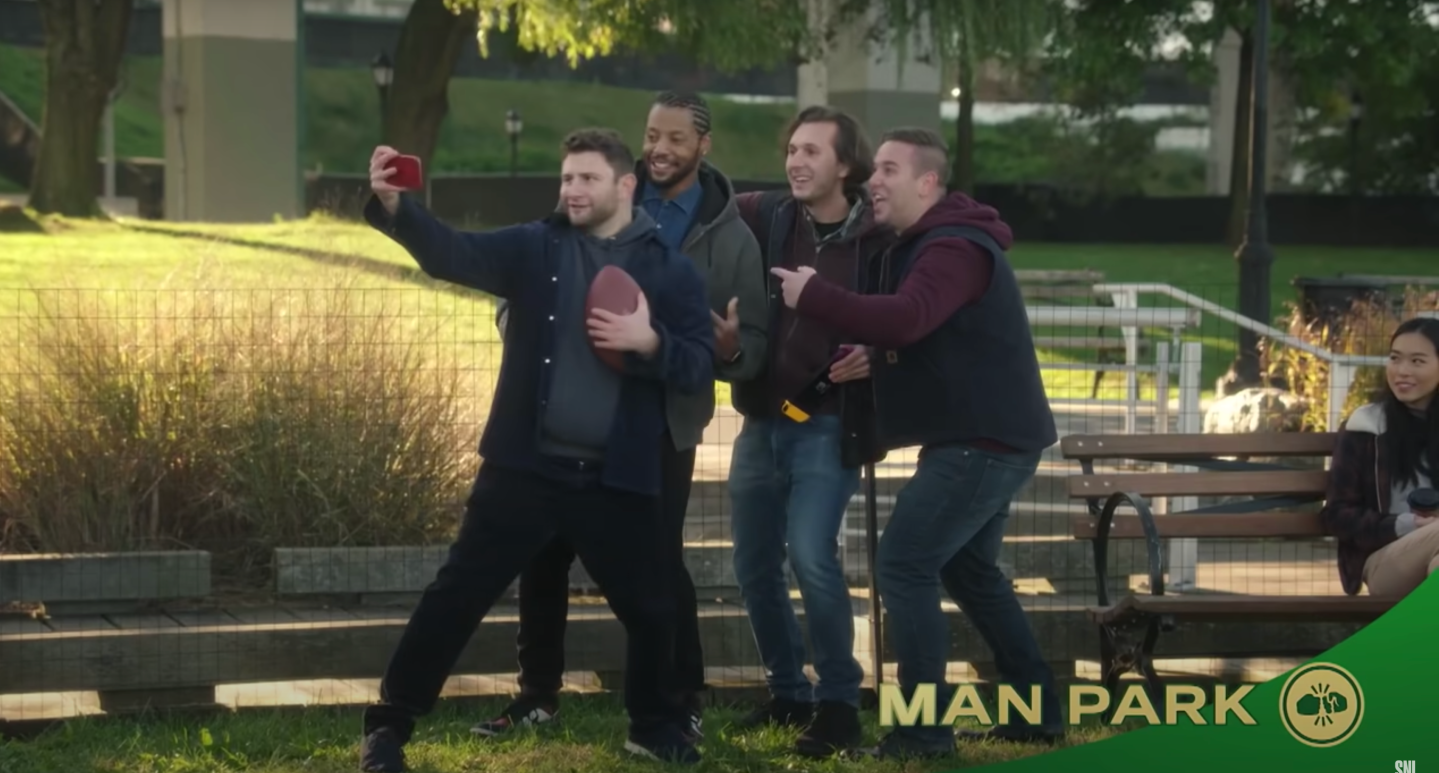
This was a line from a recent "Saturday Night Live" sketch, aptly titled “Man Park.” The premise: A girlfriend is so concerned that her male partner has no friends, that she takes him to the “Man Park” to socialize. ”It’s like a dog park, but for guys in relationships.” Like a cute clumsy puppy, the boyfriend (Pete Davidson) plays with other “breeds” as the women cheer from the sidelines. Finally, the boyfriend gets to bond with his fellow males over Dave Matthews, Marvel, and Rick and Morty. You know … guy stuff.
That sketch might be hilarious, but it is touching on the very real loneliness that men experience. If you have any doubts, just take a look at some of the comments to the video:
“I feel personally attacked but also kind of disappointed this isn’t a thing. How do you make new friends as an adult? … my girlfriend is also my only friend lmao.”
“This really hits home. It’s incredible how men fall into this state of loneliness of friendships apart from their partners. I had lots of friends when I was young and have a lot of old time friends, but as an adult it’s been pretty hard forming these new bonds. It’s a mix of a lack of time, social events and COVID has kept us isolated and at home.”
“Jesus's biggest miracle was he had 12 close male friends at age 30.”
Loneliness. A problem...
Avrum Weiss, Ph.D., wrote a brilliant article on the subject in Psychology Today (it even references the SNL sketch). In it, he pointed out how in heterosexual relationships, men often rely on their female partners to maintain friendships. And that boys start out with as many close relationships as girls do, but often start to neglect their personal relationships to “pursue external success.” Basically, the skill of making friends is not like a bicycle. You do forget if you don’t keep at it.
Add to that a culturally taught association between vulnerability and weakness, and it’s no wonder that so many men find themselves lost.
Though SNL makes light of it, Weiss notes the serious toll isolation takes, stating that “loneliness is not only an unpleasant feeling; it is an interpersonal impairment that causes significant harm.” This includes less satisfaction in their intimate relationships, and even extends to a steep decline in physical health.
...and a solution
Billy Baker, author of We Need to Hang Out, has become a bit of an expert in overcoming loneliness. His now famous article for The Boston Globe retells him getting asked to write a piece about being middle aged and having no friends. Which is, as Baker shares, quite typical.
Baker eventually solved the puzzle of the elusive male companionship with a simple, yet radically effective strategy: He made engagement a regular activity. Wednesday nights were, and still are, planned friend nights.
Meeting new people could be as simple as taking a class or even volunteering (doesn’t hurt that the last one also appeals to a masculine drive for service and purpose). The real challenge, however, is maintaining those connections once they’re established.
Though regular social interaction is important for anyone, sociologist Rebecca G. Adams notes that regular activities might be particularly important to men, who tend to use friendship to escape reality, while women tend to use friends to face reality.
...and an invitation
Perhaps the biggest takeaway though, was that Baker reframed his outlook on masculinity. As his article expresses, he learned that admitting loneliness does not make you a loser. Nor does showing affection—even to another man—imply a lack of strength. Circling back to the SNL sketch, it’s not men’s fault that many of them have been taught to think that emotion = burden. The only way to change this belief, however, is to put themselves out there and move through the discomfort of potential awkwardness or rejection.
Sounds like a pretty classically labeled male trait when you think about it: a willingness to persevere through a difficult circumstance, in order for something better. That inherent determination serves to create emotional well-being, too.
Though finding friends might not be as easy as a walk through the “Man Park,” the results are well worth the effort. And men deserve to experience the type of emotional fortitude that comes from knowing people are out there when times are hard.

- Men and women do friendship differently. Maybe it's time for that to ... ›
- Fathers need to care for themselves as well as their kids – but often ... ›
- Nick Offerman's thoughts on men crying are the perfect antidote to ... ›
- Man stuns his friends by calling to tell them goodnight, setting off a wholesome bro trend - Upworthy ›
- Trans man 'blindsided' by the loneliness and suspicion that comes with being a man - Upworthy ›
- Michael Che played a hilarious April Fools' prank on Colin Jost and they couldn't keep it together - Upworthy ›
- People share how iconic, 5-year-old SNL Christmas sketch 'changed' their holidays forever - Upworthy ›


a man sitting at a desk with his head on his arms Photo by
Can a warm cup of tea help you sleep better? If you believe it, then yes. Photo by 
A woman is getting angry at her coworker.via
A man with tape over his mouth.via
A husband is angry with his wife. via 
Three women sit on a blanket in the park. 
Two women engaging in a pleasant conversation inside a coffee shop
Two men engaging in a peaceful disagreement.
Resurfaced video of French skier's groin incident has people giving the announcer a gold medal
"The boys took a beating on that one."
Downhill skiing is a sport rife with injuries, but not usually this kind.
A good commentator can make all the difference when watching sports, even when an event goes smoothly. But it's when something goes wrong that great announcers rise to the top. There's no better example of a great announcer in a surprise moment than when French skier Yannick Bertrand took a gate to the groin in a 2007 super-G race.
Competitive skiers fly down runs at incredible speeds, often exceeding 60 mph. Hitting something hard at that speed would definitely hurt, but hitting something hard with a particularly sensitive part of your body would be excruciating. So when Bertrand slammed right into a gate family-jewels-first, his high-pitched scream was unsurprising. What was surprising was the perfect commentary that immediately followed.
This is a clip you really just have to see and hear to fully appreciate:
- YouTube youtu.be
It's unclear who the announcer is, even after multiple Google inquiries, which is unfortunate because that gentleman deserves a medal. The commentary gets better with each repeated viewing, with highlights like:
"The gate the groin for Yannick Bertrand, and you could hear it. And if you're a man, you could feel it."
"Oh, the Frenchman. Oh-ho, monsieurrrrrr."
"The boys took a beating on that one."
"That guy needs a hug."
"Those are the moments that change your life if you're a man, I tell you what."
"When you crash through a gate, when you do it at high rate of speed, it's gonna hurt and it's going to leave a mark in most cases. And in this particular case, not the area where you want to leave a mark."
Imagine watching a man take a hit to the privates at 60 mph and having to make impromptu commentary straddling the line between professionalism and acknowledging the universal reality of what just happened. There are certain things you can't say on network television that you might feel compelled to say. There's a visceral element to this scenario that could easily be taken too far in the commentary, and the inherent humor element could be seen as insensitive and offensive if not handled just right.
The announcer nailed it. 10/10. No notes.
The clip frequently resurfaces during the Winter Olympic Games, though the incident didn't happen during an Olympic event. Yannick Bertrand was competing at the FIS World Cup super-G race in Kvitfjell, Norway in 2007, when the unfortunate accident occurred. Bertrand had competed at the Turin Olympics the year before, however, coming in 24th in the downhill and super-G events.
As painful as the gate to the groin clearly as, Bertrand did not appear to suffer any damage that kept him from the sport. In fact, he continued competing in international downhill and super-G races until 2014.
According to a 2018 study, Alpine skiing is a notoriously dangerous sport with a reported injury rate of 36.7 per 100 World Cup athletes per season. Of course, it's the knees and not the coin purse that are the most common casualty of ski racing, which we saw clearly in U.S. skier Lindsey Vonn's harrowing experiences at the 2026 Olympics. Vonn was competing with a torn ACL and ended up being helicoptered off of the mountain after an ugly crash that did additional damage to her legs, requiring multiple surgeries (though what caused the crash was reportedly unrelated to her ACL tear). Still, she says she has no regrets.
As Bertrand's return to the slopes shows, the risk of injury doesn't stop those who live for the thrill of victory, even when the agony of defeat hits them right in the rocks.