upworthy
Add Upworthy to your Google News feed.
Google News Button
Joy

People are sharing heartwarming stories of libraries being safe spaces and it's so wholesome

When so much seems wrong with the world, we at least know we got this one thing right.

People are sharing heartwarming stories of libraries being safe spaces and it's so wholesome
Photo courtesy of Canva, @schlaalfan/Twitter, @Amigo2Todos/Twitter

Libraries are one of the greatest inventions humankind has ever come up with.

Human civilization has its upsides and its downsides. On the one hand, we've built incredible cities filled with amazing buildings where people work and play and are entertained, we have infrastructure that connects people and places, and we enjoy conveniences that previous generations could only dream about. On the other, we have environment-destroying excess and capitalistic greed pushing us toward widespread inequities and injustices.

And then we have libraries.

The public library is one of the greatest inventions humankind has ever imagined and actually made happen. Libraries are perfect in concept and exceptional in practice. The idea that we ought to plop a building full of books to borrow wherever groups of people live is beautiful in its simplicity and the fact that we've actually succeeded in doing it is somewhat miraculous. Libraries are something humans have created that has stood the test of time and that we can be truly, universally proud of. There is nothing but upside to a calm, quiet place where any and all people can hang out and read, without having to pay anyone anything.


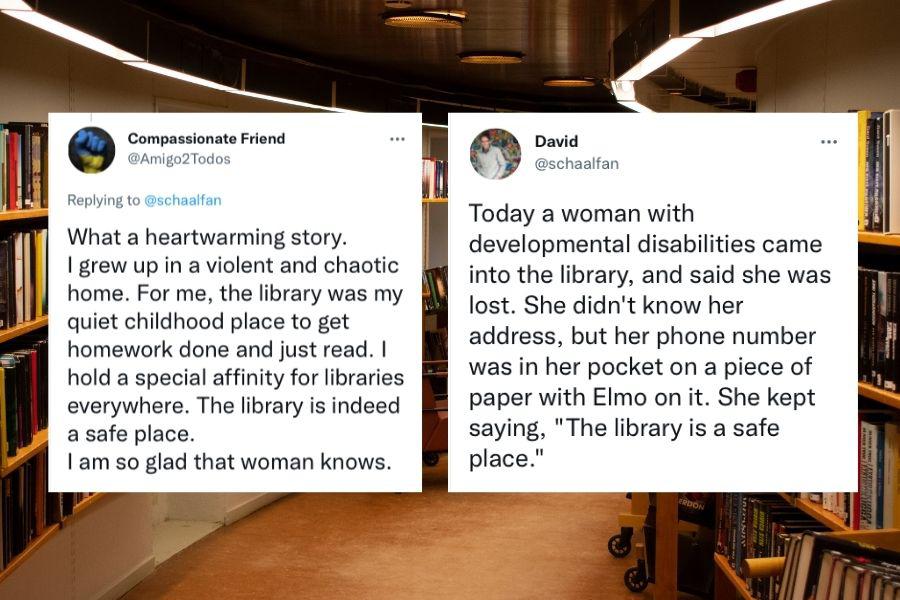
A thread on Twitter celebrating the wonderfulness of libraries illustrates this point perfectly.

"Today a woman with developmental disabilities came into the library, and she said she was lost," wrote Twitter user @schaalfan. "She didn't know her address, but her phone number was in her pocket on a piece of paper with Elmo on it. She kept saying, 'The library is a safe place.'"

"We called and her guardian came right over," they continued. "Apparently this happens pretty regularly. They even stayed long enough for her to check out some new books and Sesame Street DVDs. The library is a safe place indeed."

Indeed. The post prompted others to share their own stories of libraries being safe places for them, and it's enough to warm even the hardest of hearts.

For people who grew up in dysfunctional homes, the library can be a safe haven of calm and kindness.

For people with disabilities, it can be a safe place where people are patient and kind.

For people lacking financial means, the library is a space that provides free education and free entertainment, as well as a free indoor place to go.

People also celebrated librarians—the stewards of these wonderful places and the books and people who reside inside them. Librarians are right up there with teachers in the "best" category.

Libraries and librarians deserve all the love we can give them. When so much seems wrong with the world, we at least know we got this one thing right.

(And some people also threw a little love for Elmo into the thread, too, for good measure. "Sesame Street" is almost as wonderful as libraries, after all.)

This article originally appeared on 3.10.22

Planet

Our favorite giveaway is back. Enter to win a free, fun date! 🌊 💗

It's super easy, no purchase or donation necessary, and you help our oceans! That's what we call a win-win-win. Enter here.

Our favorite giveaway is back. Enter to win a free, fun date! 🌊 💗
True

Our love for the ocean runs deep. Does yours? Enter here!

This Valentine’s Day, we're bringing back our favorite giveaway with Ocean Wise. You have the chance to win the ultimate ocean-friendly date. Our recommendation? Celebrate love for all your people this Valentine's Day! Treat your mom friends to a relaxing spa trip, take your best friend to an incredible concert, or enjoy a beach adventure with your sibling! Whether you're savoring a romantic seafood dinner or enjoying a movie night in, your next date could be on us!

Here’s how to enter:


  • Go to upworthy.com/oceandate and complete the quick form for a chance to win - it’s as easy as that.
  • P.S. If you follow @oceanwise or donate after entering, you’ll get extra entries!

Here are the incredible dates:

1. Give mom some relaxation

She’s up before the sun and still going at bedtime. She’s the calendar keeper, the lunch packer, the one who remembers everything so no one else has to. Moms are always creating magic for us. This Valentine’s Day, we’re all in for her. Win an eco-friendly spa day near you, plus a stash of All In snack bars—because she deserves a treat that’s as real as she is. Good for her, kinder to the ocean. That’s the kind of love we can all get behind.


Special thanks to our friends at All In who are all in on helping moms!

2. Jump in the ocean, together

Grab your favorite person and get some much-needed ocean time. Did you know research on “blue spaces” suggests that being near water is linked with better mental health and well-being, including feeling calmer and less stressed? We’ll treat you to a beach adventure like a surfing or sailing class, plus ocean-friendly bags from GOT Bag and blankets from Sand Cloud so your day by the water feels good for you and a little gentler on the ocean too.

Special thanks to our friends at GOT Bag. They make saving the ocean look stylish and fun!

3. Couch potato time

Love nights in as much as you love a date night out? We’ve got you. Have friends over for a movie night or make it a cozy night in with your favorite person. You’ll get a Disney+ and Hulu subscription so you can watch Nat Geo ocean content, plus a curated list of ocean-friendly documentaries and a movie-night basket of snacks. Easy, comfy, and you’ll probably come out of it loving the ocean even more.

4. Dance all day!

Soak up the sun and catch a full weekend of live music at BeachLife Festival in Redondo Beach, May 1–3, 2026, featuring Duran Duran, The Offspring, James Taylor and His All-Star Band, The Chainsmokers, My Morning Jacket, Slightly Stoopid, and Sheryl Crow. The perfect date to bring your favorite person on!

We also love that BeachLife puts real energy into protecting the coastline it’s built on by spotlighting ocean and beach-focused nonprofit partners and hosting community events like beach cleanups.

Date includes two (2) three-day GA tickets. Does not include accommodation, travel, or flights.

5. Chef it up (at home)

Stay in and cook something delicious with someone you love. We’ll hook you up with sustainable seafood ingredients and some additional goodies for a dinner for two, so you can eat well and feel good knowing your meal supports healthier oceans and more responsible fishing.

Giveaway ends 2/15/26 at 11:59pm PT. Winners will be selected at random and contacted via email from the Upworthy. No purchase necessary. Open to residents of the U.S. and specific Canadian provinces that have reached age of majority in their state/province/territory of residence at the time. Please see terms and conditions for specific instructions. Giveaway not affiliated with Instagram. More details at upworthy.com/oceandate

arthur c. brooks, harvard, psychology, happiness research, bucket list

Harvard researcher Arthur C. Brooks studies what leads to human happiness.

We live in a society that prizes ambition, celebrating goal-setting, and hustle culture as praiseworthy vehicles on the road to success. We also live in a society that associates successfully getting whatever our hearts desire with happiness. The formula we internalize from an early age is that desire + ambition + goal-setting + doing what it takes = a successful, happy life.

But as Harvard University happiness researcher Arthur C. Brooks has found, in his studies as well as his own experience, that happiness doesn't follow that formula. "It took me too long to figure this one out," Brooks told podcast host Tim Ferris, explaining why he uses a "reverse bucket list" to live a happier life.


bucket list, wants, desires, goals, detachment Many people make bucket lists of things they want in life. Giphy

Brooks shared that on his birthday, he would always make a list of his desires, ambitions, and things he wanted to accomplish—a bucket list. But when he was 50, he found his bucket list from when he was 40 and had an epiphany: "I looked at that list from when I was 40, and I'd checked everything off that list. And I was less happy at 50 than I was at 40."

As a social scientist, he recognized that he was doing something wrong and analyzed it.

"This is a neurophysiological problem and a psychological problem all rolled into one handy package," he said. "I was making the mistake of thinking that my satisfaction would come from having more. And the truth of the matter is that lasting and stable satisfaction, which doesn't wear off in a minute, comes when you understand that your satisfaction is your haves divided by your wants…You can increase your satisfaction temporarily and inefficiently by having more, or permanently and securely by wanting less."

Brooks concluded that he needed a "reverse bucket list" that would help him "consciously detach" from his worldly wants and desires by simply writing them down and crossing them off.

"I know that these things are going to occur to me as natural goals," Brooks said, citing human evolutionary psychology. "But I do not want to be owned by them. I want to manage them." He discussed moving those desires from the instinctual limbic system to the conscious pre-frontal cortex by examining each one and saying, "Maybe I get it, maybe I don't," but crossing them off as attachments. "And I'm free…it works," he said.

- YouTube www.youtube.com

"When I write them down, I acknowledge that I have the desire," he explained on X. "When I cross them out, I acknowledge that I will not be attached to this goal."

The idea that attachment itself causes unhappiness is a concept found in many spiritual traditions, but it is most closely associated with Buddhism. Mike Brooks, PhD, explains that humans need healthy attachments, such as an attachment to staying alive and attachments to loved ones, to avoid suffering. But many things to which we are attached are not necessarily healthy, either by degree (over-attachment) or by nature (being attached to things that are impermanent).

"We should strive for flexibility in our attachments because the objects of our attachment are inherently in flux," Brooks writes in Psychology Today. "In this way, we suffer unnecessarily when we don't accept their impermanent nature."

What Arthur C. Brooks suggests that we strive to detach ourselves from our wants and desires because the simplest way to solve the 'haves/wants = happiness' formula is to reduce the denominator. The reverse bucket list, in which you cross off desires before you fulfill them, can help free you from attachment and lead to a happier overall existence.

This article originally appeared last year.

costco, costco receipt, costco receipt checker, receipts at costco, costco employee, costco employee

Costco receipt checkers double check your receipt for many reasons.

Loyal Costco shoppers know that once you check out at the big box retailer, you need to keep your receipt out and ready to hand over to a Costco employee before you're able to leave the store. But why does Costco have employees check your receipt and give it that signature marker swipe at the exit?

First, as YouTuber The Costco Dude (who has worked at Costco since 2008) explains, Costco has your receipt checked at the door rather than right there at the register to help with crowd flow.


"There's usually long lines at Costco, and Costco is all about speed," he says, adding that Costco members don't love the delay at the register when they sometimes check to make sure the number of items on the receipt matches the number of items in their cart.

So, it's up to the exit door employees to check out your Costco receipt before you leave the store. These are the six things they are looking for (and no, it's not solely because they assume you're stealing).

- YouTube www.youtube.com

They double check proper scanning

A major reason Costco employees check your receipt is to cover human error that may have occurred during checkout. It's easy to double (or even triple) scan items—especially when buying multiples.

"I bought two tubs of beer cheese. The asked me did you mean to buy two. Yes, yes I did. I appreciated the check tho, sometimes stuff gets double scanned," one Redditor commented in the thread r/CostcoWholesale.

Another Costco shopper shared how the check paid off in a missed item promotion. "Yeah, one time I bought some beer and they stopped me at the door and told me I only picked up half the beer! Apparently the price was for two twelve packs not just one! So I got to go back and grab my beer," they wrote.

A Costco employee who does receipt checks also chimed in, saying, "I work at the door of a Costco and it can be a double or even triple scan. Or no scan at all. Employees and members are human and make mistakes," they explained. "Most people think we're there to catch thieves but I think there are more people errors than outright theft though there are articles that claim a good percentage of people don't scan all their items at self checkout."

They look for items over $300

John Liang (@johnsfinancetips), a personal finance expert, explained that Costco is extra diligent about double checking any expensive purchases. For items over $300, Costco will typically have a supervisor confirm your purchase.

@johnsfinancetips

As a little kid, I always thought the receipt checkers counted every single item. When I grew up, I just thought the receipt checkers were there as a theft deterrent. But it turns out that their job is a lot more specific than that. #costco #receipt #verified #shop #personalfinance

They confirm you shopped at Costco that day

Looking at the receipt will tell the Costco employee that everything in your cart was indeed purchased that day—a way for Costco to cover itself from possible theft or fraud situations.
"I confirm there is a code on the receipt that says it's from today, I check the bottom of your cart to make sure we've missed nothing," he says.
Costco employees will typically swipe your receipt with a marker, which is another way the store protects itself.
"The swipe on the receipt prevents reuse, e.g. you just go load up your cart with the same items and try to exit again with the same receipt," another Redditor shared.

They check you got the best deals

Costco is always running promotions and discounts on items, and receipt checkers are making sure you reap the benefits.

"A few of them have gotten me price adjustments!" one Redditor noted.

They make sure you received back room items and add-ons

Costco offers a number of items that are not readily available for you to grab in the middle of the store, such as video games, iPhones (and most other electronics), jewelry, and gift cards.

The Costco Dude notes that the supervisor who brought you the item from the back will typically also check the receipt.

"Exit door checkers also verify that you’ve picked up any gift cards or other high-value items from the front. I’ve also seen them check whether add-ons (insurance or Apple Care) are shown as complete," one Redditor explained.

A happy Costco customer also shared, "Had this happen the other evening, and appreciate it so much. Was a bit tired after work and didn’t even think about needing to do that…"

They make sure you received the *correct* item

Finally, checking the receipt will also guarantee your received the correct items that needed to be retrieved from the back of the store.

"They also make sure that you received the correct item from lock up by matching the number on the receipt to the number on the side of the item. Sometimes supervisors grab the wrong item," one Redditor added.

Learning

27 English words people have a hard time enunciating properly, even native speakers

"The word I notice people struggle with is 'vulnerable'. Something about that N following an L is tricky."

enunciate, enunciation, english, words hard to say, hard to pronounce
Image via Canva/Povozniuk

English words that are difficult to enunciate.

The English language is hard to master, even for native speakers. With over an estimated one million words in the language, not only are English words hard to memorize—they can be hard to properly pronounce and enunciate. Getting tripped up with pronunciation can make your communication unclear, or worse—make you sound uneducated.

As American English teacher Vanessa explains, many mispronounced words are common and used in daily conversation due to tricky consonants and vowels in English words. But by knowing the proper pronunciation, it can help you become a more confident speaker, which is why she shared 33 words that are hard for English language learners to pronounce, such as "probably," "drawer," and "sixth."


On the subreddit r/words, a person posed the question: "What's a word you've noticed many native English speakers have difficulty enunciating even though the word is used fairly often?"

Turns out, there are a menagerie of words people notoriously stumble over. These are 27 English words that people say are the hardest to enunciate.

- YouTube www.youtube.com

Tricky 'R' words

"The word I notice people struggle with is 'vulnerable'. Something about that N following an L is tricky." - common_grounder

"Rural." - Silent-Database5613

“'Nucular' for nuclear." - throwawayinthe818

"Remuneration v renumeration (first one is correct)." - RonanH69

"February. It sounds like you're pronouncing it like it's spelled Febuary. But it's spelled February." - SDF5-0, ShadedSpaces

"Mirror. Some people pronounce it 'meer'." - weinthenolababy, diversalarums

"Anthropomorphize is a word I have to use semi-frequently with limited success each attempt." - ohn_the_quain

"I can’t say the phrase 'rear wheel' without considerable effort." - ohn_the_quain

"Eraser (erasure, but they're talking about the pink rubber thing)." - evlmgs

- YouTube www.youtube.com

Multiple syllables

"Exacerbated vs exasperated." - SNAFU-lophagus

"'Asterisk'. A lot of people wind up inadvertently name-checking Asterix. I think it's best for those who struggle to use the alternative name for that punctuation mark, the 'Nathan Hale', after the American patriot who famously declared, 'I can only regret that I have but one asterisk for my country!'" - John_EightThirtyTwo

"I realized recently I have always mispronounced mischievous. It's mis-chiv-us, not mis-chee-vee-us. I don't know if I've ever heard anyone pronounce that correctly." - callmebigley"

'Supposebly' [supposedly]. Drives me up the wall." - BlushBrat

"Library. My coworker knows I hate it, so he’ll say Liberry every time." - Jillypenny"ET cetera, not 'ect' cetera. I think people are used to seeing the abbreviation etc and since there is no diphthong tc in English their mind bends it into ect." - AdFrequent4623

"The amount of people who say Pacific when they're trying to stay specific is pretty alarming. I'm not even sure if they know it's a different word sometimes." - Global-Discussion-41

"Then there was my old boss who would confidently and consistently use the word tenant when he meant tenet." - jaelith"

"Probably." - Rachel_Silver

"Contemplate. It's one of those word I hear people stumble over more than anything, often it comes out as Comtemplate, Contempate or a combination of both." - megthebat49

- YouTube www.youtube.com

Foods

"Turmeric. People drop the first R. It drives me nuts!" - Jillypenny

"Oh, and it’s espresso, no X [ex-presso]." - Jillypenny

"Also cardamom with an N." - nemmalur

"Pumpkin (punkin)." - evlmgs

espresso, espresso gif, sipping espresso, espresso drink, drinking espresso sipping modern family GIF Giphy

Awkward vowels

"Crayon 👑. My ex pronounced it 'cran'. Drove me up a wall." - rickulele, premeditatedlasagna

'Mute' for moot. A good friend of mine, who's extremely intelligent and articulate otherwise, says that. Unfortunately, it's a word she likes to use. I haven't had the heart to tell her she's pronouncing it incorrectly, and it's been three decades." NewsSad5006, common_grounder

"Jewelry." - weinthenolababy

"I hear grown adults calling wolves woofs and they're not doing it to be funny." - asexualrhino


This article originally appeared last year.

Internet

Gen Xers and Boomers share the things kids today will never experience and it's pure nostalgia

From looking things up in the encyclopedia to slamming down the phone to hang up on someone, some experiences live only in our memories.

gen x, boomers, childhood, landline phone, encyclopedia set, vaccines

A pink landline, a hand reshelving an encyclopedia, and child getting a Band-Aid on their arm.

People who remember life before the Internet have witnessed firsthand how modern technology has changed our daily lives, for better and for worse. The world kids are growing up in today is vastly different, which has also changed what childhood looks like. Every generation sees differences between their own formative years and their kids' or grandkids', of course, but the rate of change in the digital age makes the differences between the older and younger generations today feel particularly stark.

That contrast has also led to a great deal of nostalgia for the folks who remember a simpler, slower time on a visceral level. So when someone on Reddit asked Gen Xers and Boomers, "What will kids today never get to experience?" the responses prompted a wave of memories. They're not necessarily good or bad experiences, but they do take us right back to a specific era that some of us remember with fondness.


Here are childhood experiences from Gen Xers and Boomers that today's kids likely won't experience:

Encyclopedias

Having a set of encyclopedias was almost a given before the Internet, as was a parent telling you to "Look it up in the encyclopedia" when you asked a question. There was no Google, no place to enter a search term and get information. You had to figure out the keyword for what you wanted to learn about and find it alphabetically in a huge set of books.

"Having to look up information in an encyclopedia."

"GETTING to look up information in an encyclopedia. I loved reading about random topics in my encyclopedia. That has translated into reading about random topics online."

- YouTube www.youtube.com

"I said I needed something to read at summer camp, in a letter home once. Mom sent the E volume of the 1976 World Book encyclopedia."

"Oh dear I asked the 15 year old about something and after he answered I said 'you're such an encyclopedia!' He looked me and said "Whats and esyklopedia what?" I've never felt more old...and I said it was what we used before Google, that it was a series of big books we had to open and read the letter "B" if we were looking for information on something starting with a B....he was dumbfounded."

"We watched a movie recently where a kid won an encyclopedia set and I told my six year old, 'That's how Daddy and I used to look things up when we were your age. The Internet wasn't really a thing then.' She said, 'You couldn't even enjoy things?'"

"Or the reference room at the library and need the reference librarian to dig out archives of newspapers, phonebooks. Microfiche."

Freedom to roam and be bored

Kids today can roam outside, but they often don't. Digital devices, streaming shows and movies, and parental anxieties have greatly diminished kids' abilities to explore the world around them. Parents used to send their kids out on their bikes for hours with no cell phones and no idea where they were, which sounds downright irresponsible to modern-day sensibilities.

"Riding your bike all day and exploring. Being free…just be home by dinner time."

"Street lights were our timers."

"Getting lost and then figuring out on their own how to find the way back. It’s a skill that the cavemen probably relied on."

"Just running around rolling on the grass and playing in the dirt. Laying on their backs and seeing pictures in the clouds."

"That loss is truly underrated. To be able to draw on those childhood experiences of unstructured time and wonder has been a guide to calm and center me throughout my life."

Collect calls (and knowing how to avoid them)

Pre-cell-phone, we had a use public pay phones to call home. But if you forgot to bring change for the phone booth, you had to call collect (meaning the receiver of the call would have a charge put on their phone bill for accepting the call, and it usually wasn't cheap). The operator would ask the call receiver if they wanted to accept the call, with a question like, "You have a collect call from [insert name]. Would you like to accept? You only got charged if you accepted the call, so people would get around it by giving a name that meant something specific, like a family code system.

"Making a collect call from a payphone."

"Yes, and calling home and letting it ring once to let Mom and Dad know I’d arrived safely!"

- YouTube www.youtube.com

"My Mom had a whole list of coded last names she'd use with her sisters. IIR, Mrs. McBride meant she'd be late, Mrs. Wagner meant she'd arrived and needed a ride, and so on. They kept using it well into the 80's for flights."

"Mom done (wherever we were) was mine, because i would spend the 25 cents she gave me for the payphone on candy lol."

Internet-free TV

Ah, the joy of walking across the room to change the channel and only having five channels to choose from. Or having to adjust the antenna for picture clarity. Or the sound of TV static. Or racing to the bathroom during a commercial break.

"Missing an episode of a show knowing you will never be able to see it again."

"I was talking to a Millennial the other day and she was like "Wait, so the TV just stopped broadcasting at night?" Yep. It played the national anthem and there were usually some fighter jets...Then nothing but the test pattern. Blew her mind."

tv, television, before the internet, entertainment, gen x, boomer childhood TV before the Internet was a whole different experience. Photo credit: Canva

"Arguing over the single TV because someone can’t miss 'their' programme. Learning random facts about antiques or wildlife because there’s nothing else on. Having to concentrate whilst listening to dialogue because there’s no rewind. Watching something special but having no way to show it to others. Having no problem with black and white films because you just imagine all the colours. Waiting to 'find out next week' after a cliffhanger."

"School closures scrolling across the bottom of the screen at 6 am. It was like waiting for your lottery numbers announced."

Boxes of notes and letters

We had so many handwritten notes, letters, and cards before texting. College friends would write and send snail mail letters to one another during summer break. You'd write to your friends when you were on vacation. Getting the mail was actually exciting because there was a good chance you'd have something personal.

"Having a random box of old letters and postcards to sort through now and then."

"fr fr those old letters were like little time capsules, now it's just endless scrolling through email or texts."

"I’ve noticed that a lot of people these days don’t do cards or notes anymore. I’ve collected every card I’ve got since i was in middle school! I love handwritten notes."

Passing notes to your friends, folded up in that certain way that turned the note itself into sort of an envelope. I still have a box of them from high school and they are hilarious."

The joys and woes of landline phones

So many telephone memories: Rotary dialing. Stretching the phone cord as far as it would go. Waiting by the phone. Not knowing who was on the other end when you answered it.

"Slamming the phone down in anger."

"Rotary dial: Oh the glorious feeling of slamming the phone down mid conversation during an argument and unplugging the phone from the wall :D"

"The terror of having to talk to a girl’s parents on the phone before you talked to the girl."

telephone, rotary phone, landline, before cell phones, hanging up the phone Phone calls were an entirely different ballgame before cell phones.Photo credit: Canva

"As a girl, standing by the phone in the kitchen for 5 hours waiting for the boy to call because all your 6th grade friends said he would call you and you CANNOT have your mom answering. Spoiler alert: He never called. I picture him sitting terrified by his phone and then just abandoning the idea to go outside and ride a bike or something."

"Stretching the cord around the corner of the kitchen, in a desperate bid for a bit of privacy!"

"Getting to the 7th number and realizing you made a mistake, then having to hang it up and start dialing over again lol. Ain't no backspace button on a rotary phone!"

"Prank phone calls. IDK why but sitting with my GFs, dropping open a phone book, randomly picking a number and then calling someone with some stupid voice and stupider question ('is your refrigerator running?') was the epitome of funny to my 11 year old self."

Vaccine-preventable diseases

On the positive side, communicable childhood diseases have greatly diminished thanks to vaccines. Older generations experienced the realities of polio, the mumps, and other diseases that children are now widely immunized against.

"Hopefully polio."

"A childhood without measles, polio, mumps, rubella."

communicable disease, polio, mumps, measles, vaccines, immunizations. Vaccines have helped reduce or eliminate childhood diseases that affected generations past. Photo credit: Canva

"I was just talking to one of my kids about polio! I told them that most people my age (50ish) knew at least one adult who had it as a child (my great uncle, for me) but that now it was super rare to know anyone because the disease has been eradicated by the vaccine."

"I lost 3/4ths of my hearing from the mumps. I hope that won’t happen again to anyone."

Nostalgia can be fun to revel in, but it's also easy to look at the past only through rose-colored glasses. Though some people might lament the loss of many of these experiences, some of them are better off being left in the rearview mirror. The diseases, of course, but even the pre-tech simple life wasn't always so simple. Would we really want to give up Google or GPS for encyclopedias and road atlases? Unlikely. Perhaps we can bring some of what was great about childhood experiences of the past while celebrating the genuinely helpful technology that has made our lives better in the present.

Family

2-year-old 'living her best Parisian life' turns first France trip into 'full-blown croissant tour'

A fun and adorable reminder that traveling is about savoring the small moments.

travel, traveling with toddlers, traveling with kids, france, france for kids, paris, paris for kids, kid friendly travel spots, croissant

Image of a little girl eating a croissant in front of the Eiffel Tower.

Leave it to kids to teach us how to really savor the sweetness (or in this case, battery flakiness) of life.

In an adorable video posted onto the travel content Instagram account @apeanuttravels, a mom named Vanessa shows how her two-year-old’s first trip to Paris quickly became one thing and one thing alone: a “full-blown croissant tour.”


Indeed, this little gal made the pastry the main event, eating not one, not two, not three, but TWELVE croissants. Let it be known that variety was not sacrificed, though. The croissants themselves ranged from dipped in mayonnaise, to plain, to almond cream, and having gobs of butter plopped on top.

Living “her best Parisian life,” this little one also occasionally donned a delightful red beret or croissant-themed pajamas while enjoying her culinary obsession. Other times she dined against a gorgeous backdrop that she was completely unaware of.

The pâtissière love affair only got more and more passionate, as she counted the croissants one by one (“This is my first croissant… this is my second croissant…”), eventually only being able to exclaim “croisssabbbbaaa!!!” If ever croissant drunk was a thing, she had it.

And while some parents might have felt disappointed that their child didn’t feel that same amount of appreciation for seeing the Eiffel Tower, Vanessa knows that “traveling with a toddler means experiencing a city through snacks,” and that “watching your kid fall in love with something new in a new place is one of the best parts of family travel.”

To be clear, this toddler has her priorities straight no matter where she travels. Take a look at this video from Italy. Now THAT’s how you eat noodles:

According to several of Vanessa’s videos, snacks are a major key to happy toddler travels—from helping ease airplane restlessness to setting a positive tone for the day before anyone even leaves the hotel. A well-timed treat can turn a potential meltdown into a manageable moment, and having familiar foods on hand gives little travelers a sense of stability in an otherwise new environment.

She also suggests planning just one main activity per day rather than a jam-packed itinerary, which leaves room for wandering, resting, and following a child’s natural rhythm. On-the-go naps, making lunch the main meal followed by lighter “snacky dinners” and evening strolls, keeping a consistent bedtime routine, and staying in the same accommodations for multiple nights all help create a sense of predictability.

Once the family began making these simple tweaks, travel became “more fun for all,” Vanessa writes. Less about rushing from sight to sight and more about enjoying the experience together.

This all goes to show that when it comes to traveling with toddlers, the trip you plan and the trip you actually take are rarely the same. Adults might dream of museums, landmarks, and carefully curated itineraries, but little kids tend to fall in love with the small, delicious, delightfully repetitive things. While it might take some adjustment on the parent’s end, watching a child latch onto one joyful obsession has a way of recalibrating expectations for everyone involved. It shifts the focus from checking off sights to noticing what actually feels good in the moment. And years later, those are often the details that stick. Not the postcard views.