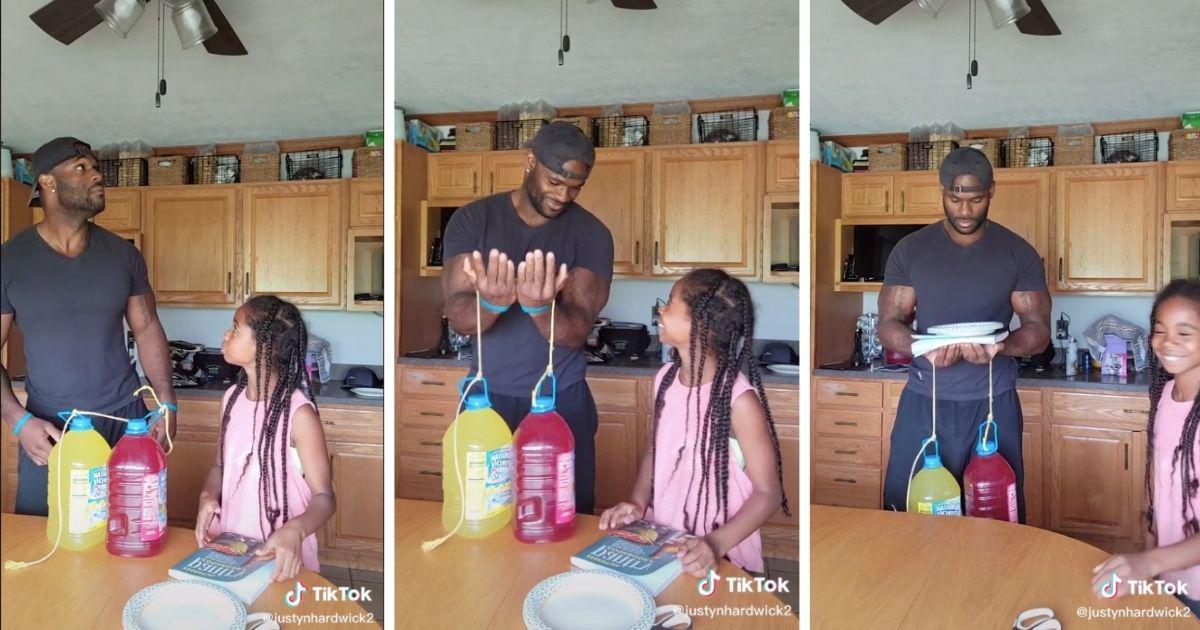
This dad suspected his daughter was pranking him and yet she still managed to pull it off
Justyn Hardwick clearly knows his daughter Ary is a die-hard prankster. The father of three frequently shares his family’s silly shenanigans on social media, and he knows to be prepared for every possible scenario. That’s why, when Ary asked him to help with a “weight challenge,” his first instinct was to search for the trap.…
Justyn Hardwick clearly knows his daughter Ary is a die-hard prankster. The father of three frequently shares his family’s silly shenanigans on social media, and he knows to be prepared for every possible scenario.
That’s why, when Ary asked him to help with a “weight challenge,” his first instinct was to search for the trap. “You play too much,” he told his daughter as he looked around the room for clues that something was amiss. His instant paranoia alone was funny.
But Ary kept her cool and convinced her pop to hold two large jugs of juice on a rope over his hands. Then she started stacking things on top of the rope.
Throughout the “challenge,” Hardwick kept looking around, waiting for the prank. Then it came, and despite being prepared for it, he clearly was not prepared for it.
Watch:
The way she immediately high-tails it out of there and the way her dad uses her full name, “ARYANNA,” at the end. Hilarious.
The video has racked up more than two million views on Facebook and has been shared widely on other social media channels as well.
David Johns, leader of the National Black Justice Coalition, shared the video on Twitter with some commentary that explains some of the appeal of the video beyond the obvious prankster humor. He wrote:
“1. I love that he knows her well enough to check for trap wires and cameras. 2. I love that she’s already considered his concerns and has planned ahead. 3. I love the ability to share media that counters the lies the media frequently tells including: Black dads aren’t absent…”
It’s always delightful to see families have good, wholesome fun together. (To see more of the Hardwicks’ silliness, follow Justyn on TikTok.)

A single door can open up a world of endless possibilities. For homeowners, the front door of their house is a gateway to financial stability, job security, and better health. Yet for many, that door remains closed. Due to the rising costs of housing, 1 in 3 people around the world wake up without the security of safe, affordable housing.
Since 1976, Habitat for Humanity has made it their mission to unlock and open the door to opportunity for families everywhere, and their efforts have paid off in a big way. Through their work over the past 50 years, more than 65 million people have gained access to new or improved housing, and the movement continues to gain momentum. Since 2011 alone, Habitat for Humanity has expanded access to affordable housing by a hundredfold.
A world where everyone has access to a decent home is becoming a reality, but there’s still much to do. As they celebrate 50 years of building, Habitat for Humanity is inviting people of all backgrounds and talents to be part of what comes next through Let’s Open the Door, a global campaign that builds on this momentum and encourages people everywhere to help expand access to safe, affordable housing for those who need it most. Here’s how the foundation to a better world starts with housing, and how everyone can pitch in to make it happen.
Volunteers raise a wall for the framework of a new home during the first day of building at Habitat for Humanity’s 2025 Carter Work Project.
Globally, almost 3 billion people, including 1 in 6 U.S. families, struggle with high costs and other challenges related to housing. A crisis in itself, this also creates larger problems that affect families and communities in unexpected ways. People who lack affordable, stable housing are also more likely to experience financial hardship in other areas of their lives, since a larger share of their income often goes toward rent, utilities, and frequent moves. They are also more likely to experience health problems due to chronic stress or environmental factors, such as mold. Housing insecurity also goes hand-in-hand with unstable employment, since people may need to move further from their jobs or switch jobs altogether to offset the cost of housing.
Affordable homeownership creates a stable foundation for families to thrive, reducing stress and increasing the likelihood for good health and stable employment. Habitat for Humanity builds and repairs homes with individual families, but it also strengthens entire communities as well. The MicroBuild® Initiative, for example, strengthens communities by increasing access to loans for low-income families seeking to build or repair their homes. Habitat ReStore locations provide affordable appliances and building materials to local communities, in addition to creating job and volunteer opportunities that support neighborhood growth.
Marsha and her son pose for a photo while building their future home with Southern Crescent Habitat for Humanity in Georgia.
Everyone can play a part in the fight for housing equity and the pursuit of a better world. Over the past 50 years, Habitat for Humanity has become a leader in global housing thanks to an engaged network of volunteers—but you don’t need to be skilled with a hammer to make a meaningful impact. Building an equitable future means calling on a wide range of people and talents.
Here’s how you can get involved in the global housing movement:
Speaking up on social media about the growing housing crisis
Volunteering on a Habitat for Humanity build in your local community
Travel and build with Habitat in the U.S. or in one of 60+ countries where we work around the globe
Join the Let’s Open the Door movement and, when you donate, you can create your own personalized door
Every action, big and small, drives a global movement toward a better future. A safe home unlocks opportunity for families and communities alike, but it’s volunteers and other supporters, working together with a shared vision, who can open the door for everyone.
It’s not always easy for teachers to come up with cohesive, compelling ways to teach their students even basic concepts. But something as abstract and dense as, say, the Circle of Fifths? Good luck!
And yet, a teacher named Benjamin Kapilow was undoubtedly up to the task.
What is the Circle of Fifths?
The Circle of Fifths visually organizes the twelve chromatic pitches in Western music into a visual, clock-like diagram. Understanding this diagram helps explain how virtually all musical elements are organized and connected. So, having mastery of it enables musicians to sight-read, aka translate sheet music, instantly.
However, music students are often instructed to simply memorize the Circle of Fifths without getting to learn how it applies to an instrument or singing, making it feel like a random assortment of conceptual ideas rather than a tool.
That’s where the “Circle of Fifths” song comes in.
In a now-viral video shared to Instagram, we see Kaplow’s entire music class grooving to a song he wrote himself to give them hands-on learning of the sight-reading concepts he had introduced earlier that week: including solfege patterns (you might know them as “do, re, mi, fa, sol, la, ti”) in minor syncopated rhythms, wherein accents are placed between counts instead of the strong downbeats, which gives a song a bouncy feel.
Beyond the impressive craftsmanship, what’s so endearing about this (that many viewers appreciated) is that Kaiplow had a clear “vision” for each of his students during this performance, assigning certain solos and lines to just the right person. Still, it was clearly a collaborative effort.
“I love that the teacher clearly knew their students and gave each student the line they thought they’d eat the hardest,” one person aptly put.
Another joked, “Is y’all’s teacher Lin-Manuel Miranda?”
And for those of us who still have no idea what’s going on but dig the tune, you’re not alone.
“Still don’t understand the circle of fifths, but this slaps lmao,” commented one person.
Creating DIY lesson plan songs is something Kapilow regularly does for his class because it’s fun, ensures no one knows the song already, and can readily test students’ sight-reading skills.
“Then I can target what they need to work on in the song,” he told Upworthy, adding that, technically, “Circle of Fifths” just shows up in the lyrics, since the actual lesson about it will happen later in the semester.
These days, we hear a lot about how hard it is to keep students engaged in the classroom. But then you see something like this, and it makes you remember that fun and novelty remain tried-and-true teaching tools. Bless the teachers who pour their creative juices into their curriculum and really infuse joy into what they teach.
German engineer Karl Benz is generally credited with inventing the modern car, patenting his three-wheeled “Benz Patent-Motorwagen” on January 29, 1886. However, not many know that his wife played a key part in bringing it to the mainstream. She’s also technically the world’s first car thief…before the word “car” even existed.
Bertha Benz was a constant supporter of her husband’s idea: using her dowry to back him financially and even offering her own input to make the contraption more practical. Her input was most impressive, considering women weren’t allowed to formally study engineering at the time.
As the story goes, Bertha could not sit idly by while their invention faded away into obscurity.
So, in the wee hours of August 5, 1888, she set out in secret with her two young sons, Eugen and Richard Benz. She left Karl a note saying that the trio had ventured to her mother’s home, around 60 miles away. She had failed to mention that she’d be using their automobile to get there.
This became not only the world’s first long-distance automobile journey but also a very fruitful field test, during which she encountered several mechanical problems along the way.
Luckily, Bertha was nothing if not resourceful. When a fuel pipe got clogged, she cleared it with a hatpin. She used a garter as insulation material for a frayed ignition lead. When the wooden brakes began to fail, Benz had a cobbler install leather, making the world’s first pair of brake linings. When the automobile ran low on petrol, she even stopped at a pharmacy to purchase a petroleum-based cleaning agent and use that as fuel. This essentially created the world’s first gas station.
Despite these challenges, Bertha made it to her destination twelve hours later. It was only then that she sent Karl a telegram sharing the details of her clandestine excursion. Relieved, Karl urged Bertha to rush the car’s chains back on a freight train to be shown at a car show. Instead, she drove it right back home.
All in all, Bertha’s stunt brought global attention to the Benz Patent-Motorwagen, which led to skyrocketing sales and changed history forever.
And yet, despite her remarkable contributions, she wouldn’t be inducted into the Automotive Hall of Fame until 2016. Meanwhile, Karl was inducted in 1984, a good 32 years before her.
In 2019, Mercedes-Benz released an ad that cinematically imagined what Bertha’s journey must have been like. How she must have appeared like a supernatural being to those who had never seen an automobile, how she surely endured sexist comments, and (perhaps most importantly) how inspiring she might have looked to young girls who witnessed her bravery.
The ad ends with: “She believed in more than a car. She believed in herself,” which feels like a little more than sensational marketing. As Bertha did famously say, “Before me, no automobile existed.”
Even though we don’t hear their stories as often, history is full of women just like Bertha. Women who believed in themselves enough to ignore the odds and change the world forever.
The 2003 film Love Actually is probably best known for its controversial-ish cue card scene, where Andrew Lincoln’s character professes his love for Keira Knightley by silently showing her cue cards, including the famous (or infamous) line, “To me, you are perfect.”
But there’s another scene in the film that doesn’t get nearly the recognition it deserves. It’s well-regarded, but not nearly well-regarded enough.
It’s been over 20 years since the late Alan Rickman broke Emma Thompson’s heart by buying that little office tart a necklace in Love Actually, and some of us still haven’t forgiven him.
With its overlapping love stories set during Christmastime, the film has become a holiday classic, despite some controversy over whether it’s actually any good. Some people love it, some people hate it, but no one can deny that Thompson gives an Oscar-worthy performance in one utterly heart-wrenching scene.
Of the eight “Love Actually” relationships, Harry and Karen (Rickman and Thompson, respectively) is the one that gives the film some serious gravitas. While other characters are pining or shooting their shot with varying levels of success, Harry is having a midlife-crisis affair with a modelesque coworker, while Karen shuffles their children to and fro and keeps Harry’s life running smoothly. We see him lie, we see her start to suspect, but the scene where she opens her Christmas present from Harry (a Joni Mitchell CD, not the necklace she had found hidden in his coat and thought was for her) is when we see Thompson’s acting strengths in full view.
Like, phew.
What’s so striking about the scene, however, is that it’s not dramatic in a typical way. There’s no external conflict—it’s just Thompson excusing herself from the family to process, in secret, what she’s just discovered. We see and feel her heartbreak—it’s so visceral—but that’s not what makes the scene so powerful. Heartbreak happens all the time in movies.
As Thompson explains in a BBC Radio 1 interview, it’s the fact that she can’t react the way she wants that pulls at people’s heartstrings so hard.
“I think it’s just because everybody’s been through something like it,” Thompson says. “What I think really gets to them, though, is that she has to pull herself together. It’s not that she’s upset. That’s, you know, ten a penny. But it’s that she has to pull herself together.”
It’s true. The conflict in the scene is between her wanting to break down and her wanting to keep her family’s Christmas memories happy and intact. She is a devastated wife, but she’s also a devoted mother who doesn’t want to devastate her kids. We feel the tension between those two roles and the way she swallows up her grief in order to get her kids to their holiday concert right after finding out her marriage isn’t what she thought it was.
When you think about it, it’s incredibly poignant. And though not everyone loves the film, it’s moments like this one that have helped it stand the test of time and stay on many people’s holiday watch-list.
“I think it’s to do with the fact that we’re required in our lives to repress the things that we’re feeling,” Thompson explained on TODAY. “So, you can be hit right between the eyes with some terrible piece of news, but you can’t react immediately because you’ve got your children there. It’s that thing of not showing — that’s why it hurts. That’s why it moves us.”
“If she went, ‘Oh my God! I thought you were going to give me a necklace! And now you’ve given it to somebody else,’ we would not be moved, you know?” she continued. “We’re moved because she just goes, ‘I’m not gonna do it.’ And then she makes the bed, the bed that sort of suddenly feels so empty of meaning. And then she goes down and goes, ‘Hello, everyone! Let’s go.’ That’s why people identify.”
And the way she plays it is perfect. Any actor can cry, but it’s her crying while trying not to cry, and the way she shows us her inner emotional turmoil without ever saying a single word is impressive.
If you’ve never seen “Love Actually” and want to see the Harry and Karen story, here are just their scenes:
Some people have asked whether Harry actually physically cheated or not, but “Love Actually” script editor Emma Freud clarified that he did. “DEFINITELY had an affair,” she wrote on X in 2015. “I begged Richard just to make it a flirtation, but no. The whole way.”
And did Harry and Karen stay together in the end? The film doesn’t really make it clear, but at the screening Freud answered the question: “They stay together but home isn’t as happy as it once was.” Oof. There’s just no non-heartbreaking answer to that question.
This is why we watch films, though, isn’t it? To see our humanity reflected back to us? To feel what the characters feel? To have our hearts broken vicariously so we can have a good cry without going through the actual pain ourselves?
People usually watch rom-coms for the romance, the comedy, and the happy endings, though. So here’s to Emma Thompson and Alan Rickman for giving us one of cinema’s most poignant scenes in one of its most unexpected places.
This article originally appeared two years ago. It has been updated.
A Somali refugee and current resident of Minneapolis, the multimedia artist and activist draws on her lived experiences to create work that explores trauma, displacement, and resilience. But like so many of the guests on Freedom to Thrive, an award-winning podcast produced by the National Immigration Law Center (NILC), Mansour doesn’t want to focus only on trauma; she also wants to celebrate the unexpected beauty she’s found during difficult experiences.
“One of the beautiful things about tragedies is that it activates hearts, and courageous people are born,” she says. For example, Mansour has noticed more Minnesotans than ever are reaching out to help the vulnerable, after the anti-immigrant crackdowns carried out by the Department of Homeland Security. “They are bringing food, they’re bringing extra clothes, they’re walking with people, and it’s just really beautiful.”
Hector Flores, co-founder of the Las Cafeteras and host of Freedom to Thrive, agrees with her. A child of immigrants himself, he has also seen how hope and hardship often live side by side.
Flores comes from a family with mixed status and is highly aware of the challenges immigrants and refugees in his community face, and how they’re affected by people’s misconceptions. “People want to know about trauma all the time, but we’re more than just undocumented,” he says. “We’re artists, singers, creatives … there’s so much richness in the culture.”
At its core, Flores’ comment is exactly what the Freedom to Thrive podcast is all about: Celebrating immigrants as complex, dynamic individuals, and challenging the dominant narrative that too often reduces them to symbols of hardship.
Launched in 2024, Freedom to Thrive explores heritage, resilience, community, and the ways art and comedy can spark social change. Now in its second season, the podcast continues to feature conversations with immigrants, policymakers, artists, musicians, activists, and more. Recent guests have included comedian Mo Amer, Grammy Award-winning singer Lila Downs, and Pulitzer Prize-winning author Viet Thanh Nguyen.
Where the first season focused on individual stories of identity and belonging, Flores says his goal for season two, where he joins as host, is to “take it to the next level” — using storytelling to highlight “the fact that we’re more similar than different.”
One recent podcast episode drives this point home. In December, Flores interviewed Bryan Andrews, a rising country music star and rural Missouri native who frequently uses his platform to speak about issues affecting immigrant families. At the heart of his message and his songwriting, Andrews says, is the idea that small-town Americans and the rest of the country, including immigrants, have more in common than they realize.
“It doesn’t matter where you’re from,” Andrews says on the podcast. “We’re all trying to make a living and we’re tired of getting railroaded by corporate greed or by politicians who don’t care.”
Rural Americans, Andrews says, are often stereotyped as racist and misogynistic but “the overwhelming majority of people in my home town have love in their hearts.” Media stereotypes often amplify differences and divide, he says, but at the end of the day, “we’re all in this together.”
Flores, who was raised in a working-class immigrant neighborhood in East Los Angeles, had similar thoughts. He says he often sees its residents stereotyped as wealthy, consumerist, and status obsessed. “That exists, but that’s not my life, that’s not my community,” he says. Like small-town Americans, people in the city “just want to work hard and take care of their families. We all want the same thing.”
Although the podcast tackles some heavy issues, each episode’s ultimate focus is how personal and collective struggles can be healed through art, driving home a message of hope and resilience:
Mansour’s episode about her experiences in Minnesota is just one of many examples. Flores asks her,
“What gives you hope for the people creating a home here?”
“The love I feel from other Minnesotans. It is trumping any hate we’re experiencing,” she replies.
CTA: Stream all episodes now on the Freedom to ThriveYouTube channel or the website,here.
The podcast has been nominated for a Webby in the “Belonging & Inclusion” category. You can vote for it to win until Thursday, April 16!
This article is part of Upworthy’s “The Threads Between U.S.” series that highlights what we have in common thanks to the generous support from the Levis Strauss Foundation, whose grantmaking is committed to creating a culture of belonging.
Childhood dishes can take you straight back to your seat at the family dinner table. Comfort meals that were served there are uber nostalgic. And there is one dish represents the epitome of Gen X and baby boomer childhoods: casseroles.
These one-dish wonders were loaded with flavor and baked to perfection. Pulled straight from the oven to the dinner table, casseroles filled the house with the smell of unique home-cooked recipes.
“Fancy Fast Chicken is delicious and so simple. Line up chicken breasts in a casserole dish. Dump uncooked stuffing over top the chicken breasts. Pour Cream of Mushroom (Onion or chicken works too) and incorporate it into the stuffing. Top with cheese of your choice, and fried onions if you’re inclined. Bake at 350 for 45min or until chicken is thoroughly cooked.” – Applepoisoneer
Chicken Curry Divan casserole
“My favorite is Chicken Curry Divan. A friend made it for me in college 40 years ago and it is a favorite to this day. Never disappoints. Many people have asked me for the recipe over the years. My best friends kids now that they are grown have each approached me for it.
1 1/2 lbs chicken breast tenders cooked and cut into bite sized pieces 3 cups broccoli in bite sized pieces 2 cans Cream of Chicken soup 1 cup mayonnaise (must be Mayo) 2 tsp curry Juice of 1 lemon Shredded sharp cheddar (use the amount you like o like a nice even cover of the top) 3/4 cup crushed Ritz crackers 3 tbsp melted butter In 9×13” baking pan layer chicken then broccoli.
Mix the soup, Mayo, lemon juice and curry together well, pour over chicken broccoli mixture evenly and smooth out. Sprinkle cheese over top evenly. Crush crackers fine, mix in melted butter well and sprinkle evenly over top. Cook at 375° for 25-30 minutes until bubbly and top brown. Serve with rice.” – karinchup
Chicken and Rice casserole
“This baked rice & cheese casserole has become a staple in our house! It’s great as a side dish, or I’ll add rotisserie chicken and serve it as a main dish.” – anchovypepperonitoni
Chicken & Dumplings casserole
“The secret of this is not to stir anything. That’s what makes your dumplings. When you dish it out, you have your dumplings on top. 2 chicken breasts, cooked and shredded; 2 cups chicken broth; 1/2 stick of butter; 2 cups Bisquick mix; 2 cups whole milk; 1 can cream of chicken soup; 1/2 medium onion, minced; 1 cup frozen peas; 3 tsp chicken Better Than Bouillon; 1/2 tsp dried sage; 1 tsp black pepper; 1/2 tsp salt.
(1) Preheat oven to 350 degrees (2) Layer 1 – In 9×13 casserole dish, melt 1/2 stick of butter. Spread shredded chicken over butter. Sprinkle black pepper and dried sage over this layer. Do not stir. (3) Layer 2 – Sprinkle minced onions and peas over chicken (4) Layer 3 – In small bowl, mix milk and Bisquick. Slowly pour all over chicken. Do not stir. (5) Layer 4 – In medium bowl, whisk together 2 cups of chicken broth, chicken bouillon, and soup. Once blended, slowly pour over the Bisquick layer. Do not stir. (6) Bake casserole for 30-40 minutes, or until the top is golden brown.” – Superb_Yak7074
Chicken broccoli casserole
“I made chicken broccoli casserole last week and that’s a favorite here. This is pretty close to how I do it.” – gimmethelulz
“Tater tot casserole. My mom made this at least once a week when I was growing up, but she added a quart of green beans to make it a meal. If you brown your ground beef in a good size cast iron skillet, you only dirty up one pan to make it!” – hcynthia1234, upperwareParTAY
Breakfast casserole
“I’m making a breakfast casserole this morning for brunch later—a bag of frozen hash brown potatoes thawed, a pound of sausage sauteed with peppers and onions, a brick of cheese grated, eight eggs beaten with a bit of milk and cream and some salt and pepper. Layer in a casserole, ending with cheese. Bake around an hour at 375.” – CWrend
Hamburger pie casserole
“One of my childhood favorites. Did not add vegetables or cheese though. This was an end of the month struggle meal that everyone loved.” – DarnHeather
Shepherd’s pie casserole
“Shepherd’s pie : brown 1.5 lbs ground beef with half a chopped onion, salt and pepper, drain it and then spread into a 13×9 and stir a can of cream of mushroom soup into it. Spread a drained family size can of corn on top, use a container of prepared mashed potatoes for the top layer. Bake for a half hour at 350.” – ExplanationLucky1143
Noodle casseroles
Tuna casserole
“Love my mom’s tuna noodle casserole: 1 bag broad egg noodles, 1 can cream of mushroom soup, 2 cans tuna, 1 cup frozen corn or 1 can kernel corn, 2 cups shredded sharp cheddar cheese, 1/2 cup seasoned bread crumbs, 1 tbsp celery salt Cook noodles per package directions, drain, then place in a 13×9 casserole dish. Mix in cream of mushroom soup, tuna, corn, 1 cup of the cheddar cheese, and celery salt. Top the casserole with the remaining cheese and bread crumbs. Bake at 350 for 20 minutes or until done enough for you.” – Pinkleton
Mock Stroganoff casserole
“Mock stroganoff – brown 1lb ground chuck. Mix in 8 oz sour cream and 1 can cream of mushroom. Add to 1 lb of cooked egg noodles. Season with black pepper. Extras – fresh mushrooms and/or onion cooked with the beef. Any precooked veggies of your choice, peas or broccoli work well. Splash of Worcestershire, soy sauce, or fish sauce. Garlic or onion powder. Parsley, thyme, or cilantro.” – Nathan_Saul
Cabbage noodle casserole
“I have a quick cabbage and noodles that uses bagged cole slaw. Cook a bag of noodles. Put aside. Cut up a lb of bacon and a med onion. Cook in pan until bacon is slightly fried and onions are clear. Add cabbage(without carrots) let sit 10 min or so. Add to noodles. It’s so easy.” – conjas11
Thanksgiving prep class is now in session! 🍂🧑🏫 If there’s one thing you need to nail on the big day (other than the turkey, of course), it’s Green Bean Casserole. This recipe tastes just like the one your grandmother used to make, if not even better! 😋 Continue reading or click the link in the @allrecipes bio to get the full recipe. Ingredients: 2 (15-ounce) cans cut green beans, drained 1 (10.5-ounce) can condensed cream of mushroom soup ¾ cup milk 1 (2.8-ounce) can French fried onions salt and ground black pepper to taste Directions: Gather all ingredients. Preheat the oven to 350 degrees F (175 degrees C). Mix green beans, condensed cream of mushroom soup, milk, and 1/2 of the fried onions in a 1.5-quart casserole dish. Bake in the preheated oven until heated through and bubbly, about 25 minutes. Sprinkle remaining onions on top and return to the oven for 5 minutes. Season with salt and pepper to taste. Let rest for a few minutes before serving. 🧑🍳: Nicole #thanksgiving#greenbeancasserole#greenbeans#thanksgivingsides
“This is the best green bean casserole recipe, it does use the canned onions but you make your own cream of mushroom and it’s soooo good. I’ve made it on random weekends, it’s not just a Thanksgiving food. I don’t know much about older foods, I just really wanted to share that recipe.”
Corn casserole
“Our family Corn custard doesn’t have crackers but we double the recipe and there’s never any left over. 2 eggs, 1 cup of sweetened condensed milk, 1/2 flour, 2 T soft butter, 1 tsp sugar, 1 can of creamed corn, 1 can of whole corn. Mix all together and bake in a 8×8 about 45 min at 350. Gotta have that!” – Psychological_Bat890
This article originally appeared last year. It has been updated.
Photo credit:
Franklin D. Roosevelt Presidential Library and Museum, Wikimedia – A Thanksgiving dinner in the Great Depression was anything but depressing.
Thanksgiving is right around the corner, and in a year when grocery prices feel like a jump-scare every time we glance at a receipt, many are looking for ways to celebrate without blowing the budget. Luckily, this isn’t the first time Americans have had to get creative in the kitchen.
During the Great Depression, families all over the country still hosted Thanksgiving dinners, often with barely anything in the pantry. Yet what they managed to whip up wasn’t dreary or depressing. Quite the opposite. These resourceful dishes would be just as flavorful and comforting today as they were decades ago.
Here are some Depression-era dishes and tricks that still deserve a spot on a modern Thanksgiving table.
Turkey was wildly expensive in the 1930s, costing more than 10 hours’ worth of wages, per archived reports from The Beaumont Enterprise. Many families simply couldn’t justify buying one, so they reached for one of the cheapest roaster birds available: an old hen. As in, past their laying prime, or even roosters. Cooked low and slow with plenty of moisture, it becomes tender and surprisingly rich.
Given today’s smaller gatherings and tighter budgets, downsizing the bird might make sense again.
One of the most legendary Depression dishes was “mock duck.” Instead of an actual duck, spread flank steak with stuffing, roll it tight, sear it, and roast it until it tastes like something far fancier than it actually is.
It’s comfort food cosplay, and it absolutely works.
Despite the prickly name, porcupine meatballs contain no porcupine. Instead, rice is mixed directly into the meat so it sticks out like little quills. The rice also bulks up the dish so a small amount of meat could feed a crowd. It’s frugal genius.
The long-running radio program Aunt Sammy’s Homemaker’s Half Hour taught home cooks how to stretch every penny. Among their most beloved suggestions: creamed pearl onions, candied sweet potatoes, and simple vegetable dishes built from affordable staples.
These sides check every Thanksgiving box: warm, creamy, sweet, and budget-friendly.
Potatoes were one of the most affordable ingredients of the era, and potato pancakes made frequent holiday appearances. They’re crispy, filling, and perfect for scooping up gravy or topping with applesauce.
Chestnut stuffing, apple-and-raisin stuffing, and even spiced cranberry stuffing were Depression-era favorites. Sure, some recipes required extra labor—like pressing boiled chestnuts through a sieve—but the flavor payoff was worth it then and now.
Many families filled their tables with whatever grew nearby. Dandelion greens—now a fancy “superfood”—were a Depression staple. Paired with citrus, eggs, or leeks, they made a fresh, bright starter salad.
Fresh pumpkin pie was the go-to, though cooks often used whole pumpkins to avoid the cost of canned puree. And if pumpkins were scarce, families turned to Indiana’s beloved sugar cream pie, sometimes also called a “Hoosier cream pie,” which dates all the way back to the 1800s. It’s simple, silky, and made from pantry basics. What’s not to like?
One thing worth noting: perhaps the even bigger takeaway here is not the recipes themselves, but the mindset of getting back to basics and making the most out of what’s available. And maybe that’s the real inspiration for today. A Thanksgiving table doesn’t need extravagance to be satisfying…or meaningful.
This article originally appeared last year. It has been updated.
Living abroad is a dream many people have, whether it’s spending a summer in a foreign country or packing up their entire life to make the permanent move. In fact, according to a 2025 Harris Poll, more than half of Americans believe they could have a higher quality of life abroad, and many say they’d move if they had the means. Some estimates show that an estimated 5.5 million Americans live abroad, according to the Association of Americans Resident Overseas.
But life is funny, and sometimes these expats come back to the United States for a variety of reasons like family or career, which gives them an extremely interesting perspective when they begin their re-entry.
Take American-born TikTok user Kayleigh Donahue, for example. She’s going viral on the platform because of her unflinching take on why it was a mistake for her to move back to the U.S. after spending 4 years in Ireland.
Moving to the U.S. was a step backwards
Kayleigh moved back to the Boston area from Ireland to make more money, but that didn’t go as planned.
Even though she got paid more, the cost of living was so much higher that she saved less money than she did in Ireland. She also missed the generous number of vacation days she got in Europe as compared to America.
“I have been bamboozled,” she begins in the now viral clip with over 600 thousand views.
Many people like Kayleigh move abroad, especially to European countries, for a slower way of life, better work-life balance, more opportunity for travel, or just to see something different. But America is the land of opportunity, right? For some, that promise always beckons, no matter where they go. So even though Kayleigh had an amazing life in Ireland, she wound up moving home to advance her career and make more money.
The real cost of the American Dream
“Basically, I really got sucked into the American Dream way of living when I was abroad, which is funny because I loved living abroad,” Kayleigh said. “But you know, making more money, that’s enticing. Good job, that’s enticing. It’s not true. It used to be. It definitely used to be. You could come here and make a ton of money, make a great life for yourself. But the younger generation today, in this country – screwed. It’s literally all a lie that is sold to you. It’s such a struggle, and the older generation doesn’t seem to see how much of a struggle it is for the younger generation here.”
In the end, who wants to work harder for a lower quality of life?
“Needless to say, I will most likely be moving back to Europe where 20-plus days of paid vacation a year is literally the law, and I will make less money, but somehow, you know, the cost of living is lower there and I can save more,” Kayleigh concluded the video.
The comments support Kayleigh
Viewers applauded Kayleigh for coming to the realization:
“Yep, I made the same mistake. Then I realized that people and quality of life are more important than income. Enjoy life!” one wrote.
“Get that. We moved back to US and it was horrible. We moved back to the UK. Happier now was 6 weeks off a year” said another.
“I think there are actually very few people who derive their enjoyment and self-worth from their job. Quality of life is so much more important,” another user added.
Kayleigh made good on her promise. As of January 2025, she now lives in Amsterdam with her Dutch husband, and they seem to be loving their life abroad.
A Mercer survey in 2024 put Amsterdam as the sixth best city in the world for quality of life. It’s a place with rich culture, amazing public transportation, and a reasonable cost of living to earning potential ratio.
Young Americans really aren’t asking for that much. They just want to be able to afford and enjoy their life, and they’re willing to work hard for it. America should be giving them those opportunities instead of losing more and more talented young people to other countries.
This article originally appeared two years ago. It has been updated.
People say having children is like having your heart walk around outside of your body. You send them off to school, practices, or playdates and hope that the world treats them kindly because when they hurt, you hurt. Inevitably, there will be times when your child’s feelings are hurt, so you do your best to prepare for that day.
But what prepares you for when the child you love so much winds up accidentally healing your inner child. A mom on TikTok who goes by Soogia posted a video explaining a phone call she received from a parent in her daughter’s classroom. The mom called to inform Soogia that their kids had been sharing lunch with each other. Soogia wasn’t prepared for what came next.
An unexpected phone call
The classmate’s mother informed her that her son loves the food Soogia’s daughter brings to school and wanted to learn how to cook it, too. “I was like, ‘thank you for my food’? Like, what is she talking about? Did she find my TikTok? ‘F**k, I’m mortified.’ But that wasn’t the case,” Soogia recalled, hardly being able to get the story out through her tears.
That may seem like a small thing to some, but the small gesture healed a little bit of Soogia’s inner child. Growing up as a Korean kid in California, Soogia’s experience was a bit different than what her children are now experiencing.
“I guess I just never thought that my kids would be the generation of kids that could go to school and not only just proudly eat, but share their food with other kids that were just so open and accepting to it,” Soogia says through tears. “Knowing that they don’t sit there eating their food, feeling ashamed and wishing that their fried rice was a bagel instead, or something like that. And I know, it sounds so small and it sounds so stupid, but knowing their experience at school is so different from mine in such a positive way is just so hopeful.”
At the end of the video, she vowed to send extra food in her daughter’s lunch every day so she could share her culture with the other kids.
The comments were heartfelt
Soogia’s tearful video pulled on the heartstrings of her viewers who shared their thoughts in the comments.
“Soogia! It will never be small. Your culture is beautiful & the littles are seeing that every day. You’ve even taught me so much. I’m grateful for you,” one person says.
“Beautiful! I can see your inner child healing in so many ways,” another writes.
“Welp. Now I’m sobbing at the airport. This is beautiful,” someone reveals.
“These Gen Alpha babies really are a different, kinder generation. I love them so much,” one commenter gushes.
Ultimately, the story is a wonderful reminder that everyone has a backstory and that a simple gesture like appreciating someone’s culture or history can mean far more to them than you’ll ever know.
This article originally appeared 2 years ago. It has been updated.