Comedian Josh Johnson perfectly describes what it's like to be broke in today's America
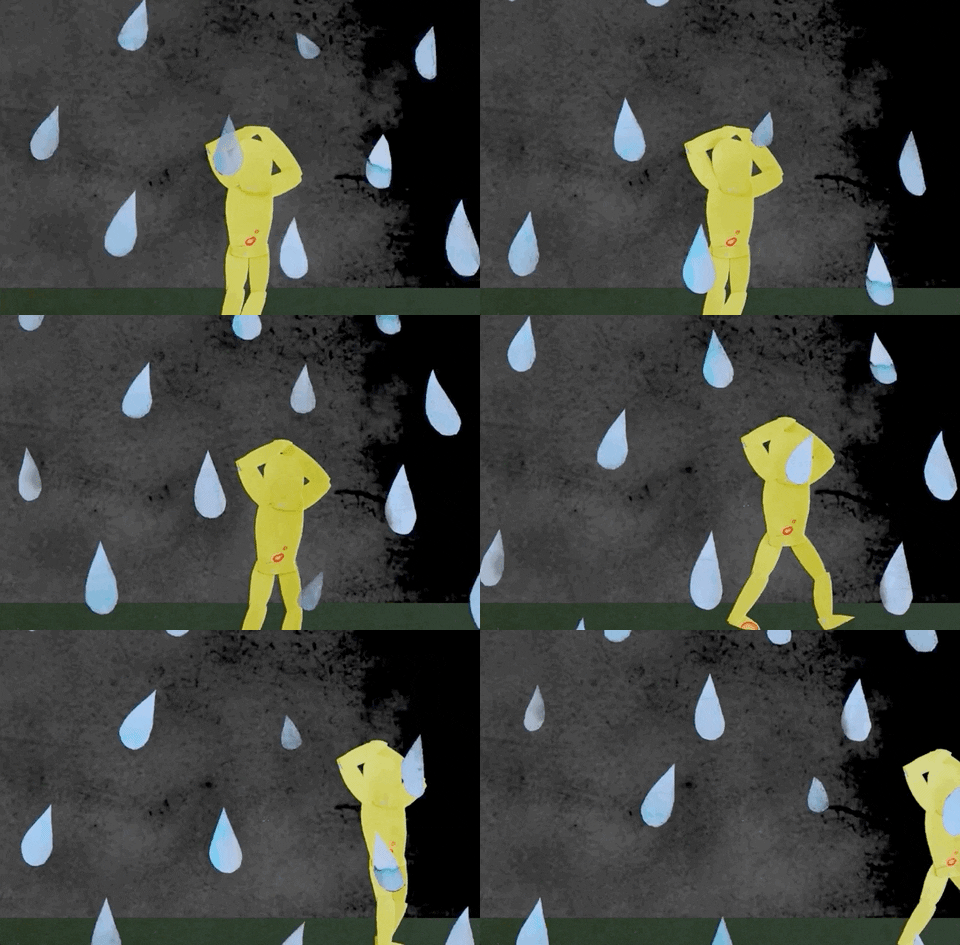
"My friend turns to me and says, 'Josh, you must not mind the rain.'"

Josh Johnson.
Income inequality isn't exactly new. However, it seems more people are aware of it than ever. In fact, according to a Pew Research poll that surveyed 36 countries, a "median of 54% of adults across the nations surveyed say the gap between the rich and the poor is a very big problem in their country."

The good news is people are learning to educate themselves—from financial planning to paying attention to where special interest money goes in terms of political leaders. But still, for many of us, it's hard to understand what it must be like to be wealthy when we've never had real wealth. Without having a lived-in experience, even the concept of money itself can be difficult to grasp.
Comedian Josh Johnson, who is also a correspondent and writer on The Daily Show, is an expert at taking complex notions and putting them into hilarious context through his long-form comedic storytelling. In a TikTok clip labeled "That Time I Almost Drowned," Josh begins by talking about the literal fabric of money. "We look at money as paper, right? At least when it's in its physical form, it's this paper thing. But it's more than paper. There's fabric that weaves into it. There's linen, there's cotton."
@joshjohnsoncomedy I Almost Drowned At A Party
Josh likens the actual fabric of money to society. "It works the same way that society works. There's fabric that weaves all of us together." He adds, "But there are people who have not been able to participate in the opportunities of making money...so when you tell them a recession is coming, they're like, 'What? Okay. I was already broke.'"
He proceeds to illustrate with a story. "One time, I was at a party with my friends, and I fell in the pool." He makes sure to note that it wasn't a "pool party" and, therefore, deeply embarrassing. But more than that, "terrifying," because he reveals, "I can't swim. And when you don't swim, being surrounded by water out of nowhere is very concerning."

He describes the sudden shock of the water. "I feel like I turned around, and water surrounded me." What he did next was not so much swim, but rather "drown," and he hilariously describes his friend fishing him out of the pool like a cat picking up its kitten. Wet and still in shock, Josh understandably wanted to leave immediately. But "the dude who saved me was my ride... and now has 'mack points' and begins to use them to hit on people."
When they finally try to leave, alongside a few other friends, his car won't start. "Luckily, he did live close enough to the party that we could walk. It was maybe a mile and some change. And as we start walking, it starts drizzling... and then really starts raining." After describing how his various friends responded to the rain (one hunched into "turtle" position and another put one hand over his head), Josh has an epiphany: "My friend turns to me and says, 'Josh, you must not mind the rain.' And I was like, I almost drowned 20 minutes ago. And THAT'S what it's like when you're broke. You're almost drowning all the time. So when people try to scare you with talks of a recession, you're like, 'Why would I... what?'” He puts a hand over his head. "You're doing this... I'm already WET!"

Many in the comment section truly empathize, and there seems to be comfort in being "seen." One fan wrote, "This is incredible. You're the Kendrick Lamar of comedy." Another said, "This is such a good way to explain it."
One top commenter perfectly sums it up: "What is loss to a man who has nothing? What's a little rain to a drowning man?"


Student smiling in a classroom, working on a laptop.
Students focused and ready to learn in the classroom.
Fish find shelter for spawning in the nooks and crannies of wood.
Many of these streams are now unreachable by road, which is why helicopters are used.
Tribal leaders gathered by the Little Naches River for a ceremony and prayer.

Communications expert shares the perfect way to gracefully shut down rude comments
Taking the high ground never felt so good.
A woman is insulted at her job.
It came out of nowhere. A coworker made a rude comment that caught you off guard. The hair on the back of your neck stands up, and you want to put them in their place, but you have to stay tactful because you're in a professional setting. Plus, you don't want to stoop to their level.
In situations like these, it helps to have a comeback ready so you can stand up for yourself while making making sure they don't disrespect you again.
Vince Xu, who goes by Lawyer Vince on TikTok, is a personal injury attorney based in Torrance, California, where he shares the communication tips he's learned with his followers. Xu says there are three questions you can ask someone who is being rude that will put them in their place and give you the high ground:
Question 1: "Sorry, can you say that again?"
"This will either make them have to awkwardly say the disrespectful remark one more time, or it'll actually help them clarify what they said and retract their statement," Xu shares.
Question 2: "Did you mean that to be hurtful?"
The next step is to determine if they will repeat the disrespectful comment. "This calls out their disrespect and allows you to learn whether they're trying to be disrespectful or if there's a misunderstanding," Xu continues.
Question 3: "Are you okay?"
"What this does, is actually put you on higher ground, and it's showing empathy for the other person," Xu adds. "It's showing that you care about them genuinely, and this is gonna diffuse any type of disrespect or negative energy coming from them."
The interesting thing about Xu's three-step strategy is that by gracefully handling the situation, it puts you in a better position than before the insult. The rude coworker is likely to feel diminished after owning up to what they said, and you get to show them confidence and strength, as well as empathy. This will go a lot further than insulting them back and making the situation even worse.
Xu's technique is similar to that of Amy Gallo, a Harvard University communications expert. She says that you should call out what they just said, but make sure it comes out of their mouth. "You might even ask the person to simply repeat what they said, which may prompt them to think through what they meant and how their words might sound to others," she writes in the Harvard Business Review.
More of Gallo's suggested comebacks:
“Did I hear you correctly? I think you said…”
“What was your intention when you said…?”
“What specifically did you mean by that? I'm not sure I understood.”
“Could you say more about what you mean by that?”
Ultimately, Xu and Gallo's advice is invaluable because it allows you to overcome a negative comment without stooping to the other person's level. Instead, it elevates you above them without having to resort to name-calling or admitting they got on your nerves. That's the mark of someone confident and composed, even when others are trying to take them down.