
upworthy
Add Upworthy to your Google News feed.
Google News Button
Pop Culture

People are sharing the adult problems that 'nobody prepared you for' and they're so true

Here are 21 of the most relatable.
being an adult, adult lessons, growing up
via PixaBay

Being an adult is tough.

Nothing can ever fully prepare you for being an adult. Once you leave childhood behind, the responsibilities, let-downs and setbacks come at you fast. It’s tiring and expensive, and there's no easy-to-follow roadmap for happiness and success. A Reddit user asked the online forum, “What’s an adult problem nobody prepared you for?” and there were a lot of profound answers that get to the heart of the disappointing side of being an adult.

One theme that ran through many responses is the feeling of being set adrift. When you’re a kid, the world is laid out as a series of accomplishments. You learn to walk, you figure out how to use the bathroom, you start school, you finish school, maybe you go to college, and so on.

However, once we’re out of the school system and out from under our parents’ roofs, there is a vast, complicated world out there and it takes a long time to learn how it works. The tough thing is that if you don’t get a good head start, you can spend the rest of your life playing catch-up.

Then, you hit middle age and realize that life is short and time is only moving faster.

Adulthood also blindsides a lot of people because we realize that many adults are simply children who grew older. The adult world is a lot more like high school than a teenager could ever imagine.

The Reddit thread may seem a bit depressing at first, but there are a lot of great lessons that younger people can take to heart. The posts will also make older people feel a lot better because they can totally relate.

Being an adult is hard, exhausting and expensive. But we’re all in this together and by sharing the lessons we’ve learned we can help lighten each other's load just a bit.

Here are 21 of the most powerful responses to the question: “What is an adult problem nobody prepared you for?”

1. Lack of purpose

"Lack of purpose. All your young life you are given purpose of passing exams and learning, then all of a sudden you are thrown into the world and told to find your own meaning," — Captain_Snow.

2. No bed time

"You can stay up as late as you want. But you shouldn't," — geek-fit

3. Friendships

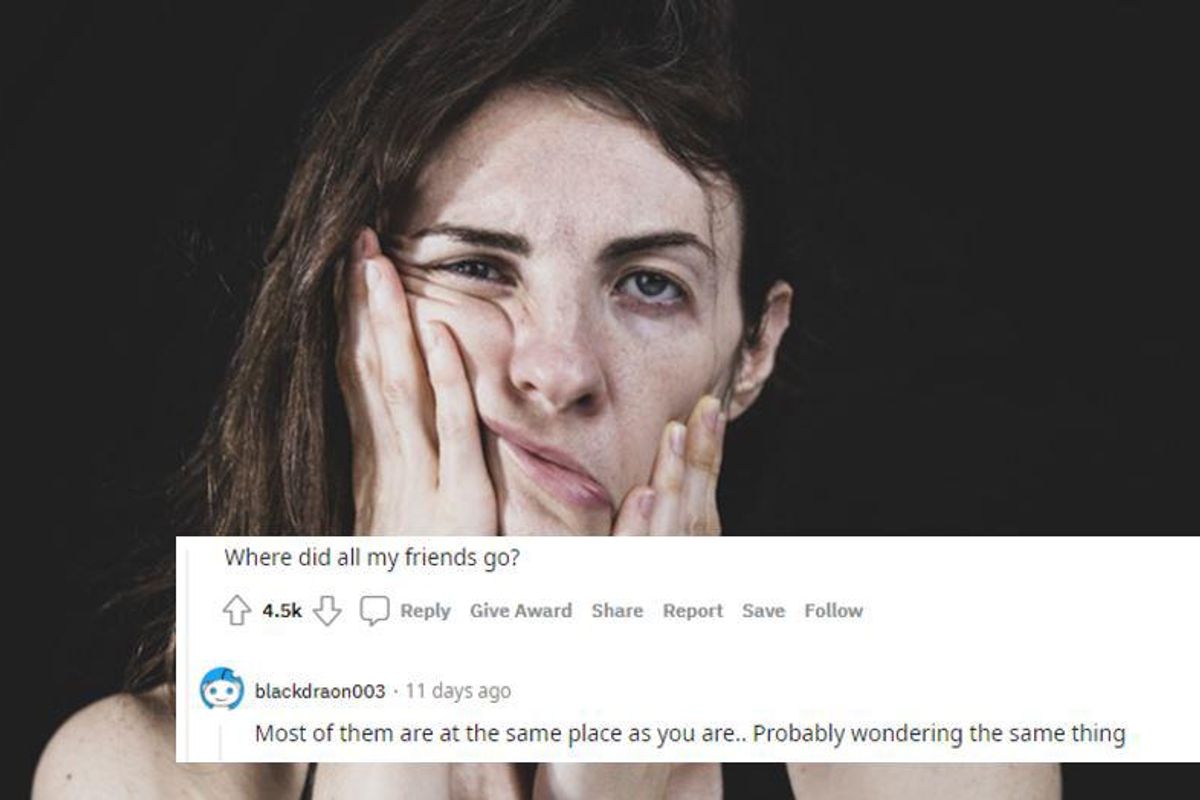
"Where did all my friends go?" — I_Love_Small_Breasts

Most of them are at the same place as you are ... Probably wondering the same thing," — Blackdraon003

4. Bodily changes

"I'm closer to fifty than forty, would have been nice to be better prepared for some of the ways your body starts to change at this point that don't normally get talked about. For instance your teeth will start to shift from general aging of your gums," — dayburner.

5. People don't change

"Didnt know that other adults have the emotional intelligence of teenagers and its almost impossible to deal with logically," — Super-Progress-6386

6. Money

"$5K is a lot to owe, but not a lot to have," — Upper-Job5130

7. Our parents age, too

"Handling the decline and death of your parents," - Agave666

8. Free time

"Not having a lot of free-time or time by myself," — detective_kiara

9. No goals

"Not having a pre-defined goal once I was out of college. Growing up my goals were set for me: get through elementary school! then middle school! Then high school, and get into college and get a degree, then get a job, and then...? Vague "advance in your career, buy a house, find a spouse, have a kid or multiple, then retire." At 22 I had no idea how to break that down more granularly," — FreehandBirdlime

10. Constant upkeep

"Life is all about maintenance. Your body, your house, your relationships, everything requires constant never ending maintenance," — IHateEditedBGMusic

11. Exhaustion

"Being able to do so many things because I'm an adult but too tired to do any of them," — London82

12. Loneliness

"Being an adult feels extremely lonely," — Bluebloop0

13. Dinner

"Having to make dinner every. Fucking. Day," — EndlesslyUnfinished

14. Time changes

"The more life you’ve lived, the faster time seems to go," — FadedQuill

15. You're responsibile, even if you didn't mean it

"You are held to account for bad behaviour for which you are negligent even if you had no intention to cause harm. As a lawyer, I see this all the time. People don't think they're responsible for mistakes. You are," — grishamlaw

16. Work is like high school

"The intricacies of workplace politics," — Steve_Lobsen writes. "

"When you're in school, you think that you won't have to deal with gossiping and bullying once you leave school. Unfortunately, that is not true," — lady_laughs_too_much

17. Nowhere to turn

"How easy it is to feel stuck in a bad situation (job, relationship, etc) just because the cost and effort of getting out can seem daunting. And sometimes you just have to accept a figurative bowl full of shit because you can't afford to blow up your life," — movieguy95453

18. The happiness question

"Figuring out what makes you happy. Everyone keeps trying to get you to do things you're good at, or that makes you money, but never to pursue what you enjoy," — eternalwanderer5

19. Constant cleaning

"The kitchen is always dirty. You’ll clean it at least three times every day," — cewnc

20. Life costs money

"One adult problem nobody prepared me for is how expensive everything is. I always thought that as an adult I would be able to afford the things I wanted, but it turns out that's not always the case! I've had to learn how to budget and save up for the things I want, and it's been a difficult process," — Dull_Dog_8126

21. Keeping above water

"All of it together. I was relatively warned about how high rent is, car bills and repairs, how buying healthy food is expensive as hell but important for your health, how to exercise and save what you can, my parents did their best to fill in my knowledge about taxes and healthcare and insurance that my schooling missed, about driving and cleaning a household, about setting boundaries at work but working hard and getting ahead if you can, about charity and what it means to take care of a pet and others, about being a good partner if you were lucky enough to have one, about how dark and messed up the world is when you just read the news and what all that means to me and my community… I was reasonably warned about all of it.

"No one could have ever prepared me for how hard doing all of it at the same time and keeping your head above that water would actually be," — ThatNoNameWriter


This article originally appeared two years ago.

time off requests, pto, sick leave, gen z manager, manager positions, asking for time off

This Manager thinks PTO is for vacation, not "life changing events."

What does it take to be a good boss? You can answer this a million different ways—by being a clear communicator, earning employee trust, providing constructive feedback, and fostering a positive and supportive work environment while also being open to feedback and recognizing your team's contributions—but really, it all seems to stem from respecting your employees as fellow human beings.

Part of that means acknowledging that these employees have lives that are, frankly, more important to them than the job, and not penalizing them for it. One manager, and Gen Zer no less, seems to fully understand this basic principle, and folks are applauding her for it.


Elizabeth Beggs, who manages a five-person team for a packaging distribution company in Virginia, recently made a TikTok sharing which time-off requests she “rejects. ”You’ll see why “rejects” is in quotes shortly.

One example: when a female rep notified Beggs that she was likely having a miscarriage. After the team member asked how she can file for time off to see to the issue, Beggs immediately responded, “Girl, go to the doctor! We’re not submitting time off for that!”

In Beggs’ mind, PTO is for “vacation,” not medical emergencies. What a concept.

@bunchesofbeggs

Edited to clarify- 1. My team is all salary. 2. These examples are not all recent or from my current position. 3. My team works hard and hits thier KPIs above and beyond. Time off is meant to recharge and be used how you need it, not to handle life changing events #mangers #corporate #genzmanagers #sales #vetstocorporate #veterans

Beggs went on to explain a couple more situations, like when one employee—a parent—was “up all night” with their sick kid. And her last one wasn’t even negative—she had an employee who wanted to work a half-day to do something nice for their anniversary.

“Seriously, if any of these triggered anyone, then you need to evaluate how you run your team as a manager,” she concluded.

By and large, the response to Beggs’ management style has been overwhelmingly positive, and people seem to find it completely refreshing.

“You are not a manager, you’re a LEADER,” one person wrote.

@bunchesofbeggs

Everything you do should be to better your team, not to make your life easier #leadership #ownership #corporatelife #veteran #military

Another said, “The better you treat your employees, the more loyal they will be and the better work they will put out. Most people do not understand how management works.”

A few noted how this attitude seems to be more present among younger leaders. One person commented, "millennial manager here. My team members are human first, employees second. Like just go do what you want but get the work done too.”

Another joked that “Boomer managers could NEVER.”

Beggs would later clarify this doesn’t mean she doesn't have clear productivity expectations for her team (who work on salary). Perhaps if she had a team member not making their KPIs (key performance indicators), there would be an additional conversation surrounding time off, but there is still an inherent respect as a fellow human being. Which, to her, means treating bona fide time off as a way to “recharge and be used how you need it, not to handle life changing events.”

@bunchesofbeggs

If you’re planning does not account for people being human- it’s bad planning #genzleaders #armyvet #militaryvet #genz #corporatelife #corporate #manager #timeoff

Younger generations might get labeled “lazy” or “entitled,” but they are also the ones fighting to change the status quo so that we all may be treated less like cogs in the machine, and more like actual human beings. Its leaders like Beggs who show that operating in new ways doesn't compromise productivity—it, in fact, enhances it. We might not be able to change the global standard overnight, but we certainly aren’t going to get to a better place without leaders who choose to serve their community rather than a bottom line.

This article originally appeared in March.

Education & Information

This surprising map reveals the real value of $100 in each state

Your purchasing power can swing by nearly 25 percent from state to state.

cheapest states, cost of living, finances, cost of living, $100

Map represents the value of 100 dollars across America.

As the cost of living in large cities continues to rise due to inflation, tariffs, and other economic factors, more and more people are realizing that the value of a dollar in the United States is a very relative concept. For decades, cost of living indices have sought to address and benchmark the inconsistencies in what money will buy, but they are often so specific they prevent a holistic picture or the ability to "browse" the data based on geographic location.

Each year, the Tax Foundation addresses many of these shortcomings using the most recent Bureau of Economic Analysis data to provide a familiar map of the United States overlaid with the relative value of what $100 is "worth" in each state. In recent years, they've further updated their data so that you can break down the value of your money across every single metro area in the United States. It's an incredibly valuable tool for the many people considering (or who have already acted and migrated from states like California to Florida), Texas and other states with friendly state taxes rates and more affordable housing options.


The map quantifies and presents the cost of living by geography in a brilliantly simple way. For instance, if you're looking for a beach lifestyle but don't want to pay California prices, try Florida, which is about as close to "average"—in terms of purchasing power, anyway—as any state in the Union. If you happen to earn (or luck) your way into Silicon Valley tax brackets, head to Hawaii, D.C., or New York. You'll burn through your money in no time. And in some of those places like Hawaii, there are quality of life measurements that often exceed raw purchasing power.

So, where does your dollar go the furthest in 2025? The financial planning site GoBankingRates.com compiled its own list of cash purchasing power across each state and found that in California, you get the least bang for your buck: only $87.42 in real purchasing power for every $100 of cash. The average person in California makes $96,344 annually, one of the higher income levels in the country. However, just living in California on average costs residents a staggering $86,408, leaving the average person with little flexibility for long-term financial planning projects like retirement, saving for a new home, or even buying a new car.

At the other end of the spectrum is Arkansas, where your dollar goes the furthest. In fact, that $100 bill burning a hole in your proverbial wallet is in fact worth more than its technical value, with a real value of $113.49. On top of that, the cost of living is only $37,067, less than half of that in California. Further, the average cost of a new home in Arkansas is $208,743, less than one-third of a new home in California. Not coincidentally, in 2023, Arkansas was the top destination for people moving to another state within the United States, followed by Texas.

family, moving, income, finances, $100 Family moving into a new home. Canva Photos.

How about Florida, which has received outsized attention in recent years for its overt efforts to draw residents from California and other states with higher costs of living? According to the most recent data, Florida is in fact much closer to California than Arkansas, coming in only in 40th place on the GoBankingRates rankings, with $100 in cash only being worth $96.55. However, the annual cost of living is still only slightly more than half of that in California, coming in at $53,505. And if you're looking to buy some real estate, the average home is valued at $404,924. That's still well outside the purchasing power of many Americans, but with built-in advantages such as warm weather and one of the top-ranked state education system in America, it's obvious why so many people, especially those with families, are choosing Florida over California in recent years.

florida, cost of living, finances, $100, education Driving Road Trip GIF by Rosen Hotels & Resorts Giphy

According to U.S. News and World Report's data analysis, California only has the nation's 23rd best education system and is ranked a paltry 37th overall in their state rankings. It's quite a contrast for a state that bills itself on the promise of opportunity, natural wonder, and positive lifestyle options. And with 2025's wildfires (as well as an annually-worsening wildfire season), the constant threat of earthquakes, and other factors, California clearly has challenges beyond economics if it wants to remain one of the more attractive states in the nation.

Of course, those numbers are always in flux, and political leaders in California have promised concrete reforms in order to address the state's high cost of living compared with the value of its social and emergency services. If you want proof of how quickly things can change, look at a similar analysis of the value of $100 in each state from 2015:

- YouTube youtu.be

However, those negative statistical trends aside, California continues to have an incredible pull on our collective imagination. Four hundred twenty-three thousand, one hundred ninety-four Americans left their state for California according to the most recent data in 2023, placing it in third behind our previously mentioned top two states, Arkansas and Texas.

So, it's clear there are a number of factors that determine the best place to live in America. When it comes to raw purchasing power, you cannot beat Arkansas. But there's so much else to consider: public resources like education and healthcare, job opportunities (you probably won't make nearly as much in Arkansas as you might in California) and other factors such as proximity to family, friends, and personal interests.

There's no doubt America is rapidly changing and that includes what people value the most when they decide where to live. In uncertain economic times, the face of America will likely change radically in the coming years with the political, economic, and social landscape shifting in meaningful ways.

This article originally appeared in August.

Wellness

How to stop waking up each night at 3 or 4 in the morning

The good news is that there are ways to get back to sleep and stop the downward anxiety spiral.

sleep, waking up, woman sleeping

A woman with her eye mask on in bed.

Do you often wake up at 3 or 4 a.m. with an intense feeling of anxiety? Do you get stressed that you’re awake and begin making a mental laundry list of everything you need to do the next day? Do you start thinking about fights you once had with your spouse or ponder how you have let yourself down in the past?

If so, you’re not alone. It’s common for people to wake up at 3 or 4 a.m. regularly and there’s a reason why we choose this time to catastrophize and worry. The good news is that there are some steps we can take to get through that awkward phase of the night so we can wake up refreshed.


Why do I wake up at 3 or 4 a.m. every night?

Many of us reliably wake up in the middle of the night because after we’ve had a good chunk of sleep, our bodies start to slowly prepare us for the day by reducing melatonin, the hormone that puts us to sleep and increasing levels of cortisol, the stress hormone.

That biological phase of sleep is why we start to feel stressed.


insomnia, sleep, sleep hacks, how to sleep better, melatonin, stress A woman struggles with insomniaImage via Canva


After the big hormone release at 3 or 4 in the morning, if you are dealing with stress in your life, you are more likely to wake up. If your life is calmer and you don’t already have a stress baseline, you will probably wake up, fall asleep quickly and forget that it happened.

Why do I wake up feeling stressed in the middle of the night?

If you’re already experiencing stress in your life, that extra cortisol kick is going to cause you to wake up with a feeling of anxiety. The problem is that when we’re lying in bed in the middle of the night, we are in a vulnerable position. “Around this time in the sleep cycle, we’re at our lowest ebb physically and cognitively. From nature’s viewpoint, this is meant to be a time of physical and emotional recovery, so it’s understandable that our internal resources are low,” Greg Murray, a psychology researcher with expertise in mood, sleep, and the circadian system, writes in The Conversation.

“But we also lack other resources in the middle of the night – social connections, cultural assets, all the coping skills of an adult are unavailable at this time,” Murray continues. “With none of our human skills and capital, we are left alone in the dark with our thoughts. So the mind is partly right when it concludes the problems it’s generated are unsolvable – at 3 a.m., most problems literally would be.”


insomnia, sleep, sleep hacks, melatonin, stress, anxiety A woman struggles with insomniaImage via Canva

At this moment, when we’re stressed and feeling vulnerable, stuck in bed with no way out, we can begin to spiral. This is when we ruminate on why we forgot to feed the dog that one day in 1994 or contemplate why things went bad with your first significant other at 21. It’s when we start recalling a disagreement with a friend and plotting out what we’ll say the next time the issue arises.

At this point, if we don’t stop spiraling, we’ll be up until 5 a.m. and will feel like garbage when it’s time to go to work.

The good news is that there are ways to get back to sleep and stop the downward anxiety spiral.

Make a list

Dr. Jade Wu says that if you wake up and feel stressed about things you need to take care of, walk out of your room (so you don’t associate it with stressors) and make a list to read in the morning. This will free you of your worries, because you know you can care for them when you are awake.

- YouTube www.youtube.com

Pay attention to your breath

Murray says you should redirect your attention from your thoughts to your breath, which is a form of meditation. “I bring my attention to my senses, specifically the sound of my breath. When I notice thoughts arising, I gently bring my attention back to the sound of breathing,” Murray writes in The Conversation. This works in 2 ways: first, it takes your attention away from your spiraling thoughts and second, the breathing exercise helps you relax.


Have a bite to eat

Sometimes, we wake up in the middle of the night because we’re hungry and our blood sugar is dropping. “The first question I ask [my patients] is, ‘When was the last time you ate?’” Michael Breus, Ph.D. psychologist specializing in sleep disorders, told Sleep.com. “Often, they’ve finished their last meal at 7 p.m.; now it’s 3 in the morning — that’s eight hours later — so guess what? They’re out of fuel.” If you’ve woken up because of a drop in blood sugar, experts recommend eating a small snack that includes protein and fat, like peanut butter.

This article originally appeared last year.

Education

A fourth-grade teacher asked for 3 'good reasons' for slavery. There was only right answer.

The school assignment was intended to spark debate and discussion—but isn't that part of the problem?

history, Black Americans, school, homework assignment, outrage

A school assignment asked for 3 "good" reasons for slavery.

Back in 2018, a fourth-grader's school assignment was so shocking that it went viral. Every news outlet from ABC7 to HuffPost to CNN reported on the incident, in which a homework assignment asked students to list three "good" reasons for slavery. Yeah, you read that right.

The assignment was given to fourth graders at Our Redeemer Lutheran School in Milwaukee, Wisconsin, and also asked for three "good" and three "bad" reasons for slavery. The absurd and offensive assignment was brought to the public's attention when one fourth grader's mom shared a photo of the homework sheet on Facebook, asking, 'Does anyone else find my 4th grader's homework offensive? 😡"


Now, it's not uncommon for parents to have questions about their kids' homework. Sometimes, it's just been too long since they've done long division for them to be of any help. Or teaching methods have just changed too dramatically since they were in school. And other times, kids bring home something truly inexplicable.

For mom Trameka Brown-Berry, looking over her 4th-grade son Jerome's homework made her jaw hit the floor.

The school assignment was intended to spark debate and discussion—but isn't that part of the problem? The shockingly offensive assignment deserved to be thrown in the trash. But young Jerome dutifully filled it out anyway, and his response was pretty much perfect:

In the section reserved for "good reasons," Jerome wrote, "I feel there is no good reason for slavery that's why I did not write."

We're a country founded on freedom of speech and the debate of ideas, which often leads us into situations where "both sides" are represented. In most cases, looking at both sides of a debate can help people come to a clear conclusion about what's right and what's wrong. But in this scenario, there is no reason that a child should ponder the positive benefits of slavery. There's no meaningful dialogue to be had about the perceived merits of stripping human beings of their basic living rights. No one is required to make an effort to "understand the other side" when the other side is bigoted, hateful, and violent.

The principal apologized to the students for the assignment

In a follow-up post, Brown-Berry writes that the school has since apologized for the assignment and committed to offering better diversity and sensitivity training for its teachers.


But what's done is done, and the incident illuminates the remarkable racial inequalities that still exist in our country. After all, Brown-Berry said to WCTI ABC News12, "You wouldn't ask someone to list three good reasons for rape or three good reasons for the Holocaust."

At the very end of the assignment, Jerome brought it home with a bang: "I am proud to be black because we are strong and brave..."


Even though the assignment was offensive, Brown-Berry found a silver lining in the experience for her son. "The moral of the story is, the only way to teach our kids to stand up for their rights and respect is to model it. With all of your support, I was able to give my child a personal life lesson about how change starts with you," she wrote in a Facebook post.

Good for Jerome for shutting down the thoughtless assignment with strength and amazing eloquence, and for being brave enough tell the truth: there are no good reasons for history's most heinous acts. The sooner the world acknowledges that, the sooner we can heal and restore.

This article originally appeared seven years ago. It has been updated.

moms, motherhood, parenting, family, teens, teenagers, letters, tough love, parenting styles
via Heidi Johnson/Facebook
A letter written from mother to son.

Parents are people, too. Whether they subscribe to "gentle parenting" ideas or a more old-school approach, the truth is that they're just doing their best. Sometimes they get it right, sometimes they make mistakes, and quite often, it's hard for anyone to tell whether they're doing a good job until years later.

Heidi Johnson's son was 13, deeply in adolescence, and in that stage where he'd frequently lash out and defy her at every turn. In one such instance, he stubbornly told her he shouldn't have to deal with her rules and should be independent. So she wrote a strict but loving "Mom's not a fool" letter. In the letter, she wrote that because he bragged about making money, he can buy back all of the things that she had purchased for him in the past and that he would also have to pay rent.


moms, motherhood, parenting, family, teens, teenagers, letters, tough love, parenting styles Teaching teenagers about real-life consequences isn't easy. Photo by Norbert Kundrak on Unsplash

"Dear Aaron,

Since you seem to have forgotten you are only 13, and I’m the parent, and that you won’t be controlled, I guess you will need a lesson in independence. Also, as you threw in my face that you are making money now, it will be easier to buy back all the items I bought for you in the past. If you would like your lamp/lightbulbs or access to the internet, you will need to pay your own share of costs.

Rent – $430

Electricity – $116

Internet – $21

Food – $150"

She also added some additional chores that, if not accomplished, she would fine him $30.

"He came home, saw the note, crumpled it on the floor, and stormed out of the apartment. I have always encouraged him to take a walk when he is upset so that he can collect his thoughts, so when we try to talk, we are able to talk, and not just yell at each other. I do the same thing — sometimes, I just need to walk away and collect myself. I am not above admitting that. He was still livid when he got home. He decided to stage a 'sit in' in my room, where he did laugh at me and repeat, 'Really? What are you going to do? You can't take my stuff,' etc.

He was asked to leave my room, and when he could be respectful, and I was more calm, we would discuss it further. He went to his room, and after about an hour, he had removed some electronics and items I missed that he felt he should have to earn back for his behavior. He apologized, and asked what could he do to make things better and start earning items back. He earned his comforter and some clothes right back. I did leave him some clothes to begin with, just not the ones he would want to wear every day. He also had some pillows and sheets, just not his favorite ones.”

Johnson decided to post the letter in its entirety on Facebook, the way one does to friends for a laugh and connection. After all, the strategy had been a success!

However, she neglected to make it "private," and soon, comments and shares proliferated, including admonishments from strangers who thought she was a bad parent. Now she had to deal with a bigger teenager: the internet and its commentariat.

But Johnson remained level-headed and wrote another Facebook post, clarifying.

"It's out there; and I am not ashamed of what I wrote... I am not going to put my 13-year-old on the street if he can't pay his half of the rent. I am not wanting him to pay anything. I want him to take pride in his home, his space, and appreciate the gifts and blessings we have.”

She explains that he is more grateful because of it, and also that he has slowly earned back things and dealt with sacrificing others. Then she lists her very organized and succinct rules of the house:


moms, motherhood, parenting, family, teens, teenagers, letters, tough love, parenting styles Kids need to be reminded, sometimes, of how much they still depend on mom. Photo by Spencer Plouzek on Unsplash

1 – Do your best in school! I don't expect a perfect 100%, but I do expect that you do your best and ask for help when you don't understand something.

2 – Homework and jobs need to be done before you can have screen time.

3 – Jobs are emptying the trash, unloading the dishwasher, throwing away trash you make in the kitchen, rinsing dirty dishes, making your bed daily, pick up bedroom nightly, and cleaning your bathroom once a week.

4 – You must complete two chores a day. Each day of the week with the exception of Sunday has a room that we work on cleaning. He has to pick two chores for that room. For example, if it is the living room he can choose two of the following options: dust, vacuum, polish furniture, clean windows, mop the floor.

5 – Be respectful and kind with your words — no back talking, no cussing at me.

6 – Keep good hygiene.

7 – Make eye contact when being spoken to, and be an active listener.

8 – Use proper manners.

It seems that after a long conversation about what being independent truly means, the mother and son came to a deeper understanding and patched things up.

"You know what.. this hasn't hurt our relationship. He and I still talk as openly as ever. He has apologized multiple times... And… he is trying harder," Johnson said.

Tough love is a controversial topic in parenting circles. Some say it makes kids anxious and unsafe while others insist that it's the only way to truly instill an understanding of consequences in young people. Experts say the best "tough love" enforces boundaries and consequences in order to teach tough life lessons, but is done with love and understanding rather than yelling — and it's certainly never violent. That's why it's so powerful how Johnson took the time to cool herself down and write a firm but level-headed letter.

It's also important to remember that teens who rebel aren't bad or ungrateful. The rebellion is a part of how they begin to establish their much-needed independence.

- YouTube www.youtube.com

After the initial negative reaction to her post, Johnson's story continued to spread and drew praise from other exasperated parents of teens:

"Tough love is real love, he has a chance because of you," one commenter wrote.

"Good for you! He needs to appreciate everything you do! You are doing him a favor teaching him what it is to take care of himself and learn some respect," wrote another.

"Best parent I have read about in a very long time. Kids do not rule the house, adults rule the house. Thank you very much for being a great mom," another said.

As for Johnson, her son is earning things back little by little, and "appreciating it more than he did before," she wrote.

"This came down to a 13-year-old telling his mother she had no right to enforce certain rules, and had no place to 'control' him. I made the point to show what life would look like if I was not his 'parent,' but rather a 'roommate.' It was a lesson about gratitude and respect from the very beginning. Sometimes, you have to lose it all to realize how well you really had it."

This article originally appeared four years ago. It has been updated.