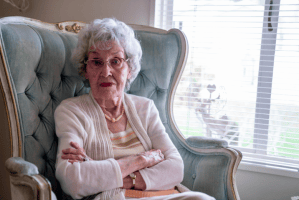
If you’re looking for some aging inspiration, look no further, because Dorothy Hoffner is about to blow your mind.
At 104, Hoffner just became the oldest person to parachute out of an airplane in a tandem skydive. That’s right, skydive. At 104 years old—or to be exact, 104 years and 289 days old—beating the previous world record set by a 103-year-old in Sweden in May of 2022.
But it’s actually even more impressive than that. It’s not like Hoffner is someone who’s been skydiving since she was young and just happened to keep on doing it as she got older. She actually didn’t go on her first skydiving adventure until her 100th birthday.
On Oct 1, 2023, she joined the team at Skydive Chicago in Ottawa, Illinois, for the world-breaking tandem skydive. Though she uses a walker to get around, she manages the physical toll of plummeting through the air at 10,000+ feet before parachuting to a skidding stop strapped to a certified U.S. Parachute Association (USPA) tandem instructor with impressive ease.
“Let’s go, let’s go, Geronimo!” Hoffner said after she boarded the plane, according to the Chicago Tribune.
Watch her do what many of us would be too terrified to attempt:
The way she rolls right out of that plane cool as a cucumber! Hoffner told the Tribune that on her first skydive, at age 100, she had to be pushed out of the plane. But this time, knowing what she was in for, she took charge with calm confidence.
“Skydiving is a wonderful experience, and it’s nothing to be afraid of,” Hoffner shares. “Just do it!”
That’s some seriously sage advice from someone who knows firsthand that age really is just a number. Learn more about skydiving with Skydive Chicago here.

From Pakistan to Tanzania, the most effective education solutions are community-led. Here’s how local leaders, in partnership with Malala Fund and supported by Pura, are mobilizing entire communities.
When asked to describe what Tanzania smells like, Grace Isekore closes her eyes and breathes in deep. For a moment, she’s somewhere else entirely. Tanzania is a rich tapestry of sights and scents, from the smell of sea mist that permeates the coastline to the earthy cardamom and cloves she cooks with in her kitchen. But when Grace emerges from her reverie, her answer is unexpected.
“Tanzania smells like peace,” she says, her eyes still closed. “I see a beautiful country where we are free to move, free to speak. And there is peace within the community.”
For Grace, that sense of peace isn’t just something she smells; it’s something she works toward every day. As a project coordinator with Pastoral Women’s Council (PWC), a women-led organization that empowers pastoralist communities in northern Tanzania, she has seen firsthand how girls flourish when they have the opportunity to attend school. Like scent, education not only connects girls to their own culture, but also helps broaden their horizons, realizing new possibilities for themselves and others. That transformation reshapes entire communities and ripples outward, with the potential to change countries and transform the world for the better.
Different scents, different approaches, and communities driving change
Spices in Tanzania. Captured by James Roh for Pura
For Grace and others around the world, education is freedom, as well as a pathway to a stronger community. Rooted in that shared belief, Pura, a home fragrance company, was inspired to build on their four-year partnership with Malala Fund to create something truly unique: a fragrance collection that connects people through scent to communities in Tanzania, Nigeria, Pakistan, and Brazil, where barriers to girls’ education are among the highest.
Using ingredients from each region, the new Pura x Malala Fund Collection uses scent to transport people to these regions directly. “Future in Bloom,” for example, invokes Pakistan’s lush valleys through notes of jasmine, cedarwood, and mango; while Tanzania’s fragrance, “Heart on Fire,” evokes the spirit and joyfulness of the girls who live there through cardamom, lemon, and green tea.
The new Collection honors the work Malala Fund does every day, partnering with locally-led organizations in these four countries to ensure every girl can access and complete 12 years of education. Each scent celebrates the joy, tenacity, and courage of the women and girls driving change on the ground, while also augmenting Pura’s annual grant to Malala Fund by donating eight percent of net revenue from the Pura x Malala Fund Collection to Malala Fund directly.
Just as each country’s scent is unique, so too are their needs related to education. But with support from Malala Fund and Pura, local leaders are coming up with creative ways to mobilize entire communities (parents, teachers, elders, and the students themselves, in their pursuit of solutions, understanding that educating girls helps everyone thrive. Here’s how their efforts are creating real, durable impact in Tanzania and Pakistan, and creating a ripple effect that changes the world for the better.
Parent-teacher associations help Maasai girls and their communities in Tanzania problem-solve
A girl’s school in Tanzania. Captured by James Roh for Pura
Northern Tanzania, Grace’s home, is home to pastoralist communities like the Maasai, a nomadic people who have moved with the seasons to nurture the land and care for their livestock for centuries. The nomadic nature of this lifestyle creates significant and unique barriers to girls’ education. Longstanding gender roles have enabled Maasai to survive in the harsh environment and have placed great value on both women and men. Over time, as nomadic life has been threatened by the privatization of land and stationary education models have been implemented, the reality of pastoralist livelihood has shifted and introduced new complexities. Now, the sheer distance to schools is both a practical challenge and one that often comes with danger from the landscape, predators, and potential exposure to assault along the journey. Girls shoulder the responsibility of household chores and there is often cultural pressure around early marriage – both leading to boys’ education being prioritized over girls’.
“There are very, very good [pastoralist] cultural practices, which are passed from generation to generation,” says Janet Kimori, an English teacher at Lekule Girls Secondary School in Longido, Tanzania. But when cultural practices act as educational barriers, “you have to sit down and look for where you are going to assist. As a school, as an individual, the school administration—all of us will chip in and know how we are going to deal with this problem.”
PWC works to ensure girls are able to exercise their right to an education while also preserving pastoralist culture. One successful approach, the organization found, has been the formation of Parent Teacher Associations (PTAs), created with help from Malala Fund. In PTA meetings, students, parents, teachers, elders, and government officials meet, discuss educational barriers, and come up with community-led solutions that preserve and honor their culture while advancing educational outcomes.
PTA meeting in Tanzania. Captured by James Roh for Pura
One recent PTA meeting highlights how these community-led solutions are often the most effective. At Lekule Girls Secondary School, the lack of fresh water forces girls to walk long distances to collect water for the school’s kitchen during the school day, and these long journeys not only disrupt class time but can leave girls vulnerable to sexual assault in isolated areas. Through facilitated discussion, PTA members landed on a solution: installing a borehole to pipe in fresh water to the school. Reliable access to water creates a better learning environment for the girls, but it also benefits the community at large, as local governments are then more likely to invest in health clinics and other community resources nearby.
With a solution in place, the PTA was then able to discuss ideas and map out a course of action. The women would raise money for the cost of the borehole, while the men would recruit workers to dig the hole and lay the pipe. Together, they would ask government officials to match their investment.
The benefits of PTA meetings within the pastoralist communities are undeniable. “The girls are talking and addressing issues in a confident way, and parents feel they are part of the resource team to solve challenges happening at school,” Grace says. One unexpected benefit: The larger cultural impact these PTA meetings have created. Thanks to the success of PTAs within pastoralist communities, the models are now being endorsed on a national level, and schools across Tanzania are starting to use them to solve problems in their own communities. When a community creates opportunities for girls to learn, everyone benefits.
Safe spaces in rural Pakistan help students and their parents connect, then drive change
Safe space for girls meeting in Pakistan. Captured by Insiya Syed.
A continent away in Pakistan, the country’s northernmost region of Gilgit-Baltistan seems like a land untouched by time. The region’s looming mountains, snow-capped peaks, lush valleys and crystalline lakes draw nature lovers and landscape photographers from around the world, but living among this kind of breathtaking scenery has its drawbacks. Schools in the region are few and far between, and the area’s harsh climate often makes roads inaccessible for travel. Poverty and gender-based discrimination are additional obstacles, making school even further out of reach, and girls are affected disproportionately. Going up against these barriers requires a persistent, quiet strength that’s found in the women who live there and reflected in Pakistan’s signature scent.
Saheli Circles are how local leaders in Gilgit-Baltistan are bridging the gap between girls and education. An Urdu term for “female friend,” Saheli Circles are after-school safe spaces where girls explore subjects like art and climate change, while also developing skills that help them manage emotions, set goals, and build positive relationships. Girls study in groups, visit the library, play sports, and tackle filmmaking and photography projects, all designed to develop self confidence and teach the girls how to advocate for issues that matter to them. But the work doesn’t stop there.
“What we’re trying to achieve here will only be impactful if it trickles down to the home environment and the school environment,” says Marvi Sumro, founder and program director of Innovate, Educate, and Inspire Pakistan (IEI), the local organization that developed the Saheli Circles model and partnered with Malala Fund in 2021 to make it a reality. Ever since, Saheli Circles have grown to involve teachers, elders, and parents to encourage relationship building that’s essential for young girls and adolescents. “Our spaces can give mothers and daughters an opportunity to interact a little differently—do an art activity, or have a cup of tea together, or some good conversation,” Marvi says.
The relationship building is what makes the biggest positive impact throughout the community. Recently, one Saheli Circle was able to bring together parents, teachers, and administrators to advocate for better education at their local school, and together they convinced the department of education to hire a science teacher. Another Saheli Circle organized a fund where members of the community can contribute monthly to pay for uniforms, books, and other school expenses for the girls in their village, eliminating those small, hidden costs that are often a barrier to education for many. A third Saheli Circle was able to produce a short film about how gender-based household chores can take away valuable study time from girls, leaving them at a disadvantage. “The girls put the film together and showed it to the mothers, and the response from the mothers was just beautiful,” Marvi says.
Girls smiling in Pakistan. Captured by Insiya Syed.
The education and relationship building that the girls receive in Saheli Circles connects them to larger opportunities and economic freedom that are not possible in their hometown. “For girls in Gilgit-Baltistan, education is extremely important because of the fact that we’re so far away from where the economy is, where the opportunity is. Education becomes this bridge for us, for our girls, to access all the opportunity and economy that exists in [larger cities].”
From rural Tanzania to remote Pakistan, local organizations prove every day that prioritizing girls’ education benefits everyone. Communities that lift up girls are able to secure resources like clean water and well-staffed schools, as well as build stronger relationships.
These outcomes are only possible because of the women and girls who work tirelessly in these regions to overcome barriers and drive progress. The Pura x Malala Fund Collection is a way to honor them, celebrate their achievements, and unite people the world over around a shared belief that education is freedom. Like scent, that belief can build, travel, and has the possibility to transform the world.
Experience the Pura x Malala Fund Collection here, and connect with the stories of real girls leading change across the globe.
There are only a few things in this life we can’t evade. One of them is aging. Sure, there’s Botox and facelifts and all that jazz to help us look younger. But in the end, our cells simply insist on keeping score, and no matter how hard some might fight it, our DNA is bombarded…
There are only a few things in this life we can’t evade. One of them is aging. Sure, there’s Botox and facelifts and all that jazz to help us look younger. But in the end, our cells simply insist on keeping score, and no matter how hard some might fight it, our DNA is bombarded with hits that will eventually take us down.
The good news is that with years often comes wisdom. I like to think of our minds as though they were hiking trails. Each trail has a sign, but instead of telling us which way to go, the signs remind us who we are. This past week, I was honored to read some of those signs at the senior home where my mom resides. Nearly every conversation, at least for me, yielded little sage sachets of advice that are truly invaluable.
Know someone before you marry them.
A woman in her early 80s shared that it takes about a year for someone’s “true nature” to be revealed, even in the most intimate of relationships. (This, at least according to a professor she had in graduate school.) In other words, she says, “A person can hide their psychological pathologies, on average, for about a year.”
So, she wishes younger people would wait at least that long before moving in or getting married. “Slow down,” she said. “Really take your time before you take the leap. Everyone puts their best foot forward at first and then sometimes that mask can slip. Don’t get stuck.”
Some research shows that the “honeymoon phase” can, of course, vary in length. Brides.com shares, “The honeymoon phase is an early part of a couple’s relationship where everything seems carefree and happy. It usually lasts from six months to two years and can be marked with lots of laughs, intimacy, and fun dates.”
No matter how long that phase lasts, her advice to slow down and really get to know someone before fully committing seems like (mostly) a good idea.
I met a woman who was a retired OBGYN. We talked at length about perimenopause, hormones, and life after 50. She urges, “Do the research, but also (for the most part) listen to your doctors. Most of them know what they’re doing.”
We both kind of laughed, and then she leaned in and said, “No. Really.” She added, “Nothing wrong with getting a second, or even third opinion. But listen and read all you can before it’s too late.”
One thing my mom rather casually mentioned really stuck with me. This was how difficult it is to make new friends—and not for reasons one might think. Sure, senior living facilities can be just as cliquey as groups were in middle school. But for my mother, it was less about fitting in and more about fearing she would lose people as she grew to love them.
“No one warns you how many of your new friends will pass on. When I first moved here, I befriended a brilliantly funny woman and within six months she was gone. This happens more and more and you never get used to it. You’re never prepared.”
If you don’t want to eat dinner at 4:30, you don’t have to.
On a simpler note, this one might be obvious to some, but it was certainly a common topic among the people with whom I spoke. Even though they serve dinner at 5:00 in many senior homes, it doesn’t mean you can’t put it in Tupperware and save it for later. To that point, just because people age, doesn’t mean they have to go to bed at 8:00 p.m. (Though for many, that timeline is just perfect.)
One man noted, “Just because we all live in one place doesn’t mean we all become one person. We’ve got night owls and early birds and every other kind of bird you could imagine. Eat and sleep when you want to. It’s still your life.”
His friend added, “If you want to play Mahjong at midnight, do it!”
This article originally appeared last year. It has been updated.
No matter how much caregivers may want to keep a loved one with dementia in their home, it’s not always feasible. Living with dementia is not easy, nor is living with someone who has dementia. But moving a loved one with dementia into a traditional care facility isn’t always ideal, either. It can be difficult to find a suitable living situation that ticks all the boxes for what a family and their loved one would want.
That’s where a “dementia village” comes in as an alternative. Instead of trying to fit a person with dementia into a living situation that either isn’t designed for them or is overly focused on their limitations, a dementia village is an environment designed specifically to help people with severe dementia feel safe and free and live as normal a life as possible.
The Hogeweyk was the world’s first dementia village, founded in 2009. Since then, the idea has been replicated in dozens of locations all over the world. The concept is quite simple: A full, self-contained neighborhood where people with dementia can walk around freely without fear of getting lost, where everyone from shopkeepers to restaurant servers to salon workers are trained in dementia care, and where people who are losing their memory to dementia diseases are treated as people who still have aspirations.
Eloy van Hal, one of the founders of the Hogeweyk, explained to Vox how the guiding principle of the village is “normalcy.” Traditional nursing homes keep all residents under one roof, and they are subject to do whatever program the institution provides for them. In the Hogeweyk, people live in small groups of six or seven in apartments with furnishings like they’d have at home. Distinct landmarks in the public space help residents know where they are, and putting a theater, grocery store, barber shop, etc. in separate buildings encourage movement through the neighborhood.
“It’s about choice, choice, choice, where you want to be during the whole day and with whom,” said van Hal. The idea is to balance safe design with controlled risk, allowing for as much of a normal life as possible.
Every worker in a dementia village is trained in dementia care. Photo credit: Canva
The one downside to the village concept, of course, is cost. Without adequate funding assistance from governments, living in a dementia village can be prohibitively expensive.
Does it really make a difference for residents, though? Has it been proven that outcomes are better than traditional care models? With dozens of villages now being used around the world, research is ongoing, but the data from the Hogeweyk is promising. People in the comments of Vox’s by Design video shared how such facilities have been life-changing for their loved ones and how traditional care doesn’t always meet the needs of people with dementia.
What are dementia villages? No, it's not clickbait. This is an actual thing that a team in the Netherlands created called the Hogeweyk. Here's what we know. pic.twitter.com/JgKI7sixo9
“My grandmother had dementia and when her caretaker who was my grandfather (her husband) passed unexpectedly we had to scramble to get her into a memory care facility in the US. The first place she was in temporarily was so sad, I could see her spirit drain but after about a year we were able to get her into a “village” and the quality of life difference is nothing short of ASTOUNDING! She could function in a way that was familiar and comfortable to her and not be in a foreign hospital setting. The abrupt change from a home where they are familiar, to a clinical setting must be very disorienting and upsetting to these people. That side of my family had mental health issues and memory loss starts early, so I know it will happen to me to some extent and I only hope I can have people take care of me as well as in this Hogeweyk.”
“I’ve worked in a nursing home through high school and college. While I can’t say it was the worst place for dementia patients, it certainly did not work well for all of them. One patient once tried to wedge herself through the door begging to go outside with me and I even had patients confide in me that they hated being institutionalized, they missed being able to live a normal life, being part of a real community, and being able to come and go as they pleased. This concept is probably the closest thing possible to a normal life a dementia patient could ever have.”
“A relative of mine used to get aggressive, violent and angry when she would encounter a locked door in the institution she was in. She couldn’t understand why there would be a locked room in what she understood to be ‘her home’, this would take a lot of calming down and management, only for her to discover another locked door, and kick off again. I love these village based models as they allow autonomy for residents, and have an individual experience. Just because someone has a brain disease doesn’t mean they aren’t entitled to the very best care. I hope the govt spends far more on these establishments in the future.”
“As he said at the end, people with dementia are still people—even if there is proven to be no benefits to this model over a care home, I would much prefer to have dignity in my final days than live in a clinical trap. Love all the incredible ideas the Netherlands come up with.”
A dementia village is a self-contained neighborhood with shops and places for people to go like a normal neighborhood. Photo credit: Canva
Dementia care is something Americans are going to have to look at closely. According to The Alzheimer’s Association, the number of people living with Alzheimer’s is set to nearly double from seven million to 13 million by the year 2050. As more of our elders require full-time care, the more we’ll have to consider prioritizing putting resources into things like dementia villages.
Everyone deserves safety and a good quality of life. The Hogeweyk is a great example of what it looks like to view people with dementia as people first and to care for them accordingly.
This article originally appeared last year. It has been updated.
If you have Boomers in your life, you may have noticed a tendency that seems a bit baffling. Despite being older and theoretically wiser, our elders can sometimes become anxious over seemingly small things.
“I had a dowel that didn’t have a price tag on it, whatever, so I ran back and took a photo of the price tag. And as I was walking back towards her, I was holding up my phone… because I had multiple dowels and that was the one that didn’t have the price tag on it,” she said in the video. “And she looks at me and she goes, ‘I don’t know which one that is,’ and she starts like, panicking.” The TikToker said that the woman was “screechy, panicking for no reason.”
Older people can become frustrated over seemingly small things. Photo credit: Canva
Many people raised by Boomers understood what she meant by “Boomer panic.” “Boomer panic is such a good phrase for this! Minor inconvenience straight to panic,” the most popular commenter wrote. And while there was some unfortunate boomer-bashing in the comments, some younger people tried to explain why the older folks have such a hard time regulating their emotions: “From conversations with my mother, they weren’t allowed to make mistakes and were harshly punished if they did.” The TikToker responded, “A lot of people mentioned this, and it breaks my heart. I think you’re right,” Myexistentialdread responded.
“Well, it’s likely that there actually was a reason the woman started panicking about a seemingly meaningless problem,” Sundholm said. “Most of us nowadays know the importance of recognizing and feeling our emotions.” Sundholm then quoted therapist Mitzi Bachman, who says that when people bottle up their emotions and refuse to express them, it can result in an “unhinged” reaction.
TikToker Gabi Day shared a similar phenomenon she noticed with her Boomer mom; she called the behavior “anxiety-at-you.”
Day’s Boomer mother was “reactive,” “nervous,” and “anxious” throughout her childhood. Now, she is still on edge with Day’s children. “She’s immediately like gasping and just really like exaggerated physical reactions, and then, of course, that kind of startles my kid,” Day said. “Again, I know that this comes from a place of care. It’s just a lot,” she continued.
There is a significant difference in emotional intelligence and regulation between how Boomers were raised and how younger generations, such as Gen X, millennials, and Gen Z, were brought up. Boomers grew up when they had to bottle up their feelings to show their resilience. This can lead to growing anger, frustration with situations and people, chronic stress, and anxiety—all conditions that can lead to panicky, unhinged behavior.
Ultimately, Sundholm says that we should sympathize with Boomers who have difficulty regulating their emotions and see it as an example of the great strides subsequent generations have made in managing their mental health. “It may seem a little harsh to call something ‘Boomer panic,’ but in the context of how many of them were raised, it makes a lot of sense,” Sundholm says. “It also underlines the importance of emotional regulation skills and teaching them to future generations. And maybe most important, having compassion for those who never had a chance to learn them.”
Having compassion for older generations can go a long way. Photo credit: Canva
Psychotherapist Jennifer Gerlach LCSW writes about the emotional reality of how Boomers were brought up and why they deserve our compassion:
“The progeny of the Greatest Generation. Their youth was a time of prosperity where appearances, ‘keeping up with the Joneses,’ was quite important. Although many of the years following are graced by stereotypes of openness and expression, parenting practices reflected more of a ‘toughness’ than most used today. Phrases like ‘quit crying or I’ll give you something to cry about’ reflected negative reactions to emotional expression. The concept of trauma only reached some ‘capital T’ traumas—sexual assault and war. Many things that we know can be traumatic today were not treated as such. Psychotherapy was stigmatized and kept secret.”
When we know more about where people from other generations came from, it’s easier to understand and find compassion for them.
Shannon Nelson, better known by her online alias Pinky Nel, describes herself as a “Boomer grandma with an edge.” She also notes in her online bio that she’s “big on family, friends, dogs and golf.” She makes a lot of content wherein nothing is off the table: ex-relationships, private parts, grandkids, being single, and hormone therapy.
Now that she’s 70, she has decided that there are things she no longer feels obligated to do. In fact, there are a few lists she has made detailing those things and many people feel totally seen.
In the first clip, she writes, “One of the many benefits of getting older is that your “To Do” list changes into a “Not To Do” list. Here’s mine:
I will no longer get a bikini wax. It’s barbaric. It’s inhumane. Not suitable for 70-year-old skin.
I’m not wearing thong underwear. Or brassieres with wire in them. Or high heels… for obvious reasons.
I gave up on coloring my hair.
I don’t drive at night. And while we’re at it, I’m not doing THIS anymore. (She then gives a hilarious X-rated gesture with her hand) and proceeds, “I mean I am single and not dating, so chances of anybody expecting me to do that are pretty slim.
I’m not going anywhere without a parking lot. I’m not gonna drive around for 20 minutes hoping somebody’s gonna leave. Forget it!
I am no longer watching gory or depressing movies. I just can’t handle it.
I’m not going to dinner at anyone’s house where my dog isn’t welcome. Or after 5:30. Make that 5:00!
Also, I’m no longer gonna hold in my gas. It’s not healthy. Also, I’m not gonna force my gas. It’s been a good party trick with the grandkids. It’s not safe.
Finally? I am done with small talk. I’m also done with mansplaining. And I will no longer accept golf tips from a guy who’s lousier than I am at the driving range.”
She then asks her followers to “add anything to the list” and they sure do. There are over 114,000 likes on this clip alone and over 4,000 incredibly relatable comments.
One Instagrammer writes, “I’m not apologizing for canceling plans if I don’t really want to go. I’m not letting unsolicited advice mess with my head. I’m no longer afraid of saying no.”
Another semi-jokingly adds, “I will no longer do anything I don’t enjoy doing—except maybe take a shower every now and then.”
And it’s not just the senior citizens who feel seen. “I’m 37 and have already given up all of this but the driving-related items.”
In part two, she stands in her kitchen holding a cup of coffee and adds, “Here are a few additions to my ‘not to do’ list now that I’m almost 70.”
“I’ve stopped saving for a rainy day. I’m not saving the ‘good China.’ Or the candles or my money. It’s already raining. In fact, it’s pouring.
I’m no longer going to say that I read books. That’s a lie. I listen to books. Ya know, the talking books. I don’t care if that makes me sound dumb.
And I’m putting an end to eating hot dogs without the bun. I don’t care about the calories. Or the carbs! Wieners are just far better when there’s buns.
I’m not ever going to say ‘I’m circling back.’ I’ve never even ‘circled forward!’ And forget about ‘jumping on a call.’ I’m 70. I don’t jump anymore. In fact, I’m not taking calls period. You can text me.
I’m not changing my sheets every week. I’m single. And I’m clean. And so are the dogs.”
Here, we see a shot of her two yellow dogs wagging their tails on the bed.
“And finally, I’m not saving ‘I love you’ for special occasions. I say it every day. To my family, to my friends, to the dogs. Hell, I’ve even said it to my golf clubs. And I meant it. And if you’ve hung in this far, I probably love you too.”
Again, the comments are totally supportive, some even from people a decade older. “I’m working towards 80,” one said, “I love you. I don’t wear makeup anymore unless I’m going to church. I don’t wear a bra unless I’m going out and that’s not very often. Growing old is wonderful. And oh by the way I change my sheets once a month. I’m clean. And I’m single so nobody cares.”
Once again, Nelson comes back for round three. This time, she writes in the comment section, “Getting older comes with one gift: the freedom to stop doing sh*t you don’t care about.”
“You can put away the rubber gloves and the Vaseline, doc. I am no longer subjecting myself to a routine pap smear or rectal.
I’m not checking on how I look from behind before I go out. If I can’t see the problem? It’s not a problem.
I’m not brushing the dog’s teeth. Or paying a thousand bucks to have them professionally cleaned. She’s a dog! (She gently lifts up one of her pup’s lips.) Look how nice they are!
And forget about changing my bed sheets every week. I’ll just switch sides! Flip the pillow over.
And no more hanging onto things I can no longer wear anymore. Even though they are so beautiful.
And finally, no more wincing when I see myself in the mirror. So I look my age! Aren’t I supposed to?”
When we’re young, we’re so often overwhelmed by new love. The beginnings of things can feel like we’re being whisked into another dimension, and then if or when it falls apart, those crashes can feel devastating. With time, the hope is that wisdom follows.
After a lifetime of experience—big loves and heartbreaks—older people often have a clearer rearview mirror when it comes to love.
William Rossy (who uses the name @Sprouht on social media) has over one million subscribers on YouTube alone and claims to have interviewed the elderly in “35 countries.” (He was even fortunate enough to interview Dalai Lama for life advice.) He asks people in their 70s, 80s, and 90s to share their deepest thoughts with questions like, “What’s a big regret you have that taught you a valuable lesson?” “What advice would you have for younger generations?” And, powerfully, “How would you define love?”
A woman in her 80s answers, “Love, to me, is a commitment. It isn’t just something that happens to you. Ya know, like ‘Pow—LOVE!’ It’s something you work at, something you have to nourish.” Her friend adds, “You grow into it; it doesn’t just happen at first sight.”
Of her third (and she says hopefully “final”) husband, she says, “We both had a lot of baggage. We met when we were 72, so you’re gonna have a lot of baggage. So you give each other a generous baggage allowance.” She adds, “It’s not easy to share your life with a person. You’re never gonna have the exact same response to things. Recognizing that your point of view may not be the other person’s point of view. A lot of tolerance.”
A man in his 90s, who has been married for 67 years, answers that the secret to such a long relationship has been “compromise.” Adding, “No question. Very few things in life are worth fighting over. I want to go downtown, and she wants to go to Westmount Square. So? We went to Westmount Square, and I’m very happy.”
When he’s specifically asked to “define the word love,” he answers, “Extreme respect and caring. No more than that. The physical side dies early.”
People in the same age range are asked about life regrets; again, the answers are truly eye-opening. One woman mentions she didn’t have children. When pushed to answer, she first says she has no regrets, but when asked, “Did you ever regret it?” she answers, “I did feel it was something I should have, perhaps, done. But I wasn’t cut out for it.” Someone counters in the comments, “Admitting you are not cut out for children despite wanting them shows massive self-awareness. It is better to not have them than to have them and not look after them properly.”
One man, whose wife passed away after a 55-year marriage, advises the younger generations to always talk. “Sit down and talk, no matter the disagreement.”
Near the end of the clip, Rossy references a dear friend in Montreal who painted a drawing of an older person sitting on a bench with a younger one. He shows the painting to the elderly people he’s speaking with and asks, “What advice would you give to me on living a great life? Maybe something you wish me and people my age would know a little sooner?”
One woman very directly answers, “Make a point of liking and knowing as many people as you can.”
A 96-year-old woman, as she holds her cute dog, says, “Look after yourself. Take care of yourself. Don’t abuse yourself.”
Another discusses the importance of travel. “Keep your options open. Travel is a big way to open your mind. Make sure that whatever you do in life, you have some international travel.”
A man seconds the travel advice. “Travel. Expose yourself. And for God’s sake, be tolerant.”
And lastly, a woman quite simply admits, “I’ve kind of learned that I don’t like to give advice. Because I don’t actually like it when people give me advice. I don’t have any advice, but I’ve got a lot of experience.”
What’s better than combining eager Halloween-celebrating kids with the elderly who could use some visitors? Why trick-or-treating of course! This idea has been making the rounds and many are sharing their cute TikTok videos to prove the joy.
Just this week, Upworthy shared the heartwarming story about a mom who took her daughter (dressed head to toe in princess pink) to a senior care facility, delighting many of the residents. She pranced around with her pumpkin Halloween bucket, into which senior citizens joyfully dropped candy. It inspired many to take part in this wonderful win/win for the elderly and the youth.
That said, after the idea also went viral on the subreddit r/MakeMeSmile, some people had concerns. A Redditor, @FinnFarrow, wrote “Such a good idea” and shared a picture of a woman holding an orange sign. It reads: “If you take your children trick-or-treating, please consider taking them by NURSING HOMES. Most of them give out candy, and the residents would love to see the little ones in their costumes. Please stop by and brighten their day! You have no idea how much this means to them!”
The comment section exploded, and not in the way one might think. The first is practical advice: “I would recommend contacting the nursing homes prior. I used to work in one, and they allowed it with restrictions.”
Another adds, “Absolutely call beforehand though. I saw a similar post a couple of years ago and called every nursing home in town, and not one allowed trick-or-treating.”
Some people were kinder in the comments than others. One bluntly points out that having lots of children in their facility could threaten health conditions of the elderly: “I would imagine bringing 100 nose miners into a nursing home during cold and flu season would be bad for residents.”
Others noted that if such a thing were unexpected, it could be confusing for some of the residents. One gave the example of a man in assisted living who, when walking to the dining hall, saw kids dressed as aliens for Halloween. He did not handle it well. One points out, “It’s also very funny seeing the kids try to explain their costumes to the old folks and for the old folks to try to comprehend what characters kids are wearing these days. I don’t even know, and I’m always online.”
And then there’s the logistics of candy. I called my mom, who is in a senior living home, and asked if her facility did this. Her answer was surprising: “I hope not. Where would I even get candy?”
But the idea is still a lovely one, at least for some. And if it’s something that resonates, here are a few tips for making it work.
NOTE THE SENIOR FACILITY
There’s a big difference between senior independent living, assisted living, and memory care. It’s important to note that before attempting a visit which includes children. Senior independent would probably be the best place to start, as the residents (often) have fewer physical or memory-health issues.
CALL AHEAD
This might take some time, but call around to different facilities to make sure this is allowed. Usually, this is a planned event on their part, so while they may love the idea, it certainly takes coordination. The site, A Place for Mom can offer a list of nearby residences.
OFFER A DONATION
Getting out and getting candy (or having the funds to do so) should also be a consideration for something like this. One idea is that once you’ve established that a facility is hosting an event like this (and/or is open to it), consider offering money to buy the actual candy. Or one could drop the candy off.
There’s a bit of magic to the idea that the circle of life has a through-line of joyous moments. When you’re young, you can’t see the days ahead of you, and so the tiniest novelties—like dressing up in a pink dress with tulle and getting copious amounts of candy—are spectacular. When we age, some of us lose sight of that magic. “Been there, done that,” we might think. And as we near an end to life, perhaps we don’t even get exposed to it anymore.
The trend of having children trick-or-treating at senior homes and nursing facilities is ultra inspiring. Such a wonderful opportunity for two age groups to be inspired by one another—an obvious win/win for both the elderly and the kids.
On TikTok, Karen Chan Binnings (@karen.channnnn) shared the video of her young daughter clad in a fluffy, bubblegum pink princess dress with a Halloween pumpkin basket. But what makes this trick-or-treating event different is she is in a nursing home. We see her approach the first resident, who notes, “Look at how pretty you are,” as she puts candy in her bucket. She continues down the hallways, with Binnings reminding her to say “thank you” when she forgets.
Occasionally, she happens upon a caregiver or staff member (who are also at the ready with candy), but it’s the senior citizens lined up in chairs (some of them in wheelchairs) that make the exchange the most special. About halfway through the video, we get a montage of the young girl posing with different residents.
And while, yes, the candy seems to be her biggest focus, occasionally the camera catches her lock eyes and smile with one of the elderly people. For her, it must feel like 100 grandparents descending all at once with chocolate.
Binnings writes, “If you haven’t gone trick or treating at a nursing or retirement home, you’re missing out! This is your sign!”
The comment section seems genuinely moved. Many point out that logistically, doing this at a senior facility should ensure that the candy “will be safe.”
Another person shares, “The residents look forward to these events so much.” Binnings replies, “The residents looked very happy. My daughter was loving the extra attention!”
Their conversation continues, with the person explaining their kids grew up in a senior living facility because they worked in one. They add that both the kids and seniors couldn’t wait to count down to Halloween. Binnings exclaims “That is adorable and so special! Kids that enjoy spending time with the elderly have a special old soul.”
KSBY News reports that “Hundreds of kids attended (a) Halloween event at Paso Robles assisted living facility” accompanied by a YouTube video of tiny witches, goblins, and ghosts visiting a senior home for their “trunk or treat” event. This specific celebration also helped support a fundraiser for an upcoming Alzheimer’s walk, which raises donations and awareness for the disease.
A popular Instagram page, @thesourcela, put up the reminder message: “If you take your children trick-or-treating, please consider taking them by nursing homes. Most of them give out candy, and the residents would love to see the little ones in their costumes. If you can, please stop by and brighten their day. You have no idea how much this means to them.”
The people agree. One person adds, “Everyone deserves a chance to feel the enjoyment of any celebration.”
It might be an understatement to say that we are in divisive times. Many of us live in an echo chamber of our own making—carefully curated social media bouncing the same news sources and opinions back and forth like a game of pickleball.
But what if you find yourself in a situation where you can no longer curate your surroundings? What happens when circumstance make it impossible to only be around like-minded people? This happened to my mother (and many of her friends) when she moved into a senior living facility. All of a sudden, she found herself having dinner and playing Mahjong with people who (gasp) held different political opinions.
It took some getting used to. My mom, like many of us, is steadfast in her beliefs. She has spent decades learning about and fighting for the things she believes in, and in her mid-80s, most of those opinions are unlikely to change. That said, there was a simple solution to bridging the (often vast) gap between her and her new friends and building mates.
I asked her, “When you’re seeking out friendships, even now in the senior center, what are the kinds of traits you look for? What bonds you?”
Her answer was quick and simple. “Volunteering together.” She further explained, “Doesn’t matter if you’re on the left or right side of the aisle. If we’re doing something together to help someone else, it’s almost like that other stuff goes out the window.”
Because of my mom’s sight and mobility issues, her ability to volunteer is a bit limited. But she can help put care packages together for those in need, donate and organize jewelry for fundraisers (like for Alzheimer’s), and she even offered up a dance class to the other residents called “Dances with Walkers.” What she has found is that others who offer themselves with acts of service tell her nearly everything she needs to know about them. And it creates a true bond that goes beyond voting records.
She shared, “I mean there are still big ideas I’ll always fight for. But the kindness people show by helping others is very important.” I asked her how else that ‘kindness’ presents itself and, again, her answer was clear. “The way they talk to the staff. When we sit in the dining hall for dinner, I want to be around people who are kind to wait staff. On the day to day, that matters more than how they feel about tax brackets.”
She also notes that laughter is a big factor. If she can sit and laugh with someone, that helps tide over any religious or political beliefs. Though here she also brings up an impactful quote that she calls “the right to exist one.” The actual quote is: “We can disagree and still love each other, unless your disagreement is rooted in my oppression and denial of my humanity and right to exist.” (Snopesshares it’s often attributed to James Baldwin, but was actually written by author Robert Jones, Jr.)
As some might imagine, there are many recent Reddit threads regarding building bridges. One asks bluntly, “Is it possible for Democrats and Republicans to get along?” There are many answers, including a few who dig into their ideologies and claim the stakes are too high at this time. But there are also many who eloquently express that it’s not only possible—it’s common.
One Redditor writes, “It is. Respect for one another just needs to transcend political opinions. My best friend is very left wing and hates Trump. They even have an autograph from Obama framed and hanging in their home. We talk about politics infrequently because we already know each other’s stances and realize our friendship is far more important.”
This person argues that most people get along, despite what social media might portray: “I would say a far majority of the people of the US get along regardless of their political affiliation. Reddit is NOT the ‘far majority.’”
Just recently, a piece was published on NJ.com (a site for all things New Jersey) about two political consultants, Julie Roginsky and Mike DuHaime, who are dear friends despite having different political views. On Friendly Fire, they’re interviewed by Star-Ledger editor Enrique Lavín. When asked, “Q: Do you think your friendship has helped you better understand the ‘other side’?” they each had insightful answers.
Roginsky said, “People would be surprised to know that Mike and I probably don’t disagree on much and I think we have probably evolved in each other’s directions as we have gotten older and ideology gave way to real learned experience. Mostly, I just really wish the best for Mike. When he has career successes or his kids do well and I hear about it, I am happy for my friend. Politics is really secondary to all that.”
And DuHaime agreed. “I realized a long time ago that Julie and I have so much in common, and we should never be distracted by different viewpoints on policy. I cannot be happier than when I see Julie doing a great job on television or hearing somebody tell me about some success she has had. Think of how many billions of people there are on the Earth, and we were dropped into New Jersey politics at the same time. There is tremendous amount to have in common and a wonderful starting point for many great conversations.”