You probably heard plenty of people say they hate small talk. You might even consider yourself someone who loathes it. One of the most common arguments against small talk is that it’s “superficial,” energy draining, and doesn’t foster a real human connection.
Well, according to British etiquette enthusiast and content creator on all things conversation-related (not to mention author) Michael Baker, “You don’t hate small talk. You’re just terrible at it.”
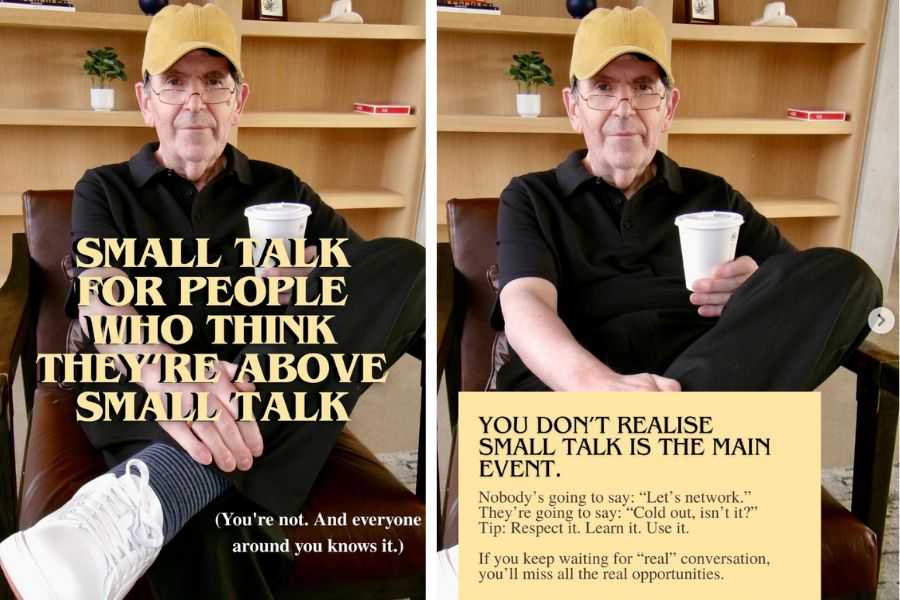
In an Instagram post, Baker argued that those who see small talk as “beneath them” are failing to see it as a “test” (for compatibility, connection, shared values, etc.), which will inevitably lead to getting “left out.”
He then gave five tips to help folks shift that mindset and make small talk work for them. Honestly, even those who aren’t adamantly against small talk might find themselves guilty of some of these mistakes and could benefit from making these tweaks.
Perhaps in an attempt to be authentic, or to avoid taking up all the oxygen in the room, people might use responses that are accurate and succinct, but not exactly conversational. This doesn’t give the other person anything to “bounce off of,” which is what’s really being asked for.
To remedy this, Baker suggests to always give a real response plus a “hook.” He gave the example of saying “Mostly work, but I’m trying to teach myself how to play guitar. Chaos!” when asked, “What have you been up to?” rather than saying “Not much, just working.”
#2 Don’t ask questions like it’s a job interview
Baker says ask “open-ended, low-stakes” questions like “what’s keeping you busy outside of work?” to invite a sense of “play.” Conversely, asking things like “where are you from?” invites a sense of formality, pressuring people to “perform.”
Since the thought of shallow conversation might seem uncomfortable, those who are small talk-averse might find themselves immediately asking overarching existential questions like, “What drives you?” Baker argues that one must trust that “shallow comes before depth,” and must be used as a “warm-up act.” Otherwise, people are put on the spot unnecessarily, which obviously doesn’t foster connection.
#4 Initiate conversation instead of only speaking when spoken to
What may seem like “politeness” can come across as unapproachable. The good thing is: this is an opportunity for some “low-pressure,” even “lightly self-deprecating” observations. Baker used the example of saying, “That snack table’s dangerously close to me.”
This might be the biggest tip of all. Here, Baker reminds us that for the majority of human interaction, small talk is the way in, and therefore should be “respected.” Virtually no one is going to say, “Let’s network,” but odds are they’ll easily comment on the weather. It’s our job to learn what they’re really saying with this mundane phrase.
Because, at the end of the day, “if you keep waiting for ‘real’ conversation, you’ll miss all the real opportunities,” Baker writes.
After reading these tips, you very well might still loathe the idea of small talk, which is totally fine. It doesn’t have to be for everyone, nor should it. But what Baker really presents here is a way to reflect on whether or not our attitudes are preventing us from making valuable connections. If we suspect that might be the case, then it could be worth experimenting with some of these tools.
If you’d like even more tips, Baker has a guide aptly titled Let’s Not Make It Weird, which you can check out here.
In a small village in Pwani, a district on Tanzania’s coast, a massive dance party is coming to a close. For the past two hours, locals have paraded through the village streets, singing and beating ngombe drums; now, in a large clearing, a woman named Sheilla motions for everyone to sit facing a large projector screen. A film premiere is about to begin.
It’s an unusual way to kick off a film about gender bias, inequality, early marriage, and other barriers that prevent girls from accessing education in Tanzania. But in Pwani and beyond, local organizations supported by Malala Fund and funded by Pura are finding creative, culturally relevant ways like this one to capture people’s interest.
The film ends and Sheilla, the Communications and Partnership Lead for Media for Development and Advocacy (MEDEA), stands in front of the crowd once again, asking the audience to reflect: What did you think about the film? How did it relate to your own experience? What can we learn?
Sheilla explains that, once the community sees the film, “It brings out conversations within themselves, reflective conversations.” The resonance and immediate action create a ripple effect of change.
MEDEA Screening Audience in Tanzania. Captured by James Roh for Pura
Across Tanzania, gender-based violence often forces adolescent girls out of the classroom. This and other barriers — including child marriage, poverty, conflict, and discrimination — prevent girls from completing their education around the world.
Sheilla and her team are using film and radio programs to address the challenges girls face in their communities. MEDEA’s ultimate goal is to affirm education as a fundamental right for everyone, and to ensure that every member of a community understands how girls’ education contributes to a stronger whole and how to be an ally for their sisters, daughters, granddaughters, friends, nieces, and girlfriends.
Sheilla’s story is one of many that inspired Heart on Fire, a new fragrance from the Pura x Malala Fund Collection that blends the warm, earthy spices of Tanzania with a playful, joyful twist. Here’s how Pura is using scent as a tool to connect the world and inspire action.
A partnership focused on local impact, on a global mission
Pura, a fragrance company that recognizes education as both freedom and a human right, has partnered with Malala Fund since 2022. In order to defend every girl’s right to access and complete 12 years of education, Malala Fund partners with local organizations in countries where the educational barriers are the greatest. They invest in locally-led solutions because they know that those who are closest to the problems are best equipped to solve and build durable solutions, like MEDEA, which works with communities to challenge discrimination against girls and change beliefs about their education.
But local initiatives can thrive and scale more powerfully with global support, which is why Pura is using their own superpower, the power of scent, to connect people around the world with the women and girls in these local communities.
The Pura x Malala Fund Collection incorporates ingredients naturally found in Tanzania, Nigeria, Pakistan, and Brazil: countries where Malala Fund operates to address systemic education barriers. Eight percent of net revenue from the Pura x Malala Fund Collection will be donated to Malala Fund directly, but beyond financial support, the Collection is also a love letter to each unique community, blending notes like lemon, jasmine, cedarwood, and clove to transport people, ignite their senses, and help them draw inspiration and hope from the global movement for girls’ education. Through scent, people can connect to the courage, joy, and tenacity of girls and local leaders, all while uniting in a shared commitment to education: the belief that supporting girls’ rights in one community benefits all of us, everywhere.
You’ve already met Sheilla. Now see how Naiara and Mama Habiba are building unique solutions to ensure every girl can learn freely and dare to dream.
Naiara Leite is reimagining what’s possible in Brazil
Julia with Odara in Brazil. Captured by Luisa Dorr for Pura
In Brazil, where pear trees and coconut plantations cover the Northeastern Coast, girls like ten-year-old Julia experience a different kind of educational barrier than girls in Tanzania. Too often, racial discrimination contributes to high dropout rates among Black, quilombola and Indigenous girls in the country.
“In the logic of Brazilian society, Black people don’t need to study,” says Naiara Leite, Executive Coordinator of Odara, a women-led organization and Malala Fund partner. Bahia, the state where Odara is based, was once one of the largest slave-receiving territories in the Americas, and because of that history, deeply-ingrained, anti-Black prejudice is still widespread. “Our role and the image constructed around us is one of manual labor,” Naiara says.
But education can change that. In 2020, with assistance from a Malala Fund grant, Odara launched its first initiative for improving school completion rates among Black, quilombola, and Indigenous girls: “Ayomidê Odara”. The young girls mentored under the program, including Julia, are known as the Ayomidês. And like the Pura x Malala Fund Collection’s Brazil: Breath of Courage scent, the Ayomidês are fierce, determined, and bursting with energy.
Ayomidês with Odara in Brazil. Captured by Luisa Dorr for Pura
Ayomidês take part in weekly educational sessions where they explore subjects like education and ethnic-racial relations. The girls are encouraged to find their own voices by producing Instagram lives, social media videos, and by participating in public panels. Already, the Ayomidês are rewriting the narrative on what’s possible for Afro-Brazilian girls to achieve. One of the earliest Ayomidês, a young woman named Debora, is now a communications intern. Another former Ayomidê, Francine, works at UNICEF, helping train the next generation of adolescent leaders. And Julia has already set her sights on becoming a math teacher or a model.
“These are generations of Black women who did not have access to a school,” Naiara says. “These are generations of Black women robbed daily of their dreams. And we’re telling them that they could be the generation in their family to write a new story.”
Mama Habiba is reframing the conversation in Nigeria
Centre for Girls' Education, Nigeria. Captured by James Roh for Pura
In Mama Habiba’s home country of Nigeria, the scents of starfruit, ylang ylang and pineapple, all incorporated into the Pura x Malala Collection’s “Nigeria: Hope for Tomorrow,” can be found throughout the vibrant markets. Like these native scents, Mama Habiba says that the Nigerian girls are also bright and passionate, but too often they are forced to leave school long before their potential fully blooms.
“Some of these schools are very far, and there is an issue of quality, too,” Mama Habiba says. “Most parents find out when their children are in school, the girls are not learning. So why allow them to continue?”
When girls drop out of secondary school, marriage is often the alternative. In Nigeria, one in three girls is married before the age of 18. When this happens, girls are unable to fulfill their potential, and their families and communities lose out on the social, health and economic benefits.
Completing secondary school delays marriage, and according to UNESCO, educated girls become women who raise healthier children, lift their families out of poverty and contribute to more peaceful, resilient communities.
Centre for Girls’ Education, Nigeria. Captured by James Roh for Pura
To encourage young girls to stay in school, the Centre for Girls’ Education, a nonprofit in Nigeria founded by Mama Habiba and supported by Malala Fund and Pura, has pioneered an initiative that’s similar to the Ayomidê workshops in Brazil: safe spaces. Here, girls meet regularly to learn literacy, numeracy, and other issues like reproductive health. These safe spaces also provide an opportunity for the girls to role-play and learn to advocate for themselves, develop their self-image, and practice conversations with others about their values, education being one of them. In safe spaces, Mama Habiba says, girls start to understand “who she is, and that she is a girl who has value. She has the right to negotiate with her parents on what she really feels or wants.”
“When girls are educated, they can unlock so many opportunities,” Mama Habiba says. “It will help the economy of the country. It will boost so many opportunities for the country. If they are given the opportunity, I think the sky is not the limit. It is the starting point for every girl.”
From parades, film screenings to safe spaces and educational programs, girls and local leaders are working hard to strengthen the quality, safety and accessibility of education and overcome systemic challenges. They are encouraging courageous behavior and reminding us all that education is freedom.
Experience the Pura x Malala Fund Collection here, and connect with the stories of real girls leading change across the globe.
Human psychology really isn’t that complicated, if you think about it. Everybody wants to see themselves in a positive light. That’s the key to understanding Jonah Berger’s simple tactic that makes people 30% more likely to do what you ask. Berger is a marketing professor at the Wharton School of the University of Pennsylvania and the bestselling author of “Magic Words: What to Say to Get Your Way.”
Berger explained the technique using a Stanford University study involving preschoolers. The researchers messed up a classroom and made two similar requests to groups of 5-year-olds to help clean up.
One group was asked, “Can you help clean?” The other was asked, “Can you be a helper and clean up?” The kids who were asked if they wanted to be a “helper” were 30% more likely to want to clean the classroom. The children weren’t interested in cleaning but wanted to be known as “helpers.”
Berger calls the reframing of the question as turning actions into identities.
“It comes down to the difference between actions and identities. We all want to see ourselves as smart and competent and intelligent in a variety of different things,” Berger told Big Think. “But rather than describing someone as hardworking, describing them as a hard worker will make that trait seem more persistent and more likely to last. Rather than asking people to lead more, tell them, ‘Can you be a leader?’ Rather than asking them to innovate, can you ask them to ‘Be an innovator’? By turning actions into identities, you can make people a lot more likely to engage in those desired actions.”
Berger says that learning to reframe requests to appeal to people’s identities will make you more persuasive.
“Framing actions as opportunities to claim desired identities will make people more likely to do them,” Berger tells CNBC Make It. “If voting becomes an opportunity to show myself and others that I am a voter, I’m more likely to do it.”
This technique doesn’t just work because people want to see themselves in a positive light. It also works for the opposite. People also want to avoid seeing themselves being portrayed negatively.
“Cheating is bad, but being a cheater is worse. Losing is bad, being a loser is worse,” Berger says.
The same tactic can also be used to persuade ourselves to change our self-concept. Saying you like to cook is one thing, but calling yourself a chef is an identity. “I’m a runner. I’m a straight-A student. We tell little kids, ‘You don’t just read, you’re a reader,’” Berger says. “You do these things because that’s the identity you hold.”
Berger’s work shows how important it is to hone our communication skills. By simply changing one word, we can get people to comply with our requests more effectively. But, as Berger says, words are magic and we have to use them skillfully. “We think individual words don’t really matter that much. That’s a mistake,” says Berger. “You could have excellent ideas, but excellent ideas aren’t necessarily going to get people to listen to you.”
This article originally appeared two years ago. It has been updated.
Sometimes when we interact with people, we can fall into autopilot mode and say something we don’t mean. Case in point: when someone accidentally ends a professional call with “I love you,” as if they were talking to a spouse, instead of a formal goodbye—or when a student accidentally refers to their teacher as “mom.”
The reason we sometimes feel like we’ve “zoned out” or acted without conscious effort is a psychological phenomenon known as automaticity. Automaticity can be very helpful when we’re doing complex tasks like catching a football or when we’re doing things that shouldn’t require much mental energy, such as brushing our teeth. However, when we’re on autopilot, we sometimes say silly things, and this teacher is a perfect example.
“I’m a high school teacher (44, been doing this for like 15 years) and today during 6th period, I was helping this kid, let’s call him Marcus, with a geometry proof,” the teacher explained in a now-deleted Reddit post. “He was really trying, you know? Had his pencil behind his ear, kept erasing, the whole thing. And when he finally got it, I just… I said, ‘There you go, sweetie!’”
“The room went *silent*. Like that record-scratch moment you see in movies, except it was real and happening to my actual life,” the teacher explained. “Marcus just stared at me. I tried to recover with ‘I mean… good job, Marcus,’ but the damage was done. By the time the bell rang, I could hear them already talking about it in the hallway.”
The teacher has a 12-year-old daughter they call “sweetie” approximately 600 times a day, so, of course, it was bound to slip out at some point. This time, it just happened to be to Marcus in geometry class. After the school day, the teacher was fraught with questions: “Do these things just blow over? Will Marcus ever make eye contact with me again?”
The post received some funny responses and genuine encouragement.
“It’s good to see there’s a teacher version of calling the teacher mom,” a commenter wrote.
“I once called my English teacher Dad in an otherwise silent classroom. He was only 24, a strawberry blond, and he blushed,” another added.
One commenter thought the teacher should take the Curb Your Enthusiasm approach:
“Double down. Call more kids ‘sweetie.’ Now it’s normalized, and you haven’t humiliated just Marcus (or yourself). There’s a Curb Your Enthusiasm episode about this! Richard Lewis hits his new gf with a premature ‘honey’ and then predictably spirals when she’s weirded out and tries to overcompensate by calling everyone he sees ‘honey’ in front of her.”
Finally, a lot of folks told the teacher everything would blow over
“It will blow over,” a commenter wrote. “I don’t know where you’re from, but calling people little things like that is common everywhere, as far as I know. If a cashier said ‘thanks sweetie’ to me or something I would think literally nothing of it. Seems an overreaction from them. If one of them accidentally called you mum, they would get some banter for it, and then it would be forgotten about. Happens to us all!”
The teacher’s story is a great reminder that we all go on autopilot sometimes and slip up, and there’s no need to feel too bad about it. But just be careful what you call your loved ones at home. It may be the next thing you call a coworker.
Generation X occupies an interesting time in history, for those who care to recognize that they actually exist. They were born between 1965 and 1980 and came into this world at an interesting inflection point: women were becoming a larger part of the workplace and divorce was at the highest point in history. This left Gen X to be the least parented generation in recent history.
Gen X was overlooked in their domestic lives and culturally were overshadowed by Baby Boomers with their overpowering nostalgia for Woodstock, The Beatles, and every cultural moment celebrated in Forest Gump. Once Boomer navel-gazing nostalgia began to wane, a much larger and over-parented generation, the Millennials, came on the scene.
“Whereas Boomers were the ‘me generation’ and millennials were the ‘me me me generation,’ Gen X has become the ‘meh’ generation,” Emily Stewart writes at Business Insider. But even if Gen X is a little aloof, that doesn’t mean they aren’t totally rad, awesome, trippindicular, and that it’d be bogus to define them any other way. To explain the unique history of Gen X and why they’re often overlooked, history teacher Lauren Cella created a timeline on TikTok to explain them to her Gen Z students.
A love letter to Gen X from your millennial cousin? Gen X didn’t start the fire, so after this I will just leave them alone because they do not care ? But seriously for a generation that sometimes gets “forgotten” and stuck between the larger boomer or millennial cohorts, the genres they created paved the way for pop culture as we know it. I’m still not sure who let kids watch “The Day After” on TV or play on those hot metal playgrounds, but Gen X survived to tell the tale. Today, the so called “latchkey” kids, born 1965-1980 are actually super involved as parents, aunts, uncles, teachers (or maybe even grandparents)?. Kids today want to say they are “built different” but I think Gen X is the one holding down that title because they grew up tough, they saw too much, they made it out, and they know exactly who they are and wouldn’t have it any other way.✌️ g#genx
In Cella’s video, she divides Gen X into three distinct phases.
Phase 1: 1970s stagflation and changing families
“Gas shortages meant stagflation. So parents either both had to work or maybe they were divorced. So that meant microwave TV dinners and kids that sort of raised themselves,” Cella explains. “There was no parenting blogs, there was no after-school travel sports, emailing. Like, none of that existed. Bored? Go outside.”
Phase 2: The neon ‘80s
“But then came the 1980s, where everything was big and loud. The hair, the bangs, the Reaganomics, mass consumerism (because now we can trade with China). The whole media just exploded,” Cella says. “But now we have TV, we have movies, we have TV, movies, home movies, TV movies, favorite TV movies, music, music, Videos, music, video, television. All these different genres and all these different cliques and all these different ways that you can express yourself.”
Phase 3: 1990s post-Cold War Skepticism
“Gen X sort of comes into the 1990s more sarcastic and skeptical,” Cella continues. “The Cold War ending meant that they rejected the excess of the eighties. And there’s the shift. Grunge, indie, alternative, flannels, Docs [Doc Martins]. At this point, the technology is also exploding, but not like fun home media, but like corporate media. So there’s this resistance to sell-out culture.”
Cella has a theory on why Gen X seems forgotten, and it’s not just because CBS News famously denied its existence. She believes that it comes down to Gen X’s inability to call attention to itself. “So Gen X is a bridge between these two larger, more storied generations. So it’s not necessarily that they get forgotten. They don’t really want the attention. They’re kind of fine to just like, fly under the radar like they always have, because honestly, it’s whatever.”
This article originally appeared last year. It has been updated.
Every school has hundreds of kids pass through its doors on a daily basis. Things are bound to get left behind. But what’s really wild (and the bane of many parents’ existence) is that many of those jackets, hats, or—God forbid—a single shoe sit in the school’s lost-and-found bin, doomed to never see the light…
Every school has hundreds of kids pass through its doors on a daily basis. Things are bound to get left behind. But what’s really wild (and the bane of many parents’ existence) is that many of those jackets, hats, or—God forbid—a single shoe sit in the school’s lost-and-found bin, doomed to never see the light of day again.
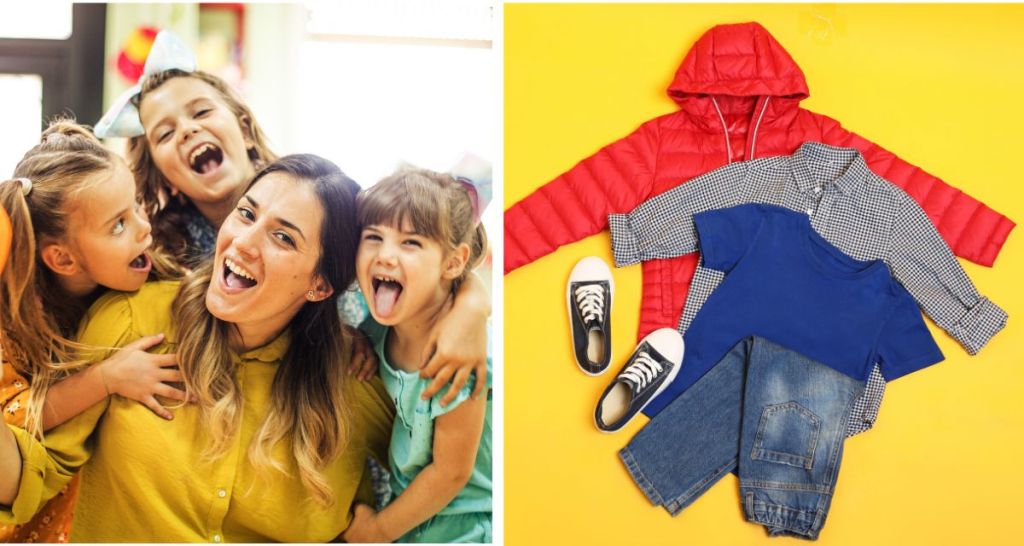
One group of teachers decided to offer their students a kind—and creative—reminder to grab their forgotten treasures: a good old-fashioned fashion show.
In a now-viral video shared by retired kindergarten teacher Leslie Johnson, we see teachers strut down a makeshift outdoor runway, faces fierce, each sporting at least five or six clothing items on hangers as *NSYNC’s “Bye Bye Bye” plays in the background. Holy moly, the number of clothing items is truly insane. Is this a year’s worth, or a week?!
The gag is not only hilarious but clearly effective, as we also see quite a few kids running up to reclaim their items. So there’s that.
The video has since been viewed a whopping 3.6 million times, garnering a ton of praise from parents whose kids never bother to look for their missing stuff in a spot specifically for that kind of thing:
“This is the MOST genius thing I have ever seen!! You would think it wouldn’t be that difficult for kids to find their belongings in a lost and found bin, but nope they don’t and then the clothes get shipped down to the nurses office whether wanted or not!!”
“I can relate to this so well.My son within the 4 days of school starting, lost four jackets during winter time.”
“I’ve seen 3 hoodies that look like my son’s and he doesn’t even go to that school! 🥴”
“My son lost two jackets in two days. I love this.”
“I know at least $300 of my hard earned dollars would be on this catwalk.”
On that note, many even suggested that parents—who are the ones earning early gray hairs actually looking for these items—should have attended.
“This needs to be a parent day too cause these kids don’t know their own dang clothes 😂😂😂”
“They need to do this at parent teacher conferences 😂😂”
Tips to help prevent kids from losing stuff…without losing your mind
Listen, kids will be kids, but the tips below might help at least lessen the frequency of things going missing. The key is to actively involve kids in any of these strategies so that they are learning responsibility.
Label everything
This is a tedious one, but very helpful. It might not keep a student from forgetting something, but if another student or teacher can see who the item belongs to, it certainly increases the chance of that item getting back to its proper owner.
Create packing routines
Establish a “pack and check” routine for both morning and afternoon to ensure all items are accounted for before leaving home and school.
Reduce clutter
Limiting the number of items carried to school makes it that much easier to manage.
Color-code subjects
Assign specific colors to subjects to help children quickly identify whether they have the correct notebooks or folders, such as red for science or yellow for math.
Use checklists
Have children write a list of their key belongings that need to leave the house in the morning and return home at the end of the day. This helps them visualize and verify that they have all the necessary items. Ideally, kids will eventually remember what to keep track of and not need the list. But even if they don’t, they’ll at least have tangible tools to keep things organized.
There has been a big shift in the delicate interplay between employers and employees since the COVID-19 pandemic. In pandemic-era America, job seekers had the advantage due to labor shortages caused by early retirements, long COVID, caregiving needs, and generous government relief programs.
There has been an economic shift over the past two years, with unemployment rising due to disruptions in global trade, declines in manufacturing, and the rise of artificial intelligence. That means the pendulum has swung in the other direction, and employers now hold the stronger hand.
How has America’s job market changed?
Popular TikToker Melissa Marcus, a career coach and recruiter, explained in a recent post that the shift between employees and employers means corporations now expect new hires to be ready to work.
“All over my LinkedIn feed, there are job postings now that are like, ‘if you’re looking for a 9-to-5 and you don’t want to be challenged, then this job is not for you,’” Marcus told her followers.
“Corporate America has always done an ebb and flow around this. The minute the job market becomes such that they are in control, the corporate culture starts to fall apart,” Marcus said, noting that this particular trend is “certainly true” in the tech space. “They have moved into this place of ‘We don’t care anymore. If you wanna come work for us, we’re gonna work you harder, we’re gonna pay you less, and you’re gonna love it.’”
This temporary shift toward an unhealthy work environment may prompt some people to rethink their options when considering a career change and focus on workplaces where culture comes first.
If you’re looking for a job and want to be sure the company supports a healthy work-life balance, there are a few ways to approach your search.
You can check out websites that host company reviews, such as Glassdoor and Indeed, where current and former employees give you an inside look at companies. You should take some of these reviews with a grain of salt, because current employees aren’t likely to write negative reviews about where they work. These sites are good for reading the tea leaves of a workplace, or noticing patterns that give you a good idea of what it’s like to work there.
When it comes to the industries where people are happiest, companies with mission-driven work tend to score among the highest in employee satisfaction. A recent survey found that people who work in science and pharmaceuticals report an overall job happiness score of nearly 92%, higher than creative arts and design (84%) and environment and agriculture (81%).
At a time when it’s becoming harder to land a new job, finding a position at a company with a great culture may feel like a luxury. But by looking into the right industries and asking the right questions, you can give yourself the best chance of finding a job that offers satisfying work and treats you with dignity.
All roads might lead to Rome, but what about avenues? Boulevards? Drives? Do all these words essentially mean the same thing? And while we’re on the subject, why do we park on a driveway and drive on a parkway? Why is English so complicated?! In a decidedly uncomplicated two-minute-long Instagram video, a man named Karim,…
All roads might lead to Rome, but what about avenues? Boulevards? Drives? Do all these words essentially mean the same thing? And while we’re on the subject, why do we park on a driveway and drive on a parkway? Why is English so complicated?!
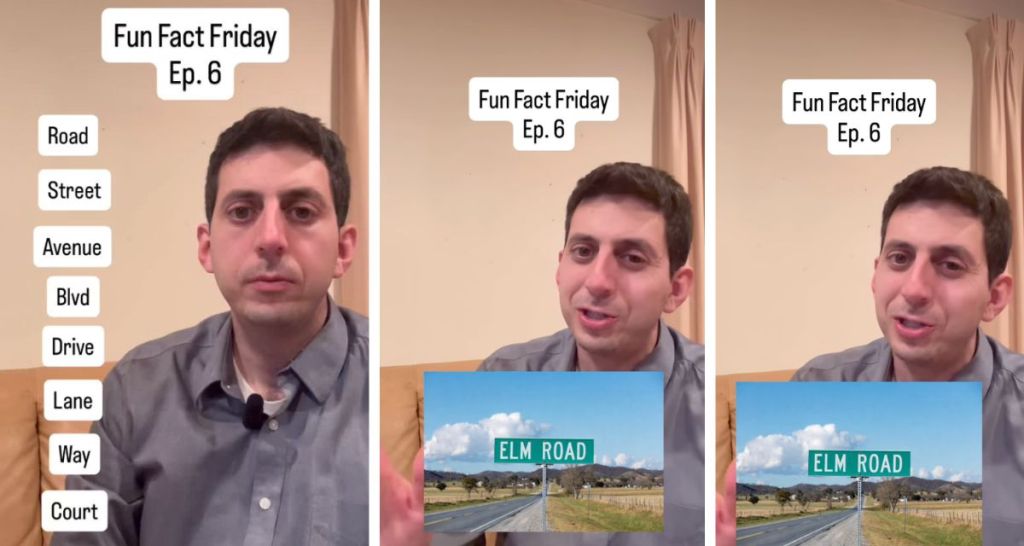
In a decidedly uncomplicated two-minute-long Instagram video, a man named Karim, who frequently posts “fun fact” content, explains, “I know we tend to use roads, streets, boulevard, avenue, all of these things kind of interchangeably, but there are some differences between these things.”
Breaking it down
Mercifully, he breaks down those differences so we don’t have to.
A “road” is a broad, generic term for any pathway that connects two points, found in both rural and suburban areas. Roads are designed to move traffic between locations.
Meanwhile, “streets” are found exclusively in towns or cities and feature buildings and/or sidewalks on both sides. They often accommodate both vehicle traffic and pedestrian activity.
In other words, “roads” connect any two places, while “streets” are part of a city’s infrastructure. For example, you might take a road to travel between cities but drive down a street to find a shop.
Moving on, Karim explained that “avenues” are wider than streets and are typically separated by a median. They often feature trees and landscaping on either side, in addition to buildings. According to Southern Living, avenues also run perpendicular to streets.
“Boulevards” are even wider than avenues and also feature a median, along with more extensive landscaping and formal lighting. While both avenues and boulevards are designed for heavy traffic flow, boulevards often feel more park-like or grand in scale.
Unlike a street, which is grid-like and structured for city life, a “drive” is shaped by the natural topography—such as hills or lakes—and is more commonly found in scenic or residential areas.
Speaking of residential areas…
A “lane” is typically a narrow road that acts as a small residential street, generally lacking shoulders or a median. A “way,” on the other hand, is usually a small side street or a path that connects other streets within neighborhoods.
Both “courts” and “places” refer to roads that lead to a dead end. However, a court typically ends in a round cul-de-sac, whereas a place is straight.
Karim admitted that there were still other terms he could have covered—such as terraces, parkways, and groves—but he did a great job explaining the basics.
And for anyone curious: “terraces” refer to streets situated on elevated ground or along the top of a slope, “parkways” involve multiple lanes and are designed for passenger vehicles and some heavy trucks, and “groves” appear to be courts surrounded by trees.
Viewers react
If you were surprised by just how unexpectedly engrossing all this was, you’re not alone. Here are some of the comments on his video:
“I never knew!!!😃”
“Showing this to my students! Interesting and educational! Keep them coming!”
“Fascinating. I thought they just chose what sounded nice!”
“I wonder how many folks in charge of naming roads these days follow these guidelines.”
And that is certainly something worth noting. Part of our collective confusion almost certainly comes from the fact that many of these terms are used interchangeably—as many viewers have apparently experienced firsthand:
“My residential street, officially, according to the postal service, is a Boulevard, but in reality is not. We don’t like to call it one. When there’s a parked car, you can barely pass if there’s an oncoming car. Definitely not what you described, which I what I think of when the word boulevard is supposed to used.”
“In my town there’s a blvd that is actually only a cut-through road that at one point was [an unnamed] gravel road. Not much of a boulevard 🤣”
Okay, so maybe a little too much poetic license is taken (especially with “boulevard”), but at least we all know something we likely didn’t know before!
Logic puzzles and brain teasers have long been used to challenge our minds and encourage critical thinking. Sometimes the most intriguing puzzles are the ones that seem the simplest. For instance, a teacher in India, Raviraj Master, posted a seemingly simple yet seemingly impossible problem for his students: “Draw a square with three lines.” That’s it. Could they do it?
Student after student came up to the board to make an attempt. One by one, they drew three lines, which of course did not add up to a square. One student cleverly drew three sides of a square with lines and the fourth side with a dotted line. That move demonstrated creative thinking, but it was not the solution.
Finally, a student walked up to the board, drew a square with all four sides, and then drew three lines inside it. That was it. She had drawn a square with three lines. Problem solved.
Thinking critically about wording
The solution is so straightforward that most people miss it. It’s not that it’s hard; it’s that our brains interpret the prompt a certain way and go full speed ahead with that interpretation. It’s an excellent lesson in thinking critically about how something is worded and what is being asked.
For instance, “Draw a square using three lines” would be a totally different ask than “Draw a square with three lines.” Just that one-word difference changes the possible meaning of the prompt. What if the teacher had asked, “Is there another way these words can be interpreted?” Proactively looking at each word to see if it could have a different meaning makes puzzles like this one a little easier.
However, the lesson extends far beyond silly brain teasers. Advertisers, politicians, and others who exploit the power of persuasion sometimes use words in ways that confuse or mislead.
The logical fallacy of equivocation or ambiguity
For instance, let’s look at the logical fallacy of equivocation, also known as the fallacy of ambiguity. Using words that have more than one meaning makes it easy to be vague and leave statements open to interpretation.
In our brain teaser, the word “with” could mean “using,” which is the way most students interpreted it. But “with” can also mean “accompanying,” which is how it’s used in the actual solution.
Politicians use ambiguity a lot. Philosopher Justin D’Ambrosio called it “manipulative under-specification.” Using terms that are open to multiple interpretations gives politicians plausible deniability if you disagree with them. They can simply say they meant something different. Even important concepts like justice, fairness, and democracy are underspecified terms, making it easy for politicians to use them in slogans or soundbites without detailing what they mean.
Ambiguity can be used to manipulate people via the media as well. Sharon Haigler and C. Anneke Snyder’s “Propaganda Techniques in Media” handout at Texas A&M University lists 12 media propaganda techniques. Check out number 10:
“Obfuscation: Intentionally confusing the issue with vague, non-specific language. By avoiding clarity, propagandists create uncertainty and prevent critical analysis. Complex legal jargon or ambiguous statements serve this purpose.”
Understanding ambiguity may help us understand each other
It’s wise to think critically when it comes to wording, whether we’re trying to solve a silly logic puzzle or serious social and political problems. Pay attention to words that are vague. Ask what various definitions or interpretations there might be for ambiguous terms.
On the positive side, staying aware of words with multiple meanings can sometimes help us see where others are coming from. Sometimes disagreements are due to defining a word differently, rather than an actual issue. So many words in our social and political discourse require definitions before we engage. Otherwise, we risk talking past one another rather than meaningfully discussing things with one another.
Amazing what we can learn from a simple brain teaser, isn’t it?
If you teach young children, or have young children in school, you might have heard of the viral “Tattle Phone.”
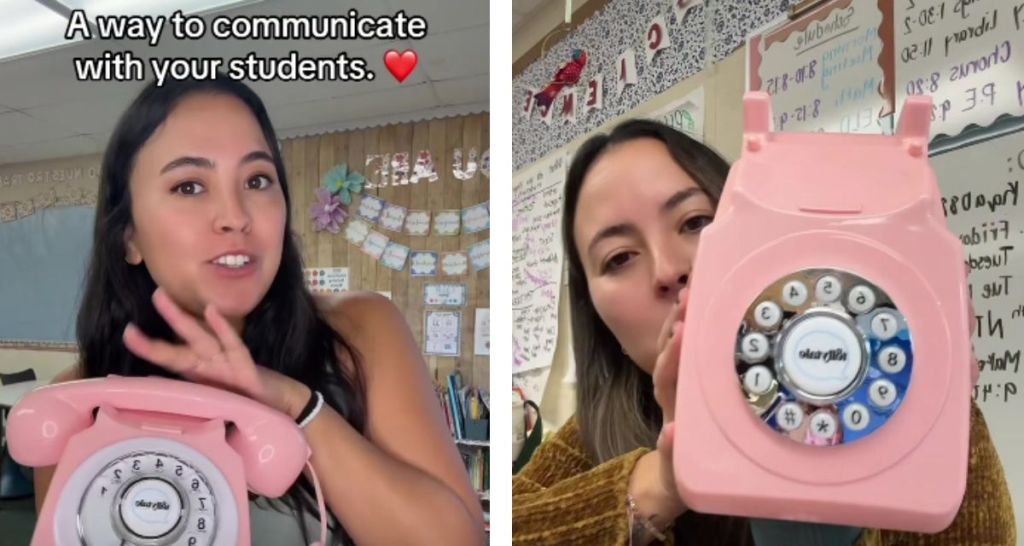
On TikTok, you’ll find several videos of teachers raving about the product, which they’ve largely purchased on Amazon, for the way it gives students a way to vent while sparing their own sanity.
Not to mention it provides some grade-A entertainment to boot. Because who can resist piping-hot tea like “Micha burped on purpose!” and “Evan has TWO erasers in his pencil pouch!”
But what you may not know is that this trendy product stems from the brainchild of a real educator looking for impactful ways to curb tattling in her own classroom.
Over her 12 years working as a teacher and counselor for transitional kindergarten students through fifth grade, Anais Zavala noticed that “constant tattling” had become a major disruptor to learning. Knowing that kids already associate phones with being listened to, she thought it might be the perfect way to make them feel seen in a structured setting without being so distracting for everyone else.
And thus the original “Tattle Phone” was born in 2023
The idea is pretty simple: students walk up to the phone, which has a small Bluetooth recording device that captures all their complaints. But Zavala didn’t stop there. After all, the intention wasn’t just to “stop kids from speaking,” she tells Upworthy, but to focus on “teaching them how to speak, reflect, and resolve conflicts.”
So, using both her teaching experience and behavioral specialist expertise, Zavala also created a curriculum (available in English and Spanish) that helps educators teach kids to manage conflict and express emotions, also known as Social-Emotional Learning, or SEL.
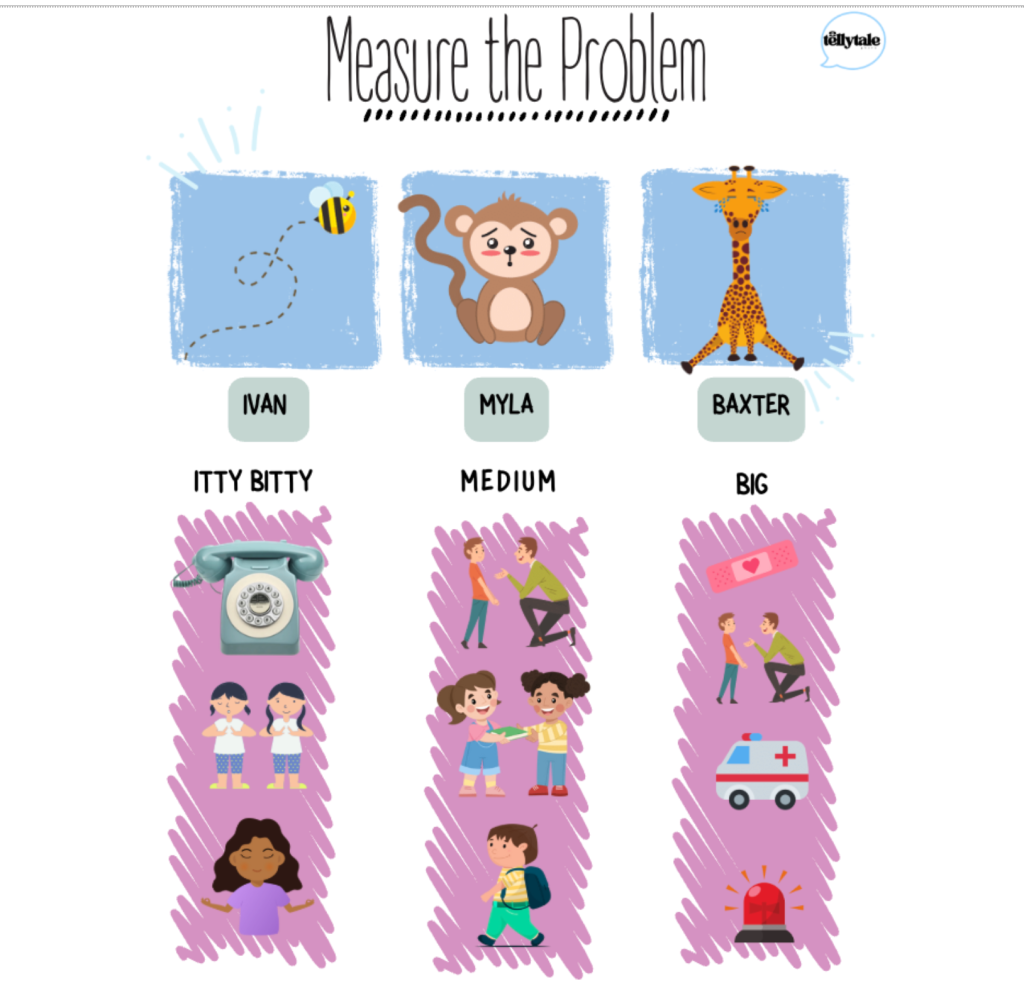
One example is learning how to identify the “size” of a problem. In the cute graph below, “itty bitty” problems are represented by a bee, “medium” problems by a monkey, and “big” problems by a giraffe. Each category also includes images of possible solutions, such as breathing deeply, talking to an adult, or calling an ambulance.
Measuring the size of a problem. Photo credit: Anais Zavala, used with permission
The reflective aspect became so integral that Zavala eventually renamed and trademarked her device the “Telly Tale Phone,” because she wanted it to feel less about reporting and more about processing what happened. Telling, versus tattling, if you will.
Zavala noticed that not only did the Telly Tale Phone result in fewer classroom interruptions, but students also became more mindful with their tattles. They began pausing to rethink what they wanted to say and often tried to solve problems on their own. Other teachers reported similar results: increased independence, better peer conflict resolution, and reclaimed instructional time.
Unsurprisingly, as Zavala’s Telly Tale Phone began making a splash, similar products started popping up. While Zavala understands that competition is “normal when something meets a real need,” she maintains that what makes the Telly Tale Phone more than a “novelty” item is its structured reflection system. It treats tattling as a learning opportunity rather than something to be squelched entirely.
“Even though more products are coming out, my focus has always been staying true to the educational mission,” she said. “Our focus has always been impact — not just popularity.”
Where to buy your own Telly Tale products
In addition to the Telly Tale Phone, Zavala also sells an adorable Ellie the Telly Elephant stuffie with a similar Bluetooth recording device tucked into its ear, for kiddos who might need something on the softer side.
If you’d like to support Zavala’s small business, you can check out the Telly Tale Phone website here, as well as follow the Telly Tale Phone socials here and here.