upworthy
Add Upworthy to your Google News feed.
Google News Button
Joy

15 women reveal the 'underrated' reasons why they left their significant others

Modern society has created new reasons for people to break up.

woman, break ups, significant others

Why are women breaking up with men these days?

When people are ready to leave a relationship, many feel pressure to have a compelling reason. There are reasons that no one will disagree with, such as a partner's abuse, infidelity, or trouble getting along with family.

But what if you just aren’t feeling the relationship anymore, or don’t think they appreciate all you have to offer? Those can be perfectly fine reasons, too. It's totally fine to break up with someone over reasons that some may find trivial.

It’s your life; you can’t live it with your chosen people.

A Reddit user named Grand_Gate_8836 asked the AskWomen forum, “What is a very underrated reason for breaking up with your significant other?” and many women shared that they broke up with their partners because they just weren’t feeling the relationship. Others brought up reasons that people may not have had in the past, such as pornography addiction, immaturity and spending too much time playing video games.


On a deeper level, the discussion made many women who feel insecure about their reasons for leaving someone feel a lot better about following their hearts.

Here are 15 of the best “underrated” reasons for breaking up with one’s significant other.

1. Mental health

"I think bad mental health can be a big reason for splitting from someone. Nobody tells you how lonely it can get to be with someone who has mental health issues. It can take years for you to understand them and then eventually realize that you can’t help them until they choose to help themselves. This is due to severe unawareness around mental health issues I feel." — Grand_Gate8836

2. They don't find you attractive

"At the risk of sounding petty: they don't 100% love the way you look, even if they try to spin it in a positive way. I mean statements like 'she's not beautiful but I love her personality and sense of humor"'or 'she's a 5 on a good day but I guess so am I' or 'she's not what I'd consider my type but there's something about her.' I appreciate honesty as much as one can, but in my opinion, this is just depressing. Beauty comes in so many different shapes and forms. How can someone not find it in a person they claim to love? To me it basically means your SO is settling for you and will be forever comparing you to some kind of ideal you don't match." — JankyRobot42069

3. Not the outdoorsy-type

"I broke up with someone who had very conflicting interests and hobbies to mine and assumed I would just be on board with taking them up with him. I like the outdoors. I do not like devoting every weekend to hiking." — Justwannaread3

"Imo, this is so underrated. 'I enjoy X, but I do not enjoy devoting all of my free time to X.' is absolutely valid in and of itself. And leaving someone who doesn't grasp that is so much better for mental health in the long run." — DragonFlySunrise

4. Different goals

"You know, one thing that doesn't get talked about enough is having different life goals and values as a reason to break up with someone. It's not just about whether you both like the same movies or enjoy the same hobbies. It's about where you see yourself going in life and what you believe in. Imagine you're super into traveling the world and experiencing new cultures, but your partner is more about settling down in one place and building a stable career. It might not seem like a big deal at first, but over time, those differences can really start to wear on the relationship. You might find yourself feeling like you're not on the same page about the important stuff, like where you want to live or what you want to prioritize in life. So yeah, having different life goals and values might not be the most obvious reason to break up, but it can definitely be a deal-breaker if you're not aligned in those areas." — Good1Mufferaw

"It never ceases to amaze me that people ignore compatibility issues. It's the most important feature in a relationship. And marriages that continue regardless of how whack the lack of compatibility is." — Savagefluerelis23

5. You're not happy

"They're just not making you happy. You're just not happy with them, and you deep down feel you could be happier elsewhere either alone or with someone else. They're a good, kind person, a responsible adult, etc, but they're not "it" for you. This is often considered a trivial reason to end a relationship or marriage but it's such a BIG DEAL. You should want to be happy and should want them to be happy too! You know when you're not happy. This idea that you should only leave a partnership or friendship because of something deemed "more serious" doesn't feel right to me. One of the hardest things is walking away from someone who is not abusing you, is really good on paper but it just NOT doing it for you because society will always shame people and especially women for leaving because of unhappiness. That inkling feeling underneath of 'they might not be it for me,' we are taught to just not listen to ourselves." — The_Philosophied

6. Bros came first

"He prioritized his friends over me. I think prioritizing friends and family are important, but it got to a point where I was miserable. We were both mid-thirties, and he wanted to go to parties and bars all the time to see his friends. We never had quality time together. It reached its breaking point when my aunt suffered cardiac arrest and was airlifted from 700km away to the hospital in my city. Instead of coming to the hospital with me, or even emotionally supporting me when I went to be with her, he went to the bar and got drunk. I didn't even get a text or call for 24 hrs he just disappeared. When I got upset, he said, 'Seeing Dave is more important, he's my friend' I broke up with him the next day. My aunt died a few hours later." — MeatCat88

7. Pornography

"Porn addiction. Society has brainwashed people into thinking this is normal behavior." — 1989sBiggestFan13

"This is what killed my relationship with my ex-fiance after 7 years. I genuinely thought I was asexual -- nope. He just watched so much, such intense porn (even when I was putting out) that I stopped having any sexual interest at all." — Arwynn

8. Conspiracy theories

"There wasn’t an insane conspiracy theory this dude didn’t believe. ...The first one he told me: on our second date was around the time of the Miami Mall incident. He truly believed 8ft tall shadow aliens invaded the Miami Mall and the government was keeping hush about it. His further conspiracy was that the government was overrun by 'replaced people' basically aliens pretending to be people." — SinfullySInless

9. Video games

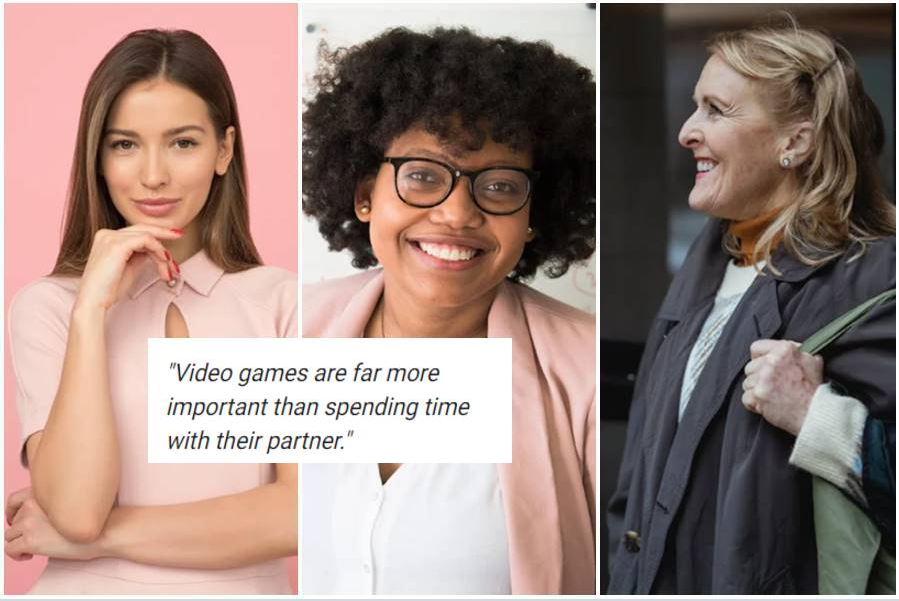
"Video games are far more important than spending time with their partner. I'm a very simple person. I don't care about gifts or having money spent on me. Let's go for a walk in the park, just spend some time with me. My ex-husband would find any excuse to not spend time with me. The most common was 'gas costs money, I'd rather hang out at home.' His idea of 'hanging out' was him playing video games with his online friends while I sat quietly watching TV, but with the volume super low so his friends wouldn't be 'distracted.' God forbid I laughed at all, he'd get so mad at me for it." — NatAttack89

10. Peter Pan syndrome

"Peter Pan syndrome. When my 60-year-old boyfriend told me (53F) the reason he had not 1 dollar saved for his retirement is because he is a 'risk taker' and I’m not, I realized I’d have to support him for the rest of his life while he looked down on me for it and walked away." — Slosee

11. Domestic burden imbalance

"Incompatible cleaning habits. Seems like an easy thing to remedy but in reality different standards of cleanliness will create an uneven burden of domestic labor for the partner with higher standards, or create a living environment in which that partner is uncomfortable, or create a situation where the partner with lower standards feels constantly berated/nagged to do something they don’t see as benefitting them in any way. I know multiple couples who broke up at or just before the 'moving in' stage for this reason, and I think it’s a super valid way to decide you’re not compatible in a long-term domestic relationship." — Angstyaspen

12. Stuck in a rut

"Disinterest in trying or experiencing new things and only sticking with what they know. If you’re someone who enjoys trying new restaurants, going to events, exploring new cultural experiences, etc and your partner is content to sit at home in their comfort zone, it eventually gets frustrating. I refused to date someone because of this mentality. If it wasn’t happening within a few miles of his house, he wasn’t terribly excited about doing it. Also, men who think basketball or gym shorts are acceptable casual attire." — Edjennersmilkmaid

13. Fell out of love

"Because you don’t love them anymore. I say this is an underrated reason because so many people think they need a catalyst event in order to justify breaking up. But if you’re not happy and the relationship isn’t fulfilling, that’s a solid enough reason." — Lydviciousss

14. Immaturity

"It felt like parenting. Like I was hanging out with a kid all the time. I was doing all the work, all the driving, all the planning. Like I was managing a child. 'This ain’t my job.'" — K19081985

15. Geographically undesirable

"Not agreeing on where you want to live. I've seen people start a relationship while one or both was living abroad, thinking 'We'll figure it out.' But actually building a life and having kids somewhere far from your own roots, or just in a place you don't really like, is a lot." — Princess Sophia Black

ideas, homelessness, prodigy, social work, solutions
Photo credit: @ribalzebian on Instagram

Ribal Zebian is going to test a house he designed by living in it for a year.

Ribal Zebian, a student from the city of London in Ontario, Canada, already made headlines last year when he built an electric car out of wood and earned a $120,000 scholarship from it. Now, he's in the news again for something a little different. Concerned with homelessness in his hometown, Zebian got to work creating a different kind of affordable housing made from fiberglass material. In fact, he’s so confident in his idea that the 18-year-old plans on living in it for a year to test it out himself.

Currently an engineering student at Western University, Zebian was concerned by both the rising population of the unhoused in his community and the rising cost of housing overall. With that in mind, he conjured up a blueprint for a modular home that would help address both problems.


Zebian’s version of a modular home would be made of fiberglass panels and thermoplastic polyethylene terephthalate (PET) foam. He chose those materials because he believes they can make a sturdy dwelling in a short amount of time—specifically in just a single day.

“With fiberglass you can make extravagant molds, and you can replicate those,” Zebian told CTV News. “It can be duplicated. And for our roofing system, we’re not using the traditional truss method. We’re using actually an insulated core PET foam that supports the structure and structural integrity of the roof.”

Zebian also believes these homes don’t have to be purely utilitarian—they can also offer attractive design and customizable features to make them personal and appealing.

“Essentially, what I’m trying to do is bring a home to the public that could be built in one day, is affordable, and still carries some architecturally striking features,” he said to the London Free Press. “We don’t want to be bringing a house to Canadians that is just boxy and that not much thought was put into it.”

Beginning in May 2026, Zebian is putting his modular home prototype to the test by living inside of a unit for a full year with the hope of working out any and all kinks before approaching manufacturers.

“We want to see if we can make it through all four seasons- summer, winter, spring, and fall,” said Zebian. “But that’s not the only thing. When you live in something that long and use it, you can notice every single mistake and error, and you can optimize for the best experience.”

While Zebian knows that his modular homes aren't a long-term solution to either the homeless or housing crisis, he believes they could provide an inexpensive option to help people get the shelter they need until certain policies are reformed so the unhoused can find affordable permanent dwellings.

@hard.knock.gospel

What to buy for the homeless at the grocery store. 🛒 Most people get it wrong. After being there myself, these are the survival items that actually matter 💯 The 2nd to last one is about more than survival—it’s about DIGNITY. We are all one circumstance away from the same shoes 🙏 SAVE this for your next grocery run. 📌 IG@hardknockgospel Substack@ Outsiders_Anonymous #homelessness #helpingothers #kindness #payitforward #learnontiktok

Zebian’s proposal and experiment definitely inspires others to try to help, too. If you wish to lend a hand to the unhoused community in your area in the United States, but don’t know where to look, you can find a homeless shelter or charity near you through here. Whether it’s through volunteering or through a donation, you can help make a difference.

Friendship

An NFL reporter was criticized for consoling the losing coach, then fans came out to defend her

"You can call me fake all you want to, honey. I’ve been doing this a long time.”

reporters, journalists, tv, press conference, NFL, football, sports, coach, kindness, humanity

A reporter gave an NFL coach a pep talk after a loss, sparking a firestorm of criticism.

The Jacksonville Jaguars haven't won a playoff game in three years, and have just a handful of postseason victories in their short history. They have never been to a Super Bowl, making them just one of four teams in the NFL never to do so. That's why, after fielding one of the franchise's best teams in years, their latest quick playoff exit was a hard one for fans and the team itself to swallow. It was heartbreaking and gut-wrenching for nearly everyone in the Jacksonville area.

After suffering a narrow defeat at the hands of the Buffalo Bills this past weekend, head coach of the Jaguars Liam Coen took the podium to answer questions and accept accountability for the loss. Business as usual, despite how demoralized he was feeling.


One of the questions, however, was far from the usual fare. A Jacksonville Free Press associate editor named Lynn Jones-Turpin raised her hand and chose to use her time to give the coach words of encouragement instead of a hardball question.

"I’m going to tell you, congratulations on your success, young man," she said. "You hold your head up. You guys have had a most magnificent season. You did a great job out there today. You just hold your head up, OK? Ladies and gentlemen, Duval. You keep it going. We got another season. Much continued success to you and the entire team."

The warm, rousing words had a visible effect on Coen, who began beaming while nodding gracefully. "Thank you, ma'am," he said with genuine appreciation.

Talk about a legendary pep talk. You can watch the roughly 30-second moment here:

- YouTube www.youtube.com

The brief interaction was picked up by national sports reporters and celebrated as a wholesome moment of compassion between two professionals.

Adam Schefter of ESPN called it an "awesome" moment. His post highlighting the interview got nearly 20 million views on X.

Commenters found the compassionate exchange extremely refreshing coming from the usually cutthroat world of sports, where reporters and coaches spar and trade passive-aggressive barbs. They're often pitted against each other as enemies, with reporters seeking transparency and accountability and coaches just wanting to be left alone to coach. Coen and Jones-Turpin broke the mold—for one afternoon at least.

"Whoever she works for needs to give her a raise. We need more people like this in the world!" one wrote.

"This really is wonderful. It’s fun watching his facial gyrations while she talks to him like an aunty. You can see the kid in the man. Wonderful."

"Epically classy from that reporter. Not the finish they wanted, but this squad showed heart all year."

"This healed me and I’m not even a Jags fan" someone added.

While not strictly professional, the moment between Coen and Jones-Turpin was a rare thing of beauty. But that didn't stop the curmudgeons from questioning the reporter's professionalism and journalistic integrity.

Many fans (notably, of non-Jaguars teams) and members of legacy media were quick to point out that a reporter consoling a coach after a loss is not a good display of journalism ethics.

Hosts on Fox News Sports Radio said, "This is a No-No. She sounds like a fan."

Jemele Hill, a writer for The Atlantic, wrote on X, " It’s literally the first lesson you learn — you aren’t a fan. You can love sports. You can be a fan of competition and games. But you are absolutely not a fan," while expressing distaste at how Jones-Turpin handled the interaction.

AP reporter Mark Long, in a now deleted post, called the question "embarrassing" and questioned Jones-Turpin' credentials, calling her "fake news."

The back and forth between supporters appreciative of her words and people looking for journalists to hold a hard line in the sand became quite a kerfuffle in social media, racking up millions and millions of interactions.

Lynn Jones-Turpin was finally given a chance to respond in an interview on local Jacksonville news, and she defended herself beautifully: By not feeling the need to defend herself at all.

"It was just an overwhelming day. I can tell you that this entire city, this town, our team, our city, and our coach, we were overwhelmed. ... Coach came out, and he was just... emotions. He was totally immersed in his feelings. He had tears, he bit his lip."

She then had a chance to address her critics head on. "I don't take no offense to it. Listen, I've been in this business more than 25 years. I've interviewed from Barack Obama to Terry Bradshaw to Tiger Woods. He can say whatever he wants about fake news. I am a member of the Black Press," she said, adding that Black-run newspapers like hers have been around for longer than most modern media outlets. "Support the Black Press. You can call me fake all you want to, honey. I’ve been doing this a long time.”

Adding more context, journalist Phil Lewis writes, "The Black Press never agreed to conform to the mainstream media’s ideal of 'objectivity.' In fact, the first Black newspaper aimed to distinguish itself from other newspapers of its time. This is not to say the pursuit of truth isn’t important, but realizing that 'objectivity' has always reinforced white worldviews."

Jones-Turpin then joked that she was the new "grandma" or "auntie" of the team.

Especially after her earnest appearance and non-apologetic attitude for her approach, the support for Jones-Turpin has been far louder than the criticism.

In a way, coaches and the reporters who cover their teams are coworkers. They interact on a near daily basis, and while they butt heads frequently, they both do what they do out of a shared love for the sport and even for the city they work for.

The game is ultimately just a game, but the emotions and real-life stakes are very real.

When emotions are high, who's to say they're not allowed a brief moment of humanity and compassion for one another? There are far worse things happening in the world—that much is for certain.

party, chatting, likable, drinks small talk, men and women

A woman speaking with two men at a party.

When we think of someone likable, we often imagine a person with a big personality who's the life of the party. We conjure up images of social butterflies and people who keep everyone at the dinner party glued to their every word when they tell a story. The funny thing is, according to research, that's not really the case.

Studies show that the easiest way to make someone like you is to show interest by asking questions during the conversation and making it clear that you like them. People also really love those who come off as genuine.


Michael Gendler, a co-founder of Ultraspeaking, a platform that helps people master the art of public speaking, recently shared three "magic" phrases that make you more likable, all of which align with what science tells us.

Three phrases that make you more likable

Phrase 1: "Here's what really scares me..."

This phrase resonates with people because it shows you're genuine by admitting your vulnerability. "Man, talk about your feats, real fears, not like 'Oh, I'm scared I'm going to be too successful.' Tell us about something that actually scares you. Don't be guarded. Be open, and other people will appreciate that," Gendler says.

Phrase 2: "You know what I really like about you?"

This phrase makes people like you because it counters a psychological phenomenon known as signal amplification bias, which suggests we tend to overestimate how clearly we express our feelings to others. This means that, many times, when we think others know we like them, they may not be so sure. So a little assurance goes a long way toward showing them the feeling is mutual. "People love being complimented as long as it is genuine," Gendler says.


Phrase 3: "Tell me more"

As Dale Carnegie wrote in How to Make Friends and Influence People, the key to interacting with others is focusing on being interested in them rather than trying to impress them by being interesting. "Be interested, not interesting," Carnegie writes.

A Harvard study supports this, showing that when you first start speaking with someone, you should follow your first question with two more. People who do this are rated as much more likable than those who, after one question, shift the conversation to themselves. "People love feeling like what they're saying is interesting. So invite them to speak more," Gendler continues.


Don't forget to be genuine

Ultraspeaking's post is a breath of fresh air for those who aren't comfortable trying to impress others at parties, on dates, or in the office. The video shows that if you make people feel important, they're much more likely to like you in return. The key is that it has to come from the heart.

"Remember, don't just use these phrases and expect them to work," Gendler says. "They have to be genuine and open. That's what makes people likable."

Culture

The 'honk if you…' bumper sticker sparks spirited debate about what honking really means

"I am almost 80 and have never heard the second interpretation. That is ridiculous."

honk bumper sticker, bumper sticker, driving, car honking, internet debate, car horn
Photo credit: Canva, aleksandrkondratov (left, cropped) / rofapic (text box) / Aflo Images from アフロ(Aflo) (right, cropped)

What does the honking mean in a "honk if you..." bumper sticker?

Novelty bumper stickers come in many varieties: proud displays of solidarity, cultural and political co-signs, and even unhinged silliness. But if you ask someone to name a famous example, there's a good chance they'll choose one that starts with the phrase "Honk if you…"

What exactly are these stickers trying to express, though? If one reads "Honk if you love dogs," does honking simply mean you also love dogs? Apparently there are two very different schools of thought, and dozens of people went online to debate how we should be interpreting these seemingly simple messages.


- YouTube www.youtube.com

Fandom or snark?

"So what I've heard is that those 'honk if you like ice cream🍦' license plates can be read two different ways," one user wrote on Reddit. "1. The idea is that this person is broadcasting that they like this particular thing a lot. 2. It's kind of a joke that they're going to ignore you honking at them, because you must just be responding to the bumper sticker, not saying they're a bad driver. It's meant to be kinda snarky."

The responses seem roughly split 50/50, with tons of people expressing their shock in both directions. Here are some of the top comments:

"Not sure if it's bulls--- or not but I have never until this moment considered option 2"

"I am almost 80 and have never heard the second interpretation. That is ridiculous."

"I always thought of it the first way, it was recently explained to me to be the second—I forget which show I was watching, maybe Gilmore Girls, and she was doing an experiment to honk at people who have 'honk if you like _____' stickers and the drivers would get mad at her for honking. So she was theorizing that people who have those types of bumper stickers don't actually want you to honk at them. Which I guess makes it option two in reality and that's the joke."

honking, car honking, car horn, honk debate, bumper sticker Someone honks a car horn. Photo credit: Canva, rattanakun

"Yeah I always took it the first way. 'I like ice cream and I want to get excited about it with other people who also like ice cream!' And I always thought it was stupid. Never even considered it the other way, which is also stupid."

"I've never considered it to be anything other than a person broadcasting their fandom."

"I always thought it was just a poll type thing until recently lol I learned of the #2 option. So bizarre"

"That's correct. It's meant to be interpreted the second way. It's a joke that if they are honking at you for driving poorly, you will ignore and assume they like pizza or whatever the sticker says."

"I think this is historical revisionism. I never heard definition #2 until a couple years ago. I've always taken it as definition #1."

"Hi. I have always seen the 2nd interpretation, because the first one makes no sense. Honking is not like making small talk in line at the grocery. Nobody wants every car to honk at each other to communicate their likes and dislikes."

"I've only seen the second explanation on social media in the last few months, which leads me to believe it's another TikTok originating thing along the lines of trying to redefine what '9 to 5' means."

@ellaellaw

Replying to @WILL (hozier’s version)

"It took me a really long time to grasp"

As for the TikTok mention, that user could be referring to a viral post from content creator Ella, who explained the second interpretation. "It took me a really long time to grasp," they said. "It's more like a 'ha, the joke's on you' from the car that you're honking at with that sticker on."

Thousands of other users weighed in with their reactions, including many instances of the popular response "WHAT?"

On a related note, lots of people have recently experienced a "today years old" learning moment related to a specific "honk" bumper sticker. In a Reddit thread, one user admitted, "I just realized the phrase 'honk if you're horny' is a pun about horns," and they weren't the only one making that realization. "I even hear this phrase a lot," someone added, "but never made the connection."

negativity, thumbs down, man in suit, judgement, no good, bad

A man giving a big thumbs down.

Everyone has that person in their life who casts everything in a negative light. You go out for a great meal, only to hear them complain about the service. They never highlight anyone's positive qualities, just their faults, and the only joy they seem to get comes from putting down the things you love.

It's like they are programmed to be antagonistic about absolutely everything. The problem is that, whether they're friends, family members, or co-workers, we're stuck dealing with people who drain our energy and have a knack for ruining a good time.


Fortunately for us, communication expert Jefferson Fisher recently shared a three-step reset method on YouTube for dealing with these impossible people. Fisher, who has become massively popular on social media, offers tips "to help people argue less and talk more."


How to deal with negative people

Here is Fisher's three-step reset method for dealing with negative energy:

1. Don't absorb the negativity

"Don't absorb what they said," Fisher says. "Instead, we're going to call it out. You're going to say it out loud. That means when you claim it, you control it. Meaning, you control your own reactions to it. That's the takeaway there."

Examples include:

"This feels tense."

"This feels heated."

"I'm sensing some negativity."

2. Call out the truth, not the tone

"When that happens to the negative energy, you're going to send it right back by having them repeat it," he says. "How? It's very similar to how I recommend handling insults. See, they can't repackage it in the same way again when you ask them to repeat it the same way. They can't say it the same way. Then they just look terrible."

@arnaldo.sifre

Master Negative Energy_ React to Truth, Not Tone Discover the simple but powerful technique Jefferson Fisher uses to stop negative energy without arguing or escalating. Instead of reacting to someone’s tone, you focus on the truth behind their words. The method? ➡️ Ask them to repeat what they said. Most passive-aggressive people cannot package their negativity the same way twice. When they repeat it, the tone weakens and the truth comes out. If it’s still negative, calmly ask again: “I need you to say that again—better.” This forces clarity, removes hostility, and shifts the power back to you. Stop reacting to tone. Start uncovering truth. Transform every interaction starting today. #fyp #CommunicationSkills #JeffersonFisher #ConfidenceTips #EmotionalIntelligence #StopNegativity #PassiveAggressive #BetterConversations #MindsetMatters #HealthyBoundaries #LifeSkills #SpeakUp #PersonalGrowth #RelationshipSkills #foryourpage

3. Protect your presence

"You cannot control another person's mood," he adds. "You cannot make somebody happier. That is their choice. … Big takeaway: you are making sure that your mind acknowledges the negative energy, but it neither matches it nor tries to attach to it. That's the difference. That's how you handle the negative energy."

Here's the whole video:

- YouTube youtu.be

Why are some people so negative?

A primary reason some people are overwhelmingly negative is that they are extremely fearful and hyperfocus on the negative aspects of life.

"In brief, almost all negativity has its roots in one of three deep-seated fears: the fear of being disrespected by others, the fear of not being loved by others, and the fear that 'bad things' are going to happen," Raj Raghunathan, PhD, writes in Psychology Today.

Humans also have a negativity bias, which means we're more primed to respond to negative than positive stimuli. That's why we remember insults far more often than praise and are more likely to recall negative moments than positive ones.

Why all the negativity? It's a survival technique. People who can detect danger and harmful situations are much more likely to survive than those who focus on the positive. Unfortunately, we sometimes have to make a conscious effort to see the good in the world.

Even though negative people can be a burden to be around, taking Fisher's advice and refusing to let them affect our presence can turn them into a reminder to reset and refocus on the positive in life.