
upworthy
Add Upworthy to your Google News feed.
Google News Button
Science

Scientists develop sensors that could heal bones in weeks, not months

These tiny implants could make a big difference in healing broken bones

Scientists develop sensors that could heal bones in weeks, not months

www.canva.com

At the University of Oregon, scientists have created a potential medical breakthrough— well, technically a “mend-through.” These researchers have created tiny implants that could help speed up the healing process of mending broken bones.

If you have suffered a broken bone, you know that proper healing requires a combination of rest, rehabilitation, and time. Your doctor likely prescribed various physical therapy exercises and increased their intensity to ensure that the bone is properly mended at top strength and mobility.

However, the key to completing recovery is finding a balance. Too little and infrequent resistance exercise won’t help “encourage” the bone enough to build strength as it heals. Too much training and the injury could become worse. Depending on the severity of the break, it could take months for a broken leg or arm to heal completely since it is difficult to determine if the bone is strong enough for more intense rehabilitation or if it still needs less resistance training to prevent harm. Recovery time also varies from person to person, too.
www.canva.com

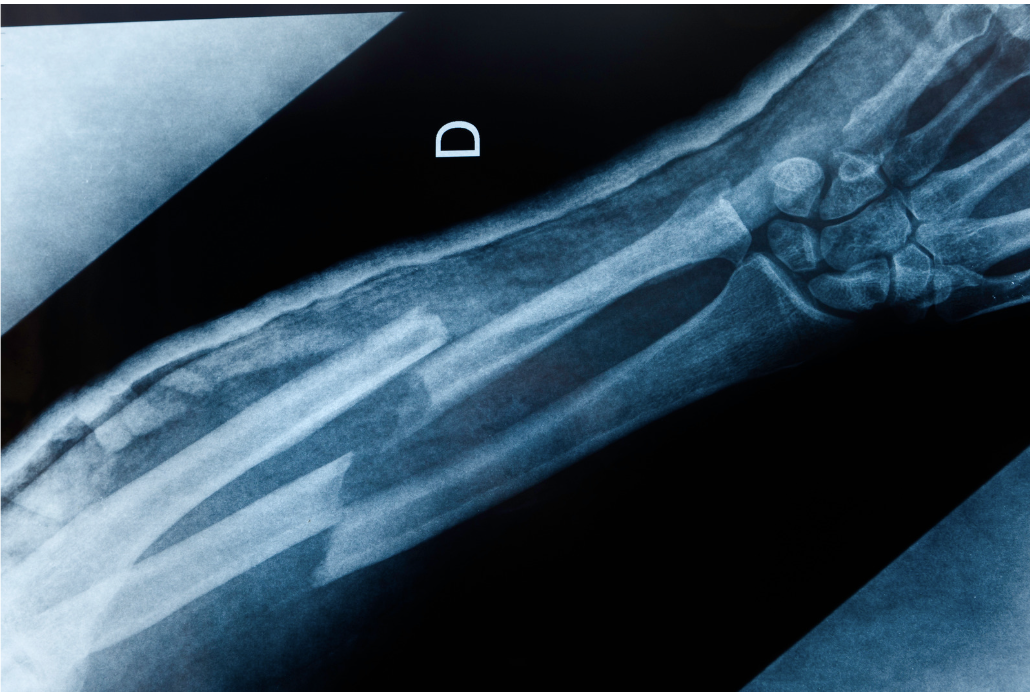
That’s the issue the researchers at the University of Oregon tackled. They created a series of small implants with sensors that can provide data in real time at the injury site to help better determine if a bone needs more resistance rehab or if it has been overworked. In a technological study, the implants “significantly improved” the healing time for broken femurs in lab rats, cutting down a healing time from four-to-six months down to as little as eight weeks.

“One of the most impactful aspects of this work is that our resistance rehabilitation could regenerate the femur to normal strength within eight weeks without biological stimulants, and we’re really excited about that,” said study leader Dr. Kylie Williams.

While monitoring their bones using the sensors, the researchers found that the rodents that were given proper physical therapy in their exercise wheels with increasing resistance to promote building strength had their femurs heal much faster and more effectively than rodents that were sedentary. This included rodents that needed their training lowered at times depending on the data retrieved from the sensors.

After seeing such positive results, campus-startup Penderia Technologies is working on perfecting the implants to a battery-free, wearable version for human patients to monitor their progress.

Recovery of any sort is a push/pull process. Depending on where you’re at, you might need to further push yourself forward, even when it isn’t comfortable. On the other hand, you might need to pull back a little bit at certain points to make sure you’re not overwhelming yourself.

Finding the balance is tricky but doable. It especially helps when you know that you’re not alone. You can also find support in your family, friends, physicians, and therapists in your life. If not those people, whatever you have experienced has been experienced before, no matter what your “broken bone” is. Whether it’s a bad habit you wish to get rid of, a new goal in your life, or a literal broken bone, it has impacted someone else that you can learn from. There are resources available to help you determine whether you need to push yourself a little harder or when to rest and recover.

Healing something that’s broken takes a combination of effort, rest, and time. That’s not just for femurs, that’s for everything.


ideas, homelessness, prodigy, social work, solutions
Photo credit: @ribalzebian on Instagram

Ribal Zebian is going to test a house he designed by living in it for a year.

Ribal Zebian, a student from the city of London in Ontario, Canada, already made headlines last year when he built an electric car out of wood and earned a $120,000 scholarship from it. Now, he's in the news again for something a little different. Concerned with homelessness in his hometown, Zebian got to work creating a different kind of affordable housing made from fiberglass material. In fact, he’s so confident in his idea that the 18-year-old plans on living in it for a year to test it out himself.

Currently an engineering student at Western University, Zebian was concerned by both the rising population of the unhoused in his community and the rising cost of housing overall. With that in mind, he conjured up a blueprint for a modular home that would help address both problems.


Zebian’s version of a modular home would be made of fiberglass panels and thermoplastic polyethylene terephthalate (PET) foam. He chose those materials because he believes they can make a sturdy dwelling in a short amount of time—specifically in just a single day.

“With fiberglass you can make extravagant molds, and you can replicate those,” Zebian told CTV News. “It can be duplicated. And for our roofing system, we’re not using the traditional truss method. We’re using actually an insulated core PET foam that supports the structure and structural integrity of the roof.”

Zebian also believes these homes don’t have to be purely utilitarian—they can also offer attractive design and customizable features to make them personal and appealing.

“Essentially, what I’m trying to do is bring a home to the public that could be built in one day, is affordable, and still carries some architecturally striking features,” he said to the London Free Press. “We don’t want to be bringing a house to Canadians that is just boxy and that not much thought was put into it.”

Beginning in May 2026, Zebian is putting his modular home prototype to the test by living inside of a unit for a full year with the hope of working out any and all kinks before approaching manufacturers.

“We want to see if we can make it through all four seasons- summer, winter, spring, and fall,” said Zebian. “But that’s not the only thing. When you live in something that long and use it, you can notice every single mistake and error, and you can optimize for the best experience.”

While Zebian knows that his modular homes aren't a long-term solution to either the homeless or housing crisis, he believes they could provide an inexpensive option to help people get the shelter they need until certain policies are reformed so the unhoused can find affordable permanent dwellings.

@hard.knock.gospel

What to buy for the homeless at the grocery store. 🛒 Most people get it wrong. After being there myself, these are the survival items that actually matter 💯 The 2nd to last one is about more than survival—it’s about DIGNITY. We are all one circumstance away from the same shoes 🙏 SAVE this for your next grocery run. 📌 IG@hardknockgospel Substack@ Outsiders_Anonymous #homelessness #helpingothers #kindness #payitforward #learnontiktok

Zebian’s proposal and experiment definitely inspires others to try to help, too. If you wish to lend a hand to the unhoused community in your area in the United States, but don’t know where to look, you can find a homeless shelter or charity near you through here. Whether it’s through volunteering or through a donation, you can help make a difference.

Joy

Man ordering steak for dog's last meal is stunned by restaurant staff’s kind response

The staff knew something was wrong when he said he didn't need any sides with the steak.

cheddar's scratch kitchen. black labrador, dogs, rainbow bridge, steak, steak house

A Cheddar's Scratch Kitchen and a black Labrador (representative image).

There are a few things that are harder than saying goodbye to a pet; it can be as difficult as losing a close friend or family member. But for some reason, many people feel that they are not supposed to grieve as deeply for the loss of a pet as they do for a human. That’s why the kindness shown by the staff at Cheddar’s Scratch Kitchen in Saint Joseph, Missouri, is so extraordinary.

CousinHomer, a country musician in Missouri, was faced with the terrible decision to put down his 13-year-old dog, Bella, so he wanted her last meal to be something truly special: a “big, juicy steak.” The staff at the restaurant asked him what he wanted for sides, and CousinHomer said he just wanted the steak. “They told me it would be the same price with or without them, so I might as well get them. I explained to them that I was having my dog, Bella, put to sleep later that day, and I wanted her last meal to be a nice, juicy steak,” CousinHomer said in his video.


@clevelandclinic

Five-finger breathing is a simple but powerful breathing technique that induces deep relaxation — and you can do just about anywhere! 🖐️ Unlike other types of breathwork, five-finger breathing is a multisensory experience where you concentrate on more than just your breath. You also focus on the movement and sensation of one hand touching another, slowly and with intentionality. This helps your brain enter a state of deep relaxation, which causes it to release endorphins.

An incredible act of kindness

“When I showed up at the restaurant about 30 minutes later to pick up her food, the manager handed me the bag of food and said, ‘We are so sorry about your dog. This meal is on us.’ I really couldn't believe it. It was so nice of them,” CousinHomer said. However, when he got home, he saw that they had done something even more special: the entire staff had signed a card that read: "Our deepest sympathy in the loss of your best friend. She'll be waiting for you over the Rainbow Bridge."


“So I just want to publicly say, thank you, Cheddar's, for being so kind and thoughtful. It really meant the world to me,” CousinHomer concluded his video. But that wasn’t the end of the story. CousinHomer asked people to tag Cheddar’s in the post, so they know how many saw their act of kindness. Cheddar’s followed up with another act of kindness, which CousinHomer documented in a follow-up video.

@cousinhomer

CHEDDAR’S Restaurant Did It AGAIN. Wow!! (A Must See). #cheddars #cheddarsscratchkitchen #rainbowbridge #steakdinner #compassion @Cheddar’s

After Cheddar’s was flooded with people tagging them in the story, they sent CousinHomer a branded fleece that he can wear like a snuggie. “May comfort wrap around you like a warm Honey Butter Croissant. Your Cheddar’s family is here for you, Cousin,” the company wrote in the comments.

Why the loss of a pet hurts so much

Losing a pet can be just as hard as losing a human loved one, but there is one thing that's uniquely painful about putting down a pet. No matter how much we know we made the right decision, it still won’t stop us from ruminating over it.

“You do that because emotional pain hurts just like physical pain. And we are hard-wired to recognize pain as a teacher,” Sarah Hoggan, a pet loss grief advocate, said in a TED Talk. “Our body has reflexes that will pull our hand off a hot stove. We have pulled ourselves to safety even before we know the burn has occurred. Unfortunately, no such instant rescue mechanism exists for emotional pain. That means we need to study the events that led to the pain, to try to learn something from it and avoid it in the future.”

Ultimately, CousinHomer is going to be in a period of grief for quite a while, but it’s nice to know that there are a whole lot of people who recognized his pain and let him know that it was completely warranted to need some love after the death of a pet. At a moment when you have to make an incredibly difficult decision, having people understand your pain can make all the difference.

- YouTubeyoutu.be

This article originally appeared last year
kids, school, school days, school week, schedule, 4 day week
Unsplash

Many school districts are moving to a 4-day week, but there are pros and cons to the approach.

American kids have fewer school days than most other major countries as it is, which poses a big challenge for families with two working parents. In a system designed for the "classic" stay-at-home mom model, it's difficult for many modern families to cover childcare and fulfill their work obligations during the many, many holidays and extra days off American children receive in school.

Some school districts, in fact, are ready to take things one step further with even fewer instructional days: for better or for worse.


Whitney Independent School District in Texas recently made news when it decided to enact a four-day week heading into the 2025 school year. That makes it one of dozens of school districts in Texas to make the change and over 900 nationally.

The thought of having the kids home from school EVERY Friday or Monday makes many parents break out in stress hives, but this four-day school week movement isn't designed to give parents a headache. It's meant to lure teachers back to work.

Yes, teachers are leaving the profession in droves and young graduates don't seem eager to replace them. Why? For starters, the pay is bad—but that's just the beginning. Teachers are burnt out, undermined and criticized relentlessly, held hostage by standardized testing, and more. It can be a grueling, demoralizing, and thankless job. The love and passion they have for shaping the youth of tomorrow can only take you so far when you feel like you're constantly getting the short end of the stick.

School districts want to pay their teachers more, in theory, but their hands are often tied. So, they're getting creative to recruit the next generation of teachers into their schools—starting with an extra day off for planning, catch-up, or family time every week.

Teachers in four-day districts often love the new schedule. Kids love it (obviously). It's the parents who, as a whole, aren't super thrilled.

- YouTube www.youtube.com

So far, the data shows that the truncated schedule perk is working. In these districts, job applications for teachers are up, retirements are down, and teachers are reporting better mental well-being. That's great news!

But these positive developments may be coming at the price of the working parents in the communities. Most early adopters of the four-day week have been rural communities with a high prevalence of stay-at-home parents. As the idea starts to take hold in other parts of the country, it's getting more pushback. Discussions on Reddit, Facebook, and other social media platforms are overrun with debate on how this is all going to shake up. Some parents, to be fair, like the idea! If they stay-at-home or have a lot of flexibility, they see it as an opportunity for more family time. But many are feeling anxious. Here's what's got those parents worried:

The effect on students' achievement is still unclear.

The execution of the four-day week varies from district to district. Some schools extend the length of each of the four days, making the total instructional time the same. That makes for a really long day, and some teachers say the students are tired and more unruly by the late afternoon. Some districts are just going with less instruction time overall, which has parents concerned that their kids might fall behind.

A study of schools in Iowa that had reduced instructional days found that five-days-a-week students performed better, on average.

Four-day school weeks put parents in a childcare bind.

Having two working parents is becoming more common and necessary with the high cost of living. Of course—"school isn't daycare!" But it is the safe, reliable, and educational place we send our kids while we we work.

Families with money and resources may be able to enroll their kids in more academics, extracurriculars, sports, or childcare, but a lot of normal families won't be able to afford that cost. Some schools running a four-day week offer a paid childcare option for the day off, but that's an added expense and for families with multiple kids in the school system, it's just not possible.

kids, school, school days, school week, schedule, 4 day week In a 4-day model, kids often (but not always) receive less instructional time. Photo by Ivan Aleksic on Unsplash

This will inevitably end with some kids getting way more screentime.

With most parents still working five-day weeks, and the cost of extra activities or childcare too high, a lot of kids are going to end up sitting around on the couch with their iPad on those days off. Adding another several hours of it to a child's week seems less than ideal according to expert recommendations.

Of course there are other options other than paid childcare and iPads. There are play dates, there's getting help from family and friends. All of these options are an enormous amount of work to arrange for parents who are already at capacity.

Working four days is definitely a win for teachers that makes the job more appealing. But it doesn't address the systemic issues that are driving them to quit, retire early, or give up their dreams of teaching all together.

@5th_with_ms.y

Replying to @emory here are my thoughts on my 4day work week as a teacher✨ #foryou #fyp #fypシ #foryoupage #foryoupageofficiall #teachersoftiktokfyp #teachersoftiktok #teachertok #teachersbelike #teachertiktok #tik #tiktok #viralllllll #teachertoks #teaching #teacher #tok #viralvideo #teacherlife #viral #trendy #teacher #teaching #worklifebalance #worklife #publicschool #publiceducation #school #student

A Commissioner of Education from Missouri calls truncated schedules a "band-aid solution with diminishing returns." Having an extra planning day won't stop teachers from getting scapegoated by politicians or held to impossible curriculum standards, it won't keep them from having to buy their own supplies or deal with ever-worsening student behavior.

Some teachers and other experts have suggested having a modified five-day school week, where one of the days gets set aside as a teacher planning day while students are still on-site participating in clubs, music, art—you know, all the stuff that's been getting cut in recent years. Something like that could work in some places.

In any case, the debate over a shortened school week is not going away any time soon. More districts across the country are doing their research in preparation for potentially making the switch.

Many parents don't theoretically mind the idea of their busy kids having an extra day off to unwind, pursue hobbies, see friends, catch up on projects, or spend time as a family. They're also usually in favor of anything that takes pressure off of overworked teachers. But until we adopt a four-day work week as the standard, the four-day school week is always going to feel a little out of place.

This article originally appeared in February. It has been updated.

flags, countries, world, patriotism, nationalism

What's the difference between patriotism and nationalism?

Patriotism can feel like a loaded term sometimes, as the meaning can range in people's minds from a basic love of country to a fierce loyalty one is willing to die for. What constitutes "country" can also impact how we perceive of patriotism, as there's a difference between the land, the people, the ideals, and the current government.

And then there's nationalism, which may sound like the same thing but isn't. So what's the difference? Episcopal priest Joseph Yoo shared his thoughts on what separates patriotism from nationalism, and people are appreciating having the key differences laid out so clearly.


@joseph.yoo

Nationalism vs. Patriotism #yourEpiscoPal #YourKoreanFather #nationalism #patriotism #LanguageLearning

"Patriotism is love," Yoo begins. "It's gratitude. It's saying, 'I care about my country enough to tell the truth about it, to celebrate what's good and work to fix what's broken."

"Nationalism, that's idolatry," he continues. "It says my nation is the nation above critique, above others, God's favorite. And once you slap God's seal of approval on your own flag, congratulations, you've just made your country a 'golden calf.'"

He explained the patriotism results in activism like that of John Lewis crossing the Edmund Pettus Bridge to demand that the country live up to its professed ideals. Nationalism results in tragedies like the January 6th invasion of the Capitol, where Confederate flags and crosses were seen in the same mob.

"Patriotism says, 'I love my family enough to admit when we've messed up, and I will help us grow," Yoo says." Nationalism says, 'My family is perfect, everyone else is trash, and if you disagree you are out."

"One is honest love. The other is toxic possession," he says. "One builds. One bullies."

Yoo concluded with a biblical point: "Jesus never called us to worship a flag, only to love our neighbor."

It's important to differentiate between patriotism and nationalism because the latter has become a bit of a lightning rod in the political discourse. Some use it as a pejorative term, while others have embraced it as something totally acceptable or even positive. When the definitions are muddied, it causes confusion.

American flags, united states, america, patriotism, nationalism Flags can be a symbol of both patriotism and nationalism.Photo credit: Canva

Of course, Yoo is not the sole authority on what these words mean, but his thoughts are aligned with what the neutral arbiters of definitions say they mean.

Dictionary.com has an entire page discussing the terms, defining patriotism as "devoted love, support, and defense of one’s country; national loyalty,” and nationalism as "the policy or doctrine of asserting the interests of one’s own nation viewed as separate from the interests of other nations or the common interests of all nations," ultimately leading to how the two words are used:

"Patriotism generally has a positive connotation. It’s used for various positive sentiments, attitudes, and actions involving loving one’s country and serving the great good of all its people.

Nationalism generally has a negative connotation. It’s used for political ideologies and movements that a more extreme and exclusionary love of one’s country—at the expense of foreigners, immigrants, and even people in a country who aren’t believed to belong in some way, often racial and religious grounds."

flags, countries, world, patriotism, nationalism Love of one's country is nice. But there's a difference between patriotism and nationalism. Photo credit: Canva

Britannica also has a whole page about the two words, with this basic synopsis of the differences:

"Patriotism is a feeling of attachment and commitment to a country, nation, or political community, and its conception has roots tracing back to Greek and Roman antiquity. It is associated with the love of law and common liberty, the search for the common good, and the duty to behave justly toward one’s country. Nationalism, on the other hand, is a more modern ideology that emerged in the 18th century, focusing on the individual’s loyalty and devotion to the nation-state, often surpassing other individual or group interests."

And then there are some famous takes on patriotism:

“I love America more than any other country in the world and, exactly for this reason, I insist on the right to criticize her perpetually.”
― James Baldwin

“Patriotism is supporting your country all the time and your government when it deserves it.”
― Mark Twain

mark twain, author, patriotism, nationalism, democracy Mark Twain had quite a bit to say about patriotism. Giphy

“Patriotism means to stand by the country. It does not mean to stand by the president or any other public official, save exactly to the degree in which he himself stands by the country. It is patriotic to support him insofar as he efficiently serves the country. It is unpatriotic not to oppose him to the exact extent that by inefficiency or otherwise he fails in his duty to stand by the country. In either event, it is unpatriotic not to tell the truth, whether about the president or anyone else.”
― Theodore Roosevelt

“The difference between patriotism and nationalism is that the patriot is proud of his country for what it does, and the nationalist is proud of his country no matter what it does; the first attitude creates a feeling of responsibility, but the second a feeling of blind arrogance that leads to war.”

― Sydney J. Harris

There's nothing wrong with loving your country, but anything taken to excess and exclusion isn't healthy. Nationalism is excessive and exclusive in its very nature, and while patriotism can be weaponized, when kept in check it's what keeps people striving to make their homelands the best that they can be for everyone who lives there.

This article originally appeared last year

Gen Alpha; Gen Z; millennials; life in 80s; 80s life; 1980s; Oregon trail generation

Teacher asks 7th graders about the 80s. Their answers have us howling.

Gen Zers joke that their parents were born in the 1900s as a way to teasingly make it seem like their parents are much older than they actually are. But the kids coming up behind them are either really good at sarcasm or they actually believe the 80s were more like the 1780s. A 7th grade teacher asked her class full of Gen Alphas what they thought the worst part of the 80s was, and no one was prepared for their answers.

When most people think about the 80s, they think of big hair teased and sprayed to the gods. Bright colors, roller skates, and people walking around with giant boomboxes on their shoulders (as if everyone wanted to hear their music choices) are also at the top of the list for things that represent the 80s. But when thinking of the worst part of that decade, the lack of things like GPS, cell phones, and search engines would probably be at the top of that list.


Gen Alpha; Gen Z; millennials; life in 80s; 80s life; 1980s; Oregon trail generation Retro vibes with bold colors and music! 🎶✨ #80sFashionPhoto credit: Canva

Gen Alpha has other ideas about the worst part of the 80s. If you lived through that decade, you may want to remove your hat so you can scratch your head. The teacher who goes by Meliciousmo on social media recently uploaded the prompt and her students' answers on TikTok, giving viewers a chuckle.

One kid answers the prompt with, "No electricity. No good food." It's starting out pretty questionably, but let's give him the benefit of the doubt by assuming his family watches a lot of Little House on the Prairie and his centuries are mixed up. The next kid's response will probably nail it.

Well, maybe not. Through a few spelling errors, the response explains that the worst part about the 80s is that they didn't have cars. Yes, this sweet summer child surmised that life was tough because cars didn't exist, so walking everywhere or riding a horse and buggy was imperative. Obviously, this is false, because there were cars in the 80s. They had seatbelts in them for decoration, and kids would slide across the backseat when their dad turned a corner too fast as their mom reflexively extended a stiff arm to stop them from flying out of the car.

Gen Alpha; Gen Z; millennials; life in 80s; 80s life; 1980s; Oregon trail generation Confused expression with a questioning gesture.Photo credit: Canva

Clearly, some of the students were exposed to either 80s movies or TV shows because a couple of answers were spot on. One student wrote that running out of hairspray was the worst thing about the 80s, while another said, "People listening to other people's phone calls." Yikes. They're right. There were no cell phones, so there were no Bluetooth devices, so everyone was privy to your private conversation. Another child said nothing was bad about the 80s because "they had cool clothes, music, people, and hair." Those are big facts, kid.

But other suggestions included having to walk through rivers because of the lack of buses, or the worst part of the 80s: the Cold War.

@meliciousmo Every Friday I ask my students a fun question. This was today’s with some of their responses. 🤦🏼♀️#teachersoftiktok #funnyanswers #genx #middleschool ♬ Don't Stop Believin' (2024 Remaster) - Journey

One person writes, "There’s[sic] like 3 kids who know the 1980s are not the same as the 1780s. LOL."

Another laughs, "Gosh I’m still tired from walking through all the rivers to school."

Someone else thinks the generational gap between parents has something to do with it, "Some of these are spot on…some think we’re over 100 years old! You can tell who has Gen X parents and who has Millennial parents!"

Gen Alpha; Gen Z; millennials; life in 80s; 80s life; 1980s; Oregon trail generation Students eagerly participate in a classroom discussion.Photo credit: Canva

Book It pizza party anyone? (Or was that the 90s?) Either way, someone is proposing that iconic classic, writing, "Ok so some good ones, shoulder pads, people listening in to phone calls and hair spary[sic] are all legit. Give those kids a classic 80s pizza paety[sic]!! As for WW2, no tv, cars, and the great depression. Well those kids need a new history book lol."

Another person adds a pressure that only those who were adults in the 80s could appreciate, saying, "I didn't even grow up in the 80s and I KNOW it was writing a check at the grocery store with four people behind you and the person behind you had a full belt. The pressure must have been CRIPPLING."

This article originally appeared last year