Parents are sharing hilarious before and after pictures of their kids’ first day of school
Since the advent of social media, parents all over the country have shared photos of their fresh-faced offspring all primped and prepped for their first day of school. Frequently, we get to see smiling kids hold a sign noting their grade, usually on the family front porch, and nearly always toting the obligatory backpack. In…
Since the advent of social media, parents all over the country have shared photos of their fresh-faced offspring all primped and prepped for their first day of school. Frequently, we get to see smiling kids hold a sign noting their grade, usually on the family front porch, and nearly always toting the obligatory backpack.
In response, we all “Like” the photos and post comments about how fast time flies and how quickly kids grow up. It’s all very cute and sweet.
But what we rarely get to see is what the rest of that first day looks like for those kids. And when we do, the photos are truly worth a thousand words.
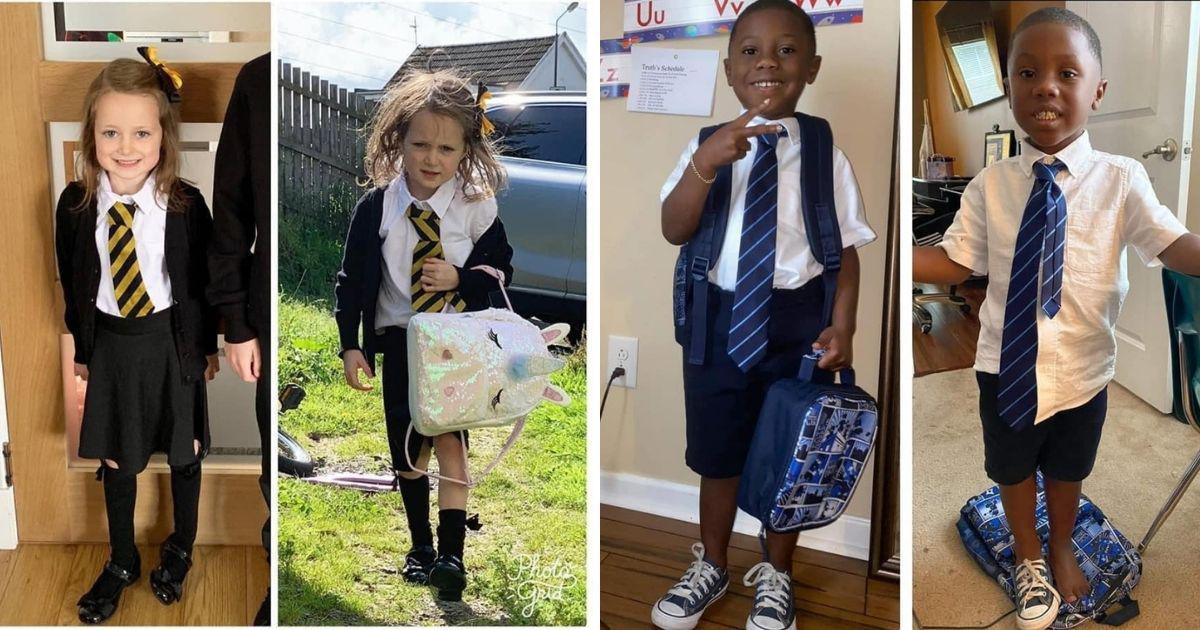
The Inspirational Quotes Page on Facebook shared a collection of before and after pics on kids’ first days of school, and oh my, these babies look like they had a heck of a day.
Some of these kiddos look like they survived a natural disaster on their first day of school.
This kid just looks stunned after his first day of kindy.
Photo after photo of perfectly coiffed hair-dos totally undone by the day.
Umm, what the hole? You know there’s got to be a story here.
And here. It’s like the Hunger Games out there, friends.
It’s not just the kids, either. Imagine how teachers feel at the end of the first day. (I can speak from experience here—teachers are frigging superheroes. It’s a rewarding job, but it’s physically and mentally exhausting.)
Especially considering the challenge of living and trying to educate children through a global pandemic, it’s not surprising to see these before and after photos of the first day of school.
The after photos don’t negate the excitement of starting a new school year, of course, and let’s hope that most of these kids look so disheveled because they had so much fun and activity during their day. The images are a refreshing reminder that social media images don’t tell the whole story, though, and that kids’ lives aren’t as simple as we often mistake them to be.
We feel you, wee ones, because we’re draggin’ too. Solidarity.
In a small village in Pwani, a district on Tanzania’s coast, a massive dance party is coming to a close. For the past two hours, locals have paraded through the village streets, singing and beating ngombe drums; now, in a large clearing, a woman named Sheilla motions for everyone to sit facing a large projector screen. A film premiere is about to begin.
It’s an unusual way to kick off a film about gender bias, inequality, early marriage, and other barriers that prevent girls from accessing education in Tanzania. But in Pwani and beyond, local organizations supported by Malala Fund and funded by Pura are finding creative, culturally relevant ways like this one to capture people’s interest.
The film ends and Sheilla, the Communications and Partnership Lead for Media for Development and Advocacy (MEDEA), stands in front of the crowd once again, asking the audience to reflect: What did you think about the film? How did it relate to your own experience? What can we learn?
Sheilla explains that, once the community sees the film, “It brings out conversations within themselves, reflective conversations.” The resonance and immediate action create a ripple effect of change.
MEDEA Screening Audience in Tanzania. Captured by James Roh for Pura
Across Tanzania, gender-based violence often forces adolescent girls out of the classroom. This and other barriers — including child marriage, poverty, conflict, and discrimination — prevent girls from completing their education around the world.
Sheilla and her team are using film and radio programs to address the challenges girls face in their communities. MEDEA’s ultimate goal is to affirm education as a fundamental right for everyone, and to ensure that every member of a community understands how girls’ education contributes to a stronger whole and how to be an ally for their sisters, daughters, granddaughters, friends, nieces, and girlfriends.
Sheilla’s story is one of many that inspired Heart on Fire, a new fragrance from the Pura x Malala Fund Collection that blends the warm, earthy spices of Tanzania with a playful, joyful twist. Here’s how Pura is using scent as a tool to connect the world and inspire action.
A partnership focused on local impact, on a global mission
Pura, a fragrance company that recognizes education as both freedom and a human right, has partnered with Malala Fund since 2022. In order to defend every girl’s right to access and complete 12 years of education, Malala Fund partners with local organizations in countries where the educational barriers are the greatest. They invest in locally-led solutions because they know that those who are closest to the problems are best equipped to solve and build durable solutions, like MEDEA, which works with communities to challenge discrimination against girls and change beliefs about their education.
But local initiatives can thrive and scale more powerfully with global support, which is why Pura is using their own superpower, the power of scent, to connect people around the world with the women and girls in these local communities.
The Pura x Malala Fund Collection incorporates ingredients naturally found in Tanzania, Nigeria, Pakistan, and Brazil: countries where Malala Fund operates to address systemic education barriers. Eight percent of net revenue from the Pura x Malala Fund Collection will be donated to Malala Fund directly, but beyond financial support, the Collection is also a love letter to each unique community, blending notes like lemon, jasmine, cedarwood, and clove to transport people, ignite their senses, and help them draw inspiration and hope from the global movement for girls’ education. Through scent, people can connect to the courage, joy, and tenacity of girls and local leaders, all while uniting in a shared commitment to education: the belief that supporting girls’ rights in one community benefits all of us, everywhere.
You’ve already met Sheilla. Now see how Naiara and Mama Habiba are building unique solutions to ensure every girl can learn freely and dare to dream.
Naiara Leite is reimagining what’s possible in Brazil
Julia with Odara in Brazil. Captured by Luisa Dorr for Pura
In Brazil, where pear trees and coconut plantations cover the Northeastern Coast, girls like ten-year-old Julia experience a different kind of educational barrier than girls in Tanzania. Too often, racial discrimination contributes to high dropout rates among Black, quilombola and Indigenous girls in the country.
“In the logic of Brazilian society, Black people don’t need to study,” says Naiara Leite, Executive Coordinator of Odara, a women-led organization and Malala Fund partner. Bahia, the state where Odara is based, was once one of the largest slave-receiving territories in the Americas, and because of that history, deeply-ingrained, anti-Black prejudice is still widespread. “Our role and the image constructed around us is one of manual labor,” Naiara says.
But education can change that. In 2020, with assistance from a Malala Fund grant, Odara launched its first initiative for improving school completion rates among Black, quilombola, and Indigenous girls: “Ayomidê Odara”. The young girls mentored under the program, including Julia, are known as the Ayomidês. And like the Pura x Malala Fund Collection’s Brazil: Breath of Courage scent, the Ayomidês are fierce, determined, and bursting with energy.
Ayomidês with Odara in Brazil. Captured by Luisa Dorr for Pura
Ayomidês take part in weekly educational sessions where they explore subjects like education and ethnic-racial relations. The girls are encouraged to find their own voices by producing Instagram lives, social media videos, and by participating in public panels. Already, the Ayomidês are rewriting the narrative on what’s possible for Afro-Brazilian girls to achieve. One of the earliest Ayomidês, a young woman named Debora, is now a communications intern. Another former Ayomidê, Francine, works at UNICEF, helping train the next generation of adolescent leaders. And Julia has already set her sights on becoming a math teacher or a model.
“These are generations of Black women who did not have access to a school,” Naiara says. “These are generations of Black women robbed daily of their dreams. And we’re telling them that they could be the generation in their family to write a new story.”
Mama Habiba is reframing the conversation in Nigeria
Centre for Girls' Education, Nigeria. Captured by James Roh for Pura
In Mama Habiba’s home country of Nigeria, the scents of starfruit, ylang ylang and pineapple, all incorporated into the Pura x Malala Collection’s “Nigeria: Hope for Tomorrow,” can be found throughout the vibrant markets. Like these native scents, Mama Habiba says that the Nigerian girls are also bright and passionate, but too often they are forced to leave school long before their potential fully blooms.
“Some of these schools are very far, and there is an issue of quality, too,” Mama Habiba says. “Most parents find out when their children are in school, the girls are not learning. So why allow them to continue?”
When girls drop out of secondary school, marriage is often the alternative. In Nigeria, one in three girls is married before the age of 18. When this happens, girls are unable to fulfill their potential, and their families and communities lose out on the social, health and economic benefits.
Completing secondary school delays marriage, and according to UNESCO, educated girls become women who raise healthier children, lift their families out of poverty and contribute to more peaceful, resilient communities.
Centre for Girls’ Education, Nigeria. Captured by James Roh for Pura
To encourage young girls to stay in school, the Centre for Girls’ Education, a nonprofit in Nigeria founded by Mama Habiba and supported by Malala Fund and Pura, has pioneered an initiative that’s similar to the Ayomidê workshops in Brazil: safe spaces. Here, girls meet regularly to learn literacy, numeracy, and other issues like reproductive health. These safe spaces also provide an opportunity for the girls to role-play and learn to advocate for themselves, develop their self-image, and practice conversations with others about their values, education being one of them. In safe spaces, Mama Habiba says, girls start to understand “who she is, and that she is a girl who has value. She has the right to negotiate with her parents on what she really feels or wants.”
“When girls are educated, they can unlock so many opportunities,” Mama Habiba says. “It will help the economy of the country. It will boost so many opportunities for the country. If they are given the opportunity, I think the sky is not the limit. It is the starting point for every girl.”
From parades, film screenings to safe spaces and educational programs, girls and local leaders are working hard to strengthen the quality, safety and accessibility of education and overcome systemic challenges. They are encouraging courageous behavior and reminding us all that education is freedom.
Experience the Pura x Malala Fund Collection here, and connect with the stories of real girls leading change across the globe.
She had been on the job for four months when she was pulled without warning into a meeting with her manager, HR, and legal. Effective immediately, she was fired. The reason given: she took ten minutes to respond to emails.
“That was a bullsh*t reason,” she wrote in a post to Reddit’s r/MaliciousCompliance that has since racked up more than 19,000 upvotes. “To be honest, I was furious.”
The job itself had never been easy. She’d been hired as a speaker coordinator for a company that planned large conferences, and from the start, as she described it to Bored Panda, there was no onboarding, no training, and no clear point of contact. “I was simply given the log-in info for a couple of different websites and told to get to work.” She was the only person in the role. All the institutional knowledge about speakers, schedules, and upcoming events lived entirely with her.
Audience listening to a speaker at a conference. Photo credit: Canva
Her manager spoke limited English, which made communication difficult in ways that weren’t anyone’s fault but created real problems. When she once asked her manager for a call to clarify something, the response came back: “No cranne. Self skills is a must. I am bird without head.” It took her several days to piece together that her manager was trying to say she was overwhelmed and needed her employee to be more self-sufficient.
She adapted, figured things out, and by her own account, kept the speakers happy. Then came the meeting, the firing, and the reason that didn’t add up. Ten minutes to reply to an email. No written warning. No verbal warning. Nothing.
During the exit interview, HR asked her to hand over her files and walk them through where things stood with an upcoming event scheduled in 17 days. She reached into her bag and pulled out her copy of the NDA she’d signed when she started.
As she told it on Reddit, she pointed to a specific clause: as a former employer, they were now prohibited from receiving confidential information about the position under the terms of the very agreement they’d had her sign. “As per my NDA, I am not to discuss intimate details or share documents relating to this position with any employer, past or future. Since this firing was effective immediately, you are now a former employer and I am bound by my NDA.”
A non-disclosure agreement (NDA). Photo credit: Canva
HR pushed back. She held firm. Legal was brought in. Legal read the clause and confirmed she was correct.
The event, by her account, was a disaster. More than half the speakers pulled out once communication broke down. Her former manager nearly lost her job over it. The employee, for her part, closed her Reddit post with the mocking subject line that had gotten her fired in the first place: “All because I ~tAKe ToO lONg tO ResPoND tO EMaILS~”
The story resonated because it captures something many workers recognize: the particular frustration of being let go without cause, without warning, and without recourse, and the rare satisfaction of finding that the company had, in this case, handed her exactly the recourse she needed. Save your contracts. Read the fine print. Sometimes the NDA works both ways.
This article originally appeared earlier this year.
For nearly four decades, a retired art teacher had been turning her rental house into something extraordinary. Every wall inside held hand-painted murals, Disney movies and fairy tales rendered floor to ceiling, the kind of place that people in the neighborhood knew by reputation. Outside, she’d added a cottage facade. Inside, it was unlike anything else on the street.
She had no lease. The original landlord had given her a verbal agreement that the art on the walls wouldn’t be a problem, and she’d been there since the mid-1980s with an informal understanding that the house might one day be hers.
Then the original landlord died. His son inherited the property, came to inspect it with his daughter, and they fell in love with what they saw. According to a post shared to Reddit’s r/pettyrevenge by a neighbor, u/ZZZ-Top, the family decided the art house should go to the daughter. Without a lease, the tenant had limited options. The murals she’d painted, the very thing that made the property desirable, were used as justification to push her out.
But she landed on her feet. Friends helped her find a property in another state at the last minute, one with a full art studio on the ground floor. The question of what to leave behind was where things got interesting.
She had originally planned to leave the murals intact. Then her neighbor, a friend who had been wanting to practice using a powered paint sprayer, made her an offer: he would restore the house to what he called “Rebecca standards” for free. As he explained in the post, “Rebecca standards” is neighborhood shorthand for the look of a flipped house: everything painted in the same flat white and depressing grey, every surface generic, every trace of personality gone. The landlord’s family had evicted her specifically to get the murals. Rebecca standards would make that impossible.
A woman paints a mural on a wall. Photo credit: Canva
She agreed.
Her furniture went into storage. Her neighbor let her stay in his guest house in exchange for one new mural on his living room wall. Then the work began. As the Someecards account of the story details, the painter friend sanded every wall in the house until the murals became nothing but blotchy color ghosts. Then came the Kilz primer, sprayed wall to wall. Then the grey. Wood paneling, trim, switch covers, outlet covers, counters, cabinets. All of it the same flat, lifeless shade. “The house looked dead inside when I went in to check it out,” the neighbor wrote. “It was weird not seeing all the murals.”
Outside, a landscaping friend cleared the cottage facade and the plants, replacing everything with gravel, sand, and a single boulder.
A few days after she left, the neighbor noticed the house was still empty. He asked around. Some U-Haul trucks had shown up earlier in the week, he was told, but none of them had been unloaded. Nobody had moved in.
The post drew over 38,000 upvotes and hundreds of comments from people who understood exactly what had happened. “They could have easily asked her for a commission to do the same murals in their own home,” one commenter wrote, “but chose to kick her out instead.” Another kept it simpler: “Kick me out? My art goes with me. Enjoy the blank walls.”
For anyone renting without a written lease, the story carries a quieter lesson. Verbal agreements offer almost no protection when ownership changes hands. The woman lost her home of 40 years because of a handshake arrangement with someone who was no longer alive to honor it. She found a better situation in the end, one with a proper studio and walls she actually owns. But the path there didn’t have to be that hard.
This article originally appeared earlier this year.
Every day at Waunakee High School in Wisconsin, she’d walk past classmates in the halls, people she’d known since elementary school, and they had no idea what she was doing in the corner of the school library after the final bell, or in the studio she’d set up at home. She was painting their portraits. All of them.
“It was almost kind of like evil shenanigans that were going on,” she told the NW Indiana Times. “You have no idea what I’m doing. You have no clue what I’m making.”
A high school basketball game. Photo credit: Canva
Schafer had been outgoing in elementary and middle school, but social anxiety reshaped her high school years. She drifted from her peers, found a circle of older students, and watched that circle graduate and leave while she stayed behind. “I’ve never really known anyone in my senior class,” she told hngnews.com. “And I’ve just been so alone.” One moment captured the feeling precisely: she was photographing a basketball game for Warrior Media, the school’s sports streaming channel, when she slipped and fell. Every student in the gym turned to look. Nobody asked if she was okay.
But the photography gave her something she hadn’t expected. A catalog. Thousands of shots of her classmates mid-game, mid-leap, mid-effort, faces alive with concentration and competition. When it came time for her AP Art final, she knew what she wanted to do with them.
Starting in the fall of 2024, she began painting. She’d work at school, then go home and paint for another four or five hours in the studio she’d built in her garage. She originally planned 50 portraits, reduced it to 45, and finished with 44, each one based on her own sports photography, each one a classmate she’d known once and wanted to know again. By graduation, she’d spent approximately 600 hours across all of them, as reported by CBS News in a Steve Hartman “On the Road” segment that aired in June 2025.
The paintings were portraits in the truest sense. Not posed, not generic, but specific people caught in specific moments, rendered with the kind of attention that takes months to accumulate. Each one was a gift.
“I wanted to be seen,” she told Fox47. “I wanted to reconnect with these people who I haven’t talked to in years, and I wanted to show them that even though they’ve been such a small part of my life, they’ve stuck with me.”
The reactions, when she handed them out, ranged from stunned to emotional. “It’s one of the coolest things I’ve ever seen someone do, especially for someone you aren’t that close with,” one classmate told CBS News. Another admitted: “We did have that friendship, and I didn’t put forth the work to keep it.” A third said: “All of us probably feel a little regret for not paying more attention.” Senior Brady Barman, one of the recipients, said that it simply felt good “to feel appreciated by someone else.”
Schafer’s art teacher, Beth Crook De Valdez, watched the whole project unfold. “Watching her go through that process and seeing her internal reflection about this project she came up with really fills your heart,” she said.
After the CBS segment aired, commission requests started arriving. More than 100 of them from people who had seen what she could do and wanted her to do it for them.
Schafer’s own takeaway was characteristically direct. “You can’t go through life thinking that you don’t have friends because they don’t like you, because that’s not the case,” she said. “People aren’t thinking that hard about you. It’s all in your head. You just have to try.”
She spent 600 hours proving it.
This article originally appeared earlier this year.
In early February 2024, Beyoncé rocked the music world by releasing a surprise new album of country tunes. The album, Renaissance: Act II, includes a song called “Texas Hold ‘Em,” which shot up the country charts—with a few bumps along the way—and landed Queen Bey at the No.1 spot.
As the first Black female artist to have a song hit No. 1 on Billboard’s country music charts, Beyoncé once again proved her popularity, versatility, and ability to break barriers without missing a beat. In one fell swoop, she got people who had zero interest in country music to give it a second look, forced country music fans to broaden their own ideas about what country music looks like, prompted conversations about bending and blending musical genres and styles, and gave the Internet a crash course on the Black roots of country music.
And she inspired the Gardiner Brothers to add yet another element to the mix—Irish step dance.
Michael and Matthew Gardiner are professional Irish-American step dancers and choreographers who have gained international fame with their award-winning performances. They’ve also built a following of millions on social media with videos like this one, where they dance to popular songs, usually in an outdoor environment.
People are loving the blending of genres and culture that the TikTok exemplifies.
“Never thought I’d see Irish step dancing while Beyoncé sings country,” wrote on commenter. “My life is complete. ♥️”
“So happy Beyoncé dropped this song and exposed my timeline to diversified talent ,” wrote another.
“Beyoncé brought the world together with this song ,” offered another person.
“Ayeeee Irish Dancing has entered the BeyHive chatroom… WELCOME!! ” exclaimed another.
“I don’t think I can explain how many of my interests are intersecting here,” wrote one commenter, reflecting what several others shared as well.
The Beyoncé/Gardiner Brothers combo and the reactions to it are a good reminder that none of us fit into one box of interest or identity. We’re all an eclectic mix of tastes and styles, so we can almost always find a way to connect with others over something we enjoy. What better way to be reminded of that fact than through an unexpected mashup that blends the magic of music with the delight of dance? Truly, the arts are a powerful uniting force we should utilize more often.
And for an extra bit of fun, the Gardiner Brothers also shared their bloopers from filming the video. Turns out stepping in the rain isn’t as easy as they make it look.
Gen X also had a major sweet tooth. In the ’80s, they were munching on unique candy from drugstores and corner shops. Many Gen Xers argue that candy in the ’80s was the best, including comedian Karen Morgan—whose bit about ’80s candy being “mean to children” resonated with Gen Xers on Reddit.
“We had candy like Atomic Fireballs. You couldn’t eat that! It was who could leave it in your mouth the longest before you spit it out,” she quips.
More Gen Xers shared their favorite candies from the ’80s that they miss most. Although some are still around, most don’t taste the same—and many have been discontinued.
“Soo many great memories seeing this box! I wish they would bring them back!!” — blue_eyed_girlie
“I liked getting to the sour center.” — robgrab
“Duuude remember these and loved them! There was an urban legend in my neighborhood that there was some of these that had a candy shaped dinasour inside…. Never got one! ( never made it to the cherry tree in pitfall either!) lol.” — right_bank_cafe
Mr. Bones
“I loved that candy!! I had so many coffins all over my room!” — FlawedWoman
“OMG I completely forgot about this candy! We ate it to quick to make a skeleton 😂😂.” — PaleontologistSad316
Fun Dip
“My little brother always liked the powder better so if we both got a pack of fun dip I’d give him the powder and he’d give me the candy stick. 😆” — Happy_Leg-2063
“The Lik-a-Stix from the Fun Dip. I just threw the powder away.” — non3ck
“I wish they still had the lime.” — bubblehead772
Johnny Apple Treats
“Johnny Appletreats were my favorite😋” — Longjumping-Shoe7805
“I’ve been looking everywhere for apple treats. They are like f*cking CRACK.” — truthteller5
Alexander The Grape
“Alexander!!!!!!! So good.” — cwvandalfan
“I ate all of these but probably Alexander The Grape most of all.” — Grand_Snow_2637
Cherry Clan
“I really loved the cherry clan!!!!” — McKitNassty
“Cherry Clan were the best. 🍒” — Krystalmyth
Marathon
“This is THE answer. I sure miss them.” — Beanholiostyle
“I both loved these and forgot about them. Now I have a craving for one.” —Ok_Experience_8194
“Marathon Bar (stealer of fillings).” — JCo1968
Tangy Taffy
“Best part was freezing them, then you could bang them on a table and they would shatter then you had little pieces of them to eat.” — Chewcudda42
“Tangy Taffy. So much better than Laffy Taffy IMO.” — User Unknown
Reggie!
“Ooh, those were so good…like an oversized chocolate turtle, but more savory.” — throw123454321purple
“They were awesome. Pretty much was just a round Baby Ruth but sooooo good.” — jmf0828
“Peanut Butter Oompas… they were similar to peanut butter M&Ms, but tasted better.” — Interesting-Night740
BarNone
“Bar None. Like a cross between a Twix and KitKat.” — Katriina_B
Milk Shake
“There used to be a candy bar called Milkshake. They at I remember it would have been slightly between an Uno Bar and a Three Musketeers. It has a taste of a chocolate malted milkshake. They were delicious but did not last long that I remember.” — Salt_Ingenuity_720
PB Max
“I swear when I talk to my kids about the PB max, I feel like one of those old cartoons where you’re saying ‘back in my day’ 😂 by far the best peanut butter candy bar ever.” — New-Car-3759
“These are discontinued but they were so good! Well my young mind used to think they were good lol.” — Pink_Pixie00
Atomic FireBall
“Atomic Fireballs, I used to love those things!” — AzureGriffon
“When I quit smoking, I used these to get through it. Then I had an Atomic Fireball addiction. Thankfully, that was a much easier habit to break.” — ThresherGDI
Whatchamacallit
“Whatchamacallits are my favorite candy bar, hands down. They are definitely different size wise and also the taste, but they are still pretty good. Rarely do things stay the same, but it’s especially bad when it’s your favorite candy.” — yellow_forsythia
“When Whatchamacallit first came out, it was a bar of crispy rice covered in chocolate. I LOVED it. Then they decided to ‘improve’ it by adding caramel. I didn’t like it as much anymore, but still bought it because it was still a good candy bar.” — Alman54
“🎶Whatchoo say? Whatchamacallit! 🎶 Can still remember the song from the commercial.” — demonOS_
Skor
“I had a Skor bar the other day and it just hit SO right.” — Luvsseattle
“Skor. I remember when those things came out that they positioned them as upscale candy bars. My great-grandmother loved them because they made her feel fancy.” — jimb575
Oh Henry!
“This was one of my favs in 5th grade going to the candy store after school.” — banana_fana_1234
“Oh, made my mouth water I miss those😧.” — Wuddlecat
Shakespeare is a staple of any high school English curriculum. Yet, getting young folks to actually understand, let alone appreciate, the Good Bard’s work has always been a bit of a challenge. Unless you’re teaching it to a room full of theatre kids, that is.
Recently, a high school teacher named Molly Dugan shared some of her current students’ reactions to one of Shakespeare’s most notable works, Romeo & Juliet. Spoiler alert: they weren’t fans. Nonetheless, their remarks were comedy gold.
High schoolers react to Romeo & Juliet
Some of the comments reflected the same counterpoints many younger generations have had about well-received works of yesteryear (looking at you, ’90s rom-coms).
For instance, one student said, “Romeo is hella cringe, get him off my screen.”
Meanwhile, two other students accused him of being a “hella stalker” with “bad rizz” who just “wants the huzz,” a.k.a. a girl, a woman, or, to really make it feel dated, a “boo.”
Folks in the comments didn’t really disagree with these points.
“‘Bro’s a hella stalker’ oddly accurate take😂,” one viewer wrote.
Another echoed, “Bro actually was a hella stalker and arguably was hella cringe.”
Another teacher even shared, “Directed it last year. Best response: ‘where are their parents?!’”
Distinct brand of savage high school sarcasm on full display
“Oh, so you actually hate us,” one student said, apparently after Dugan asked the class to get their notebooks out.
Another delivered a rather low blow, saying, “We don’t need subtitles. We’re not old.”
But then some genuinely baffling questions left many wondering if this generation is, in fact, “cooked”:
“Was there time back then? Like, did it exist when Romeo and Juliet were alive?”
“Is Shakespeare a real person? Because I thought he was one of those Greek gods. So I’ve been confused.”
Woof. That’s…something.
Apparently, a few other teachers have had very similar experiences
“One year I got ‘What’s Shakespeare’s last name?’” one commented.
Another shared, “At the beginning of teaching the Anne Frank unit, I asked my 8th graders what they knew about her…’Isn’t she a rap star?’ 😳”
Who knows—perhaps the kiddos would have appreciated this Gen Z–ified version of Romeo & Juliet.
Shakespeare’s work has always been a bit of a hurdle for students
His plays were written more than 400 years ago, after all, and can sometimes feel as though they’re in an entirely different language. On top of that, Shakespeare wrote in verse, using rhythm and poetic devices that were meant to be heard onstage rather than quietly analyzed in a classroom. When those lines are lifted from the stage and dropped into a worksheet or textbook, it can take a lot more effort for students to connect with what’s actually happening in the story.
Cultural references can also add another layer of confusion. Jokes, social norms, and expectations around love, family, and marriage were very different in Elizabethan England than they are today. Without that context, characters’ actions can seem strange, exaggerated, or downright problematic to modern readers.
That’s part of what makes teaching Shakespeare such a unique challenge. Teachers often have to act as translators, guiding students through unfamiliar vocabulary and historical context while also trying to reveal the very human stories beneath it all.
Once you get past the old-fashioned phrasing, the themes are surprisingly relatable
Romeo & Juliet is about power dynamics, rivalry, and impulsive decisions that spiral out of control (and love, I guess). Those ideas are still easy to recognize, even if the characters express them in dramatically poetic language. It’s what gives Shakespeare such staying power and explains why he continues to show up in classrooms century after century, much to the bemoaning of high schoolers.
Imagine you’re young and strolling through a university campus, wishing you could randomly chat with someone much older. Perhaps you’re looking for a bit of wisdom. Or maybe you simply wish to talk to a Baby Boomer, like a parent or grandparent. If you’re on the Boston University campus near Pavement Coffeehouse, this wish could become a reality.
The folks at Matter Neuroscience have created another social experiment in which they set up what look like payphones in two locations. One, outside a building on the BU campus, says “Call a Boomer.” The other is in the game room of a senior housing complex in Reno, Nevada. That one has a sign suggesting someone “Call a Zoomer.” The hope? That two generations can connect, have a lovely conversation, and spark a little dopamine in their day.
On the Matter Neuroscience Instagram page, they share the statistic that younger and older adults often suffer from loneliness: “Younger adults and older adults tend to experience the highest levels of loneliness of any age group, so the goal of this project is to inspire generational connection through meaningful conversations, despite differences in age, lifestyle, or politics.”
They report that statistically, “over a third of people over 65 report being lonely. And over half of the students in college report being lonely.” They go on to note that loneliness can be more detrimental to one’s health than lack of exercise or even smoking cigarettes.
Loneliness demographics in America. Photo credit: Matter Neuroscience
A new idea
Upworthy spoke with Calla Kessler, a social strategist at Matter Neuroscience, who explained the process:
“The boomer/zoomer payphones are the second iteration of our Party Line experiment, which originally included in San Francisco and Abilene, Texas, encouraging Democrats and Republicans to find common ground and walk away with a positive interaction.”
Kessler is referring to a project that Upworthy covered a little over a month ago. In that project, the team set up two makeshift “payphones” in Texas and California. The idea was for people on the left and right sides of the political aisle to connect without all the extraneous noise.
Ben Goldhirsh, one of the co-founders of Matter Neuroscience (alongside neuroscientist Axel Bouchon), reported that after reviewing hours of footage, people were looking to connect on a human level 100% of the time. No arguments—just two people laughing while sharing a brief moment of their lives with a total stranger.
Kessler said the success of the project inspired them to think about other demographics that would benefit from connection:
“We landed on two groups that research shows experience some of the highest levels of loneliness: younger adults and older adults. The purpose of these projects is to share the science of happiness and help people live emotionally and molecularly balanced lives.”
She reiterated how dangerous chronic loneliness can be:
“Loneliness has been linked to health risks comparable to smoking, excessive drinking, and lack of exercise. Positive social interactions can influence our biology in the opposite direction, lowering cortisol while increasing feel-good neurotransmitters like dopamine, cannabinoids, and oxytocin.”
For those wondering how the payphones work, they were bought on Facebook Marketplace. They were then deconstructed so modems with SIM cards could be placed inside, making it possible to make toll-free calls.
While they’re waiting for the results (the phones were just recently installed), people in the comment section were already excited. At the mere mention of the idea, thousands chimed in to add their two cents. One wrote, “This is so great! Can we make pen pals cool again?”
Another noted that although they don’t fall into either generation, they’d love to take part as well: “I’m not old. I’m not young. But if that phone were in my vicinity, I would be calling someone every day.”
If we look back over the last 100 years of fashion, we can see how much has changed. The 1920s were famous for loose, square-cut flapper dresses and pinstripe suits with wide-legged trousers. The ’50s saw fitted shirts, poodle skirts, and the “greaser” in his jeans, T-shirt, and leather jacket. The ’70s brought us bell-bottoms. The ’80s lit up with neon, and the ’90s grunge craze had us all in flannels.
Just hold those images in your mind real quick as we make our way back to the 1890s. Victorian-era fashion was marked by corsets, bell-shaped skirts, and three-piece suits. Against that backdrop, in 1893, The Strand Magazine published predictions of what people would wear in the coming century. And, well, you just have to see it.
The magazine feature by W. Cade Gall was called “Future Dictates of Fashion.” Gall framed his piece as a fictional story about an old man mysteriously finding a book published in 1993 called The Past Dictates of Fashion.
Fashion, according to the made-up 1993 author of the made-up book, was governed by “immutable laws.” But according to Gall, those laws were unknown in 1893, when people thought of fashion as “a whim.” By the 1940s, however, fashion would assume “the dignity of a science.” It would even be taught in universities from the 1950s onward.
Whatever those immutable laws of fashion were supposed to be, they must have been wild to explain the hilariously wrong predictions of what people would wear in the 20th century.
You still have those 1920s fashion images in your head, right? Compare them to these drawings:
The 1920s predictions were a far cry from the roaring ’20s. Photo credit: Public domain
To add to the hilarity, here’s the commentary on the skirt length in the first drawing:
“The skirt, it is true, is short enough to alarm prim contemporary dames, and it is scarcely less assuring to find in the whole of the remaining plates only three periods when it seems to have got longer.”
Imagine if they’d seen the knee-length flapper dresses of the actual 1920s, followed by the miniskirts of the ’60s. The sheer horror.
The style sketches for each decade provide laugh after laugh. What in the Shakespearean Strawberry Shortcake–Bo Peep is happening here in the 1930s?
There’s a lot going on here, and none of it looks like the actual 1930s. Photo credit: Public domain
The 1950s weren’t much better. Apparently, there was a trend toward a court-jester look in the mid-’50s?
The 1950s: Puritan clowns or Shakespearean court jesters? Photo credit: Public domain
The ’70s got a couple of things closer-ish to reality, kind of. Those collars could hint at butterfly collars, perhaps? And that 1978 outfit almost looks like bell-bottoms. Can we imagine people showing up to the disco in these digs?
At least the 1970s had bell-bottoms, sort of. Photo credit: Public domain
How about the ’80s? Do we see acid-washed jeans? Parachute pants? A preppy sweater tied around the shoulders, perhaps? Mmm, not exactly. More like The Wizard of Oz meets Alice in Wonderland.
Imagined outfits of the 1980s by a man in 1893. – Photo credit: Public Domain
If you look at what models wear on haute couture runways, you might see clothing that aligns somewhat with these sketches. But we certainly don’t see it in the daily wear of ordinary people.
Imagine showing the folks in 1893 today’s kids in hoodies and jeans. Or moms in yoga pants and cropped tees. It would blow their Victorian minds.
Of course, no one can predict the future, and Mr. Gall in 1893 didn’t have the benefit of seeing the drastic shifts in clothing that we’ve witnessed over the past several generations. It’s hard to look outside of our own experience and timeline and imagine something totally different. Could we predict the next century of fashion? Would we even dare to try?
Perhaps someone should, if only to provide some chuckles to our descendants 100 years from now.