upworthy
Add Upworthy to your Google News feed.
Google News Button
Family

Woman creates detailed list of things men 'should' be doing for their postpartum wives

This is a solid plan.

postpartum care, babies, marriage
Canva, @melissamesser/TikTok

Postpartum can be a challenging time. Extra support goes a long way

Bringing a baby into the world can be a dream come true for many women. But that bliss is quickly compromised by the physical and emotional toll caused by the postpartum phase.

During this time, when hormones are raging and focus is compromised and energy is practically nonexistent—all while trying to recover from extreme physical transformations and keeping a newborn alive—having partner support is more important than ever.

That’s what makes one woman’s detailed list of things husbands (or just the partner who didn’t not deliver the baby, really) can do to help support mom moms through postpartum such an important read.


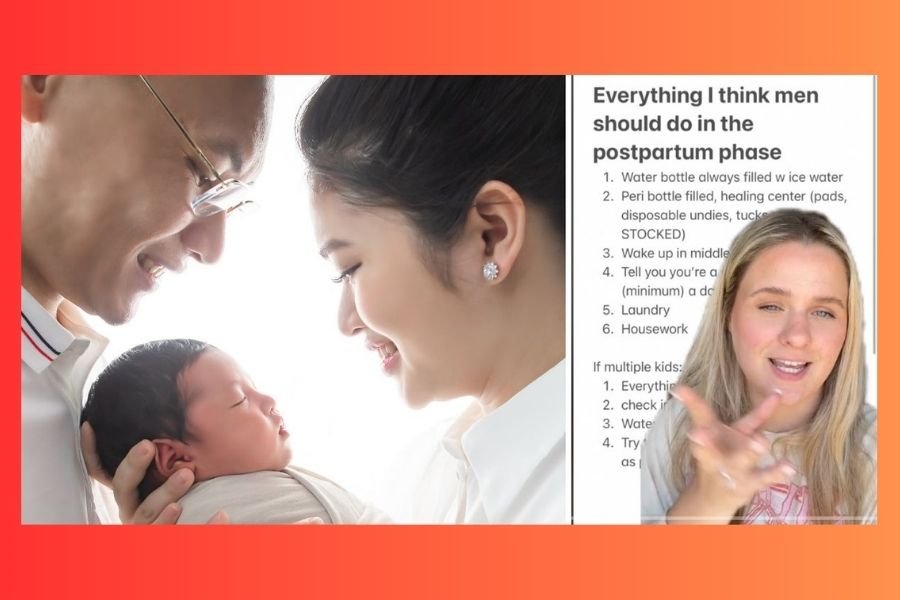
In a clip posted to her TikTok, Melissa Messer noted that her list was still the “bare minimum” of what she thinks men “should” be doing during the postpartum phase in order to really show support. But the list was comprehensive nonetheless.

To start, Messer stated that two different water bottles should be filled for mom at all times — her water bottle and her peri bottle. One for hydration, the other for comfort.
postpartum care

Have healing products stock and ready to go.

Canva

“Okay, first and arguably most important is that water bottles should always be filled with ice water. Like, don't even let it get to the point where she has to ask. Just have that thing ready. Another thing that should be filled without them having to think about is their peri bottle that they're using to heal,” she said.

And that’s not the only healing product that should be at the ready. Messer also suggested that there be a constant stockpile of pads, disposable underwear and Tucks pads. That way moms “don’t even have to think about it when they go into the bathroom.”

Since emotional support is also part of the job, Messer gave a tip for what to do during late night feedings, which can be “lonely” for their postpartum partner.

“I know, at night, it's like, ‘What can I do? Like I can't feed the baby if she's breastfeeding.’ Wake up in the middle of the night for moral support, you know?” she suggested, which brought her into her next point: “Tell her she's a good mom, at least three times a day minimum.”

Next up: domestic chores, like laundry, housework, changing diapers, etc., so that mom can “shower and nap.” though Messer noted that “that's kind of like a given,” especially if this is the couple’s first child.

For families that already do have kids, Messer said that responsibilities might change a bit, and might require more attention towards the older kids.

“You should be doing everything with the other kids. Checking in and asking if mom needs anything, even though you're with the other kids the whole time,” she explained.

She also added that with multiple kids the house is more likely to be messy, but it should never get “completely overwhelming.”

Last but certainly not least, Messer encouraged husbands to be “extra nice” to their wives, and even get them a “special treat” from time to time. Because “there is so much that moms are going through that guys are never gonna experience.”

@melissmesser Clearly i feel strongly about the water bottle LMAO #greenscreen #momsoftiktok #POSTPARTUM #postpartumrecovery #postpartumjourney #pregnancytiktok #pregnancy #postpartumlife #postpartumsupport #postpartumbody #postpartum ♬ original sound - Melissa

Over in the comments, viewers added some other tips to the list, like managing the meals and buying a bottle warmer for peri bottle, so it can be used instantly.

Others chimed in to praise their current hubbies who already showed up in big ways.

“I see these lists and immediately feel so grateful I got a good one!” one mom wrote.

Another added “I am so emotional right now listening to those knowing I got a good one.”

Postpartum is rarely a walk in the park—for either mom or dad. But just like any other challenge, it can be so much easier to navigate through partnership. And it doesn't hurt to review where you can be a more supportive partner, even if you are already doing a ton of things right. Seeing things simplified into a list just like this one is an easy way to do that.


34 broken bones, a mural, and Buddy the Elf—what these three things have in common
True

The Bank of America Chicago Marathon took place on Sunday, October 12th. Every runner who took on the enormous feat of 26.2 miles is truly an inspiration. We’re proud to share three outstanding stories about the power of community, giving back and crossing the finish line. Not only did they run an outstanding distance, but they each also gave back by fundraising for an organization that changes lives for the better.

Running a marathon is so much more than race day. It’s sticking to a schedule, getting enough rest, learning how to fuel your body for long distances, and—perhaps the most challenging of all—building mental resilience.


Meet Leanne: Running after 34 Bone Fractures

Leanne was only 12 years old when during her middle school cross country practice, she fractured her right tibia, the shin bone in her leg. This wasn’t Leanne’s first time breaking a bone—it was actually her 34th fracture. After many years of being overlooked as "clumsy," Leanne felt immense relief and recognition when a doctor diagnosed her with brittle bone disease, an incredibly rare condition.

Lurie Children’s provided a care plan for Leanne to build strength and start running again. And as of October 12th, Leanne ran her second Bank of America Chicago Marathon. She said in an interview, “I never thought I’d run again. But against the odds, here I am, training for my second Bank of America Chicago Marathon... all because of Lurie Children’s.”

Leanne’s impressive journey is a testament to the incredible research of Lurie Children’s, where she gives back by volunteering at the hospital and running on its behalf. Talk about being a true inspiration.


Meet Everett: Running to Inspire Through Art

Everett is an artist who creates beautiful murals around the city of Chicago. He uses his art as a tool for storytelling for community and connection.

In addition to being an artist, Everett is a runner. He ran the 2025 Bank of America Chicago Marathon on behalf of Peace Runners 773, a non-profit organization that strengthens the community of Chicago. In this video, we follow Everett on a run to visit some of his favorite murals. The run ends at Garfield Park, where Everett just finished a mural that he dedicated to the organization—symbolizing growth, strength and togetherness. Everett didn’t stop there.

While building his strength as a runner, Everett is strengthening his city of Chicago. Through his running and artwork, Everett has brought more awareness and resources to his community.

Meet Joseph: Running on Behalf of Special Olympics


Joseph ran the Chicago Marathon on behalf of Special Olympics, dedicating each mile to one of 26 friends with a developmental disability. The last 1.2 miles were extra special. It was for one of his closest friends, Matt.

In this video, Joseph runs to Matt’s house. For every mile of this training run, he tells us a heartwarming anecdote about Matt. They met at camp and soon, Matt will be a groomsman in Joseph’s wedding. The duo even sends a Christmas card every year—most notably dressing up as Buddy the Elf and sharing a bowl of spaghetti with maple syrup (spoiler: it doesn’t taste good).

As Joseph runs, he says, “Before we get to Matt, a quick note about why I’m running on behalf of Special Olympics. Matt and I love sports. And so do many of my other friends. Donations help provide year-round sports training and competition for more than 20,000 people with intellectual disabilities across Illinois.”

Joseph is the perfect example of inspiration. Not only did he run an entire marathon, but he also found inspiration in his friends who love sports as much as he does.


Leanne, Everett and Joseph are three incredible people who have shown how much strength and perseverance it takes to run a marathon. Each runner is both empowering themselves and their community. Their dedication to the Bank of America Chicago Marathon shows that the people of Chicago have a passion for the city, their neighbors and their personal achievements.

Culture

American shares his 9 realizations about the U.S. after 13 years abroad and it's eye-opening

“If you’ve never left, you can never understand what it’s really like…”

united states, american, europe, living abroad, U.K.
Image credit: Evan Edinger/YouTube

You learn a lot about your country when you leave it for a while.

Evan Edinger moved to London over 13 years ago to study abroad but never planned on staying overseas permanently. His goal was to get his degree, return to the United States, start his career, and make a life for himself. He thought of his time in London as a "temporary adventure."

But when he finished his degree, he found himself in an unexpected situation: He didn't want to go back. "The longer I stayed in London," Edinger shares on his YouTube channel, "the more I began to notice all of the assumptions that I'd grown up believing in America, the things I was brought up to believe were undeniably true and just the way the world worked—it turns out they weren't true at all."


One of the benefits of living in another country is seeing your country of origin through different eyes. That perspective can cause you to appreciate some things and question other things. Edinger shares nine realizations he's had about the U.S. since he left, starting with one of the most quintessentially American realities he found himself questioning.

- YouTube www.youtube.com

1. Guns

Edinger grew up in New Jersey and describes it as "quite a blue state," but he was still immersed in the gun culture that views gun ownership as a fundamental part of being an American.

"I was raised in a very pro-gun household," Edinger says. "In my family home in America, we had a 12-gauge shotgun, a 10-gauge, a black powder rifle, and a .410 shotgun for the children. My dad would take us out some days to shoot empty cans of beer or play pigeons or sometimes go hunting for pheasants or deer."

He says the notion of not owning a gun was unthinkable in his upbringing. "The idea that other countries do not allow guns is viewed more like these other countries are missing a fundamental right," he says.

His ideas about guns have changed dramatically since moving to London and living in a society without ubiquitous access to guns. "Visiting Philadelphia when I was younger was always scary to me because I never knew who had a gun, who wanted to rob me," Edinger shares. "Visiting New Orleans a couple years ago, I was told by my hotel staff that a few days prior, a tourist was shot and died in the local Popeye's Chicken because he caught a stray bullet of two people having an argument in the restaurant. So, that's just something that people just have to deal with. This constant fear of I could just die being caught in a crossfire and there's nothing I can really do about it because freedom. I've pretty much never felt that level of fear in London at all. And that alone was enough to sway my opinion on guns."

guns, gun culture, gun violence, united states, second amendment The U.S. has a unique gun culture.Photo credit: Canva

2. Government

"One thing that's really drilled into you pretty much every year of American school is that American democracy is the end-all be-all of government and that it is the beacon of freedom other countries look to emulate. Then, once you become an adult and you see how dysfunctional the U.S. government is, you search for anything to feel better about it and usually settle on 'Well, at least it's not a third world dictatorship.'"

But those aren't the only two options. Edinger explains how the parliamentary system in the U.K. is far from perfect, but it tends to be more effective at actually getting things done because lawmakers aren't constantly stymied by the inherently destructive two-party gridlock we have in the U.S.

"It's messy, yes, but after 13 years away, I've come to the belief that no system of government is perfect," he says. "But most systems in Western Europe are far more effective than what I grew up believing was the 'best in the world.'"

3. Walkability and Public Transport

In the U.S., having a car is practically a symbol of freedom, but Edinger says he's never felt the need to have a car in his 13 years living in London. He says it's been incredibly freeing to be able to walk and take public transit everywhere, and not just in the city. He's been able to travel all over Europe, in larger cities and small towns, and the focus on walkable neighborhoods and public transportation is everywhere.

walkable cities, public transportation, car dependency, london underground, subway It's much easier to get around without a car in Europe. Photo credit: Canva

"After having spent some time living in walkable neighborhoods, I would never ever choose to live in a car dependent place ever again," Edinger says. "It is truly one of the most life-changing parts of living over here. And because I'm always walking everywhere, because I'm always cycling everywhere, it's so much easier to be healthy and physically fit without even trying."

4. Food Quality and Price

Europe has different regulations than the U.S., Edinger explains, with an approach that leads to a lot less additives and chemicals being added to foods.

"Europe's food agency focuses on possibilities and the U.S.'s focuses on probabilities. Is it possible an unnecessary additive could be harmful? Europe prohibits it just to be safe. The US agency, the FDA, they only step in if the probability of it being harmful is high. So, that risk is passed on to the average American consumer."

Edinger also points out that the ability to walk down to the store to get fresh ingredients regularly makes it a lot easier to eat well. "It's one of those things where once you experience both, there is no contest. No contest. So, it's much easier to be healthy in Europe than in America."

5. Healthcare in the U.S. vs. Europe

"If my health does have issues, I am glad it's not something that would ever bankrupt me or cause me to ever think about how much it would have to cost me just to be sick," says Edinger.

Americans often hear horror stories about socialized medicine, but Edinger's experience with going to the doctor and even going to the hospital have been positive, and barely cost him anything.

health, healthcare, universal healthcare, health insurance, cost of healthcare The U.S. is an outlier in the world when it comes to healthcare costs. Photo credit: Canva

"There are only two types of people that are against the freeing social safety net that is universal healthcare," says Edinger. "People that have never experienced socialized healthcare and people that profit from the broken system. That's it." Most Americans want it, but "most Americans" is not where the money is.

6. Consumer Protections in the U.S. vs Europe

Edinger shares that he bought a MacBook Pro in 2019 that didn't work right, and he hadn't purchased AppleCare because he knew he didn't have to.

"If you buy a tech product in Europe, you have a reasonable expectation that it should last you at least two years free of defects," says Edinger. "And if it's not up to your expectations or breaks down before then, you can demand a return or replacement. This law protects consumers from shady business practices."

He ended up getting his full money back on the computer due to those consumer protections.

"It's laws like this where you really begin to notice a pattern that life in Europe is one that gives more rights to the everyday person over giant corporations and shared benefit over private," says Edinger.

7. Worker Rights

"A quick summary would be 28 days minimum paid holiday, one year paid maternity leave, two weeks paid paternity leave, sick leave, even the right against unlawful termination," said Edinger. "When working part-time at Urban Outfitters in London, even though I worked less than 20 hours a week, I still got two days paid holiday per month. That's insane, right? No, that's just life over here. Meanwhile, I worked five years at a Pizza Hut in New Jersey for over 30 hours per week. Never got a single day of paid vacation."

Indeed, there's more than a handful of European countries that guarantee at least a month of paid days off, with some countries actually requiring a certain number of days or weeks off.

vacation, holiday, paid vacation days, paid time off, work life balance Europeans get far more generous paid leave than Americans do.Photo credit: Canva

Edinger points out the irony that he was always taught that the U.S. was for the individual, for individual freedoms. But in his experience, in Europe individuals have more rights than those with money or power, while it's the opposite in the U.S.

8. Money (Live to work or work to live?)

Edinger says that most things are more affordable in Europe, from groceries to data plans, but Americans do earn higher salaries.

"So if you earn a lot of money and money is your sole defining metric of success, then you can feel a lot more successful in the U.S.," he says. "But because the culture in Europe is work to live and not live to work, you might find that the stress and cost tradeoffs and quality of life erode the value of that higher salary quite quickly."

9. On Romanticizing Europe

People often wonder if Americans romanticize Europe too much, and Edinger says the same question used to be asked of Europeans romanticizing America. But now that we have YouTube and social media and a better ability to see the realities of both places, he says what Americans "romanticize" about Europe is really just the things we want and don't have.

work-life balance, united states, working, european culture, worker rights Work-life balance is something a lot of Americans struggle with.Photo credit: Canva

"I think most Americans who are eyeing up Europe are doing so because of the things that America is lacking. Nearly two in three Americans want universal healthcare. Well, America doesn't offer that. Again, two in three Americans want European style vacation policies. America doesn't offer that. And 53% of Americans would prefer to live in a walkable neighborhood, but sorry, America doesn't offer that. The list goes on. If America were an actual democracy, I don't think many of these people would be having romanticized views of Europe at all because they wouldn't need to. They could have everything they wanted in the country they were born and raised."

Of course, every country has its problems and there are certainly downsides to moving abroad. Edinger acknowledges that but says it really boils down to what you value in life. Americans are taught to romanticize the U.S., and leaving it helps you see the reality, what's good about your country and where it has room for improvement.

"I think the main thing though out of everything that I miss about the U.S. that I can't really get here is not rights, not freedoms, not anything that's big on quality of life improvements," says Edinger. "It's just Mexican food and good ice cream."

You can follow Evan Edinger on YouTube for more on his experiences as an American living abroad.

vanessa van edwards, communications tips, meeting people, first impressions, people skills

Vanessa Van Edwards and people drinking wine.

Have you ever been to a networking event or on a first date and wanted to impress the person you’re talking to, but it was hard to make a natural connection because you were stuck in your head? The conversation feels like it’s on the brink of stalling, and you’re overthinking, trying to come up with something to say.

It’s natural to overthink a social interaction, especially when you want the other person to like you. So, how do you get over that blocked feeling and make a genuine connection? Communications expert Vanessa Van Edwards, founder of the Science of People and author of Captivate: The Science of Succeeding with People, shared some great advice during a Reddit Ask Me Anything.


Van Edwards says the key to overcoming overthinking is to go from perfect to purpose.

happy date, first date, smiling woman, social skills, people skills A grinning woman has good people skills.via Canva/Photos

How to stop overthinking during small talk

Van Edwards' advice came after someone asked: “I tend to overthink when trying to make a genuine connection with someone, which can sometimes cause a block in conversation. How do you recommend shaking it off?”

“The ONLY way I have been able to conquer this is reframing from perfect to purpose,” Van Edwards wrote. “I used to try to make a connection with someone by being ‘perfect.’ The perfect conversation. The perfect stories. The perfect connection. The perfect handshake...you get it. It actually caused me to be less perfect.”

She added, “I realized that what made me less nervous was trying to aim for a purpose. So now in EVERY interaction I create some kind of purpose, anything from ‘pretend you are about to introduce this person on stage, what would you need to know about them’ to ‘find 3 similarities between us.’”

By reframing social interactions so they have a purpose beyond impressing people, you're bound to feel more relaxed.


networking event, work event, employees talking, a woman talking, people in dress clothes A woman speaking to colleagues at a networking event. via Canva/Photos

Let’s say it’s a first date. Here are some examples of a purpose that’ll direct your conversation:

Find the types of entertainment you have in common.

How would you write a short Wikipedia introduction on them?

Get a clear picture of where they would like to be in 5 years.

What’s a great purpose to have in a networking conversation?

How can I help this person achieve their goals?

What are some things about our industry that they know that I don’t?

What are some pitfalls they’ve encountered in our industry that I should avoid?

man drinking coffee, man laughing, a woman paying attention, networking event, fun networking, Three people talk during a networking event. via Canva/Photos

The great thing is that in situations where you can plan ahead, such as a networking event or a date, you can already have your purposes top-of-mind, so you can go into the interaction without feeling nervous. After you’ve spent the first 20 minutes or so focusing on your purpose, the conversation may begin to flow naturally.

Finally, there’s no need to try to impress people when you first meet them by showing off how smart, funny, and accomplished you are. In fact, your job is to do the opposite. Studies reveal that by showing an interest in others, you will be seen as far more likable than if you try to impress people. So practice active listening and ask a lot of questions, and you’ll make the best first impression possible.

last name, last name change, legal name change, marraige, getting married, married life, maiden name, keeping maiden names, names

There are plenty of reason not to take a husband's last name beyond pure feminism.

A growing number of women are deciding to keep their last name after saying “I do.”

Content creator Lucy is one of them. In a recent TikTok video, Lucy shared with her 438,000 viewers that taking her husband’s name wasn’t even something she “considered” leading up to getting married, because “why should I change it for someone else?” This led her to wonder why other women had made the same choice. So, she posed the question, “For my girls who didn’t change your last name, I want to hear your reason why.”


@lumomoneyyy Let’s hear it! Your reasons for not changing it or honestly for changing it! Very curious #marriage ♬ Chasm in the heart of Wyoming - Butterghost

It turns out, the answers were as varied as the individuals who wrote them.

For some, it’s about identity and accomplishment

last name, last name change, legal name change, marraige, getting married, married life, madien name, Name carries so much identity. It makes sense that some women wouldn't want to give up a part of theirs. Photo credit: Canva

Many commenters said their last name carries personal or professional meaning—a part of who they are that they’ve worked too hard to give up:

“I earned my doctorate with my last name and I’m the only one in my family with an advanced degree.”

“Because I got married not bought. I don’t find it necessary for a woman to change her identity once she gets married.”

“It felt weird. I came into this world with my name. Why would I change it.”

For others, it’s cultural

last name, last name change, legal name change, marraige, getting married, married life, madien name, Taking the husband's last name isn't tradition everywhere. Photo credit: Canva

Heritage and lineage play a big role too. Keeping a name can mean keeping a connection to family, culture, or faith.

“I’m first gen Mexican American and it was a piece of my identity I was not willing to give up. Also will be first gen college graduate so I want my family name on that degree.”

“I didn’t change mine because in Islam a woman is supposed to keep her last name and not erase her identity by taking someone else’s name. It also is your link to your lineage.”

“My fiance (male) is taking my (female) last name instead of me changing my name! He is adopted and isn’t closely attached to his last name, whereas my dad passed when I was a kid and I have always felt close to him and to my last name. He wants to honor my dad by taking his name instead!”

Some made the choice out of practicality (or paperwork fatigue)

last name, last name change, legal name change, marraige, getting married, married life, madien name, "I love paperwork," said no one ever. Photo credit: Canva

Then there were those whose reasons were more… logistical. After all, love might be forever, but so is the DMV line.

“I avoid the Social Security office and DMV like the plague.”

“My passport photo was good and I didn’t want to change it until it expires.”

“We got married in 2021 and so the social security office still had covid measures. They wanted me to mail in sensitive documents and I wasn’t comfortable with it.”

“Um did you see how much paper work that was? I said to him, I don’t mind changing my name, but you’re going to have to all this paper work. SO THAT NEVER HAPPENED.”

“It will take me 273784938824 years to get an appointment at the DMV and I don’t want to miss an election where I can vote against Ted Cruz.”

…and then some reasons were just plain funny

last name, last name change, legal name change, marraige, getting married, married life, madien name, If your last name is King, you keep it forever. Photo credit: Canva

“My last name is King and his is Butler — why would I demote myself?”

“I wont cause his name is too long and I like saying that I’m related to Marvin Gaye.”

“I’ve heard people I love say ‘it’s not even your name, it’s your dad’s’ and I get so frustrated because ??? my fiancé’s last name is just his dad’s too? WTH kind of argument is that? So now I’m keeping it out of spite.”

Still, that doesn’t mean women who do take their partner’s name are doing anything wrong. Far from it (Lucy even made a point to say “no shade” was being thrown at those who do).

For some, sharing a last name feels romantic or symbolically unifying. For others, it’s simply easier for travel, medical paperwork, or raising kids. Couples simply have more options now, so that they can do what’s best for them.

And still, while more and more women are opting out of forgoing their maiden name (particularly millennials and Gen Z), a Pew Research Center survey from 2023 says about 8 in 10 women in opposite-sex marriages do still take their husband’s last name.

Bottom line: there’s no one-size-fits-all approach to modern marriage. For every woman who keeps her name because it's just too badass to part ways with, another happily takes her partner's. Both choices can be equally valid and meaningful.

Education

I had a bachelor's degree, a full-time job, and family support. I still got food stamps.

I still got dirty looks from people as I checked out using my SNAP card.

food stamps; SNAP; food insecurity; government shut down; food banks; food help; hunger in America
Courtesy of Kind, Not Nice

I had a bachelor's degree, a full-time job, and family support. I still got food stamps.

Honestly, I don’t feel like people are stressed out enough about families and children going hungry next month. I really don’t. Thinking about them cutting SNAP benefits has me sick to my stomach. Do I have SNAP? No. As an adult, I only qualified for food stamps for less than a year when I was a newly single mom.

I only received around $300 a month to help feed myself and my three kids. I worked full-time at an AT&T call center as a customer service representative for $14/hr. My ex-husband paid his child support faithfully and always provided extra if the kids needed something. It still wasn’t enough.


I needed a safety net for the safety net, and thankfully, my ex-husband and my parents filled the gap when all that was left was a couple of packs of ramen noodles and milk for the toddler. In those moments of extreme scarcity, I had privilege. I had parents who loved me enough to shuffle their own bills around or do odd jobs to send me money for food. I had an ex who would rather he struggle than have his kids miss a meal. I had friends who would let us stay with them for a week so they could feed us, and the kids were none the wiser.

food stamps; SNAP; food insecurity; government shut down; food banks; food help; hunger in America Family outing on a sunny day.Courtesy of Kind, Not Nice

Then, I got another job. After 90 days, I got my first raise. I went from $14/hr to $17/hr, which cut my SNAP benefits to around $100. A few months later, I got another raise. I was making a whopping $21/hr, and my SNAP was cut again to $36 a month. It was more of a hassle to renew it than it was helpful, so I never renewed.

Instead, I struggled. My number of children did not decrease, and I worked 40+ hours a week. I lived in a single-wide trailer on a dirt road in the middle of nowhere because that’s all I could afford. My youngest went to live with his dad for a year because I couldn’t afford daycare on top of everything else, and he could enroll him on base. Even that was a privilege.

food stamps; SNAP; food insecurity; government shut down; food banks; food help; hunger in America Children enjoying a sunny day at the beach.Courtesy of Kind, Not Nice

Over 70% of people on SNAP benefits work a job, but not everyone has a village to lean on. Without my village, I would not be where I am. They show up to hold me when my knees want to give out, but other people are trying to get through the weeks with bloodied, throbbing, scabbed knees because there’s no one to catch them when their knees buckle. The majority of single parents don’t plan on becoming single parents. I know I didn’t.

Popping out babies so I could get that fat, nearly nonexistent food stamp money was not on my bingo card of life. I did things the “right way.” I met a boy who was kind. We got married before having kids. I earned a bachelor's degree. He was military. We raised our kids together, the best we could, for nearly 15 years. I still wound up being a single mom on food stamps, robbing Peter to pay Paul, trying to shield my kids from how poor we actually were.

food stamps; SNAP; food insecurity; government shut down; food banks; food help; hunger in America Children by the lakeside, enjoying a peaceful moment together.Courtesy of Kind, Not Nice

I still got dirty looks from people as I checked out with my SNAP card because I was holding an iPhone and a Coach purse, both of which were older than Jesus’ first pair of sandals, and the purse was a hand-me-down from my sister. People judge because they can’t imagine that it would be them. They’ve convinced themselves that they made the “right” choices in life, so they’re shielded from ever having to experience the consequences of being poor.

They believe poverty is a punishment for poor moral choices instead of a result of capitalistic greed. They believe the billionaires in silk ties that cost more than their mortgage payment telling them that paying more in taxes on their gajillion dollars would cause them hardship over the elderly man in the food bank line. They believe the rich fat cats because, in their mind, only good people reach that level of wealth, when in reality God is in the pauper, not the prince.

food stamps; SNAP; food insecurity; government shut down; food banks; food help; hunger in America Joyful moments: A playful child, fun costumes, and curious exploration.Courtesy of Kind, Not Nice

One thing they emphasized in my social work program was that at any moment, we could be on the other side of the desk needing help. Even with our fancy degrees, we are much closer to being the ones going without meals than the ones looking down from their ivory towers telling us to eat a $300 million ballroom and two private jets.