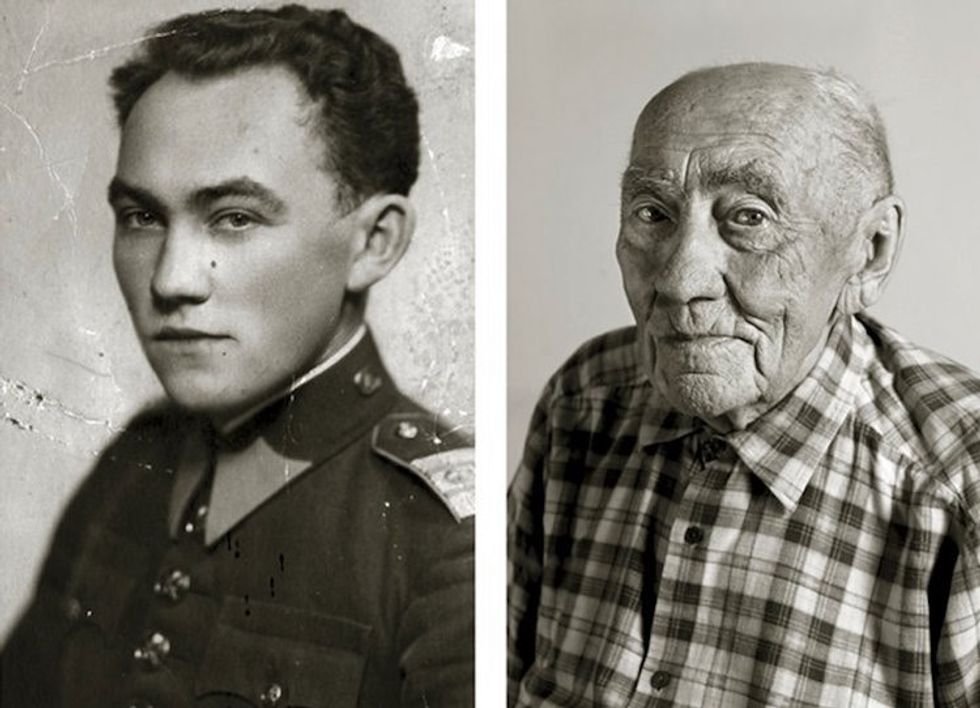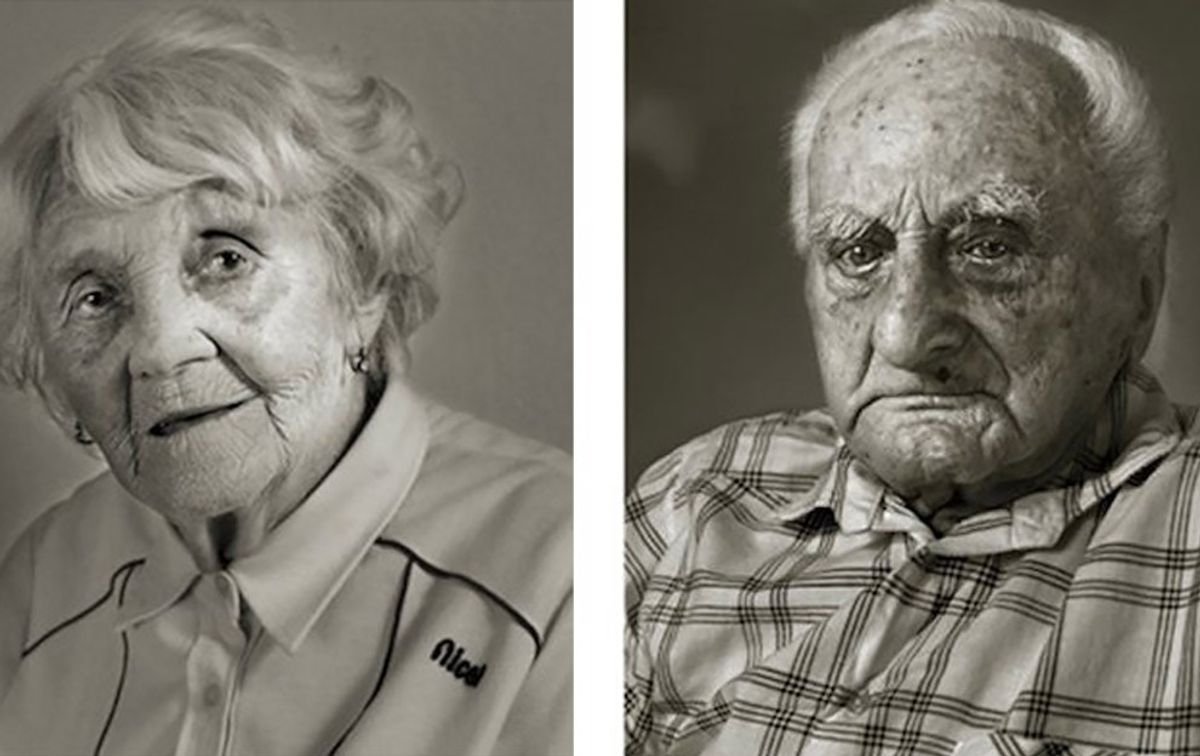
Czech photographer Jan Langer‘s portrait series “Faces of Century” shows them in a different light: as human beings aged by years of experience, but at their deepest level, unchanged by the passing of time. In the series, Langer juxtaposes his portraits with another portrait of the subject from decades earlier. He recreates the original pose and lighting as closely as he can — he wants us to see them not just as they are now, but how they have and haven’t changed over time. That is the key to the series.
These are the rare faces of people who have lived through two world wars, a cavalcade of regimes, and the rush of advancements in modern life. These photos, and the stories of the lives lived by the people in them, show not only the beauty of aging, but how even as we age, we still remain essentially ourselves.
Vejdělek is a former metallurgical engineer who will never forget the taste of warm fresh goat’s milk.
2. Bedřiška Köhlerová, at age 26 and 103
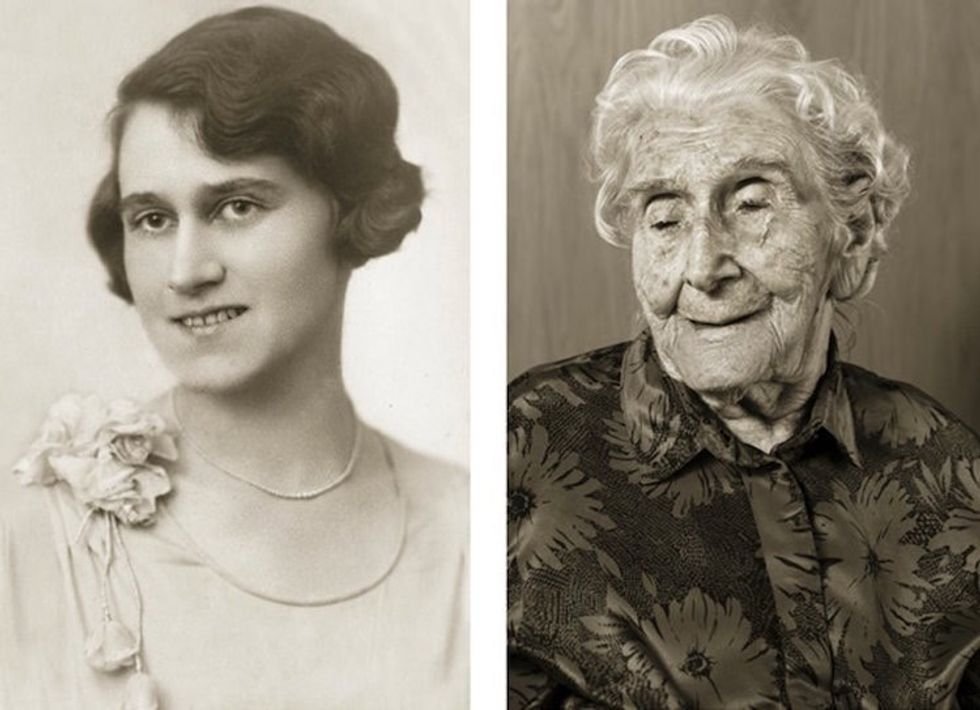
Originally born in Merano, Italy, Köhlerová wishes to visit Italy one more time.
3. Ludvík Chybík, at age 20 and 102
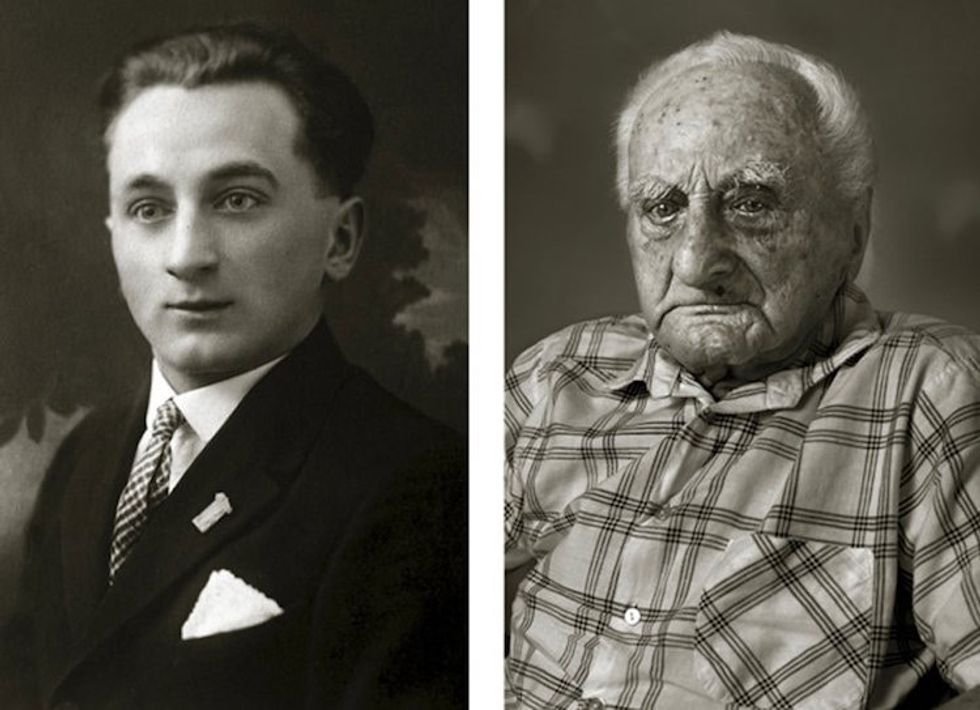
Chybík is a former postal carrier and says he will never forget the route he worked every day.
4. Vincenc Jetelina, at age 30 and 105
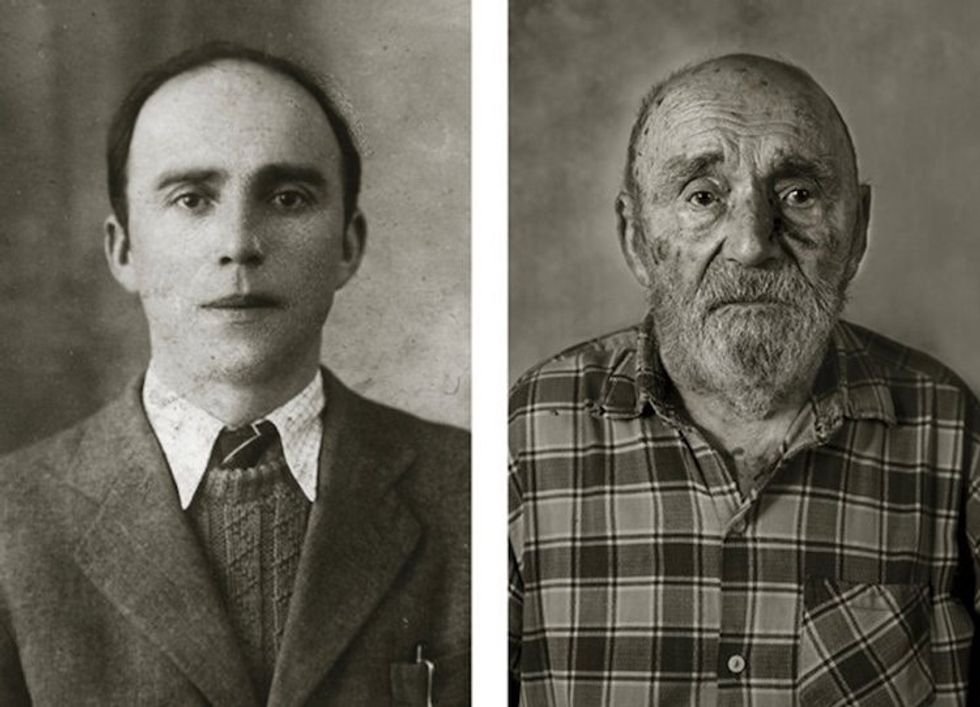
Jetelina spent eight years in prison after World War II. Now, he just wants to live the rest of his life in peace.
5. Antonín Kovář, at age 25 and 102
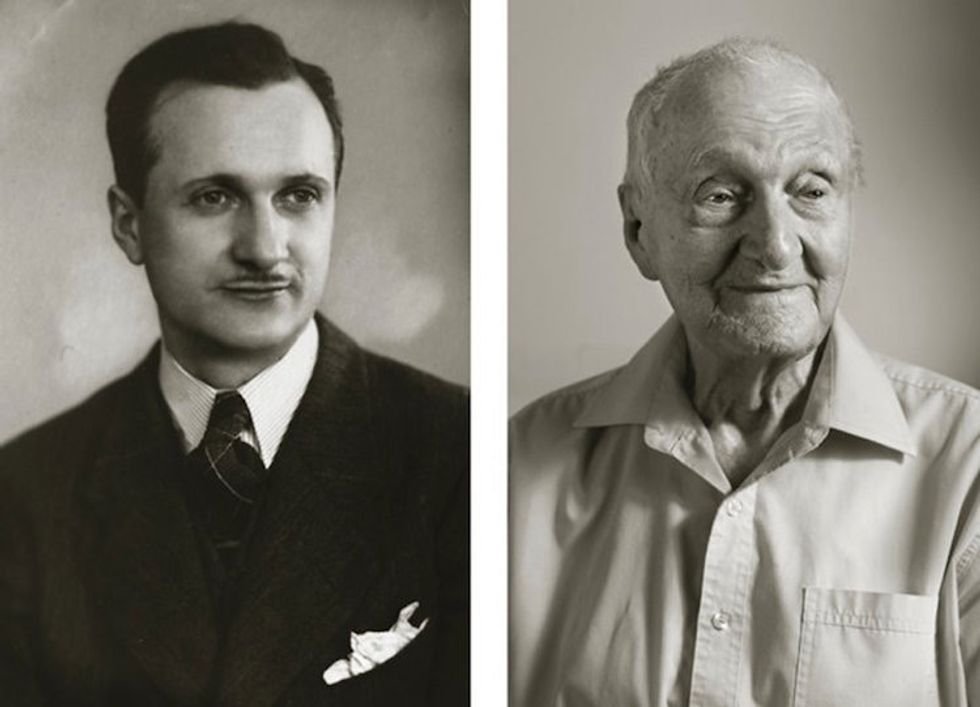
Kovář is a former musician whose daughter comes to visit him every day. He wishes to play the clarinet once more.
6. Anna Vašinová, at age 22 and 102
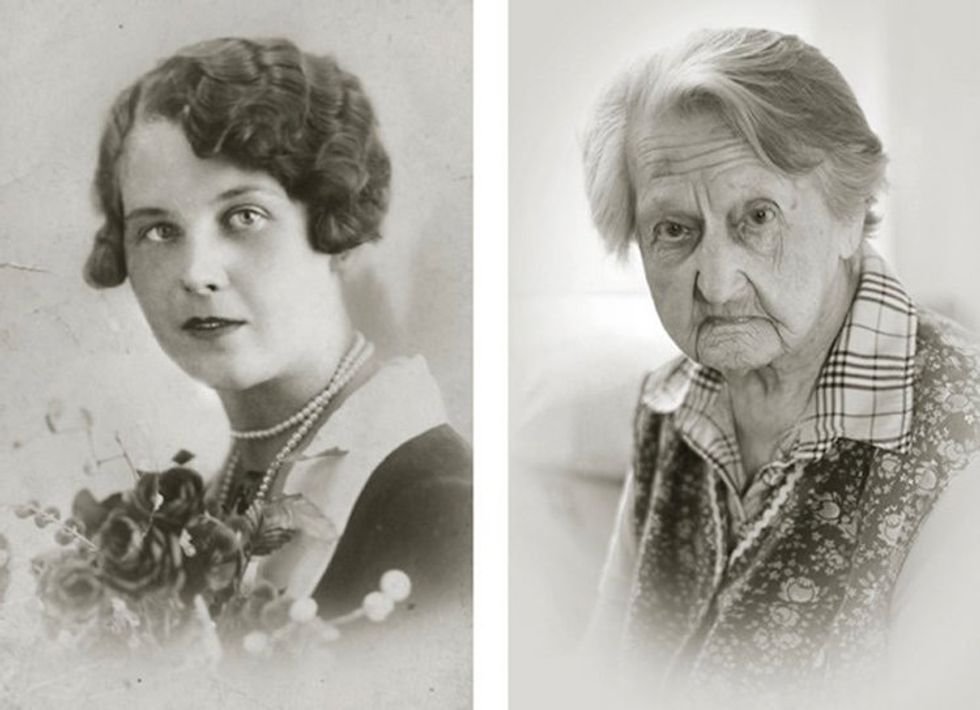
Vašinová will always remember the day her husband was taken away by the Nazis. She wishes to be reunited with him after death.
7. Stanislav Spáčil, at age 17 and 102
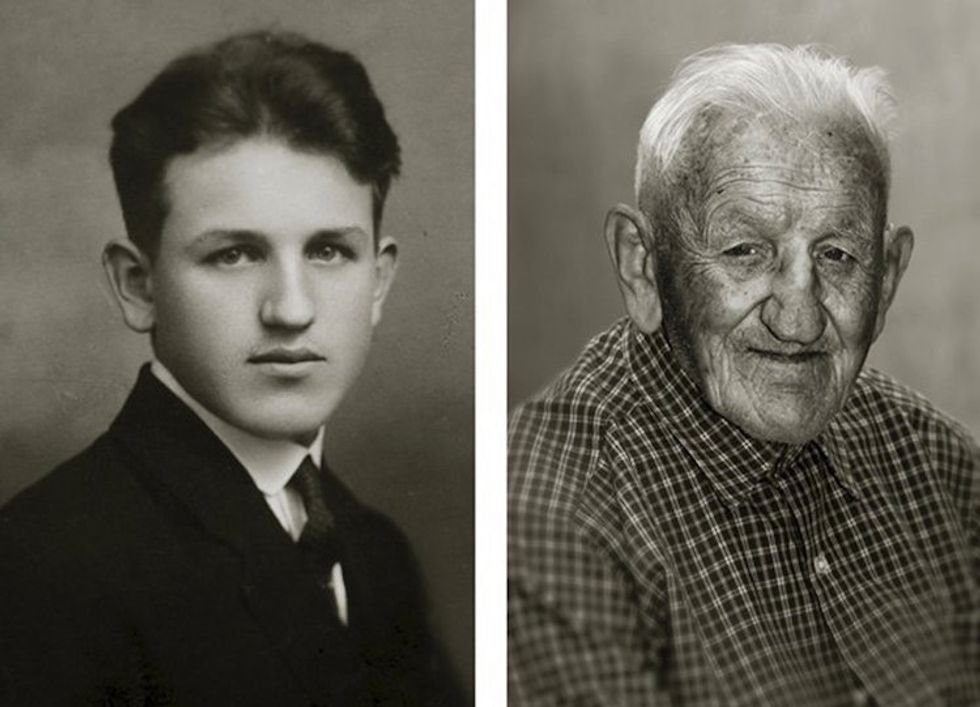
Spáčil was an electrical engineer throughout his life and thinks that it’s too early in his life to think about the past.
8. Anna Pochobradská, at age 30 and 100
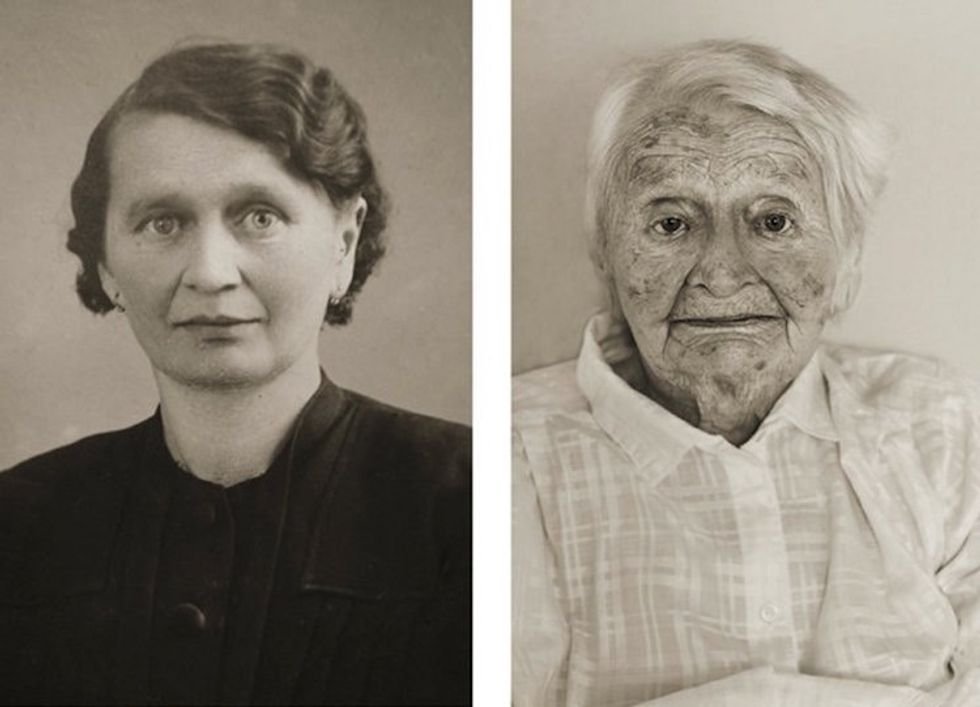
Pochobradská was a farmer. She now lives a quiet life and is thankful that her daughter visits her every weekend.
9. Antonín Baldrman, at age 17 and 101
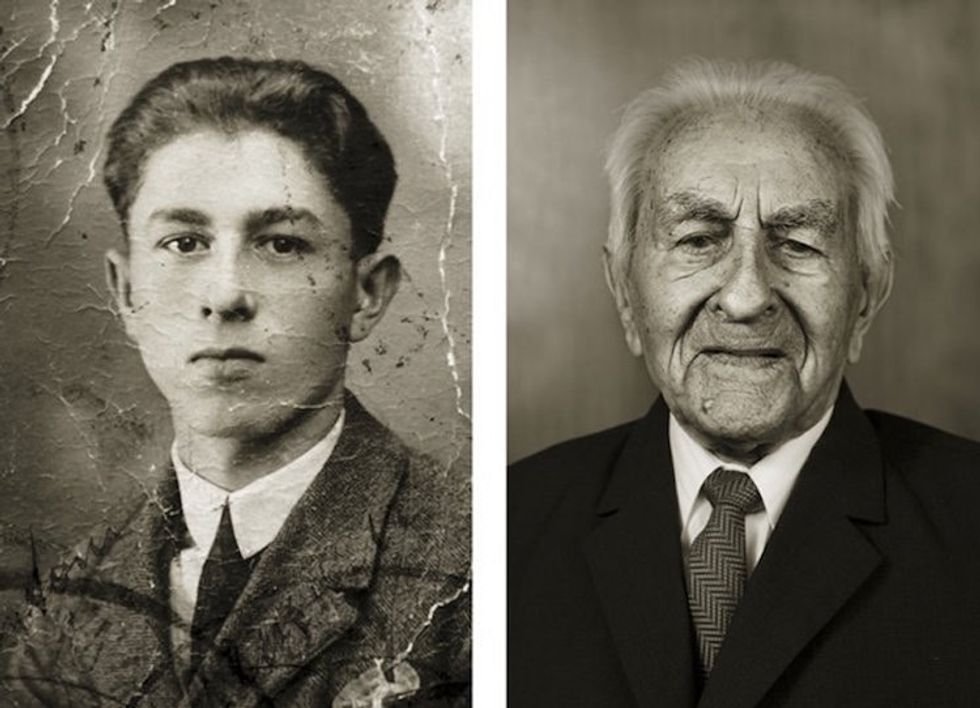
Baldrman was a clerk early in life and keeps up with current events by reading the newspaper.
10. Marie Burešová, at age 23 and 101
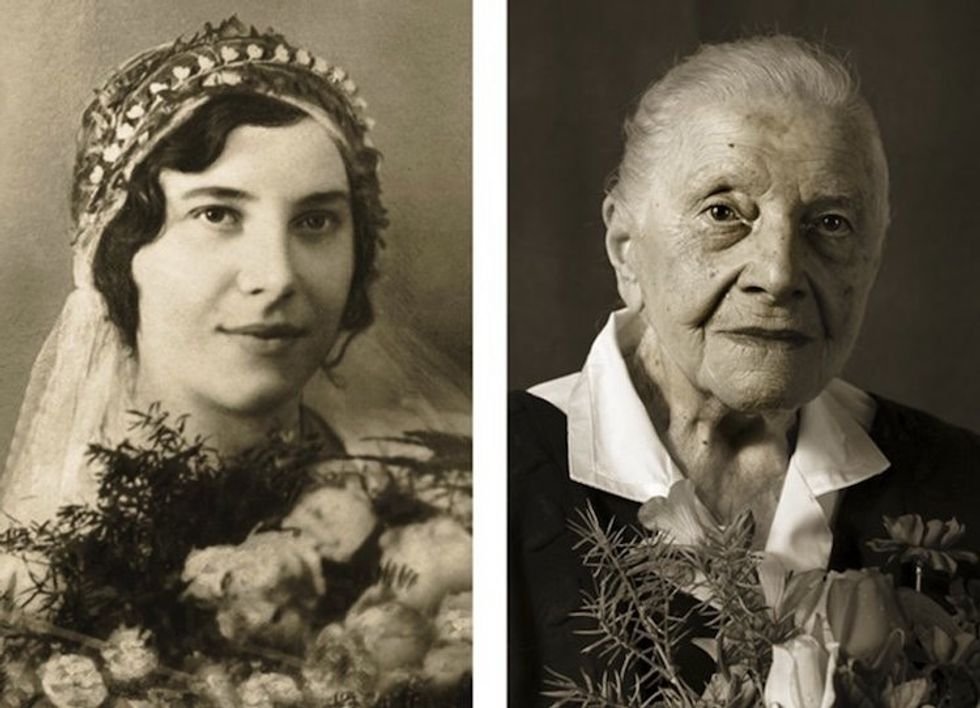
Burešová loves talking to her family and wishes to have them all together again.
11. Vlasta Čížková, at age 23 and 101
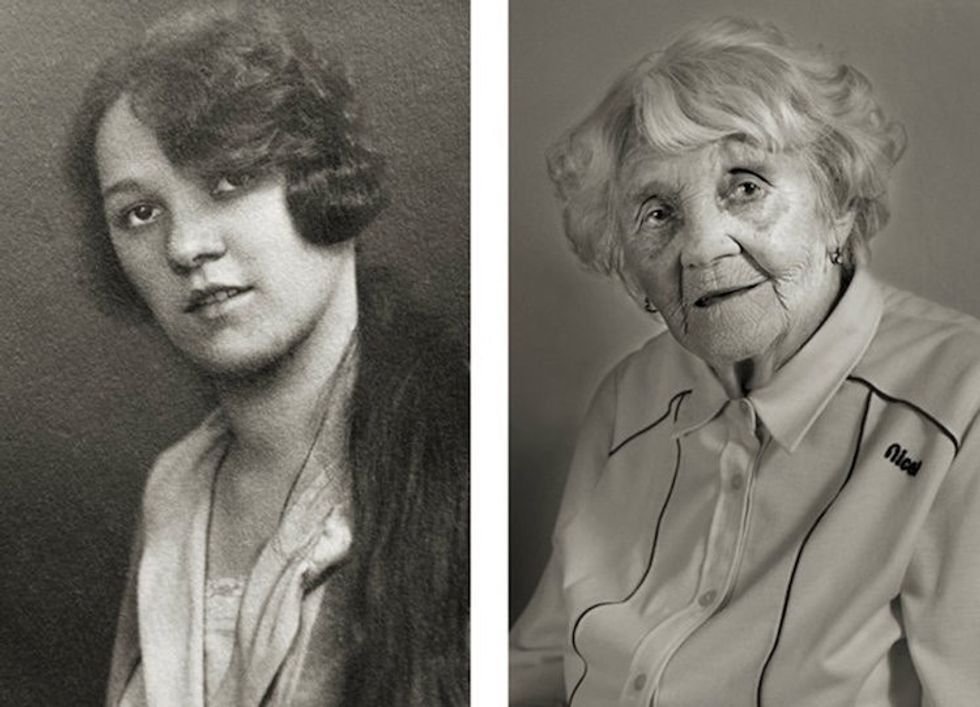
Čížková cooked in the dining room at the airport in the small village of Vodochody. She’ll never forget reciting her own poetry at wedding ceremonies.
12. Ludmila Vysloužilová, at age 23 and 101
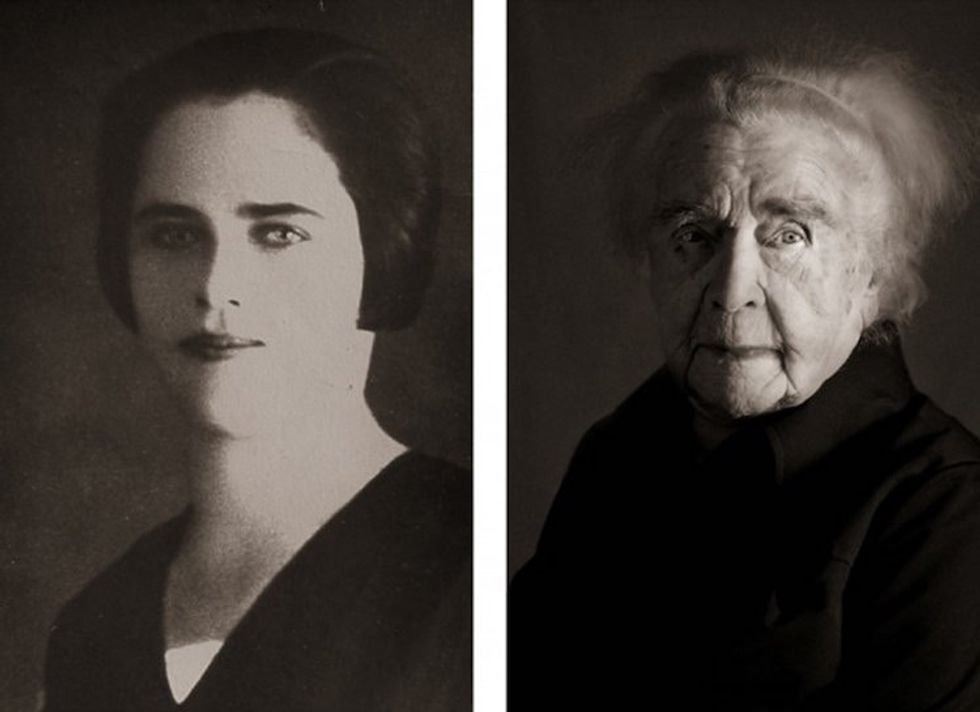
Vysloužilová stays active every day by chopping wood, shoveling snow, and doing work around her house.
The photographer Langer was initially inspired to document the lives of elderly people because of what he saw as the media’s lack of coverage of them. He decided to focus on people over the age of 100 — a very rare demographic indeed. The 2020 U.S. Census recorded 80,139 people aged 100 or older, a 50.2% increase from the 53,364 centenarians counted in 2010. As our aging population continues to increase, and technology evolves along with it, it’s likely these incredibly photo essays will become far more common. But for now, they are an incredible reminder of how precious and valuable life is, sometimes especially when we reach our golden years.
“One should live every single moment according to their best knowledge and conscience because one day we will see clearly what has a real value,” Langer says of what he learned from his subjects while photographing them.
The series was originally part of a story that Langer did for the Czech news outlet aktuálně.cz. You can see more photos from the portrait sessions by following the link.
In a small village in Pwani, a district on Tanzania’s coast, a massive dance party is coming to a close. For the past two hours, locals have paraded through the village streets, singing and beating ngombe drums; now, in a large clearing, a woman named Sheilla motions for everyone to sit facing a large projector screen. A film premiere is about to begin.
It’s an unusual way to kick off a film about gender bias, inequality, early marriage, and other barriers that prevent girls from accessing education in Tanzania. But in Pwani and beyond, local organizations supported by Malala Fund and funded by Pura are finding creative, culturally relevant ways like this one to capture people’s interest.
The film ends and Sheilla, the Communications and Partnership Lead for Media for Development and Advocacy (MEDEA), stands in front of the crowd once again, asking the audience to reflect: What did you think about the film? How did it relate to your own experience? What can we learn?
Sheilla explains that, once the community sees the film, “It brings out conversations within themselves, reflective conversations.” The resonance and immediate action create a ripple effect of change.
MEDEA Screening Audience in Tanzania. Captured by James Roh for Pura
Across Tanzania, gender-based violence often forces adolescent girls out of the classroom. This and other barriers — including child marriage, poverty, conflict, and discrimination — prevent girls from completing their education around the world.
Sheilla and her team are using film and radio programs to address the challenges girls face in their communities. MEDEA’s ultimate goal is to affirm education as a fundamental right for everyone, and to ensure that every member of a community understands how girls’ education contributes to a stronger whole and how to be an ally for their sisters, daughters, granddaughters, friends, nieces, and girlfriends.
Sheilla’s story is one of many that inspired Heart on Fire, a new fragrance from the Pura x Malala Fund Collection that blends the warm, earthy spices of Tanzania with a playful, joyful twist. Here’s how Pura is using scent as a tool to connect the world and inspire action.
A partnership focused on local impact, on a global mission
Pura, a fragrance company that recognizes education as both freedom and a human right, has partnered with Malala Fund since 2022. In order to defend every girl’s right to access and complete 12 years of education, Malala Fund partners with local organizations in countries where the educational barriers are the greatest. They invest in locally-led solutions because they know that those who are closest to the problems are best equipped to solve and build durable solutions, like MEDEA, which works with communities to challenge discrimination against girls and change beliefs about their education.
But local initiatives can thrive and scale more powerfully with global support, which is why Pura is using their own superpower, the power of scent, to connect people around the world with the women and girls in these local communities.
The Pura x Malala Fund Collection incorporates ingredients naturally found in Tanzania, Nigeria, Pakistan, and Brazil: countries where Malala Fund operates to address systemic education barriers. Eight percent of net revenue from the Pura x Malala Fund Collection will be donated to Malala Fund directly, but beyond financial support, the Collection is also a love letter to each unique community, blending notes like lemon, jasmine, cedarwood, and clove to transport people, ignite their senses, and help them draw inspiration and hope from the global movement for girls’ education. Through scent, people can connect to the courage, joy, and tenacity of girls and local leaders, all while uniting in a shared commitment to education: the belief that supporting girls’ rights in one community benefits all of us, everywhere.
You’ve already met Sheilla. Now see how Naiara and Mama Habiba are building unique solutions to ensure every girl can learn freely and dare to dream.
Naiara Leite is reimagining what’s possible in Brazil
Julia with Odara in Brazil. Captured by Luisa Dorr for Pura
In Brazil, where pear trees and coconut plantations cover the Northeastern Coast, girls like ten-year-old Julia experience a different kind of educational barrier than girls in Tanzania. Too often, racial discrimination contributes to high dropout rates among Black, quilombola and Indigenous girls in the country.
“In the logic of Brazilian society, Black people don’t need to study,” says Naiara Leite, Executive Coordinator of Odara, a women-led organization and Malala Fund partner. Bahia, the state where Odara is based, was once one of the largest slave-receiving territories in the Americas, and because of that history, deeply-ingrained, anti-Black prejudice is still widespread. “Our role and the image constructed around us is one of manual labor,” Naiara says.
But education can change that. In 2020, with assistance from a Malala Fund grant, Odara launched its first initiative for improving school completion rates among Black, quilombola, and Indigenous girls: “Ayomidê Odara”. The young girls mentored under the program, including Julia, are known as the Ayomidês. And like the Pura x Malala Fund Collection’s Brazil: Breath of Courage scent, the Ayomidês are fierce, determined, and bursting with energy.
Ayomidês with Odara in Brazil. Captured by Luisa Dorr for Pura
Ayomidês take part in weekly educational sessions where they explore subjects like education and ethnic-racial relations. The girls are encouraged to find their own voices by producing Instagram lives, social media videos, and by participating in public panels. Already, the Ayomidês are rewriting the narrative on what’s possible for Afro-Brazilian girls to achieve. One of the earliest Ayomidês, a young woman named Debora, is now a communications intern. Another former Ayomidê, Francine, works at UNICEF, helping train the next generation of adolescent leaders. And Julia has already set her sights on becoming a math teacher or a model.
“These are generations of Black women who did not have access to a school,” Naiara says. “These are generations of Black women robbed daily of their dreams. And we’re telling them that they could be the generation in their family to write a new story.”
Mama Habiba is reframing the conversation in Nigeria
Centre for Girls' Education, Nigeria. Captured by James Roh for Pura
In Mama Habiba’s home country of Nigeria, the scents of starfruit, ylang ylang and pineapple, all incorporated into the Pura x Malala Collection’s “Nigeria: Hope for Tomorrow,” can be found throughout the vibrant markets. Like these native scents, Mama Habiba says that the Nigerian girls are also bright and passionate, but too often they are forced to leave school long before their potential fully blooms.
“Some of these schools are very far, and there is an issue of quality, too,” Mama Habiba says. “Most parents find out when their children are in school, the girls are not learning. So why allow them to continue?”
When girls drop out of secondary school, marriage is often the alternative. In Nigeria, one in three girls is married before the age of 18. When this happens, girls are unable to fulfill their potential, and their families and communities lose out on the social, health and economic benefits.
Completing secondary school delays marriage, and according to UNESCO, educated girls become women who raise healthier children, lift their families out of poverty and contribute to more peaceful, resilient communities.
Centre for Girls’ Education, Nigeria. Captured by James Roh for Pura
To encourage young girls to stay in school, the Centre for Girls’ Education, a nonprofit in Nigeria founded by Mama Habiba and supported by Malala Fund and Pura, has pioneered an initiative that’s similar to the Ayomidê workshops in Brazil: safe spaces. Here, girls meet regularly to learn literacy, numeracy, and other issues like reproductive health. These safe spaces also provide an opportunity for the girls to role-play and learn to advocate for themselves, develop their self-image, and practice conversations with others about their values, education being one of them. In safe spaces, Mama Habiba says, girls start to understand “who she is, and that she is a girl who has value. She has the right to negotiate with her parents on what she really feels or wants.”
“When girls are educated, they can unlock so many opportunities,” Mama Habiba says. “It will help the economy of the country. It will boost so many opportunities for the country. If they are given the opportunity, I think the sky is not the limit. It is the starting point for every girl.”
From parades, film screenings to safe spaces and educational programs, girls and local leaders are working hard to strengthen the quality, safety and accessibility of education and overcome systemic challenges. They are encouraging courageous behavior and reminding us all that education is freedom.
Experience the Pura x Malala Fund Collection here, and connect with the stories of real girls leading change across the globe.
According to her daughter, Lucille Ball never considered herself a feminist, but there’s no question she blazed many a trail for women. A working mother in real life, she depicted issues facing housewives with her brilliant television comedy and became the first female studio head in Hollywood. She broke glass ceilings but wasn’t particularly outspoken about women’s rights. In fact, in a 1980 interview with People she said, “They can use my name for equal rights, but I don’t get out there and raise hell because I’ve been so liberated, I have nothing to squawk about.”
Ball empowered women by example—and by speaking her mind. Carol Burnett shared a story on PBS about how Ball was unhappy with a script for her new show, but women at that time didn’t raise concerns about such things. Men could express criticism and demand changes, but women simply didn’t. Ball did—and firmly—despite being non-confrontational by nature. Later she told Burnett, “Kid, that’s when they put the ‘s’ at the end of my name.”
Lucille Ball shuts down TV host
A video has been circulating on social media showing Ball’s no-nonsense way of speaking up when she felt the need to, and people are gushing over it.
Lucille Ball was a massive star, but perhaps best known for the show ‘I Love Lucy By CBS Television – Public Domain
In 1978, Ball participated in a Q & A session with UCLA theater arts students on the television program “America Alive!” The viral clip shows Ball repeatedly telling one of the hosts, David Sheehan, to take his hands off of female audience members when they were asking a question.
“Will you take your hands off, David?” she says as he introduces one young woman. “Take your hands off of her,” she says again as he places his hand on the shoulder of another. “David, would you take your hands away?” she says as he places his hands on another woman in a sparkly gold dress.
People laughed every time, but Ball didn’t so much as crack a smile during her clear, simple, repeated “hands off” admonitions.
For 1978 especially, her advocacy for the women in the audience was extraordinary. Sheehan wasn’t touching these women in a lewd or sexual manner, but he was touching them in a way that he wouldn’t have touched a man who was asking a question. Most people wouldn’t have thought much of it at the time, but Lucille Ball immediately noted it and didn’t let it stand.
Here are some of the best comments
“I love that she didn’t even laugh when the room was. She was not joking.”
“‘Take your hands off her, David,’ should be a sound AND a t-shirt.”
“He kept trying. She kept telling him. Love her.”
“Lucille Ball always reminds me of my grandma. She hated to be seen as delicate, and she hated men that would touch her even more. She would say, stone-faced, ‘Get your paws off.’”
“The audience laughed and she said ‘ain’t nothing funny.’ Love her”
.”This happened to me so much growing up and I noticed from very young the boys weren’t treated this way.”
“Even then she knew how the industry was. I LOVE IT AND LOOOOVE LUCY SO MUCH.”
A commenter on Reddit noted that Ball started her career as a chorus girl and dancer. “She knows every creepy man trick in the book”
The wider culture of handsy TV hosts
Television and game shows from the 70s and 80s are an incredible time capsule of the culture and norms of the era. Sheehan wasn’t the only one who tended to get a little handsy.
It was common for male hosts to kiss female contestants. Richard Dawson, host of The Family Feud, was famous for it. Even our beloved Bob Barker of The Price Is Right often had women suggestively reach into his jacket to fish out their $100 bill.
Richard Dawson kissing all the women in the family. YouTube
There’s a casual lecherous-ness that famous men seemed to get away with easily at the time. For anyone to publicly challenge them on their behavior was absolutely shocking.
Even if Sheehan was casually touching those women out of habit and not ill intent, it’s laudable that Ball made a point of making him aware of it. Unfortunately, women are still having to deal with men touching them without being invited to, but seeing Lucille Ball’s serious face while calling it out is a good reminder that women have been fighting this battle for a long time. Good for her for using her microphone and the respect afforded her to speak up for the young women in her audience.
Culture Club’s “Do You Really Want to Hurt Me” is a pop song that has stood the test of time. The hit was written by the band’s lead singer, Boy George, and topped the Billboard charts in 1982.
It continues to resonate with younger generations. During a 2018 blind audition on Season 7 of The Voice Australia, singer Sheldon Riley performed an evocative version of the song for judge Boy George himself.
Riley’s personal touches on the hit made a deep impact on Boy George.
Singing to Boy George
In the viral clip, Riley takes a few deep breaths before beginning to sing, accompanied only by a piano. “Give me time to realize my crime,” he croons, as judge Joe Jonas immediately recognizes the tune, along with Boy George.
“I know that song,” Boy George says.
With their ears perked, Riley continues to sing, and Boy George quickly presses the button to turn his chair. Riley immediately becomes emotional as the three remaining judges—Jonas, Delta Goodrem, and Kelly Rowland—also press their buttons.
“I love it!” Boy George continues, as Riley keeps singing a hauntingly sad version of his major pop hit. Riley bursts into tears at the end of his performance, and Boy George sings his praises.
“Great song!” he quips. “Obviously that song is so personal to me—it’s my own personal love story in a way. And it’s almost impossible to imagine anyone else singing it. You just added so much kind of sadness to it.”
Boy George quickly compliments Riley on his outfit—a purple top with large faux-fur sleeves and white ripped jeans—with Riley sharing that his look isn’t “normally accepted” by others.
Boy George says to him, “Honey, can I just say…never, ever look for acceptance. Take me as I am—that should be your motto.”
Later in the clip when Riley is choosing his coach, he tells Boy George, “I just want to say thank you so much. You let people like me wear what I want to wear, and put these lashes on that take thousands of years. You just inspire me so much…I’m going to go Team George!”
The history of “Do You Really Want to Hurt Me”
In a 2015 interview with The Guardian, Boy George said he wrote the song about his former partner, Kirk Brandon.
“I did play the victim. That was the role I took on: ‘Oh, why are you doing this to me?’ Back in the day, I spent so much time trying to change the people I was in love with–and not trying to change myself,” he said.
And he didn’t think it would be a hit.
“I thought the song was too personal to be a hit and I didn’t want it to be a single. I went to Virgin and stomped my feet and sat on the stairs saying: ‘You’re going to ruin our career before we’ve even started!’, he said. “Our audience needed something to dance to, and ‘Do You Really Want to Hurt Me’ was too slow, too personal, too long. Everything about it was wrong. So its success was a big education for me: I learned that being personal was the key to touching people.”
The song peaked at No. 2 on the Billboard charts in March 1983 and spent 25 weeks on the chart.
It’s 9 a.m. You arrive at your desk feeling fresh, but by noon, when you catch a glimpse of yourself in the bathroom, you barely recognize yourself. And by the end of the workday…yeesh.
That was the case for Noa Donlan, a flag-waving “corporate girly” who couldn’t help but notice the visible difference between how she looked when clocking in and even just hours later. So she decided to document it.
In a series of now-viral videos posted to TikTok and Instagram, we see her face transform from glowing and vibrant to puffy-eyed, with dry, gray-toned skin and hair weighed down by oil.
I leave the house feeling fine and by 12pm my skin is dry, my eyes look tired, and my hair is oily?? tell me I’m not the only one follow for realistic 9–5 POVs 💻✨ #creatorsearchinsights
There’s something in the OFFICE air💻 Follow if this is you by 1pm in the office🤍 someone mentioned this song in the comments and I can’t remember who it was so if this was you THANK YOU for the song idea 😉 #corporategirl#officelife#workhumor#9to5#corporategirly
Perhaps you could blame it on unforgiving bathroom lights, but Donlan has a different theory: office air.
And apparently, she isn’t the only one who thinks it might be to blame. Her video drew a ton of comments from people sharing similar experiences.
“I look like a sick Victorian child by lunch,” lamented one viewer.
Plus, there are millions of videos on TikTok from others documenting the same phenomenon, many of whom film themselves in the exact same location for before-and-after shots. The most common complaints are dry skin, a shiny forehead, oily hair, and cracked lips.
“Office air is the most fatal of them all,” another office worker said in a video with 1.2 million views.
“No matter how good I try to make myself look in the morning, I’m going to leave the office looking like I just ran a marathon and washed my face with grease,” they said.
Now, is this a Severance-level work conspiracy? Probably not. (The odds are low, but never zero.)
However, there are some potential explanations, one of which is the air in the office, which tends to be stripped of humidity thanks to the A/C blasting nonstop.
Plus, offices without openable windows mean the skin may get less oxygen throughout the day. This, combined with dehydration, “leaves skin looking dull and fatigued,” said skin expert Fiona Brackenbury in an interview with Refinery29.
There’s also something to be said about the effects that reduced circulation from being stationary, stress, and squinting at screens can have on our appearance, according to the Skin Elite blog.
Prevent “office air” from damaging skin
Thankfully, there are expert-approved ways to combat the effects of “office air,” particularly dryness.
Dr. Catherine Chang, a plastic surgeon, recommends using a small portable humidifier at your desk, as well as a good moisturizer or hyaluronic acid that you can reapply as needed.
If you work in an office 9-5, this is for you. “Office air” aka “work air” might be the reason your skin gets dry and make up patchy while at work. 👀 #skincare#skincaretips#beautytok#beautytips
She also suggests spraying hypochlorous acid, which can help with inflammation and free radical damage. She noted that it might not actually help with dryness, but can at least leave you feeling “refreshed.”
In addition, experts recommend serums containing niacinamide, vitamin E, and/or resveratrol, which help protect against environmental damage, support collagen production, and soothe the skin.
As for the stress portion? That’s a harder nut to crack, but it goes to show, once again, that stress management affects us in more ways than one. Short of packing it all up to live on a cruise ship, don’t forget that some form of relaxation—whether it’s taking a few deep breaths or going for a walk during your lunch break—is vital.
So, while “office air” might not be fully researched or proven, it serves as a reminder that our work environments shape how we feel—and even how we look—throughout the day. Hopefully, it only takes a few small adjustments to help you leave the office matching the person who walked in that morning, inside and out.
Picture this: A 90-year-old woman has been diligently volunteering with the Los Angeles Police Department for 22 years simply because “she loves to help.” Now here’s the kicker: That’s not even the coolest thing about her. The thing is, she’s actually Bruce Willis’ mom.
But those at the police station might never have known because, apparently, she doesn’t bring it up. Not that she isn’t proud. She even has a giant screensaver on her computer of Bruce hugging her. But she doesn’t lead with that. Giving back to the community is incredibly important to her, and she doesn’t want anything to distract from that work.
In a clip posted on NBC LA, reporter Robert Kovacik highlights how much she’s appreciated: “There is often that colleague who makes the day a little easier. Who makes the week go a little faster. But this is no ordinary workplace. This is the Los Angeles Police Department’s West LA station.”
“Integral” part of the LAPD
Though her first name is Marlene, she is affectionately referred to as Mrs. Willis by the police force. We see her sitting at a computer, a jet-black streak contrasting beautifully against her thick white hair. She wears a volunteer vest and badge over a lacy, satin taupe blouse. She means business, but it’s her kindness that seeps through.
The police station’s commanding officer, Captain Rich Gabaldon, shares, “Mrs. Willis is a very integral part of West Los Angeles and the LAPD. She is an icon here, really. 22 years she’s been a volunteer.”
Willis, who is sitting next to Gabaldon for the interview, interjects: “Yeah, what did you think of me when you first came here?”
He answers passionately: “You said, ‘I’m Mrs. Willis. I’m a volunteer here, and it’s a pleasure to meet you, Captain. Anything you need, you let me know. I’m here to help.’”
Willis seems choked up by his memory. “You see,” she says, “that’s how I feel inside. And he remembered it. That’s wonderful!”
Volunteer of the year
Kovacik goes on to share, “She’s been recognized as LAPD’s ‘Volunteer of the Year,’ an award presented by then–Chief of Police Michael Moore, who then went one step further.” He gave her an LAPD badge.
We then see a clip of Moore, speaking from his home in Tennessee, who has this lovely message for Willis: “Marlene, there are people in our lives that when you cross their path, they leave a lasting impression. To you and the work you do, we’ll be forever grateful.”
Gabaldon says directly to her, “She is part of our family. I don’t know what we’d do without you.” Willis seems overjoyed and moved by his words, echoing the sentiment: “This,” she says, pointing around the room, “is my family. I mean that. I mean that a hundred percent, okay?”
Willis certainly has her son’s charm. In relaying a story about some of her kids and grandkids coming over on Sundays, she shares that she “cooks a big meal for” them. When asked if she likes to cook, she doesn’t even skip a beat, deadpanning, “No.”
Bruce Willis is beloved
Speaking of Bruce, much of the police department is made up of fans as well. Moore shares, “When I first met Marlene, ya know, someone said, ‘Well, this is Bruce Willis’ mother.’ And she never mentioned it. And in each of our encounters, I would never have know that. And, by the way, I think he’s a gentleman, and I’m sorry he’s gone through such a challenging disease and circumstances of his life.” (He is referring to Bruce’s diagnosis of frontotemporal dementia.)
Moore continues, “But again, Marlene was never one to wear her identity as his mother on her sleeve, or even involve him in even passing references of her life, which impressed me.”
Willis’ role is no small task. Gabaldon explains just some of her duties: “She reviews reports. She makes notes. She’s very good with English grammar, what’s right and what’s wrong.” We hear her laugh heartily at this.
Detective Justin Malcuit takes it a step further:
“One of the duties that she doesn’t even maybe know that she’s doing is just her presence here with the officers is huge. So for instance, when an officer comes to the station from whatever God-awful incident they dealt with in the field during the day, she comes up to that officer to give him a hug. That is beyond words and tremendous help to all of us here at the station, just in her day-to-day. And that happens every single day here at the station. And it’s just truly a testament to who she is.”
“The city needs that”
On every platform where the video has been posted, the comments are incredibly supportive.
One person writes, “Looove that she is like the station’s ‘mother’ giving hugs to the officers. Truly. The city needs that.”
Another commenter suggests it may be an attribute of the Silent Generation: “No wonder she has lived to be 90. That generation was built to serve.”
And many are simply inspired to be like her. “This is so wonderful! 90 years old still feeling useful and strong,” a commenter writes. “Working her computer, doing paperwork. I admire her and hope I am just as active at 90!”
Sometimes our coping mechanisms are found where we least expect them. Such was the case for a woman named Ruby Gregory, who went through a breakup so difficult she completely lost her appetite. (It happens to the best of us.) That is, until she discovered her love of boiled peanuts.
Gregory took to Instagram to publicly express her gratitude for a company called Peanut Patch Boiled Peanuts. (They, of course, make the boiled peanuts.) Before reading her heartfelt letter, she made it clear in the post that she was not sponsored by the company.
She also clarified that she has eaten a lot of boiled peanuts. “I have consumed well over 100 cans of Peanut Patch Boiled Peanuts after my wife left me back in September.”
“Hello. My name is Ruby. And I’m writing today to express my appreciation and gratitude for your product. Back in September, my wife came home, told me she cheated on me with someone in her nursing program, and left. I was so sad. I could hardly eat for about a month. I lost 30 pounds in 30 days. Yikes.”
A delicious craving
But suddenly, she began to crave them. She continued:
“Then one day I got a craving for boiled peanuts, the ones you’d see being sold on the side of the road on game days growing up. Since I had that craving back in November, I have consumed approximately 5-10 cans of Peanut Patch boiled peanuts per week. Usually the standard size, but I’ve since discovered the giant cans sold at Sam’s Club. If you do the math, I have consumed well over 100 cans of Peanut Patch Boiled Peanuts since my wife left me.”
But here’s where the wonderful news comes in:
“I am doing much better now. This has been the hardest and best thing that has ever happened to me.
I have learned so much about my resiliency and strength and am genuinely excited for what my future holds. More importantly, I have learned that real love is consistent, dependable, and nourishing, just like Peanut Patch cans of boiled peanuts.
In the coming weeks, my divorce will be finalized, and I will be able to officially and legally move forward with my life, but I will always remember that when things got hard and money got tight, I could always count on my Peanut Patch cans of boiled peanuts to keep me going no matter what the next day brought. Thank you for your product. Thank you for listening. And I hope this email finds you well.”
The company responds
Peanut Patch Boiled Peanuts responded in kind, writing in an Instagram message, “Hey there Ruby! Just wanted to let you know that there are some boiled peanuts heading your way, but we are also putting together another care package for ya, that’ll take a little longer. Didn’t want you to think we forgot about ya or anything!”
The comment section came alive, proving that an online community can truly deliver.
One person joked, “Have you thought about maybe seeking a therapist?” Gregory responded, “My therapist is aware and has cried over said boiled peanuts with me.”
Others were merely supportive of her heartbreak. “I have never felt more seen. Boiled peanuts heal the soul!” one person said. Another shared, “Facing heartbreak and life hardship, but hitting your protein every day despite it all… a true icon!”
Another agreed, “Wow. I’ve never been so emotionally touched by a video about boiled peanuts and divorce, which outwardly has no correlation. I hope life continues to treat you and your boiled peanuts well.”
This person summed up what many might be thinking: “Romance is temporary, boiled peanuts are forever.” Gregory replied, “You get it.”
Upworthy spoke with Gregory, who said the company sent an initial giant care package and is sending another one soon. “I don’t know what will be in it! By this time next week, I’ll also be a single woman!” she said.
She’s also overjoyed by the response, saying, “I’m just so overwhelmed with the support and community of people there who have bonded over this regional delicacy. Shout out to Badass Tally Peanuts and Peanut Patch. They have both been supportive. Badass Peanuts is local to Tallahassee and is Black-owned, LGBT friendly, and a family business.”
It’s perfectly normal to forget how much the world changes month by month. It can feel like we blinked, and suddenly there are self-driving cars, delivery robots, and home 3D printers. But not long ago, what was once considered “the way it was” would drive people batty today.
A user going by the name u/CharlesUFarley81 took to the r/AskReddit subreddit to pose this question: “What ‘back then’ inconvenience would break people today in 10 minutes?” The post received 6,200 upvotes and more than 4,000 responses, offering some surprising reminders of how different things once were.
One commenter described what an ordeal going to the bank used to be: “No online banking. I remember being a kid, and it seemed like my parents were constantly going to the bank.”
Another followed up with, “More than that, no ATMs. If you want to spend any money on the weekend, you’d better withdraw it before 5 p.m. on Friday.”
This Redditor reminded us that before trusty computers, we had only typewriters: “Projects for class had to be typed. Mistakes were corrected with white-out. If you decided there’s a better way to say something, you’d have to retype the whole thing.”
Oh, and never forget there was a time before remote controls. “Having to stand up and walk across the room to change the TV to one of the three channels,” one user wrote.
Speaking of media, there was no Spotify in years past, so the music we wanted to hear wasn’t always at our fingertips. One Redditor shared the memory: “Having to wait to hear your favorite song on the radio and try to record it onto a cassette tape without the DJ talking.”
A little personal fun fact: I was a DJ on the KZLA morning show in Los Angeles, and we were taught to talk over the beginnings (and sometimes the ends) of songs. It was called “talking up the ramp” (or “hitting the post”), and it was annoying to time perfectly. So, this wasn’t just difficult for the listener.
One Redditor took it a step further, noting how available many of us are expected to be 24/7:
“Nobody was expected to be reachable at all times. You needed to say something to a relative? You called them, and if nobody answered the phone, tough luck, you called them again a few hours later. And automatic answering machines were a later invention.
I don’t know about other countries, but in mine (Argentina), phone lines were some kind of luxury until roughly 30-35 years ago, to the point that homes were sold for more if they had a landline. And because not everybody had a landline, some people used a neighbor’s number as a reference. So, people would call that number, the owner would answer, and then notify the person in question. Or, a neighbor would notify you about an incoming call they were expecting around that time, and they would wait (sometimes for like half an hour) next to the phone. Inside your house, obviously.”
That comment alone received nearly 5,000 upvotes, with one person (of many) responding, “That sounds so peaceful. That’s one of the things I truly dislike about the modern age: you’re expected to instantly reply to people. It gets exhausting.”
Missing being present
Similarly, the information you were given on any given day was all you had. One user wrote:
“You agree to meet up with a friend at a particular time and place. You’re there on time, but your friend still isn’t. Did they forget? Did they get in an accident on the way, or are they just late? Once they’ve left their home, there’s no way of calling them to find out. You will only find out what happened after they finally show up, or, if you wait around forever and they don’t show, then you go back home and try calling them at home.”
Speaking of calls, the panic of not knowing who was calling with each ring wouldn’t be tolerated today. As one person pointed out, “Not knowing who was calling you; you had to answer the phone to find out. Caller ID and *69 were like magic that only the rich could afford at first.”
And don’t forget: before Google or Apple, navigation meant paper maps. Not only did we have to use them for directions, but as one Redditor pointed out, it was all about “having to FOLD them.”
Arielle Nissenblatt has many questions for her followers on Threads. But one in particular stood out last week, and it led to days of laughter. She asked, quite simply, “Please share exactly one (1) thing that makes you laugh without fail every time.”
In less than a week, the question inspired more than 8,000 responses. The Arielle was so pleased that she wrote, “Going through this thread as I fall asleep and am crying laughing snorting. What a joy!”
That’s a lot of funny things. Here are just a handful:
Funny stories
User @loreleiarmstrong shared a hilarious story from a woman named Barbara, who went through quite the ordeal with a brilliantly satisfying ending:
Screenshot
Flatulence
More than one Threader mentioned how hilarious they find flatulence. @johnpark quoted writer Emily Heller, who wrote, “If you don’t find farts funny, then you’re a loser because you’re choosing to have less joy in your life but the exact same amount of farts.”
Another commenter agreed with just one word: “Farts.”
This, of course, also included texting mishaps involving, you guessed it, farts:
Screenshot
Animals
The daughter of Martin Scorsese, @francesca.scorsese (and yes, she has a blue checkmark, so it’s likely really her), chimed in with “Funny animal videos.” The OP agreed, adding, “Unlikely animals getting along.”
Sweetness
A few people said that simply hearing someone else laugh makes them laugh. @lima_sierra wrote, “Anyone 5 or younger laughing.”
Another user added that “the rubber duckies on a Jeep’s dashboard” always make them happy.
Silly conversations
In one exchange shared by @dolphin_dom, a fun fact quickly goes off the rails:
Screenshot
TV moments
@catscoffeebookslove recalled the time Tim Conway played a dentist on The Carol Burnett Show:
@jazaaiekj shared, “Tim Conway talking about the elephant. Cry laughing every single time.”
@cheesee_lizee shared her favorite moment from Parks and Recreation: “The ‘Get on Your Feet’ music scene from Parks and Rec.”
Quite a few people mentioned their favorite Saturday Night Live sketches. One in particular kept popping up, featuring Beavis and Butt-Head lookalikes:
@jodicelesteee wrote that one particular blooper from The Office cracks her up:
Screenshot
Memories
One Threader reminded fellow Brits about a guy trying to make limoncello during lockdown:
Screenshot
Another fun memory? The man whose kids kept interrupting him during a BBC News interview.
@jennknapp reminded readers, “The video of the guy on a zoom call and his toddler marches into his home office, followed by a baby in a walker, and then the mom absolutely driving the struggle bus, trying to remove them with her pants half mast. Hilarious. Every. Single. Time.”
And of course, perhaps the most wonderful moment to come out of a strange time was “lawyer cat.” People from all around the world mentioned the image of a lawyer accidentally using a cat filter during a Zoom hearing. That one is a gift that keeps on giving:
During a red carpet interview leading up to the 2026 Oscars ceremony, actor Ethan Hawke was asked to speak about unrequited love, as Blue Moon, the film that earned him a Best Supporting Actor nomination, centers heavily on the theme.
As Hawke often does, he left viewers stunned and inspired with his thoughtful, poetic answer in a now-viral clip.
According to Hawke, one needn’t feel as though they’ve lost anything when romantic feelings aren’t returned, because the act of feeling itself is the true gift of being alive.
“The one who’s in love always wins,” the Dead Poets Society star explained. “It doesn’t matter if you get your heart broken; you’re living. When you’re feeling, you’re alive.”
He added, “The sun doesn’t care whether the grass appreciates its rays, right? It just keeps on shining. That’s you.”
And to top it all off, when the interviewer, Amelia Dimoldenberg, said “I love you” in response to Hawke’s inspiring words, the actor didn’t skip a beat, replying, “I love you too,” with genuine affection.
Reactions
The message, now seen more than 13 million times, left many marveling at how Hawke was able to deliver such “insanely beautiful” and “absolutely brilliant” words off the cuff.
“That was just off the dome??”
“He freestyled that???? no script, nothing…. such heavenly Shakespearean poetic words off the top of his head?? Wow.”
“This man is always spitting pure poetry.”
“Ethan Hawke is my fave modern philosopher.”
Others couldn’t help but share that it instantly changed their mindset for the better.
“This switched something in my brain like a full factory reset.”
“It’s the most profound thing I’ve literally ever heard.”
It’s not hard to see why the clip resonated so deeply
Unrequited love is often framed in pop culture as something embarrassing or tragic. But here, Hawke reframed it as something beautiful and life-affirming. Loving someone, even without those feelings being reciprocated, becomes proof of openness, courage, and emotional vitality. Not a failure.
That perspective can feel especially radical, since we are often taught to measure success by what we receive in return, whether through affection, validation, or monetary gain. But Hawke’s words gently push against that idea, suggesting that the experience of loving itself holds inherent value, regardless of the result. His take echoes a quote by C.S. Lewis that many referenced in the comments: “Love is never wasted, for its value is not based on reciprocity.”
Moments like this are part of why Hawke has built a reputation not just as an actor, but as a thoughtful observer of the human experience. Whether through interviews, writing, or performances, he often taps into something both deeply personal and universally relatable.
If the reaction online is any indication, this brief red carpet exchange did more than promote a film. It offered millions of viewers a small but meaningful shift in perspective, reminding them that feeling deeply is not a weakness, but a sign of being fully alive. And isn’t that, in a way, the point of it all?