Ah, summer. The glorious season of barbecue parties, beach picnics and perpetual body image issues.
If you’re a human living in our society, you’ve likely been impacted by messages about what your body should look like in a swimsuit. And if you’re a female, those messages have been compounded by a multibillion dollar beauty industry designed to make you feel insecure so you’ll spend more money on “fixing” your “flaws.” Add in a culture of competition and mean-girl immaturity that weaponizes size and shape, and we have a perfect recipe for all kinds of body image-oriented disorders.
There’s nothing wrong with our bodies, but there is something very wrong with the messages we get about our bodies. Thankfully, we’ve come a long way in recognizing the need for body positivity to counter those messages. However, according to Harvard researchers, it takes five positive comments to counteract the effects of one negative one. That means we have to meet the ads, billboards and magazine covers that constantly tell us we’re not good enough with a tsunami of body-positive content.
And that’s where a viral “Victoria’s Secret” song from TikTok songwriter Jax comes in.
Jax has created a devoted following by sharing snippets of silly songs she makes up on TikTok. But her latest ditty isn’t just a silly song—it’s the summer anthem we didn’t know we needed.
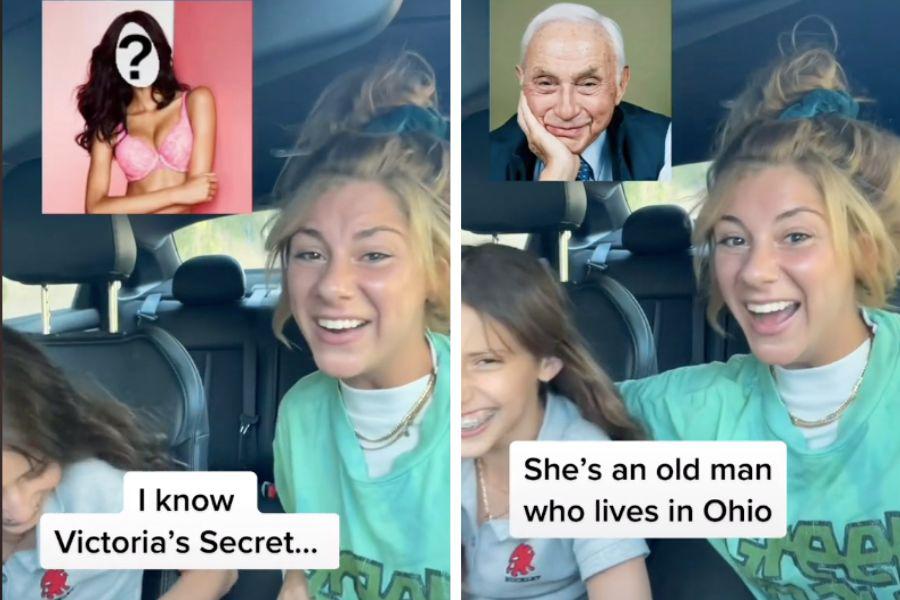
Jax introduces Chelsea, the kid she babysits, and they share a story about how a girl had told Chelsea that the swimsuit she tried on at Victoria’s Secret made her look “too fat and too flat.”
First of all, seething rage at that comment. Second of all, the mom in me is blinking twice at the idea of a preteen shopping for a bikini at Victoria’s Secret, but let’s just move on past that part. Third, it was meant as an insult of course, but even if it were a totally neutral descriptor, no one in their right mind would ever describe that child as fat. Why do girls do this?
So many WTHs going through my head before Jax even gets to her point, but when she gets there, it’s awesome.
“I wrote a song for you,” she tells Chelsea, “because when I was your age I had a lot of eating problems and I wish somebody would’ve said this to me.”
(Jax also shared in the comments, “?Triggerr Warning? for girls, guys, and whomever going through ED, this song is meant to make you smile but I know it’s much deeper than this.”)
The “old man who lives in Ohio” is Les Wexner, the billionaire founder of Victoria’s Secret’s former parent company, L Brands. He stepped down from his role in the company in 2020 after buying the then little-known lingerie brand in 1982 and spending more than five decades at the helm.
So when Jax says she knows Victoria’s “secret” is that she was made up by a dude, it’s true. In fact, even the original Victoria’s Secret was founded by a man. Businessman Roy Raymond wanted to buy his wife some lingerie, but was embarrassed when he went to the department store to look for some. He decided to create a store for women’s underwear where men would feel comfortable shopping.
As Naomi Barr wrote in Slate in 2013, “Raymond imagined a Victorian boudoir, replete with dark wood, oriental rugs, and silk drapery. He chose the name ‘Victoria’ to evoke the propriety and respectability associated with the Victorian era; outwardly refined, Victoria’s ‘secrets’ were hidden beneath.”
After Raymond sold the brand, with its catalog and six stores, to Les Wexner, the focus shifted. Wexner recognized a huge opportunity to market his brand directly to women, and thus the Victoria’s Secret juggernaut was created. For decades, Victoria’s Secret has been synonymous with men ogling models in sexy underwear and women hopelessly trying to fit themselves into those unattainable model bodies.
Jax’s video has gotten more than 13 million views in less than a week and the comments are raving.
“Thank you! I have 2 teenage daughters who are struggling with eating disorders all bc of social media and mainstream media,” wrote one parent.
“This is perfection. This song should be a commercial or PSA or something,” wrote another commenter. Couldn’t agree more.
“The inner 13 year old me needed this. This was the best,” wrote another.
I know Victoria’s Secret, and girl you wouldn’t believe … she’s an old man who lives in Ohio, making money off of girls like me.
In a small village in Pwani, a district on Tanzania’s coast, a massive dance party is coming to a close. For the past two hours, locals have paraded through the village streets, singing and beating ngombe drums; now, in a large clearing, a woman named Sheilla motions for everyone to sit facing a large projector screen. A film premiere is about to begin.
It’s an unusual way to kick off a film about gender bias, inequality, early marriage, and other barriers that prevent girls from accessing education in Tanzania. But in Pwani and beyond, local organizations supported by Malala Fund and funded by Pura are finding creative, culturally relevant ways like this one to capture people’s interest.
The film ends and Sheilla, the Communications and Partnership Lead for Media for Development and Advocacy (MEDEA), stands in front of the crowd once again, asking the audience to reflect: What did you think about the film? How did it relate to your own experience? What can we learn?
Sheilla explains that, once the community sees the film, “It brings out conversations within themselves, reflective conversations.” The resonance and immediate action create a ripple effect of change.
MEDEA Screening Audience in Tanzania. Captured by James Roh for Pura
Across Tanzania, gender-based violence often forces adolescent girls out of the classroom. This and other barriers — including child marriage, poverty, conflict, and discrimination — prevent girls from completing their education around the world.
Sheilla and her team are using film and radio programs to address the challenges girls face in their communities. MEDEA’s ultimate goal is to affirm education as a fundamental right for everyone, and to ensure that every member of a community understands how girls’ education contributes to a stronger whole and how to be an ally for their sisters, daughters, granddaughters, friends, nieces, and girlfriends.
Sheilla’s story is one of many that inspired Heart on Fire, a new fragrance from the Pura x Malala Fund Collection that blends the warm, earthy spices of Tanzania with a playful, joyful twist. Here’s how Pura is using scent as a tool to connect the world and inspire action.
A partnership focused on local impact, on a global mission
Pura, a fragrance company that recognizes education as both freedom and a human right, has partnered with Malala Fund since 2022. In order to defend every girl’s right to access and complete 12 years of education, Malala Fund partners with local organizations in countries where the educational barriers are the greatest. They invest in locally-led solutions because they know that those who are closest to the problems are best equipped to solve and build durable solutions, like MEDEA, which works with communities to challenge discrimination against girls and change beliefs about their education.
But local initiatives can thrive and scale more powerfully with global support, which is why Pura is using their own superpower, the power of scent, to connect people around the world with the women and girls in these local communities.
The Pura x Malala Fund Collection incorporates ingredients naturally found in Tanzania, Nigeria, Pakistan, and Brazil: countries where Malala Fund operates to address systemic education barriers. Eight percent of net revenue from the Pura x Malala Fund Collection will be donated to Malala Fund directly, but beyond financial support, the Collection is also a love letter to each unique community, blending notes like lemon, jasmine, cedarwood, and clove to transport people, ignite their senses, and help them draw inspiration and hope from the global movement for girls’ education. Through scent, people can connect to the courage, joy, and tenacity of girls and local leaders, all while uniting in a shared commitment to education: the belief that supporting girls’ rights in one community benefits all of us, everywhere.
You’ve already met Sheilla. Now see how Naiara and Mama Habiba are building unique solutions to ensure every girl can learn freely and dare to dream.
Naiara Leite is reimagining what’s possible in Brazil
Julia with Odara in Brazil. Captured by Luisa Dorr for Pura
In Brazil, where pear trees and coconut plantations cover the Northeastern Coast, girls like ten-year-old Julia experience a different kind of educational barrier than girls in Tanzania. Too often, racial discrimination contributes to high dropout rates among Black, quilombola and Indigenous girls in the country.
“In the logic of Brazilian society, Black people don’t need to study,” says Naiara Leite, Executive Coordinator of Odara, a women-led organization and Malala Fund partner. Bahia, the state where Odara is based, was once one of the largest slave-receiving territories in the Americas, and because of that history, deeply-ingrained, anti-Black prejudice is still widespread. “Our role and the image constructed around us is one of manual labor,” Naiara says.
But education can change that. In 2020, with assistance from a Malala Fund grant, Odara launched its first initiative for improving school completion rates among Black, quilombola, and Indigenous girls: “Ayomidê Odara”. The young girls mentored under the program, including Julia, are known as the Ayomidês. And like the Pura x Malala Fund Collection’s Brazil: Breath of Courage scent, the Ayomidês are fierce, determined, and bursting with energy.
Ayomidês with Odara in Brazil. Captured by Luisa Dorr for Pura
Ayomidês take part in weekly educational sessions where they explore subjects like education and ethnic-racial relations. The girls are encouraged to find their own voices by producing Instagram lives, social media videos, and by participating in public panels. Already, the Ayomidês are rewriting the narrative on what’s possible for Afro-Brazilian girls to achieve. One of the earliest Ayomidês, a young woman named Debora, is now a communications intern. Another former Ayomidê, Francine, works at UNICEF, helping train the next generation of adolescent leaders. And Julia has already set her sights on becoming a math teacher or a model.
“These are generations of Black women who did not have access to a school,” Naiara says. “These are generations of Black women robbed daily of their dreams. And we’re telling them that they could be the generation in their family to write a new story.”
Mama Habiba is reframing the conversation in Nigeria
Centre for Girls' Education, Nigeria. Captured by James Roh for Pura
In Mama Habiba’s home country of Nigeria, the scents of starfruit, ylang ylang and pineapple, all incorporated into the Pura x Malala Collection’s “Nigeria: Hope for Tomorrow,” can be found throughout the vibrant markets. Like these native scents, Mama Habiba says that the Nigerian girls are also bright and passionate, but too often they are forced to leave school long before their potential fully blooms.
“Some of these schools are very far, and there is an issue of quality, too,” Mama Habiba says. “Most parents find out when their children are in school, the girls are not learning. So why allow them to continue?”
When girls drop out of secondary school, marriage is often the alternative. In Nigeria, one in three girls is married before the age of 18. When this happens, girls are unable to fulfill their potential, and their families and communities lose out on the social, health and economic benefits.
Completing secondary school delays marriage, and according to UNESCO, educated girls become women who raise healthier children, lift their families out of poverty and contribute to more peaceful, resilient communities.
Centre for Girls’ Education, Nigeria. Captured by James Roh for Pura
To encourage young girls to stay in school, the Centre for Girls’ Education, a nonprofit in Nigeria founded by Mama Habiba and supported by Malala Fund and Pura, has pioneered an initiative that’s similar to the Ayomidê workshops in Brazil: safe spaces. Here, girls meet regularly to learn literacy, numeracy, and other issues like reproductive health. These safe spaces also provide an opportunity for the girls to role-play and learn to advocate for themselves, develop their self-image, and practice conversations with others about their values, education being one of them. In safe spaces, Mama Habiba says, girls start to understand “who she is, and that she is a girl who has value. She has the right to negotiate with her parents on what she really feels or wants.”
“When girls are educated, they can unlock so many opportunities,” Mama Habiba says. “It will help the economy of the country. It will boost so many opportunities for the country. If they are given the opportunity, I think the sky is not the limit. It is the starting point for every girl.”
From parades, film screenings to safe spaces and educational programs, girls and local leaders are working hard to strengthen the quality, safety and accessibility of education and overcome systemic challenges. They are encouraging courageous behavior and reminding us all that education is freedom.
Experience the Pura x Malala Fund Collection here, and connect with the stories of real girls leading change across the globe.
The winter Olympic viewership numbers don’t lie: Figure skating is one of the most beloved sports in the world. Honestly, is there anything more beautiful and graceful? It’s got the gorgeous aesthetics of gymnastics and dance combined with an almost other-worldliness as the skaters glide and fly around the ice. There’s a reason people can’t seem to look away from the rink when the Olympics roll around every couple of years.
However, the sport of ice skating comes with certain expectations or even stereotypes of what the skaters body should look like. For women, most high level skaters are almost always extremely petite and slight. It stands to reason that this body type must be a requirement to perform at a high level, right?
Wrong. Laine Dubin is one skater who’s out to prove that there’s no “right way” for an athlete to look.
Dubin, most recently a student at Quinnipiac University where she was a standout on the skating team, began posting videos of her routines online in 2018. Believe it or not, she didn’t set out to start a body-positive revolution—she just wanted to document her progress and free up some space on her phone.
But almost instantly, she began to develop a following. No one had ever seen anyone like her pulling off the moves that she could, all with so much personality and showmanship that sucked people in. Not only that, but Dubin displays outstanding power and grace on the ice. If you’ve only ever watched the “prototypical” Olympic skaters perform, what Dubin does almost looks impossible. It’s really amazing to behold.
One clip in particular recently went mega viral to the tune of over 30 million views:
Dubin has undoubtedly found her people on social media. The responses to her videos could bring tears to your eyes. Not only are viewers in awe of her skill on the ice, they find so much hope and inspiration in what Dubin is doing:
“Ok but as a bigger Asian girl who has always dreamed of ice skating this made me tear up so proud of you”
“I NEVER see plus sized rep in figure skating, YOU ARE INCREDIBLE THIS IS SO COOL!!”
“the fact no one knows how absolutely impressive this is especially with girls our size I love ice skating I’ve been a fan forever the power and strength you need to pull your up and spin like that”
“wait! someone with my body type figure skating?!!! like a GODDESS may I add, this makes me feel so seen, and like, maybe I could do this with some practice as well!!!!!???”
“As a plus sized girl who had the idea of figure skating shot down, thank you for making the lil girl in me happy and I’m so damn proud of you. You’re awesome.”
Comments just like these roll in on Dubin’s videos every single day. But that doesn’t mean that general attitudes across the sport are ready to change.
Women skaters, especially, are mercilessly mocked, fat-shamed, and picked apart by viewers, coaches, and even judges of the sport. Five-time Olympic medalist Tessa Virtue has dealt with people nitpicking her body her entire career, calling her either too fat or too muscular. Bronze medalist and two-time US National Champion Gracie Gold had to take a hiatus from the sport to get help with an eating disorder. One of the most promising young figure skaters in recent memory, Yulia Lipnitskaya, was forced to retire at just 19 due to anorexia along with injuries.
There are a lot of factors that contribute to this major problem. The norm is for female skaters in competition to wear incredibly skimpy dresses and outfits that accentuate their form and technique, which would make anyone self-conscious about their body. Canadian skater Kaetlyn Osmond adds that less body mass also helps them achieve sky-high jumps on the ice.
Dubin is living proof, though, that a plus-sized body can be athletic, graceful, and beautiful. It means so much to all the kids who think they shouldn’t bother pursuing their love of the sport because their own body type will never allow them to fit in.
“It’s just people seeing representation in the media of themselves being represented first,” Dubin told US Figure Skating in 2023. “That’s what will make people feel validated and that’s what will lead to change with body inclusivity in the skating space.”
The way she’s racking up millions and millions of views, it’s fair to say she—along with other plus-sized skaters—could have a real, tangible impact on the next generation of skating athletes. The official Olympics Facebook page even shared one of her clips, exposing her moves and her message to a new, massive audience. She was also interviewed on Behind the Skates on YouTube:
Keep up with Dubin and watch her progress, play, and fashion on TikTok and Instagram and visit her Linktree for even more.
This article originally appeared in April. It has been updated.
There is something extremely unfair about people born with great genetics who are extremely attractive. Sure, folks can improve their looks after putting in some work at the gym or learning how to present themselves. But many people we consider conventionally good-looking hit the jackpot by simply being born that way.
With little effort, these people have an incredible social advantage in life. They are seen as morally virtuous, receive random favors, are always the center of attention, and are more likely to get raises and promotions at work. The funny thing is that many people with pretty privilege don’t realize the incredible advantage they have until it’s gone.
People with pretty privilege get the social advantage that comes with a lot of people wanting to date them. They also have the advantage of the “halo effect,” where people take one trait, their attractiveness, and use that to make blanket positive assumptions about their intelligence, kindness, and integrity without much evidence.
What happens when people lose their pretty privilege?
In a since-deleted post, a woman on Reddit shared how she realized the power that comes with pretty privilege when she gained a lot of weight, and the world immediately began treating her differently.
“Whether we want to admit it or not, pretty privilege is a thing. And it’s something that I now realize I had for the majority of my life,” the woman wrote in a viral post. “People were usually very nice to me. I got offered perks like drinks at bars and extra attention when I went out. And I was stared at a lot.”
Things changed for the woman after she had a health condition that required her to take a medication that slowed her metabolism, which resulted in rapid weight gain.
“The fatter I got, the less attention was paid to me,” the woman continued. “I didn’t notice it at first, but I began to have to ask for customer service at places instead of being offered, and I started to feel invisible, because no one looked at me. No one. People would walk right by and not even acknowledge my existence. It was strange at first, then incredibly humbling. I thought, well, this is the new normal.”
The power of thin privilege
It’s important to note that being a certain weight doesn’t automatically make you good-looking. People can look good at any weight. However, it would be naive to believe that thin people don’t have an advantage in this world.
The drastic fluctuation in the woman’s weight made her conscious of what other people who don’t have the privilege of being pretty or thin go through in life. It allowed her to have greater compassion for people, regardless of how they look.
“My personality started to change a little,” she wrote. “I began being thankful for any small interaction someone had with me, and responded to any small act of kindness with gratefulness. I noticed other not conventionally pretty people, and other overweight people, and made an effort to talk to them and treat them like they mattered. I became a better person. Not that I wasn’t a good person before, but I was now more aware and empathetic to those around me.”
The woman soon went off the medication and, just like that, she lost weight, and people began to treat her as they had before.
Realizing the inequity of pretty privilege
“The first time I noticed it was when I was in a store looking for something, and a handsome male worker came up to me and asked if I needed help. He looked me in the eyes. I felt like I mattered again,” she continued. “Then I instantly felt sad and horrified, because of the cosmic unfairness of life, that how we look really does determine how people treat us, even though it shouldn’t.”
After the woman lost her privilege, she better understood what other people go through. On one hand, she probably enjoys the privilege, but on the other, she feels that the world is much less fair than she once imagined. At least, in the end, it’s taught her to be more empathetic to everyone she meets.
“And also, when someone looks at me and smiles, no matter who they are, I give them a huge smile back,” she finished her post.
This article originally appeared last year. It has been updated.
One of the major differences between women and men is that women are far more likely to be judged on their appearance rather than their character or abilities.
“Men as well as women tend to establish the worth of individual women primarily by the way their body looks, research shows,” Naomi Ellemers, Ph.D., wrote in Psychology Today. “We do not do this when we evaluate men.”
Ellemers believes that this tendency to judge a woman solely on her looks causes them to be seen as an object rather than a person. “As a result of focusing on their outwardly visible features, we are tempted to overlook their inner states, ignore markers of their intentions, beliefs, and desires, and less likely to empathize with their plight,” Ellemers continued.
Women in the spotlight are constantly judged more for their appearance than for their performance in their field. Tennis star Serena Williams once won the French Open, yet much of the press focused more on what she wore on the court than on her victory. Former Secretary of State Hillary Clinton has been repeatedly criticized throughout her political career for her clothing and hairstyles rather than her accomplishments.
Maggie Vespa, a news anchor at KGW-TV in 2019, was criticized by a male viewer for how she dressed, and she brilliantly turned the incident into an opportunity to highlight the double standards women face.
“Just wanted to let you know that the clothes you’ve been wearing, especially those crazy pants that ride half way up your torso, are not cool looking, in any way!,” Jeffrey, a male viewer, wrote to Vespa on Facebook. “You’re way too pretty to look so foolish.”
The next day, he sent her another message: “OMG, you really looked uncomfortably tonight. Try dressing like a normal woman. Doesn’t KGW pay you enough for a wardrobe makeover?”
Vespa posted about the emails on social media and received hundreds of responses, so she carved out a few minutes on the newscast to address the situation.
“Let’s just get this out of the way at the top, okay? This is dumb. We know that,” Vespa responded. “These are my pants. I like them. I bought them.”
Vespa said the harassment “hit a nerve” with people on social media who used it as an opportunity to discuss “the pressure women obviously face, especially those in the public eye to embody the epitome of physical attractiveness at all times.”
“If we don’t, it’s somehow seen as a sign that we’re less credible or less capable and, by and large, guys don’t have to deal with this,” she continued. “As my awesome male coworkers can and have attested to.”
Vespa then showed photos of five different pairs of high-waisted pants she wore in the week following Jeffrey’s messages. Her colleagues joined in as well, donning their own high-waisted pants to show their support.
Vespa then brilliantly transformed the harassment into an empowering message.
“Our goal here is to send a message, to women, to girls, to everyone: Dress how you want, look how you want, and if anyone tries to make you feel less than because of that, that’s their problem, not yours,” she said. “There’s no one way for a normal woman to look or be.”
Vanessa, a TikTok user who goes by (@soberspouse), is an inspiration to many because of the way she handled an incredibly uncomfortable situation on a flight from Tampa, Florida, to New York on Delta Airlines. It all started when she sat down beside a man, who immediately rolled his eyes at her.
When she sat down, she noticed he had sent a text message to someone that read: “Ugh, HUGE woman sat next to me,” she recalled. “As soon as I sat, I just glanced over, and I saw it. It was right there in front of my face, and after he had to hit send, he sent a series of empty texts to essentially push what he had written off the view of his screen,” Vanessa told The Mary Sue. Before the plane took off for the two-hour flight of misery, she posted a TikTok sharing her story while asking for kindness.
“Be kind. If you’re feeling inclined, can you send some love? I lost 60+ lbs and have actually been feeling good about myself,” she requested.
After two hours of torture in the sky, Vanessa landed in New York to countless well-wishers congratulating her on her weight loss. “You lost 60 lbs?!? CONGRATULATIONS! That clearly took a lot of effort from you… Don’t let the jerk derail you as you are on a JOURNEY!” one TikTok commenter wrote. “CONGRATS on losing 60lbs! That’s amazing!! So proud of you! Keep feeling good about yourself and do NOT let someone else that clearly doesn’t even like themselves make you doubt yourself!” another added.
During the flight, Vanessa wanted to speak her mind and tell the guy off, but she didn’t want to cause drama on the airplane. To make it through two hours without causing a scene was a lesson in grace. “I didn’t wanna say anything because I really needed to get home to my kids, and I was afraid that if I started this conversation with him, I would be asked to leave the plane,” she told The Mary Sue. “So I took a few deep breaths, made the TikTok or two. I remember thinking I wish I could tell the flight attendant, but I didn’t even wanna get up or move.”
A representative image of a text. via Tod Perry
Vanessa attributes her self-control to the personal development she’s made as a sober spouse. “When it happened, my husband was the first person I texted,” she told Upworthy. “He responded by validating the situation I was in and then reassured me I am beautiful, to take a deep breath, and that I would be home soon. If he didn’t have the tools from the program, I’m sure the conversation would have looked different.”
Even though she stayed quiet, Vanessa had some things she would have wished she could have told the man. “I’ve thought about this a lot. Part of me has some choice words for him and his khaki pants and his manspread, but then I remember the whole lesson in kindness here. I’m going to assume he’s been through something or has been hurt before, and just remember that his comment was more about what he’s experienced than me. I honestly have prayed for him and hope he can find some kindness to pay forward in his life,” she told Upworthy.
Vanessa shared a follow-up video sharing the real lesson of the incident. “I’m so glad this little moment of lemons has turned into so much lemonade for so many people,” she said. “The amount of kindness that’s been spread and shared is really unbelievable.”
The winter Olympic viewership numbers don’t lie: Honestly, is there anything more beautiful and graceful than ice skating? It’s got the gorgeous aesthetics of gymnastics and dance combined with an almost other-worldliness as the skaters glide and fly around the ice. There’s a reason people can’t seem to look away from the rink when the Olympics roll around every couple of years.
However, the sport of ice skating comes with certain expectations of what the skaters body should look like. For women, most high level skaters are almost always extremely petite and slight. It stands to reason that this body type must be a requirement to perform at a high level, right?
Wrong. Laine Dubin is one skater who’s out to prove that there’s no “right way” for an athlete to look.
Dubin, most recently a student at Quinnipiac University where she was a standout on the skating team, began posting videos of her routines online in 2018. Believe it or not, she didn’t set out to start a body-positive revolution—she just wanted to document her progress and free up some space on her phone,
But almost instantly, she began to develop a following. No one had ever seen anyone like her pulling off the moves that she could, all with so much personality and showmanship that sucked people in. Not only that, but Dubin displays outstanding power and grace on the ice. If you’ve only ever watched the “prototypical” Olympic skaters perform, what Dubin does almost looks impossible. It’s really amazing to behold.
One clip in particular recently went mega viral to the tune of over 30 million views:
Dubin has undoubtedly found her people on social media. The responses to her videos could bring tears to your eyes. Not only are viewers in awe of her skill on the ice, they find so much hope and inspiration in what Dubin is doing:
“Ok but as a bigger Asian girl who has always dreamed of ice skating this made me tear up so proud of you”
“I NEVER see plus sized rep in figure skating, YOU ARE INCREDIBLE THIS IS SO COOL!!”
“the fact no one knows how absolutely impressive this is especially with girls our size I love ice skating I’ve been a fan forever the power and strength you need to pull your up and spin like that”
“wait! someone with my body type figure skating?!!! like a GODDESS may I add, this makes me feel so seen, and like, maybe I could do this with some practice as well!!!!!???”
“As a plus sized girl who had the idea of figure skating shot down, thank you for making the lil girl in me happy and I’m so damn proud of you. You’re awesome.”
Comments just like these roll in on Dubin’s videos every single day. But that doesn’t mean that general attitudes across the sport are ready to change.
Women skaters, especially, are mercilessly mocked, fat-shamed, and picked apart by viewers, coaches, and even judges of the sport. Five-time Olympic medalist Tessa Virtue has dealt with people nitpicking her body her entire career, calling her either too fat or too muscular. Bronze medalist and two-time US National Champion Gracie Gold had to take a hiatus from the sport to get help with an eating disorder. One of the most promising young figure skaters in recent memory, Yulia Lipnitskaya, was forced to retire at just 19 due to anorexia along with injuries.
There are a lot of factors that contribute to this major problem. The norm is for female skaters in competition to wear incredibly skimpy dresses and outfits that accentuate their form and technique, which would make anyone self-conscious about their body. Canadian skater Kaetlyn Osmond adds that less body mass also helps them achieve sky-high jumps on the ice.
Dubin is living proof, though, that a plus-sized body can be athletic, graceful, and beautiful. It means so much to all the kids who think they shouldn’t bother pursuing their love of the sport because their own body type will never allow them to fit in.
“It’s just people seeing representation in the media of themselves being represented first,” Dubin told US Figure Skating in 2023. “That’s what will make people feel validated and that’s what will lead to change with body inclusivity in the skating space.”
The way she’s racking up millions and millions of views, it’s fair to say she—along with other plus-sized skaters—could have a real, tangible impact on the next generation of skating athletes.
Keep up with Dubin and watch her progress, play, and fashion on TikTok and Instagram and visit her Linktree for even more.
This article originally appeared in April. It has been updated.
One of the major differences between women and men is that women are often judged based on their looks rather than their character or abilities. “Men as well as women tend to establish the worth of individual women primarily by the way their body looks, research shows. We do not do this when we evaluate men,” Naomi Ellemers Ph.D. wrote in Psychology Today.
Dr. Ellers believes that this tendency to judge a woman solely on her looks causes them to be seen as an object rather than a person. “As a result of focusing on their outwardly visible features, we are tempted to overlook their inner states, ignore markers of their intentions, beliefs, and desires, and less likely to empathize with their plight,” Ellers continued.
Women in the spotlight are constantly being judged based on their looks rather than their performance in a given field. Serena Williams once won the French Open but all the press was about what she wore on the court.
For example, Hillary Clinton has been constantly being criticized throughout her political life for what she wore or her hair style rather than her accomplishments.
Maggie Vespa, a news anchor at KGW-TV in Portland, was criticized for how she dresses by a male viewer, so she brilliantly took the incident and used it as a way to talk about the double standards women face.
The sexist message Maggie Vespa received Twitter
“Just wanted to let you know that the clothes you’ve been wearing, especially those crazy pants that ride half way up your torso, are not cool looking, in any way!,” Jeffrey, a male viewer, wrote to Vespa on Facebook. You’re way too pretty to look so foolish.”
The next day, he sent her another message. “OMG, you really looked uncomfortably tonight. Try dressing like a normal woman. Doesn’t KGW pay you enough for a wardrobe makeover?” Jeffrey wrote.
Another sexist message sent to Maggie Vespa Twitter
Vespa posted about the emails on social media and received hundreds of responses, so she carved out a few minutes to discuss the situation on the news.
“Let’s just get this out of the way at the top. This is dumb,” Vespa responded.
There was no way she was going to start dressing for the male gaze.
“These are my pants. I like them. I bought them.”
Maggie went on to show photos of five different pairs of high-waisted pants that she wore in the week following Jeffrey’s messages. Maggie’s colleagues also got in on it, donning high-waisted pants to show their support.
Vespa said the harassment “hit a nerve” with people on social media who used it as an opportunity to discuss “the pressure women obviously face, especially those in the public eye to embody the epitome of physical attractiveness at all times.”
“If we don’t, it’s somehow seen as a sign that we’re less credible or less capable and, by and large, guys don’t have to deal with this,” Vespa continued. ” As my awesome male coworkers can and have attested to.”
Vespa then brilliantly spun the harassment into an empowering message for women.
“Our goal here is to send a message, to women, to girls, to everyone: Dress how you want, look how you want, and if anybody tries to make you feel less than because of that, that’s their problem, not yours,” Vespa said.
With every Facebook or Instagram ad, it can often feel like we’re constantly being told that a beauty standard exists and none of are living up to it. “Drink THIS to get slimmer, eat THAT to gain muscles.” It’s exhausting and can truly do a number on self-esteem from an early age.
In Psychology Today’s article “Words have Weight: the Many Forms of Body Shaming” author Alice E. Schluger, Ph.D. poses the question, “When was the last time you looked in the mirror and admired your reflection? We are bombarded with images of perfect bodies on TV, in magazines, and all over social media. In our weight-conscious culture, physical appearance often overrides health considerations.”
But what if we could simply deny those societally-imposed “standards,” and start writing a script where we (gasp) actually love our bodies? The thing is, we totally can.
This was recently put to the test for me in terms of height. “Fun-sized,” is what they used to say in college. I’m five foot two and, frankly, I never gave it much thought. Not too long ago, however, I was meeting a friend’s 27-year-old daughter for the first time. Upon seeing me, in heels, she exclaimed, “My dad didn’t mention you were SO SHORT. You’re too short.”
I was taken aback. I was stunned. I don’t think she meant it nefariously per se. But it felt so strange because I walk around all day in my body without thinking about my inches. For someone to fixate on it and scream it to me? Well, that felt odd.
Sure, there were “clap-backs” with which I could have replied. From the subreddit r/Comebacks, there are tons of choices, the most scathing of which might be, “I can see all your chins from here.” The issue with hitting them where it hurts is you’re perpetuating the cycle of shame and, frankly, becoming the very bully who’s hurting you to begin with. The old adage “Hurt people hurt people” is so true, and if we recognize it before we do it, we can be part of the solution rather than the problem.
The key is to reframe what being short even means. For many, it’s not negative in the slightest. While many memes will tell us how important it is to embrace body positivity, it’s nice when it comes from external sources too. The more positive representation for every body type, the better. So what I wish I’d said is, “Yeah. Like Lady Gaga. And Reese Witherspoon and Ariana Grande and Salma Hayek and Scarlett Johansson and Quinta Brunson and Sabrina Carpenter. The list goes on.” Or, in going back to the Reddit thread, there were lots of sweet ways to own my inches proudly without lashing back. My favorite—and what I wish I’d said, “So the worst thing about me is that there isn’t MORE of me?”
Short men have also been an inspiration on this topic lately. Being short for guys has been challenging in years past. Just recently, a few online dating sites made the news for allowing height to be filtered, resulting in some shorter men getting pushed out of the algorithm. (In anUpworthy story, Evan Porter humorously suggests more sensible filters than height, such as “Can the person spell?”)
Tom Cruise in a scene from Mission: Impossible Giphy
However, there has been a clear turn in body positivity for shorter men. Articles like “5 Reasons Short Guys Make the Best Husbands“ from Your Tango note that shorter men, on average, live longer. And, as mentioned, there’s more representation in the media. Notoriously, Tom Cruise showed the world what a short king could do. Couples like Tom Holland, photographed beautifully with his much taller fiancé Zendaya, are giving men the much-deserved confidence boost some really need.
Just a couple of years ago, an opinion piece ran in The New York Times called “There Has Never Been a Better Time to be Short.” Among many claims, writer Mara Altman notes, “Short people don’t just save resources, but as resources become scarcer because of overpopulation and global warming, they may be best suited for long-term survival.”
Comedian Dan Toomey (@Dhtoomey on TikTok) has some fun with the article as a short king himself:
At the end of the day, it’s not about being short or tall or thin or fat. It’s about challenging beauty norms and embracing our wonderous, unique bodies that house our hearts and lungs and bones. Ya know, those organs that keep us breathing and alive. Oprah Winfrey’s advice on the matter is perfection:
“Are you ready to stop colluding with a culture that makes so many of us feel physically inadequate? Say goodbye to your inner critic, and take this pledge to be kinder to yourself and others.”
When lifting weights at the gym, the discomfort you feel should be coming from the workout. Not from other people with no concept of boundaries. However, this is an all-too-common occurrence for women. Personal trainer Heidi Aragon (@fit_with_heidi) is used to sharing her fitness journey on social media. Her video, which has now garnered more than 8 million views on TikTok, didn’t go viral because of the workout. Instead, people are responding to how she confronted a man who not only wouldn’t stop staring at her, but denied the fact that he was. Until Heidi beat him at his own game.
Heidi explains in the text video, “This creepy old guy at the gym kept coming over and staring at me.” Sure enough, the video shows a man in a green shirt, eyes undeniably fixated on Heidi. Uncomfortable, Heidi tries to get her husband to stand between her and the man, hoping to send a not-so-subtle cue to back off. But subtlety is clearly not this guy’s language.
So what does Heidi do? She stares back. The strategy seemed to work, at least for a while, but eventually Heidi had to go over and confront the guy directly.
Her video text read: “I told him if he’s going to work out in this corner, he needed to stop staring and making me uncomfortable. His response was, ‘I’m just looking around.’ I then told him I record my workouts and I have him on film. He shut up real quick.”
I know what you’re thinking: “Wait, didn’t we just hear a story about this?” Why yes, you’re right. Our very own Tod Perry covered another woman who had to deal with a guy at the gym who couldn’t take a hint.
Yes, almost back-to-back stories of women who have had enough of fellow male gym-goers. And still, there is victim-blaming. In the video’s comment section, one user wrote, “Wear pants like that and expected something different??” “Man let the old man enjoy the view!!! But it’s ok for all of us on tiktok to stare?” another added.
How many videos have to go viral before we stop blaming a woman’s choice of clothing (which were really quite normal gym attire, by the way) for a man’s obviously intrusive behavior?
Others also seemed to assess that because Heidi was a fitness influencer, she more or less signed up for this kind of attention, invited or not. This completely negates this woman having any choice in the matter. However, a lot of people did support Heidi in the comments. “This happens too often to women from old guys. Happens to my girl all the time. Sorry y’all gotta deal with this but Proud of you for addressing him,” one man wrote. “All the men saying it’s your fault. That attitude is the problem.”
After the video went viral, Heidi did post a tongue-in-cheek follow-up video thanking those who posted negative comments, as it gave her more followers and likes. So I guess there’s some small victory.
Though we may never have a consensus on proper gym etiquette, a good rule of thumb is keep to yourself. Getting the gumption to go work out is hard enough; don’t make staying there a hardship as well.