+
High school senior is going to Harvard after inspiring essay on losing her mom goes viral
via Abigail Mack / Instagram and Abigail Mack / TikTok

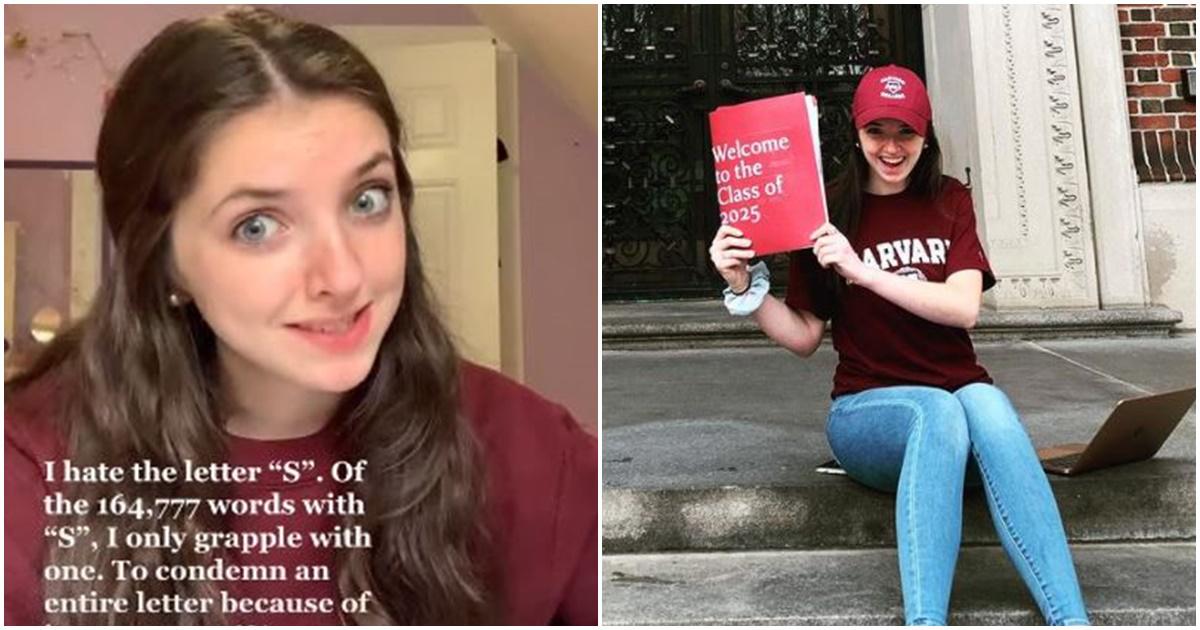
Abigail Mack, an 18-year-old high school senior from Massachusetts, is over the moon after being admitted to Harvard during the most competitive admission season of all time.

Applications to the university skyrocketed during the pandemic and it was only able to accept 1,968 out of 57,435 first-year applicants, less than 4%.

However, Abigail didn't just overcome long odds during the application process, she was accepted because she was able to thrive as a high school student after losing her mother to cancer. Her experience losing a parent was the topic of her inspiring admissions essay which has touched countless lives.


A TikTok post of her reading a portion of the letter went viral with millions of views.


Her essay begins with a meditation on the letter "S" and how it has affected her life.

"I hate the letter 'S,'" Abigail's essay begins. "Of the 164,777 words with 'S,' I only grapple with one. To condemn an entire letter because of its use .0006 percent of the time sounds statistically absurd, but that one case changed 100 percent of my life. I used to have two parents, but now I have one, and the 'S' in 'parents' isn't going anywhere."

"'S' follows me," she continued. "I can't get through a day without being reminded that while my friends went out to dinner with their parents, I ate with my parent. As I write this essay, there is a blue line under the word 'parent' telling me to check my grammar; even Grammarly assumes that I should have parents, but cancer doesn't listen to edit suggestions."

"I won't claim that my situation is as unique as one in 164,777, but it is still an exception to the rule — an outlier," she continued. "The world isn't meant for this special case."

Abigail then shares that after losing a parent she got involved with as many extracurricular activities as possible to get her mind off of the gut-wrenching loss.

"You can't have dinner with your parent...if you're too busy to have family dinner," she said. "I couldn't fill the loss that 'S' left in my life, but I could at least make sure I didn't have to think about it. There were so many things in my life I couldn't control, so I controlled what I could — my schedule."

But eventually, she decided to go from mourning the loss of one "S" to embracing two by whittling down her activities to three "paSSions": Theater, academics, and politics.

"'S' got me moving, but it hasn't kept me going," Abigail concluded in her essay. "I don't seek out sadness, so 'S' must stay on the sidelines, and until I am completely ready, motivation is more than enough for me."

Abigail's mother opened up a dance studio which is still run by her father, a musician, so theater is a natural extension of her upbringing. She excelled at academics, becoming the valedictorian of her school. Politics is a passion she developed over the summer of 2020.

"When the Black Lives Matter demonstrations were occurring this past summer, I realized how passionately I felt about politics," she told Buzzfeed. "I knew that I could no longer stand idly by and watch as the world made leaps forward without me. I became a fellow on Senator Ed Markey's re-election campaign and also taught volunteers how to phone bank for Joe Biden's campaign. It was extremely gratifying to feel like my voice was being heard."

Abigail is unsure what her major will be at Harvard but she plans to pursue social sciences, the humanities, and possibly French.

She has some great advice for high schoolers coming up behind her to get into their dream schools.

"Your college application is a culmination of everything you've done in high school," she said. "You've already put in the work, so the hardest part is done. Now, you just have to put pen to paper, share what you've accomplished, and, most importantly, illustrate how you plan to make a difference going forward in your own, unique way."

Pop Culture

Artist uses AI to create ultra realistic portraits of celebrities who left us too soon

What would certain icons look like if nothing had happened to them?

Mercury would be 76 today.

Some icons have truly left this world too early. It’s a tragedy when anyone doesn’t make it to see old age, but when it happens to a well-known public figure, it’s like a bit of their art and legacy dies with them. What might Freddie Mercury have created if he were granted the gift of long life? Bruce Lee? Princess Diana?

Their futures might be mere musings of our imagination, but thanks to a lot of creativity (and a little tech) we can now get a glimpse into what these celebrities might have looked like when they were older.

Alper Yesiltas, an Istanbul-based lawyer and photographer, created a photography series titled “As If Nothing Happened,” which features eerily realistic portraits of long gone celebrities in their golden years. To make the images as real looking as possible, Yesiltas incorporated various photo editing programs such as Adobe Lightroom and VSCO, as well as the AI photo-enhancing software Remini.

“The hardest part of the creative process for me is making the image feel ‘real’ to me,” Yesiltas wrote about his passion project. “The moment I like the most is when I think the image in front of me looks as if it was taken by a photographer.”

Yesiltas’ meticulousness paid off, because the results are uncanny.

Along with each photo, Yesiltas writes a bittersweet message “wishing” how things might have gone differently … as if nothing happened.
Keep ReadingShow less
All images provided by Adewole Adamson

It begins with more inclusive conversations at a patient level

True

Adewole Adamson, MD, of the University of Texas, Austin, aims to create more equity in health care by gathering data from more diverse populations by using artificial intelligence (AI), a type of machine learning. Dr. Adamson’s work is funded by the American Cancer Society (ACS), an organization committed to advancing health equity through research priorities, programs and services for groups who have been marginalized.

Melanoma became a particular focus for Dr. Adamson after meeting Avery Smith, who lost his wife—a Black woman—to the deadly disease.

melanoma,  melanoma for dark skin Avery Smith (left) and Adamson (sidenote)

This personal encounter, coupled with multiple conversations with Black dermatology patients, drove Dr. Adamson to a concerning discovery: as advanced as AI is at detecting possible skin cancers, it is heavily biased.

To understand this bias, it helps to first know how AI works in the early detection of skin cancer, which Dr. Adamson explains in his paper for the New England Journal of Medicine (paywall). The process uses computers that rely on sets of accumulated data to learn what healthy or unhealthy skin looks like and then create an algorithm to predict diagnoses based on those data sets.

This process, known as supervised learning, could lead to huge benefits in preventive care.

After all, early detection is key to better outcomes. The problem is that the data sets don’t include enough information about darker skin tones. As Adamson put it, “everything is viewed through a ‘white lens.’”

“If you don’t teach the algorithm with a diverse set of images, then that algorithm won’t work out in the public that is diverse,” writes Adamson in a study he co-wrote with Smith (according to a story in The Atlantic). “So there’s risk, then, for people with skin of color to fall through the cracks.”

Tragically, Smith’s wife was diagnosed with melanoma too late and paid the ultimate price for it. And she was not an anomaly—though the disease is more common for White patients, Black cancer patients are far more likely to be diagnosed at later stages, causing a notable disparity in survival rates between non-Hispanics whites (90%) and non-Hispanic blacks (66%).

As a computer scientist, Smith suspected this racial bias and reached out to Adamson, hoping a Black dermatologist would have more diverse data sets. Though Adamson didn’t have what Smith was initially looking for, this realization ignited a personal mission to investigate and reduce disparities.

Now, Adamson uses the knowledge gained through his years of research to help advance the fight for health equity. To him, that means not only gaining a wider array of data sets, but also having more conversations with patients to understand how socioeconomic status impacts the level and efficiency of care.

“At the end of the day, what matters most is how we help patients at the patient level,” Adamson told Upworthy. “And how can you do that without knowing exactly what barriers they face?”

american cancer society, skin cacner treatment"What matters most is how we help patients at the patient level."https://www.kellydavidsonstudio.com/

The American Cancer Society believes everyone deserves a fair and just opportunity to prevent, find, treat, and survive cancer—regardless of how much money they make, the color of their skin, their sexual orientation, gender identity, their disability status, or where they live. Inclusive tools and resources on the Health Equity section of their website can be found here. For more information about skin cancer, visit cancer.org/skincancer.

The mesmerizing lost art of darning knit fabric.

For most of human history, people had to make their own clothing by hand, and sewing skills were subsequently passed down from generation to generation. Because clothing was so time-consuming and labor-intensive to make, people also had to know how to repair clothing items that got torn or damaged in some way.

The invention of sewing and knitting machines changed the way we acquire clothing, and the skills people used to possess have largely gone by the wayside. If we get a hole in a sock nowadays, we toss it and replace it. Most of us have no idea how to darn a sock or fix a hole in any knit fabric. It's far easier for us to replace than to repair.

But there are still some among us who do have the skills to repair clothing in a way that makes it look like the rip, tear or hole never happened, and to watch them do it is mesmerizing.

Keep ReadingShow less
Joy

Nurse turns inappropriate things men say in the delivery room into ‘inspirational’ art

"Can you move to the birthing ball so I can sleep in the bed?"

Holly the delivery nurse.

After working six years as a labor and delivery nurse Holly, 30, has heard a lot of inappropriate remarks made by men while their partners are in labor. “Sometimes the moms think it’s funny—and if they think it’s funny, then I’ll laugh with them,” Holly told TODAY Parents. “But if they get upset, I’ll try to be the buffer. I’ll change the subject.”

Some of the comments are so wrong that she did something creative with them by turning them into “inspirational” quotes and setting them to “A Thousand Miles” by Vanessa Carlton on TikTok.

“Some partners are hard to live up to!” she jokingly captioned the video.

Keep ReadingShow less