upworthy
Add Upworthy to your Google News feed.
Google News Button
Joy

Her boyfriend asked her to draw a comic about their relationship. Hilarity ensued.

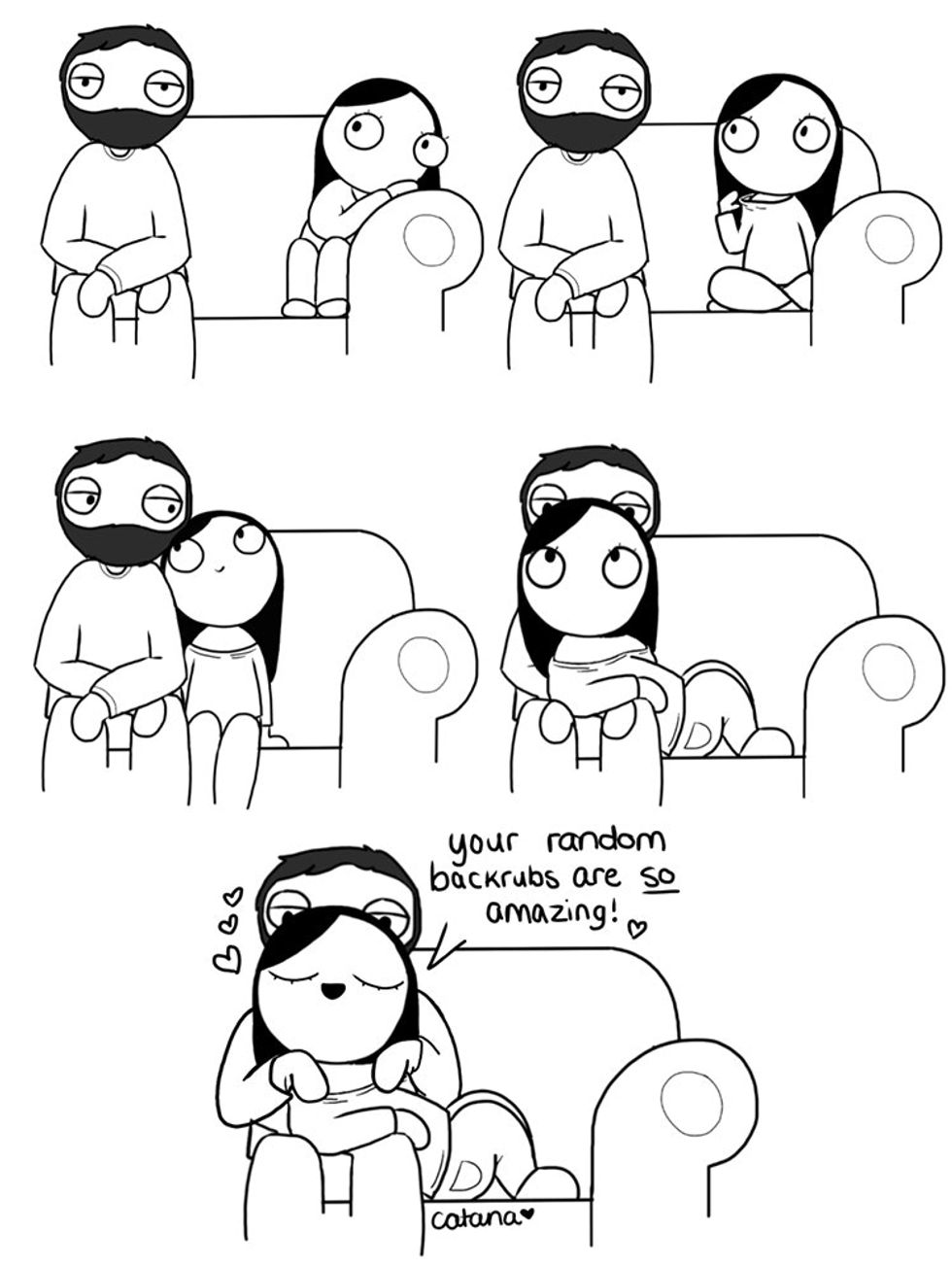
The series combines humor and playful drawings with spot-on depictions of the intense familiarity that long-standing coupledom often brings.

comic of a couple
All images by Catana Chetwynd

The sweetest illustrations


"It was all his idea."

An offhand suggestion from her boyfriend of two years coupled with her own lifelong love of comic strips like Calvin and Hobbes and Get Fuzzy gave 22-year-old Catana Chetwynd the push she needed to start drawing an illustrated series about long-term relationships.

Specifically, her own relationship.

Chetwynd says her goal is to explore the peculiar aspects of relationships at different stages, using her own as the master template.

The drawings are refreshingly touching, honest, and instantly recognizable to anyone who's ever had to learn to live with, for, and around a long-term partner.

The series combines humor and playful drawings with spot-on depictions of the intense familiarity that long-standing coupledom often brings.

The comics are almost too real—and really, really funny.

If the following comics capture your relationship to a T, you're most definitely not alone.

(All images by Catana Chetwynd.)

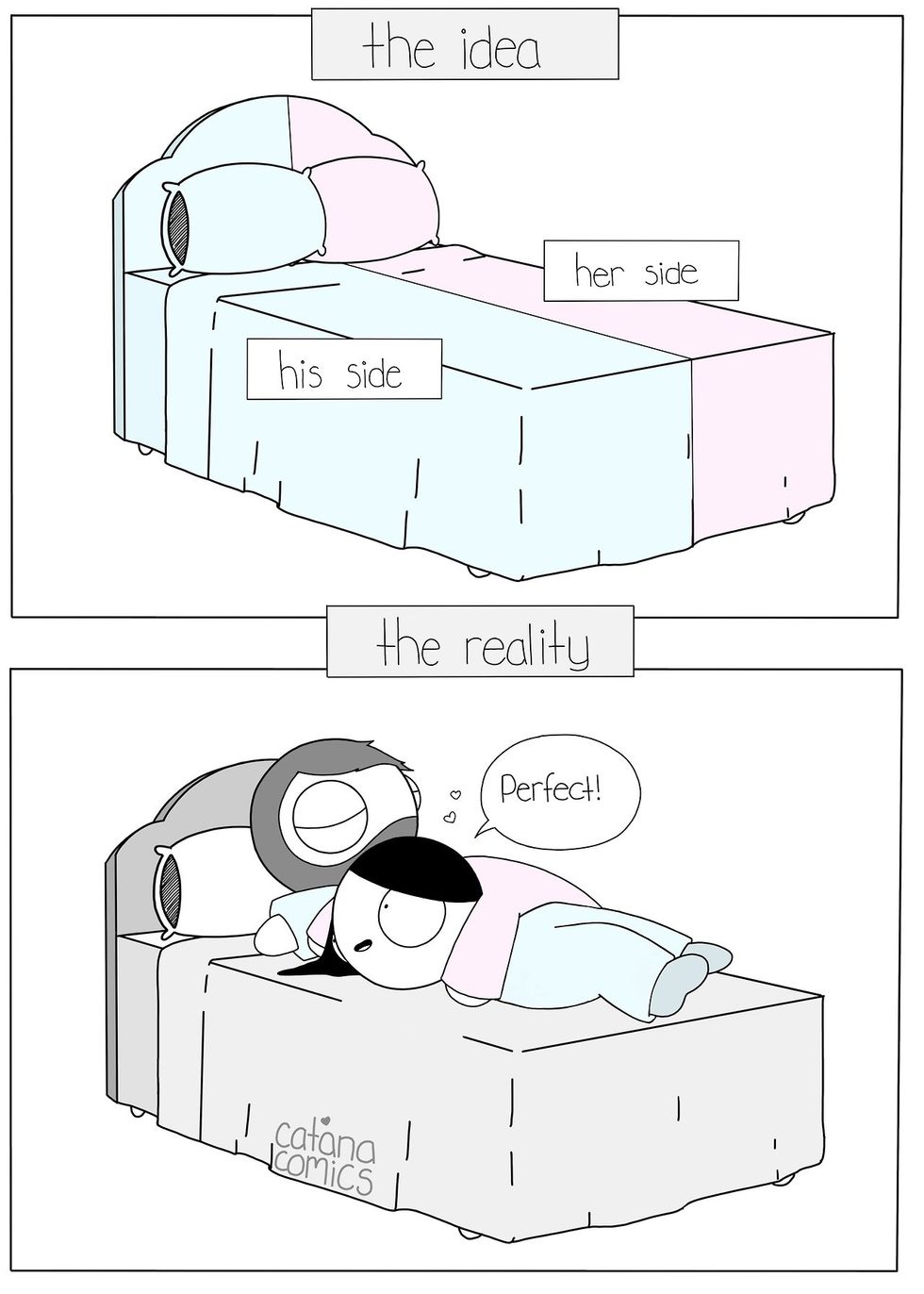
comic of a couple negotiating sides of the bed

There are no sides, actually.

Catana Comics

comic of couple sharing food

The answer is always yes

Catana Comics

comic of woman feeling special

Kind words always hold a big impact

Catana Comics

comic of couple out for the night

Beauty is pain, after all.

Catana Comics

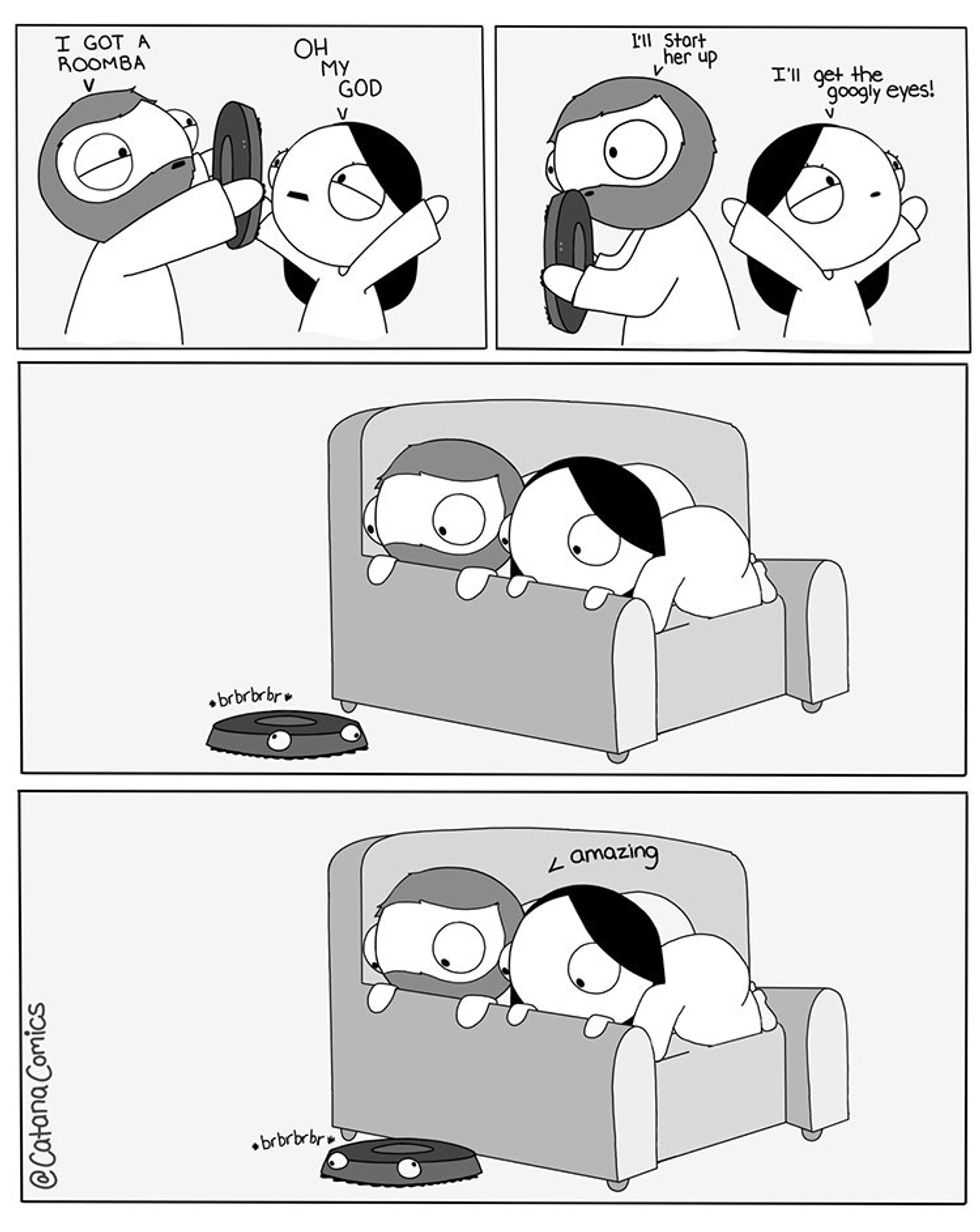
comic of couple playing with a roomba

Important business

Catana Comics

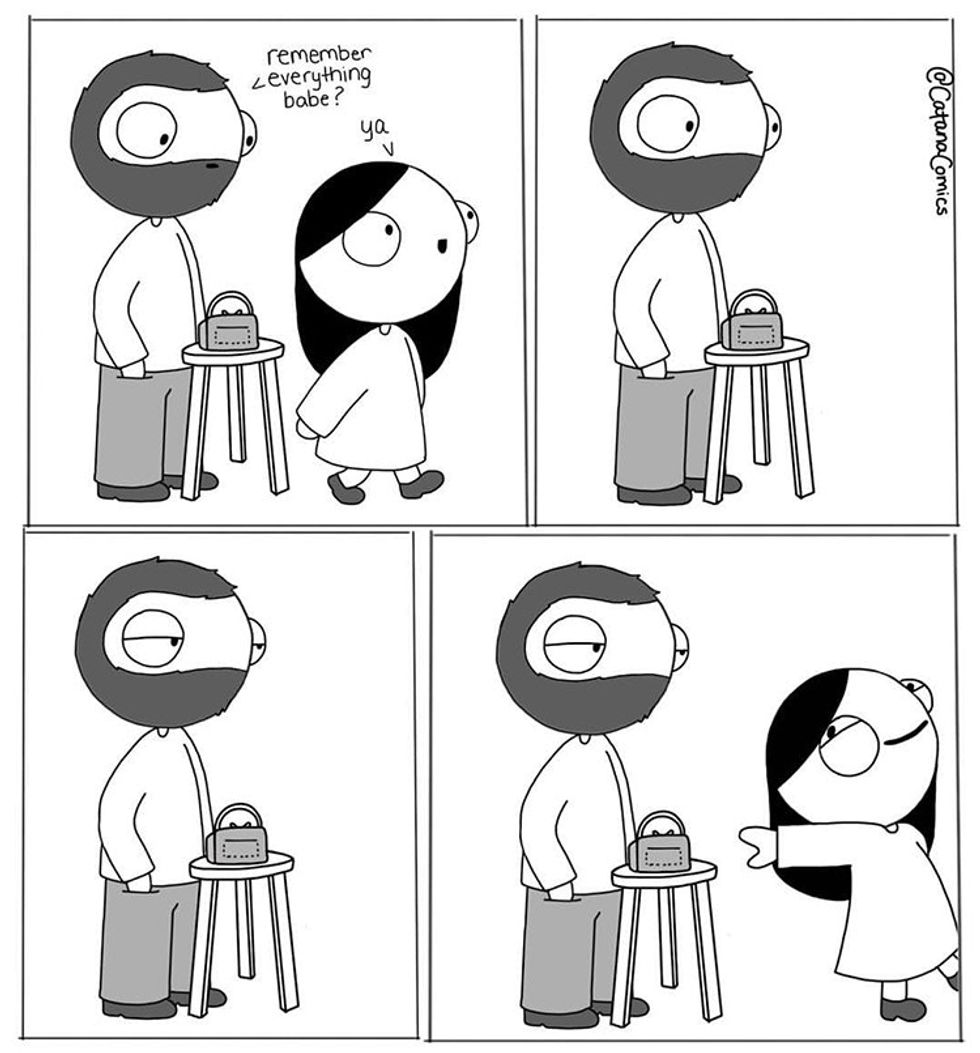
comic of a couple

She'd forget her head if it wasn't attached, probably

Catana Comics

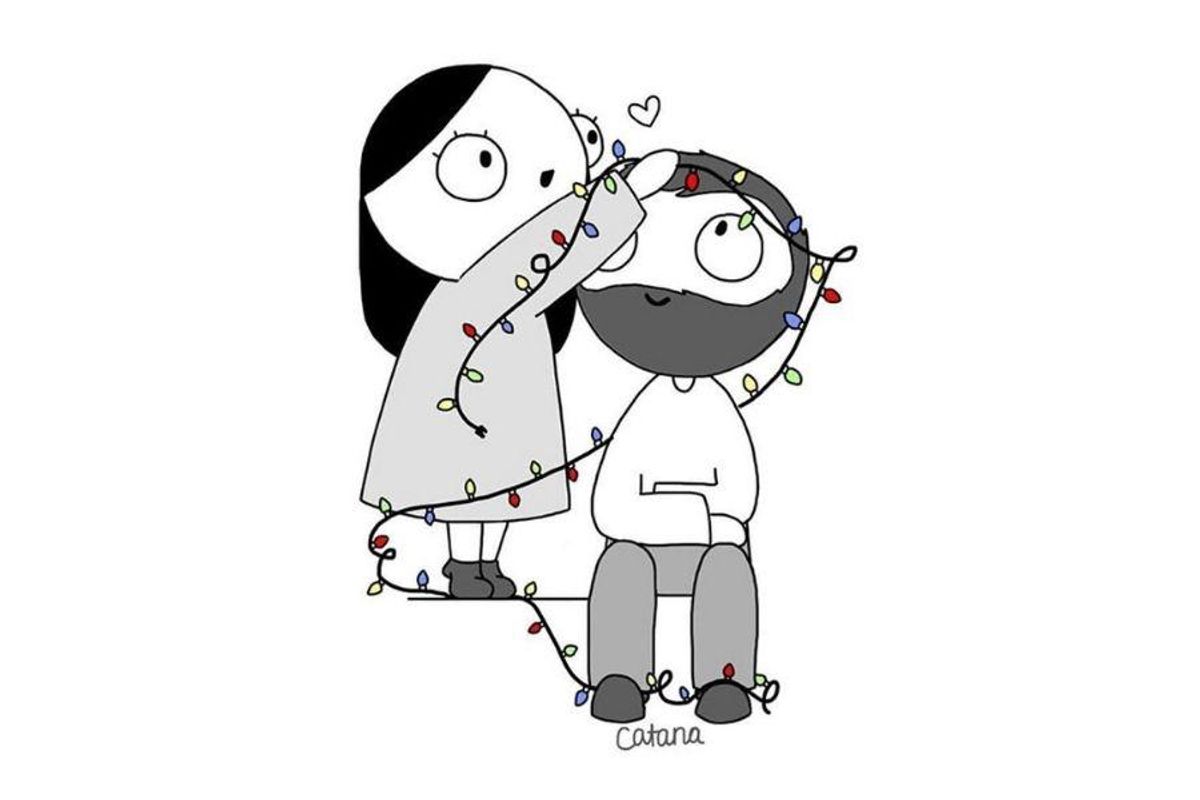
comic of a couple

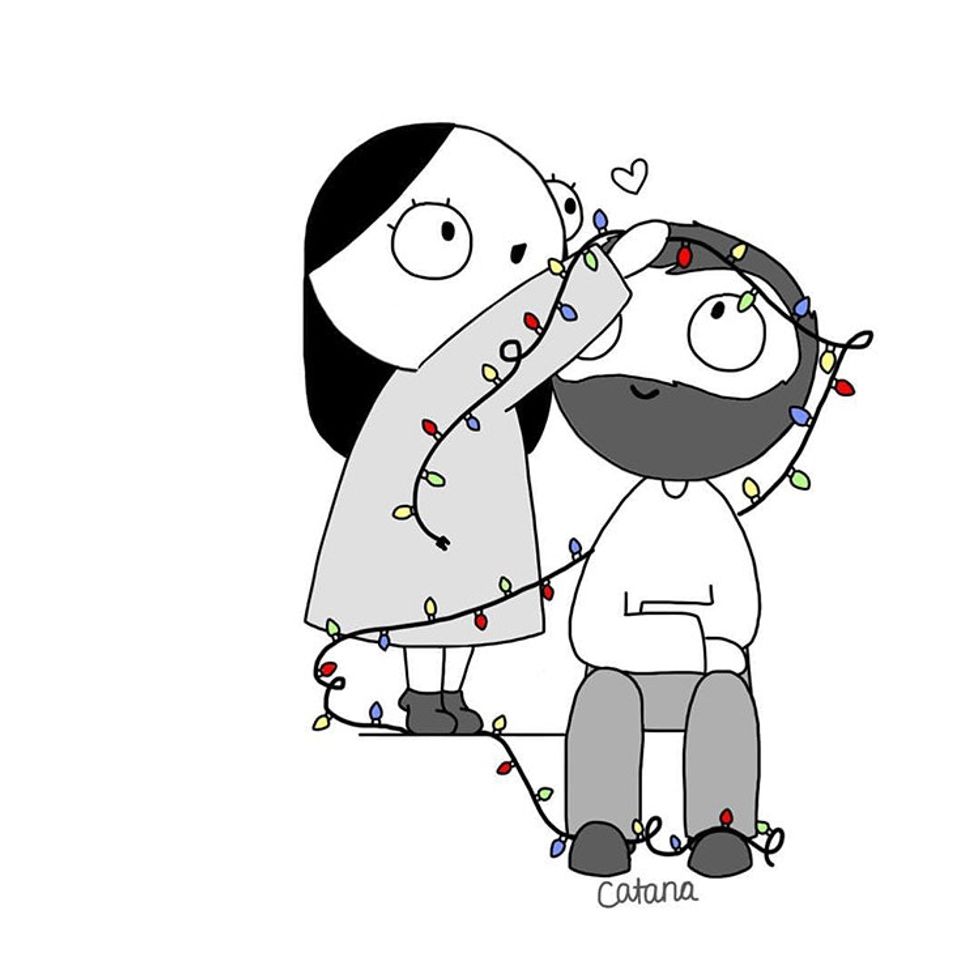
Happy Holidays!

Catana Comics

comic of couple

Growing closer all the time

Catana Comics

comic of couple

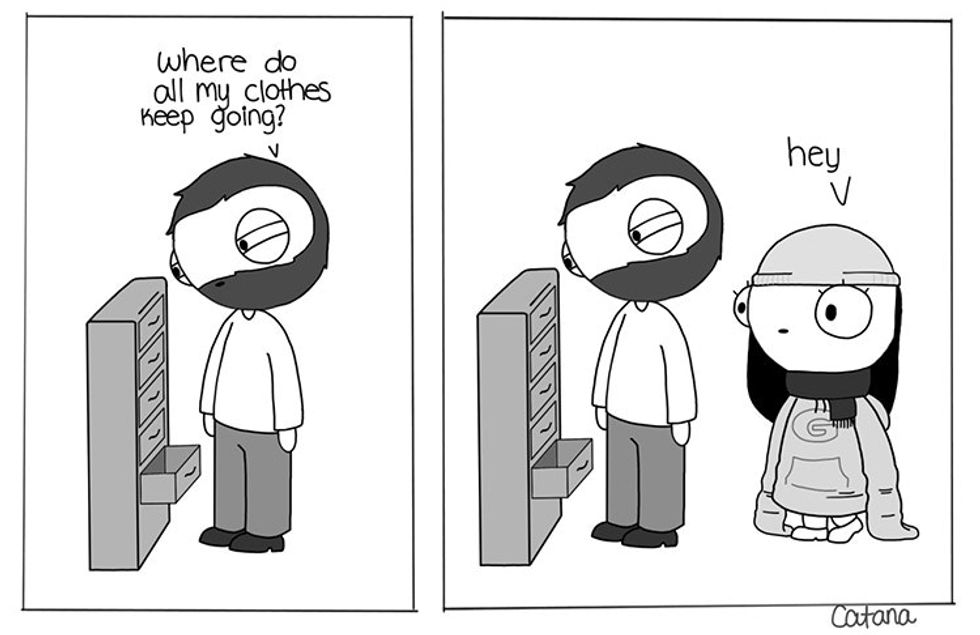
They're OUR clothes now.

Catana Comics

comic of couple

No boundaries!

Catana Comics

comic of couple

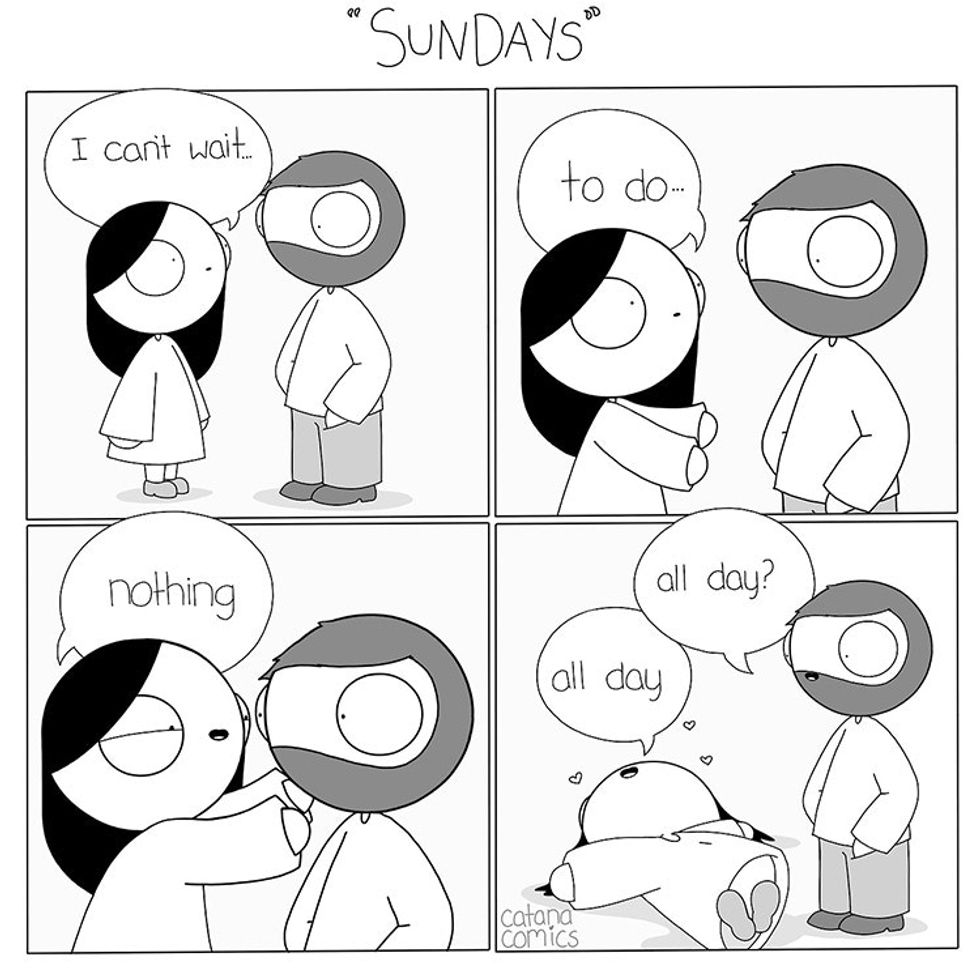
Do-nothing days are the best.

Catana Comics

comic of couple

He can take a hint.

Catana Comics

comic of couple

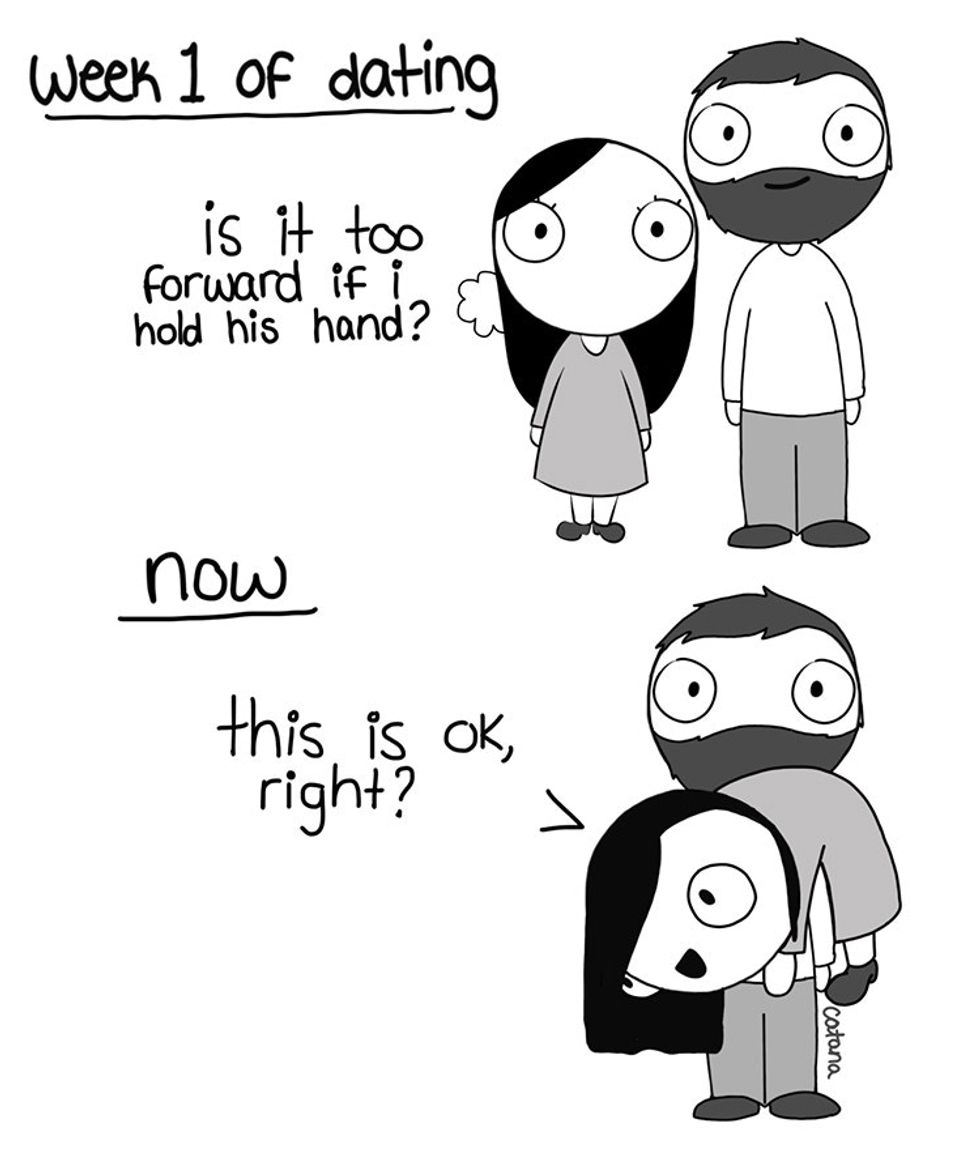
Time is split into the Before Time and the Now.

Catana Comics

comic of couple

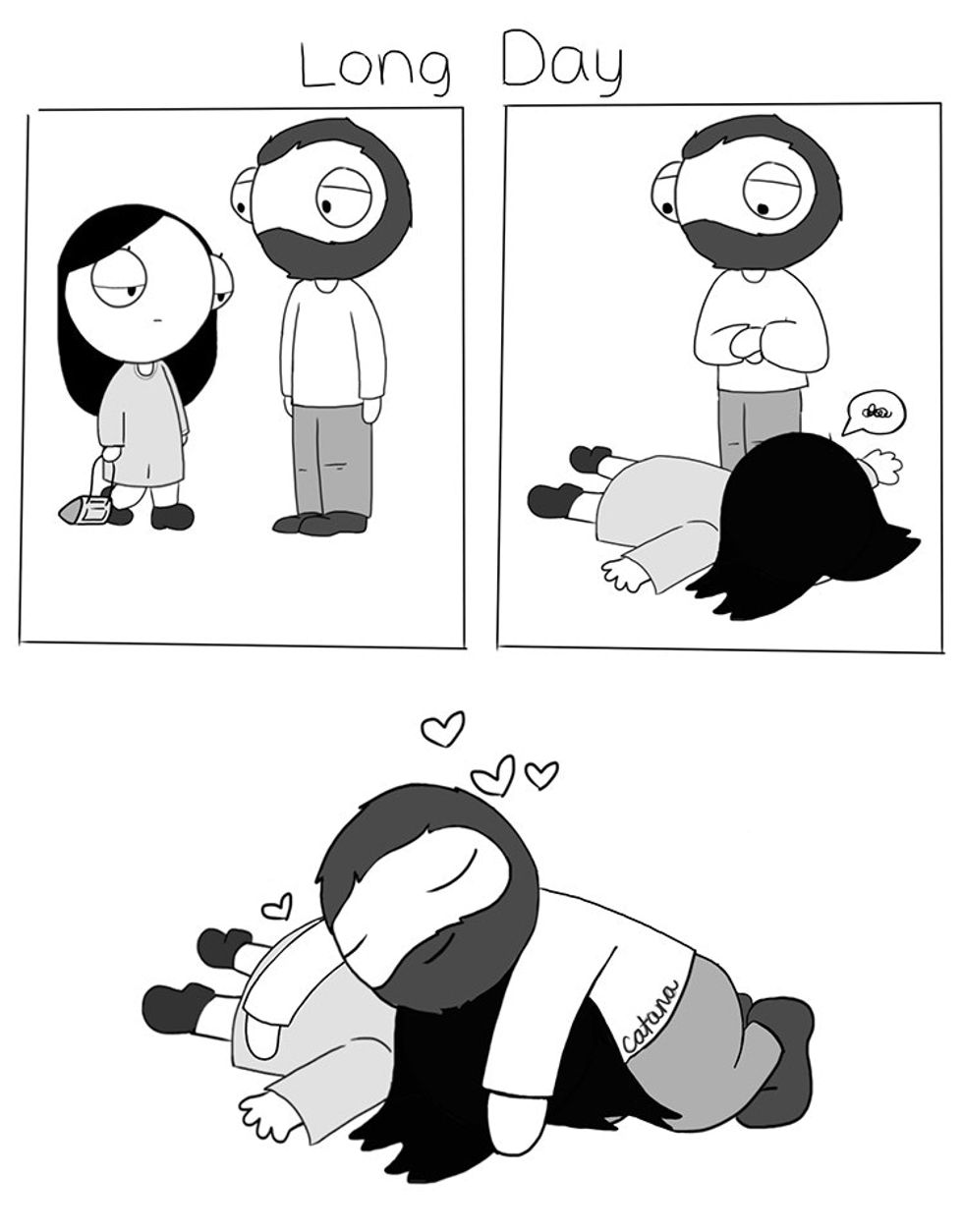
Long days don't feel so long.

Catana Comics

"When I started doing the comic, we hadn't lived together or anything yet, and now we've done the whole thing of moving in together and meeting the parents and everything." 


The evolution of their relationship provides the creative fuel for the comic strip. Thankfully her boyfriend, John Freed, is fully on board with being depicted in (digital) ink—despite having to occasionally awkwardly explain things that appear in the strip to their family and friends.

The connection she has built with Freed, Chetwynd says she wouldn't trade for anything—especially now that it inspires her art.

"The end goal for me was always to have somebody that I could be comfortable with in this way, and I think I got that."

You can follow Catana Comics on Facebook, X (formerly Twitter), and Instagram where she still posts comics every week.


This article originally appeared eight years ago.


Gen Z; Millennials; technology; cell phones; social media; teens and technology; teens social media

Gen Z is the first generation less cognitively capable than their parents. Denmark has the solution.

Nearly every parent hopes their child will be better off than they are: smarter, more secure, and more well-adjusted. Many parents see this as a stamp of successful parenting, but something has changed for children growing up today. While younger generations are known for their empathy, their cognitive capabilities seem to be lagging behind those of previous generations for the first time in history.

Dr. Jared Cooney Horvath, a teacher turned cognitive neuroscientist who focuses on human learning, appeared before Congress to discuss concerns about cognitive development in children. In his address to the members of Congress, he says, "A sad fact that our generation has to face is this: our kids are less cognitively capable than we were at their age. Since we've been standardizing and measuring cognitive development since the late 1800s, every generation has outperformed their parents, and that's exactly what we want. We want sharper kids."


kids, intelligence, sharp kids, generations, education, cognitive abilities Student smiling in a classroom, working on a laptop.Photo credit: Canva

Horvath explains that the reason this happens is that each generation has gone to school longer than the previous generation. Gen Z is no exception to the longer duration of time spent in school, but they're the first ones who aren't meeting this normal increase in cognitive development. According to the cognitive neuroscientist, the decline is due to the introduction of screens in the classroom, which started around 2010.

"Across 80 countries, as Jean was just saying, if you look at the data, once countries adopt digital technology widely in schools, performance goes down significantly. To the point where kids who use computers about five hours per day in school for learning purposes will score over two-thirds of a standard deviation less than kids who rarely or never touch tech at school," Horvath reveals.

In most cases, the decline in performance doesn't result in better strategies. The neuroscientist shares that the standardized testing has been adjusted to accommodate lower expectations and shorter attention spans. This is an approach that educators, scientists, and researchers went to Capitol Hill to express wasn't working. But not every country is taking the approach of lowering standards to meet lowered cognitive ability. Denmark went in the opposite direction when it realized their students were slipping behind.

France24 recently interviewed educators in Denmark following their seemingly novel approach to students struggling with cognitive development. Since the beginning of the 2025/2026 school year, Denmark has not only been having students turn in their cellphones, but they've also taken tablets, laptops, and computers out of the classroom. No more digital learning for the majority of the school day. Danes went old school by bringing back physical textbooks, workbooks, and writing assignments. The results have been undeniable. Even the students can't seem to deny the success of the countrywide shift in educational approach.

"I think the biggest issue has been that, because we kind of got rid of the books and started using screens instead, that we've noticed that a lot of the kids have trouble concentrating, so it's pretty easy to swipe with three fingers over to a different screen and have a video game going, for example, in class," Copenhagen English teacher, Islam Dijab tells France24.

Now, instead of computers being part of every lesson, Denmark uses computers very sparingly and with strict supervision. One student says that it has been nice not having screen time at school because she loves to read and write. But it wasn't just the lack of attention span children were developing, they were also developing low self-esteem and poor mental health due to the amount of time spent on devices.

kids, intelligence, sharp kids, generations, education, cognitive abilities Students focused and ready to learn in the classroom.Photo credit: Canva

The data showing the negative impact of screens on teens' brains has prompted a nationwide change in Denmark that extends outside of the classroom. Afterschool activities are eliminating or extremely limiting electronic use. There is also a national No Phone Day that encourages everyone to put away their devices for the day, and Imran Rashid, a physician and digital health expert, is petitioning parliament to ban social media use for children under the age of 15. The no phone movement in Denmark is a nationwide effort that hopes to right the ship before another generation feels the effects.

skunk, wildlife, skunk spray, animals, good people
Photo Credit: Canva

A skunk from the front and from the back.

Imagine you’re a skunk, just minding your own business waddling down the street. You're sniffing around when suddenly a glass jar gets stuck onto your snout. It becomes harder to breathe as carbon dioxide fills the jar, leaving you little to no room to exhale.

The clock is ticking. Perhaps you begin to panic. But, because there really is still absolute good in this world, so you're in luck.


This is what happened when Cheryl Rhodes spotted a skunk with a jar on its head. In a video posted to her TikTok page in December 2025, we see her running after the tiny skunk, knowing that time is of the essence. "Oh gosh, please," she exclaims. As she approaches, she bends down and beckons, "Come here, baby. Come here, come on." The skunk continues walking toward her as she gently gives it direction. "Come here. Let me get it off of your face."

@cherlavie

I found a lil skunk with a glass jar stuck on its head. Against my husband's advice, I pursued the skunk. I'm still in shock that it let me relieve it without retaliation. Ain't smellin like a skunk today! #skunkrescue #animalrescue #skunkslivesmatter #savealife #skunksoftiktok

She gingerly reaches out and grabs the jar, lifting the skunk temporarily into the air. Her voice becomes tense. "Please get it off. Please come on. Good boy!" She is able to remove the jar and quickly yells to her husband, "Honey, I got it! He didn't spray me!" She then cries in joyous relief.

The last shot oof the clip is of the dirty little jar, which created all the trouble in the first place.

Rhodes told Storyful, "I asked my husband to try to take the glass jar off the skunk's head. He said no, he's been sprayed before in the past. I couldn't just leave the skunk in that condition. My husband started to record unbeknownst to me. He thought I was going to get sprayed. Thankfully, I had a much better outcome."

Skunk spray is actually a fluid stored in their glands. Other animals, like opossums, have similar abilities. Havahart, "a leading manufacturer of wildlife control products," explains, "Skunk spray consists of a chemical called N-butylmercaptan, which is a pungent mix of sulfur-based compounds. The skunk stores the spray in glands positioned alongside its anus, which is why it needs to lift its tail to spray."

On the ABC Humane Wildlife site, they share that skunks don't actually enjoy spraying. "They actually only use their spray as a last resort when they feel they have exhausted all of their other defense mechanisms. A skunk only holds about 4 tablespoons of its noxious fluid, and it can take several days to replenish, leaving it vulnerable in the meantime."

In fact, they often attempt other defense mechanisms first. "When someone is bold enough to threaten them, the skunk’s first instinct is to run away. If this doesn’t work, it will turn around to face its enemy, raise its tail as a warning, and stomp its front feet. If this still isn’t effective in scaring away the attacker, the skunk will then use its spray."

The science behind skunk spray is fascinating. www.youtube.com, Animalogic

The comments on this heroic story are so lovely. On TikTok, one person paraphrases writer Karen Davidson, who once said, "Saving one dog won't change the world, but for that one dog, the whole world will change forever." The commenter changed it to, "Saving one animal won't change the world, but for that one animal, the whole world will change forever."

Another notes the tears at the end. "The crying while walking away victorious in your rescue mission is so valid."

Yet another noticed the skunk seeming to trust her, though it must have also been terrified. "The fact that the skunk came to you for help makes me (four smiling face emojis)."

And many simply wish the skunk-helper wonderful wishes. "I hope your pillow is always cool and you get all the green lights when you're running late."

On ABC 7's Instagram, others relay their admiration for Rhodes rescue. "I don't know her, but I love her," says one. Another agrees, "More people like her in the world please." And "Bay Area…protect this woman at all costs."

Another Instagrammer notes what helping the skunk says about her character. "You know the type of person they are when they show compassion towards animals."

Unfortunately, the world isn't always safe for animals like these. In a perfect scenario, a skunk or other wildlife wouldn't have access to a dangerous jar or other trash that might be left around.

Environmental consultant and educator Roberta C. Barbalace writes on EnvironmentalChemistry.com how dangerous trash can be, giving many examples. "Broken glass can cut the feet of foxes, coyotes, or badgers, and unbroken bottles present a hazard to various small animals. Lizards often crawl inside bottles or cans to bask in the warm interior, to seek protection, or search for food; but they may find it difficult to squeeze out again and can die of overheating. Small mammals in search of food often get their heads caught in the openings of jars. Replacing lids on bottles and jars before discarding can help prevent animals from becoming entrapped. Birds, fish, and mammals may be ensnared by plastic six-pack holders."

But there are solutions: "This can be prevented by cutting up the plastic rings so that they do not become traps."

raccoon, wildlife, animals, safety, trash A raccoon poses for the camera. Photo by Joshua J. Cotten on Unsplash

There are other ways people can do their part. The website Plain Disposal offers tips on keeping raccoons, skunks, and even bears safe and out of your trash.

"Keep trash in a secure location," they recommend. "When possible, store your trash inside an enclosed shed or garage until it’s time for pickup. This will prevent animals from accessing it and help keep the trash contained and out of sight. This is probably the easiest solution to keep wildlife out of trash."

They also suggest "installing a small secure enclosure or fencing area where you can store your bins," and/or putting your trash out of reach. "Elevating your trash bins off the ground can help deter them."

As for this little skunk, hopefully it went on to have the best day milling about town—thanks to this good, animal-loving Samaritan.

Science

Helicopters dump 6,000 logs into rivers in the Pacific Northwest, fixing a decades-old mistake

Forty years ago, restoration workers thought logs were the problem. They were wrong.

river restoration, washington, river fish, restoration, Yakama Nation, indigenous land, indigenoues tribes, salmon, trout, pacific northwest

Restoration workers now see how "critical" wood is to the natural habitat.

For decades, river restoration in the Northwestern United States followed a simple rule: if you saw logs in the water, take them out. Clean streams were seen as healthy streams, fast-moving water was seen as optimal, and wood was treated like a "barrier" to natural processes, particularly those of the local fish.

Now, helicopters are flying thousands of tree trunks back into rivers to undo that thinking.


In central Washington, one of the largest river restoration efforts ever attempted in the region is underway. More than 6,000 logs are being placed along roughly 38 kilometers, or 24 miles, of rivers and streams across the Yakama Reservation and surrounding ceded lands.

Nearly 40 years ago, Scott Nicolai was doing the opposite kind of work, all in the name of restoration.

"(Back then) the fish heads — what I call the fisheries folks — we stood on the banks, and we looked at the stream," Nicolai, a Yakama Nation habitat biologist, told Oregon Public Broadcasting. "If we saw a big log jam, we thought, 'Oh, that's a barrier to fish. We want the stream to flow.'"

river restoration, washington, river fish, restoration, Yakama Nation, indigenous land, indigenoues tribes, salmon, trout, pacific northwest Fish find shelter for spawning in the nooks and crannies of wood. Photo credit: Canva

At the time, logs were removed in an effort to simplify the habitat. However, it soon became clear that wood provided vital "complexity," creating sheltered pockets for salmon and bull trout to spawn and supporting algae that feed aquatic insects. Logs also slow water, spread it across floodplains, and allow it to soak into the groundwater. That water is then slowly released back into streams, helping keep them flowing and cooler during hot, dry periods.

The consequences of removing this "critical part of the system" (in addition to overgrazing, railroad construction, and splash dam logging) were made all too clear over the years as the rivers dried up and wildlife populations declined.

"We're trying to learn from our mistakes and find a better way to manage," said Phil Rigdon, director of the Yakama Nation Department of Natural Resources.

That's why Nicolai is now helping lead a project for the Yakama Nation aimed at rebuilding river complexity by returning logs to their rightful place. Many of these streams are now unreachable by road, which is why helicopters are used. Logs are flown from staging areas and carefully placed at precise drop locations marked with pink and blue flagging tape.

river restoration, washington, river fish, restoration, Yakama Nation, indigenous land, indigenoues tribes, salmon, trout, pacific northwest Many of these streams are now unreachable by road, which is why helicopters are used.Photo credit: Canva

The wood comes from forest-thinning projects led by The Nature Conservancy and includes species such as Douglas fir, grand fir, and cedar. Although some of the timber could have been sold, it is instead being used as river infrastructure.

For tribal leaders, the work carries even deeper meaning. During the helicopter flights, they gathered along the Little Naches River for a ceremony and prayer.

river restoration, washington, river fish, restoration, Yakama Nation, indigenous land, indigenoues tribes, salmon, trout, pacific northwest Tribal leaders gathered by the Little Naches River for a ceremony and prayer.Photo credit: Canva

"It was very simple: to bring what was rightfully part of this land back to us," said former tribal chairman Jerry Meninick.

The aftermath of the original restoration project illustrates how human concepts, such as the belief in the superiority of "cleanliness," can be limited and sometimes cause more harm than good. The miracle of nature, however, is that when left to her own devices, she can heal herself.

job interview tips, public speaking, water, job interview, life hack

A glass of water could help you get the job.

Job interviews or any form of public speaking can easily trip a person up, even when they’re totally prepared. It’s human to get lost and go blank in the middle of a thought, or get stuck on a question you've been asked. Well, one expert says that your best ally in such situations is your glass of water.

Behavioral therapist Dr. Shadé Zahrai shared on her TikTok that the next time you go blank during a job interview or a presentation, pause and take a sip from a glass or bottle of water. This isn’t just to refresh your throat, but to buy you time to refresh your mind. Not only does taking a drink of water buy you time to get your mind refocused, but the pause psychologically resets the conversation overall.


@shadezahrai

When your mind goes blank, take a sip! Simple trick to buy yourself more time.

It also puts you back in control. Whomever you're talking to will politely wait for you to finish your sip, allowing you to get the first word in after you’ve regained your composure. This pause can also provide more control in that it forces the conversation to slow down so you can think it through and speak thoroughly and clearly. It eliminates the feeling of needing to match speedy or frantic energy that may have built up during the chat.

In a job interview, it’s likely that the interviewer will offer you water. Some people online have interpreted this gesture as a form of test or mind game, but its actually nothing to worry about in most cases. You won't be judged on whether you drink the water, and it's better to have it if you need it. Career experts also say that, whether you feel thirsty or not, the safest bet is to accept the offer of water during an interview.

Beyond potentially feeling parched or needing a moment to pause Zahrai suggests you should go ahead and say yes to an offering of water from your interviewer. In some cases, there is a psychological component to accepting an offer of a glass of water that increases your chances of getting the job.


@postupcareers

#careersandbeers is mixing in a water. Here are reasons to accept a water in a #jobinterview. #jobinterviewtips #mixinawater #jobinterviewprep

By accepting the water, you’re allowing your interviewer to feel like an accommodating guest. It creates a friendly give and take before you both sit down to discuss the job.

@joshotusanya

Job Interview Hack 😎 (Thoughts?) #interview #learnontiktok #interviewtips #joshosays

Furthermore, saying “no” to the water offer may unintentionally throw off the vibe since, polite or not, "no" is a rejection. That feeling could carry over into the interview, and you’ll go into it at a disadvantage. By saying “yes” to the water offer, however, your interviewer is more likely to take a shine to you. In short, your “yes” might just lead to a job offer down the line.

cleaning, cleaning tips, cleaning hacks, productivity, productivity hacks, adhd, twitter, x, social media

Chronic procrastinators share their weird tricks for tidying up the house.

A lot of people struggle to keep their homes clean and tidy. It can be because they don't have the time, the know-how, or the ability to keep up with how quickly things get dirty again. But for many people, the biggest challenge is simply getting motivated to start. For those folks, finding the right approach can make a world of difference.

Social media users and mega-procrastinators are chiming in with their weird, quirky, and laughably inefficient cleaning strategies that actually work.


It started when an old viral cleaning hack, posted by a user named Pontifier on Hacker News, resurfaced on X:

"I have a cleaning technique I call ant mode. A colony of ants can accomplish a lot. They can move immense amounts of materials, and create well organized groupings of things.

In ant mode, I pick up one thing, and then I put it in a place it belongs. If I don't know where it belongs, I put it down with something else of the same type. I'm only ever picking up one thing, I'm only ever putting it down in one spot. I envision myself becoming a colony of ants.

It's very helpful when moving lots of things from one spot to another, and I pretend that I am one of multiple ants making the same trip back and forth. It's surprising how effective it is because there's no thought required. No second guessing. There's no wondering what to do next, it's just pick up something out of place and move where it belongs.

The best thing about ant mode, is that I can stop anytime, and I've accomplished something. Things are better than I found them."

The post on X went viral, racking up more than 300,000 views along with thousands of likes and comments.

People began confessing that "ant mode" sounded strikingly similar to habits they'd unknowingly picked up on their own.

"I do this all the time," a user replied. "Totally haphazard, no method, just clean something, put something away, wash [something], organize something. Totally at the mercy of whatever I happen to see in that exact moment. No order, no plan, just keep going. These are incredibly productive 10 minutes."

Others began chiming in with their own methods as well.

"The jellyfish"

User Sivori explained their own method, "the jellyfish," which involves wandering the house aimlessly while picking things up and tidying. It's not efficient, but it works.

"I call this action 'entropy walking', I walk from room to room never with hands empty and slowly decrease entropy," user Full Body Alchemist wrote.

Chaining tasks

Another form of structured wandering:

"Also you can 'chain' tasks together: return nail clippers to bathroom, oh shoot trash needs emptied, drop off the trash and notice a charger that should be in the bedroom. it's more efficient because now there's fewer wasted return trips," user Flat suggested.

"Kindred piles"

"I prefer the 'kindred piles' technique," user TheFutureIsDesigned added. "All items of Type A (let's say tools) go to pile A. Don't need to figure out what kind of tool it is or which specific drawer it should go into. First just pile up all the tools. Office supplies. Books. Cables-adapters-extension-cords: if it conducts electricity, it goes into a separate pile. Etc. Even if you don't have the storage space/subdivisions to super-organize everything, at least you have things grouped by properties."

The "GAP method"

"I do [something] similar, for similar reasons," user Thea Nyktos wrote. "I call it the GAP method. Grab, Assess, Put. Grab the nearest thing. Assess where it belongs. Put it there. Rinse and repeat as long as I have the energy."

Timers and counters

Some people swear that turning cleaning into a game or a race is the key to getting themselves motivated:

"I started saying I'll pick up 30 things and count items I put away until it's 30. Similar items or things next to each other count as one. Once I hit 30 it's noticeable cleaner and I'm usually in a good groove to keep going."

"Another trick is just to clean for 5 minutes, set a timer. everyone can spare 5 minutes. you will be amazed at how much you can pick up, how much space you can clear in that time."

One thing at a time

"This is how I get my kids to clean," user StarFox added. "Pick up ONE THING and put it away. Don't even look at everything else, just one thing. OK, good, now do ONE more thing.' And so on until the job is done. With four kids and two adults doing this, cleanup is a breeze."

If all of these methods sound horribly inefficient, that's kind of the point.

"Ant mode" has been a popular idea in ADHD subreddits and other forums for a few years now. It strikes a chord with people who have trouble completing a task from start to finish.

The general concept lines up with how most experts agree people with ADHD should approach cleaning and other tasks. They're often advised to use timers and gamification for short bursts of motivation and to work in "sprints" rather than long, sustained periods. This isn't necessarily because they can't focus, but because the idea of tackling a huge, multi-pronged task (like cleaning the entire house, for example) can be so overwhelming that it causes their brain to slip into a kind of paralysis.

You know what's not overwhelming? Picking up one thing and putting it away.

- YouTube www.youtube.com

Though there is a strong link between the two, not all chronic procrastinators have ADHD, and vice versa. However, there is a lot of overlap when it comes to helpful strategies for both groups.

Some users in the X thread shared how being too focused on efficiency and perfection can ultimately cause them to get nothing done:

If you're not a procrastinator by nature and don't struggle with task paralysis, unstructured, inefficient techniques like the jellyfish or ant mode might seem extremely bizarre. But as the old expression goes, "don't let perfect be the enemy of good." For some people, just getting started at all is already a massive victory.