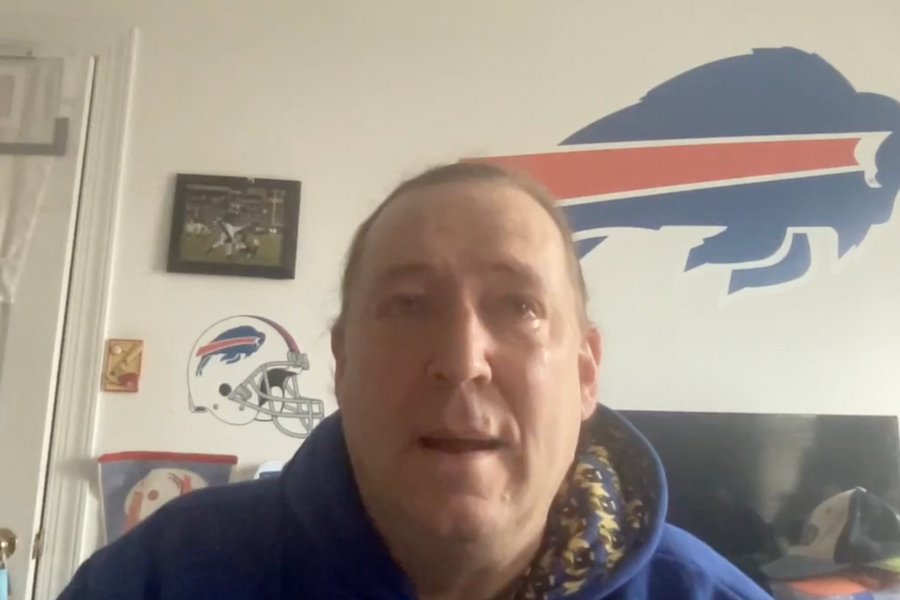
Grieving father explains why he's changing the way he talks about his teen son's death
"We are doing this the wrong way."

David Booth is on a mission.
Losing a child is every parent's worst nightmare, but losing a child to a preventable accident is a unique kind of grief. Such bereaved parents are often haunted by what ifs, and many choose to channel their grief into helping prevent whatever killed their child from happening to other people.
That's what David and Jennifer Booth decided to focus on when they lost their 18-year-old son Nicholas in a car accident in April of 2023. Nick and his friend Will had left lacrosse practice and were driving along a treacherous road near Richmond, Virginia, when they lost control of the car around a curve. The car hit a retaining wall, flipped and burst into flames, killing both teens. The Virginia Department of Transportation estimated that the car was traveling in excess of 80 mph when it struck the wall.
After another local teen was killed in a car crash two days before the new year, Booth reflected on how he talks about his son's death. He took to Facebook Live in January of 2024 to share his thoughts.
After describing the basic details of his son's accident, Booth shared that Nick and Will's bodies had to be identified by their dental remains, which took more than 10 days.
"Since that time, in addition to grieving our children, we parents have worked very hard to share the story of our boys and how their death affected us, in hopes that other young people would make better decisions when getting into cars," he said. "We have focused on love and community and how special those two young men were, and how much they're going to be missed."
Booth explained that he woke up the morning December 30, on what would have been Nick's 19th birthday, to the news that another teen had lost his life in a car accident because of poor decisions. Booth said it felt like he was reading about his own son again—a young man who was "an athlete" with "an unwavering smile and sense of optimism." At first, Booth felt sad, but then he became angry that another young life had been lost after all they'd done to tell Nick and Will's story.
"What it made me realize was that we're telling the story the wrong way," he said. "Instead of talking about how awesome those boys were when they were alive and how much they were loved and how much they meant to the community, in order to reach the young people we're trying to reach, we really need to focus on their death. The fact that it's not cool. It's not a badge of honor. It's not 'neat' that they have 3-on-3 tournaments named after them and plaques hung up on walls and trees planted for them in other neighborhoods. That all sucks. Because they're dead."
"So I will forever change the way I deliver my message," Booth continued. "Instead of showing pictures of my son and his friends having a good time and loving life, I will show pictures of the crash scene. Or instead of talking about what an amazing kid he was, I will talk about how scared he must've been when the car hit that wall. I will talk about the pain associated with the fact that we never even got to see him again in death because he was burned beyond recognition."
"We are doing this the wrong way," he reiterated. "We've got to do better. Young people do not believe that it can happen to them. They do not believe that when it happens, it's forever…I am forever changed by my son's death, but now I am equally changed by the realization that in order to really send the message, you have to use the shock factor and you have to use words that make people uncomfortable."
Watch Booth's message here:
It's heartbreaking that a parent should have to share and relive their son's death in tragic detail in order to prevent the same thing from happening to other young people, but if that's what it takes, that's what it takes. Teens and young adults often see themselves as invincible and, unfortunately, take life-threatening risks in the name of fun, but Booth is on a mission to get people to rethink taking risks behind the wheel.
"I do this for me, I do it for my family, and I do it for my son," he said.
Here's hoping that this father's courage to tell it like it is, even though it's painful, will help the message sink in so that other families can be spared being put in the same position.






a man sitting at a desk with his head on his arms Photo by
Can a warm cup of tea help you sleep better? If you believe it, then yes. Photo by 
A woman is getting angry at her coworker.via
A man with tape over his mouth.via
A husband is angry with his wife. via 
Three women sit on a blanket in the park. 
Two women engaging in a pleasant conversation inside a coffee shop
Two men engaging in a peaceful disagreement.
Resurfaced video of French skier's groin incident has people giving the announcer a gold medal
"The boys took a beating on that one."
Downhill skiing is a sport rife with injuries, but not usually this kind.
A good commentator can make all the difference when watching sports, even when an event goes smoothly. But it's when something goes wrong that great announcers rise to the top. There's no better example of a great announcer in a surprise moment than when French skier Yannick Bertrand took a gate to the groin in a 2007 super-G race.
Competitive skiers fly down runs at incredible speeds, often exceeding 60 mph. Hitting something hard at that speed would definitely hurt, but hitting something hard with a particularly sensitive part of your body would be excruciating. So when Bertrand slammed right into a gate family-jewels-first, his high-pitched scream was unsurprising. What was surprising was the perfect commentary that immediately followed.
This is a clip you really just have to see and hear to fully appreciate:
- YouTube youtu.be
It's unclear who the announcer is, even after multiple Google inquiries, which is unfortunate because that gentleman deserves a medal. The commentary gets better with each repeated viewing, with highlights like:
"The gate the groin for Yannick Bertrand, and you could hear it. And if you're a man, you could feel it."
"Oh, the Frenchman. Oh-ho, monsieurrrrrr."
"The boys took a beating on that one."
"That guy needs a hug."
"Those are the moments that change your life if you're a man, I tell you what."
"When you crash through a gate, when you do it at high rate of speed, it's gonna hurt and it's going to leave a mark in most cases. And in this particular case, not the area where you want to leave a mark."
Imagine watching a man take a hit to the privates at 60 mph and having to make impromptu commentary straddling the line between professionalism and acknowledging the universal reality of what just happened. There are certain things you can't say on network television that you might feel compelled to say. There's a visceral element to this scenario that could easily be taken too far in the commentary, and the inherent humor element could be seen as insensitive and offensive if not handled just right.
The announcer nailed it. 10/10. No notes.
The clip frequently resurfaces during the Winter Olympic Games, though the incident didn't happen during an Olympic event. Yannick Bertrand was competing at the FIS World Cup super-G race in Kvitfjell, Norway in 2007, when the unfortunate accident occurred. Bertrand had competed at the Turin Olympics the year before, however, coming in 24th in the downhill and super-G events.
As painful as the gate to the groin clearly as, Bertrand did not appear to suffer any damage that kept him from the sport. In fact, he continued competing in international downhill and super-G races until 2014.
According to a 2018 study, Alpine skiing is a notoriously dangerous sport with a reported injury rate of 36.7 per 100 World Cup athletes per season. Of course, it's the knees and not the coin purse that are the most common casualty of ski racing, which we saw clearly in U.S. skier Lindsey Vonn's harrowing experiences at the 2026 Olympics. Vonn was competing with a torn ACL and ended up being helicoptered off of the mountain after an ugly crash that did additional damage to her legs, requiring multiple surgeries (though what caused the crash was reportedly unrelated to her ACL tear). Still, she says she has no regrets.
As Bertrand's return to the slopes shows, the risk of injury doesn't stop those who live for the thrill of victory, even when the agony of defeat hits them right in the rocks.