French parents may be banned from sharing photos of their kids online. Should every country do it?
Has “sharenting” gone too far?

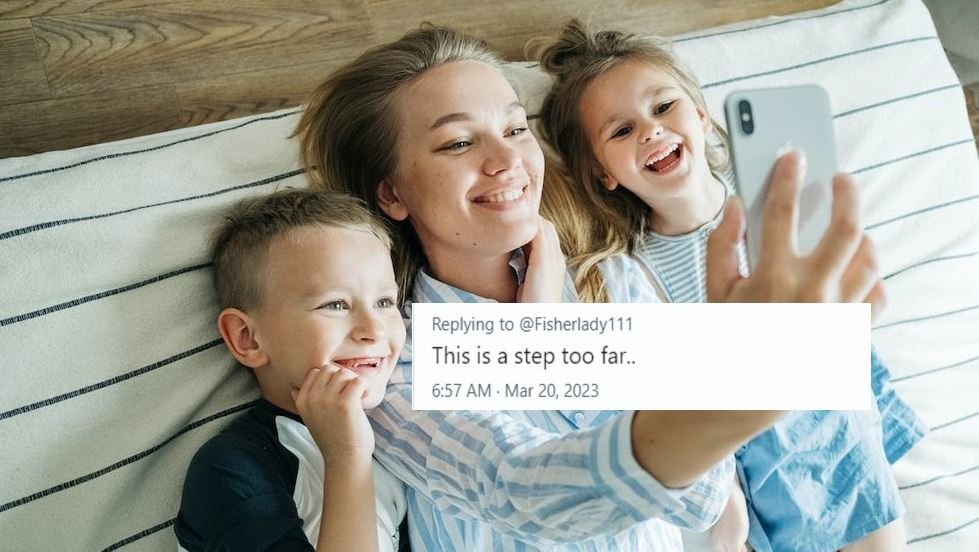
A mom takes a selfie with her two children.
France’s National Assembly has passed a new law that could seriously impact parents’ ability to share photos of their children online. If passed by the Senate and signed by the president, it would give courts the power to ban parents from posting pictures of their children online.
The bill is controversial because it takes away parents’ rights and puts them in the hands of the government. But supporters believe there are more than a few good reasons for the potential ban.
First, it keeps the child’s image out of the hands of unsavory characters. Member of Parliament Bruno Studer, who proposed the bill, told Le Monde, “'A 13-year-old child has an average of 1,300 images of themselves circulating on the internet. These are photos that can be misused for child pornography or that can lead to bullying in the school environment.”
According to Le Monde, 50% of all imagery of children shared on child pornography forums was first posted online by the child’s parents. The bill would also give both parents the right to the child’s image, so if one parent thinks the other is posting inappropriate images, they have the right to stop it.
"The first two articles aim to establish the protection of privacy as one of the responsibilities of parents as holders of parental authority, for which they must obviously involve the child,” Struder continued. "In the most extreme cases, it is provided that the family judge may, if necessary, make a forced partial delegation of parental authority for the specific case of an exercise of image rights."
Opponents of the bill believe that the legislation would strike a blow to parents’ rights. But doesn’t a child have a right to choose how their image is used, especially in a world where the photos could remain visible for the foreseeable future? As the old saying goes, online is forever and photos taken of someone as a child could follow them around well into adulthood.
Further, as the first generation of children who grew up in influencer families are becoming adults, we’re starting to realize the damage the lifestyle can have on young people. Aren’t these kids entitled to some protection from being exploited by their parents?
"We talk a lot about image rights, but not about children's dignity," Thomas Rohmer, Director and founder of l’Observatoire de la Parentalité et de l’Education Numérique, told Le Monde.
The bill has struck up a much-needed debate online and some parents are adamant that it’s their business what they do with photos of their children and no one else’s.
Don't think it's necessarily a bad move, but it should be left at the behest of the parent and not the State.
— Joel (@JoelEveretMusic) March 20, 2023
This is a step too far..
— Walking_Each_Other_Home ♱ (@SouvlakiStud) March 20, 2023
Others joked that bills like this would help end the annoying “sharenting” trend.
A significant percentage of American moms might have nothing to do if banned in the US.
— Lee (@timshel_lee) March 20, 2023
Some applaud the idea.
THANK GOODNESS
— Antikythera (@RealAntikythera) March 20, 2023
Not a bad idea.
— harry webb (@harrywe26805243) March 20, 2023
Once you put your child on social media facial recognition follows them for life . There is no escape no privacy . It is not fair to your child to make such an important decision for them.
— A Conservative Environmentalist (@SUITE911) March 20, 2023
The debate is interesting because it involves three rightfully interested parties—parents, their children, and a state entrusted to protect children's rights. Whether or not the law is passed, the debate should serve as a way for people to confront this serious idea and to give parents a reason to think twice before posting photos of their children online.

- Teacher gets down on the ground to help a boy with autism navigate ... ›
- Couple announces vasectomy with hilarious photos mimicking ... ›
- Parents dress up NICU babies in adorable Halloween costumes to ... ›
- How to stop the new 'Rage Bait' scam where people steal your family photos and warp them with profane text - Upworthy ›
- Interior designer says having family photo 'shrines' in your house is tacky - Upworthy ›


A woman is getting angry at her coworker.via
A man with tape over his mouth.via
A husband is angry with his wife. via 
a man sitting at a desk with his head on his arms Photo by
Can a warm cup of tea help you sleep better? If you believe it, then yes. Photo by 
Three women sit on a blanket in the park. 
Two women engaging in a pleasant conversation inside a coffee shop
Two men engaging in a peaceful disagreement.
Resurfaced video of French skier's groin incident has people giving the announcer a gold medal
"The boys took a beating on that one."
Downhill skiing is a sport rife with injuries, but not usually this kind.
A good commentator can make all the difference when watching sports, even when an event goes smoothly. But it's when something goes wrong that great announcers rise to the top. There's no better example of a great announcer in a surprise moment than when French skier Yannick Bertrand took a gate to the groin in a 2007 super-G race.
Competitive skiers fly down runs at incredible speeds, often exceeding 60 mph. Hitting something hard at that speed would definitely hurt, but hitting something hard with a particularly sensitive part of your body would be excruciating. So when Bertrand slammed right into a gate family-jewels-first, his high-pitched scream was unsurprising. What was surprising was the perfect commentary that immediately followed.
This is a clip you really just have to see and hear to fully appreciate:
- YouTube youtu.be
It's unclear who the announcer is, even after multiple Google inquiries, which is unfortunate because that gentleman deserves a medal. The commentary gets better with each repeated viewing, with highlights like:
"The gate the groin for Yannick Bertrand, and you could hear it. And if you're a man, you could feel it."
"Oh, the Frenchman. Oh-ho, monsieurrrrrr."
"The boys took a beating on that one."
"That guy needs a hug."
"Those are the moments that change your life if you're a man, I tell you what."
"When you crash through a gate, when you do it at high rate of speed, it's gonna hurt and it's going to leave a mark in most cases. And in this particular case, not the area where you want to leave a mark."
Imagine watching a man take a hit to the privates at 60 mph and having to make impromptu commentary straddling the line between professionalism and acknowledging the universal reality of what just happened. There are certain things you can't say on network television that you might feel compelled to say. There's a visceral element to this scenario that could easily be taken too far in the commentary, and the inherent humor element could be seen as insensitive and offensive if not handled just right.
The announcer nailed it. 10/10. No notes.
The clip frequently resurfaces during the Winter Olympic Games, though the incident didn't happen during an Olympic event. Yannick Bertrand was competing at the FIS World Cup super-G race in Kvitfjell, Norway in 2007, when the unfortunate accident occurred. Bertrand had competed at the Turin Olympics the year before, however, coming in 24th in the downhill and super-G events.
As painful as the gate to the groin clearly as, Bertrand did not appear to suffer any damage that kept him from the sport. In fact, he continued competing in international downhill and super-G races until 2014.
According to a 2018 study, Alpine skiing is a notoriously dangerous sport with a reported injury rate of 36.7 per 100 World Cup athletes per season. Of course, it's the knees and not the coin purse that are the most common casualty of ski racing, which we saw clearly in U.S. skier Lindsey Vonn's harrowing experiences at the 2026 Olympics. Vonn was competing with a torn ACL and ended up being helicoptered off of the mountain after an ugly crash that did additional damage to her legs, requiring multiple surgeries (though what caused the crash was reportedly unrelated to her ACL tear). Still, she says she has no regrets.
As Bertrand's return to the slopes shows, the risk of injury doesn't stop those who live for the thrill of victory, even when the agony of defeat hits them right in the rocks.