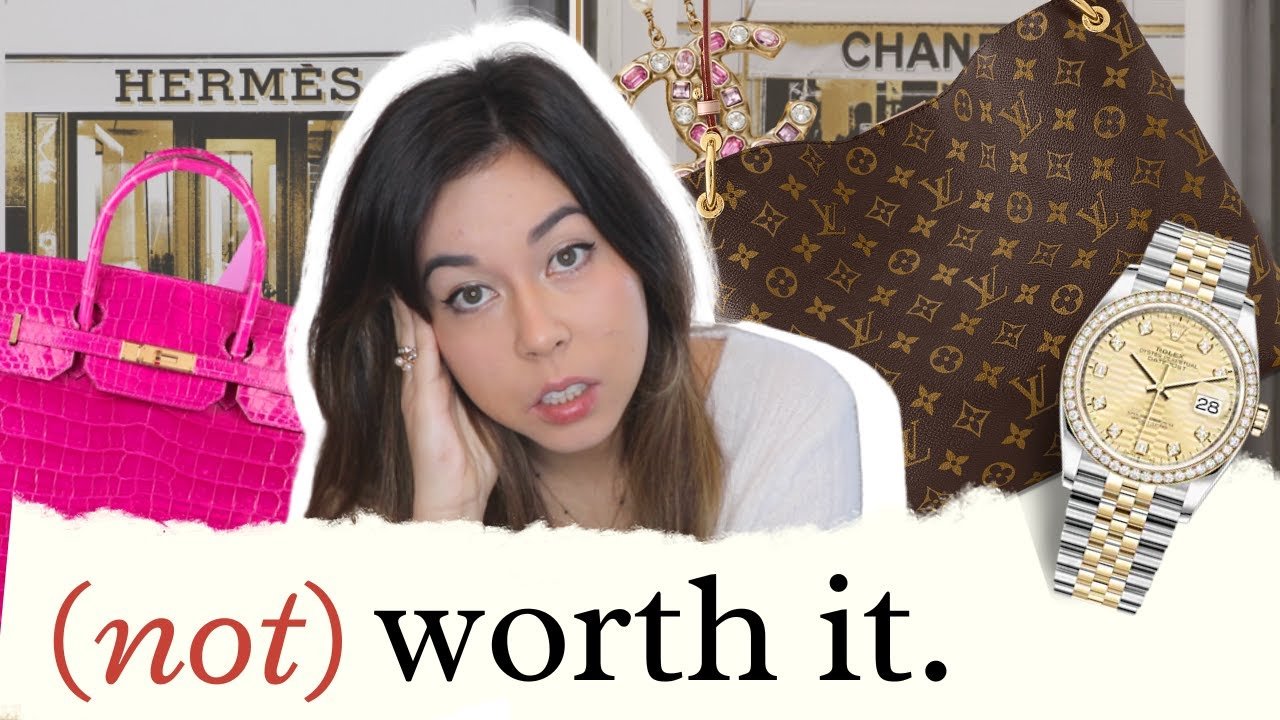
Woman flawlessly breaks down how luxury bags—and other designer brands—keep people ‘poor’
“They’re targeting the people who want to look rich—middle and lower class folks who don’t have a lot of money or savings. That is the bread and butter of designer brands.”
It feels safe to say that we are all hoping to be more mindful about how we spend our money these days, whether it’s to be kinder to the environment, align better with our values, improve our finances or simply exercise free will against the siren call of consumerism.
That’s why this video essay created by Cara Nicole (who gives all kinds of financials and sustainability education on her Youtube channel) feels so timely.
In just under twenty minutes, Nicole astutely breaks down how luxury brands like Hermes, Louis Vuitton and Rolex create the fake illusion of wealth through “manufactured exclusivity” and getting free marketing from celebrities and influencers—who often don’t even pay for the products themselves. Meanwhile, most real rich people wouldn’t be caught dead in the flashy brands, and in reality consider them “overrated.” But still, the illusion persists. Because advertising.
And thus, people are trapped in a cycle of buying “cheat codes” in hopes of improving their status. This not only creates a culture of wastefulness—which does our already taxed planet no favors—it also causes folks to lose out on the opportunity to create actual wealth for themselves.In other words, designer brands will keep you poor.
Nicole did acknowledge that for some, having luxury items brings joy, which holds its own intrinsic value. However, she noted that what is spent on a luxury item could just as easily go into an investment fund, which would pay back more over time, and as a result, allow someone to spend less time working.
Considering the recent uptick of interest in work/life balance, it feels safe to assume that many folks would choose quality time over something material, considering one of these things is virtually a non-renewable resource.
Really, it all comes down to awareness. As Nicole concluded in her video, “Money is time…I think it’s always a good idea to reflect on how we are spending both of them.”
Watch below—every minute is filled with gems. You can follow along on even more finance videos on Nicole’s Youtube channel here

In March 2023, after months of preparation and paperwork, Anita Omary arrived in the United States from her native Afghanistan to build a better life. Once she arrived in Connecticut, however, the experience was anything but easy.
“When I first arrived, everything felt so strange—the weather, the environment, the people,” Omary recalled. Omary had not only left behind her extended family and friends in Afghanistan, she left her career managing child protective cases and supporting refugee communities behind as well. Even more challenging, Anita was five months pregnant at the time, and because her husband was unable to obtain a travel visa, she found herself having to navigate a new language, a different culture, and an unfamiliar country entirely on her own.
“I went through a period of deep disappointment and depression, where I wasn’t able to do much for myself,” Omary said.
Then something incredible happened: Omary met a woman who would become her close friend, offering support that would change her experience as a refugee—and ultimately the trajectory of her entire life.
Understanding the journey
Like Anita Omary, tens of thousands of people come to the United States each year seeking safety from war, political violence, religious persecution, and other threats. Yet escaping danger, unfortunately, is only the first challenge. Once here, immigrant and refugee families must deal with the loss of displacement, while at the same time facing language barriers, adapting to a new culture, and sometimes even facing social stigma and anti-immigrant biases.
Welcoming immigrant and refugee neighbors strengthens the nation and benefits everyone—and according to Anita Omary, small, simple acts of human kindness can make the greatest difference in helping them feel safe, valued, and truly at home.
A warm welcome
Dee and Omary's son, Osman
Anita Omary was receiving prenatal checkups at a woman’s health center in West Haven when she met Dee, a nurse.
“She immediately recognized that I was new, and that I was struggling,” Omary said. “From that moment on, she became my support system.”
Dee started checking in on Omary throughout her pregnancy, both inside the clinic and out.
“She would call me and ask am I okay, am I eating, am I healthy,” Omary said. “She helped me with things I didn’t even realize I needed, like getting an air conditioner for my small, hot room.”
Soon, Dee was helping Omary apply for jobs and taking her on driving lessons every weekend. With her help, Omary landed a job, passed her road test on the first attempt, and even enrolled at the University of New Haven to pursue her master’s degree. Dee and Omary became like family. After Omary’s son, Osman, was born, Dee spent five days in the hospital at her side, bringing her halal food and brushing her hair in the same way Omary’s mother used to. When Omary’s postpartum pain became too great for her to lift Osman’s car seat, Dee accompanied her to his doctor’s appointments and carried the baby for her.
“Her support truly changed my life,” Omary said. “Her motivation, compassion, and support gave me hope. It gave me a sense of stability and confidence. I didn’t feel alone, because of her.”
More than that, the experience gave Omary a new resolve to help other people.
“That experience has deeply shaped the way I give back,” she said. “I want to be that source of encouragement and support for others that my friend was for me.”
Extending the welcome
Omary and Dee at the Martin Luther King, Jr. Vision Awards ceremony at the University of New Haven.
Omary is now flourishing. She currently works as a career development specialist as she continues her Master’s degree. She also, as a member of the Refugee Storytellers Collective, helps advocate for refugee and immigrant families by connecting them with resources—and teaches local communities how to best welcome newcomers.
“Welcoming new families today has many challenges,” Omary said. “One major barrier is access to English classes. Many newcomers, especially those who have just arrived, often put their names on long wait lists and for months there are no available spots.” For women with children, the lack of available childcare makes attending English classes, or working outside the home, especially difficult.
Omary stresses that sometimes small, everyday acts of kindness can make the biggest difference to immigrant and refugee families.
“Welcome is not about big gestures, but about small, consistent acts of care that remind you that you belong,” Omary said. Receiving a compliment on her dress or her son from a stranger in the grocery store was incredibly uplifting during her early days as a newcomer, and Omary remembers how even the smallest gestures of kindness gave her hope that she could thrive and build a new life here.
“I built my new life, but I didn’t do it alone,” Omary said. “Community and kindness were my greatest strengths.”
Are you in? Click here to join the Refugee Advocacy Lab and sign the #WeWillWelcome pledge and complete one small act of welcome in your community. Together, with small, meaningful steps, we can build communities where everyone feels safe.
This article is part of Upworthy’s “The Threads Between U.S.” series that highlights what we have in common thanks to the generous support from the Levi Strauss Foundation, whose grantmaking is committed to creating a culture of belonging.
Ever look through your parents’ high school yearbook and all the teenagers look like they are 35 years old? When you think about how teenagers look today, the difference is striking. But why? Did people grow up much faster back in the day, or is there something else at play?
If you look back to the 1980s, there’s a clear difference between actors Paul Rudd and Wilford Brimley at 50.
Sure, that’s a cherry-picked, extreme version of the difference in how people age, but it does support the idea that just a few decades ago, people aged much faster.
In a recent video, the folks atRecollection Road did a deep dive into why your average high school junior in 1958 looked like a 55-year-old bank manager, and they found seven reasons. They were a mix of environmental and cultural factors that boiled down to one central point: people are much healthier these days.
1. Smoking
“Cigarettes were everywhere: in diners, in offices, even on airplanes. In the 1950s, it wasn’t unusual to see a mother with a baby in one arm and a cigarette in the other. High school kids would light up behind the gym, and by adulthood, many were chain smokers.”
A Gallup poll found that in 1954, 45% of U.S. adults smoked cigarettes at least once a week. Compare this with 2024, when only 11% of Americans smoked a cigarette in the previous week.
2. Sun exposure
“Back in the 1960s and 1970s, a summer tan wasn’t just fashionable, it was almost required. People slathered on baby oil, laid out under the blazing sun, and cooked. There was no SPF 50. In fact, lotion was designed to help you burn faster for a deeper tan. Families on vacation didn’t think twice about spending hours on the beach with no shade. By the time they were in their 30s or 40s, the sun had also carved wrinkles and dark spots into their skin.”
3. Fashion
“Think about old photos of your parents or grandparents. A 25-year-old man in 1948 was often dressed in a suit and tie, maybe even a fedora. A young woman might be wearing a conservative dress and practical shoes. By modern standards, those styles look more grown-up, more like something we’d expect from someone middle-aged.”
4. Life was harder
“Someone who grew up during the Great Depression often started working as a teenager to help put food on the table. A lot of young men were drafted into World War II or Vietnam before they were even old enough to legally drink. That kind of responsibility leaves its mark. … Even women carried heavy burdens. In the 1950s, a young mother might have had three or four kids by the time she was 25, while also running a household without modern conveniences like microwaves or dishwashers.”
5. Drinking
“Having a three martini lunch was common in the business world of the 1960s. Beer was practically considered a food group in some households. Combine that with less knowledge about exercise and health, and you can see why bodies wore down faster, giving people an older appearance earlier in life.”
There has been a sharp decline in the number of Americans who consume alcohol. In 1971, 71% of Americans had the occasional drink, but that number dropped to 54% in 2025. The decline in drinking is attributed to concerns over alcohol’s effect on health and a decrease in consumption amongst younger people.
6. Cultural expectations
“By their mid-20s, most people in the 1950s and ‘60s were married, raising children, and working full-time jobs. Life was about responsibility, not self-expression. They dressed older, behaved older, and carried themselves as adults.”
7. Testosterone
“Studies show that the average testosterone has been steadily declining for decades. Men in the 1950s and ‘60s often had higher natural testosterone than men today, which gave them more muscle mass, broader builds, and in some cases, more facial hair. While that might sound like it would make them look younger, it often had the opposite effect. The heavy brows, thick body hair, and rugged features made young men look tougher, older, and more weathered than their actual age.”
The reunification of Oasis seems to represent something bigger than just two lads who put their differences aside to go on tour. Some could even argue that the notorious repair of the longtime rift between the Gallagher brothers (Liam and Noel) was symbolic of the idea that healingis possible.
This world might need that right now. Representing that healing (at least in clothing form) is the bucket hat, made extremely popular by the Brit Pop era of which Oasis ruled. The Sunday night show at the Rose Bowl in Los Angeles was full of them, bouncing around in different colors by the thousands.
Oasis performs at The Rose Bowl in Los Angeles in 2025. Photo Credit: Marcia Neumeier
According to fashion experts, bucket hats first became popular in the early 1900s, mostly worn by Irish fishermen and farmers. They reemerged in the 60s, then again in the 80s, and then pretty much every decade after. Whether it’s TV character Gilligan, a rapper, or, yes, Liam Gallagher himself, this fashion statement is so strong it creates a movement in the zeitgeist.
Millennials (and some Gen X-ers on the younger end of the spectrum) seemed to especially enjoy ramping up the sales in bucket hat merch. I saw firsthand that you couldn’t throw a guitar pick without bouncing one off those happy little head coverings.
Fashion accessories stylist Fay Parrish told Upworthy that it’s not just bucket hats coming along for the Brit Pop reemergence ride. “Plaid oversized shirts, boot cut jeans and funnel neck tech jackets are back, and with that, their crowning glory, the bucket hat,” she says.
Upworthy also spoke to Eric Turney, President of Sales and Marketing at The Monterey Company. He shares the interesting note that there’s actually a name for this phenomenon. “People in our industry are referring to it as the Oasis Effect. Since the reunion buzz, bucket hats have jumped from streetwear collections to mainstream fall style. Our sales are up, and clothing designers are building them into full seasonal collections.”
At an Oasis show in July in London, Liam made sure the hat was properly described, yelling, “This isn’t f— velvet, and it’s not a f— beanie hat. It’s jumbo cord, and it’s a bucket hat.”
Not quite everyone appreciates the style, though. On Reddit, nearly 300 people have already commented on the post, “Wearing a bucket hat instantly makes people look like jerks.” (Though the OP noted L.L. Cool J pulls it off well, stating, “Maybe LL Cool J gets away with it, but he needs to state that he’s ‘cool’ in his name.”)
Even though there were quite a few jokes, many even in this thread came to the bucket hat’s defense. Some for practical reasons: “I love the bucket hat. It’s perfect for working outside and is better for sun protection or for the rain compared to a baseball hat.” Others were more sentimental, with one exclaiming in all caps: “OASIS FANS IN THE AREA.”
Others took note of Liam fully embracing the look. On the subreddit r/Oasis, many discuss his consistency at every show. Some speculated he’s growing out a bad haircut. Others just believe he’s reinforcing his brand. But whatever he’s doing, it’s creating a bond among generations and setting a reminder that change and forgiveness are possible.
Robin Williams was not just an amazing actor and comedian—he was also a fashion icon. Williams, who passed away on August 11, 2014, has recently been recognized by fans from all generations for his unique personal style that often went unrecognized.
On Reddit on several fashion subforums, Williams is being celebrated for his sartorial style during his long career. “Had no idea Robin Williams had so much drip,” member Classic-Carpet7609 shared in one forum, expressing their admiration for his style that ranged from streetwear to couture.
“Robin Williams was a huge weeb when it came to fashion, like several years ahead of other western celebrities like rappers, etc when it came to wearing a lot of Japanese labels,” one member commented. Another added, “It was news to me too until a couple years ago when I saw that photo of him in the Issey Miyake bomber jacket. I was like daaaaamn he’s like cool cool.”
Fans also are pointing out that Williams was well-versed in fashion brands. He also wore Jean Paul Gaultier, Alexander McQueen, BAPE, Visvim, Acronym, and Mishka, per British GQ.
His taste in fashion wasn’t only elevated, but also functional, and Williams could pull it all off. “I love how versatile, comfortable and confident his looks are. You couldn’t box the man in and I really appreciate that now as an adult,” another commented. “A style icon ahead of his time,” another wrote. Another quipped, “Wtf multiple of these fits you could see someone walking down the street today.”
However, at the time Williams’ style was not making best-dressed lists. “He was RIDICULED at the time for his dress sense. Seriously. On every ‘worst dressed ‘ list constantly,” one commented. Regardless, it was his confidence that continues to stand out with his fashion choices. “I think it must be the confidence. For a dude who was known to be plagued with self-doubt, you would never know it looking at him. He always looks supremely confident in himself and so when he wears, for example, a matador jacket, he pulls it off instead of looking just silly,” another added.
Many fans pointed out that his sometimes outlandish fashion choices had a deeper meaning. “He was more into making statements with his fashion than he was into ‘looking good’.” Another wrote, “I really like his more flamboyant looks.” While another fan noted, “Na honestly that’s wild. He’s wavy.”
Although Williams’ personal style may not have been understood by others, today his boldness is being recognized. “But seriously, I somehow was not aware that he gave so much thought to his looks, and they very much reflect who he is,” one fan commented. Another agreed, saying, “I did not realize until now how good of a dresser he was, wow!” One more confirmed, “So ahead of the curve!”
Most of all, Williams’ fans are most in awe of his style’s authenticity. “There’s a purity and realness about him that is primal. I love his self expression through these outfits,” said one. Another summed it all up wonderfully, writing, “His personality was brighter than any shirt.”
Have you ever looked back at your parents’ high school yearbook and thought that all the 11th graders looked like they were in their early 30s? Whether they were in school in the ‘60s and the kids had horn-rimmed glasses or the ‘80s with feathered hair, they looked at least a decade older than today’s high school kids. One wonders if in 30 years, kids look at a yearbook from 2025 and see boys with broccoli cuts and girls with nose rings and they think, “What are they, 35?”
The folks at Bright Side did a deep dive into the phenomenon and found a few reasons why people looked so much older in the past than they do now. It’s a mix of how our minds perceive older fashion and why people age more gracefully in modern times.
Why did people look older in the past?
“Specialists have looked into this phenomenon, and it does have some scientific facts to back it up,” the narrator states. “It’s not necessarily that our ancestors looked older; it’s more that we appear to look younger. And younger as generations go by, that’s because over time humans have improved the way they live their lives in the us alone over the last 200 years.”
A big reason people looked a lot older when photography became common in the late 1800s is that it happened at a time when we were making tremendous advances in public health. The 1880s to the 1920s were a time of rapid advancement, when we began to understand infectious diseases and how they spread. “We gained access after safer types of foods, and we understand the importance of clean water. Our individual lifestyle choices can impact the way we look,” the video says.
The way we work has also drastically changed how people look. Working in an office for eight hours a day in air conditioning will keep you a lot younger-looking than working all day as a Victorian chimney sweep. Plus, for people who work outside, sunscreen has made it much easier to protect our skin and decrease wrinkles.
Let’s not forget the importance of a straight, white smile. Advances in dental care also help make people look younger.
Why do people wearing styles from the past appear older?
Finally, there’s the clothes issue, and, yes, this does have a big impact on how we view the age of people from the past. “Our brains are wired to associate old trends with being old,” the video says. “For example, your grandpa might still have the shirt he wore in that 1970s picture, and it’s because of that shirt that you retroactively associate that trend with being old, despite the fact that your granddad does look younger in the picture than he looks today. “
In the end, the fact that people look a lot younger today than they did in the past is a testament to how the quality of life has drastically improved since cameras were first invented. However, that doesn’t mean that fashion has improved at all. You have to admit that your dad with that fly butterfly collar in his 1977 graduation photo looks better than that multi-colored, Machine Gun Kelly-style hoodie you see guys wearing in high schools today.
Americans’ attitudes about water have changed over the past 30 years. In the past, a common phrase on the athletic field was, “Don’t drink too much water, you’ll get a cramp,” which was partially true because of the risk for overhydration. Beyond that, the only people with water bottles were hippies. Now, people everywhere walk around with large water bottles, sometimes up to 64oz, attached to themselves like purses. It’s like people leave the house with the sincere belief that they will not be able to find potable water for the next three weeks.
The hydration craze has also meant that water bottles have become trendy status symbols and markers of personal identity. Are you more of a Yeti person or a Stanley? The trend has also been passed down to our children, who are encouraged to bring water bottles to school daily. In 2024, Miss Smith from the popular Bored Teachers TikTok page had fun with the trend in a video that received over 1.5 million views.
“Does anyone over 30 remember being allowed to have a water bottle in their elementary classroom?” she asks in the video.
Miss Smith recalls the only water she had during school back in the day was at lunch or during snack time and even then, the time she was allowed at the water fountain was limited.
“You were like gulping for life at that water fountain while kids behind you were like obnoxiously counting down or being like, ‘She’s getting more than 3 seconds!’” Then, the teacher would tap you on the shoulder, and you were done.
“Can you imagine if we did that to today’s kids? The emails! The calls I would get,” she continued.
The funny thing is that even though kids didn’t drink much water back in the day—and if they did, it was out of a fountain—somehow they survived. Now, we’re raising an entire generation that feels compelled to lug a heavy and costly bottle with them wherever they go, fearing they will suffer from dehydration.
Season 2 Hydration GIF by SpongeBob SquarePants Giphy
The post resonated with many folks over 30 who lived through the dry days of pre-Millennium America.
“I hear all the time that behavior issues have risen since we were kids; my theory is we were too dehydrated to misbehave,” one commenter joked. “We didn’t have water bottles because they also didn’t want us to ever go to the bathroom,” another added. “I don’t remember drinking water as a kid. Unless it was from a hose, it was Kool-Aid or milk. How am I still alive?” another said.
The hydration craze was a news topic in early 2024 after the new, limited edition Stanley + Starbucks water bottle was released at Target stores. The frenzy over the $45 bottle had people camping outside Target and jumping counters to get their hands on newly designed bottles popular with younger women.
The bottles promise to keep hot drinks hot and cold drinks cold for an extended period of time. So, when you drop your daughter off at first period, her water is still cold by the time the 3:05 bell rings. Having cold water throughout the day certainly is a luxury, but does it explain the hype? Some think the hydration craze has gotten out of control but, if history has anything to say about it, trends come and go and extra hydration in fancy cups might be on the way out.
Theodor Capitani von Kurnatowski III has come a long way from Louisiana, where he emancipated himself from his parents at just 14. While shedding parental supervision, he also shed most of his name, so you might only know him as Theo Von.
Just five years later, Theo became a cast member on MTV‘s Road Rules and subsequently appeared on four seasons of MTV’s The Challenge. If you watched those shows, you’ll know Theo never shies away from a funny quip, a weird take, something controversial bordering on dumb, or just plain awkward absurdity.
But through his now many years as a stand-up comic, content creator, and podcaster, he always asks interesting questions of his guests… and of himself. In an article for NOLA, he claimed his evolution of thought was born from having had the “frame of reference of a poor person.”
Just recently, he took a stand on an extremely controversial topic: vests. That’s right…that clothing item that used to be reserved only for tuxedo purposes or Diane Keaton. Brace yourselves: Theo is PRO-VESTS.
He breaks it down on his podcast. “Now I love a vest,” he exclaims. “A vest is the only piece of clothing that you can look sharp and catch a football at the same time. Comfortably, okay?” He pauses for a split second as if to say, let THAT sink in. “If you wanna hug somebody and feel a little bit more of the hug than usual—THAT’S a vest.”
He continues, “If you’ve been drinking all day or doing drugs or whatever and you don’t know if you’re supposed to go to a wedding or a rave, hmm, what am I gonna wear? A snorkel? No! A vest. And that’s just a snorkel for your torso, baby. That f-ing vest.”
Need more proof that a vest is the best? “If you’re not sure if you’re gonna be doing magic later on tonight,” he says as he mimes doing magic, “Vest.”
Krendl magician doing a card trick in Virginia. www.flickr.com
“The crazy thing about vests is… they remember your body shape. Not a lot of different pieces of clothing remember your body like a vest does.”
He compares it to protection during intimate moments, claiming that a vest remembers your contours. “A vest knows if you’re a man or a woman. A vest knows. You want to have a gender reveal party? Tie a vest up around that womb. A vest knows. A vest knows a lot more than we think it does.”
Theo himself dares his Instagram followers to “name a better clothing.” After many puns, including what good “inVESTment” vests are, no one in the nearly 1,500 comments can beat it.
Interestingly, Reddit has claimed the “vest” has made a comeback, as recently as last year. On the subreddit r/femalefashion advice, one person asks, “I want to buy a vest, but I really don’t know if it’s just for now. I know vests have come and gone through the years, but I just recently started getting into fashion.”
This shockingly receives over 100 comments, with one responding, “Oh, it’s definitely trendy. It’s a big part of the 20-year fashion cycle — right now the early 00s are trendy again. But that doesn’t mean you shouldn’t enjoy the trend! There’s no such thing as timeless fashion, and you should wear things that you like.”
Another Redditor offers this wise cautionary advice: “Vests can be a hard piece to pull off. The popular ones right now are an easy entry point, which is cool for folks wanting to experiment with their style. But I only see these types of vests being classic staples for a small amount of folk. So the vests everyone is wearing are trends, but not the article of clothing itself.”
And this person really opposes the idea: “Girl, trendy. They were hot in the mid-late 90s and we wore them then for a few years and then haven’t seen them since. You’ll wear it a few times before the trend evolves (brocade floral vests instead of oatmeal blah linen vests?) and then after that it will be gone completely for another 20–30 years. Timeless is a myth.”
Theo would probably answer that with, “You know what’s not a myth? Vests.”
Online culture has had an incredible effect on fashion trends. It used to take a trend about 20 years to complete a cycle: introduction, rise, peak, decline, and obsolescence. However, in 2024, this cycle has been sped up incredibly due to several factors. Trends can be quickly introduced and adopted due to social media, online shopping and quick turnaround through fast-fashion distribution. The speed of adaptation also means they can fizzle out just as fast.
This means a fashion trends we’d usually see stick around for years can come and go in months. It’s an expensive pill to swallow for anyone trying to keep up with the latest (Gen Z, we’re looking at you), but it’s a blessing for those of us who have a problem with some of today’s polarizing looks.
The bad news is you may not like broccoli cuts. The good news is that they will be gone and forgotten before you know it.
A great conversation recently broke out on Reddit, where commenters weighed in on all the fashion trends they couldn’t wait to go away. It seems that some of the most controversial styles are the work of Gen Z. Whether it’s the nose ring that looks like it belongs on a bell cow or big pillowy eyelashes, Gen Z has championed some looks that will probably look a little silly in a few years.
Here are 15 fashion trends currently “in” that people are already over.
1. Suits with shorts
“Took my cousin to prom and saw at least 30 dudes wearing a suit with shorts.”
2. Anti-aging tweens
“Children (I’ve mostly seen around ages 9-13) going to Sephora for anti-aging serums and makeup. You all can hardly go to the park by yourselves, yet you’re plastered in expensive creams and makeup like you’re 20+.”
“This one really bothers me. It’s pretty dark, honestly, and the parents who allow this are weird as hell.”
3. Limp Biz-kids
“I’m a high school teacher and a surprising number of the boys dress like it’s 2000 and they’ve got Limp Bizkit’s ‘Nookie’ on repeat. There’s one kid that looks like he’s from 1977. Puka shells, feathered hair, big, open collars. I like that kid.”
Patricia Wexler, MD, of Wexler Dermatology in Manhattan, told Vogue that getting preventative Botox injections at a young age can lead to more wrinkles. “If you do too much Botox on your forehead for many, many years, the muscles will get weaker and flatter,” Wexler says. This means that surrounding muscles do more work when you make facial expressions. “If one stops using their forehead muscles, they may start squinting using their nose and have wrinkles along the side of their nose,” she continued.
5. Teen boys with alpaca hair
“I used to work reception at a salon and it was always fricken hilarious when these kids would come in to get a perm. They’d come sulking in behind their mommies, sit for 2 hours with curlers and stinky perm solution in their hair looking like cats being forced to take a bath, then prance out thinking they were the shit with their new poodle cuts lol.”
“Some of them are definitely embracing their natural curls, which is awesome! But a good chunk of them, especially the preppy ones with rich parents, are getting straight up 80s style perms. It’s great.”
6. Laminated brows
“Eyebrows that are brushed upwards. That’s the only way I can think to describe it. I can’t see anything else when looking at someone who has that style brows. I just don’t know why people like it.”
“Almost every eyebrow trend ends up looking kinda silly. Let’s just all work with the eyebrows we have. Sure, clean it up a lil bit if you feel like it.”
7. Over-the-top fake eyelashes
“The ridiculous false eyelashes. I get it. I’ve got no problem with the ones that at least have a semblance of being natural. But the uber thick ones that look more like fur are just…pointless.Someone I deal with at work wears them. And it’s so weird, because most of the time she dresses down in sweatshirts, jeans, sneakers, etc. And doesn’t pay much attention to her hair. But she’s got those stupid wooly caterpillar eyelashes in. They just call attention to how un put together the rest of her is. I know that everyone should just dress for themselves, but it’s just weird.”
How did Crocs go from the bargain bins to becoming one of the top footwear brands in the U.S.? The big reason is that comfort became more important during the pandemic than aesthetics. They were also quite a statement for people who wanted to rebel against traditional beauty standards. Add celebrity endorsements from Justin Bieber and Post Malone and Crocs came back in a big way.
Body dysmorphia really knows no bounds. We tend to think of insecurities as focusing on things like the flatness of our stomachs or the size of our noses. But perhaps the thing that people are most self-conscious about is the thing we actually talk about the least.
According to one study, about 30% of men are “dissatisfied” with the size, shape, or appearance of their penis. That number is even higher when it comes to how women feel about their vaginas. A survey done by Refinery29 showed that almost half of women had “concerns” about the appearance of their vulva.
The numbers say anywhere from a third to a half or more of all people think there’s something wrong with the way our private parts look. Which begs the question: If we all think we’re weird, is anybody really weird at all?
A fascinating Reddit thread recently polled experts on this very topic—people who tend to see an awful lot of genitals in their line of work: Waxing technicians or estheticians. The responses were oddly inspiring.
The prompt asked, “Waxers, how often are you surprised by how a clients genitals look?”
Professional waxers chimed in with their stories and observations. As did doctors, nurses, pelvic floor therapists, urologists, and lots of other pros who work closely with people’s unmentionables.
Here are a few of the best responses:
“Gonna chime in as a doctor – and I would imagine it’s the same for professional waxers. WE. DONT. CARE. And in my case I would be surprised if you’d show me something I’ve never seen before.” – feelgoodx
“I use to be very self conscious and insecure about my genitals. I honestly thought I had a weird vagina. But working in this industry has taught me that every one is a snowflake. I’ve seen it all and nothing surprises me. Just clean yourself before coming in.” – Wild-Clementine
“Not a waxer but I am a labor and delivery nurse. I see a vulva every single day I work, often multiple, and frequently about 3 feet from my face with a spotlight on it lol. Not much surprises me. Most are out of my memory by the time they’re clothed or covered up. When it comes to genitals you want to be unremarkable.” – tlotd
“Very, very rarely. Shaved, not shaved, lots o’ labia, no labia, etc—it’s all the same to me. I’m just here to work.” – Important-Tackle
“never. i have seen it all. scars, hyperpigmentation, unevenness; none of it surprises me. just please wash yourself before coming to me.” – pastelmorning
“Nothing surprises me, I’m mostly just focusing on the hair, but i do have a client who has a tuft of hair on the underside of his shaft near the tip of his penis we call his downstairs soul patch.” – noorisms
Two big takeaways:
First, outside of obvious mutilations or pathologies, nothing stands out to people who are extremely knowledgeable about genitals. Differences in size, shape, and structure are totally normal and barely even register on the radar!
Second, no matter what you look like down there, good hygiene is always appreciated. A solid tip that extends far beyond the borders of the esthetician’s office!
Being embarrassed, self-conscious, or even ashamed of the way your parts look doesn’t seem like a big deal, but it can be.
It’s bizarre and tragic that unrealistic beauty standards actually effect the way we perceive our own nether regions. Pornography, media, and inconsiderate past partners all play a role in people developing anxiety about the way their genitals look.
Both men and women can have their sex lives negatively impacted by bad self-image and anxiety over the way they look naked. When the shame is really bad, it can hold them back in relationships, or even stop them from seeking them in the first place.
Fear of being judged or humiliated can stop women in particular from not just going in for a wax, but from going to the gynecologist or asking potentially-embarrassing but critical and life-saving health questions.
If you’ve ever been a little self-conscious, take it from the experts, from the people who have seen hundreds if not thousands of genitals up close and personal, in the most unflattering lighting and from the worst angles possible: You’re totally normal!