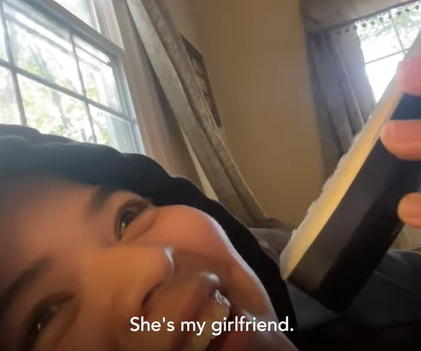
Everyone loves this dad’s genuine, heartfelt response to learning his daughter has a girlfriend

If only every dad could be this open.

lgbtq, coming out, connie and daya
Connie Kingston come out to her father, Michael, over the phone.Photo credit: via ilovemygf1ffffffffffff/TikTok

A video posted to TikTok by Connie Kingston has received over 8.8 million views in just four days for the wholesome way that her father responds to her coming out of the closet. The big moment seems to come out of nowhere, and her father doesn’t even miss a beat.

In the video, Connie is lying down and talking to her father, Michael Kingston, about dinner plans when she coyly slips in some information about her “friend,” Daya.

Daya and Connie live in North Carolina and have been dating since November 2022.

Here’s how the conversation went:

Connie: Oh yeah, Daya’s not my friend.

Dad: Why do you say that?

Connie: She’s my girlfriend.


Dad: Oh, that’s cool. I really like Daya.

Connie: Really?

Dad: Yeah, of course.

Connie: I like her too.

Dad: She’s wonderful. Yeah. So are you.

The father then explains why he is accepting of her lifestyle and supportive of her relationship.

“Connie, I love you so much,” her dad says over the phone. “There’s nothing you can do that would make me not love you. And there’s nothing wrong with that lifestyle. I perfectly agree with that lifestyle. So some of my good friends in college had different lifestyles than me. I love you.”

Michael doesn’t just tell her he supports her but shares why he feels that way, so she’s even more confident about coming out to him.

https://www.tiktok.com/@ilovemygf1ffffffffffff/video/7222876685379570987

The video attracted countless comments from people touched by the genuine, heartfelt interaction between father and daughter.

“Does your dad need extra children? Cuz we allll need a dad like that!” Tristann Whittaker wrote.

“When his voice shakes when asking if you were worried about that tore me up, he loves and cares about you so much you are lucky girl,” Deactive added.

The father and daughter appeared on Good Morning America to discuss their relationship.

Unfortunately, Daya’s family wasn’t as supportive of her relationship as Connie’s father. “They weren’t exactly as accepting as I wish that they would have been. And it was kind of a letdown for me,” she told Good Morning America. Daya’s parents’ reaction inspired Connie to tell her parents about their relationship because Daya needed the support.

Michael was concerned that Connie didn’t think he’d be as supportive as he was. “Did she think that I was going to react in a negative way?” he wondered.

“I’m surprised and a little sad because I hope that would be everybody’s responsibility,” Michael told Good Morning America. “You know, when someone you love finds someone they really care about in this world and that person cares about them, then why wouldn’t that bring everybody joy?”

It’s 2023, and just as Michael says, everyone should be accepting of their LGBTQ child. But his reaction is remarkable because of the tender way that he shows his total support for Connie and Daya’s relationship. His response is an excellent lesson to parents everywhere on how to give full support to an LGBTQ child.


  • Expatriate reveals 8 words and phrases that mean the opposite to Brits and Americans
    Evan Edinger shares how the meanings of certain words are opposite in the U.K. and the U.S.Photo credit: Evan Edinger/YouTube
    ,

    Expatriate reveals 8 words and phrases that mean the opposite to Brits and Americans

    The English language is full of idiosyncrasies and inconsistencies that can drive English learners batty. But even for native English speakers, some words and phrases can cause confusion in ways they may not expect. For instance, not only are there English words that mean opposite things depending on how they are used (called contronyms), but…

    The English language is full of idiosyncrasies and inconsistencies that can drive English learners batty. But even for native English speakers, some words and phrases can cause confusion in ways they may not expect.

    For instance, not only are there English words that mean opposite things depending on how they are used (called contronyms), but there are also words and phrases that have opposite meanings depending on where they are used.

    A person holding an American flag and a person holding a British flag
    A person holding an American flag and a person holding a British flag. Photo credit: Canva.

    Evan Edinger moved to the United Kingdom 13 years ago. He shares videos on YouTube about his experience as an American living in the U.K., including linguistic differences. For instance, saying the food in London is “quite good” may sound like a compliment, but it would likely be received as a bit of an insult by Londoners.

    “English is full of words that quietly flip meaning when you cross the Atlantic,” he says. “Words that you think sound polite or a compliment, like this one, can really land you in hot water if you use them across the pond.”

    “Quite”

    That’s because Americans generally use “quite” as an intensifier. If something is “quite good,” we see it as better than just “good.” For Brits, “quite” is often used as a dampener, so “quite good” can mean less good than simply “good.”

    “With all due respect…”

    Other opposite meanings are less subtle, like the phrase “with all due respect.”

    “I’ve lived in this country for over 13 years, and I’ve only found out this year, Brits do not mean this when they say it,” shares Edinger. “When an American says, ‘With all due respect,’ it’s usually just a polite way to pad out some criticism. ‘With all due respect, I think we should do it this way instead.’ Basically, ‘I respect you. I do. But I do disagree with you in this instance.’ In Britain, they say the same words, ‘with all due respect,’ but the implication is that they actually don’t respect you or your opinion at all. The amount of respect that you’re due? That’s in question. ‘With the respect you’re due,’ which, of course, is nothing.”

    “I’ll bear that in mind…”

    It’s a bit similar with “I’ll bear that in mind.” In the U.S., that usually means you’ll consider it and might actually do it. In the U.K., it more often means you have no intention of doing it and have probably already forgotten it.

    “Though diving deeper into the data, it would appear that Americans in the Northeast are significantly more likely to share the British stance,” Edinger adds. “I think that makes sense, actually. But overall, American culture prioritizes direct communication. If they like your idea, an American will probably tell you. Same as if they dislike it, you’ll know. As a lot of British culture emphasizes indirectness and not causing offense, expressions like, ‘I’ll bear that in mind,’ act as a polite way of refusing an idea without outright saying it to soften the blow.”

    To “table” something

    If you’re an American and you hear “let’s table that discussion,” it means, “Let’s not talk about this now. We’ll come back to it later, if we have time.” For Brits, it means, “Let’s talk about this right now.”

    “This is one expression that causes a lot of confusion in international meetings,” says Edinger. “In British English, to table a motion or an issue means to bring it forward for discussion. For instance, if an item is tabled in parliament, well, it has been figuratively put on the table to be addressed immediately.”

    In the U.S., it’s the opposite.

    “In both houses of the United States Congress, the motion to table is used to kill a motion without debate or further discussion,” he says. “Quite interesting that both countries’ political bodies have the same word that means quite literally the very opposite. It’s quite literally the difference between, ‘Well let’s talk about this immediately. It’s really important,’ and ‘Let’s never speak of this again.’”

    A “moot point”

    For Brits, a “moot point” is a point that’s debatable—something that can be argued either way, which aligns with its original meaning. A moot was an Anglo-Saxon assembly or court, so a moot point is one that would be argued there.

    For Americans, a moot point isn’t debatable—it’s irrelevant. It doesn’t matter. There’s no point in debating it at all anymore. (Or, as Joey on Friends would say, “Like a cow’s opinion.”)

    How did we end up with such an opposite meaning? Edinger explains:

    “Often, an important part of law school is arguing hypothetical cases in a moot court for practice. It’s similar to a mock trial. So, a moot point would be a point brought up in a moot court. During the 19th century in America specifically, this evolved more to focus on the hypothetical nature of the moot point.”

    Edinger points out that even the Supreme Court of the United States uses the term “moot question” to refer to a question that has no bearing on an issue.

    Solicitor

    In the U.S., when we hear the word “solicitor,” we usually think of a door-to-door salesperson or someone who knocks on the door trying to persuade us to buy something or believe something. People often hang “No Solicitors” signs on their front porches to deter them.

    A “No Solicitors” sign hangs on a door. Photo credit: Canva

    A “No Solicitors” sign in the U.K. might be confusing, as a solicitor is not a salesperson but “a qualified legal professional who provides specialist legal advice on different areas of law and is responsible for representing a client’s legal interests.” Americans would call them lawyers, but in the U.K., a lawyer could be anyone working in a law-related role.

    Public school

    A solicitor in the U.S. probably went to public school, and a highly regarded solicitor in the U.K. also probably went to public school, but the term means something completely different in each country.

    In the U.S., a public school is a free school funded by the government that anyone has the right to attend. In the U.K., a public school is one of the prestigious, selective, and expensive private boarding schools attended by the children of wealthy families. The famous Eton College is a public school in the British sense, but not at all in the American sense.

    To make matters even more confusing, what Americans call public schools, Brits call state schools. In the U.S., we usually use “state school” to refer to public universities.

    Momentarily

    If a pilot announces, “We’ll be landing momentarily,” Americans understand that to mean “very soon.” But for Brits, that sentence might be confusing, since “momentarily” means “just for a moment.” As in, maybe the plane will touch down and then immediately take off again.

    It’s the difference between “in a moment” and “for a moment,” which may not seem huge but could lead to big misunderstandings.

    It just goes to show that even when we speak the same language, there’s plenty of room for miscommunication.

    You can follow Evan Edinger on YouTube for more.

  • Mariel Hemingway’s emotionally raw poem about aging is hauntingly beautiful
    A woman studies her face in the mirror.Photo credit: Canva
    ,

    Mariel Hemingway’s emotionally raw poem about aging is hauntingly beautiful

    Actress and author Mariel Hemingway has quite the legacy. Her grandfather was the famed Pulitzer Prize– and Nobel Prize–winning author Ernest Hemingway. In fact, her family is full of writers, actors, painters, and opera singers. Like her grandfather, she came by her own talents at a cost. Many of those gifts in acting and writing…

    Actress and author Mariel Hemingway has quite the legacy. Her grandfather was the famed Pulitzer Prize– and Nobel Prize–winning author Ernest Hemingway. In fact, her family is full of writers, actors, painters, and opera singers. Like her grandfather, she came by her own talents at a cost. Many of those gifts in acting and writing came with deep mental anguish.

    While Hemingway continues a successful career onscreen—she was nominated for a Best Supporting Actress Oscar as a teen for her role in Manhattan—she is also a writer. In exploring her complicated family struggles, she never seems to shy away from stripping away any semblance of ego. This is reflected in her work, where she bares vulnerable parts of life: mental health, depression, and most recently, aging.

    Her prose poem resonated with women everywhere

    In a recent Instagram post, she shared a close-up photo of her face—no smile and perhaps just a dash of makeup. With Sheryl Crow’s “If It Makes You Happy” underscoring the photo, she wrote:

    “I have been talking about aging lately.

    But today it is not aging.

    It is wrinkles.

    The lines around my mouth I swore I would never have.
    The soft crepe skin at my neck that seems to appear overnight.
    The mirror catching me in light I did not ask for.

    Some days I do not care.

    Other days it feels like a punishment.

    I eat well.
    I move my body.
    I take care of myself.
    I do the things we are told will protect us.

    And still… time touches my face.

    There is a voice that whispers,
    Why this? Why me? Why now?

    I know it is fashionable to say we earned our wrinkles.
    That this is graceful.
    That this is beautiful.

    And yes… part of me knows that is true.

    But another part feels something deeper.

    What I realized is this.

    The ache is not about the wrinkles.

    It is about identity.

    Somewhere along the way we start to believe the mirror is telling us who we are.

    That youth equals value.
    That smooth skin equals worth.
    That beauty equals belonging.

    And that is the lie.

    Because there is a woman inside of me who has not aged one day.

    She is calm.
    She is radiant.
    She is grounded.
    She is sovereign.

    She does not disappear because my skin changes.

    She was never my skin.

    She is my rhythm.
    My breath.
    My voice when I stop performing.

    Time changes the body.

    But it does not touch the throne.

    When I remember that, something softens.

    I stop fighting the season.
    I stop punishing myself for nature.
    I stop confusing appearance with identity.

    This is not about pretending you love every wrinkle.

    It is about remembering you are not the wrinkle.

    It is not what you add.

    It is what you remove.

    Remove the belief that beauty is youth.
    Remove the fear that aging equals invisibility.
    Remove the story that your value lives in your face.

    When there is nothing left to remove, the Queen remains.”

    Fans respond

    Her prose has clearly resonated with fans. More than 92,000 people liked the post, and over 5,000 have commented so far. Famous and non-famous Instagrammers alike chimed in to share how touched they were.

    Go-Go’s guitarist Jane Wiedlin exclaimed, “Yes! Exactly what you said. We are not allowed to age, at the same time men are elevated as they age, for their sage wisdom.”

    Comedian Chelsea Handler simply wrote, “Beautifully said.”

    Another woman shared a personal anecdote: “Last Sunday was my 70th birthday. I looked into the mirror and cried tears of joy. Lines and dark spots? No! They were tears of joy, gratitude, and for my life. If you make it this far, it’s for a reason. Life is so worth living. Who cares what I look like? I’m covered in paint every day anyway!”

    It’s beautiful to age

    Hemingway is far from the first woman to openly discuss the beauty standards seemingly placed on women in society.

    In a recent appearance on the podcast How to Fail with Elizabeth Day, actress Kate Winslet didn’t hold back. “We’re so conditioned, women in our 40s, to think, ‘Okay, well, I’m creeping closer to the end,’” she said. “You know, you think you go into menopause and you’re going to stop having sex, and your boobs are going to sag, and your skin’s going to go crepey, and all these things.”

    She continued, “First of all, so what? And secondly, it’s just conditioning. You know, I think women, as they get older, become juicier and sexier and more embedded in their truth and who they are. More powerful and more able to walk through the world and care less.”

    It can seem easier said than felt. Luckily, many women are feeling more empowered to get raw thanks to celebrities using their voices.

  • A woman didn’t think she had an accent. A linguist proved her wrong with just one word.
    Who knew the word "bagel" was an accent giveaway?Photo credit: Canva
    ,

    A woman didn’t think she had an accent. A linguist proved her wrong with just one word.

    If you travel around the United States, you’ll find that Americans sound different everywhere you go. If you go from Boston to Birmingham, you’ll hear a big contrast in dialects and accents. Going from Seattle to San Diego, the differences would be much smaller, but they’d still be there. Some people don’t think they have…

    If you travel around the United States, you’ll find that Americans sound different everywhere you go. If you go from Boston to Birmingham, you’ll hear a big contrast in dialects and accents. Going from Seattle to San Diego, the differences would be much smaller, but they’d still be there.

    Some people don’t think they have an accent at all. It’s common for Americans outside the South and Northeast to believe they speak “normally,” unaware of the geographic “tells” in how they pronounce certain words. But as linguist Carson Woody demonstrates, sometimes just a single word can reveal where in the U.S. a person is from.

    A woman shared a social media trend in which people say three words that supposedly indicate where they’re from. She said she didn’t think she had an accent, but she only got as far as saying “bagel.” That’s okay, Woody said, because that was all he needed to clock her hometown.

    “Baby girl, you sound like the Pope,” Woody said. Sure enough, like Pope Leo XIV, she’s from Chicago.

    Woody said he understood what she meant when she said she didn’t think she had an accent.

    “A lot of people use the term ‘accent’ when referring to someone who has a distinct accent from them,” he said. “Like, ‘You have an accent, I don’t. Because you’re not from here and I am.’ You’re saying you don’t think you have an identifiable, regional accent. But linguistically, when we say, ‘an accent,’ what we’re talking about is just how you pronounce things. If you speak, you have an accent.”

    He explained that the way she pronounced the “a” in “bagel” gave away her location. He also shared that none of the various pronunciations of words are right or wrong.

    “Every accent, every dialect, every language, the way everybody speaks around the world are all equally valid and beautiful,” he said.

    What’s the difference between an accent and a dialect?

    As Woody said, an accent is the way words are pronounced. A dialect is broader, encompassing not only pronunciation but also grammar and vocabulary.

    So just how many dialects are there in American English? More than you might think. It’s hard to pin down an exact number because it depends on how broad or specific you want to get. Linguists recognize somewhere between three and 24 (or more) distinct American English dialects in the U.S. Within those dialects, there are hyperlocal pronunciation variations as well.

    For instance, there are some commonalities among Midwestern accents, but someone from Chicago will pronounce certain words differently than someone from northern Minnesota.

    Woody even shared how a dialect can practically—and in some cases actually—become a totally different language:

    Everybody has one

    As Woody pointed out, everyone has an accent. People in the comments even shared some metaphors that help illustrate this point:

    “Saying, ‘I don’t speak with an accent’ is like saying ‘I don’t type with a font.’”

    “Someone told me once to think of accents like fonts, you can’t really write or type without a font lol, everyone has their own accent that shows your heritage, family, origins, or even sometimes your personality. Humans are pretty cool.”

    “‘I don’t have an accent, everyone else does.’ ‘I don’t have a location, everyone else does.’ Same energy.”

    “If you eat you have a diet, and if you speak you have an accent.”

    “I had a professor years ago (ASL grammar) who could tell what part of the country someone was from or where they went to college by how they signed or finger spelled words. Even sign languages have accents!”

    And if you’re wondering what the other two words were that supposedly help indicate where you’re from, they’re “milk” and “eggs.” Apparently, ordering breakfast gives a lot away. Isn’t language fun?

    You can follow Carson Woody on YouTube for more linguistics fun.

  • A dad who lost his young son to cancer shared a note on male grief that has gone massively viral
    A father and his young son hold hands while walking.Photo credit: Representative image via Canva
    ,

    A dad who lost his young son to cancer shared a note on male grief that has gone massively viral

    Grief is an unfortunately universal and often inescapable feeling. Yet, due to certain societal norms, it can be harder for some people to embrace or fully work through than for others. In a Reddit post titled “100% Really Sucks,” a man wrote: “About ten years ago, our at the time 9-year-old son died of cancer.…

    Grief is an unfortunately universal and often inescapable feeling. Yet, due to certain societal norms, it can be harder for some people to embrace or fully work through than for others.

    In a Reddit post titled “100% Really Sucks,” a man wrote:

    “About ten years ago, our at the time 9-year-old son died of cancer. Hundreds of people asked my wife how she was doing, offered her support, etc. Lots of people asked me how she was doing, how the kids were doing, and how I had to be strong for her and our two remaining kids. Only a few close male friends asked how I was doing. Not one of my female friends did. Not even my mother. It never occurred to them.

    That really sucked. Not because I don’t think my wife deserved support. Of course she did – but so did I.”

    Reddit post. Photo credit: StreetKindly3614/Reddit

    The good news is that the OP bravely began a difficult discussion that seemed to resonate deeply with many people. The post received over 90,000 upvotes and 2.6 thousand comments. Clearly, people seem ready to talk about it.

    One Redditor noted that they shared a similar experience: “My wife and I divorced – after our marriage she chose drugs and alcohol and I chose to be a dad. People still ask me all the time how she’s doing through everything. She still gets invited to parent/kid meet ups even though the kids live with me 7 days a week. It’s unfair.”

    Another commenter added the importance of including men when an entire family needs support, writing, “It absolutely is unfair. I hope future generations will learn to be more supportive after seeing more great dads in action!”

    What was even more encouraging was that the Reddit community came together not only to commiserate but also to offer hopeful suggestions.

    Another commenter pointed out a similar situation, sharing, “We had a house fire. Lost everything. People in the community donated so many clothes and toiletries for my wife and kids. But nothing for me. One year later and I’m still struggling with wardrobe choices.”

    This Redditor was ready to help, writing, “What size do you wear bro? I have some nice clothes that I never wear I’d be happy to have dry cleaned and sent your way.”

    Not everyone, thankfully, had the same experience, though the post helped some feel a sense of gratitude:

    “My word, reading these comments just makes me appreciate my wife and my mom all the more. They actually support me when I let them know I am hurting or depressed.

    I do have to vocalize that I want the support in the moment because my wife will pick up on the fact that I’m down almost immediately and I’ll tell her I’m just having a down day. I don’t really deal with very bad depression but I do have days where it gets bad and she’s always there for me.

    When I was growing up, my mom never dismissed my feelings, never told me to ‘act like a man’.

    I’m so sorry to hear all of your stories of your struggles. I wish the best for all of you out there dealing with this type of stuff.”

    Society needs to encourage men to open up

    In the article “The Problem of Male Grief” for Psychology Today, Nick Norman, LICSW, discusses what he refers to as a “silent epidemic” among men.

    “According to the CDC, 1 in 10 men experiences anxiety or depression, but less than half reach out for help,” Norman wrote. “They are less likely to seek help for mental or emotional difficulties overall.”

    Norman seems to hit the nail right on the head when it comes to the Reddit post:

    “While there are common ways that men respond to grief, that does not mean that they are actually processing their emotions or coming to a healthy resolution. The real issue is not that men have some other means or manner of grieving. It is that the Western cultural expectation of men discourages grieving altogether.”

    He offered suggestions for men to create healthy spaces for one another:

    “The unspoken rules of oppressive masculinity often lead men to shame those who dare step outside of the limited emotional box we’re given. In this way, we become enemies of our brothers and create more pain when what we need is support. Although we may struggle with our own discomfort, we need to stop shaming other men for weeping and feeling authentically. We have enough challenges in this work. We owe it to one another to buoy each other up, or at least grant each other silent respect.”

    Mindfulness can help

    Jeanette Lorandini, LCSW, founder of Suffolk DBT in New York, spoke to Upworthy about the issue:

    “From a DBT [Dialectical Behavior Therapy] perspective, many boys grow up in environments where their emotions are invalidated. They are often taught very early that showing sadness or vulnerability is a sign of weakness and that they should ‘be strong.’ Over time, this can lead men to learn how to hide their emotions rather than understand or process them. They may become skilled at making their feelings invisible to others, but that does not mean those feelings are not there.”

    To counter this, Lorandini suggested men practice mindfulness to help process their emotions:

    “Mindfulness, a core component of DBT, encourages people to slow down, notice their emotional experience, and give themselves permission to feel sadness rather than push it away. We call that mindfulness of current emotion. When someone does not give themselves these important moments to grieve, they develop what we call inhibitive grief. It doesn’t go away but remains in a ‘holding cell.’ While it may not be a literal prison, it won’t go away until it is experienced. It often will show up in ways such as anger, substance use, working excessively, heavy screen time, or other maladaptive behaviors.”

    She added, “Grief does not require someone to fall apart, but it does require space to be felt. Learning to experience sadness in manageable moments, while continuing to move forward at a balanced pace, can help men process loss in a way that honors both their emotional needs and their role within their family.”

  • Woman ticketed for driving with phone in her ‘right hand’ has a huge surprise for police officer
    A woman hands her license to a police officer. Photo credit: Canva

    Distracted driving is a dangerous issue that police officers are taking more seriously. But when Katie, who runs the social media page Slightly Off Balance, was pulled over for the offense, she had questions. The officer writing the citation insisted that she was driving with her phone in her right hand. That didn’t make sense to her.

    The woman uploaded a clip of the interaction in which she asks the officer for clarification. According to the officer, he witnessed Katie committing the driving infraction. Katie asked for clarification several more times because it would be impossible for her to hold a phone in her right hand. Why? She doesn’t have one.

    police, traffic ticket, traffic stop, pulled over, amputee, distracted driving
    Police car seen through the rearview mirror. Photo credit: Canva

    In the video, which has been viewed nearly eight million times, Katie pokes fun at the situation. “Turns out you can still get a ticket for driving with a device in your right hand, even if you don’t have a right hand,” she says, holding up her arm. Clearly, the entire lower part of her right arm is missing.

    After cutting to the bizarre interaction between herself and the officer, Katie shows herself attempting to hold a phone with her nonexistent hand. Spoiler alert—it doesn’t work. In the video, the officer can be heard saying, “If you want to take it to court, option five on the back of the ticket. That’s how you take it to court.”

    police, traffic ticket, traffic stop, pulled over, amputee, distracted driving
    A police officer stops a driver. Photo credit: Canva

    Taking it to court is exactly what she plans to do. In a follow-up video, she shares that her court date is scheduled for mid-April. Commenters are not only gobsmacked that she could be cited for this particular infraction, but they’re also completely invested in her court case.

    @slightlyoff.balance

    Low key thought I had two hands for a minute 🤦🏻‍♀️ #palmbeach #cops #PBSO #floridaman #pulledover

    ♬ original sound – slightlyoff.balance

    One person begs, “Please take us to court with you, I want to hear the judge.”

    Another writes, “I’m glad you recorded him saying it was the right hand otherwise I guarantee he would have lied later on and claim he never said that.”

    “Ok but how would you ve able to drive with a phone in ur LEFT hand anyway,” someone questions.

    “Oh I wanna see a part 2. I know it sucks tho, cause you shouldn’t have to take time off work/life just to prove a cop wrong,” a person laments.

    One commenter shares a cheeky way Katie could have handled the situation, writing, “I would have said ‘ok I’ll see you in court’ and waved with your right hand to get his reaction. And then still gone to court to let the judge know he was lying.”

    police, traffic ticket, traffic stop, pulled over, amputee, distracted driving
    A woman being pulled over. Photo credit: Canva

    Some people wonder why she didn’t inform the officer on the spot that she didn’t have a right hand. But others argue that the officer had already proven to be untrustworthy and would likely change his story. Katie didn’t respond to those questions, but the officer could likely see that she didn’t have a hand while looking directly into her window.

    Katie appears to have a sense of humor about missing a hand, liking several comments that joke about her limb difference.

    “I would have held my right hand out for the ticket. So glad you got that admission recorded,” someone writes.

    “Cutting your hand off to get out of a traffic ticket is wild,” another jokes.

  • Man gets wave of support after tearful confession that a friend called him ‘too poor’ to get invited anywhere
    A man gets a wave of support after sharing how a friend excluded him for being “poor.”Photo credit: @father_vs_world/TikTok

    Recently, a man went on TikTok to tearfully recount being called “poor” by a close friend. He was overwhelmed by the amount of support he received from total strangers.

    On February 12, Andrey Borul explained in a video that he had fallen into medical debt after spending two weeks nearly dying in the hospital. Now, he’s “working almost twenty hours a day trying to recover.”

    Borul isn’t alone in this struggle. Studies estimate that approximately 100 million Americans have some form of medical or dental debt, with total outstanding debt around $220 billion.

    And yet, Borul’s family has tried their best to keep their spirits up and “make it work.” They’ve always managed to “bring a gift” to whatever parties they were invited to.

    “Too poor” to get invited

    So when, at one of these parties, a friend said that Borul and his wife don’t get invited anywhere because they’re “too poor,” he was “dumbfounded.”

    Things only seemed to get worse when, presumably at the same party, couples were talking about “buying houses.” Borul’s wife suggested making a group trip to the mountains so the kids could enjoy the snow together. Again, a friend immediately “shot down” the idea, saying, “You can’t afford that.”

    Tears welling up in his eyes, Borul admitted, “It’s true—we can’t.” He then shared how, the next morning, he drove up to the mountains himself to bring down some snow for his kids to play with.

    @father_vs_world

    Daughter been praying for snow and since Idaho had zero snow days i made a secret trip high into the mountains to bring snow for them to play in

    ♬ Snow Day – Tabitha Meeks & Ryan Corn

    “After our bills are paid, we have so little left over for entertainment,” he said. “I’ve been working nonstop to dig ourselves out of this financial hole…being poor sucks.”

    Borul ended his clip saying, “I feel so alone. We haven’t been invited for three months anywhere.”

    Thankfully, Borul was met with a wave of support from viewers 

    A few people shared that they had found themselves in equally disheartening situations.

    “Most of us in North America are in your shoes.”

    Many chimed in to remind him what real friendship looks like.

    @father_vs_world

    Replying to @Sandyyy.R. How can so called close “friends “ be so crule.. just thinking about it makes me cry 😭

    ♬ original sound – father_vs_world

    “Bro, you literally went to the mountain and brought your kids back snow…you’re working 20 hours a day for your family…you are THE MAN. Do not let those types of people make you feel any sort of way. Run from them. You’re the kind of guy I would be honored to call my friend.” 

    “You almost died, lost two weeks of income, and those people did not help you? They are not your friends.” 

    “This broke my heart and angered me because I’ve been in between blessings before and I remember when we planned a trip and our friends knew we were in between blessings. They ended up paying for the trip and once we got back on our feet, that’s when we paid them back (they wouldn’t take it). My point is friendship is about support (not necessarily financial), love, and grace. As hard as it’s going to be it may be time for you and your wife to leave them where they are at. Sending you love.”

    “You should not be wasting your time and energy on these people. You are richer than them in the most important way.”

    “If they were your friends, they would ask how to help you, not leave you out because you don’t have the money.” 

    And perhaps most encouraging of all, donations began pouring into Borul’s GoFundMe to help cover some of those exorbitant medical bills and give him some room to breathe. So far, a little over $30,000 has been raised, inching closer to the overall $35,000 goal.

    Understandably, Borul was overwhelmed by all the support 

    “I woke up with a total lightness in my chest,” he said. “Total strangers showed me more compassion than my own friends. I am so beyond grateful.”

    Hopefully, Borul can take solace in knowing that he does have a friend group, even if it wasn’t who he was expecting.

    If you’d like to donate to Borul’s GoFundMe page, click here

  • Texan who moved to the UK shares 3 ‘mortifying’ experiences that almost made her want to leave
    A woman in a cowboy hat and a woman in a phone booth in the UK. Photo credit: Canva

    If you’re looking to move abroad from the United States, the United Kingdom seems like a natural candidate on its face. After all, moving to the UK means you’ll already speak the language, be relatively familiar with the country’s political structure, and exist within a similar pop culture and media ecosystem.

    But many people who move to London or its surrounding areas are stunned to learn just how different American and British cultures can be.

    Ashley Jackson recently moved from Amarillo, Texas, to South Manchester. She’s been documenting her journey acclimating to the new culture on her TikTok channel. Recently, she shared three “mortifying” experiences that almost made her rethink her new life in the UK.

    texas, london, uk, america, americans, living abroad, UK culture, american culture, cultural differences
    London at night. Photo credit: barnyz/Flickr

    In the tongue-in-cheek post, she reiterates that despite the difficulties and hilarious flops that have arisen from her new life, she’s still having a great time living in Manchester. But things were certainly touch-and-go for a while at first.

    “One, I’ve had a full-on conversation with a person and I didn’t understand a lick of it. She had a very different accent I couldn’t understand,” Jackson says.

    Accents and regional dialects in the UK are among the most diverse and wide-ranging in the world. In the U.S., there are subtle differences between Southern, Cajun, and Northeastern accents, for example. But that’s nothing compared to what even locals encounter in the UK. Even they sometimes have a hard time understanding more niche or obscure dialects like Glaswegian or Devonian. Most Americans are woefully unprepared for the accents they encounter there.

    Issue number two for Jackson? “It hailstoned. While on a hike up a hill, it rained, hailstone, my daughter was crying. Everyone was wet, soggy, feet muddy. Quite traumatizing for all of us, but we’re still here.”

    Weather in the UK can be all over the map, but one thing the region is famous for is rain and hail. Heatwaves and climate change have only contributed to hailstones becoming larger and more frequent. In another video, Jackson says acclimating to the weather in the UK has been a challenge, noting that she had to “toughen up.”

    And finally, issue number three: “I was cut off by my GP (general practitioner) after the 10-minute mark. I didn’t realize there were 10-minute time slots for doctor’s appointments. Learned that one the hard way.”

    One big appeal of living in the UK is the mostly free healthcare provided through the NHS. However, appointments can be hard to come by, and many doctors are strict about keeping visits under 10 minutes so they can manage their patient load. Jackson was stunned to be “cut off” in the middle of a visit, but for locals, that’s just the way it goes.

    Americans moving to the UK often experience extreme culture shock. We sometimes expect the cultures to be so similar that the small differences that do exist catch us completely off guard.

    The language, though fundamentally similar, can take Americans a while to pick up on. British culture is full of slang, regional dialects, and colloquialisms that can be confusing for outsiders. One American who moved there, for example, was baffled when everyone kept calling her cookies “biscuits.”

    A lot of American daily conveniences either don’t exist in the UK or are far more rare. Air conditioning and garbage disposals, for example, are hard to come by. Houses and living quarters in general are much smaller than what most Americans are used to as well.

    Work culture is very different in the UK as well. Citizens usually have a stronger work-life balance and a government-mandated minimum of five weeks of paid vacation.

    In short, moving from America to the UK won’t necessarily be easy just because of the common language. Whether you ultimately enjoy American or British culture more is a matter of taste, but it will take some getting used to—that’s for sure.

    As for Jackson, she says in her videos that even if the adjustment wasn’t easy, she loves the rain, the NHS, and the walkability of life in the UK. She just had to stick it out through a few embarrassing faux pas before she could start enjoying all the perks.

  • 15 things tourists notice in the U.S. that Americans totally miss
    A family poses in front of a home with an American flag.Photo credit: Canva
    , ,

    15 things tourists notice in the U.S. that Americans totally miss

    “I’ve lived in the US my whole life. Somehow, I’ve never noticed this before.”

    Tourists see new places with fresh eyes and fresh observations. In 2024, 72.4 million tourists visited the United States, according to the National Travel and Tourism Office. (That’s a lot of eyes seeing America in a new light.)

    Tourists to the States have pointed out that Americans really do like to put ranch dressing on everything. They’ve also noted that in the U.S., squirrels seem to run rampant.

    While these are insightful observations, most Americans would say they already know them to be true. On Reddit, Americans shared the shocking realizations they had about the U.S. that were only revealed to them by tourists.

    As one American noted, “I’ve lived in the US my whole life. Somehow, I’ve never noticed this before.”

    These are 15 eye-opening things tourists brought to Americans’ attention that truly blew their minds:

    Culture

    “We sure do have a lot of flags everywhere.” – myfourmoons

    “American coins don’t have numbers on them.  Some of the coins will say ‘One Cent’ or ‘Quarter Dollar’ but I don’t think that’s helpful if your English is not so good. And sometimes that labeling is just not in a place that easy to see on a coin.” – chocotacogato

    Michael White, a former spokesman for the United States Mint, told The Gainesville Sun that the reason coins in the U.S. don’t have numbers is simple: “It is an artistic choice in the majority of instances.”

    White added that certain coins in the past in the U.S. have used numerical notations, including the dime, nickel, and quarter. The article notes, “From 1809 to 1836, there was a half dollar imprinted with ’50 C.’ That was changed to ’50 cents’ for two years and then, in 1838, artistic choice deemed it should be called ‘half dollar.’”

    “The gap around the stall doors in public restrooms. It’s weird, and I hate it.” – SidheRa

    “So. Many. Insurance. Commercials.” – Reddit_Talent_Coach

    “Bank drive-thru lanes. I was told ‘why don’t you just get out of your car and walk in the bank?’” – JWilsn_Art

    According to Wells Fargo, “motor banks” (aka drive-in and drive-thru banks) were invented in the U.S. and came into existence in the 1930s.

    “That every morning, all American children from kindergarten to 12th grade, stand before the US flag (found in every classroom, ofc) and recite “the pledge of allegiance” to the country in unison, with their right hands over their hearts. Upon learning this universal American school experience, my Russian colleague said: ‘That is the most Comm*nist thing over ever heard!’” – jzzdancer2

    The Pledge of Allegiance, written by Francis Bellamy, debuted in 1892, according to the American Legion. Over the years, it went through various edits until it was recognized by Congress and included in the U.S. Flag Code on June 22, 1942.

    “How much daily life revolves around cars. In many cities, if you don’t drive, you basically don’t exist. It’s convenience on steroids.” – Prior_Bank7992

    Mannerisms

    “That Americans switch between hands when eating with silverware, cutlery, etc.” – BasilRevolutionary38

    Called the “cut-and-switch” table habit, it’s described by NPR as when you “hold your fork in your left hand and cut with your right and then put down your knife so you can switch your fork to your right hand before you take a bite.”

    Americans actually adapted this use of cutlery from the French. Writer Mark Vanhoenacker explained to NPR, “Americans got it from France in the 19th century even as France was giving it up, and no one knows why France gave it up. Maybe just convenience or another change of fashion.”

    “We smile too much. To the point where foreigners, specifically Asians (Korean and Chinese) have pointed out that our smiles feel disingenuous and mean nothing. Really hit home, but despite that, I still smile ‘too much’.” – BMdabbleU

    “How much casual socializing we do with strangers. From small talk to things people in other places consider weirdly intimate (like talking about health problems).” – Practical-Water-9209

    “The lean! The fact that people from the U.S. tend to lean on things while standing, no matter how inappropriate a place or circumstance. I’ve thought about it, and I think its because the U.S. (for the most part) isn’t walkable, so we aren’t used to standing for as along as other countries.” – Lobstertales143

    The Central Intelligence Agency has deemed the “American Lean” a dead giveaway that someone is an American. In 2019, Jonna Mendez, the CIA’s former chief of disguise, and Gina Haspel, former CIA director, told NPR that Europeans can easily spot Americans in a crowd.

    “They think that we are slouchy, a little sloppy,” Mendez said. “And they think that they can almost see that in our demeanor on the street because they stand up straight. They don’t lean on things.”

    Food

    “Root beer tastes like medicine. It’s still my favorite soda but… yeah it tastes mediciney.” – TheNerdNugget

    “Had a German foreign exchange student and she said ‘All American breakfast is dessert. Pancakes, donuts, Cinnabon, muffins, French toast…’ I was like yea you have a point lol.” – dom954

    Words

    “Apparently Americans use the word ‘awesome’ a lot. I’ve had people in other countries tease us for how we think everything is awesome lol. But to be fair, tons of things ARE awesome, and also you’re talking to me on vacation when I’m in the best mood of my life lol.” – Gold_Telephone_7192

    “‘Yeah’ ‘Yeah no’ ‘Yeah right’ ‘Oh yeah’ ‘Hell yeah!’ All mean different things!” – zippy_97

Identity

Mariel Hemingway’s emotionally raw poem about aging is hauntingly beautiful

Science

Neuroscience totally backs this 90-second hack to get your sanity back

Culture

How an unethical World War 2-era study pushed Swedes only to eat sweets on Saturdays

Culture

Woman explains ‘Millennial teaching’ to her Boomer teacher mom and it backfires hilariously