A class presentation listing 'pros' and 'cons' of slavery is why we need racism education

How race and racism are handled in schools has been an issue for decades, but the debate has been pushed into the spotlight in the past couple of years as the Black Lives Matter movement has gained momentum. Hysteria over critical race theory (or what people think critical race theory is) has overtaken school board meetings and resulted in legislation governing what can and can't be talked about in the classroom when it comes to race and racism.
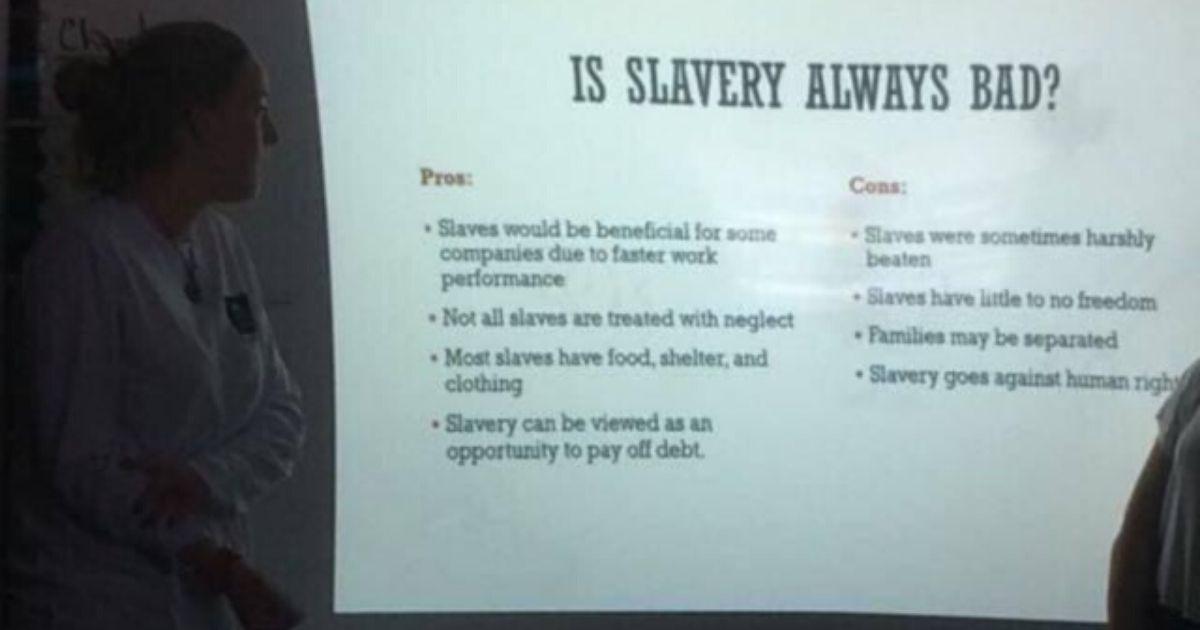
A viral photo of a class presentation listing the pros and cons of slavery illustrates how vital it is to incorporate racism education in schools. The watering down of American slavery has gone on for far too long, and no matter what the assignment was here, this kind of slide has no place in a classroom.
The image, which seems to have first been shared in 2016, shows what appears to be a student presenting a slide with the title, "IS SLAVERY ALWAYS BAD?" followed by a list of "pros" and "cons" of enslaving people.
According to the presentation, the pros of slavery include:
- Slaves would be beneficial for some companies due to faster work performance
- Not all slaves are treated with neglect
- Most slaves have food, shelter, and clothing
- Slavery can be viewed as an opportunity to pay off debt.
And the cons listed were:
- Slaves were sometimes harshly beaten
- Slaves have little to no freedom
- Families may be separated
- Slavery goes against human rights.
Hoo boy. Lots to unpack here.
We don't know what class this photo came from—maybe history, maybe a debate class—but it doesn't matter. There is one, and only one, correct answer to the question the slide poses. YES, slavery is always bad. End of discussion. There are things that are simply not debatable, and slavery is one of them.
But unfortunately, it's far too common for Americans to engage in these kinds of "let's weigh the pros and cons before determining if making Black people work for free, using violence and family trauma to keep them enslaved for centuries, was really as evil as it sounds" arguments. It's been happening in textbooks and classrooms throughout our history. It's wrong. It has always been wrong.
We don't even have to stretch our imaginations very far to understand why it's wrong.
Imagine a slide asking, "IS GENOCIDE ALWAYS WRONG?" with a list of pros that include "A smaller population would be beneficial for some due to fewer mouths to feed" and "Many people killed in a genocide aren't tortured before they die." No. We don't do that. Never ever.
Imagine a pros and cons list like this for domestic violence. Pro: Abusers get what they want. Con: Sometimes the abused get physically injured. Ridiculous, right?
Imagine asking high schoolers to make a pros and cons list for drunk driving. No. That would be asinine.
But some people treat slavery as if it's debatable how bad it was. I once had someone try to convince me that slavery wasn't all that bad because "many slaves were considered members of their owner's family and weren't mistreated." As if being enslaved was not mistreatment in and of itself. The mental gymnastics some Americans will do to make slavery sound better than it was is astounding.
The fact that this slide was made and presented to a classroom in the 21st century is an indication that education about racism in schools is necessary. This slide is racism, and the fact that that's not obvious to everyone is exactly the problem.
This kind of presentation is what happens when you teach slavery as if it were just another policy decision and not the racist, dehumanizing evil driven by white supremacy and greed that it was. We need to teach history honestly and thoroughly, explaining the racist ideology that led to racist chattel slavery in the United States and the racist oppression that followed emancipation. Otherwise, we end up with this kind of whitewashed, false-equivalency pros and cons list that has no place in a civilized society.

- A school assignment asked for 3 benefits of slavery. This kid gave ... ›
- Still think the Civil War wasn't fought over slavery? The Confederate ... ›
- Hamilton's missing 'Cabinet Battle #3' addresses the slavery issue ... ›
- Student gives a good answer to an assignment on slavery - Upworthy ›
- A school assignment asked for 3 benefits of slavery. This kid gave the only good answer. - Upworthy ›
- Parents were irate when a 5th grade assignment asked kids to "set their price for a slave" - Upworthy ›
- A fourth-grade teacher asked for 3 'good reasons' for slavery. There was only right answer. - Upworthy ›


A woman is getting angry at her coworker.via
A man with tape over his mouth.via
A husband is angry with his wife. via 
a man sitting at a desk with his head on his arms Photo by
Can a warm cup of tea help you sleep better? If you believe it, then yes. Photo by 
Three women sit on a blanket in the park. 
Two women engaging in a pleasant conversation inside a coffee shop
Two men engaging in a peaceful disagreement.
Resurfaced video of French skier's groin incident has people giving the announcer a gold medal
"The boys took a beating on that one."
Downhill skiing is a sport rife with injuries, but not usually this kind.
A good commentator can make all the difference when watching sports, even when an event goes smoothly. But it's when something goes wrong that great announcers rise to the top, and there's no better example of a great announcer in a surprise moment than when French skier Yannick Bertrand took a gate to the groin in a 2007 super-G race.
Competitive skiers fly down runs at incredible speeds, often exceeding 60 mph. Hitting something hard at that speed would definitely hurt, but hitting something hard with a particularly sensitive part of your body would be excruciating. So when Bertrand slammed right into a gate family-jewels-first, his high-pitched scream was unsurprising. What was surprising was the perfect commentary that immediately followed.
This is a clip you really just have to see and hear to fully appreciate:
- YouTube youtu.be
It's unclear who the announcer is, even after multiple Google inquiries, which is unfortunate because that gentleman deserves a medal. The commentary gets better with each repeated viewing, with highlights like:
"The gate the groin for Yannick Bertrand, and you could hear it. And if you're a man, you could feel it."
"Oh, the Frenchman. Oh-ho, monsieurrrrrr."
"The boys took a beating on that one."
"That guy needs a hug."
"Those are the moments that change your life if you're a man, I tell you what."
"When you crash through a gate, when you do it at high rate of speed, it's gonna hurt and it's going to leave a mark in most cases. And in this particular case, not the area where you want to leave a mark."
Imagine watching a man take a hit to the privates at 60 mph and having to make impromptu commentary, straddling the line between professionalism and acknowledging the universally understood reality of what just happened. There are certain things you can't say on network television that you might feel compelled to say. There's a visceral element to this scenario that could easily be taken too far in the commentary, and the inherent humor element could be seen as insenstive and offensive if not handled just right.
The announcer nailed it. 10/10. No notes.
The clip frequently resurfaces during the Winter Olympic Games, though the incident didn't happen during an Olympic event. Yannick Bertrand was competing at the FIS World Cup super-G race in Kvitfjell, Norway in 2007, when the unfortunate accident occurred. Bertrand had competed at the Turin Olympics the year before, however, coming in 24th in the downhill and super-G events.
As painful as the gate to the groin clearly as, Bertrand did not appear to suffer any damage that kept him from the sport. In fact, he continued competing in international downhill and super-G races until 2014.
Alpine skiing is a notoriously dangerous sport, with a reported injury rate of 36.7 per 100 World Cup athletes per season, according to a 2018 study. Of course, it's the knees and not the coin purse that are the most common casualty of ski racing, which we saw clearly in U.S. skiier Lindsey Vonn's harrowing experiences at the 2026 Olympics. Vonn was competing with a torn ACL and ended up being helicoptered off of the mountain after an ugly crash that did additional damage to her legs, requiring multiple surgeries (though what caused the crash was reportedly unrelated to her ACL tear). Still, she says she has no regrets.
As Bertrand's return to the slopes shows, the risk of injury doesn't stop those who live for the thrill of victory, even when the agony of defeat hits them right in the rocks.