

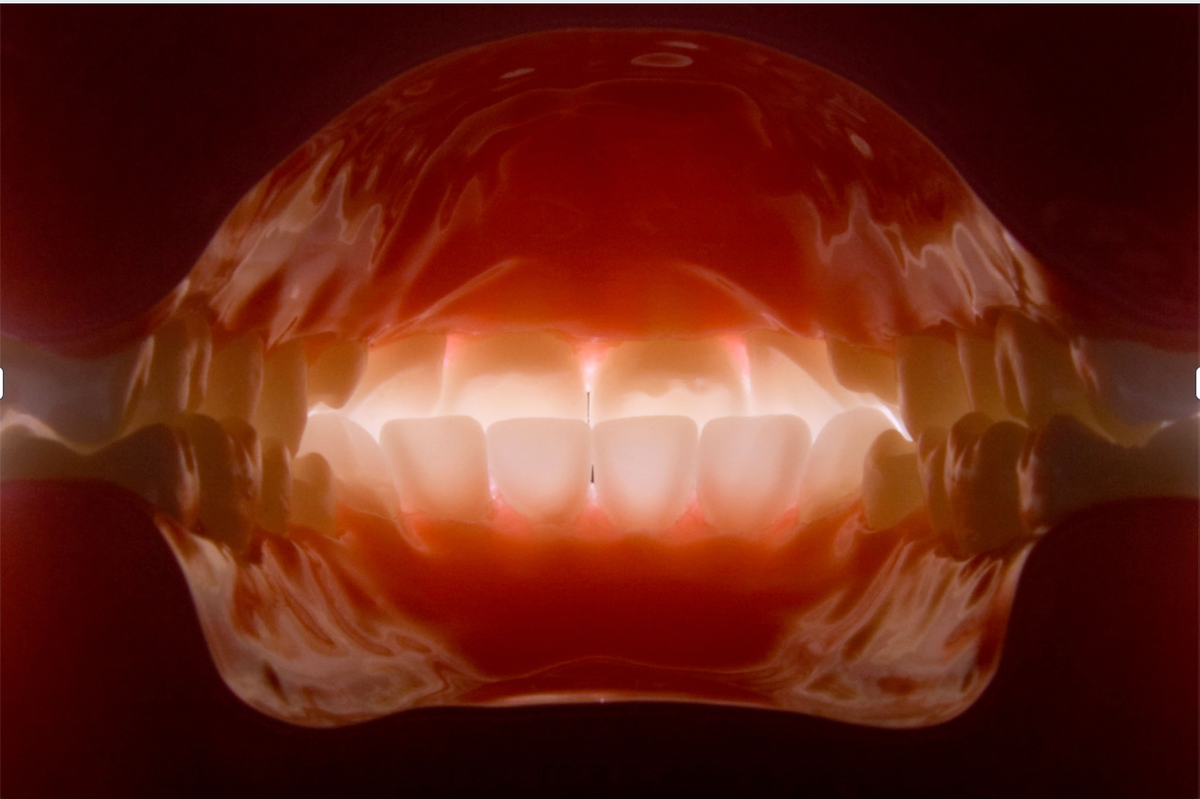
how many wonders can this mouth cavern hold?
We know your relationship with your parents can affect a lot about who you are as you grow up. But is it possible that the good and bad of that relationship could actually show up in your saliva?
That's the bizarre-but-important question a team of researchers recently asked, the results of which were published in Developmental Science.
Led by Elizabeth Shirtcliff, an associate professor from Iowa State University who studies early childhood adversity, the study gathered 300 8th-grade kids and used a simple survey to determine some basic facts about their parents. The kids were asked things like whether they were close with their parents and how often positive reinforcement was used in their household.
The team was looking for signs of what they called "positive parenting, attachment, and bonding."
Six years later, the kids — now adults — were brought back in for a strange follow-up. The researchers collected a dozen different samples of their saliva.
It sounds a little gross, but they were looking for something important: the presence of a hormone called cortisol. Cortisol is crucial to our overall well-being. Lower levels of cortisol are correlated with fatigue, mood swings, and muscle loss, for example. Higher levels of cortisol correlate with healthy blood pressure levels and better immune system function (though extremely high levels are a health risk).
For this study, cortisol was particularly important because it plays a big role in how we process and react to stress. When we're faced with extreme stress or danger, cortisol floods our bodies, resulting in the "fight or flight," response.
The study's authors observed that people who are generally more stressed over longer periods of time, however, often show lower cortisol levels — almost like they get accustomed to all that stress over time and have a lesser reaction to it. While this might sound like a good thing, as far as your health goes, it's definitely not.
The results of the study were clear: The more signs the kids showed of a positive bond with their parents when they were young, the better their cortisol functioned in adulthood.

Canva
That's a good thing, the researchers suggest, because it helps keep kids alert and sensitive to all of the stimuli and information swirling around them from day to day, rather than having a blunted response to stressors and life in general.
So having great parents who use positive parenting methods is a good thing. Yay!
But the study had an important twist when it came to looking at racial demographics.
When race differences were accounted for — about half the kids were black and half were white — the cortisol correlation didn't hold up.
On average, the study found, white and black parents were equally likely to have a positive bond with their kids. But parenting styles aren't the only thing that can affect stress levels and kids' response to it.
 Photo by ia huh on Unsplash
Many of the white students in the study may have benefited from "low stress, resource-rich contexts which unfortunately may be less common for black youth," the researchers explained.
It's also worth noting that many groups — including black people of people Jewish descent — carry biological markers of trauma from previous generations (i.e., slavery, the Holocaust), which can also affect cortisol response.
In other words, growing up with various socioeconomic and other hardships does indeed have a lifelong impact, and now we've got the beakers full of saliva (so to speak) to prove it.
This is important work. It proves that, in many cases, being a great parent can actually physically manifest itself in kids growing up to be well-adjusted and adaptable.
Being a loving parent can actually have a biological impact on your kids years and years later. That's amazing!
Perhaps most importantly, however, it shows a glaring need for kids — particularly those belonging to marginalized or disadvantaged groups — to get better support in the form of solid education, safe communities to grow up in, and more opportunities to learn and grow.
Having great parents isn't always enough to overcome a world that seems to be stacked against you, but it certainly helps.
This article originally appeared on 12.18.17





 a man sitting at a desk with his head on his arms Photo by
  Can a warm cup of tea help you sleep better? If you believe it, then yes. Photo by
 A woman is getting angry at her coworker.via
  A man with tape over his mouth.via
  A husband is angry with his wife. via
 Three women sit on a blanket in the park.
 Two women engaging in a pleasant conversation inside a coffee shop
 Two men engaging in a peaceful disagreement.
Resurfaced video of French skier's groin incident has people giving the announcer a gold medal
"The boys took a beating on that one."
Downhill skiing is a sport rife with injuries, but not usually this kind.
A good commentator can make all the difference when watching sports, even when an event goes smoothly. But it's when something goes wrong that great announcers rise to the top. There's no better example of a great announcer in a surprise moment than when French skier Yannick Bertrand took a gate to the groin in a 2007 super-G race.
Competitive skiers fly down runs at incredible speeds, often exceeding 60 mph. Hitting something hard at that speed would definitely hurt, but hitting something hard with a particularly sensitive part of your body would be excruciating. So when Bertrand slammed right into a gate family-jewels-first, his high-pitched scream was unsurprising. What was surprising was the perfect commentary that immediately followed.
This is a clip you really just have to see and hear to fully appreciate:
- YouTube youtu.be
It's unclear who the announcer is, even after multiple Google inquiries, which is unfortunate because that gentleman deserves a medal. The commentary gets better with each repeated viewing, with highlights like:
"The gate the groin for Yannick Bertrand, and you could hear it. And if you're a man, you could feel it."
"Oh, the Frenchman. Oh-ho, monsieurrrrrr."
"The boys took a beating on that one."
"That guy needs a hug."
"Those are the moments that change your life if you're a man, I tell you what."
"When you crash through a gate, when you do it at high rate of speed, it's gonna hurt and it's going to leave a mark in most cases. And in this particular case, not the area where you want to leave a mark."
Imagine watching a man take a hit to the privates at 60 mph and having to make impromptu commentary straddling the line between professionalism and acknowledging the universal reality of what just happened. There are certain things you can't say on network television that you might feel compelled to say. There's a visceral element to this scenario that could easily be taken too far in the commentary, and the inherent humor element could be seen as insensitive and offensive if not handled just right.
The announcer nailed it. 10/10. No notes.
The clip frequently resurfaces during the Winter Olympic Games, though the incident didn't happen during an Olympic event. Yannick Bertrand was competing at the FIS World Cup super-G race in Kvitfjell, Norway in 2007, when the unfortunate accident occurred. Bertrand had competed at the Turin Olympics the year before, however, coming in 24th in the downhill and super-G events.
As painful as the gate to the groin clearly as, Bertrand did not appear to suffer any damage that kept him from the sport. In fact, he continued competing in international downhill and super-G races until 2014.
According to a 2018 study, Alpine skiing is a notoriously dangerous sport with a reported injury rate of 36.7 per 100 World Cup athletes per season. Of course, it's the knees and not the coin purse that are the most common casualty of ski racing, which we saw clearly in U.S. skier Lindsey Vonn's harrowing experiences at the 2026 Olympics. Vonn was competing with a torn ACL and ended up being helicoptered off of the mountain after an ugly crash that did additional damage to her legs, requiring multiple surgeries (though what caused the crash was reportedly unrelated to her ACL tear). Still, she says she has no regrets.
As Bertrand's return to the slopes shows, the risk of injury doesn't stop those who live for the thrill of victory, even when the agony of defeat hits them right in the rocks.