
upworthy
Add Upworthy to your Google News feed.
Google News Button
Family

Teacher admits there are 11 things that Boomer parents totally got right

Did they teach their kids respect?

boomer parents, entitled kids, rude kids

Teresa Kaye Newman thinks that Boomer parents were right about a few things.

Teresa Kaye Newman, a teacher about to have a son, knows a lot about how to deal with children. So she created a list of 11 things she agrees with Boomers on when it comes to raising kids.

Newman believes she has credibility on the issue because she has 13 years of experience dealing with “hundreds and hundreds” of other people’s kids and has seen what happens when her so-called “Boomer” parenting principles aren’t implemented.

Of course, Newman is using some broad stereotypes in calling for a return to Boomer parenting ideas when many Gen X, Millennial and Gen Z parents share the same values. But, as someone who deals with children every day, she has the right to point out that today’s kids are entitled and spend too much time staring at screens.


Here are the 11 things that Newman agrees with Boomers on when it comes to raising kids.

11 Things I agree with boomer parents on raising children

@teresakayenewman

11 Things I agree with boomer parents on raising children, as a #teacher and soon to be mom.

1. No iPads

“All I’m going to say is my kid has a whole world to explore and none of that has to do with being stuck in front of a tablet.”

2. No smartphone until high school

“Kids that are younger than that age do not know internet safety to a point where I feel comfortable letting them have free reign of the internet.”

3. Teaching the value of education

“What I’m going to teach them is [education] has nothing to do with how much money you’re making or how successful you’ll be professionally. But you will still value it, nonetheless. You will go with it as far as you possibly can, and then once you’re done with it, you can do whatever you want.”

4. Respect your teachers and treat them well

“This may be biased because I am a teacher, but everyone who has gone through a professional degree program and has put in the time and is there, giving you the quality education, deserves some type of attention and deserves to be treated well.”

5. Be kind to elderly folks

“If they’re on public transportation and they’re sitting down and there’s an old lady standing next to them and there are no other seats available, my child will know to stand up and give that lady his seat.”


6. Yes ma’am

Newman will teach her kid to use the terms sir and ma’am when speaking to adults. “It does not matter your age or status in society, as long as they are respecting their pronouns, that’s how we’re gonna be talking to other people.”

7. Greetings and gratitude

“Simple greetings and simple terms of gratitude are just not being taught like they used to. I think it’s really sad.”

8. Consequences for poor behavior

“If they’re neglecting their schoolwork and not doing what they’re supposed to do, they get their technology taken away. … Simple things like this are pretty common sense and I’m not sure why they’re not being done anymore.”

9. Respect adult conversations and spaces

“They don’t get to interrupt 2 adults speaking to each other. They don’t get to come and butt in at an inappropriate time when 2 people are talking to each other."

10. Clean your mess

“My child is going to put as much work in the house as we are regardless of whether he’s paying rent out of his own pocket or not. That’s because when my son becomes an adult, I want him to be a partner or a spouse or a roommate that someone is proud to have around.”

11. Bedtime

“I don’t care how old my kid is as long as he is living under my roof as a minor; he’s gonna have some sort of bedtime. But this staying up until 3 or 4 or 5 o’clock in the morning or pulling all-nighters like kids are used to … is absolutely not normal. And I’m not going to have a kid that’s staying up that late and then not waking up the next day.”


This article originally appeared on 12.20.23

boomer grandparents, boomer grandparent, millennial parents, millennial parent, grandkids
Image via Canva/PeopleImages

Boomer grandparents are excessively gifting their grandkids, and Millennial parents have had enough.

Millennial parents and Boomer grandparents don't always see eye to eye on parenting and grandparenting. Now, Millennial parents are uniting on a nightmare Boomer grandparenting trend that sees them "excessively gifting" their grandkids with tons of both new and old *unwanted* stuff during visits.

Ohio mom Rose Grady (@nps.in.a.pod) shared her "Boomer grandparent" experience in a funny and relatable video. "Just a millennial mom watching her boomer parents bring three full loads of 'treasures' into her home," she wrote in the overlay.


Grady can be seen looking out the window of her home at her Boomer mom and dad carrying bags and boxes up her driveway after several visits. The distressed and contemplative look on Grady's is speaking to plenty of Millennial moms.

@nps.in.a.pod

Today's "treasure" highlight was the mobile that hung in my nursery... #boomerparents #boomers #boomersbelike #millennialsoftiktok #millenialmom #motherdaughter

Grady captioned the video, "Today's 'treasure' highlight was the mobile that hung in my nursery..."

The humorous video resonated with with fellow Millennial parents. "Straight to the trash when they leave," one viewer commented. Another added, "I always say 'if you don’t want it in yours, we don’t want it in ours' 😂."

Even more Millennial parents have shared and discussed their situations with Boomer grandparents buying their kids too much stuff on Reddit. "Both my mother and my MIL love buying and sending toys, books, clothes, etc. I don't want to be ungrateful but we just don't need it and don't have the space. I have brought this up politely in 'we are all out of drawers for that' but it hasn't slowed things down," one explained. "I think part of the issue is that the grandparents live in different cities and vacation a lot. They don't get to see our daughter much so they buy stuff instead."

Another Millennial parent shared, "While the intention is very kind behind these, all the grandparents are very aware that we do not need, nor wish to receive these gifts in such an excessive volume - as it creates a daily struggle to store and accommodate in our home. I struggle to keep on top of tidying as it is, and this is a massive added challenge."

millennial parents, millennial parent, millennial mom, kids room, organize Millennial mom struggles to organize her son's room.Image via Canva/fotostorm

How to talk to Boomer grandparents about gifts

So, why are Boomer grandparents excessively gifting? "Boomer grandparents may be the first grandparent generation to have accumulated the substantial discretionary funds that enables them to spend money on their grandchildren," Sari Goodman, a Certified Parent Educator and founder of Parental Edge, tells Upworthy. "These grandparents probably grew up with grandparents who didn’t have that kind of money and so they may be excited to give their grandchildren the things they didn’t get."

Goodman suggests that Millennial parents first discuss with them the "why" behind the gifting. "What comes before setting a boundary to limit over-the-top gift-giving is delving into the reasons grandparents are buying so much," she explains. "Coming from a place of compassion and understanding makes it possible to come up with mutually beneficial solutions."

- YouTube www.youtube.com

She recommends that Millennial parents sit down with their Boomer parents to learn more. "Did they grow up without many toys and clothes and are fulfilling a dream? Ask them about the values they learned as children (hard work, perseverance, the power of delayed gratification) and how they can pass on these lessons to the grandchildren," she suggests.

She adds that another reason may be that Boomer grandparents live far away and want their grandchildren to feel a connection with them. "Set up a regular FaceTime or Zoom meeting. Rehearse with the kids so they have something to say and suggest a topic for the grandparents," says Goodman. "Or send snail mail. Kids love getting mail. The grandparents can send postcards from where they live and explain some of the special sites."

boomer grandparents, boomer grandparenting, video chat, video call, grandkids Boomer grandparents have a video call with grandkids.Image via Canva/Tima Miroshnichenko


Finally, Goodman adds that for some grandparents, this may be is the only way they know how to show their love. Millennial parents could ask if they would be open to other ideas. "Parents can set up an activity for grandparents and kids to do when they come over—a jigsaw puzzle, art activity, board game, magic tricks," she says. "Arrange for the grandchildren to teach the grandparents something their phones can do or introduce them to an app they might like."

This article originally appeared last September

couple fight, argument, upset woman, woman in sweatshirt, marriage

A woman can't stand what she's hearing.

Some folks in this world just have to be right. All the time. Even when you present them with every fact imaginable that proves they are wrong, they will resort to any rhetorical tactic they can to make it seem as though they are right. If that doesn't work, they turn to personal attacks.

People like this can be infuriating to deal with because talking to them is like screaming at a wall. Fortunately, communication expert Jefferson Fisher recently shared a two-step method on TikTok for dealing with these impossible people.


Fisher, who has become massively popular online, offers tips "to help people argue less and talk more."

@art_for_feeling

How to handle someone who is always right. 3 steps from @ Jefferson Fisher #power #insporation

Here is Fisher's two-step process for dealing with people who will never admit they are wrong:

Step 1. Diffuse the situation

"Know that the harder we work to prove that they're wrong, the more convinced they are that they're right," he says. "So what you're gonna do is diffuse that by just saying something simple as well, 'maybe you're right,' or 'maybe so.' That diffuses the whole situation."

Step 2. Open the conversation up

Fisher says you can encourage the other person to explore your ideas by saying: "'It's helpful for me to know that you're at least considering my thoughts, even if you don't agree with me.' Now you've made a safe space to have a discussion that's not threatening their identity. That's how you talk to somebody who thinks they're always right. So try that."

coffee, women having coffee, serious talk, women on couch, agreement Two woman having a heart-to-heart conversation. via Canva/Photos

Why identity matters

In his video, Fisher notes that people who won't admit when they are wrong have developed an identity based on always being correct. That's why, when they're confronted with the possibility that they may be incorrect, they will do anything to avoid admitting it.

Research shows that when people feel their identity is being attacked, they perceive it as an affront to their authenticity and value as human beings. This can lead to a physical reaction known as the amygdala hijack, where people feel as if they are being physically threatened. That's a big reason some people get enraged when discussing politics or religion. If their views on these issues are closely tied to their identity and those views are challenged, it can invalidate their entire sense of self.

angry, arms folded, angy man, won't listen, sneer A man who has dug in his heels. via Canva/Photos

The 'backfire effect'

Fisher explains that the harder we try to prove someone wrong, the more convinced they become they're right, due to a psychological phenomenon known as the "backfire effect." When people are shown facts that clearly contradict their views, they often cling to those beliefs even more strongly. That's because those beliefs are tied to emotion, not facts. When their views are challenged, it triggers defensiveness, and the brain works to protect their self-image rather than reconsider the belief.

Getting through to stubborn people who always think they're right isn't easy, but Fisher's advice can help break through the wall they erect when their beliefs are challenged. It's good for you and the other person. When you're never wrong, you never learn from your mistakes, and that can quickly lead to problems far worse than admitting you were wrong.

the great depression; Florence Thompson; Mona Lisa of the Great Depression; Mona Lisa; the depression; depression era
Photo by Dorothea Lange via Library of Congress
The woman from the famous Great Depression photo didn't know about her fame for 40 years.

It's one of the most iconic and haunting photos of all time, up there with the likes of Hindenburg, The Falling Soldier, Burning Monk, Napalm Girl, and many others. It's called simply Migrant Mother, and it paints a better picture of the time in which it was taken than any book or interview possibly could.

Nearly everyone across the globe knows Florence Owens Thompson's face from newspapers, magazines, and history books. The young, destitute mother was the face of The Great Depression, her worried, suntanned face looking absolutely defeated as several of her children took comfort by resting on her thin frame. Thompson put a human face and emotion behind the very real struggle of the era, but she wasn't even aware of her role in helping to bring awareness to the effects of the Great Depression on families.


It turns out that Dorothea Lange, the photographer responsible for capturing the worry-stricken mother in the now-famous photo, told Thompson that the photos wouldn't be published.

Of course, they subsequently were published in the San Francisco News. At the time the photo was taken, Thompson was supposedly only taking respite at the migrant campsite with her seven children after the family car broke down near the campsite. The photo was taken in March 1936 in Nipomo, California when Lange was concluding a month's long photography excursion documenting migrant farm labor.

the great depression; Florence Thompson; Mona Lisa of the Great Depression; Mona Lisa; the depression; depression era Worried mother and children during the Great Depression era. Photo by Dorthea Lange via Library of Congress

"Migrant worker" was a term that meant something quite different than it does today. It was primarily used in the 30s to describe poverty-stricken Americans who moved from town to town harvesting the crops for farmers.

The pay was abysmal and not enough to sustain a family, but harvesting was what Thompson knew as she was born and raised in "Indian Territory," (now Oklahoma) on a farm. Her father was Choctaw and her mother was white. After the death of her husband, Thompson supported her children the best way she knew how: working long hours in the field.

"I'd hit that cotton field before daylight and stay out there until it got so dark I couldn't see," Thompson told NBC in 1979 a few years before her death.

the great depression; Florence Thompson; Mona Lisa of the Great Depression; Mona Lisa; the depression; depression era A mother reflects with her children during the Great Depression. Photo by Dorthea Lange via Library of Congress
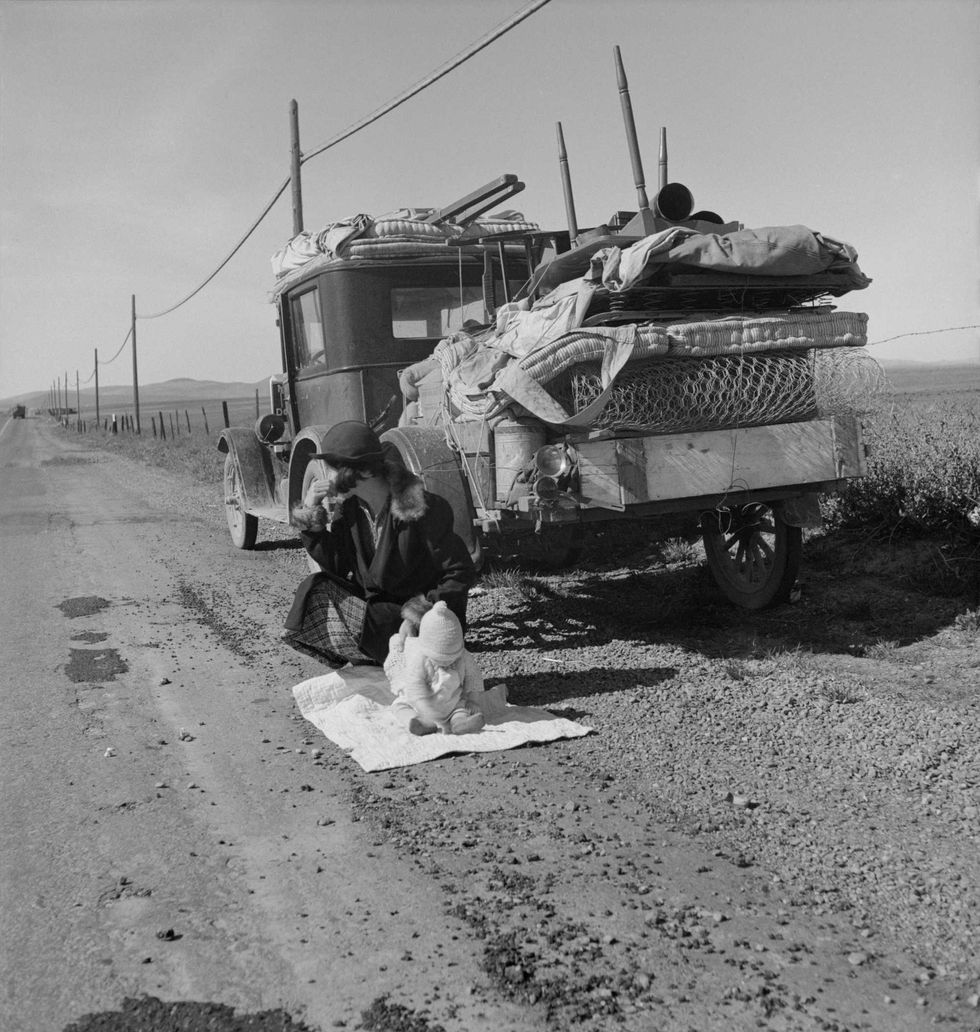
When talking about meeting Thompson, Lange wrote in her article titled "The Assignment I'll Never Forget: Migrant Mother," which appeared in Popular Photography, Feb. 1960, "I saw and approached the hungry and desperate mother, as if drawn by a magnet. I do not remember how I explained my presence or my camera to her, but I do remember she asked me no questions. I made five exposures, working closer and closer from the same direction. I did not ask her name or her history. She told me her age, that she was thirty-two. She said that they had been living on frozen vegetables from the surrounding fields, and birds that the children killed."

Lange goes on to surmise that Thompson cooperated because on some level she knew the photos would help, though from Thompson's account she had no idea the photos would make it to print. Without her knowledge, Thompson became known as "The Dustbowl Mona Lisa," which didn't translate into money in the poor family's pocket.

In fact, according to a history buff who goes by @baewatch86 on TikTok, Thompson didn't find out she was famous until 40 years later after a journalist tracked her down in 1978 to ask how she felt about being a famous face of the depression.

@baewatch86

Florence Thompson, American Motherhood. #fyppppppppppppppppppppppp #historytok #americanhistory #migrantmother #thegreatdepression #dorthealange #womenshistory

It turns out Thompson wished her photo had never been taken since she never received any funds for her likeness being used. Baewatch explains, "because Dorothea Lange's work was funded by the federal government this photo was considered public domain and therefore Mrs. Florence and her family are not entitled to the royalties."

While the photo didn't provide direct financial compensation for Thompson, the "virality" of it helped to feed migrant farm workers. "When these photos were published, it immediately caught people's attention. The federal government sent food and other resources to those migrant camps to help the people that were there that were starving, they needed resources and this is the catalyst. This photo was the catalyst to the government intercepting and providing aid to people," Baewatch shares.

- YouTube www.youtube.com

As for Lange, Migrant Mother was not her only influential photograph of the Great Depression. She captured many moving images of farmers who had been devastated by the Dust Bowl and were forced into a migrant lifestyle.

"Broke, baby sick, and car trouble!" is just one of her many incredible photos from the same year, 1937.

She also did tremendous work covering Japanese internment in the 1940s, and was eventually inducted into the International Photography Hall of Fame and Museum and the National Women's Hall of Fame.

the great depression; Florence Thompson; Mona Lisa of the Great Depression; Mona Lisa; the depression; depression era Families on the move suffered enormous hardships during The Great Depression.Photo by Dorthea Lange via Library of Congress


Thompson did find some semblance of financial comfort later in life when she married a man named George Thompson, who would be her third husband. In total, she had 10 children. When Thompson's health declined with age, people rallied around to help pay her medical bills citing the importance of the 1936 photo in their own lives. The "Migrant Mother" passed away in 1983, just over a week after her 80th birthday. She was buried in California.

"Florence Leona Thompson, Migrant Mother. A legend of the strength of American motherhood," her gravestone reads.

Family

College prep expert ranks how 17 common extracurricular activities affect student applications

"Anything that thousands of kids are doing is always going to be less helpful for you."

College prep expert ranks how 17 common extracurricular activities affect student applications

Prepping for college is a daunting task for kids and parents alike, and it can be difficult to know exactly which submission strategies will actually help prospective students stand out to their dream schools.

Take extracurricular activities, for example. According to Kate Stone, founder of Kate Stone Prep, some extracurriculars will add exponentially more value to an application, while others…not so much.


In an Instagram reel posted in November 2025, Stone ranked a handful of popular high school activities—from instruments to prom-planning—from one to 10.

See how each fared below:

  • Newspaper editor: 7/10
  • Robotics: 3/10
  • Student council: 5/10
  • Winning academic competitions: 8/10
  • Playing viola: 9/10
  • Playing violin: 3/10
  • Taking an independent online course or college course: 8/10
  • Planning your prom: 7/10
  • Solving a real-world problem in your community: 10/10
  • Model U.N. and debate: 5/10
  • Eagle Scout: 6/10
  • Founder of a club: 3/10
  • Founding a club with a measurable impact: 9/10
  • Varsity captain: 5/10
  • Tutoring: 4/10
  • Internships: 7/10
  • Deca: 5/10

extracurriculars, extracurricular activities, school, college, students Girl choosing between extracurriculars.Canva Photos.
In an interview with Today, Stone noted that the highest ranking activities help students differentiate themselves (hence why the viola is a high ranking instrument than the more common violin), show their passion (rather than “just check a box”), and/or demonstrate their ability to make a positive impact (this is why solving community issues ranks so high).

To that end, she warned that "anything that thousands of kids are doing is always going to be less helpful for you."

Choosing the right extracurricular activity

What Stone has touched on, which many other experts agree with, is that, above all, an extracurricular activity should reveal something authentic about the applicant.

“Ultimately, effective selection means finding a "spike"—a deep engagement with a specific subject that creates digital evidence of excellence. Whether you are self-studying for an AP exam, securing a niche internship, or mastering an "off-the-beaten-path" talent like Puppet Arts, your goal is to show colleges that you are self-aware, dynamic, and ready to solve complex, real-world problems,” says Carrie Jorgenson, owner at Early Bird College Inc.

- YouTube www.youtube.com

“Extracurriculars tell you what motivates a student when no one is looking. They reveal curiosity and the kind of self‑driven learning most colleges are looking for today… A student’s activities should help tell a coherent story about who they’re becoming," added Melanie Haniph, founder of College Admissions for Parents.

Still, Lisa Marker-Robbins, Master Certified Birkman Consultant and founder of Launch Career Clarity® warns that many colleges seek out applicants with “major-specific” extracurriculars. So “applying without evidence of interest in that field can weaken an application, even at schools that do not directly admit by major.” Another thing to keep in mind.

College prep is undeniably overwhelming, but at least when it comes to extracurriculars, the mission seems rather straightforward: Commit and go deep. Applications aside, that seems like a pretty good skill for young folks to hone no matter what.

kids, school, school days, school week, schedule, 4 day week
Unsplash

Many school districts are moving to a 4-day week, but there are pros and cons to the approach.

American kids have fewer school days than most other major countries as it is, which poses a big challenge for families with two working parents. In a system designed for the "classic" stay-at-home mom model, it's difficult for many modern families to cover childcare and fulfill their work obligations during the many, many holidays and extra days off American children receive in school.

Some school districts, in fact, are ready to take things one step further with even fewer instructional days: for better or for worse.


Whitney Independent School District in Texas recently made news when it decided to enact a four-day week heading into the 2025 school year. That makes it one of dozens of school districts in Texas to make the change and over 900 nationally.

The thought of having the kids home from school EVERY Friday or Monday makes many parents break out in stress hives, but this four-day school week movement isn't designed to give parents a headache. It's meant to lure teachers back to work.

Yes, teachers are leaving the profession in droves and young graduates don't seem eager to replace them. Why? For starters, the pay is bad—but that's just the beginning. Teachers are burnt out, undermined and criticized relentlessly, held hostage by standardized testing, and more. It can be a grueling, demoralizing, and thankless job. The love and passion they have for shaping the youth of tomorrow can only take you so far when you feel like you're constantly getting the short end of the stick.

School districts want to pay their teachers more, in theory, but their hands are often tied. So, they're getting creative to recruit the next generation of teachers into their schools—starting with an extra day off for planning, catch-up, or family time every week.

Teachers in four-day districts often love the new schedule. Kids love it (obviously). It's the parents who, as a whole, aren't super thrilled.

- YouTube www.youtube.com

So far, the data shows that the truncated schedule perk is working. In these districts, job applications for teachers are up, retirements are down, and teachers are reporting better mental well-being. That's great news!

But these positive developments may be coming at the price of the working parents in the communities. Most early adopters of the four-day week have been rural communities with a high prevalence of stay-at-home parents. As the idea starts to take hold in other parts of the country, it's getting more pushback. Discussions on Reddit, Facebook, and other social media platforms are overrun with debate on how this is all going to shake up. Some parents, to be fair, like the idea! If they stay-at-home or have a lot of flexibility, they see it as an opportunity for more family time. But many are feeling anxious. Here's what's got those parents worried:

The effect on students' achievement is still unclear.

The execution of the four-day week varies from district to district. Some schools extend the length of each of the four days, making the total instructional time the same. That makes for a really long day, and some teachers say the students are tired and more unruly by the late afternoon. Some districts are just going with less instruction time overall, which has parents concerned that their kids might fall behind.

A study of schools in Iowa that had reduced instructional days found that five-days-a-week students performed better, on average.

Four-day school weeks put parents in a childcare bind.

Having two working parents is becoming more common and necessary with the high cost of living. Of course—"school isn't daycare!" But it is the safe, reliable, and educational place we send our kids while we we work.

Families with money and resources may be able to enroll their kids in more academics, extracurriculars, sports, or childcare, but a lot of normal families won't be able to afford that cost. Some schools running a four-day week offer a paid childcare option for the day off, but that's an added expense and for families with multiple kids in the school system, it's just not possible.

kids, school, school days, school week, schedule, 4 day week In a 4-day model, kids often (but not always) receive less instructional time. Photo by Ivan Aleksic on Unsplash

This will inevitably end with some kids getting way more screentime.

With most parents still working five-day weeks, and the cost of extra activities or childcare too high, a lot of kids are going to end up sitting around on the couch with their iPad on those days off. Adding another several hours of it to a child's week seems less than ideal according to expert recommendations.

Of course there are other options other than paid childcare and iPads. There are play dates, there's getting help from family and friends. All of these options are an enormous amount of work to arrange for parents who are already at capacity.

Working four days is definitely a win for teachers that makes the job more appealing. But it doesn't address the systemic issues that are driving them to quit, retire early, or give up their dreams of teaching all together.

@5th_with_ms.y

Replying to @emory here are my thoughts on my 4day work week as a teacher✨ #foryou #fyp #fypシ #foryoupage #foryoupageofficiall #teachersoftiktokfyp #teachersoftiktok #teachertok #teachersbelike #teachertiktok #tik #tiktok #viralllllll #teachertoks #teaching #teacher #tok #viralvideo #teacherlife #viral #trendy #teacher #teaching #worklifebalance #worklife #publicschool #publiceducation #school #student

A Commissioner of Education from Missouri calls truncated schedules a "band-aid solution with diminishing returns." Having an extra planning day won't stop teachers from getting scapegoated by politicians or held to impossible curriculum standards, it won't keep them from having to buy their own supplies or deal with ever-worsening student behavior.

Some teachers and other experts have suggested having a modified five-day school week, where one of the days gets set aside as a teacher planning day while students are still on-site participating in clubs, music, art—you know, all the stuff that's been getting cut in recent years. Something like that could work in some places.

In any case, the debate over a shortened school week is not going away any time soon. More districts across the country are doing their research in preparation for potentially making the switch.

Many parents don't theoretically mind the idea of their busy kids having an extra day off to unwind, pursue hobbies, see friends, catch up on projects, or spend time as a family. They're also usually in favor of anything that takes pressure off of overworked teachers. But until we adopt a four-day work week as the standard, the four-day school week is always going to feel a little out of place.

This article originally appeared in February. It has been updated.