Robin Williams The Movie: Actor’s beautiful impression has folks wanting the full film
I think we can all agree, the loss of Robin Williams is still one that just hurts. He had an otherworldly type of quirkiness and charm that is simply irreplaceable. Not to mention a warmth that was like no other. Luckily, we get to have one more viewing opportunity. One that feels remarkably like watching…
I think we can all agree, the loss of Robin Williams is still one that just hurts. He had an otherworldly type of quirkiness and charm that is simply irreplaceable. Not to mention a warmth that was like no other.
Luckily, we get to have one more viewing opportunity. One that feels remarkably like watching Williams on screen again. All thanks to a fellow comedian.
Jamie Costa, like Williams, is a jack-of-all-trades in the performing world. His bio describes him as an actor, director, producer, writer, voice actor, filmmaker, comedian and—most important for this story—a very talented impressionist. Though he embodies many well-known characters, Costa’s claim to fame is his uncanny rendition of Robin Williams.
It’s easy to see why. The actor not only bears an eerie physical resemblance to the late comedian, but perfectly matches his (unique) vocal tone to a tee.
Feel free to grab some tissues and watch it all here:
If you need further proof, just check out this tribute video Costa put out when Williams passed away in August 2014, titled “Never Had A Friend Like Him.” In the video, Costa masterfully reenacts 20 impressions of Williams’ most well-known characters.
My personal favorites? Alan from “Jumanji” and Peter from “Hook.”
But this next video is pretty breathtaking, and gives us all what feels like an intimate, hidden and never-before-seen aspect of Williams. It feels like watching a bonafide Williams biopic. So much so that many rallied in the YouTube comments calling for it to actually happen.
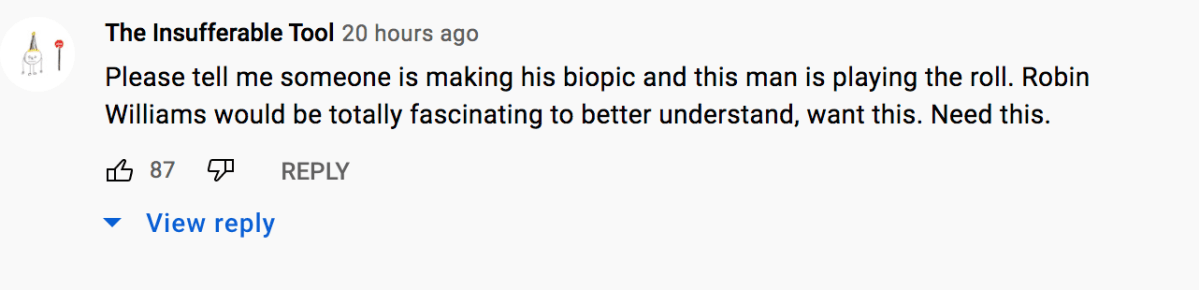
One user wrote: Please tell me someone is making his biopic and this man is playing the role. Robin Williams would be totally fascinating to better understand, want this. Need this.
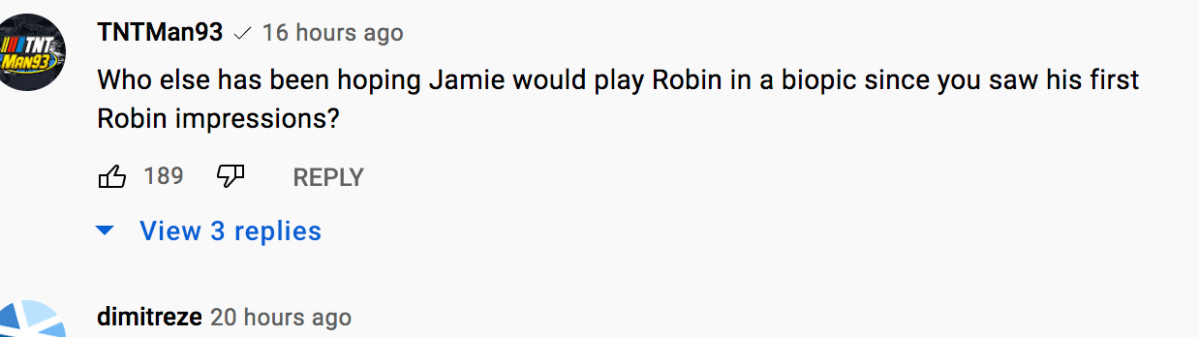
Another person, one who clearly had been following Costa’s work, wrote, “Who else has been hoping Jamie would play Robin in a biopic since you saw his first Robin impressions?”

Another simply stated, “This bio needs to be made with Jamie playing Robin.”
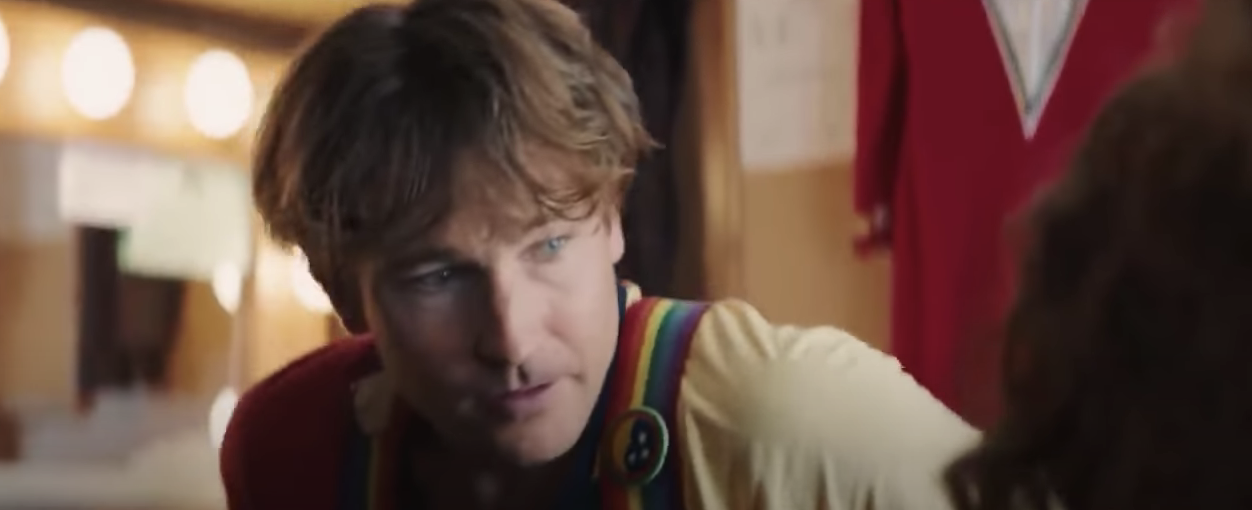
The video, simply titled “ROBIN Test Footage Scene” on YouTube, depicts a young Robin Williams (played by Costa) backstage prepping for the “Mork & Mindy” In the scene, Pam Dawber (played by actress Sarah Murphree) gives Williams the tragic news that John Belushi had died.
Unsure how to handle this initial grief, Williams goes into denial, saying “I was with him last night.”
The elephant in the room, of course, is how Belushi died. Instead of coming right out and saying it was an overdose, Dawber simply gives Williams her plea that “I can’t let what happened to him happen to you.”
The clip ends with one of those bittersweet and beautiful “the show must go on” moments. Williams runs his lines in the mirror, fighting back emotion. And for the first time, past the veil of one of his beloved characters, we catch a glimpse of the REAL Robin Williams. The Williams who made the whole world laugh, yet hid away great pain.
Costa does a beautiful job of bringing to life not only the Williams mannerisms and quirks, but also the rich depth and, not to be melodramatic, some of the inner torture as well. It’s beyond an impression; he actually embodies Williams’ essence. And it’s a great service to an artist who gave the world so much.
Great job Jamie Costa. You’ve done the impossible and brought back to life one of the greats.
A single door can open up a world of endless possibilities. For homeowners, the front door of their house is a gateway to financial stability, job security, and better health. Yet for many, that door remains closed. Due to the rising costs of housing, 1 in 3 people around the world wake up without the security of safe, affordable housing.
Since 1976, Habitat for Humanity has made it their mission to unlock and open the door to opportunity for families everywhere, and their efforts have paid off in a big way. Through their work over the past 50 years, more than 65 million people have gained access to new or improved housing, and the movement continues to gain momentum. Since 2011 alone, Habitat for Humanity has expanded access to affordable housing by a hundredfold.
A world where everyone has access to a decent home is becoming a reality, but there’s still much to do. As they celebrate 50 years of building, Habitat for Humanity is inviting people of all backgrounds and talents to be part of what comes next through Let’s Open the Door, a global campaign that builds on this momentum and encourages people everywhere to help expand access to safe, affordable housing for those who need it most. Here’s how the foundation to a better world starts with housing, and how everyone can pitch in to make it happen.
Volunteers raise a wall for the framework of a new home during the first day of building at Habitat for Humanity’s 2025 Carter Work Project.
Globally, almost 3 billion people, including 1 in 6 U.S. families, struggle with high costs and other challenges related to housing. A crisis in itself, this also creates larger problems that affect families and communities in unexpected ways. People who lack affordable, stable housing are also more likely to experience financial hardship in other areas of their lives, since a larger share of their income often goes toward rent, utilities, and frequent moves. They are also more likely to experience health problems due to chronic stress or environmental factors, such as mold. Housing insecurity also goes hand-in-hand with unstable employment, since people may need to move further from their jobs or switch jobs altogether to offset the cost of housing.
Affordable homeownership creates a stable foundation for families to thrive, reducing stress and increasing the likelihood for good health and stable employment. Habitat for Humanity builds and repairs homes with individual families, but it also strengthens entire communities as well. The MicroBuild® Initiative, for example, strengthens communities by increasing access to loans for low-income families seeking to build or repair their homes. Habitat ReStore locations provide affordable appliances and building materials to local communities, in addition to creating job and volunteer opportunities that support neighborhood growth.
Marsha and her son pose for a photo while building their future home with Southern Crescent Habitat for Humanity in Georgia.
Everyone can play a part in the fight for housing equity and the pursuit of a better world. Over the past 50 years, Habitat for Humanity has become a leader in global housing thanks to an engaged network of volunteers—but you don’t need to be skilled with a hammer to make a meaningful impact. Building an equitable future means calling on a wide range of people and talents.
Here’s how you can get involved in the global housing movement:
Speaking up on social media about the growing housing crisis
Volunteering on a Habitat for Humanity build in your local community
Travel and build with Habitat in the U.S. or in one of 60+ countries where we work around the globe
Join the Let’s Open the Door movement and, when you donate, you can create your own personalized door
Every action, big and small, drives a global movement toward a better future. A safe home unlocks opportunity for families and communities alike, but it’s volunteers and other supporters, working together with a shared vision, who can open the door for everyone.
Since the 1970s, people on the Supplemental Nutrition Assistance Program (SNAP), have not been able to purchase hot, prepared foods—only those they can cook at home. So, if you stopped by your local grocery store’s deli counter, you could have the cold mashed potatoes in the refrigerated section, not the warm ones next to the chicken.
The idea behind the ban is that lawmakers want to provide grocery assistance and not restaurant assistance. It’s believed that when you buy hot food, the government wastes money on preparation fees. While a strict cost-saving measure on the surface, it overlooks that 79% of SNAP households include someone who is elderly, has children, or is disabled, which can make meal preparation challenging.
A bipartisan group of lawmakers in the Senate recently warmed to the idea of allowing people receiving SNAP benefits to purchase the grocery-store staple: hot, prepared rotisserie chicken. These typically retail for $5 to $9, making them a great deal and a healthy, lean protein source. So, in this case, the hot, prepared chicken is a better deal for everyone involved.
Behold, the Hot Rotisserie Chicken Act
In April, a bipartisan group of Senators including Jim Justice (R-W.V.), Shelley Moore Capito (R-W.V.), John Fetterman (D-Pa.), and Michael Bennet (D-Colo.) introduced the Hot Rotisserie Chicken Act to amend the 2008 Food and Nutrition Act by allowing a carve-out for the food.
It’s plain common sense: a hot rotisserie chicken is a healthy, easy meal for busy families. Folks on SNAP should be able to grab one on the go.
“America’s best (and delicious) affordability play is Costco’s $4.99 rotisserie chicken,” Fetterman said in the statement. “It’s one of my family’s favorites and I’m proud to join this bill with Senator Justice for all to try. SNAP funds would be well spent to feed our nation’s families who need it.”
On April 30, a similar amendment to the act was added to the broader Farm Bill with dramatic bipartisan support. The measure cleared the House with a 384 to 35 vote. It seems that with all the partisan bickering in America, we can all agree that everyone deserves hot rotisserie chicken.
SNAP to include HOT ROTISSERIE CHICKEN.
384-35!
Doesn’t only include my crew’s favorite + affordable $4.99 Costco rotisserie 😜 — but ANY hot rotisserie.
— U.S. Senator John Fetterman (@SenFettermanPA) April 30, 2026
However, the $390 Farm Bill package wasn’t greeted with such bipartisan enthusiasm. It passed on a partisan vote in the House of Representatives, 224-200, with only 14 Democrats in support, as it locked in a $187 billion cut to SNAP benefits through 2034.
After the passing of the Big Beautiful Bill last year, four million people lost some or all of their SNAP benefits, including: able-bodied adults without dependents who don’t work or volunteer at least 80 hours a month, refugees, those on political asylum, veterans, unhoused people, and former foster youth.
Rotisserie chicken at a warehouse store. Credit: Canva
Why are rotisserie chickens so cheap?
Usually, prepared food is more expensive than buying it uncooked. However, there are multiple reasons why buying a whole rotisserie chicken at your local grocery store or Costco is more affordable.
At Costco, the chickens are a loss-leader, meaning if the $5 chicken gets you in the door, you’ll probably cruise through the store and spend $400 on frozen fish, a 40-lb bag of dog food, 48 rolls of toilet paper, and an oversized holiday lawn decoration. In some grocery stores, rotisserie chickens are offered at a great price because they are butcher leftovers that may soon expire. Instead of throwing out the unsold raw chickens, they roast them and sell them at a discount.
When we think back to what we might deem the best of times, at least in terms of age, the answers are multilayered and, of course, subjective. For some, it’s age five, when even the smallest dandelion seemed whimsical. For others, it’s freshman year of college, when we perhaps felt truly autonomous and ready for reinvention.
At the Carrington Court Assisted Living and Memory Care facility in Utah, elderly residents were asked the simple question: “What was your favorite age of life?” While The Beatles’ “Here Comes the Sun” underscores the video, a handful of people give their unique answers. Many of them are downright surprising.
In one clip shared on Instagram, we see senior citizens tackling the question. The caption reads, “You can still hit milestones at 93!” The first woman in the clip answers quickly. “25,” she says. She’s asked why, and she laughs while explaining, “My dad had bought me a new convertible car for my birthday. And I just drove it and drove it and drove it!”
We cut to the next resident, who answers, “About 63. Not too long ago, because I was looking forward to retiring.”
The next woman has a harder time making a choice. “I have so many,” she shares, “because my children have been very busy in their life and I’ve been busy in mine, and enjoyed what we were doing.”
A man is asked, and he doesn’t have to think about it long. “Last year!” This is followed by the obvious question: “Last year? How old were you?” He vulnerably shares, “Oh my goodness. I don’t remember.” But when his memory is prompted, he remembers he’s now 94. He continues, “Last year. Because I had no interest in life until this wonderful woman here brought it back to me.” The camera then pans over to the woman who had answered 63. She chuckles lovingly while absorbing the compliment.
Another man who is asked the same question says, “My favorite year of life would have to be probably when I was 17 or 18, because I was able to win a contest on a project I had made on my own lathe or a project on my dad’s lathe. And it took first place.”
Other videos shared on their social media pages show residents being asked the same question, with various answers: “Hopscotch, true love, babies, childhood farms.” Whatever it was for each, it was tied to moments embedded in their memories that brought them pure bliss.
The comment section seems moved by their answers, with plenty of opinions of their own. Some share how they would have answered: “I’m gonna vote 63, although I’m not there yet.”
This person can’t decide: “Who can pick just one… first true loves, seeing bands and just livin’… then the kids come along, and is anything better? Then they’re gone, but you’ve got money and time, and still can party and have fun… and I’m supposed to pick one, no can do.”
A few offer success stories from people in their lives: “My widowed aunt got remarried at 94. She’s now 99.”
Another had a similar experience with a family member: “My Mom met the love of her life at 80 in her Assisted Living home. They loved life together for the rest of their lives.”
The truth is that well-being researchers have studied the topic of happiness for quite some time. The consensus, at least for a handful of people, seems to be that we’re happiest in our twenties, take a big dip in middle age, and rediscover happiness again in older age.
This is known as the U-shaped happiness curve. While some dispute its accuracy and are quick to point out biases (as is often the case with studies), many take solace in the idea that there is always hope. And instead of thinking of “40” as “over the hill,” as it used to be so popular to claim, the idea that it’s actually uphill after—or at least could be—is promising.
Even just from the tiny sample received from the senior living home, it seems pretty clear: it’s not over till it’s over.
From the outside gate, Far Meadow Farm looks quite standard. A fenced-off riding area with two horses; hens pecking at the ground. Trees gather around the buildings, and in the gaps between them, you can see glimpses of the moors beyond: windy, dramatic landscapes shaped by wild remoteness, rain, and lacerating winds.
Here, on a small farm in Godley, a bucolic suburb in northwest England on the edge of Manchester, you’ll find farmer Alan French, a 76‑year‑old local who refuses to let his little slice of pastoral heaven disappear—not again.
“I just think, piss off, leave me alone, I’m not moving. Every time I move somewhere developers want it,” French told the Manchester Evening News. “This is no longer a rural place. It’s going to get worse if they get their way.”
Before moving to Godley, French had to leave two previous homes to make way for development. Now, he’s been here for 17 years, and the humble farmer is fed up. As a huge new housing project backed by Tameside Council closes in around him, he keeps repeating the same four words to anyone who asks what happens next: “I am not moving.”
A life of being pushed along
French grew up in the days when the strip of land between the Tameside and Stockport boroughs still felt rural, its fields and farmhouses sitting just outside Manchester’s reach. As the city expanded, housing estates descended on places like Romiley, a village just a few miles south of Godley, and local councils turned to a planning tool that lets them seize land for “the greater good.”
In the United Kingdom, it’s a compulsory purchase order, or CPO. In the United States, it’s eminent domain, the power government agencies use to acquire private land for things like highways, schools, pipelines, and housing.
Over the course of his life, French has had to leave two homes: both in Romiley, both because of compulsory purchase orders tied to development projects. That’s a pattern.
Now, with Godley Green Garden Village looming, he’s scared it’s happening again. Yet the 76-year-old farmer remains resolute: he will not sell Far Meadow Farm voluntarily.
What’s coming to Godley
For Tameside Council, Godley Green Garden Village is not just another development. It’s their flagship, a 15-year project that will see 2,150 homes built between Hyde and Hattersley, east of Manchester. The site sits on land that used to have green belt status, a planning zone meant to keep cities from sprawling endlessly outward. Places for Everyone, a region-wide development plan, removed this particular patch’s protected status, clearing the way for housebuilding.
Greater Manchester, like most big U.S. metros, has a housing crisis you can feel in people’s lives. Local reports describe tens of thousands of people on social housing waiting lists. Younger households can’t find anything affordable near work. Older residents struggle to downsize. Tameside Council argues that schemes like Godley Green are how they meet government-set housing targets and give more people decent places to live.
The outline for Godley Green goes like this: two “village” centres on either side of a small waterway called Godley Brook, each with some shops, commercial space, and community facilities. Developers say they’ll reserve more than half the land in the final master plan for open space, parks, and habitat areas. The plan also includes expanded school options, healthcare facilities, sports fields, and walking paths. About 15% of the homes—roughly 323—will count as “affordable” in a mix of rentals and ownership schemes.
Council leaders echo that language. They say the scheme has been “thought through carefully” and describe a “natural, representative community” with homes for young families, single people, and retirees. They also point to the money the project will bring for roads, schools, healthcare, and other infrastructure. Exact dates shift, but the broad picture is this: infrastructure starts soon, then the first homes a couple of years later, with a full build-out carried out over 15 years.
A community speaks out
For people in charge of meeting housing targets, Godley Green looks like a necessary piece of a large puzzle. But for those who already live there, it looks like something else.
Campaigners like Anne Tym, whose family owns land earmarked for development, emphasize that “the green belt is there for a purpose.”
During the planning process, more than 4,000 objectors spoke out against the new housing development. “Save Tameside Greenbelt” groups have sprouted up, warning residents that this new, utopian village will “ruin” an area they’ve walked, ridden, and worked on for decades. Many residents do not need to wait 15 years; their once-rural home already feels like a city, and they cite increased traffic and decreased wildlife.
“All the green space is being turned urban,” French told one reporter. “The wildlife we’ve got here is becoming less. The deer used to come into the ménage with their babies. There was one dead last week on the road because the traffic is ridiculous.”
Life on the edge of “maybe”
French’s farm sat inside early development maps for Godley Green. More recent outlines appear to wrap around him rather than over him; he now believes he’s right on the edge of the red line, while neighbors report compulsory purchase orders have landed in their mailboxes.
Planners claim compulsory purchases will be a “last resort” and that they’re trying to strike private deals with landowners first. But they also make clear they can’t rule it out. For French, that’s not reassuring.
He doesn’t go to the consultation meetings anymore. “I can’t be bothered with it all,” he toldManchester Evening News. “I’m done with it.”
Friends and other farmers come back with updates: another committee meeting, another map, another speech about targets, homes, and growth. At planning hearings, some of them hold up banners with his name; he lets them do the shouting while he stays with the horses.
In the meantime, he feeds Yan and Tommy at the same times every day because the animals don’t care what’s on the council agenda. He points out where he can still see moorland between the trees. On some mornings, if the light is right and he looks in the right direction, it’s still possible to forget that a 15‑year construction project could soon begin on the other side of that horizon.
He knows, intellectually, that he doesn’t “own the view.” A council officer reminded him of that once. But he also knows what it feels like to lose more than bricks and mortar when a place goes. When asked where he’d go if he did have to leave, he tends to shrug. He hasn’t let himself imagine it.
“I love it here. It’s the happiest I’ve ever been,” he said.
This isn’t just a British story
If you live in the U.S., you don’t need a deep understanding of U.K. planning law to understand the shape of this. Swap the moors for a cornfield in Iowa, a ranch outside Austin, or a farming community in rural Georgia, and the outlines look familiar.
In America, the tools have different names—eminent domain instead of compulsory purchase orders, highway expansions instead of garden villages—but the basic tension is the same: a government or corporation says, “We need this land,” and your options are either to obey or to get out of the way.
All over the country, farmers have fought wind farms that cut across their fields, arguing that easements and buyouts do not compensate for a way of life being sliced up. In cities like Denver and Atlanta, long-time landowners watch new subdivisions march across what used to be their neighbors’ pastures and wonder when someone will knock on their own door.
Almost every major U.S. city now carries its own version of the Godley Green argument: We need more housing, but where do we put it without erasing the people and places that already make a place feel like home?
Holding two truths at once
It would be easy, and maybe emotionally satisfying, to file French’s story under “heroic farmer vs. greedy developers” and call it a day. It would also be easy to shrug and say, “Well, people need somewhere to live,” and move on.
The harder, truer version lives in between.
On one hand, Greater Manchester does need more homes. So do San Francisco, Phoenix, Denver, and Detroit. Young families in cramped rentals and older folks stuck on waiting lists are not imaginary abstractions; they are as real as French and his horses. On the other hand, someone has to pay the price of that new stability. In French’s case, that bill has come due three times in one lifetime.
As of early 2026, Tameside councillors have granted planning permission for Godley Green again after a brief refusal. Infrastructure work could begin soon. The full build‑out will take about 15 years. No one knows how long French can hold his line. No one knows if a CPO notice will ever arrive with Far Meadow Farm on it.
For now, the story looks like this: a 76‑year‑old farmer gets up in the morning, feeds his animals, and looks out over fields that, on paper, already belong to the future. Beyond his fence, a council talks about “modern placemaking” and “representative communities.” In between those two visions is a question neither side has quite answered yet in England or in the U.S.:
When we say we’re building for the public good, how many times do we expect the same people to move?
Everyone remembers their favorite teachers. What we often can’t remember are the exact moments that left such a fond impression on us.
And while good teachers help us understand their subject, the absolute best of them help us think differently about the world.
Author taught a first-year college course and noticed some strange student behavior
Years ago, Joseph Fasano, a poet, writer, and author, was teaching an introductory college course on composition, writing, and critical thinking. By all appearances, he was crushing it.
“One semester I thought [my students] were just really focused on taking notes,” he wrote in a recent Instagram post, noticing that the students were spending an awful lot of time scrawling in their notebooks.
He wasn’t wrong, but it wasn’t the material in his lectures they were paying attention to. They weren’t diligently taking notes just to pass an exam.
“Turns out they were compiling a book of all the slightly unhinged things I’d said. It’s 152 pages long,” he wrote.
As an author and poet, Fasano has more than a way with words. He has a way of capturing essential truths and reflecting them in ways that are incisive and memorable. His students were eager not to let those nuggets escape them. Once the book was completed, they gifted it to him, and he calls it “the best thing my students ever gave me. … I love these kids.”
The first page reads, “You once said in class that you wanted to be sure that what you were saying was being heard and absorbed. Well… here ya go.”
A few of the most memorable quotes from those 2016 lectures, as handwritten by Fasano’s students:
“Who taught you wonder, love, and learning were supposed to be easy?”
“Your assignment is to read a writer someone told you not to.”
“Every day of your life is a rough draft.”
“Another day, another chance to make the mistake that will save you.”
“The only thing more painful than becoming yourself is not becoming yourself.”
Fasano may call the quotes “unhinged,” but the rest of us just see wisdom.
The post went viral, and people are wishing they could have taken Fasano’s course
The post racked up 179,000 likes and 1,300 comments in just two days, and the response has been nothing short of overwhelming. A few standouts:
“This is the best thing I’ve ever seen. You can actually see how you’ve positively influenced your students. What more could we want as teachers?”
“This book needs to be published.”
“Do you teach classes for 23 year old girls preferably for free”
“And evidently they love you. What an accomplishment. I hope this book gives you the peaceful sleep you have earned. Please do not stop.”
“This is the most thoughtful, touching thing ever. What great kids. What a great teacher. Thank you for your passion, for inspiring them and for making the best kind of impression on them. What a gift!”
Calm wisdom like this lands hardest when times are tough
A few sentences scribbled in a notebook. A couple of motivational quotes. Why are Fasano’s words landing and resonating so deeply with hundreds of thousands of social media users?
“I have a feeling it is resonating with people because we’re all looking for a teacher, a guide, an adult in the room,” Fasano told Upworthy. “Especially when those seem to hard to find right now.”
The words are beautiful and memorable, but they wouldn’t have quite the same impact if we didn’t have physical proof that they touched his students. They were compelled to write them down, and it’s easy to imagine that taking that introductory course with him may truly have changed the way some of them viewed the world.
Though Fasano only teaches occasionally, he continues his work as a poet and author. Fellow poet Dorothea Lasky described him as “A poet brave enough to return poetry to its troubled and eternal origins…This is the poet I trust to see the world as it is, quietly writhing around us.”
Fasano was able to pass on some of his gift to his students. But what’s even cooler is what they were able to give back to him—and so did thousands on social media.
“This is clearly the good side of social media,” he wrote on Instagram regarding the flood of appreciative and heartfelt messages. “I can’t (but can) believe people are this beautiful.”
It’s fairly common to see someone propose on the Jumbotron at a sporting event. A couple from Virginia, however, found a new way to add some drama. They turned their Jumbotron proposal into a Wheel of Fortune-style game.
It all went down at the Coca-Cola Center in Toronto, Canada, during a Professional Women’s Hockey League matchup between the Toronto Sceptres and the New York Sirens.
The couple, Nina Borgeson and her partner, Meg Beizer, appeared to be playing a game similar to Wheel of Fortune during a break in the hockey match, but Meg knew otherwise. The announcer asked her, “What three letters are you going to guess next?” After the traditional RSTLNE were put up on the board, she replied, “W, O, U,” making it obvious what the puzzle said.
Meg then got down on one knee and, in front of the cheering crowd, she popped the question. Meg slipped the ring on Nina’s finger, they kissed, and Nina raised her hand in celebration.
The couple traveled to the game from Virginia, and when Meg learned that it was Pride night, she knew it was the perfect time to ask for Nina’s hand in marriage. “This league quickly became a big part of our life and something so special to us,” Meg told Queerty. “The community is unlike any other fan base I’ve ever seen. I knew sharing it with other fans would make our proposal that much more special and memorable, and it exceeded expectations. The amount of love and support we received was something we will truly never forget.”
A popular place for proposals
PWHL games have become a popular place for LGBTQ women to propose. Back in December, at an Ottawa Charge game, two women were being interviewed when the conversation veered into unexpected territory. “I love this community, I love everything that’s been given to us,” a woman named Theresa said into the microphone, “and I can’t think of a better moment to ask Dani…” she said before dropping to one knee and proposing.
The PWHL just completed its third regular season, during which it saw attendance and viewership expand dramatically. This season, the league expanded from six to eight teams and saw attendance eclipse the million mark for the first time. Attendance was up 28% this season, with the average game attendance rising from 7,230 in 2024-25 to 9,304. Viewership is also up on the league’s YouTube channel. This season, viewership across the U.S. and Europe increased by 77%.
A growing community
The league saw an opportunity for growth after women’s hockey made headlines in Milan earlier this year, with the U.S. women’s team beating Canada for the gold medal. “We knew this moment was going to be big for us,” PWHL executive vice president of business operations Amy Scheer told The Athletic, “and felt that this could be a game changer for us.”
If you haven’t heard of Mark Rober, your kid almost certainly has. Rober, a former NASA engineer, has more than 76 million followers on YouTube, where he’s famous for wildly creative science experiments.
In one popular series, he tries to create a squirrel-proof bird feeder and eventually builds an obstacle course to challenge the agile creatures. In another, he invents a robot that can outkick the NFL’s best field-goal kicker. Probably Rober’s most famous experiment involved creating “glitter bombs” to catch porch-pirate package thieves.
Rober left NASA in 2013 to go out on his own, creating things he thought were cool and making some of the most entertaining and educational science content on the Internet. Today, he never loses perspective on the privilege of his massive platform, which he calls a “responsibility.”
Rober does cool science with Wish kids at Disneyland
Rober grew up in Brea, California, about 10 minutes from Disneyland. As a kid, he could hear the nighttime fireworks from his neighborhood. Getting to go to the park at all felt like a big deal. Getting escorted to the front of a ride? Unthinkable.
“That would have been my peak,” he told Upworthy, laughing.
This week, Rober got the experience of a lifetime meeting with several kids from the Make-A-Wish Foundation, including Piper, a young girl with Marfan syndrome, and Brendan, a boy with aggressive leukemia who says Rober’s videos kept his spirits up during treatments.
Alongside fellow creators like MrBeast and Dude Perfect, Rober led kids through an egg-drop challenge off the top of Avengers Tower and got to spend much of the day just hanging out and riding rides with his new friends. It’s all part of an event put together by YouTube, The Walt Disney Company, and the Make-A-Wish Foundation called “Wishes Assemble.”
When asked if he ever could have imagined, when he was working at NASA or creating his first YouTube videos, that one day it would be a child’s greatest wish in the world to meet him, he said, “No way. Like, five years ago, I’d have been like, ‘no,’ two years ago, I’d have been like, ‘no way.’” It’s still hard for him to wrap his mind around the impact he has on the kids who watch his videos.
Rober recalls he was told that among YouTube creators, he ranked just behind MrBeast last year in fulfilled wishes. “It’s crazy,” he said. “I want to remind everyone—I make science videos. Since when is science cool? Like, I shouldn’t be getting that many requests.”
Rober has worked with Make-A-Wish many times before. He says it can be tough not to get overwhelmed with emotion when hearing the Wish kids’ stories, but overall, he just tries to bring his signature fun energy and enjoy his time with them as much as he can.
“[The goal is] escapism,” he said. “These families and kids have been through some pretty tough stuff.”
Mark Rober does cool science with Wish kids at Disneyland. Photo credit: Disneyland Resort/Sean Teegarden
Not Rober’s first foray into philanthropy
Rober’s philanthropy extends well beyond Make-A-Wish.
He’s led Team Trees, Team Seas, and Team Water alongside fellow creators and helped raise tens of millions of dollars for environmental causes. Like Rober’s experiments and stunts, the projects have been rooted in real impact, not just dollar amounts: Team Trees has planted 24 million trees worldwide, and counting.
Rober has also partnered with STEM education nonprofits and has raised millions of dollars for autism awareness and grants for autistic people, a cause close to his heart: Rober’s son has autism.
He says there was no one crystallizing moment when he realized he had the platform to actually make a difference. It was more of a slow realization about what having a platform actually means.
“You come to realize that you have a big megaphone and a spotlight, and it almost becomes a responsibility,” he said. “It’s almost immoral not to do something with that. To move the needle in the right direction.”
Rethinking how America teaches science
Next up for Rober and his team is something so massive it sounds impossible—which is exactly the kind of challenge he specializes in: completely reimagining the way kids learn science in school.
He’s taking everything he’s learned about what kids love about science and engineering from his videos and applying it to a real curriculum. It’s taken a team of 50 people and $60 million, but the new curriculum, called Class CrunchLabs, will meet all the rigorous educational standards while still being fun—and it’ll be free for all educators.
Rober will be publishing a TED Talk on the project on May 5.
“Most of the curriculum out there—teachers have to pay for it, and those curriculum writers never had to earn a single view,” he said. Rober, for his part, has earned about 16 billion. “So they just make really boring content. Science should not be boring.”
Rober pays his respects to the work of Bill Nye, but notes that a lot of (very) old Nye videos are still being used in education. He thinks we can do better by today’s kids and likens his engaging approach to “hiding the vegetables.”
“You could have the best curriculum in the world. If the students don’t care, it doesn’t matter,” he said. “We know how to solve that motivation gap. And that’s like 90% of the issue.”
It’s hard to believe this is the guy who got famous for inventing a Halloween costume that made it look like the wearer had a bloody hole in their torso. But seeing how seriously he now takes his responsibility—an audience of tens of millions of people, many of whom are children—it’s not hard to see why it would be a kid’s biggest wish to meet him, especially alongside other heroes like The Avengers.
When Rober isn’t making kids’ dreams come true or reimagining the education system, he’s planning his next video. It may or may not involve him playing tug-of-war against a real lion. It sounds crazy, but we wouldn’t bet against him.
A simple compliment can have the most powerful impact. Allie Hartung, a young woman battling breast cancer, shared the story about a life-changing interaction with a thoughtful grocery store worker that is showing the world the true significance of small acts of kindness.
Allie told Upworthy, “My journey started with a small lump near my rib cage that I was told twice was ‘probably just a lymph node,’ but I trusted my instincts and sought a second opinion. During an ultrasound at my third doctor’s request for answers, a full breast exam revealed a different small mass, and two days before my 32nd birthday, a biopsy confirmed it was cancer.”
Allie recently went through chemotherapy that resulted in total hair loss. Back in March, she visited her local grocery store to get some essentials. Only this time, she made the brave choice to not cover her baldness.
Her courage did not go unnoticed, and she shared the story in a moving video. “Anyway, compliment a stranger,” she captioned it.
In the video, Allie shares what happened after she went to the grocery store.
“I was getting stuff I need, and the lady who worked there stops me while she as mopping, and she was like, ‘Girl! You rock your hair like that!’” she says. “And I said, ‘Thanks. It’s not by choice.’ And we both kind of went our separate ways.”
But they find each other again in the store.
“She comes back around and she says, ‘Did you just say it’s not by choice?’ And I said, ‘Yes. I’m going through chemo.’ And she was like, ‘Oh my gosh, you’re going to rock it! And you’re gonna kill it!’” Allie noted she doesn’t remember exactly what the kind woman said to her, but that she thanked her.
But before she left the store, Allie found her once again.
“I stopped her and I just said, ‘Actually this is the first time I’ve left the house without wearing a scarf or a hat. And I know it was something [a] very small part of your day, but I’ll never forget this moment and it really means a lot to me.’”
She adds that the two hugged, and the interaction had a deep impact on her.
“I think through cancer, I’m realizing compliments can go a really long ways,” she shared, explaining that she used to work at the store for years, but that two of her managers didn’t recognize her without her hair.
“I’m just not really feeling like myself, and I just really needed that,” she concluded.
Allie met up with the kind stranger
The woman who complimented Allie was named Tracy. She found and commented on Allie’s video, sharing more details about their chance meeting:
“…I was mopping the store and saw her come around the corner I told myself ok yeah she looks really good and she’s rocking that hair style. I was fighting with myself on telling her and a voice just told me to go for it, worse thing thing she could do is chew me out. She told me her story before she left. I never expected this to blow up like it did! I’m so glad to have gained and friend and make someone feel good about themselves. I also try to give a compliment even if I don’t receive anything in return I don’t do it for that. Keep pushing Allie!!! I’m here always girl.”
The two met once again after the video had gone viral. Allie brought Tracy a little gift basket of flowers to show her appreciation, and shared it with her followers.
kindness takes so little but can mean so much. you never know how much someone needs to hear it. compliment a stranger and if you’re lucky, you may make a new friend. the biggest shout out to my newest pal @tracy for being a shining light in my cancer journey. also please forgive the recording angle and audio. i find it creepy to record others when they’re not expecting it 🙃
“Kindness goes a long way, and this has impacted me in the most unbelievable ways that I could think of,” Allie says in her car before meeting Tracy.
She finds Tracy, and gets to tell her about the impact her kindness made. “It really meant more to me than you know,” she tells her.
Allie’s message on early detection
Early detection and self-advocacy were essential for Allie’s early breast cancer diagnosis, and she encourages other young women to take steps for early breast cancer detection.
“A self exam doesn’t have to be complicated, you’re just looking for changes. A new lump, (sometimes it can feel as small as a lemon seed), swelling, skin dimpling, or anything that feels different from your normal,” she tells Upworthy. “And if something feels off, even if you’re told it’s probably nothing, it’s okay to push for answers or seek a second opinion. Trusting yourself can make all the difference. Early detection truly saves lives.”
and just like that i’m loving life again 🥹🩷💪 i have a month long of radiation ahead but so thrilled to be done with this chapter. i have been so blessed with the best doctors and nurses throughout this process. i don’t know how yall in health care do it but i couldn’t be more thankful. #chemo#cancer#breastcancer#nursing
Allie recently finished her chemotherapy treatment, and will soon start radiation.
“If there’s one thing I hope people take away from all of this, it’s that kindness truly matters,” Allie says. “It takes almost no effort, but it can completely shift someone’s day, or even how they’re feeling about themselves. You never know what someone is carrying, and something as simple as a compliment can have a lasting impact.”
“Listen to your elders” sometimes feels like a saying from a bygone era, especially in the “OK, Boomer” age. While it’s true that age doesn’t always equal wisdom, we may have tossed the Baby Boomer out with the bathwater when it comes to giving an ear to elder perspectives.
A woman who goes by “TikTok Memaw” shared a video addressing people younger than her.
“I’m 64 years old, and I’m gonna tell you that you don’t know what you have,” she said. “But not in the same way people usually say it.”
She shared that she heard an older person say, “I know what it feels like to be young. But you don’t know what it feels like to be old.” And that stuck with her.
“That’s the part nobody warns you about,” she said. “Because when you’re young, you think you have time. That’s just something you have. You spend it like it’s endless. You put things off. You say, ‘later’ like it’s promised. Later, I’ll take the trip. Later, I’ll call them back. Later, I’ll wear that outfit. Later, I’ll start living.”
Memaw pointed out that older people don’t have to guess what it’s like to be young. They remember it.
“We remember having energy and not realizing that was a gift,” she said. “We remember bodies that didn’t hurt. We remember chances we thought would come back around. We remember being you.”
Old people remember being young more clearly than young people might imagine. Photo credit: Canva
Time is shorter looking back than looking forward
Those of us in the latter half of life do remember being young. It’s easy for young people to assume that older people can’t relate to them, that their youth is just a distant memory. When you’re young, “old” feels like the distant future. But when you’re old, young feels an awful lot like yesterday.
“One day, you’re gonna remember being who you are right now,” Memaw said. “And it’s gonna hit you in the chest when you realize this moment you’re rushing through was the life you’re going to miss. You don’t know what it feels like to wake up and wish you had just one more ordinary Tuesday with the people you love. You don’t know what it feels like to look at your hands and realize how much time has passed through them. But the older people do.”
‘Trying to reach backwards and hand you something before it’s too late’
Memaw highlights why it’s important to listen when an elder tells young people to slow down, or take the picture, or take the trip while they are able to.
“It’s not nagging,” she said. “It’s memory talking. It’s experience. It’s trying to reach backwards and hand you something before it’s too late, and it’s gone.”
It’s not always easy for young folks to hear such advice. Life feels so big when you’re young. There’s so much to figure out. So many possible paths you could choose, which is both exhilarating and terrifying. But older people know how that feels, too. They lived it. And their perspective looking back might just help you live your younger years with greater rewards and fewer regrets.
‘A live well-lived’ vs. ‘a life…well, lived’
An Oscar-nominated short film called Retirement Plan speaks to the idea of not squandering time and prioritizing how you want your life to be spent while you have it.
As one person wrote in the comments on the film, “There is a difference between a ‘life well-lived’ and ‘a life… well, lived.’”
Naturally, not everyone responds to advice to live life to its fullest in the same way. Some people really need to hear it and find it inspiring. Other people already feel anxious about all the things they aren’t doing or haven’t done, so being reminded of the fleeting nature of time tends to increase anxiety.
Still, the perspective older people have can be really valuable. Elders may not fully understand the external realities facing young people in the modern world, but wisdom about time is timeless.