upworthy
Add Upworthy to your Google News feed.
Google News Button
Humor

Jimmy Fallon asked people to share funny, weird or embarrassing stories from their bad summer jobs

The things we do for a summer paycheck.

jimmy fallon worst summer job hashtag twitter

His face is all of us after that first summer job paycheck.

Call it a rite of passage, a baptism by fire, or simply a necessary evil, but a terrible summer job is pretty much a staple of young adulthood. Those concert tickets aren’t gonna pay for themselves, after all. Some summer jobs are heinous by the sheer amount of manual labor involved. Others are just plain weird. I remember one year working as a “live strolling table.” Yep, just walking around attached to an elaborately dressed table offering hors d'oeuvres and champagne. A human-furniture hybrid. How do you put that on a resume?

No matter the role, there is one thing all summer jobs have in common: They teach us humility in one way or another … especially once we see that first paycheck. There’s simply no way to prepare for seeing two weeks worth of hard work equate to a (usually) paltry sum. Hopefully that experience alone makes generous tippers of us all.

worst jobs jimmy fallonResponsibility. Yay. Giphy


Jimmy Fallon recently asked people to share their own “funny, weird, or embarrassing story about a bad summer job” as part of his iconic #hashtags challenge.

Here are 15 that might make your own summer job memory feel a little less dreadful:

1.

“I planted trees for the US Forest Service one summer in HS. Our foreman would go through our lunches, eat our cookies and chips, and take bites out of our sandwiches. We were all about 15 so too afraid to tell.” – @dumpster_diva

2.

“One summer I worked at Taco Bell during lunch and Furr’s cafeteria during dinner. People would see me at both and ask if I was twins.” – @kerrikgray

3.

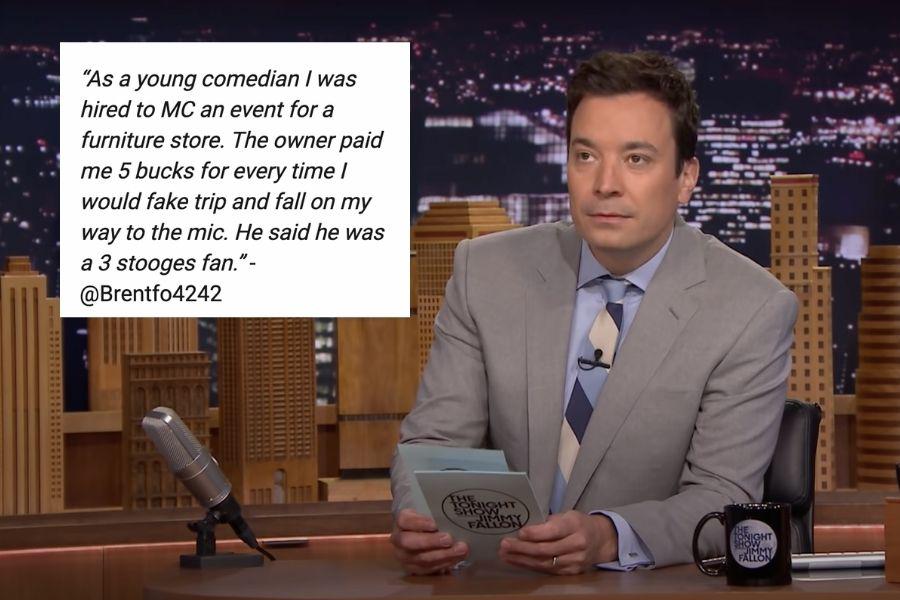
“As a young comedian I was hired to MC an event for a furniture store. The owner paid me 5 bucks for every time I would fake trip and fall on my way to the mic. He said he was a 3 stooges fan.” – @Brentfo4242

4.

“I applied for a job while in high school at a toy store. I called back days after the interview asking if they had any news for me. They told me I got the job, and they forgot to tell me. They had me scheduled for that day and was told ‘you’re late.’” – @RockerSam91

5.

“In high school, I worked at an insurance agency...let’s just say the bus ride to and from work was the best part of the job.” – @SharonZurcher

6.

“In high school I worked at a bounce house company. My first day working was an elementary school field day and the huge inflatable slide starting deflating and collapsing with kids at the top…angry parents staring at me like I had an answer for this at 16 years old.” – @calamari_carly

7.

“In middle school my friend and I got paid to fill, lick and seal about 500 envelopes with documents for a lawyer - a penny per envelope. 3 hours later, we asked for 2 cans of soda from his cooler. He said sure, and took $2 each from our pay. We made a dollar.” – @CameronFontana

8.

“I worked at a dog kennel. A guy brought in 2 dogs to stay a month. He told me to give a pill every morning to dog #1. So, I did for the month. When he returned, I brought out dog #1 and he said, ‘Hi, dog #2!’ My face turned so red. Oh, well. The dog survived.” – @TheTomeWebster

9.

“I babysat identical twin boys where one constantly screamed and got into mischief but potty trained early while the other was quiet, well behaved but always blowing out diapers. They never did anything ‘identical’. I'm shocked that I still wanted kids after that!” @overbaughs

10.

“Worked at Crumbl in high school. One coworker had the exact same shifts as me, and she was a theater kid. Like MAJOR theater kid, was cracked out 24/7, randomly performing theater at work. I am not proud to say I memorized 10 Shakespeare monologues because of her.” – @itstherealmeboo

11.

“I held human hearts with a white cotton glove during open heart surgeries, so they didn’t ‘slip’.…No pressure! That’s why l am now a planetary medium and asteroid deflector. Much less stress.” – @rosamalvaceae

12.

“I worked for a local sweet corn farm. I had to sort the corn into boxes for their stands around the state or local grocery stores. It came off the truck onto a conveyor belt by the 1000s. I literally saw thousands of corn cobs in my dreams at night.” – @jdianemiller

13.

“In high school my mom got me a job working with the city to clean an island in the local lake that ducks lived on. Everyday I had to fight a duck, and everyday I needed a bandaid after getting bit by a duck. It was a nightmare and I still hate ducks 30 years later.” – @KingSergioS

14.

“Hired at an amusement park for the summer, taking summer college classes at the same time…Show up for my 1st day to a supervisor who says ‘Oh, the girl who didn’t show up!’ Proceeds to show me the previous week’s schedule where I had 40 hours during my class time. He rolls his eyes when I explain and gives me every crappy task he can find....

jimmy fallon hashtagsGiphy

...I left after the 2nd day, never picked up my check, but kept my employee ID & got in for free all summer!” – @trixiebelle47


This article originally appeared three years ago.

Gen Z; Millennials; technology; cell phones; social media; teens and technology; teens social media

Gen Z is the first generation less cognitively capable than their parents. Denmark has the solution.

Nearly every parent hopes their child will be better off than they are: smarter, more secure, and more well-adjusted. Many parents see this as a stamp of successful parenting, but something has changed for children growing up today. While younger generations are known for their empathy, their cognitive capabilities seem to be lagging behind those of previous generations for the first time in history.

Dr. Jared Cooney Horvath, a teacher turned cognitive neuroscientist who focuses on human learning, appeared before Congress to discuss concerns about cognitive development in children. In his address to the members of Congress, he says, "A sad fact that our generation has to face is this: our kids are less cognitively capable than we were at their age. Since we've been standardizing and measuring cognitive development since the late 1800s, every generation has outperformed their parents, and that's exactly what we want. We want sharper kids."


kids, intelligence, sharp kids, generations, education, cognitive abilities Student smiling in a classroom, working on a laptop.Photo credit: Canva

Horvath explains that the reason this happens is that each generation has gone to school longer than the previous generation. Gen Z is no exception to the longer duration of time spent in school, but they're the first ones who aren't meeting this normal increase in cognitive development. According to the cognitive neuroscientist, the decline is due to the introduction of screens in the classroom, which started around 2010.

"Across 80 countries, as Jean was just saying, if you look at the data, once countries adopt digital technology widely in schools, performance goes down significantly. To the point where kids who use computers about five hours per day in school for learning purposes will score over two-thirds of a standard deviation less than kids who rarely or never touch tech at school," Horvath reveals.

In most cases, the decline in performance doesn't result in better strategies. The neuroscientist shares that the standardized testing has been adjusted to accommodate lower expectations and shorter attention spans. This is an approach that educators, scientists, and researchers went to Capitol Hill to express wasn't working. But not every country is taking the approach of lowering standards to meet lowered cognitive ability. Denmark went in the opposite direction when it realized their students were slipping behind.

France24 recently interviewed educators in Denmark following their seemingly novel approach to students struggling with cognitive development. Since the beginning of the 2025/2026 school year, Denmark has not only been having students turn in their cellphones, but they've also taken tablets, laptops, and computers out of the classroom. No more digital learning for the majority of the school day. Danes went old school by bringing back physical textbooks, workbooks, and writing assignments. The results have been undeniable. Even the students can't seem to deny the success of the countrywide shift in educational approach.

"I think the biggest issue has been that, because we kind of got rid of the books and started using screens instead, that we've noticed that a lot of the kids have trouble concentrating, so it's pretty easy to swipe with three fingers over to a different screen and have a video game going, for example, in class," Copenhagen English teacher, Islam Dijab tells France24.

Now, instead of computers being part of every lesson, Denmark uses computers very sparingly and with strict supervision. One student says that it has been nice not having screen time at school because she loves to read and write. But it wasn't just the lack of attention span children were developing, they were also developing low self-esteem and poor mental health due to the amount of time spent on devices.

kids, intelligence, sharp kids, generations, education, cognitive abilities Students focused and ready to learn in the classroom.Photo credit: Canva

The data showing the negative impact of screens on teens' brains has prompted a nationwide change in Denmark that extends outside of the classroom. Afterschool activities are eliminating or extremely limiting electronic use. There is also a national No Phone Day that encourages everyone to put away their devices for the day, and Imran Rashid, a physician and digital health expert, is petitioning parliament to ban social media use for children under the age of 15. The no phone movement in Denmark is a nationwide effort that hopes to right the ship before another generation feels the effects.

tired woman, coffee work, feeling off, redhead woman, woman at desk,

A woman feeling tired at work.

Do you regularly feel off? You're lethargic, maybe dealing with some joint stiffness, or your brain feels a tad foggy. Do you get the feeling there's always some new, nagging issue holding you back from feeling your best? On Monday, you're tired; on Tuesday, a little out of focus. But by Wednesday and Thursday, you feel 100%. Friday is fine, good enough to slide into the weekend, and then the cycle continues.

A recent survey found that this fluctuation between feeling pretty good one day and weighed down the next is completely normal. Research by Talker Research, commissioned by Bayer, shows that people feel truly healthy only about 16 days a month. In other words, for every day you wake up feeling good, there's likely to be another that feels like a bit of a struggle.


Most people don't feel great every day and it's okay

The fact that a lot of folks aren't feeling their best on any given day may offer reassurance to those of us who wake up feeling a bit down and wonder, "Why me? Why can't I feel good every day?" Don't worry, we're all going through it. It's a wonderful invitation to truly embrace the days when everything feels as it should. And when you're not feeling 100%, you can have some faith that tomorrow will be better.

The study also found that many of us are doing our best to feel as good as possible, with "(62%) report prioritizing wellness this [winter] more than at any previous time." However, that comes with a catch: "[Fifty-nine percent] admit that maintaining healthy habits becomes harder when battling winter illness, creating a cycle where sickness disrupts routines, making recovery more difficult."

tired man, man needs sleep, feeling off, man shrugging, sick man A man feeling a bit down.via Canva/Photos

The Catch-22 is that most of us want to prioritize our health, but nagging fatigue and body aches tend to be worse in the winter. The study also found that 45% of Americans feel guilty and don't take time to rest when they feel a bit off, which only makes them feel worse.

"A lot of the routine, annoying health issues that prevent us from feeling our best are the symptoms of stress," Dr. Reem Hasan, chief medical officer at Vista Health and an NHS GP, told Yahoo Life. "These symptoms are often associated with stress, overwork, poor sleep, dehydration, or insufficient nutrition and do not usually involve fever, acute pain, or rapidly worsening symptoms, which are more typical of infection."

The day-to-day stresses of working, raising a family, cleaning the house, keeping our finances in check, and staying sane in an unpredictable world can all lead to a sense of nagging fatigue.

"Chronic stress activates cortisol pathways that mimic viral symptoms such as aches, tiredness, and low appetite," Dr. Kazim Dhanji, a general practitioner in the UK, says.

The doctors agree: just because you aren't technically sick doesn't mean you shouldn't take care of yourself.

happy woman, energized woman, woman running, running on beach, feeling great A happy woman running on the beach.via Canva/Photos

The message is loud and clear: feeling a bit off doesn't mean you should ignore your symptoms. They're most likely caused by stress, so taking care of yourself by getting enough rest, eating well, and staying hydrated can increase your chances of feeling good more often than a measly 16 days a month.

The good news is that if you regularly wake up feeling like you're not at your best, you're in the same boat as most Americans. Feeling bad without having the flu or a cold doesn't mean you shouldn't take good care of yourself. The survey shows that many people feel guilty about prioritizing their health when they feel "off," but there's nothing wrong with listening to your body and putting your health first.

"When people tune into what their mind and body are asking for, whether it's rest, movement, nourishment, or medicinal support, they're better primed to maintain their overall wellness throughout the year," Dr. Gabriela Zuniga, head of medical affairs for the Americas at Bayer Consumer Health, said in a statement.

likable, likable person, likable people, conversation, conversation tips

Likable people say these things during conversations to build better relationships.

Making friends and developing deeper, stronger relationships starts with good conversation. Sometimes that means small talk at work, while other times it's the kind of conversation that really takes off at a party.

Some people are naturals when it comes to easy, flowing conversation—especially highly likable people, who tend to attract others and often hold the key to mastering genuine conversation. From their gestures to the way they articulate questions, there's a lot others can learn from them.


Communication experts who spoke to Upworthy say there are 10 things highly likable people do during conversations to build stronger relationships.

- YouTube www.youtube.com

1. They listen without distraction

Listeners often make the best conversationalists.

"That means not looking at your phone or scanning around the room to see who you want to talk to next," says Kerri Garbis, CEO and founder of Ovation Communication. "Focus on the person in front of you only. Make eye contact. This fosters a relationship because when you are fully present, it signals respect, interest, and helps others feel valued versus like they are competing for your attention."

2. They collect data

Being inquisitive about what people need during conversations is key to building stronger relationships.

"If you take a moment to ask your colleague or even friend, 'What are you worried about? What's the biggest concern facing you right now?' you can get great data on how you can help them - in a way that taps into something urgent and top of mind for them," says Kate Mason, PhD, an executive communications coach and author of Powerfully Likeable: A Woman's Guide to Effective Communication. "They'll remember your thoughtfulness and the actions you took."

3. They balance the conversation

Highly likable people never make it all about themselves.

"Sometimes conversations can be 'lopsided' where it's more about the other person than about you," says Rob Volpe, a communication expert and author of Tell Me More About That: Solving the Empathy Crisis One Conversation at a Time. "While that can be okay, you aren't there to be their therapist. Sometimes the context and topic may make it off balance, but if it continues and you aren't feeling seen yourself, feel free to say something like 'I'd love to share my thoughts on this' or 'May I share something I'm dealing with at the moment?'"

4. They mirror their conversation partner

Taking cues from body language can foster deeper relationships.

"It's a subtle way to make someone comfortable because they recognize themself in your actions," says Jennifer Anderson, a communication expert who works with entrepreneurs. "Your energy should match the energy of your counterpart. Think relaxing-in-lounge-chair energy vs. about-to-deliver-a-presentation energy. Those are two very different conversations. If you paired them up, there's definitely about to be some awkwardness."

- YouTube www.youtube.com

5. They skip pre-planned questions

While coming to conversations prepared with questions may help you feel less anxious, highly likable people usually don't use them.

"Often people have questions in their back pocket, like about the weather or sports, but the most likeable people in the room are those who can be present in conversations and ask follow-ups based on what someone is talking about," Garbis says. "This builds a relationship by making conversations feel relational and not transactional."

6. They are self-aware

Highly likable people are masters of self-awareness, especially during conversations.

"Self-awareness of your judgment is key to building relationships," Volpe says. "We all carry biases which can block our view of the person standing in front of us. When you catch yourself being judgmental, have some grace with yourself and get curious about the other person as well as where your judgment is coming from. This clears one of the biggest obstacles to having empathy with others."

7. They respond with affirmation

Highly likable people make others feel seen and heard.

"No matter what is coming out of the person's mouth, make it clear that you're not judging or competing with them," Garbis notes. "If they say: 'I went skiing this weekend,' don't jump in and say that you also went skiing. Say something like, 'Wow, that sounds exciting, tell me more about that.' You can respond with validating statements like: 'That makes sense, or I can see why you're so good at that, or I can see why that matters to you.' This reduces defensiveness and nervousness, and it makes people feel safe to be themselves and creates relationships faster."

@justaskjefferson

it’s been great catching up! #communicationtips #communicationskills

8. They remain calm

Bringing a sense of calm rather than chaos to a conversation can put everyone at ease.

"Calm is the most powerful communication flex you can do," Mason says. "If you can stay calm, especially in a heated conversation, you actually end up looking trustworthy, reliable and unruffled - all very powerful things to be remembered for."

9. They remember names

Highly likable people personalize conversations by using the other person's name.

"Never ever tell people you are terrible at remembering names," Garbis explains. "This will tank the conversation because it signals you don't matter, nothing you say matters, and that you aren't worth remembering. It makes a person mentally check out of the conversation. Use good tricks like repeating a person's name at the beginning and again at the end. If you forgot by the end, say something like, 'It was so fun to hear about your skiing adventure. By the way, I'm Kerri, it was so nice to meet you, and can you remind me of your name? I don't want to forget it?' They'll be so grateful you repeated your name too!"

10. They use humor where they can

Finally, highly likable people make sure to infuse conversations with laughter.

"It's a great connector," Anderson notes. "Don't try to be a standup comic, just find the lighthearted observations and details that you can share in conversations. Humor is never a weapon; judgy and mean-spirited comments convey weakness, not confidence. You'll risk alienating your conversation partner if you come in with a full roast of your friends or coworkers. If all else fails, everyone loves a Dad Joke."

Schools

Teachers get honest about the 7 things in education 'no one wants to admit' but are absolutely true

"Rote memorization is a better way to learn things like math facts and vocabulary words than whatever the latest trendy method is at the moment."

teachers, teachers, educational system, parents, student, kids, public school, pucblic school system, school, teens, literacy

A frustrated teacher in a classroom in front of a white board.

School really only serves one purpose: provide a nurturing environment for students to learn. But that singular task seems to grow more herculean for educators every year. Though many parents are generally aware of the challenges teachers face today, it’s still alarming to hear firsthand the full scope of what’s happening.

On the Reddit subforum r/Teachers, teachers were asked to name “something in education no one wants to admit, but we all know is true" and, well…there was no shortage of insight.


Technology (and the resulting well-documented cognitive decline it causes) was a primary source of exasperation.

teachers, teachers, educational system, parents, student, kids, public school, pucblic school system, school, teens, literacy Young students playing with numbers on a screen. Photo credit: Canva

"Nobody reads anymore…kids have unlimited use of devices."

"Screentime has killed attention spans. Students have horrible handwriting because they never write anything. It's time to close the laptops and get back to pen and paper."

"There's too much screen time in our schools right now. Technology has its place, but districts have gone all-in on 1:1 and iPads in lower grades because of 'keeping up with the Joneses' and how it looks for PR rather than instructional effectiveness. I see this as the next big battleground with parents. New parents I interact with know of the dangers of screentime, and they hate how their kids are getting inundated with it in schools."

"Cellphones are the single largest impediment to childhood development."

A school system in which students are no longer allowed to fail (and therefore actually learn from those failures) was also a recurring theme. Combine that with state testing in grades as early as Pre-K.

"The fact that teachers are often held more responsible for students failing than the students is ridiculous."

"We need to let kids fail and not graduate without punishing schools for several years to do a hard reset on our education system. The social pressure of failing works. We just have to hold the standard from K-12."

"Allowing one student to ruin the learning of an entire class should never be allowed."

Many warned that, despite certain statistics reporting suspension and other forms of punishment were going down, bad behavior is still very prevalent.

teachers, teachers, educational system, parents, student, kids, public school, pucblic school system, school, teens, literacy A male student causing trouble in the classroom with a paper airplane. Photo credit: Canva

"Administrators care much more about keeping parents happy than they do about supporting teachers or keeping disruptive kids out of classrooms."

"Not allowing kids to have consequences is going to lead to a generational crisis."

"Just because suspensions are down doesn’t mean behaviors have improved."

"I was at a school where they said at a staff meeting as a 'celebration' that office referrals were down. A teacher who DNGAF proceeded to respond, 'Well yes, because you took away the online referral form and it took you three weeks to give us a new paper form.'"

"Kids who continue to disrupt classrooms should be expelled, leaving only the kids who want to learn. Kids have a right to an education until they disrupt other kids’ ability to receive it. Throwing out the bottom 10 percent of problem behaviors would almost certainly increase the speed at which material can be covered, resulting in those kids getting wider and deeper opportunities."

Many could not hold back their frustration with the lack of support not only from the school system, but from parents.

teachers, teachers, educational system, parents, student, kids, public school, pucblic school system, school, teens, literacy A frustrated teacher with her head in her hands. Photo credit: Canva

"We are lying to the parents and community. We are producing illiterates by the bushel, and no one is addressing the issue."

"Some parents seem to think kids magically learn things as they age. This issue goes hand in hand with all the kindergartens still not potty trained or the preschoolers who can barely talk."

A couple called out the not-so-obvious ways the education system is being exploited for capital gain.

"A few years in a classroom isn’t enough to become an administrator. There should be a minimum of 10 years in a classroom before you're allowed to become even an assistant principal, let alone more than that."

"The real money in education is selling programs to schools. There is an entire parasitic class of grifters, 'entrepreneurs,' and 'thought leaders' that do nothing but go around giving speeches about how if you just buy this book/program/trademarked strategy, all your students will behave and start paying attention."

And yet, on a slightly bright note, there were plenty who offered some tough-love takes on why teaching need not be entertainment, and how the classic methods still work just fine.

teachers, teachers, educational system, parents, student, kids, public school, pucblic school system, school, teens, literacy A teacher lecturing.Photo credit: Canva

"Sometimes shit is boring, and that’s okay. Most of life is boring. I'm not a cruise director, I'm trying to teach about the Ottoman Empire."

"Lecture is okay in the classroom. Not every single minute and activity needs to be exciting and action-packed. Kids need to learn the background or reasoning behind a lesson before applying it. They're also going to need to learn to take notes if they go to college."

"'Gamifying lessons' just feeds into the instant gratification bullshit of iPad kids."

"Omg yes this. I've gotten back into education through subbing, and often it means just putting the students on whatever gameified version of education is expected of them. They often just get frustrated and let the game time out or give them the correct answer if they are even mildly frustrated by the problem."

"Rote memorization is a better way to learn things like math facts and vocabulary words than whatever the latest trendy method is at the moment."

"I'm taking French right now, and no matter what the chosen method (vocab and grammar lists, listening to lessons, etc., etc.), in the end every single method revolves around repetition (aka beating it into your head)."

And lastly, this one really hit the nail on the head…

"Every issue that exists in public schools is a microcosm of the issues that exist in society in general, and until society fixes itself, the things that are broken about the system won't get better."

That’s probably the hardest truth of all.

winston churchill, winston churchill british, sir winston churchill, winston churchill painter, winston churchill painting, winston churchill depression
Images via Wikipedia

Winston Churchill was a talented painter.

Winston Churchill may be best known as the inspired and determined Prime Minister of the United Kingdom. He served the role twice—during World War II (from 1940 to 1945), and once again from 1951-1955.

Born on November 30, 1874, Churchill's destiny as a powerful world leader began generations before him. His ancestor, John Churchill, who lived from 1650-1722, was an undefeated general considered one of England's most successful. And centuries later, Churchill would follow the footsteps of his father, Randolph, into the world of politics.


Despite his political success, Churchill battled depression much of his life. He referred to it as the "Black Dog," a metaphor he likely gleaned from Victorian nannies that was used to describe dark moods.

- YouTube www.youtube.com

One way Churchill found relief was through art. Churchill was 40 years old when he discovered his love and talent for painting. He noted that his painting began as "experiments with a child's paint-box [that] led me the next morning to produce a complete outfit in oils."

It would become a prolific passion for Churchill, who had a home studio at his country home called Chartwell.

"During his lifetime, Winston Churchill created more than 570 canvases and firmly believed that the power of observation, concentration, and creativity afforded to him by painting helped him as a leader and a statesman," said curators Timothy Riley, Sandra L., and Monroe E. Trout, Director and Chief Curator of America’s National Churchill Museum.

Of his 570 works, 350 were of landscapes or seascapes. He favored color in his works. "I rejoice with the brilliant ones, and am genuinely sorry for the poor browns," Churchill said in his essay "Painting as Pastime."

winston churchill, winston churchill painting, winston churchill painter, sir winston churchill paint Winston Churchill's painting "Tower of the Koutoubia Mosque"Image via Wikipedia

Churchill exhibited his earlier pieces as an amateur painter in the 1920s. In 1947, Churchill submitted two of his works professionally to the Royal Academy Summer Exhibition under the pseudonym Mr. David Winter to give himself a fair shot at recognition. He earned the title Honorary Academician Extraordinary, solidifying his status as a former amateur painter.

Renowned painter Sir Oswald Birley said of his talent: "If Churchill had given the time to art that he has given to politics, he would have been by all odds the world's greatest painter."

For Churchill, the creative process of painting helped him persevere through dark times.

- YouTube www.youtube.com

"Painting came to my rescue in a most trying time," Churchill also noted in "Painting as Pastime."

Churchill's daughter, Lady Soames, noted painting was a respite for him: "A lot has been made of depression in his character by psychiatrists who were never in the same room with him. He himself talks of his Black Dog, and he did have times of great depression. But in my opinion, marriage to my mother, and later his discovery of painting, which was a lifelong solace, largely kennelled the Black Dog...Of course, if you have a Black Dog, it lurks somewhere in your nature and you never quite banish it. But I never saw him disarmed by depression. I’m not talking about the depression of his much later years, because surely that is a sad feature of old age which afflicts a great many people who have led a very active life."

Churchill died on January 24, 1965. He once noted that, if he had it his way, he would be painting in the afterlife:

"When I get to heaven I mean to spend a considerable portion of my first million years in painting, and so get to the bottom of the subject," he said. "But then I shall require a still gayer palette than I get here below. I expect orange and vermilion will be the darkest, dullest colours upon it, and beyond them there will be a whole range of wonderful new colours which will delight the celestial eye."