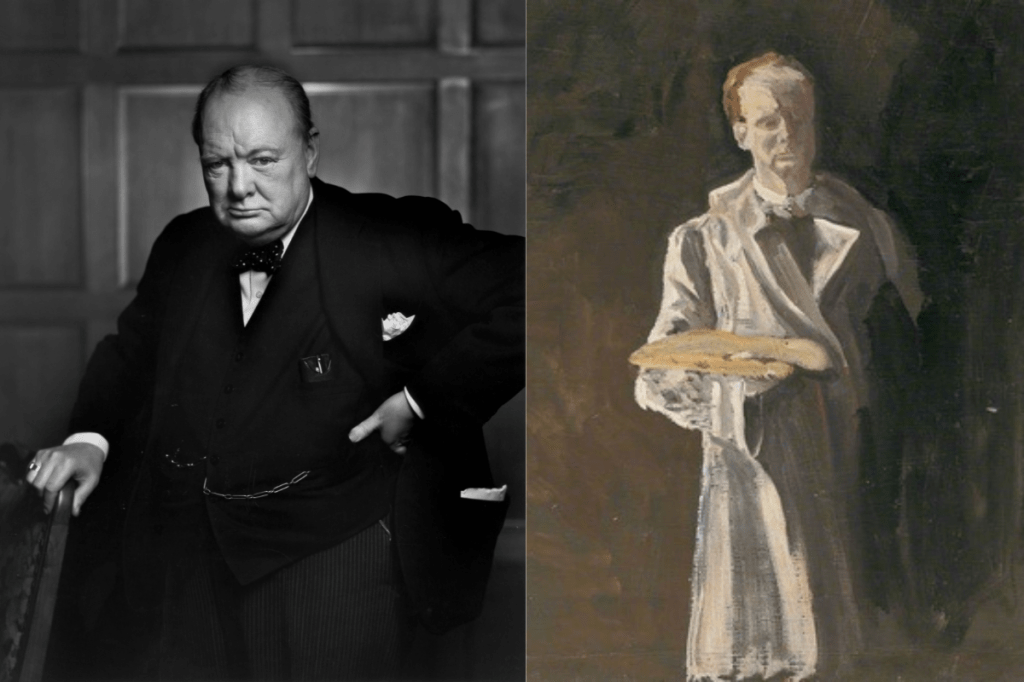
Winston Churchill referred to his depression as the 'Black Dog.' He coped by creating art.
Churchill turned to painting during dark times.
Winston Churchill was a talented painter.
Winston Churchill may be best known as the inspired and determined Prime Minister of the United Kingdom. He served the role twice—during World War II (from 1940 to 1945), and once again from 1951-1955.
Born on November 30, 1874, Churchill's destiny as a powerful world leader began generations before him. His ancestor, John Churchill, who lived from 1650-1722, was an undefeated general considered one of England's most successful. And centuries later, Churchill would follow the footsteps of his father, Randolph, into the world of politics.
Despite his political success, Churchill battled depression much of his life. He referred to it as the "Black Dog," a metaphor he likely gleaned from Victorian nannies that was used to describe dark moods.
- YouTube www.youtube.com
One way Churchill found relief was through art. Churchill was 40 years old when he discovered his love and talent for painting. He noted that his painting began as "experiments with a child's paint-box [that] led me the next morning to produce a complete outfit in oils."
It would become a prolific passion for Churchill, who had a home studio at his country home called Chartwell.
"During his lifetime, Winston Churchill created more than 570 canvases and firmly believed that the power of observation, concentration, and creativity afforded to him by painting helped him as a leader and a statesman," said curators Timothy Riley, Sandra L., and Monroe E. Trout, Director and Chief Curator of America’s National Churchill Museum.
Of his 570 works, 350 were of landscapes or seascapes. He favored color in his works. "I rejoice with the brilliant ones, and am genuinely sorry for the poor browns," Churchill said in his essay "Painting as Pastime."

Churchill exhibited his earlier pieces as an amateur painter in the 1920s. In 1947, Churchill submitted two of his works professionally to the Royal Academy Summer Exhibition under the pseudonym Mr. David Winter to give himself a fair shot at recognition. He earned the title Honorary Academician Extraordinary, solidifying his status as a former amateur painter.
Renowned painter Sir Oswald Birley said of his talent: "If Churchill had given the time to art that he has given to politics, he would have been by all odds the world's greatest painter."
For Churchill, the creative process of painting helped him persevere through dark times.
- YouTube www.youtube.com
"Painting came to my rescue in a most trying time," Churchill also noted in "Painting as Pastime."
Churchill's daughter, Lady Soames, noted painting was a respite for him: "A lot has been made of depression in his character by psychiatrists who were never in the same room with him. He himself talks of his Black Dog, and he did have times of great depression. But in my opinion, marriage to my mother, and later his discovery of painting, which was a lifelong solace, largely kennelled the Black Dog...Of course, if you have a Black Dog, it lurks somewhere in your nature and you never quite banish it. But I never saw him disarmed by depression. I’m not talking about the depression of his much later years, because surely that is a sad feature of old age which afflicts a great many people who have led a very active life."
Churchill died on January 24, 1965. He once noted that, if he had it his way, he would be painting in the afterlife:
"When I get to heaven I mean to spend a considerable portion of my first million years in painting, and so get to the bottom of the subject," he said. "But then I shall require a still gayer palette than I get here below. I expect orange and vermilion will be the darkest, dullest colours upon it, and beyond them there will be a whole range of wonderful new colours which will delight the celestial eye."