

Unique words defining emotions beyond the scope of a typical dictionary.
What if you needed a word for something that you can't quite define? Where would you turn?
Have you ever tried to explain something but gave up because the person you're talking to wouldn't be able to relate? Or worse yet, there's not an actual word for what you're trying to explain?
Well, there's a word for that feeling: exulansis.
Haven't heard that term before? How about this one:
Anecdoche — a conversation in which everyone is talking, but nobody is listening.
No? How about this:
Opia — the ambiguous intensity of looking someone in the eye.
Now, before you start doubting your own vocabulary skills, you won't find those words in any of the major dictionaries. Instead, they come from The Dictionary of Obscure Sorrows, a collection of newly minted words for life's hard-to-define feelings.
So, these words aren't real? Well, it's not quite that simple.
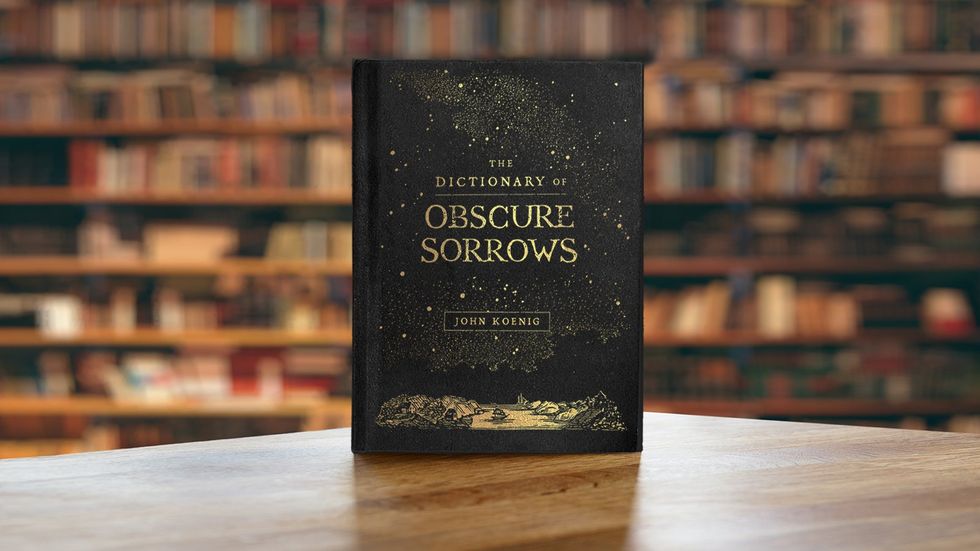 Dictionary of (@ObscureSorrows) / Twitter
What makes something a "real" word?
It's a word that's found in the dictionary, you might say. That leads to an entirely separate question: Whose dictionary? Merriam-Webster? Oxford? Cambridge? Urban?
The truth is that language is ever-changing, and what one might say is a "fake" word today could very well be a "real" word tomorrow (or within a few years, at least).
In June 2015, the Oxford English Dictionary added a handful of new words to its rolls, including "Interweb," "jeggings," "hot mess," "crowdfunding," and "cisgender." Will all of these words stick with us for the long haul? Almost certainly not. Still, in the mind of OED's editors, those words are just as real as any others.
The Dictionary of Obscure Sorrows, on the other hand, contains many useful terms that you won't find in a traditional dictionary ... yet.
You'll find words like "Vellichor" ("The strange wistfulness of used bookshops") and "Adronitis" ("Frustration with how long it takes to get to know someone") buried within the dictionary's six-year history.
While some terms come off as, well, obscure, others seem to fill meaningful voids left by the limitations of language for common emotions.
Its existence feels almost otherworldly, like spells from the mind of J.K. Rowling.
"I've been writing a dictionary of emotions for about five years, and still the most common question I get is, 'Are these words real?'" Dictionary of Obscure Sorrows creator John Koenig told Upworthy over email.
To answer that question, Koenig says (emphasis mine):
"One answer is an obvious 'no,' [they're not real] because you couldn't find them in a leather-bound dictionary — and because I create them myself by twisting together word roots from any one of a dozen different languages, from French, Japanese and Mayan to my personal favorite, Greek.
On the other hand, of course these words are real, because in reality there is no such thing. A word is not like a gold coin that you bite to tell whether it's counterfeit, so you might be able to trade it for a mule. It becomes real when it's spoken and understood. And by that standard, I've seen some of my words (particularly 'sonder') used earnestly in many different conversations online. Are they all wrong? Is 'sonder' any less meaningful because it hasn't yet been enshrined on the page of a leather-bound book? After all, almost every word in the Oxford English Dictionary has a birthdate, a notation of its first recorded use, back when it was just a yawp of nonsense that only made sense to one person, then two. All words were born this way."
Here's "sonder" by the way:
When it comes to how we think about words, popularity is often a stand-in for legitimacy.
You might not find the verb "retweeted" in the dictionary on your bookshelf, but it's an understood term. Koenig has thoughts on that, as well:
"So then, does realness require the blessing of popular use? How many millions of people does it take to change the word 'literally' to mean 'figuratively'? Is a word still alive if only one person knows its meaning? Or is that too far?"
"Personally, I think words should exist for their own sake, regardless of how they are used," Koenig says, pointing out that our language is particularly lacking when it comes to describing emotions.
"When I post a new definition or a new episode of The Dictionary of Obscure Sorrows, I often have no idea if anyone else out there feels the emotion I'm trying to pin down. Because it's a one-man show, it's totally possible that it's just me. So then this question about realness [of a word] becomes just another way of asking, 'Am I the only person who feels this way?'"
Koenig isn't alone in his curiosity about the authenticity of words. English professor Anne Curzan gave a TED Talk on this exact topic.
During her talk, Curzan recounts someone asking her if "defriend" is a "real word." She wound up in the same sort of existential rabbit hole:
"What makes a word real? My dinner companion and I both know what the verb 'defriend' means, so when does a new word like 'defriend' become real? Who has the authority to make those kinds of official decisions about words, anyway?"
Here's Curzan giving her TED Talk "What makes a word 'real'?" in March 2014.
She touched on the process of words making their way into the dictionary. This might seem like a stale topic, but it's pretty fascinating.
To her, dictionary editors are similar to anthropologists — that's a way most of us probably hadn't thought about them before (if we thought about them at all).
"So how does a word get into a dictionary? It gets in because we use it and we keep using it, and dictionary editors are paying attention to us. If you're thinking, 'But that lets all of us decide what words mean,' I would say, 'Yes it does, and it always has.'
Dictionaries are a wonderful guide and resource, but there is no objective dictionary authority out there that is the final arbiter about what words mean. If a community of speakers is using a word and knows what it means, it's real. That word might be slangy, that word might be informal, that word might be a word that you think is illogical or unnecessary, but that word that we're using, that word is real."
So, what makes a "real" word? That's entirely up to you.
This article originally appeared on 07.02.15
- 10 interesting facts about Iran you probably won’t hear on the news ›
- 21 interesting facts about penguins that may just put a smile on your face. ›
- Idioms from around the world that become hilarious when translated into English - Upworthy ›
- The surprising etymology of 11 words we use all the time - Upworthy ›
- Expand your vocabulary and sound smarter with these 16 words - Upworthy ›

 A Generation Jones teenager poses in her room.Image via Wikmedia Commons
 An office kitchen.via
  An angry man eating spaghetti.via



An Irish woman went to the doctor for a routine eye exam. She left with bright neon green eyes.
It's not easy seeing green.
Did she get superpowers?
Going to the eye doctor can be a hassle and a pain. It's not just the routine issues and inconveniences that come along when making a doctor appointment, but sometimes the various devices being used to check your eyes' health feel invasive and uncomfortable. But at least at the end of the appointment, most of us don't look like we're turning into The Incredible Hulk. That wasn't the case for one Irish woman.
Photographer Margerita B. Wargola was just going in for a routine eye exam at the hospital but ended up leaving with her eyes a shocking, bright neon green.
At the doctor's office, the nurse practitioner was prepping Wargola for a test with a machine that Wargola had experienced before. Before the test started, Wargola presumed the nurse had dropped some saline into her eyes, as they were feeling dry. After she blinked, everything went yellow.
Wargola and the nurse initially panicked. Neither knew what was going on as Wargola suddenly had yellow vision and radioactive-looking green eyes. After the initial shock, both realized the issue: the nurse forgot to ask Wargola to remove her contact lenses before putting contrast drops in her eyes for the exam. Wargola and the nurse quickly removed the lenses from her eyes and washed them thoroughly with saline. Fortunately, Wargola's eyes were unharmed. Unfortunately, her contacts were permanently stained and she didn't bring a spare pair.
- YouTube youtube.com
Since she has poor vision, Wargola was forced to drive herself home after the eye exam wearing the neon-green contact lenses that make her look like a member of the Green Lantern Corps. She couldn't help but laugh at her predicament and recorded a video explaining it all on social media. Since then, her video has sparked a couple Reddit threads and collected a bunch of comments on Instagram:
“But the REAL question is: do you now have X-Ray vision?”
“You can just say you're a superhero.”
“I would make a few stops on the way home just to freak some people out!”
“I would have lived it up! Grab a coffee, do grocery shopping, walk around a shopping center.”
“This one would pair well with that girl who ate something with turmeric with her invisalign on and walked around Paris smiling at people with seemingly BRIGHT YELLOW TEETH.”
“I would save those for fancy special occasions! WOW!”
“Every time I'd stop I'd turn slowly and stare at the person in the car next to me.”
“Keep them. Tell people what to do. They’ll do your bidding.”
In a follow-up Instagram video, Wargola showed her followers that she was safe at home with normal eyes, showing that the damaged contact lenses were so stained that they turned the saline solution in her contacts case into a bright Gatorade yellow. She wasn't mad at the nurse and, in fact, plans on keeping the lenses to wear on St. Patrick's Day or some other special occasion.
While no harm was done and a good laugh was had, it's still best for doctors, nurses, and patients alike to double-check and ask or tell if contact lenses are being worn before each eye test. If not, there might be more than ultra-green eyes to worry about.