83-year-old hospice patient’s last wish was for a tattoo and it’s a great lesson for everyone
Nine years ago, an Australian hospice nurse and blogger wrote a post about the lessons she learned working for several years in palliative care. After spending time with countless people in their final days she learned that they all had similar regrets. The most common regret was that they wished they “had the courage to…
Nine years ago, an Australian hospice nurse and blogger wrote a post about the lessons she learned working for several years in palliative care. After spending time with countless people in their final days she learned that they all had similar regrets.
The most common regret was that they wished they “had the courage to live a life true to myself, not the life others expected of me.”
Just about everyone has had to make compromises in their lives due to the expectations of friends, family, coworkers, and society-at-large. How would we be happier if we gave up caring about what others think and lived as our true selves?
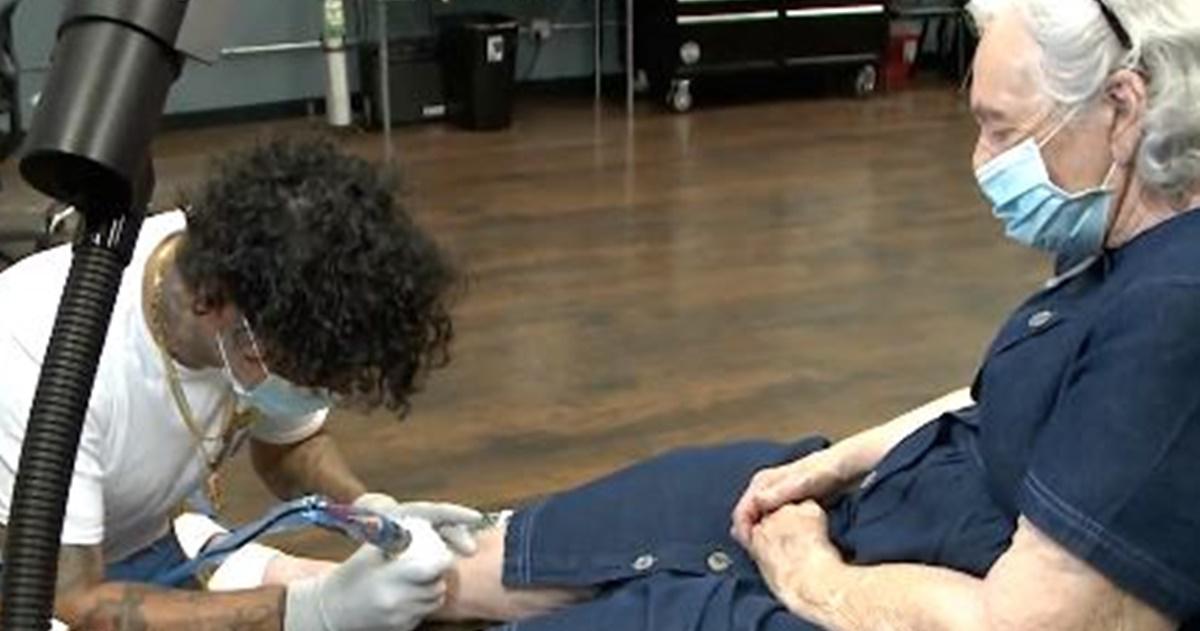
A hospice patient in her final days is a great example of doing just that. Clare Burnett, 83, a terminally ill patient at Harbor Hospice in Johnson County, Kansas decided that she would get a tattoo that she always wanted because she no longer has to care about anyone else’s opinion. The fact that her husband is deceased made the decision even easier.
Fifteen years ago she got a tattoo of Tweety bird on her left leg but was never able to get a tattoo of his arch-nemesis, Sylvester the Cat, on the other. “Ever since I got Tweety, I’ve wanted Sylvester,” Clare told Fox 4. “But things just didn’t work out that way.
“My husband had a fit when I got Tweety so I didn’t get Sylvester,” Burnett told KCTV 5.
But all of that changed last week thanks to a program at the hospice that allows patients to live out their dreams in their final days of life.
“We grant wishes anywhere from small ones to hot air balloon rides, to meeting celebrities, to going to concerts like Garth Brooks and George Strait,” Tracy Bunch, a wish coordinator at Habor Hospice, told KCTV 5. “Right now, over the last two years, a lot of them have been actually getting them out of the nursing homes and taking them to their families homes.”
Clare was taken in her wheelchair to Midtown Tattoo in Kansas City, Missouri on Wednesday to have her final wish fulfilled. The tattoo artist took it “real, real easy” on Clare so that her new ink wouldn’t hurt.
The final results looked fantastic and Clare was over the moon about the new feline on her leg. When asked what others have to say about her new body art, Clare’s response was powerful.
“I don’t know. Don’t care. Haha! I think it’s gorgeous,” Clare said. “Look at that red nose. I think he’s gorgeous.”
Clare’s bold decision to live out her final days with the tattoo she always wanted is a great life lesson for those of us who haven’t lived long enough to have the same realization. We should all ask ourselves: What’s my Sylvester tattoo? What have I put off doing in life because I was worried about what others think?
Clare Burnett would probably say you should go out and do it.
In a small village in Pwani, a district on Tanzania’s coast, a massive dance party is coming to a close. For the past two hours, locals have paraded through the village streets, singing and beating ngombe drums; now, in a large clearing, a woman named Sheilla motions for everyone to sit facing a large projector screen. A film premiere is about to begin.
It’s an unusual way to kick off a film about gender bias, inequality, early marriage, and other barriers that prevent girls from accessing education in Tanzania. But in Pwani and beyond, local organizations supported by Malala Fund and funded by Pura are finding creative, culturally relevant ways like this one to capture people’s interest.
The film ends and Sheilla, the Communications and Partnership Lead for Media for Development and Advocacy (MEDEA), stands in front of the crowd once again, asking the audience to reflect: What did you think about the film? How did it relate to your own experience? What can we learn?
Sheilla explains that, once the community sees the film, “It brings out conversations within themselves, reflective conversations.” The resonance and immediate action create a ripple effect of change.
MEDEA Screening Audience in Tanzania. Captured by James Roh for Pura
Across Tanzania, gender-based violence often forces adolescent girls out of the classroom. This and other barriers — including child marriage, poverty, conflict, and discrimination — prevent girls from completing their education around the world.
Sheilla and her team are using film and radio programs to address the challenges girls face in their communities. MEDEA’s ultimate goal is to affirm education as a fundamental right for everyone, and to ensure that every member of a community understands how girls’ education contributes to a stronger whole and how to be an ally for their sisters, daughters, granddaughters, friends, nieces, and girlfriends.
Sheilla’s story is one of many that inspired Heart on Fire, a new fragrance from the Pura x Malala Fund Collection that blends the warm, earthy spices of Tanzania with a playful, joyful twist. Here’s how Pura is using scent as a tool to connect the world and inspire action.
A partnership focused on local impact, on a global mission
Pura, a fragrance company that recognizes education as both freedom and a human right, has partnered with Malala Fund since 2022. In order to defend every girl’s right to access and complete 12 years of education, Malala Fund partners with local organizations in countries where the educational barriers are the greatest. They invest in locally-led solutions because they know that those who are closest to the problems are best equipped to solve and build durable solutions, like MEDEA, which works with communities to challenge discrimination against girls and change beliefs about their education.
But local initiatives can thrive and scale more powerfully with global support, which is why Pura is using their own superpower, the power of scent, to connect people around the world with the women and girls in these local communities.
The Pura x Malala Fund Collection incorporates ingredients naturally found in Tanzania, Nigeria, Pakistan, and Brazil: countries where Malala Fund operates to address systemic education barriers. Eight percent of net revenue from the Pura x Malala Fund Collection will be donated to Malala Fund directly, but beyond financial support, the Collection is also a love letter to each unique community, blending notes like lemon, jasmine, cedarwood, and clove to transport people, ignite their senses, and help them draw inspiration and hope from the global movement for girls’ education. Through scent, people can connect to the courage, joy, and tenacity of girls and local leaders, all while uniting in a shared commitment to education: the belief that supporting girls’ rights in one community benefits all of us, everywhere.
You’ve already met Sheilla. Now see how Naiara and Mama Habiba are building unique solutions to ensure every girl can learn freely and dare to dream.
Naiara Leite is reimagining what’s possible in Brazil
Julia with Odara in Brazil. Captured by Luisa Dorr for Pura
In Brazil, where pear trees and coconut plantations cover the Northeastern Coast, girls like ten-year-old Julia experience a different kind of educational barrier than girls in Tanzania. Too often, racial discrimination contributes to high dropout rates among Black, quilombola and Indigenous girls in the country.
“In the logic of Brazilian society, Black people don’t need to study,” says Naiara Leite, Executive Coordinator of Odara, a women-led organization and Malala Fund partner. Bahia, the state where Odara is based, was once one of the largest slave-receiving territories in the Americas, and because of that history, deeply-ingrained, anti-Black prejudice is still widespread. “Our role and the image constructed around us is one of manual labor,” Naiara says.
But education can change that. In 2020, with assistance from a Malala Fund grant, Odara launched its first initiative for improving school completion rates among Black, quilombola, and Indigenous girls: “Ayomidê Odara”. The young girls mentored under the program, including Julia, are known as the Ayomidês. And like the Pura x Malala Fund Collection’s Brazil: Breath of Courage scent, the Ayomidês are fierce, determined, and bursting with energy.
Ayomidês with Odara in Brazil. Captured by Luisa Dorr for Pura
Ayomidês take part in weekly educational sessions where they explore subjects like education and ethnic-racial relations. The girls are encouraged to find their own voices by producing Instagram lives, social media videos, and by participating in public panels. Already, the Ayomidês are rewriting the narrative on what’s possible for Afro-Brazilian girls to achieve. One of the earliest Ayomidês, a young woman named Debora, is now a communications intern. Another former Ayomidê, Francine, works at UNICEF, helping train the next generation of adolescent leaders. And Julia has already set her sights on becoming a math teacher or a model.
“These are generations of Black women who did not have access to a school,” Naiara says. “These are generations of Black women robbed daily of their dreams. And we’re telling them that they could be the generation in their family to write a new story.”
Mama Habiba is reframing the conversation in Nigeria
Centre for Girls' Education, Nigeria. Captured by James Roh for Pura
In Mama Habiba’s home country of Nigeria, the scents of starfruit, ylang ylang and pineapple, all incorporated into the Pura x Malala Collection’s “Nigeria: Hope for Tomorrow,” can be found throughout the vibrant markets. Like these native scents, Mama Habiba says that the Nigerian girls are also bright and passionate, but too often they are forced to leave school long before their potential fully blooms.
“Some of these schools are very far, and there is an issue of quality, too,” Mama Habiba says. “Most parents find out when their children are in school, the girls are not learning. So why allow them to continue?”
When girls drop out of secondary school, marriage is often the alternative. In Nigeria, one in three girls is married before the age of 18. When this happens, girls are unable to fulfill their potential, and their families and communities lose out on the social, health and economic benefits.
Completing secondary school delays marriage, and according to UNESCO, educated girls become women who raise healthier children, lift their families out of poverty and contribute to more peaceful, resilient communities.
Centre for Girls’ Education, Nigeria. Captured by James Roh for Pura
To encourage young girls to stay in school, the Centre for Girls’ Education, a nonprofit in Nigeria founded by Mama Habiba and supported by Malala Fund and Pura, has pioneered an initiative that’s similar to the Ayomidê workshops in Brazil: safe spaces. Here, girls meet regularly to learn literacy, numeracy, and other issues like reproductive health. These safe spaces also provide an opportunity for the girls to role-play and learn to advocate for themselves, develop their self-image, and practice conversations with others about their values, education being one of them. In safe spaces, Mama Habiba says, girls start to understand “who she is, and that she is a girl who has value. She has the right to negotiate with her parents on what she really feels or wants.”
“When girls are educated, they can unlock so many opportunities,” Mama Habiba says. “It will help the economy of the country. It will boost so many opportunities for the country. If they are given the opportunity, I think the sky is not the limit. It is the starting point for every girl.”
From parades, film screenings to safe spaces and educational programs, girls and local leaders are working hard to strengthen the quality, safety and accessibility of education and overcome systemic challenges. They are encouraging courageous behavior and reminding us all that education is freedom.
Experience the Pura x Malala Fund Collection here, and connect with the stories of real girls leading change across the globe.
Few people spend more time with kids than teachers. From the classroom to the playground, teachers have deep and intuitive insight into what their students’ relationships are like with their parents, and many teachers can tell when parents are invested and truly care about their kids.
In a Reddit forum, member @allsfairinwar posed the question: “Teachers of Reddit: What are some small, subtle ways you can tell a child’s parent really cares about them?”
Teachers from all education levels shared their insight. From elementary teachers to high school teachers, these educators offered their firsthand experience with students that informed them about their relationship with parents at home. These are their most powerful observations.
Hit It Bang Bang GIF by Eddie & Laura Burton Realty Group Giphy
“When the parent stops and actually looks at their kid’s art/work/listens about their day before heading home. I know everyone gets busy but damn don’t shove the art your kid is proud of right in their bag without first looking at it. We do the same piece of art for a week. They spent 2 hours on that, spare 2 minutes to show them their effort is worth something to you.” —@Worldly_Might_3183
“When the child speaks, the adult listens. When the adult speaks, the child listens.” —@homerbartbob
“When the parents are familiar with the child’s friends and talk to their child’s friends, I know they’re listening to their child talk about their day at school. Or when parents let slip that they got a full recap of something I said or that happened at school. I know they are having conversations with their child at home, and paying attention.” —@Pinkrivrdolphn
“When the kid is happy/quick to tell their parents about things. Not just serious or important things, but just random bullsh*t. Do I care about Minecraft? Not really. Do I care that my kid cares about Minecraft? Very much. Lay it on me kid. Spare no detail.” —@IJourden
“They let their kids fail and experience natural consequences. Good parents are preparing their children to be adults, and part of that is learning responsibility and accountability. Let your kids make mistakes and learn from them!” —@oboe_you_didnt
“You can tell a lot about home life based on students behavior the week leading up to a break. If they are happy/excited/giddy/endearingly obnoxious I know they are going somewhere safe to someone who cares. The students who don’t have that are often increasingly anxious/angry/withdrawn/acting out.” —@pulchritudinousprout
“The moment that a parent greets the child at the end of the day is very telling. Some parents clearly want to know all about their child’s day and connect with them, some don’t.” —@Smug010
“When I make positive contact home and the parent speaks glowingly about their own kid. It’s great to hear.” —@outtodryclt
“A few years back, I heard a parent ask their kid if they found someone to be kind to today. That made a real impact on me. Now I try to remind my own kids to ‘find someone to be kind to’ if I’m doing drop off and/or ask ‘Who were you kind to today?’ after school.” —@AspiringFicWriter
“When a student asks for help, they actually need the help. They are not doing it just to get your attention.”—@Typical_Importance65
Dance Marathon Reaction GIF by Children’s Miracle Network Hospitals Giphy
“It doesn’t always mean everything is perfect at home, but a child who is well-groomed is always a good sign. That doesn’t always mean the most fashionable clothes or perfect hair, just that the child is clean, their clothes are clean and appropriate for the weather. Also when a child knows how to celebrate their own wins and isn’t afraid of making a mistake or being wrong- that shows that their parents have modeled good emotional regulation.” —@itscornelectric
“They get them services when they’re struggling. I work with kids with disabilities and the learning outcomes/experience of school (and by extension, the greater world) for kids who have their needs met is far different to those who don’t. The number of parents who respond to a teacher saying ‘I think it might be worth John seeing an OT/a speech therapist/ getting his eyes checked’ with something along the lines of ‘f*ck you, what would you know?’ Is astounding. The parents who make appointments, share information from specialists with the school, and are proactive about their children’s abilities or disabilities – their kids see such improvements.” —@prison_industrial_co
“They ask thoughtful questions. Even something that seems routine to adults like, ‘How is/was your day?’ I’m in elementary, and it’s appropriate for kids to talk mostly about themselves. Kids who ask thoughtful questions are doing so because it’s consistently modeled. It’s also not very common (again, age appropriate egocentrism) so it stands out.” —@mundane-mondays
“When you know they’re being exposed to reading at home. Maybe they can read at a higher level or they’re mastering their sight words. For students with learning disabilities, the kids are trying their hardest to read, using context clues, using pictures and making up a story, or even making different voices for characters. When I was in a low functioning Autistic support room, this one little boy couldn’t form words, but he made noises is different voices and used dramatic face expressions on each page to represent characters talking.” —@Mediocre-Bee-9262
“Accountability. A good parent knows that their kids isn’t perfect and if the kid does something wrong (like hitting or bullying other kids) they don’t look for excuses, or for how the other kid provoked that behavior, but helps their kid understand why their behavior was hurtful.” —@SadlyNotDannyDeVito
This article originally appeared last year. It has been updated.
The Sound of Music has been beloved for generations, partially for the music (and Julie Andrews’ angelic voice), partially for the historical storyline, and partially for the love story between Maria and Georg Von Trapp. The idea of a nun-in-training softening the heart of a curmudgeonly widower, falling in love with him, and ultimately becoming a big, happy family is just an irresistible love story.
But it turns out the real love story behind their union is even more fascinating.
Maria Von Trapp (left) was played by Julie Andrews and her husband Georg was played by Christopher Plummer in Photo credit: Public domain
The National Archives has collected information about what’s fact and what’s fiction in The Sound of Music, which is based on a real family in Austria named Von Trapp. The film was generally based on the first section of Maria Von Trapp’s 1949 autobiography, The Story of the Trapp Family Singers, with some of the details being true and others fictionalized for a movie audience.
For instance, Maria was actually hired on as a tutor for just one of Georg’s children, not as a governess for all of them. The children, whose names, ages and sexes were changed, were already musically inclined before Maria arrived. Georg was not the cold, grumpy dad he was portrayed as in the beginning of the film, but rather a warm and involved parent who enjoyed making music with his kids. Maria and Georg were married 11 years before leaving Austria, not right before the Nazi takeover. The Von Trapps left by train, not in a secret excursion over the mountains.
But perhaps the most intriguing detail? Maria was not in love with Georg at all when they got married.
Sound Of Music Flag GIF by The Rodgers & Hammerstein Organization Giphy
It doesn’t initially make for a great Hollywood romance, but the Von Trapp love story began with marriage for other reasons and evolved into a genuine love story. Maria wrote that she fell in love with Georg’s children at first sight, but she wasn’t sure about leaving her religious calling when Georg asked her to marry him. The nuns urged her to do God’s will and marry him, but for Maria it was all about the children, not him. When Georg proposed, he asked her to stay with him and become a second mother to his children. “God must have made him word it that way,” Maria wrote, “because if he had only asked me to marry him I might not have said yes.”
“I really and truly was not in love,” she wrote. “I liked him but didn’t love him. However, I loved the children, so in a way I really married the children.”
However, she shared that her feelings for Georg changed over time. “…[B]y and by I learned to love him more than I have ever loved before or after.”
The idea of marrying someone you don’t love is antithetical to every romantic notion our society celebrates, yet the evolution of Maria’s love for Georg has been a common occurrence across many cultures throughout history. Romantic love was not always the primary impetus for marriage. It was more often an economic proposition and communal arrangement that united families and peoples, formed the basis of alliances, and enabled individuals to rise through social ranks. Some cultures still practice arranged marriage, which limited research has found has outcomes identical to love-first marriage in reports of passionate love, companionate love, satisfaction, and commitment. The idea of marrying someone you don’t already love is anathema to modern Western sensibilities, but the reality is that people have married over the centuries for many reasons, only one of which is falling in love.
Maria’s marriage to Georg actually was about falling in love, but not with him. She loved his children and wanted to be with them. It definitely helped that she liked the guy, but she wasn’t swept off her feet by him, there were no moonlit confessions of love a la “Something Good,” and their happily ever after love story didn’t come until much later.
Ultimately, Maria and Georg’s love story was one for the ages, just not one that fits the Hollywood film trope. And it’s a compelling reminder that our unwritten rules and social norms determining what love and marriage should look like aren’t set in stone. Do marriages for reasons other than love always evolve into genuine love? No. Do marriages based on falling in love first always last? Also no. Should a marriage that starts with “like” and develops into to a genuine, deep love over years be considered “true love” in the way we usually think of it? Who can say? Lots to ponder over in this love story.
But Maria’s description of learning “to love him more than I have ever loved before or after” is a pretty high bar, so clearly it worked for them. The Von Trapps were married for 20 years and had three more children together before Georg died of lung cancer in 1947. Maria would live another four decades and never remarried. She died in 1987 at age 82 and is buried next to Georg on the family’s property in Vermont.
This article originally appeared last year It has been updated.
There are so many conflicting ideas about building self-confidence in children. Is there a right way? Could praise be harmful? Should everyone receive a gold star? As with many things in life, sometimes the best solution is the simplest one—hiding in plain sight, or just out of it.
Namwila Mulwanda and her partner Zephi practice “gentle-parenting” with their daughter, Nhyara. Shared in a video on Instagram, one of their techniques is talking about Nhyara when she’s within earshot but out of sight. These aren’t your typical behind-closed-doors parent conversations—no venting about daily frustrations or sharing complaints they’d never say to her face. Instead, they create intentional moments of celebration, offering genuine praise and heartfelt affirmation.
In a viral Instagram post that’s garnered over one million likes, Mulwanda writes, “POV: You talk behind your child’s back so they can hear you.” Self-described as a “passionate mother, content creator, and small business owner,” Mulwanda naturally overflows with ideas: she writes a Substack, She Who Blooms, which is about “blooming in our own time, in our own way.” She also runs Rooted, a shop where she “carefully curates products that embody the essence of growth, empowerment, and staying rooted in one’s true self.”
In the video, Mulwanda and her partner sit in a quiet corner, chatting about their daughter Nhyara while occasionally peeking around to see if she’s listening—which she is. With her within earshot but not directly part of the conversation, they discuss their daughter:
“I’m just so proud of her and the things she does,” her mom starts.
“She works on her reading, like that difficult word that she took the time to really sound out,” adds her dad. They go on to applaud her independence (“She’s always telling me, ‘Daddy, I want to brush my teeth on my own,’” says Zephi), before concluding that she’s amazing.
“She’s amazing,” says Mulwanda. “So, so, so amazing,” Zephi responds.
People in the comments were obviously here for it. Parents shared their own versions of this technique, including one who wrote, “As a solo mom, I pretend to make phone calls to a family member and do this.”
Another parent shared a powerful example:
“My son used to be scared of climbing down the stairs. So, my husband said loudly, ‘He’s very brave! He has shown a lot of courage lately.’ The next day, when we tried carrying him down the stairs, he said, ‘Nope, I have a lot of courage in me.’”
Others reflected on their own childhoods. One commenter wrote, “No exaggeration, I’d be an entirely different person had my parents been like this with me.”
“Stop, I was just thinking last night, ‘When I have kids, I’m going to have loud conversations with my future husband about how much I love our children and how proud I am of them,’” another enthusiastically shared.
Children believe that conversations between adults are more u201cauthenticu201d and honest. Photo credit: Canva
Research indicates that indirect praise has a stronger psychological impact than direct praise, particularly in young children.
“This is such a powerful way of reinforcing positive behavior,” explains parenting influencer Cara Nicole, who also went viral for her unique approach to parenting. “There’s something special about overhearing others talk about you—you know they’re being genuine because they’re not saying it directly to you.”
This effectiveness stems from children’s innate understanding that conversations between adults tend to be more honest than parent-child interactions. From an early age, children recognize that direct conversations with parents often have an intentional, behavior-shaping purpose. In contrast, overheard praise feels authentic and spontaneous, rather than an attempt to influence the child’s self-image.
These techniques work best when praise focuses on effort and process rather than innate qualities. Take Nhyara’s dad’s comment: “She works on her reading, like that difficult word that she took the time to really sound out.”
Yet, it’s crucial to keep praise realistic and measured. Avoid overzealous claims about future achievements, like acing every spelling test for the rest of her life. Children have keen intuition; if they sense insincerity, the strategy can backfire, damaging their trust in parents. Similarly, over-inflated praise—like declaring “incredible” performance for average effort—can burden children with unrealistic expectations.
Keep it simple. A casual remark like, “I noticed how carefully Maya put away her toys without being asked. That was so nice. It really helped keep the house clean.”
The viral response to Mulwanda’s video demonstrates the power of gentle parenting combined with thoughtful, specific praise. It’s heartening to see modern parents sharing their diverse approaches to showing their children love. For many commenters who didn’t experience this kind of upbringing, these conversations offer a path to healing. As Mulwanda eloquently states in her pinned comment:
“To those of you who only heard negative as a child, you were never the problem. You were a child, and you didn’t deserve the experience you had. Your presence on this earth is a blessing, and the fact that you show up every single day is proof of just how amazing you are. You are brave, you are beautiful (you too, boys), and you deserve the world and more. If any of you feel emotions rising up, close your eyes, hug your inner child, and remind them that you’re there.” – Namwila Mulwanda
This article originally appeared last year. It has been updated.
Gift giving should feel good for the giver and the receiver. But around the holidays, it can be a major cause of stress. – Photo credit: @morethangrand/TikTok
Parents and grandparents find themselves at odds frequently. It could be a disagreement over how much screen time the kids get, battles over grandma giving them too many sweets, or arguments around how often grandma and grandpa should be babysitting. Conflict in their relationships is almost a given, and navigating disagreements in a healthy, productive way is key for the relationship to evolve and grow.
One huge source of that conflict comes in the form of… stuff! All parents can relate to the sense of dread they feel at the sight of the grandparents arriving for a visit with a trunk-full of of presents. Toys, furniture, costumes, decor, you name it. And that’s just on a regular Tuesday. Around the holidays, it can get even worse. It’s not that they don’t want their kids getting gifts, it’s just all too much, especially when you live in a home with a finite amount of storage.
“75% of the parents that we surveyed wished grandparents would respect their wishes about gifts,” she explained, noting that while there are myriad reasons why this would be the case, the most common one (and incidentally the one most “waved off” by the grandparents) is the lack of physical space to accommodate.
Now, you might be thinking: How much harm can it really do to give a kid a new card game or a baby doll? Certainly those don’t take up that much room. But when Moore breaks down the math, it’s a bit hard to deny.
“Say your grandson has four other grandparents and four aunts and uncles. Each of these people get him one gift for a second birthday. That’s already nine gifts plus something for mom and dad. We’re up to 10,” she said.
“If all of those grandparents buy him three things, and two of the aunts get him a little extra something, that’s 22 presents for a 2 year old who would be just as happy with a box.”
Add in gifts from friends, and random gift-dumps from grandma when she’s been on a hot-streak at the thrift store, and you’ve got a serious storage problem on your hands.
Yikes, gotta admit that’s a lot. And that’s not counting the additional problems too much gift-giving can incite listed on the More Than Grand website, which included:
Undermining the parent’s values that they are trying to instill to their children
Damaging a child’s ability to use their imagination
Normalizing overconsumption
Teaching children to associate seeing grandma or grandpa with getting a gift, rather than focusing on the actual relationship
(Here’s another one: Too many gifts steals Mom and Dad’s thunder! Parents often put a lot of thought into picking out presents they know their kids will love, only for them to get buried in the avalanche of surprise presents.)
These are all good points, and yet, what to do with all those good intentions and a desire to spoil some precious little nugget? Luckily, Moore has the perfect fix.
“While your grandchildren are faced with getting too many gifts, many children are in the opposite situation. Take some of the things you bought to Toys for Tots or another organization that provides gifts for less fortunate families.”
This allows folks to step into the “true spirit of giving,” Moore concluded.
Viewers by and large seemed to agree, though many also noted how powerful experiential or future-building gifts could be, even if they’re not as cute as toys or as fun to open.
“My in-laws opened up a college fund for both my kids. Instead of stuff they put more money in the account. I’m so grateful!” one person wrote.
Another added, “I am giving experiences and putting money in an account for future needs (college, 1st house, starting business, etc).”
In the vein, here are two other tips grandparents can use for intentional gift-giving…
First and foremost: open up a discussion with the parents. See if they need help with a big ticket item, find out which hobby or sport the child is interested in, ask what’s a definite “no.” this can save a lot of headaches for everyone.
“The gifts should surprise the grandkids, not their parents,” as one commenter wrote on the video.
Second: prioritize memories over stuff. A trip to the zoo, an education membership, a ticket for two to the movies…these are often the gifts that truly keep on giving.
And grandparents, don’t forget: just because you’re honoring boundaries, it doesn’t mean you have to pass up that sweet little something you see in the aisles. After all, shopping is fun, and it’s even better when you find a great deal or a cool discovery. But it can easily go to a little one who could really use it.
For even more tip on all things grandparenting, give More Than Grand a follow here.
This article originally appeared last year. It has been updated.
By 1973, the Bee Gees’ career had hit a low. After a series of hits in the late 1960s and early 1970s, including “To Love Somebody,” “How Can You Mend a Broken Heart,” and “I Started a Joke,” the band was in a rut. Their latest album, Life in a Tin Can, and single “Saw a New Morning” sold poorly, and the band’s popularity declined.
On April 6, 1973, the Gibb brothers (Barry, Robin, and Maurice) appeared on The Midnight Special, a late-night TV show that aired on Saturday mornings at 1 a.m. after The Tonight Show with Johnny Carson. Given the lukewarm reception to their recent releases, the Bee Gees decided to change things up and play a medley of hits from their idols, The Beatles, who had broken up three years before.
The Beatles were the biggest band on Earth in their heyday. Giphy
The performance, which featured five of the Fab Four’s early hits, including “If I Fell,” “I Need You,” “I’ll Be Back,” “This Boy,” and “She Loves You,” was a stripped-down, acoustic performance that highlighted the Bee Gees’ trademark harmonies.
“When you got brothers singing, it’s like an instrument that no one else can buy. You can’t go buy that sound in a shop. You can’t sing like The Bee Gees because when you got family members singing together, it’s unique,” Noel Gallagher, who sang with his brother Liam in Oasis, said according to Far Out.
A year later, the Bee Gees performed in small clubs, and it looked like their career had hit a dead end. Then, at the urging of their management, the band began to move in a new direction, incorporating soul, rhythm and blues, and a new, underground musical style called disco into their repertoire. Barry also adopted a falsetto singing style popularized by Black singers such as Curtis Mayfield and Marvin Gaye.
This unlikely change for the folksy vocal group catapulted them into the stratosphere and they became the white-satin-clad kings of disco.
In the late ‘70s, the band had massive hits, including songs featured on the 40-million-selling Saturday Night Fever soundtrack: “Stayin’ Alive,” How Deep is Your Love,” More Than a Woman,” Jive Talkin’,” and “Night Fever.”
In 1978, the band made a significant misstep, starring in a musical based on The Beatles’ music called Sgt. Pepper’s Lonely Hearts Club Band, produced by Robert Stigwood, the man behind Saturday Night Fever and Grease. The film was a colossal bomb, although the soundtrack sold well.
The Beatles’ George Harrison thought the Bee Gees film was about what happens when you become successful and greedy.
“I just feel sorry for Robert Stigwood, the Bee Gees, and Pete Frampton for doing it because they had established themselves in their own right as decent artists,” Harrison said. “And suddenly… it’s like the classic thing of greed. The more you make the more you want to make, until you become so greedy that ultimately you put a foot wrong.”
Even though the Bee Gees’ Beatle-themed musical was a flop, former Beatle John Lennon remained a fan of the group. He sang their praises after the public’s growing distaste of disco resulted in a significant backlash.
“Try to tell the kids in the seventies who were screaming to the Bee Gees that their music was just the Beatles redone,” he told Playboy magazine in 1980. “There is nothing wrong with the Bee Gees. They do a damn good job. There was nothing else going on then.”
The Bee Gees historic career ended when Maurice passed away in 2003 at 53. Robin would follow in 2009 at 62. Barry is the final surviving member of the band.
There’s a popular trend where parents often share they are creating “core memories” for their children on social media posts, whether it’s planning an elaborate vacation or creating an extra-special holiday moment. While it’s important for parents to want their kids to have happy childhoods, sometimes it feels presumptuous when they believe they can manufacture a core memory. Especially when a child’s inner world is so different than an adult’s.
The concept of “core memories” was made mainstream in 2015 thanks to Disney’s Inside Out. In it, “core memories” are born from moments and experiences that majorly shape a part of the main character, Riley’s, personality. The experience(s) can be grand or benign; the point is these moments are ultimately forming Riley into the person she is. Seems pretty hard to manufacture such a moment, but parents are certainly trying.
Carol Kim, a mother of three and licensed Marriage and family Therapist, known as Parenting.Resilience on Instagram, recently shared the “5 Things Kids Will Remember from Their Childhood” on her page. The fascinating insight is that none of the entries had to do with extravagant vacations, over-the-top birthday parties, or Christmas gifts that kids could only dream about.
According to Kim, the five things that kids will remember all revolve around their parents’ presence and support. “Notice how creating good memories doesn’t require expensive toys or lavish family trips. Your presence is the most valuable present you can give to your child,” Kim wrote in the post’s caption.
“Taking some time to focus only on your child is very special. Playing games, reading books, or just talking can create strong, happy memories. These moments show your child that you are present with them.”
2. Words of encouragement
“Encouraging words can greatly impact your child during both good times and tough times. Kids often seek approval from their parents and your positive words can be a strong motivator and source of comfort…. It can help kids believe in themselves, giving them the confidence to take on new challenges and keep going when things get tough.”
3. Family traditions
“It creates a feeling of stability and togetherness … Family traditions make children feel like they belong and are part of a larger story, deepening their sense of security and understanding of family identity and values.”
“Seeing and doing kind things leaves a strong impression on children. It shows them the importance of being kind and caring. They remember how good it feels to help others and to see their parents helping too.”
5. Comfort during tough times
“Knowing they can rely on you during tough times makes them feel secure and build trust. … Comforting them when they’re struggling shows them they are loved no matter what, helping them feel emotionally secure and strong.”
Kim’s strategies are all beautiful ways to be present in our children’s lives and to communicate our support. However, these seemingly simple behaviors can be challenging for some parents who are dealing with issues stemming from their pasts.
“If you find barriers to providing these things, it’s important to reflect on why,” Kim writes in the post. “There could be several reasons, such as parenting in isolation (we’re not meant to parent alone), feeling overstimulated, dealing with past trauma, or struggling with mental health. Recognizing these challenges is the first step to addressing them and finding support.”
Alright, that’s it. We’ve finally had enough in this country. In a move that’s long overdue, we’re finally cracking down on… *checks notes*…basic human kindness?
The orders have come straight from the top. Being nice to people who are different than you is now bad. Creating environments that are welcoming and inclusive of everyone? Also bad. What’s most disturbing is just how far these mandates are trickling down—all the way into our schools.
A 6th grade teacher in Idaho was recently told by school administrators to remove a controversial sign from her classroom. She refused.
An angry elementary school teacher sits in class Canva
Earlier this spring, world civilization teacher Sarah Inama at Lewis and Clark Middle School was told that one of the posters in her class was inappropriate. The school asked her to remove it.
Initially, she complied, but upon reflection and discussion with her husband, decided that it didn’t feel right. She needed to take a stand. So Inama put the poster back up and left it visible for all to see, even after administrators warned her she could lose her job over the noncompliance.
Finally, among growing outcry and threats of termination, Inama decided to resign rather than remove the poster. She bravely decided to stick up for her controversial beliefs, even though she knew her personal opinion may not be popular.
Just wait until you see the outrageous sign. Here it is:
Seriously, that’s it. The sign reads “Everyone Is Welcome Here” and shows hands of different colors. This is the poster that was deemed not appropriate for the public school environment.
The district’s chief academic officer Marcus Myers clarified that, “The political environment ebbs and flows, and what might be controversial now might not have been controversial three, six, nine months ago.”
Inama’s sign was said to have violated the school’s “content neutral” policy, which prohibits any speech or messaging that might reflect personal opinions, religious beliefs, or political ideologies.
What’s hard to believe is that a sign meant to show kids that they are welcome in Inama’s classroom somehow reflects a “personal belief” that the school won’t tolerate. The sign made no mention of religion or LGBTQ+ identities or political ideologies; and it was still deemed too woke. That’s extremely frightening.
Inama received an outpouring of support from the community, but it wasn’t enough to change the district’s mind. After her resignation, she didn’t hold back, sharing her resignation letter with local news.
“This will be my last year teaching in the West Ada School District, and it saddens me to leave under these circumstances,” Inama’s letter begins.
“I cannot align myself nor be complicit with the exclusionary views and decisions of the administration. It is deeply troubling that the people running this district and school have allowed a welcoming and inclusive message for my students to be considered controversial, political, and, worst of all, an opinion.”
“I hope for the sake of the students in your district that you can remember the core values of public education,” she concludes. “To serve all citizens, foster an inclusive and safe learning environment, and protect your staff and students from discriminatory behavior.”
And now, the education system has lost a talented and passionate teacher because of it. But at least Inama hasn’t gone quietly, and with millions of outraged supporters all over the country and now world, we probably haven’t heard the last of this case.
This article originally appeared last year. It has been updated.
Some people are just naturally good at reading others. They pick up on subtle cues, body language, tone of voice, and facial expressions that go over other people’s heads. They are adept at seeing past other people’s words and cuing into the energy or emotions behind them.
People who are great at reading others have a significant advantage in being creative, building relationships, and building teams. But where does it come from? Why does it seem like some people have an extra social muscle that others just don’t?
Some posit that people who are adept at reading others often come from backgrounds where they grew up with chaotic parents or family members. To preserve themselves, they become keen observers of subtle clues to protect themselves against abusive outbursts.
This makes them excellent students of tone of voice, body language, and emotional states so that they can defend themselves.
To those who aren’t brilliant at reading others, these people’s skills seem mysterious at best. So, a Reddit user posed a question to the AskReddit forum to see what other people have noticed about people who are great at reading others. “What’s a sign that someone is dangerously good at reading people?” they asked. They received over 1,300 replies, and we compiled the best.
Here are 13 signs that someone is “dangerously good” at reading people.
1. You immediately overshare
“You feel comfortable talking to them and you find yourself sharing things with them you don’t typically share.”
2. They’re hard to read
“They themselves are typically hard to read.”
“Or better yet people think they are reading you and know you but all they know is what you want them to think they know.”
“Observe the person. It helps if you’re naturally empathetic. You can tell when they’re being sincere or when there’s motivation. You can hear it in their voice when they’re nervous, jealous, or uncomfortable. You can see it in their face. You can feel when their energy pauses, dips, or spikes. The key is to be neutral yourself. If you’re not invested in the outcome of the interaction at all, you can read others better.”
“My mom is the one who tipped me off to this. She said it was the key to learning about our lives when we were preteens and teens. She said she was careful not to ever react in big ways to anything we said, especially if it was negative, because if she did we would be more likely to stop providing info. If she acted neutral, we’d keep talking.”
4. They had unpredictable parents
“Some people who grew up with unpredictable parents become hyper-observant of micro-expressions. When coupled with empathy and a good memory, they can ask good questions at the right time, or pick up on unspoken emotions (or intentions/danger). This can be a blessing and a curse.”
“This is exactly how I got good at reading people. If I found myself unable to predict what my father was going to do next, there’s a good chance bad things happen to me. It’s born out of necessity.”
5. They know you before you open your mouth
“They clock your mood or thoughts before you’ve even said anything. They would ask really specific questions. Not nosy, just oddly on point. Also, watch how fast they adjust. You’re all fired up, and they’re calm and grounding.”
6. They’re accurate
“When they say something about you that you’ve never told anyone, but it’s scarily accurate… like ?? How do you know that, that’s when you know they’re built different.”
“People who are highly intuitive, very observant and understands people dynamics usually at the expense of knowing themselves well at times.”
“OH MY GOD. This. This this this. This is exactly my wife who is by far the best people person I’ve ever seen…and she’s terrible at understanding herself or solving her own problems.”
8. They understand receptivity
“Children and animals like and trust them. They are constantly aware of the receptivity levels of others.”
“When they ask lots of questions to people, especially when they’re based off observations.
You usually don’t ___ and i see now you’re ___, is everything alright?
Since you’ve been dating your partner, I’ve noticed _____. What’s up?
I’ve noticed when you feel like ____ you usually do _____, and you’ve been doing ____ lots recently, how come?
NEVER in a way which sounds or is judgemental, is always evidence based, and as a result people are often willing to open up and elaborate more without fear of being judged. My friends do this and I try so hard to learn from them.”
10. They don’t show it
“One of the biggest signs that someone is exceptionally skilled at reading people is that they don’t show it. People who are truly skilled observers mask their awareness and let others underestimate them while they quietly collect insight. They downplay their intuition and pretend to guess poorly. Also, they ask or say things that are psychologically strategic.”
11. You don’t know them, but they know you
“You feel super close to them, very comfortable sharing anything with them and consider them a close friend. In retrospect, you realize you know next to nothing about them beyond the surface.”
12. They can make friends with anyone
“I had a friend who was insanely good at reading people. He once told me ‘if I want you to be my friend, you will.’ I believed it too. He could be friends with anyone.”
“That’s kinda creepy ngl, smacks of the Machiavellian type more than the empathetic type.”