upworthy
Add Upworthy to your Google News feed.
Google News Button
Joy

19 brutally honest pieces of advice that 'everyone should know'

"When someone shows you who they are believe them."

sad woman, harsh truths, reality

A woman coming to grips with a harsh truth about life.

Life is filled with lessons; unfortunately, there are some we must learn the hard way, whether it’s how the real world works when you start your career or the first time someone breaks your heart. These lessons are essential to learn so that you don’t have to go through the same pain again, but don’t you wish you learned them the easy way — by hearing the harsh truth from others — rather than going through the pain yourself?

Wouldn’t it be great if you could download all of these harsh truths into your brain to learn them the easy way? Some folks online got together and did just that. And, for those who pay attention, it can save them a lot of grief in the future. Many touched upon the thornier issues in life, love, family, friendships, the transitory nature of relationships, and how you can do everything right and still lose.

We chose the top 19 “brutally honest” pieces of advice that were the most important so you don’t have to learn them the tough way.

1. Take care of yourself

"If you have poor hygiene, you will be treated poorly."

"People can and will judge by appearances, so don’t make it any easier for them to do so."

2. Don't ever expect the world to be fair.

"But work to make the parts of the world you influence as fair as possible."

"The concept of fairness is a human invention, which implies that fairness only exists in reality when humans put it there. That's the only way it exists. Do your part."

3. Your job doesn't care about you

"Your company doesn’t give a sh*t about you. If you die, your job will be posted within the week to replace you. You might get a bouquet of flowers on the break room table, but once those die, so will your presence at the job."

"A coworker of mine passed away from cancer a few years back. I think about her sometimes, though we never worked closely, but they sent out an email, and that was that."


4. No one has to forgive you

"Just because you apologize to someone doesn't mean they have to forgive and forget what you did to them."

"The reverse is also true, you don't have to forgive someone just because they apologized to you."

Even though we are conditioned to say "it's okay" when someone apologizes to us, we don't have to condone their actions. Karina Schumann, a psychology professor who studies conflict resolution, apologies, and forgiveness at the University of Pittsburgh, says we only owe them a genuine response. “It’s important to be genuine without being hostile,” says Schumann. “Research shows that using a ‘constructive voice’ — where you voice your concerns in a positive, calm way — is the most effective way to invite behavioral changes and better relationships. Sweeping things under the rug and pretending to forgive when you’re not ready is not going to fix the problem.”

5. 'Brutal opinions aren't always true

"People who describe themselves as brutally honest are usually more interested in the brutality than the honesty."

6. Not all friends are forever

"Friends come and go and some were never really friends."

"And some that ran their course years later start again and it’s like a totally new relationship since you’re in a completely different phase of your life!"

"Can I add that just because you may have had good times with people, that does not make them good friends."


7. Some people shouldn't have kids

"People who are dumb, trashy, or otherwise not great will lack the critical thinking skills to realize they won’t be great parents, or maybe that they won’t have the money to raise a child well. People who are smarter, or have better jobs and lives, will be more likely to not have kids so they can preserve their good life, or will maybe think “maybe I won’t be a good parent” and will not have kids, these people are infinitely better equipped to have kids. This means that a majority of people having kids will not raise them well, a majority of kids will be raised poorly, and a majority of kids will display the same poor personality traits as their parents."

8. No one else’s life revolves around you

"Yep, we all suffer from Main Character Syndrome, but we’re all just extras in someone else’s world."

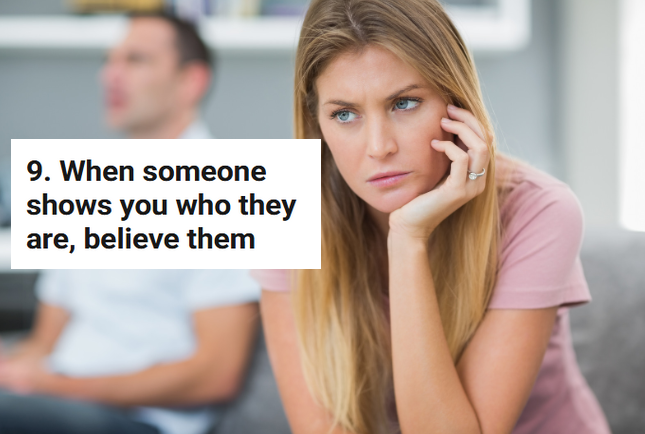
9. When someone shows you who they are, believe them the first time

"I kind of guess it means. Don’t let yourself be fooled and do not gaslight yourself. Don’t excuse bad behavior; say sorry that’s not acceptable, and I’m no longer going to tolerate it. Bye bye, Felicia."

This quote is believed to have been first written by writer Maya Angelou, and Orpah Winfrey would later expand on it to share how it applies to our daily lives. "Remember this because it will happen many times in your life," Winfrey said. "When people show you who they are the first time believe them. Not the 29th. time. When a man doesn't call you back the first time, when you are mistreated the first time, when someone shows you a lack of integrity or dishonesty the first time, know that this will be followed many, many other times, and that will some point in life come back to haunt or hurt you. Live your life in truth. Don't pretend to be someone you're not. You will survive anything if you live your life from the point of view of truth.”



10. Sometimes you lose

"'It is possible to commit no mistakes and still lose. That is not a weakness. That is life.' Jean-Luc Picard."

"Another from sports: The best team doesn't always win; the team that plays the best does."

11. Some bridges are worth burning

"Don't hang on to toxic people, INCLUDING FAMILY. Don't fall for the 'But they are your family...'"

12. If it’s not yes, it’s a no

"Particularly helpful dating advice."

"If they like you, you’ll know it. If they don’t, you’ll feel confused."

"Also add, stop saying no when you mean yes. People can’t read minds."


13. Learn to deal with yourself

"The person who you spend the most time with is yourself. Literally, 24/7 til you die. Learn to deal/exist with that person."

"If you can’t like yourself, why would anyone else? Instead of complaining that no one likes you, work on making yourself into someone likable."

14. Use protection

"Wear a condom. Especially if she tells you you don’t have to and you don’t know her very well."

"In general, when anyone tells you that you don't need something that is for your protection/safety/peace-of-mind, YOU NEED IT."

15. Simple isn't always right

"We live in a complex world, and you should be wary of simplistic explanations."


16. Don't be afraid to fail

"Doing nothing is often worse then doing something wrong. Go make mistakes. Live your life and collect memories and wisdom. If you are in the box. Be there cause you chose to, not because someone told you to be there."

17. Maybe you just don't want it

"If you keep making excuses as to why you aren’t meeting some goal, maybe you just don’t actually want to achieve said goal. And if you just accept this, then you can spend your time focusing on a goal you actually want to achieve."

"You make time for the things you care about and excuses for the things you don't."

18. Be wary of critics

"Only accept criticism from someone you’d take advice from."

"And only take advice from someone successful in the topic at hand."

19. Be pleasant

"Once you reach adulthood, being an a**hole is going to close a lot of doors for you: at school, at work, with friends, and with family. Some of those doors don’t open again. Adults don’t go out of their way to help unpleasant people."

"Similarly, way too many people focus entirely on 'I don't owe anyone anything' and don't focus enough on common courtesy and basic respect. If you refuse to ever help someone else unless you're strictly obligated to, don't be surprised when nobody opts to help you when you need it."

generation jones, gen jones, gen jonesers, girls in 1970s, 1970s, teens 1970s
Image via Wikimedia Commons

Generation Jones is the microgeneration of people born from 1954 to 1965.

Generational labels have become cultural identifiers. These include Baby Boomers, Gen X, Millennials, Gen Z and Gen Alpha. And each of these generations is defined by its unique characteristics, personalities and experiences that set them apart from other generations.

But in-between these generational categories are "microgenerations", who straddle the generation before and after them. For example, "Xennial" is the microgeneration name for those who fall on the cusp of Gen X and Millennials.


And there is also a microgeneration between Baby Boomers and Gen X called Generation Jones, which is made up of people born from 1954 to 1965. But what exactly differentiates Gen Jones from the Boomers and Gen Xers that flank it?

- YouTube www.youtube.com

What is Generation Jones?

"Generation Jones" was coined by writer, television producer and social commentator Jonathan Pontell to describe the decade of Americans who grew up in the '60s and '70s. As Pontell wrote of Gen Jonesers in Politico:

"We fill the space between Woodstock and Lollapalooza, between the Paris student riots and the anti-globalisation protests, and between Dylan going electric and Nirvana going unplugged. Jonesers have a unique identity separate from Boomers and GenXers. An avalanche of attitudinal and behavioural data corroborates this distinction."

Pontell describes Jonesers as "practical idealists" who were "forged in the fires of social upheaval while too young to play a part." They are the younger siblings of the boomer civil rights and anti-war activists who grew up witnessing and being moved by the passion of those movements but were met with a fatigued culture by the time they themselves came of age. Sometimes, they're described as the cool older siblings of Gen X. Unlike their older boomer counterparts, most Jonesers were not raised by WWII veteran fathers and were too young to be drafted into Vietnam, leaving them in between on military experience.

How did Generation Jones get its name?

generation jones, gen jones, gen jones teen, generation jones teenager, what is generation jones A Generation Jones teenager poses in her room.Image via Wikmedia Commons

Gen Jones gets its name from the competitive "keeping up with the Joneses" spirit that spawned during their populous birth years, but also from the term "jonesin'," meaning an intense craving, that they coined—a drug reference but also a reflection of the yearning to make a difference that their "unrequited idealism" left them with. According to Pontell, their competitiveness and identity as a "generation aching to act" may make Jonesers particularly effective leaders:

"What makes us Jonesers also makes us uniquely positioned to bring about a new era in international affairs. Our practical idealism was created by witnessing the often unrealistic idealism of the 1960s. And we weren’t engaged in that era’s ideological battles; we were children playing with toys while boomers argued over issues. Our non-ideological pragmatism allows us to resolve intra-boomer skirmishes and to bridge that volatile Boomer-GenXer divide. We can lead."

@grownupdish

Are you Generation Jones? Definitive Guide to Generation Jones https://grownupdish.com/the-definitive-guide-to-generation-jones/ #greenscreen #generationjones #babyboomer #generationx #GenX #over50 #over60 #1970s #midlife #middleage #midlifewomen #grownupdish #over50tiktok #over60women #over60tiktok #over60club

However, generations aren't just calculated by birth year but by a person's cultural reality. Some on the cusp may find themselves identifying more with one generation than the other, such as being culturally more Gen X than boomer. And, of course, not everyone fits into whatever generality they happened to be born into, so stereotyping someone based on their birth year isn't a wise practice. Knowing about these microgenerational differences, however, can help us understand certain sociological realities better as well as help people feel like they have a "home" in the generational discourse.

As many Gen Jonesers have commented, it's nice to "find your people" when you haven't felt like you've fit into the generation you fall into by age. Perhaps in our fast-paced, ever-shifting, interconnected world where culture shifts so swiftly, we need to break generations into 10 year increments instead of 20 to 30 to give everyone a generation that better suits their sensibilities.

This article originally appeared two years ago. It has been updated.

teenage boy, teenage girl, conversation, meeting people, talking
Photo credit:Canva/Photos

A teenage girl and boy having a nice chat.

You’re standing in line at the grocery store and you see someone cute. You’d like to strike up a conversation without it being awkward...but that feels kinda nerve-wracking, right? Or maybe you’re standing around at a party and see someone you’d like to get to know, and want to approach them in a way that doesn’t feel uncomfortable. That probably feels a little scary, too.

The good news is that with a few easy tricks, you can improve your communication skills and feel confident approaching anyone.


According to years of psychological research, several principles can help make striking up conversations with strangers easier. The great thing is that they all work best when approached in a casual, effortless way.

1. Comment on the environment

Let’s say you’re at a party in someone’s living room. You can comment on physical objects: “Gee, this guy sure has a lot of books.” Or maybe you’re at a party where everyone brought food: “The food smells great. What are you grabbing first?” You can also comment on people’s behavior: “Is it me, or is everyone really well dressed tonight?”

This works because of the Joint Attention Effect, which says that when two people pay attention to the same thing at the same time, they create a common point of reference. This shared focus can immediately make people feel closer, even in social situations.

man and woman, wine, social skills, conversation

2. Make a playful comment

People will usually respond when you make a playful or unexpected comment, as long as it isn’t threatening. For example, if the person you want to talk to is holding a cocktail, you might joke, “That drink looks serious.” If you’re stuck in a long line: “Do you know why we’re here? I almost forgot why we’re in line—it’s been so long.” Or if you’re at a child’s birthday party and spot another parent you’d like to talk to: “Be honest, how tired of Little Caesars’ pizza are you?”

This works because of the Benign Violations Theory, which suggests that when someone violates a social norm in a non-threatening way, it makes people laugh and activates bonding mechanisms. It signals to your new friend that you’re playful and friendly, and when they laugh at your joke, it shows that you share similar values.

man and woman, people laughing, sitting on couch, good company, jokes

3. Ask their opinion

Another effortless way to engage someone you don’t know is to ask their opinion. For example, if you’re in the produce section at the supermarket, you might ask, “Do these peaches look good to you?” Or if you’re at a party and bring up a pop culture moment most people watched: “So, was Bad Bunny great at the Super Bowl, or is he overrated?”

This works because of what’s known as Cognitive Ease: people are more likely to respond to questions that are easy to process. Asking someone for their subjective opinion is non-threatening, and it’s easy for them to come up with an answer that makes them feel comfortable. Plus, if social media has taught us anything, it’s that everyone loves to share their opinions.

drinks, bar, socializing, man and woman, party

Next step: Pivot and ask questions

Given that all of these strategies are psychologically designed to elicit a response, even from someone you’ve never met, you have a strong chance of sparking a conversation. The key is to widen the exchange once you get that response by asking two more questions. In fact, a Harvard University study found that one of the easiest ways to be likable is to start a conversation with a question and then follow up with two more.

“We identify a robust and consistent relationship between question-asking and liking,” the study's authors wrote. “People who ask more questions, particularly follow-up questions, are better liked by their conversation partners.”

These three psychological rules show that it doesn’t take a Herculean effort to coax a stranger into having a conversation. All you have to do is make an effortless invitation by tapping into the environment you share with them, make a playful joke, or ask their opinion. Then ask a few questions, listen, and there’s a good chance you’ve made a new friend.

nail salon ad; funny nail salon ad; Henry Pro Nails videos; viral videos; canada manicure; canadian nail tech

This Canadian nail salon has people packing their bags for a manicure

There are a lot of nail salons out there, and without word-of-mouth recommendations from people you trust, it can be impossible to know which salon to visit. Thanks to social media, many businesses can advertise their services without spending much on traditional marketing like television, billboards, and radio. Using pictures and videos of their amazing work to market can help maintain a steady flow of customers, but one Canadian nail salon is taking a slightly different approach.

Henry Pro Nails which started in Toronto, Canada, is leaving the Internet in stitches after creating a viral ad for his nail salon. The video uses the beginnings of several viral clips, but instead of the expected ending, Henry pops in to complete the viral moment in hilarious, unexpected ways.


HenryProNails takes viral videos and turns them into funny marketing

It opens with a familiar viral video of a man on a stretcher being pulled by EMS when the stretcher overturns, flopping the man onto the ground. But instead of it ending with the injured man on the ground, Henry seamlessly appears, lying out on the floor of his salon and delivers his first line, "Come to my nail salon. Your nails will look beautiful."

nails, nail salon, red nail polish, manicure, hands A woman getting her nails painted.via Canva/Photos


In another clip, a man holds his leg straight up and somehow flips himself into a split. When the camera cuts back to Henry, he's in the splits on the floor of his nail salon promoting loyalty discounts. The ad is insanely creative, and people in the comments can't get enough. Some are even planning a trip to Toronto just to get their nails done by the now Internet-famous top nail artist in Canada. This isn't Henry's first rodeo making creative ads, but this one is, without a doubt, his most popular—and effective.

People love Henry's videos

"I will fly to Canada to get my nails done here just because of this hilarious video. You win this trend for sure," one woman says.

"Get yourself a passport and make a road trip! My bf and I are legit getting ours, and it's only a 4 hr drive from where we are in Pennsylvania. Their prices are a lot better than other places I've been too," another person says while convincing a fellow American citizen to make the trip.

"Omg, where are you located? I would fly to get my nails done by you," one person writes.

"The pedicure I had at Henry’s was the best I have ever had. Unfortunately, it made all other places disappointing, and I don’t live close enough for Henry’s to be my regular spot," someone else shares.


In another hilarious video, Henry urges a woman not to divorce her husband for not cooking her dinner, but instead to come get her nails done so she'll feel a lot better.


Henry also jumped onto the "very demure, very mindful" trend on TikTok with his own take on the phrase.


It just goes to show that creative advertising can get people to go just about anywhere, but great service is what keeps them coming back. If you're ever in Canada and find yourself needing an emergency manicure, Henry's Pro Nails is apparently the place to be.

This article originally appeared two years ago. It has been updated.

Jim Henson interviewing with Muppets is a delightful reminder of his magical genius

Even adults would forget that his characters weren't actually alive.

jim henson, muppets, puppets, puppeteering, the muppet show
Public domain

Jim Henson with some of his Muppets

Few individuals have had an impact on the childhoods of millions and the imaginations of people of all ages like Jim Henson. From Sesame Street to The Muppet Show to The Dark Crystal and Labyrinth, Gen Xers grew up with Henson's magic being a familiar and comforting presence. And to this day, over three decades after his death, the characters he created are still household names.

For those of us who were raised on Big Bird, Bert and Ernie, Kermit, and Miss Piggy, Henson's creatures feel as real as any living, breathing performer from our childhoods. But it's not just because we were kids when we were introduced to them. Even adults who met the Muppets found themselves transported into Henson's imaginary world, and after seeing interviews of the puppeteer with his creatures, it's easy to see why.


Watch:

Henson didn't even pretend to not be controlling Kermit. He didn't bother with ventriloquism. And yet, Kermit feels truly alive and separate from the person animating him. It almost feels surreal. Or perhaps just...real.

Henson's characters even convinced film crew members

Both guests and crew members alike found themselves pulled into Henson's world, even while fully understanding that the puppets were being controlled by people. The crew would sometimes move the boom mic to a puppet instead of the puppeteer. Directors would sometimes give stage directions directly to the Muppet instead of the human animating it. Dick Cavett, who interviewed Henson with his Muppets, said, “No matter how much you know about this, it’s completely convincing.”

Even when a Muppet would explain the fact that the person was speaking to a puppet, it still seemed like a sentient being. Case in point:

(This may be the one time you see Henson swear, but in context, it's brilliantly wholesome.)

@guygilchrist

My old boss’s last public performance as Rowlf.🐶🙏🏻 . . #jimhenson #jimhensonscartoonist #themuppets #fyp #foryoupage


Frank Oz shared what it was like to work with Henson

Of course, Henson didn't work alone. Bringing his characters to life in all the ways he envisioned took the work of many people, but none were more aligned with Henson himself than his partner-in-puppetry, Frank Oz. Oz was the Miss Piggy to Henson's Kermit, the Bert to his Ernie, the Animal to his Dr. Teeth.

Oz started working with Henson when he was just 19 years old, and for 27 years the duo created unforgettable magic together. It wasn't just the puppets. It was the voices, the comedic timing, the way they could make you laugh in one moment and well up with tears in the next. Their creatures entertained us but also taught us about being human, which was a truly remarkable feat.

Oz shared what it was like to work with Henson with Gene Shalit after Henson's death in 1990:

- YouTube www.youtube.com

Like Fred Rogers, Jim Henson is remembered for being a distinctly decent person in addition to his creative work. He brought the ancient art of puppetry into the modern world, touching every generation in his lifetime and after in a way that remains unmatched. As the tribute song "A Boy and His Frog" by Tom Smith says:

"They say, 'Oh that's foam and a wire, attached to a green velvet sleeve. Anyone can do that.' Well, that's true, I suppose, but who else can make them believe?" (Grab a tissue before listening to this song, Henson lovers. It's a doozy.)

- YouTube youtu.be

How his legacy lives on

Henson’s children, Lisa, Cheryl, Brian, John, and Heather, have carried on his work by running the Jim Henson Company and Jim Henson Foundation, performing themselves, and continuing to advocate for the art of puppetry. They've also kept Jim Henson's Creature Shop running, creating puppets, animatronics, and even digital puppetry. The shop designed and built the full-size animatronic puppets for the 2023 Five Nights at Freddy's movie and works on television, commercial, and themed projects as well.

In 2024, renowned director Ron Howard released a documentary about Henson's life and work, Jim Henson: Idea Man, which can be found on Disney +.

- YouTube www.youtube.com


Malala Yousafzai, Khushal Yousafziai Pakistan, siblings, support, family
Photo credit: Used with permission from Khushal Yousafzai

Malala Yousafzai and her brother, Khushal, pose for a photo.

Malala Yousafzai most certainly has a lot of light. At the young age of 11, she began advocating for education for girls after the Taliban took over her district of Swat in Pakistan. About three years later, she—alongside two other girls—was shot in the head on a bus for her passionate, outspoken views.

She survived and went on to address the United Nations about the importance of education. According to her nonprofit's website:


"The U.N. recognized July 12 as Malala Day, in honour of her courageous advocacy and to highlight the global struggle for education. With her father, her ally and inspiration, she established Malala Fund, an organisation dedicated to giving every girl the opportunity to learn and choose her own future."

Just one year later, she became the youngest-ever recipient of the Nobel Peace Prize. She has received numerous awards, been honored by Time Magazine, and continues to inspire people around the world.

Recently, one of her younger brothers, Khushal Yousafzai, was speaking at the Oxford Scholars Program when he was asked whether he ever felt "overshadowed" by his sister's accomplishments. His answer was vulnerable, heartfelt, and lovely:

"My sister nearly died. Forget her winning the Nobel Prize. Forget her getting the limelight. I would give up my life for you to have a life. Death puts things into perspective like nothing else does."

He pauses, then says, "Why would her success take anything away from me? I'm not in my sister's shadow. I'm in my sister's light. And Rumi has this beautiful quote: 'A candle doesn't lose its light when it lights up another candle.' Actually makes the world a brighter place. It lights up the whole room."

He continues with a message about supporting the people you love:

"So guys, uplift each other. If you see your friend, uplift them. Because guess what? We all are gonna die someday. And your friends, I'm sure they mean a lot to you. And at times, there is that feeling of jealousy. You don't want to be going to their funeral and telling their parents how amazing they were. Because guess what? It's too late. So tell them while they're still alive. You don't want to live with that, so uplift people while they're still here."

Khushal speaks frequently to students about his journey. He is also a fierce advocate for education and finding the fuel to live life to its fullest. According to a biography he shared with Upworthy: "Through his educational platform, Yousafzai Academy, he mentors students about personal and academic growth, learning from setbacks, and leadership."

Many commenters on Instagram expressed heartfelt support and said they were deeply touched by his words.

"So beautiful to see his immense love for his sister shared so honestly, vulnerably, and without any hint of shame or resentment," one commenter said. "And the Rumi quote is just so perfect. ❤"

Another notes that his wisdom isn't surprising, considering his whole family is involved in activism: "This family has got all the right things going on! What a gift to the world."

This person was moved by his words, especially by the idea of uplifting people while there's still time: "Wisdom. Beautiful. Fabulous. What a family! Uplift your friends. Uplift people while they are still here. Yes!"

And this commenter deduces that the trauma his family has been through has created a thoughtful empath: "You have a high level of empathy 🙏🏽💕. Only people who have come close to death know the depth of your words and the bond you share with your sister."