Bong Water, Parking Lot and Cruchwrap Supreme. People are sharing their hilarious cat names.

"The Naming of Cats is a difficult matter,

It isn't just one of your holiday games..."

When T.S. Eliot wrote "Old Possum's Book of Practical Cats" in 1939, he probably never imagined his poetry would be turned into a delightfully despised musical. And when unsuspecting show-goers witnessed the spectacle of CATS on stage for the first time, they likely had no idea how much of the largely non-existent plot would be about what, why, how cats are named.

Silly, perhaps, but the naming of cats truly is a difficult matter. Cats are bizarro screwballs of the highest order. They start off adorable little puffs purring fur, and evolve into beautiful animal specimens that emanate strength and grace on the one hand and hilarious quirks and personality on the other. How can you possibly choose a name that truly befits such a magnificently weird creature?

You can't. Which is why people end up naming their cats the silliest names they can think of.


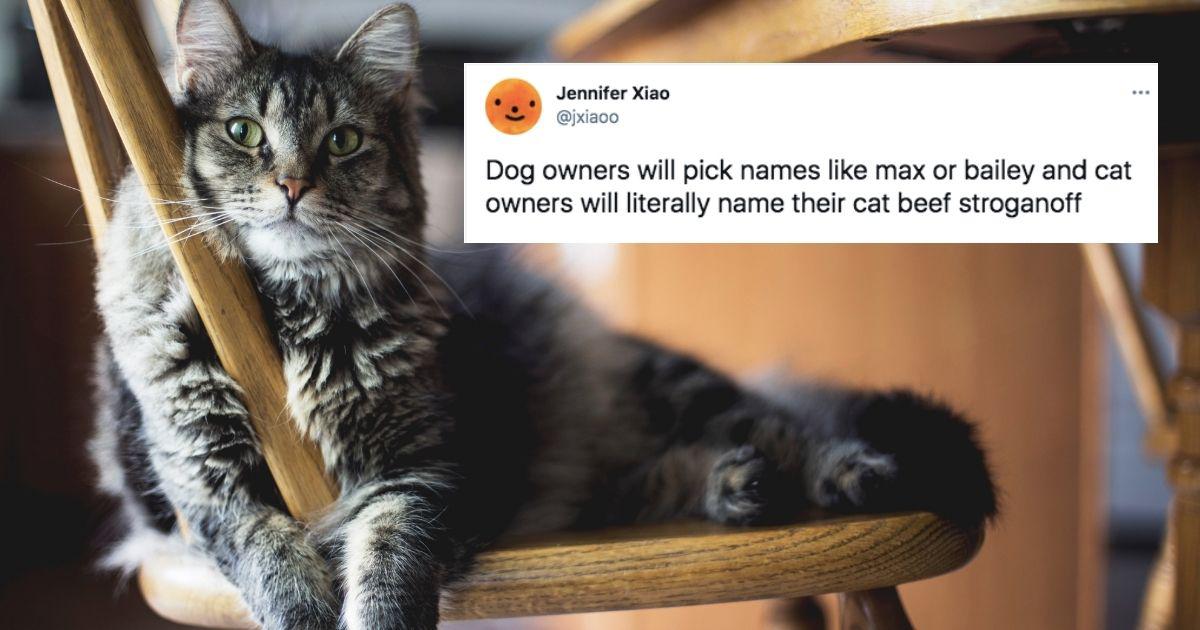
On Twitter, Jennifer Xiao posted a simple observation that got a hilarious ball rolling: "Dog owners will pick names like max or bailey and cat owners will literally name their cat beef stroganoff."

Cue the deluge of pretty kitties with shameless names.

Lots of pasta cats out there. How cute is "Wednesday Fettucine"? Come on now.

No shortage of fruit and fruit-flavored names as well.

Rooty tooty fresh and frutiy kitties, all day long.

Who names a cat "Egg"? Several people, apparently. Egg, Eggs, Eggsy.

CRUNCHWRAP SUPREME. I can't.

Green Bean Casserole is a cutie. But the promotion and demotion of Beans is hilarious. "Grand Marshall Beans!"

And yes, someone actually did name their cat Beef Stroganoff. "Strogi" for short.

But food names are just the beginning. It gets so much better.

Meet beautiful baby Bong Water.

And Mozzarella Television.

Hallway. HALL.WAY. People are so magical.

Missy sounds normal enough, until you find out it's short for Missile Launcher.

And then there's Beanbag. Is her middle name Chair? Hope so.

Stinky and Pot Roast are cute. But Astral Projection (to the Nearest Target) might just take the cake.

Someone shared that their friend had named their huge cat Parking Lot. Another had a cat named Beep. Some shared epically long names like Lady Cassandra Johanna Von Mussel Klossowski De Rolo De Conerty II.

One person pointed out that the reason people feel they can name their cats any old random thing is because they never have to call their cats' names in public. Yelling out "BEEF STROGANOFF!" or "BONG WATER!" or "PARKING LOT!" might be a little...awkward.

But of course, unique names are not the domain of cats alone. Check out this person who named their snake Minecraft Creative Mode and who once had a dog whose full name was Lego Star Wars: The Complete Saga (2007). (Lego for short.)

Going back to T.S. Eliot, he wrote that every cat has three different names—one everyday name that the family uses, one name that's peculiar and unique even among other cats, and a secret name that only the cat knows and enjoys pondering on occasion:

"When you notice a cat in profound meditation,
The reason, I tell you, is always the same:
His mind is engaged in a rapt contemplation
Of the thought, of the thought, of the thought of his name:
His ineffable effable
Effanineffable
Deep and inscrutable singular name."

Perhaps that's why we give cats such silly, goofy, laughable names. They have their own cosmic, mysterious name we're never going to know, so why the heck not name them Microsoft Windows or Spam Sandwich or Driveway? They're just going to ignore us when we say it anyway.

True

When Sue Hoppin was in college, she met the man she was going to marry. "I was attending the University of Denver, and he was at the Air Force Academy," she says. "My dad had also attended the University of Denver and warned me not to date those flyboys from the Springs."

"He didn't say anything about marrying one of them," she says. And so began her life as a military spouse.

The life brings some real advantages, like opportunities to live abroad — her family got to live all around the US, Japan, and Germany — but it also comes with some downsides, like having to put your spouse's career over your own goals.

"Though we choose to marry someone in the military, we had career goals before we got married, and those didn't just disappear."

Career aspirations become more difficult to achieve, and progress comes with lots of starts and stops. After experiencing these unique challenges firsthand, Sue founded an organization to help other military spouses in similar situations.

Sue had gotten a degree in international relations because she wanted to pursue a career in diplomacy, but for fourteen years she wasn't able to make any headway — not until they moved back to the DC area. "Eighteen months later, many rejections later, it became apparent that this was going to be more challenging than I could ever imagine," she says.

Eighteen months is halfway through a typical assignment, and by then, most spouses are looking for their next assignment. "If I couldn't find a job in my own 'hometown' with multiple degrees and a great network, this didn't bode well for other military spouses," she says.

She's not wrong. Military spouses spend most of their lives moving with their partners, which means they're often far from family and other support networks. When they do find a job, they often make less than their civilian counterparts — and they're more likely to experience underemployment or unemployment. In fact, on some deployments, spouses are not even allowed to work.

Before the pandemic, military spouse unemployment was 22%. Since the pandemic, it's expected to rise to 35%.

Sue eventually found a job working at a military-focused nonprofit, and it helped her get the experience she needed to create her own dedicated military spouse program. She wrote a book and started saving up enough money to start the National Military Spouse Network (NMSN), which she founded in 2010 as the first organization of its kind.

"I founded the NMSN to help professional military spouses develop flexible careers they could perform from any location."

"Over the years, the program has expanded to include a free digital magazine, professional development events, drafting annual White Papers and organizing national and local advocacy to address the issues of most concern to the professional military spouse community," she says.

Not only was NMSN's mission important to Sue on a personal level she also saw it as part of something bigger than herself.

"Gone are the days when families can thrive on one salary. Like everyone else, most military families rely on two salaries to make ends meet. If a military spouse wants or needs to work, they should be able to," she says.

"When less than one percent of our population serves in the military," she continues, "we need to be able to not only recruit the best and the brightest but also retain them."

"We lose out as a nation when service members leave the force because their spouse is unable to find employment. We see it as a national security issue."

"The NMSN team has worked tirelessly to jumpstart the discussion and keep the challenges affecting military spouses top of mind. We have elevated the conversation to Congress and the White House," she continues. "I'm so proud of the fact that corporations, the government, and the general public are increasingly interested in the issues affecting military spouses and recognizing the employment roadblocks they unfairly have faced."

"We have collectively made other people care, and in doing so, we elevated the issues of military spouse unemployment to a national and global level," she adds. "In the process, we've also empowered military spouses to advocate for themselves and our community so that military spouse employment issues can continue to remain at the forefront."

Not only has NMSN become a sought-after leader in the military spouse employment space, but Sue has also seen the career she dreamed of materializing for herself. She was recently invited to participate in the public re-launch of Joining Forces, a White House initiative supporting military and veteran families, with First Lady Dr. Jill Biden.

She has also had two of her recommendations for practical solutions introduced into legislation just this year. She was the first in the Air Force community to show leadership the power of social media to reach both their airmen and their military families.

That is why Sue is one of Tory Burch's "Empowered Women" this year. The $5,000 donation will be going to The Madeira School, a school that Sue herself attended when she was in high school because, she says, "the lessons I learned there as a student pretty much set the tone for my personal and professional life. It's so meaningful to know that the donation will go towards making a Madeira education more accessible to those who may not otherwise be able to afford it and providing them with a life-changing opportunity."

Most military children will move one to three times during high school so having a continuous four-year experience at one high school can be an important gift. After traveling for much of her formative years, Sue attended Madeira and found herself "in an environment that fostered confidence and empowerment. As young women, we were expected to have a voice and advocate not just for ourselves, but for those around us."

To learn more about Tory Burch and Upworthy's Empowered Women program visit https://www.toryburch.com/empoweredwomen/. Nominate an inspiring woman in your community today!

via Pixabay

Over the past six years, it feels like race relations have been on the decline in the U.S. We've lived through Donald Trump's appeals to America's racist underbelly. The nation has endured countless murders of unarmed Black people by police. We've also been bombarded with viral videos of people calling the police on people of color for simply going about their daily lives.

Earlier this year there was a series of incidents in which Asian-Americans were the targets of racist attacks inspired by the COVID-19 pandemic.

Given all that we've seen in the past half-decade, it makes sense for many to believe that race relations in the U.S. are on the decline.

Keep Reading Show less