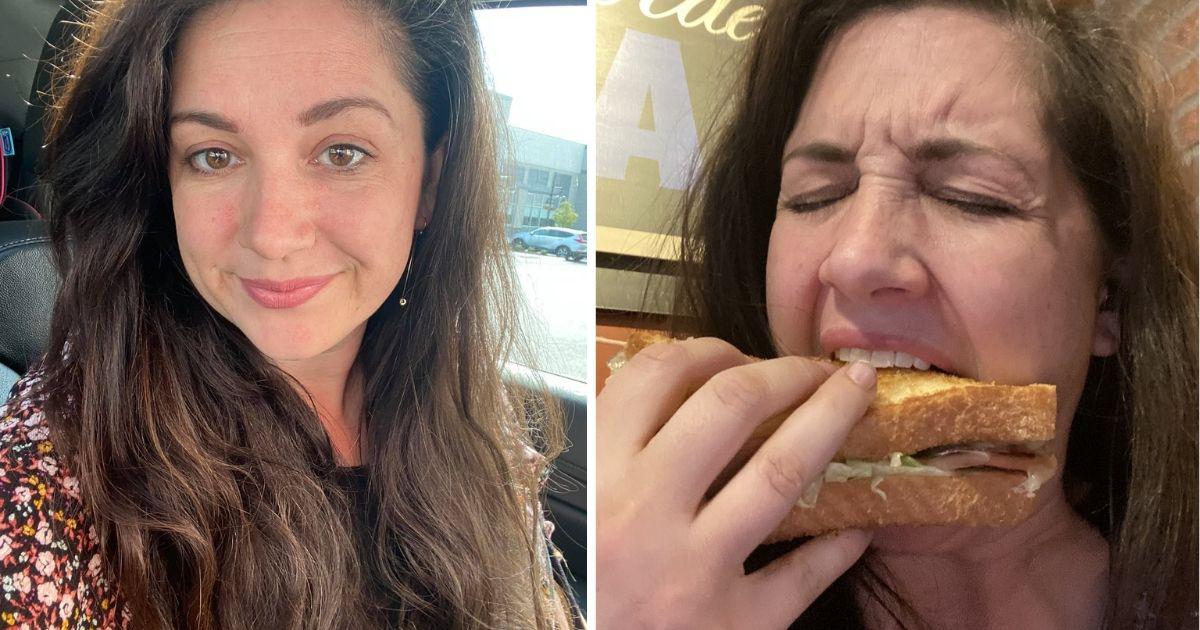
Writer uses a bologna sandwich to illustrate the beauty battle women wage with themselves

When you wake up to Khloe Kardashian’s unedited photo debacle making headlines, it’s not hard to see why so many women have body and beauty complexes. Even for those of us who roll our eyes at Kardashian drama, the struggle is real. Even when we know that the images on Instagram are filtered and edited…

Array
Photo credit: Mary Katherine Backstrom/FacebookArray

When you wake up to Khloe Kardashian’s unedited photo debacle making headlines, it’s not hard to see why so many women have body and beauty complexes.

Even for those of us who roll our eyes at Kardashian drama, the struggle is real. Even when we know that the images on Instagram are filtered and edited to unrealistic perfection. Even when we understand that societal beauty standards are arbitrary and stupid. Even with the proliferation of body-positive messages that encourage us to love the skin we’re in, most women I know wage some kind of internal daily battle over beauty.

If only it were as simple as embracing what we look like in our natural state. If we truly and fully did that, though, we’d be smelly and unkempt, hair matted, nails scraggly, and teeth rotting. There’s a certain amount of grooming that’s reasonable to expect in civilized society, but what’s enough and what’s too much? At what point does beautification become problematic? There’s no definitive line.

Then there’s “health and fitness,” which is good on the one hand, but toxic on the other. I could write an entire book on the social politics of fat on women’s bodies. Follow that up with the make-up, the hair coloring/curling/straightening/styling, the wrinkle creams, the injections, and gracious, I’m already feeling mixed up inside barely 200 words into talking about women and beauty.

Writer and video blogger Mary Katherine Backstrom described these internal struggles women experience perfectly in a Facebook post. Sharing a photo of herself biting into a bologna sandwich, Backstrom wrote:


“You want to understand a woman?

Let’s start right here: smack dab in the middle of a romantic moment I shared with a fried bologna sandwich. This was five minutes ago, y’all.

It was, in a word: intense.

Soft white bread, a generous schmear of mayo, and more than a couple slices of homegrown tomatoes. My word. I felt like confessing to my husband, which is why you have this picture.

I texted it to Ian, with a joke that I might actually be cheating, because nothing satisfies a woman quite like a solid sammy, hot tots, and a little bit of dippin sauce.

You can argue all you want, but you’d be wrong.

Sandwich. Tots. Dipping Sauce.

That’s all we need.

I was fully in the moment when I got a little *ping* from my Optavia coach. She wanted to know how I was doing on the program. “The program” being a thing I signed up for a few months ago when couldn’t fit in my skinny jeans and was suddenly motivated to shed a few bologna sandwiches.

So, now I’m invested to the tune of hundreds of dollars, with two full boxes of powdered astronaut food sitting in my entryway closet because I don’t care how delicious a powder brownie mix is, NOTHING, and I mean NOTHING, competes with fried tots and dipping sauce.

Anyways, back to understanding a woman.

You need to understand:

I am fiercely committed to enjoying bologna sandwiches.

I am 100% committed to becoming the next Brooklyn Decker via overpriced crash diet space food.

And I am ALSO anti-diet culture and will probably post a picture of myself weighing 200 pounds telling everyone on this page to LOVE THEMSELVES AS THEY ARE because, DAMMIT you are beautiful!

And you know what the crazy part is?

I am 100%, full-hearted, unabashedly all three opposing people at once.

The woman eating the bologna sandwich.

The woman who says “screw diet culture”.

And the woman who signs up for random crash diets when I want to fit into a fashionable dress for a family wedding.

If you want to understand a woman, you have to understand this conflict.

I want to love myself as I am.

I want to enjoy life without reservation.

And I want to be beautiful by society’s standards.

And I understand that none of these things agree or make any damn sense, and it drives me crazy, and makes me feel like a hypocrite, and makes me rage at the system, and makes me order overpriced powdered brownies, and makes me binge on bologna sandwiches, and makes me go to bed feeling like I should’ve done it better because if I was just

a little more disciplined

a little bit thinner

a little more consistent

a little more wild

a little more free

a little more original

but also a little more like the standard

then…maybe THEN, I would be an ideal woman.

And maybe I already am. I certainly believe that my friends are, and they enjoy bologna sandwiches.

But I wouldn’t know. Because I look to the right and look to the left and all I see are things society thinks I should improve.

And it messes me up and confuses my brain and it drives me to space food and fried bologna sandwiches.

And that, my friends, is what it is to be a woman.”

Seriously. She nails it.

It’s not that men can’t have this same kind of internal conflict; I’m sure some men are torn between wanting a burger and fries and embracing their dad bod, while also coveting Lenny Kravitz’s abs. But for women, there are just so many elements for us to grapple with. We want to feel beautiful, but we don’t want to conform to stupid societal beauty standards. We want to be in shape, but we want to love our bodies just as they are. We want to feel sexy, but we don’t want to be sexualized. We slip down beauty standard rabbit holes—from hair to skin to weight to eyebrows—and we roll our eyes all the way down while also taking notes.

It’s a confusing struggle, but for so many women, it’s very real. Thank you, Mary Katherine, for keeping it real.

  • Millennials are ditching ‘boring grey’ for this joyful mid-century color
    Photo credit: Mike Shaw, Wikimedia CommonsRetro '50s-styled bathroom.
    ,

    Millennials are ditching ‘boring grey’ for this joyful mid-century color

    Just a few tweaks can bring this look into every bathroom.

    Everything old is pink again, to paraphrase a famous adage. This applies even in bathrooms. Neutral colors have ruled the interior design of powder rooms for quite some time. But some Millennials (and Gen X-ers too) are ready to swap the greys and tans for vintage pops of mid-century pinks, yellows, and bright greens.

    While of course Millennials had their own brand of pink (which has been popular since around 2016,) they did often flock to neutral colors, perhaps for a sense of serenity. But as is the case for all generations, it can be fun to dabble back into the vintage pool.

    Where did these bright colors come from?

    In the piece “The Retro ‘50s Pink Bathroom is Back and Designers are Giving it a Deluxe New Twist,” Contributing Lifestyle Reporter Wendy Rose Gould shares the history of the design. “Pink bathrooms are an icon of mid-century Americana, rising in popularity from the 1940s through the 1960s. Pam Kueber, founder of the original ‘Save the Pink Bathrooms’ website (now called Retro Renovation), writes that pink was the single-most popular color for bathrooms in the 1950s. And that an estimated 5 million pink bathrooms went into the 20+ million homes built in the United States from 1946 to 1966.”

    The “Save the Pink Bathrooms” movement Gould is referring to was the brainchild of Kueber, who felt that builders and designers were getting rid of historical mid-century design too quickly. On her site, Kueber claims that, like other fans of the style, they were concerned that “original vintage pink bathrooms were being ripped out of post-war American homes way too hastily.”

    This of course didn’t just apply to bathrooms. The site, as previously mentioned, became Retro Renovation. It gives all kinds of tips on how to bring kitchens, bedrooms, and dining rooms restored to a long, lost era.

    Adding a modern twist

    But back to those bathrooms, the vintage color pops are coming back swiftly. In a piece for Better Homes and Gardens, E-design Consultant Maria Sabella shares that as is the case with most resurgences of old designs, there can be a modern twist. “When you think of retro bathrooms, chances are you picture floral print wallpapers and salmon pink tiles. While these iconic features are making an updated comeback (spoiler alert!), experts say nostalgic decor classics are returning in a more stylish form.”

    She quotes design expert Daniel Siegel, who gives excellent tips on how to pair the old with the new. “When paired with clean lines, thoughtful lighting, and modern details, these retro touches feel timeless rather than trendy.”

    Retro wallpaper patterns

    While not everyone can re-tile a bathroom, especially renters or those who don’t have tons of remodeling money laying around, there are super easy ways to grab the vibe.

    Wallpaper is one simple way to jump on the retro train. The article shares designer Thecla Glueck’s thoughts on the trend. “Layered thoughtfully, retro and vintage-inspired patterns bring intimacy and warmth, transforming the bathroom into a cocooning retreat rather than a purely functional environment.” She even adds specific patterns, noting, “Checkerboard in classic black and white marble or jewel-tone checks, small geometric shapes such as penny rounds or hexagon, pastel mosaics, floral, or softly faceted subway, are returning with a more restrained, contemporary lens.”

    Easy ways to bring in the look

    Skirted sinks are also an easy way to bring back the mid-century flair. In another quote, Glueck explains how useful these can be. “They discreetly conceal storage and reinforce the idea of the bathroom as a thoughtfully designed room, not just a utilitarian space.”

    Oval mirrors are mentioned as well, as something that can be mixed and matched into a room without commitment. The same goes for accessories like tissue boxes and perfume caddies. Pinks, buttery yellows, greens, and blues can all be mixed and matched to create a more vibrant feel without spending too much money.

  • Welfare check on a 91-year-old woman ends with funny twist police never saw coming
    Photo credit: CanvaAn older woman plays a video game.

    Many communities are trying to provide quality attention and care to their elderly residents. For example, seniors in Westlake, Ohio, can sign up for a program that provides frequent welfare checks. But when the police were sent on a welfare check for a 91-year-old woman after multiple unanswered phone calls, they couldn’t have expected a better, funnier result.

    The woman was safe and sound in her bedroom, playing video games

    “Everyone was a little bit alarmed that she was missing these contacts,” Westlake Police captain Jerry Vogel told News 5 Cleveland. “It turned out to be okay. Everyone got a good laugh out of it.”

    The elderly gamer was a part of Westlake’s “Are You Okay?” program for senior citizens and other qualified residents. Upon signing up, elderly residents receive a daily phone call to answer, ensuring that they are safe and okay. If the call goes unanswered, the police do a welfare check. After multiple missed calls, including a follow-up from police dispatch and one from the woman’s daughter, the police entered the woman’s home to find her trying to beat her record in a “bubble pop” video game.

    The police and the woman both laughed in relief, and the woman thanked the police for checking in through the “Are You Okay?” service. To protect her privacy, the police shut off their body cams and aren’t releasing the 91-year-old gamer’s identity.

    Seniors are a growing demographic in video gaming

    While this welfare check ended in a funny result, the police shouldn’t have been too shocked to see a person over 90 playing a video game. In fact, seniors are a growing demographic in video gaming. An Entertainment Software Association report found that 28% of gamers in the United States are over the age of 50.

    The reasons why more elderly people play video games are numerous. Some play video games involving hunting, fishing, bowling, etc., since they can continue their favorite pastimes regardless of their mobility or accessibility. Other older gamers play to connect with their grandkids or just younger people in general.

    There are also studies showing and encouraging seniors to play video games for health benefits, including improving their social lives through in-person or online gaming. Some games are mentally challenging, helping seniors’ cognitive health as well.

    So the next time you log in to play Call of Duty, Minecraft, Fortnite, or another game online, there’s a chance that one of the people you’re playing with could be a senior. Who knows? It could be a 91-year-old woman in Westlake.

  • ‘Hecka tight, bra’: Millennial teacher bridges generational gap by translating ’90s slang to Gen Z speak 
    Photo credit: CanvaA teacher's lesson on 1990s slang.

    These days, there’s a lot of love for the 1990s, especially among younger generations, who fantasize about the last decade before smartphones and social media upended society. In fact, a 2023 study found that 60% of American Gen Z adults “wished they could return to a time before everyone was ‘plugged in.’”

    Kaity Broadbent, a microschool teacher and head of learning at Prenda, had a really fun lesson with her students by showing them the parallels in slang among Gen Zers, Gen Xers, and Millennials who were young during the golden era of the 1990s.

    The interesting thing about her lecture is that it showed how young people, regardless of generation, create their own slang terms for the same words.

    In her Instagram Reel, Broadbent bridged the generational divide by noting that “bruh,” a popular term among Gen Z and Gen Alpha, sounded different in the ’90s, when it was pronounced “bra,” like the ladies’ undergarment. Although the pronunciation is different, the meaning is the same. She put it in a sentence, asking her students to say, “Hecka tight, bra.” (It seems she substituted “hella” for “hecka” to be more classroom-appropriate.)

    She also introduced her students to the term that kids in the ’90s used to reveal they’d fooled someone: “Psych!” which is a shorter version of saying, “Psyched you out.”

    She then rattled off some of the ’90s greatest hits:

    • “As if” (Cher from Clueless, you paying attention?)
    • “You da bomb” — a phrase meaning that someone is great or incredibly attractive. 
    @aliciasilverstone

    Ugh! As if… I wouldn’t join TikTok. 😉💛😘 #Clueless #AsIf

    ♬ Ugh… As if – Alicia Silverstone
    • She also noted that kids from the ’90s had their own version of one of Gen Z’s most popular slang phrases for questionable people or things. “So, instead of sus, we would say sketch,” she said in a very studious tone.
    • “I gotta bounce” or “I’m outtie” means that you have to leave. Extra ’90s points: If you’ve ever said, “I gotta go, Audi 5-thou.” This takes the term “outtie” and merges it with a popular luxury car at the same time: the Audi 5000.
    • She also noted that in the ’90s, your “crib” was your house, as evidenced by MTV’s popular show Cribs.
    @topwtf_

    Sad that’s most of these are fake 😪 #mtv #mtvcribs #topwtf_

    ♬ original sound – TOPWTF
    • “Home skillet” and “home slice” are two phrases that Gen Zers probably wouldn’t naturally understand, but they mean the same thing. It’s an evolution of the term “home boy,” meaning friend, which became “homie” or “home skillet.”
    • What would a ’90s kid say if someone was acting strangely or seemed confused about a situation? “You straight trippin’, G.” That means, “I believe that you are out of your mind, friend.”
    • She then asked a big question that makes little sense in the smartphone era: Why would we say ‘411’? Because “You would call 411, and you’d pick it up, and that was calling information.”

    The post sparked a great conversation among the commenters:

    “This is all that and a bag of chips,” Kid joked.

    “We stopped saying ‘psych’ when I was in 6th grade and switched to ‘NOT!’” Amanda clarified.

    “This is both amazing and hurts so much,” Mads admitted.

    Broadbent’s lesson is a great reminder for older people to stop being annoyed by younger generations’ slang, because when they were young, their trends were pretty cringey, too. It’s also a great lesson for the young people out there: Be careful how you judge your elders; one day you’re going to be just like them.

  • People in their 40s say these 5 unique life changes make it the weirdest and most diverse phase of life
    Photo credit: Canva & XA 42-year-old’s observations about his early 40s are striking a nerve on social media.

    Turning 40 marks a major milestone for many people. It can be an exciting time when your family, career, hobbies, and sense of self are finally falling into place. Unfortunately, it can also be the decade when your joints start hurting and your hair goes gray.

    In other words, your 40s can be a mixed bag. What’s especially fascinating is that everyone’s experience in their early 40s will be different. Some people say that’s exactly what makes it such an interesting season of life.

    Guy on X notices a few strange things about being in his 40s

    Ben Eisenhart, a self-described dad and husband who turned 42 earlier this year, recently took stock of his peers and found that there was a wild amount of variety.

    He realized that he’d reached a point in time when minor differences in life choices, luck, and genetics that were barely noticeable in his 20s were becoming massively evident.

    The post was a hit, racking up nearly two million views and hundreds of comments from people eager to share their own experiences and observations. Here are five things people say make your 40s the weirdest and most interesting decade of your life.

    1. Kids

    In your early 20s, the vast majority of your peers don’t have kids yet. In your mid-to-late 20s, the process begins, and newborns start crashing group hangouts. Late nights at the bar become lazy afternoons at the brewery as parent friends try to survive the early stages of parenthood. Others either aren’t ready for kids yet or have decided not to have them.

    In your 40s, it’s not nearly as simple.

    Some folks are still child-free. Others might have grown children who are out of the house. Some are even grandparents by this point. Others are just getting started in parenthood with their first newborn. In fact, the latter is becoming increasingly common, with over 20% of women now having their first child after the age of 35.

    2. Looks

    Some people look older, and some look younger. That’s just the genetic lottery, and it’s true at almost any age.

    But by your 40s, life choices and health issues have piled up and widened this gap. Some 40-year-olds could pass for being in their 20s, while others look 20 years older.

    Genetics alone can account for huge differences in how we age, and it’s a topic of great interest to scientists. But a few decades of staying fit, or smoking, or using or not using sunscreen really start to show up around your early 40s.

    3. Couples

    Similar diversity shows up not just in whether people are partnered up, but in the many different shapes and timelines of romance that appear.

    As Eisenhart notes, many people marry relatively young and remain together well into their 40s and beyond. Others are divorced, on their second or third marriage, or have been single the entire time. Even among those who are single, they may be dipping their toe in the dating pool of folks their own age…or, in some cases, much younger.

    It can make for some very interesting get-togethers.

    4. Career

    There’s a great camaraderie in your 20s when everyone you know is just getting started in their careers. Some are struggling through menial jobs, while others are in more prestigious fields but are grinding their way up from the bottom of the totem pole.

    You’re all in it together, in a sense.

    In your 40s, those career paths have diverged a great deal over the years. Some folks are executive-level leaders at big companies. Others have been doctors and scientific researchers for over a decade. Some have suffered setbacks or are in the midst of a career change, piecing together work the best they can. More and more people in their 40s are even going back to school.

    It can, and should, be a time of deep empathy and leaning on one another.

    5. Hope for all

    Ultimately, most people in their 40s who commented on the post agreed on one thing: it’s a pretty cool season of life.

    “All these are just lessons that we ain’t competing with anyone, at every age in our life just live your best and do things that makes you happy and always love yourself even more,” one X user wrote.

    Another said, “Life really doesn’t follow one timeline. People the same age can be in completely different seasons, and that’s normal.”

    “I turn 48 in July, and what ive gathered is wherever you find yourself during these years, as long as you find the joy, its all good,” another user added. “Out of all my decades, 40s have been surprisingly my favorite, mainly because ive learned to only worry about what i can control.”

    One person noted that your 40s offer an amazing opportunity for transformation: “Early 40s is the last time of a big ‘potential’ horizon. Where you could totally reinvent yourself and make it if you wanted to.”

    And finally, many wisely advised that your 40s are nothing to fear:

    It wasn’t just 40-year-olds who were drawn to the viral post, however. More than a handful of people in their 50s and 60s stopped by with just a few choice words: “Just you wait.”

  • The Bee Gees’ 1973 acoustic performance of ‘Run to Me’ perfectly showcases their amazing harmonies
    Photo credit: via MIdnight Special/YouTubeThe Bee Gees singing "Run to Me."

    On June 22, 1973, the Bee Gees, brothers Barry, Robin, and Maurice Gibb, appeared on the TV show The Midnight Special and, throughout the 90-minute broadcast, showcased their humor, soul, and incredible harmonies. But, by far, the highlight of the night was a performance of their recent hit, “Run to Me,” off their 1972 release, To Whom It May Concern.

    The Midnight Special was a late-night music and variety show that ran on NBC for nine years (1972-1981). Along with “Run to Me,” on this episode, the Bee Gees played their 1968 hit “I Gotta Get a Message to You,” sang a duet with Wilson Pickett of The Beatles’ “Hey Jude,” and performed a medley which included, “Morning of My Life,” “Holiday,” “Let There Be Love,” and “My World.”

    The Bee Gees’ incredible ‘Run to Me’ performance

    Their performance of “Run to Me” is incredible because with the stripped-down, acoustic-guitar-only arrangement, you can really hear their amazing harmonies—especially when Robin and Maurice hop in on the chorus.

    “‘Run to Me’ was one of those songs that all three of us sang. It was never really written for one person. ‘I’ll sing the verses. You sing the chorus because they are much higher,’ Gibb recalled, as if speaking with his brothers. “Robin’s voice was much higher than mine … See, it wasn’t like a group. It was a family. And so, whoever wanted to sing, sang.”

    The origins of ‘Run to Me’

    “We wrote [Run to Me] at our manager Robert Stigwood’s house in Beverly Hills. He was a great visionary and championed our beliefs and chemistry as brothers. Lyrically, this song chronicles the wishes of a man who longs to be noticed by a broken-hearted girl,” Robin recalled.

    Even though the Bee Gees appear at the top of their game in the performance, it was a transitional point for the band. “Run to Me” would be their last significant hit for three years, until they transitioned into a more soulful, disco sound, with their 1975 hit “Jive Talkin’.” This would launch the band into superstardom, peaking with 1977’s Saturday Night Fever Soundtrack which featured three number one singles from the album contributed by the Bee Gees—”How Deep Is Your Love”, “Stayin’ Alive,” and “Night Fever.” The brothers also penned “If I Can’t Have You,” which became a number-one hit for Yvonne Elliman.

    Sadly, Maurice Gibb would pass away in 2003 and Robin in 2012. But “Run to Me” got a second life in 2021 when Barry re-recorded it with country singer Brandi Carlile for his solo album, Greenfields. Greenfields features reworked versions of his Bee Gees hits, sung with country collaborators, including Dolly Parton, Jason Isbell, and Miranda Lambert. 

    This new version of “Run to Me” features a similar vocal arrangement to the original, with Carlile filling in for the late Robin.

    Earlier this year, Barry spoke with Upworthy about his love for Bob Dylan and his opposition to the Vietnam War. You can read it here. 

    Here is the entire June 22, 1973, broadcast of The Midnight Special.

  • Quick-thinking gas station clerk stops kidnapping after victim mouths ‘help’
    Photo credit: via Hamtramck Police DepartmentA kidnapping victim saved in Detroit.

    A gas station clerk in Detroit is being hailed a hero after he risked his life confronting a suspected kidnapper who came into his store. It all began at around 7:00 a.m. on Monday, April 13, in Hamtramck, Michigan, when a 16-year-old girl was approached by the suspect at a bus stop while waiting for her ride to school. The suspect pointed a gun at her and demanded she get in his car.

    Thirty minutes after the abduction, the man took the girl into a gas station in nearby Detroit and forced her to buy him a pack of cigarettes. The gas station cashier thought the situation looked suspicious, a hunch that the girl confirmed. “When he asked her to pay for the cigarette, I said, ‘Stop. There’s something wrong.’ And she mouthed, like talked to me like with no sound, ‘Help,’” Abdulrahman Abohatem told WXYZ

    Abohatem put his life on the line to help the abducted girl

    Abohatem asked the girl to come around the counter and get behind him. He walked outside the bulletproof glass, told the suspect to leave the store, and followed him out just as the police rolled up to the gas station. “I see the police outside. I point to him—’That’s the guy,’” Abohatem recalled.

    The police were at the right place at the right time because they had been tracing the girl using her smartphone. After word spread of the abduction, a friend of the girl was able to track her location. 

    Gas station footage shows Abohatem following the suspect out of the store as the police pulled up to detain him.

    “One of her friends opened the location through one of the social media apps. I said, ‘Oh, I could see her location right now,’” Mohammed Alsanai, the principal at the girl’s school, Frontier International Academy, told ABC News. “As we show the police the location, informed the dispatch, and as she walked in and said she had the location, like the whole room froze, and we all look at each other like, ‘Here we go.’”

    Amazing things can happen when people work together

    It’s incredible that the girl was saved just 30 minutes after being abducted by a group of quick-thinking people working together—although some of them didn’t know it). It was a great piece of teamwork from the girls’ friends, school administrators, the police, and a quick-thinking clerk who trusted his gut and took a big risk to do what was right. The suspect was armed, so he could have easily been shot for confronting the man.

    The entire situation is a great reminder that people of all ages and walks of life are willing to step up and do what’s right when someone’s life is on the line. 

    “It is very concerning because we’re talking about a child’s life here,” Hamtramck Police Chief Hussein Farhat said during an April 13 press conference. “It’s scary to [the victim’s family]. It’s scary to every parent who has children. So, we can only imagine what’s going through their head right now. Just want to make sure they know we’re there for them.”

  • For 10 years, social anxiety kept us from meeting our neighbors. One afternoon changed everything.
    Photo credit: CanvaWe learned a vital lesson about taking the first step.

    My 80-year-old mother lives in a neighborhood most people would envy. It’s not fancy or desirable in a material sense, but it is rich in a sense of community. Her neighbors share home-baked bread and extra veggies from their gardens. They pet-sit for one another and chit-chat about their kids and grandkids. They borrow tools and shovel snow from one another’s sidewalks. It’s a beautiful thing.

    My family’s neighborhood, just a mile away, isn’t like that. We live on a busy street. We don’t even have sidewalk in front of our house. Several homes around us are rentals where college students stay for less than a year. In the decade we’ve been here, we’ve only met three neighbors total, one of whom has since moved away.

    We can’t have block parties because our road is an arterial. People can’t park on our street, so everyone parks behind their homes. There’s almost no natural opportunity to even see, much less talk to, most of our neighbors

    street, neighborhood, yellow lines, road
    How do you meet your neighbors when there’s not a natural opening to do so? Photo credit: Canva

    The Anxiety

    I’ve relied on “our block is just different” to explain away the contrast between my mom’s neighborhood and ours. But in reality, someone at some point took the initiative to create that community where she lives. There was no reason we couldn’t do the same with our neighbors.

    So, why hadn’t we done it? Social anxiety. Simple as that. We’d have to physically go up and knock on our neighbors’ doors to meet them, and no one in my family felt comfortable doing that. We love people as a whole and want our neighborhood to feel like a community. But we would rather do almost anything than randomly knock on a stranger’s door and introduce ourselves.

    So, we sat in that conflicted space for years, feeling silly about wanting to know our neighbors but avoiding taking action out of fear.

    The Decision

    Inspired by friends who had visited their closest 15 neighbors when they moved to a new neighborhood, we decided it was time to kiss our comfort zone goodbye. We made an ambitious plan: Instead of starting small with just one neighbor, we’d spend one afternoon visiting the 10 houses we could see from our front porch. And instead of just introducing ourselves, we’d invite them all to a brunch at our house the following Saturday morning.

    We made flyers with the brunch details and talked about what to say. We decided we’d just lay out how we’d been feeling:

    Hi! We live in the house with the white fence over there. We’ve lived here for 10 years and hardly met any of our neighbors, and we’re feeling kind of silly about that. So we wanted to introduce ourselves and invite you to a neighborhood brunch at our house on Saturday. Super casual. Bring something if you want, but don’t feel like you need to. Would love it if you could come. Our phone number to RSVP is on the flyer. Let us know if you can make it.

    We prayed for courage, gathered our wits, and set out with flyers in hand.

    (Those who don’t struggle with social anxiety may wonder what all the fuss is about. Let me put it this way: My family is not unsocial. We have lots of friends. But I would rather give a speech in front of 50,000 people than walk up and introduce myself to someone I don’t know. It’s hard to explain why that specific act is so difficult, but taking this step was a very big deal.)

    hand, knocking, door
    Someone has to take the initiative to reach out first. Photo credit: Canva

    The Response

    No one was home at the first two houses. At the third, we met a man and his wife in the yard. As soon as we said, “We’re your neighbors,” and pointed out our house, their faces lit up. They were so happy and grateful we were reaching out. We had a lovely chat, and they said they’d try to make it to the brunch.

    Of the remaining seven houses, three had people at home. One was a young family with a preschooler and twin newborns. Next was an older man who said he and his wife had lived there for 15 years. The last was a young mom with a two-month-old baby.

    Again, as soon as we told them we were going around to meet the neighbors, their faces lit up with beautiful expressions of recognition. Yes, we’ve been wanting that, too. Yes, thank you for going out of your way to come by. Yes, we’ll try to make it. Yes, yes, yes.

    We left flyers on the doors of people who didn’t answer and returned home, exhausted from the effort but invigorated by the response.

    The What-ifs

    As the Saturday brunch approached, the anxious what-ifs kicked in. What if no one comes to the brunch? What if people do come and it’s just weird? What if we run out of food? What if we unwittingly just invited a bunch of psychos into our home?

    Anxiety excels at two things: Making excuses not to act and forecasting catastrophy once you do. We knew this, thankfully, so we sat in the uncomfortable uncertainty of what might happen and hoped for the best.

    The day before, we received RSVPs by text from the first couple and a woman who’d found the flyer on her door. Okay, three new-to-us neighbors, two of whom we knew were easy to talk to. Totally doable, right?

    meal, sharing, family, community, together
    Sharing a meal is a great way to start getting to know people. Photo credit: Canva

    The Result

    About 30 minutes before brunch time, our doorbell rang. It was the husband of the mom with the two-month-old, who wanted to thank us for the invite. They had hoped to make it but couldn’t, but he at least wanted to come by and introduce himself. He and my husband chatted for a few minutes. Before he left, they had already talked about swapping tools.

    Those who had RSVP’d arrived shortly after 10:00 a.m., one with homemade bread in hand. As we were eating and chatting away about 30 minutes later, the doorbell rang again. A woman holding a plate of apple muffins introduced herself. She’d found the brunch invite on her front door, but accidentally texted the wrong number to RSVP. She apologized that she couldn’t stay, as she had company at her house, but she at least wanted to stop by and say hello. She came in for a few minutes to meet everyone, left the muffins, and returned to her house just across the street.

    It’s a small detail, but I happily noted that she brought the muffins over on a real plate. Now I get to return her plate to her, like a true neighbor.

    About an hour into brunch, the couple’s teen son showed up to join us. We were tickled to find out he’d been at a rehearsal for the same community concert our adult daughter was performing in the next day. We were already connected in ways we didn’t even know about.

    The Takeaway

    Brunch lasted a couple of hours. It was leisurely, friendly, and wonderful to see how the conversations flowed. It was also a good reminder that people actually want this. People want to know their neighbors. They want community and connection. Even if we have our own established social networks outside of our immediate neighborhood, there’s something special about getting to know the people who live around us.

    I know some people already have this kind of neighborhood, which is great. And I know it all could have gone another way, too. Sometimes neighbors don’t get along, and in some neighborhoods, it might not make sense to do something like this. But most Americans don’t know any or only know some of our neighbors and we have a hard time trusting one another. A Pew Research survey found that most people say they would help their neighbors with various tasks, but far fewer believe their neighbors would do the same for them. Perhaps our perceptions of one another would be different if we actually knew each other.

    My family is thrilled with how meeting our neighbors went and excited to make opportunities to meet the ones we missed. It feels like a solid first step in building that sense of community my mom and her neighbors enjoy so much. My only regret is that we waited so long to make it happen.

Generations

People in their 40s say these 5 unique life changes make it the weirdest and most diverse phase of life

Pets

Dog celebrates 5th birthday by going on an adorable ‘sniffari’

Pop Culture

The Bee Gees’ 1973 acoustic performance of ‘Run to Me’ perfectly showcases their amazing harmonies

Pets

Winston the cat becomes an icon for introverts with his secret ‘alone cabinet’